FTIR AND IONIC CONDUCTIVITY
STUDIES ON BLEND POLYMER
ELECTROLYTES
J. Senthil*
Department of Physics, Tejaa Shakthi Institute of Technology, Coimbatore – 641 659, Tamil Nadu, India Email: [email protected], Ph. No: +91 90434 92893
N.S. MINIMALA, GOVINDA NAGARAJAN AND O. MAHENDRAN
Department of Physics, Saraswathi Narayanan College, Madurai – 625 022
Abstract
Investigations on structural and conductivity properties of solid polymer complexes have attracted a high degree of attention. The main applications of solid polymer electrolytes (SPEs) are found in various secondary batteries and energy conversion units. In view of the abundant resources, low costs and relatively low reactivity of magnesium, solid-state batteries using magnesium metal are worthy of investigations. The polymer electrolytes were prepared using poly methyl methacrylate (PMMA), poly vinyl chloride (PVC) and magnesium chloride (MgCl2) by solvent casting technique. The complex formation and ionic conductivity were characterized by Fourier Transform Infra Red spectroscopy (FTIR) and impedance spectroscopy respectively. The FTIR studies provide the evidence of interaction of cation Mg2+ with the polymers. The maximum conductivity found for PMMA-MgCl2 is 0.57 x 10⁻⁷ Scm-1 at room temperature.
Key Words: polymer blend, FTIR, ac impedance, PMMA, PVC and Magnesium salt 1. Introduction
The need and high performance of environmental friendly batteries has been a major interest for the development of novel electrochemical systems. The development of polymer electrolytes has drawn the attention of many researchers in the last three decades as they find applications not only in secondary batteries but also, in other electrochemical devices such as super capacitors, sensors and electro chromic devices, etc. [Song J.Y. et al., (1999)].
Solid polymer electrolyte may generally be defined as a membrane that possesses transport properties comparable with that of common liquid ionic solutions. The properties SPEs are governed by all the three components viz. polymers, salt and solvent, and studies on various combinations of these have been reported. Bohnke et al reported that poly methyl methacrylate (PMMA) based electrolyte possessed significant conductivity at 300 K [Rajendran S and Uma T. (2000)]. The presence of the high-molecular-weight PMMA imparts a very high macroscopic viscosity to the system without significantly diminishing the conductivity, i.e., the conductivity of the gel remains very close to that of a liquid electrolyte. Poly vinyl chloride (PVC) can act as a mechanical stiffener in the electrolyte due to its immiscibility with the plasticizer. Stephan et al studied that PVC-based polymer electrolyte system plasticized with ethylene carbonate and propylene carbonate is to be applicable to secondary batteries [Manuel Stephan A, (2006)].
Many types of solid polymer electrolytes (SPEs) have been proposed based on organic polymer matrixes which dissolved inorganic salts, especially such alkali metal salts. Contrarily, little has been published for materials in which multivalent (divalent, trivalent, or tetravalent) cations are the mobile species [Gin-ya Adachi, (2000)]. Indeed, materials showing Mg2+ conductivity are quite interesting due to the following advantages: 1. The ionic radii of Li+ and Mg2+ are 68 and 65 pm, respectively, i.e., comparable in magnitude. Hence, easy replacement of Li+ ions by Mg2+ ions in insertion compounds is possible. 2. Magnesium metal is more stable than the lithium. It can be handled safely in oxygen and humid atmospheres unlike lithium which requires high purity argon or helium atmosphere. Therefore, safety problems associated with magnesium metal are minimal. 3. Global raw material resources of magnesium are plentiful and thus, it is much cheaper than the lithium [Munichandraiah N and Girish Kumar G, (2000)].
glass–polymer composite films [Kushwaha S.S.S and Mishra J., (2005)]. Chu and Jaipal Reddy studied the PEO-Mg polymer electrolyte system [Peter P. Chu and Jaipal Reddy M., (2002)]. Vito Di Noto et al has done a research on Li and Mg polymer electrolytes based on esters of ethylenediaminetetraacetic acid and PEG400 [Vito Di Noto et al., (2002)].
In the present work, The PMMA-MgCl2, PVC-MgCl2 and PMMA-PVC-MgCl2 electrolytes were prepared, investigated by Fourier Transform Spectroscopic Technique for structural analysis and impedance spectroscopic technique for conductivity measurement.
2. Experimental
Appropriate amount of polymer PMMA of average molecular weight 1.7 x 10⁵ (Aldrich), PVC of average molecular weight 1.2 x 10⁵ (Aldrich) and magnesium chloride (MgCl2) were taken separately in specific gravity battles and solutions prepared using the solvent tetra hydra furan (THF) from E-Merk allowing two day for dissolution. All samples were prepared by solvent casting technique. The cast films were allowed to evaporate slowly. The resulting films were dried in vacuum for two hours. FTIR spectrophotometer (Perkin-Elmer 883) measurements were made in the range 400 – 4000 cm-1. The ionic conductivity of polymer complexes was measured at room temperature by Keithley LCZ meter.
3. Results and Discussion 3.1. FTIR studies
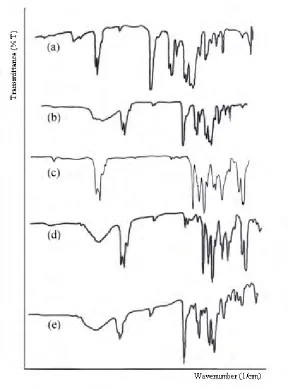
FTIR spectroscopy has been used to identify the functional groups. The FTIR spectra for pure PMMA, PVC and the polymer complexes are shown in fig. 1. For pure PMMA the frequency at 842 cm-1 is assigned to C-H rocking vibrations. The frequencies at 2950 cm-1 and 1242 cm-1 are assigned to CH2 stretching and O-CH2 deformation vibrations of pure PMMA. The peaks at 950 cm-1 and 1240 cm-1 may be assigned to CH2 wagging and CH2 rocking vibrations respectively in pure PVC. The absorption peaks at 1654 cm-1, 1389 cm-1 and 1259 cm-1 are assigned to C-C stretching, CH2 deformation and CH2 stretching vibration respectively in PVC. The peak at 1736 cm-1 corresponding to the stretching frequency of C=O of pure PMMA is shifted to about 1732 cm-1 in the complex PMMA-MgCl2. The frequency 1151 cm-1 due to the C-C vibration is shifted to 1148 cm-1 in the complex. The C-C stretching frequency 1654 cm-1 of pure PVC is shifted to about 1645 cm-1 in the polymer complex PVC-MgCl2.
The characteristic frequencies of PMMA (364, 1365, 1484 and 2993 cm-1) and PVC (595, 660, 760, 950 and 2920 cm-1) are shifted to (356, 1330, 1479 and 2989 cm-1) and (615, 690, 750, 966 and 2920 cm-1) in the polymer complex PMMA-PVC-MgCl2 respectively. The absorption of peaks of PMMA (809, 912, 988, 1271 and 1448 cm-1) and PVC (1259, 1508 and 1684 cm-1) are found absent in the complexes. In addition to these some new peaks at (840, 1066, 1149, 1537, 2848 & 2948 cm-1) are found in the complexes. The formation of new peaks along with changes in the existing peaks in the FTIR spectra confirms the complexation. These results suggest that homogeneous polymer salt electrolytes are formed over all the blend compositions.
3.2. Conductivity studies
The composite polymer electrolyte samples were characterized in terms of their ionic conductivity. The ionic conductivity of polymer electrolytes depends on the actual concentration of the conductivity species and their mobility. The conductivity of the electrolyte was calculated from
A R l b
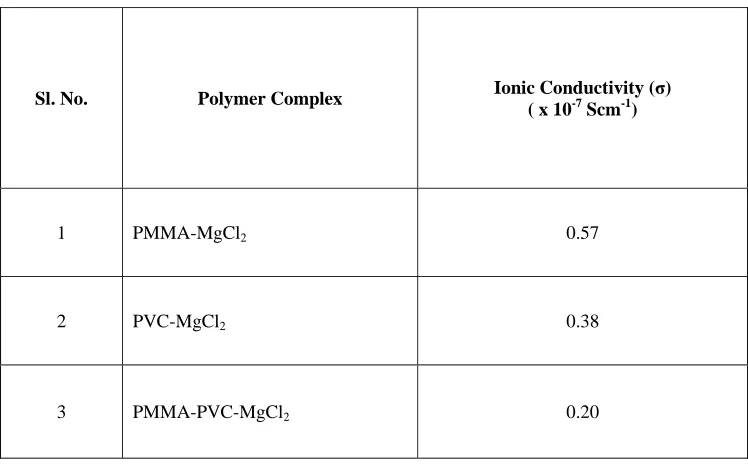
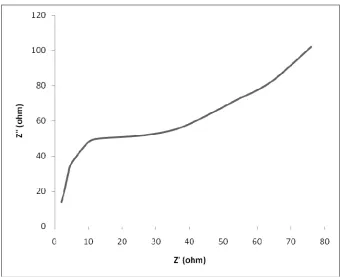
where ‘l’ represents the thickness of the film, ‘A’ represents the area and ‘Rb’ represents the bulk resistance of the material which is obtained from the intercept on the real axis at the high frequency end of the Nyquist plot of complex impedance spectrum. The typical impedance plot for the composition PVC-MgCl2 is shown in fig. 2. The conductivity value obtained for polymer electrolytes films were summarized in table 1. It is found that the pure PMMA based electrolytes exhibit significantly higher conductivity than PMMA-PVC blend electrolytes. The conductivity value of PMMA-MgCl2 electrolyte system presented in this work is estimated as 0.5 x 10
-7
the use of plasticizers and nanoparticles to develop the mechanical and electrical properties of the polymer electrolyte in electrochemical cells.
4. Conclusion
Polymer blend electrolytes based on PMMA and PVC with MgCl2 were prepared using solvent casting technique. Its structural characteristics have been studied using the FTIR spectroscopy. Its ionic conductivity at room temperature has been studied using the ac impedance measurements. Further studies need to be carried out to improve the conductivity of the films and this will form the next step in the investigations.
References
[1] Song J.Y. et al., (1999): Review of gel-type polymer electrolytes for lithium-ion batteries, J. Power Sources, 77, 183-197.
[2] Rajendran S and Uma T. (2000): Characterization of plasticized PMMA–LiBF4 based solid polymer electrolytes, Bulletin of Materials Science, 23, 27-29.
[3] Manuel Stephan A, (2006): Review on gel polymer electrolytes for lithium batteries, European Polymer Journal, 42, 21–42.
[4] Gin-ya Adachi, (2000): Divalent magnesium ion conducting characteristics in phosphate based solid electrolyte composites, J. Mater. Chem., 10, 1431-1435.
[5] Munichandraiah N and Girish Kumar G, (2000): Solid-state Mg/MnO2 cell employing a gel polymer electrolyte of magnesium triflate, Journal of Power Sources, 91, 157–160.
[6] Abdelrazek E.M., (2004): Physical properties of MgCl2-filledPMMA films for optical applications, Physica B, 351, 83–89.
[7] Kushwaha S.S.S and Mishra J., (2005): Preparation and characterization of magnesium ion conducting glass–polymer composite films, Research Communications, Current Science, 88, 1159-1162.
[8] Peter P. Chu and Jaipal Reddy M., (2002): Ion pair formation and its effect in PEO:Mg solid polymer electrolyte system, Journal of Power Sources, 109, 340–346.
[9] Vito Di Noto et al., (2002): Synthesis, characterization and conductivity studies of Li and Mg polymer electrolytes based on esters of ethylenediaminetetraacetic acid and PEG400, Solid State Ionics, 147, 397– 402.
[10] Masayuki Morita et al., (2001): Ionic conductance of polymeric electrolytes consisting of magnesium salts dissolved in cross-linked polymer matrix with linear polyether, Electrochimica Acta., 46, 1195–1200.
[11] Levi M.D. et al., (2005): Microelectrode studies of reversible Mg deposition in THF solutions containing complexes of alkylaluminum chlorides and dialkylmagnesium, Journal of Electroanalytical Chemistry, 576, 183–195.
[12] Nam-Ju Jo, et al., (2006): Decoupled ion conduction mechanism of poly(vinyl alcohol) based Mg-conducting solid polymer electrolyte, Electrochimica Acta, 52, 1549–1555.
[13] Mahendran O and Rajendran S., (2003): Ionic conductivity studies in PMMA/PVdF polymer blend electrolyte with lithium salts, Ionics, 9, 282-288.
[14] Hashmi S. A., et al., (2010): Electrical and electrochemical properties of magnesium ion conducting composite gel polymer electrolytes, J. Phys. D: Appl. Phys., 43, 255501.
[15] Sagar Mitra and Srinivasan Sampath, (2002): Sol–gel derived, magnesium based ionically conducting composites, J. Mater. Chem., 12, 2531–2537.
Table 1: Conductivity values of the polymer complexes at 300 K
Sl. No. Polymer Complex Ionic Conductivity (σ) ( x 10-7 Scm-1)
1 PMMA-MgCl2 0.57
2 PVC-MgCl2 0.38
Fig 1: FTIR spectrum of (a) pure PMMA (b) PMMA-MgCl2 (c) pure PVC