SYMMETRIC KEY IMAGE
ENCRYPTION USING CONTINUOUS
DISTRIBUTIONS WITH MOD
OPERATOR
H.B.KEKREComputer Engineering Department, NMIMS University, VileParle Mumbai, Maharashtra 400056, India
TANUJA SARODE
Computer Engineering Department, Mumbai University, Bandra Mumbai, Maharashtra 400050, India
PALLAVI N. HALARNKAR
Computer Engineering Department, NMIMS University, VileParle Mumbai, Maharashtra 400056, India
Abstract :
Encryption methods are based on either symmetric key or asymmetric key. In this paper a symmetric key based encryption technique has been proposed. The method is based on pseudo random numbers generated by continuous distributions. For encryption purpose, mod operator is used. A scaling function is also applied for scaling the values between 1 to 256. From Experimental results it can be seen that the proposed method gives a good encryption results. The approach has a very big key space which can make the method robust against cryptanalysis.
Keywords: Continuous Distributions; Image Encryption; NPCR; PAFCPV
1. Introduction
With the rapid developments across network communications where there is an ease of transfer of information using internet, there is also a threat to the information passed across the network. Information is not limited only to text but it can be in the form of images also. A lot of cryptographic techniques are already proposed to secure data. Due to their limitations not all of them can be applicable to digital images. Image encryption is still in its development phase where there is a need for novel approaches to encrypt the image.
Image encryption is a method to provide more security to digital images. A new image cryptosystem is proposed in[1]. It has two main parts, encryption/decryption algorithm and ciphered key. The encryption process consists of two main steps diffusion stage and substitution stage. Diffusion stage makes use of the XOR operator. For substitution two encryption processes are used, Lagrange process and Least square process. For decryption the processes are just reversed to obtain the original image. Based on the initial key two different approaches are proposed, the first one makes use of a key whose length is 192bits (24 bytes) in hexadecimal system as its input and then the key is expanded using AES-192 key expansion algorithm. The second approach makes use of the image as a key to cipher the plain image.
An encryption scheme based on Elliptic chaotic maps is proposed in [2] . The families of one-parameter elliptic chaotic maps of cn and sn at the interval [0,1] are defined as the ratio of Jacobian elliptic function of cn and sn types. One Elliptic chaotic map is used to permute the image pixels and another one for diffusion process. The proposed approach works for color and variable size images. The method fulfils high level of security requirements, large key space and acceptable encryption speed.
A combined approach based on chaotic encryption system and watermarking is presented in [3]. It involves two steps. In the first step a modified Tao algorithm based on chaotic map is applied. This encrypted data is then hidden in the DCT frequencies of another transformed image, by coding it in order to hide the presence of data. The proposed technique is more secure and reliable for any kind of image data.
XORed with bit stream of the image. Confusion is applied based on the displacement of the cipher’s pixels in accordance with a reference mask. The proposed method is secured and efficient from cryptographic point of view.
In [5] ,a 512 bit secret key is given as an input to salsa20 hash function which is used to generate a key stream , which can be used for image encryption. Two rounds of diffusion process are used. In the first round of diffusion process an original image is partitioned into 1024 blocks each of size 8X8. In the second round the above step is repeated vertically. The average of the two arrays is now encrypted. The main advantage of this method is that it uses different averages when encrypting different images and still the same hash function. This method increases the resistance of the cryptosystem against known/ chosen plaintext and differential attacks. A number of experimental parameters like 2D correlation, PSNR, EQ, Entropy and MAE satisfy security and performance requirements.
A Modified Hill Cipher Technique is proposed in [6]. The traditional Hill cipher technique is a symmetric cryptosystem and a polygraph substitution cipher based on matrix multiplication. The advantage of Hill cipher technique is that it requires inverse of a matrix to decrypt the given data, and in nature not all the matrices have inverses. The method’s linear nature fails to known plain text attacks. This drawback is been overcome in the modified version of hill cipher technique.
An Advanced version of Hill Cipher technique is proposed in [7]. This technique overcomes the drawback of the traditional Hill cipher technique by using the involution matrix method, which generates the key matrix which is itself invertible and needed for decryption.
A chaos based image encryption technique is proposed in [8]. The technique is demonstrated over grayscale images. The method first used extended Arnold’s Cat map to shuffle the image. Applying this map, doesn’t only shuffle’s the image pixels but also modifies the corresponding pixel values. This shuffled image is then encrypted using Chen’s Chaotic System(CCS). The chaotic system values are computed using fractional order method.
Bibhudendra et.al[9] proposed image encryption which made use of index based chaotic sequence, M sequence, and Gold sequence. The method was demonstrated on gray scale images. The chaotic sequence permutes the image on the basis of index position of the sequence. The process of permutation is based on storing the index position of the sequence in respected to their sorted value
An Advanced Combined Encryption Technique for Encrypting Images Using Randomized Byte Manipulation is proposed in [10]. The entire process is divided into three steps. In the first step, every gray value of image is first converted into its 8-bit binary equivalent, in that the number of bits that are equivalent to the password length are rotated and then reversed. In the second step, Advanced Hill cipher technique which uses involution matrix method is used for second stage of encryption, this step makes use of the same password as in the first step. In the last stage the whole image is randomized a number of times using Modified MSA randomization technique. This randomization is based on the password used in the encryption process. When the proposed method was compared to other existing encryption technique the method takes optimal amount of time as compared to the existing ones.
The non Linear dynamics of compound sine and cosine chaotic map is used for Image encryption in [11]. Pixel shuffling and bit plane separations prior to XOR operation, is applied in diffusion process. This results in fast encryption process. Security key conversions from ASCII code to floating number for use as initial conditions and control parameters are also presented in order to enhance key-space and key-sensitivity performances. Non Linear dynamics of the chaotic maps were also investigated. Encryption qualitative performances are evaluated through pixel density histograms, 2-dimensional power spectral density, key space analysis, key sensitivity, vertical, horizontal, and diagonal correlation plots. Encryption quantitative performances are evaluated through correlation coefficients, NPCR and UACI.
A novel cryptographic system is proposed in [12] which makes use of Rubik’s cube principle in conjunction with a digital chaotic cipher. The image is firstly scrambled using Rubik’s cube principle. Then the scrambled image is encrypted using digital chaotic cipher. XOR operator is used for encrypting the scrambled image. The experimental results and security analysis show that the newly proposed image encryption scheme not only can achieve good encryption and perfect hiding ability but also can resist any cryptanalytic attacks (e.g., exhaustive attack, differential attack, statistical attack, etc.)
Nidhi et.al[13] proposed a New cryptology approach which is based on Logistic map. In this method a Haar wavelet transform is used to decompose an image and de correlate its pixels into averaging and differencing components. The logistics map is used for Image encryption. The cipher produced has a good confusion and diffusion properties. The experimental results show that the method is efficient and secure. Keys are transmitted using steganography concept.
equation. The pixel position and value permutation are done with 2D and 3D maps. The sensitivity to initial condition of the chaotic maps guarantees the diffusion property. The proposed method has a large key space. Parallel encoding is also proposed for large scale images.
Syed Ali et.al proposed an extension to Block-Based Image Encryption Algorithm (BBIE) scheme in [15]. This method makes used of blowfish encryption algorithm. BBIE works on 256 –color bit map, the proposed technique works for RGB color images. In the proposed technique the image is divided into blocks, then two operations are applied over it. Firstly each is rotated by 900 followed by flipping row-wise down. These rendered blocks are scrambled to form transformed confused image this process is followed by blowfish cryptosystem with a secret key.
Wencai Du et.al. [16] proposed a hybrid –key based image encryption scheme which overcomes the drawback of traditional cryptosystems which are not suitable for image encryption because of slow speed and ineffectiveness in removing the correlation among pixels in an image. Another limitation of chaotic based cryptosystem is that they are symmetric key based system, the key exchange in these types of system is difficult. Ergodic matrices are utilized not only as public keys throughout the encryption/decryption process, but also as essential parameters in the confusion and diffusion stages. The proposed method proves to be more secure in means of image encryption and transmission as compared to existing chaos based cryptosystems.
Evaluation of Image Scrambling Degree with Intersecting Cortical Model Neural Network is proposed in [17]. Firstly Arnold transformation is used to analyze the periodicity of scrambling process , then Intersecting Cortical Model Neural Network (ICMNN) designed is used to extract 1D signature of the original image and scrambled image. L1 norm was used to evaluate the scrambling degree and compared to universal rules obtained in the above steps.
Kekre.et. al [18] proposed a approach for image encryption using discrete distributions. In this paper the method is extended to continuous distributions. The scaling function used in this approach can be referred from [18].
2. Continuous Distributions
The Continuous Distributions can take any number of values over a certain range for x. this range might be infinite unbounded or finite bounded distribution. Continuous Random variables have supports that look like
, , (1) Or union of intervals of the above form. Examples of random variables that are often taken to be continuous are
The Weight or height of an individual
The length or size of an object
Duration of time
Every continuous random variable X has a probability density function(PDF) denoted as fx associated with it that satisfies three basic properties
1. 0
2. 1,
3. P X A ,
2.1. The Continuous Uniform Distribution
A random variable X with the continuous uniform distribution on the interval (a, b) has PDF
f , a (2)
Fig 1. 2D Uniform Random Distribution
2.2.The Exponential Distribution
The Exponential Distribution of x is given by
f x λ e , x 0 (3)
The 2 D Exponential Random Distribution and its modified version using the Scaling function is shown in Figure 2.1 and 2.2.
Fig 2.1 Exponential Distribution Fig 2.2 Exponential Distribution after Scaling
2.3. The Weibull Distribution
The Weibull distribution is given by
f x exp , x 0 (4)
The 2 D Weibull Random Distribution and its modified version using the Scaling function is shown in Figure 3.1 and 3.2
0 50 100 150 200 250 300
0 5 10 15 20 25 30
0 500 1000 1500 2000 2500 3000 3500 0
50 100 150
p
0 50 100 150 200 250 300 0
50 100 150
Fig 3.1 Weibull Distribution Fig 3.2 Weibull Distribution after Scaling
2.4. The Gamma Distribution
The Gamma distribution is a generalization of the exponential distribution. Its Probability Density function (PDF) is given by
f x e , x 0 (5)
The 2 D Gamma Random Distribution and its modified version using the Scaling function is shown in Figure 4.1 and 4.2.
Fig 4.1 Gamma Distribution Fig. 4.2 Gamma Distribution after Scaling
2.5.The Normal Distribution
X has a normal distribution if it has PDF
f x
√ exp
µ , ∞ ∞
(6)
The 2 D Normal Random Distribution and its modified version using the Scaling function is shown in Figure 5.1 and 5.2.
0 100 200 300 400 500 600 700 0
10 20 30 40 50 60 70
0 50 100 150 200 250 300 0
10 20 30 40 50 60 70
120 140 160 180 200 220 240 260 280 0
10 20 30 40 50 60
0 50 100 150 200 250 300
Fig 5.1 Normal Distribution Fig 5.2 Normal Distribution after Scaling
2.6.The Lognormal Distribution
The Lognormal distribution is derived from Normal Distribution, its PDF is given by
f x
√ exp
– µ , 0 ∞
(7)
The 2 D Lognormal Random Distribution and its modified version using the Scaling function is shown in Figure 6.1 and 6.2.
Figure 6.1 Lognormal Distribution Figure 6.2 Lognormal Distribution after Scaling
3. Symmetric key Encryption Approach using continuous distributions
In this Paper, the Encryption method is extended for continuous distributions and compared to discrete distributions which is already published by kekre et.al in [18].
The pseudorandom numbers generated by the continuous distributions for Image encryption are generated by using matlab tool. Customizing the randomstream constructor to specific parameters we set the default stream. MOD operator is used as a invertible operator for encrypting the images. The step by step Procedure is given below
Encryption
Read the 24-bit color image
Generate the Pseudo Random Matrix (size same as the original image) from the desired continuous distribution by using some initial condition which will act as a key along with other parameters of random stream constructor in matlab.
105 110 115 120 125 130 135 140 145 150 0
10 20 30 40 50 60
0 50 100 150 200 250 300 0
10 20 30 40 50 60
125 126 127 128 129 130 131 0
10 20 30 40 50 60 70
0 50 100 150 200 250 300 0
Use one to one mapping between the Pseudo Random Matrix and the original image and apply the MOD operator.
Apply step no 3 to R Plane, G Plane and B Plane Separately.
Repeat the step no 3 till an encrypted image is formed.
Save the image obtained in step 4 as Encrypted Color image. Decryption
Read the 24-bit color Encrypted Image
Generate the Pseudo Random Matrix (size same as the original image) from the desired continuous distribution and using the same key which was used for image encryption.
Use one to one mapping between the Pseudo Random Matrix and the encrypted image and apply the MOD inverse operation.
Apply step no 3 to Encrypted R Plane, Encrypted G Plane and Encrypted B Plane Separately.
Repeat the step no 3 till original image is obtained.
Save the image obtained in step 4 as Original image. 4. Experimental Results
For Experimental purpose , we have used 24-bit color images. The proposed approach was tested on five different images of size 256x256. For experimental analysis , different moments like mean , std deviation, skewness and kurtosis of the encrypted image was calculated, another two experimental parameters were also tested called as Peak Average Fractional Change in Pixel Value(PAFCPV) and Number of Pixels Change Rate(NPCR)[1] given in equation 8 and 9 below
.
PAFCPV
=
MN
∑
∑
O , E ,
N
M
(8)
Where o(x,y) is the original image of size MxN and E(x,y) is the encrypted image.
NPCR ∑, ,
100%
(9)
Where D(i,j) represents the difference between original image (O) and encrypted image(E).if O(i,j)= E(i,j) then D(i,j) =0 else D(i,j)=1. MXN represents the size of the original image.
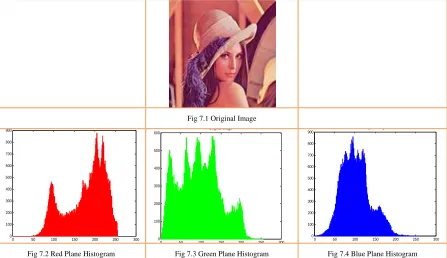
Figure 7.1 shows the original image, Figure 7.2, 7.3, and 7.4 shows the histogram of the Red Plane, Green plane and the Blue Plane.
Fig 7.1 Original Image
Fig 7.2 Red Plane Histogram Fig 7.3 Green Plane Histogram Fig 7.4 Blue Plane Histogram 0 50 100 150 200 250 300
0 100 200 300 400 500 600 700 800 900
0 50 100 150 200 250 300 0
100 200 300 400 500
600 Original Image
0 50 100 150 200 250 300
0 100 200 300 400 500 600 700 800 900
Figure 8.1 shows the encrypted image obtained by using 2 D Uniform Random distribution and the histogram of the encrypted image i.e. red plane, green plane and blue plane is shown in figure 8.2, 8.3 and 8.4.
Fig 8.1 Uniform Distrbution Encrypted Image
Fig 8.2 Red Plane Histogram Fig 8.3 Green Plane Histogram Fig 8.4 Blue Plane Histogram
Figure 9.1 shows the encrypted image obtained by using 2 D Exponential Random distribution and the histogram of the encrypted image i.e. red plane , green plane and blue plane is shown in figure 9.2, 9.3 and 9.4.
Fig 9.1 Exponential Distrbution Encrypted
Image
Fig 9.2 Red Plane Histogram Fig 9.3 Green Plane Histogram Fig 9.4 Blue Plane Histogram
Figure 10.1 shows the encrypted image obtained by using 2 D Weibull Random distribution and the histogram of the encrypted image i.e. red plane , green plane and blue plane is shown in figure 10.2, 10.3 and 10.4.
0 50 100 150 200 250 300
0 100 200 300 400 500 600 Uniform Image
0 50 100 150 200 250 300
0 50 100 150 200 250 300 350 400 450 500 g
0 50 100 150 200 250 300
0 100 200 300 400 500 600
0 50 100 150 200 250 300
0 100 200 300 400 500 600 700 800 p g
0 50 100 150 200 250 300
0 50 100 150 200 250 300 350 400 450 500 p g
0 50 100 150 200 250 300
Fig 10.1 Weibull Distrbution Encrypted Image
Fig 10.2 Red Plane Histogram Fig 10.3 Green Plane Histogram Fig 10.4 Blue Plane Histogram
Figure 11.1 shows the encrypted image obtained by using 2 D Gamma Random distribution and the histogram of the encrypted image i.e. red plane , green plane and blue plane is shown in figure 11.2,11.3 and 11.4.
Fig 11.1 Gamma Distrbution Encrypted Image
Fig 11.2 Red Plane Histogram Fig 11.3 Green Plane Histogram Fig 11.4 Blue Plane Histogram
Figure 12.1 shows the encrypted image obtained by using 2 D Lognormal Random distribution and the histogram of the encrypted image i.e. red plane , green plane and blue plane is shown in figure 12.2, 12.3 and 12.4.
0 50 100 150 200 250 300
0 100 200 300 400 500 600 700
g
0 50 100 150 200 250 300 0
50 100 150 200 250 300 350 400 450 500
0 50 100 150 200 250 300
0 100 200 300 400 500 600
weibull Image
0 50 100 150 200 250 300
0 100 200 300 400 500 600
g g
0 50 100 150 200 250 300
0 100 200 300 400 500 600
ga a age
0 50 100 150 200 250 300
0 100 200 300 400 500 600
Fig 12.1 Lognormal Distrbution Encrypted
Image
Fig 12.2 Red Plane Histogram Fig 12.3 Green Plane Histogram Fig 12.4 Blue Plane Histogram
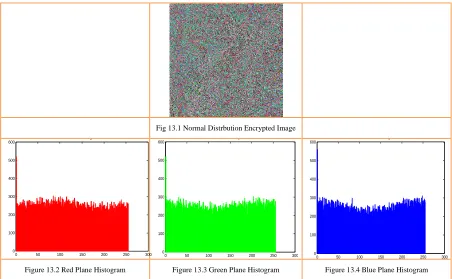
Figure 13.1 shows the encrypted image obtained by using 2 D Normal Random distribution and the histogram of the encrypted image i.e. red plane , green plane and blue plane is shown in figure 13.2, 13.3 and 13.4.
Fig 13.1 Normal Distrbution Encrypted Image
Figure 13.2 Red Plane Histogram Figure 13.3 Green Plane Histogram Figure 13.4 Blue Plane Histogram 0 50 100 150 200 250 300
0 100 200 300 400 500 600
0 50 100 150 200 250 300
0 50 100 150 200 250 300 350 400 450 500
g g
0 50 100 150 200 250 300 0
50 100 150 200 250 300 350 400 450 500
0 50 100 150 200 250 300 0
100 200 300 400 500 600
g
0 50 100 150 200 250 300 0
100 200 300 400 500 600
g
0 50 100 150 200 250 300 0
100 200 300 400 500 600
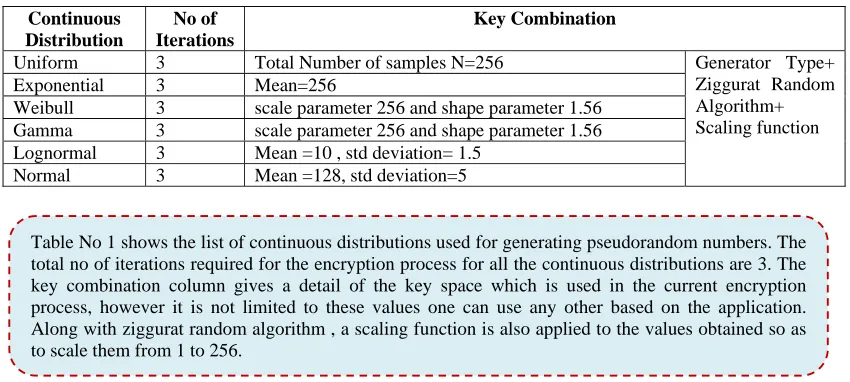
Table 1. No of Iterations for Continuous Distributions and Key space Analysis
Continuous Distribution
No of Iterations
Key Combination
Uniform 3 Total Number of samples N=256 Generator Type+
Ziggurat Random Algorithm+ Scaling function
Exponential 3 Mean=256
Weibull 3 scale parameter 256 and shape parameter 1.56
Gamma 3 scale parameter 256 and shape parameter 1.56
Lognormal 3 Mean =10 , std deviation= 1.5
Normal 3 Mean =128, std deviation=5
Table 2. Experimental values obtained for Image Moments like Mean, Std, Skewness, and Kurtosis, PAFCPV and NPCR for Original image, Uniform, Exponential, Weibull, Gamma , Lognormal and Normal Distributions in Lena Image
Lena Original Uniform Exponential Weibull Gamma Lognor
mal
Norma l
MEAN R Plane 177.17 126.93 127.63 122.32 126.25 127.45 125.52
GPlane 96.60 127.26 132.18 134.87 129.29 127.34 128.42
BPlane 102.71 127.31 136.06 139.17 131.12 127.46 128.28
STD R Plane 48.47 73.80 78.24 77.85 75.03 73.83 73.40
GPlane 50.99 74.05 71.09 72.80 73.51 73.57 75.06
BPlane 35.30 74.12 70.17 73.08 73.46 73.68 75.97
SKEWNES S
R Plane -54.25 80.55 84.56 84.29 81.60 - 80.58 80.26
GPlane 57.55 80.78 -78.21 -79.87 -80.32 80.28 -81.62
BPlane 41.08 - 80.82 -77.79 -80.59 - 80.31 80.46 -82.40
KURTOSIS R Plane 58.88 85.52 89.15 89.00 86.43 85.55 85.32
GPlane 62.70 85.73 83.52 85.14 85.34 85.24 86.46
BPlane 46.00 85.76 83.49 86.23 85.39 85.45 87.13
PAFCPV 0.304 0.309 0.337 0.309 0.302 0.316
NPCR 99.80 99.99 99.99 99.99 98.73 99.99
Table No 1 shows the list of continuous distributions used for generating pseudorandom numbers. The total no of iterations required for the encryption process for all the continuous distributions are 3. The key combination column gives a detail of the key space which is used in the current encryption process, however it is not limited to these values one can use any other based on the application. Along with ziggurat random algorithm , a scaling function is also applied to the values obtained so as to scale them from 1 to 256.
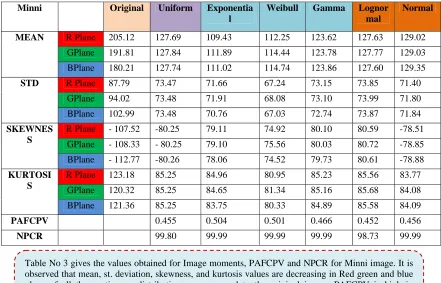
Table 3. Experimental values obtained for Image Moments like Mean, Std, Skewness, and Kurtosis, PAFCPV and NPCR for Original image, Uniform, Exponential, Weibull, Gamma , Lognormal and Normal Distributions in Minni Image
Minni Original Uniform Exponentia
l
Weibull Gamma Lognor
mal
Normal
MEAN R Plane 205.12 127.69 109.43 112.25 123.62 127.63 129.02
GPlane 191.81 127.84 111.89 114.44 123.78 127.77 129.03
BPlane 180.21 127.74 111.02 114.74 123.86 127.60 129.35
STD R Plane 87.79 73.47 71.66 67.24 73.15 73.85 71.40
GPlane 94.02 73.48 71.91 68.08 73.10 73.99 71.80
BPlane 102.99 73.48 70.76 67.03 72.74 73.87 71.84
SKEWNES S
R Plane - 107.52 -80.25 79.11 74.92 80.10 80.59 -78.51
GPlane - 108.33 - 80.25 79.10 75.56 80.03 80.72 -78.85
BPlane - 112.77 -80.26 78.06 74.52 79.73 80.61 -78.88
KURTOSI S
R Plane 123.18 85.25 84.96 80.95 85.23 85.56 83.77
GPlane 120.32 85.25 84.65 81.34 85.16 85.68 84.08
BPlane 121.36 85.25 83.75 80.33 84.89 85.58 84.09
PAFCPV 0.455 0.504 0.501 0.466 0.452 0.456
NPCR 99.80 99.99 99.99 99.99 98.73 99.99
Table 4. Experimental values obtained for Image Moments like Mean, Std, Skewness, and Kurtosis, PAFCPV and NPCR for Original image, Uniform, Exponential, Weibull, Gamma , Lognormal and Normal Distributions in fruits Image
Fruits Original Uniform Exponentia
l
Weibull Gamma Lognor
mal
Normal
MEAN R Plane 153.05 127.13 128.43 126.30 127.49 127.49 125.99
GPlane 93.64 127.57 128.48 130.94 127.95 127.68 127.63
BPlane 28.66 128.11 117.47 123.73 125.53 127.40 131.99
STD R Plane 66.87 73.95 76.00 76.13 74.58 74.02 73.74
GPlane 64.57 73.95 72.40 72.94 73.41 74.01 74.51
BPlane 30.96 73.70 67.86 65.34 71.87 74.02 72.75
SKEWNES S
R Plane -75.14 80.64 -82.46 82.56 - 81.25 80.74 80.47
GPlane 70.59 - 80.66 -79.16 - 79.75 -80.21 - 80.71 -81.12
BPlane 40.02 -80.46 75.15 72.72 78.91 - 80.76 -79.67
KURTOSI S
R Plane 81.67 85.59 87.21 87.28 86.16 85.69 85.44
GPlane 75.77 85.61 84.19 84.82 85.22 85.65 86.00
BPlane 49.49 85.45 80.76 78.35 84.12 85.73 84.82
PAFCPV 0.360 0.345 0.370 0.358 0.358 0.373
NPCR 99.80 99.99 99.99 99.99 98.73 99.99
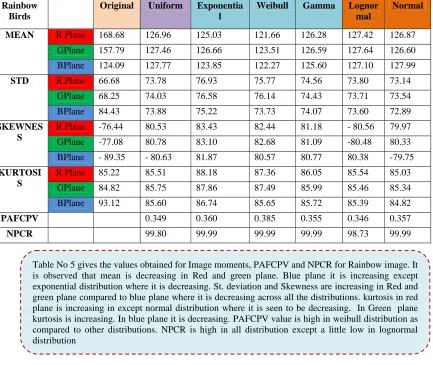
Table 5. Experimental values obtained for Image Moments like Mean, Std, Skewness, and Kurtosis, PAFCPV and NPCR for Original image, Uniform, Exponential, Weibull, Gamma , Lognormal and Normal Distributions in Rainbow birds Image
Rainbow Birds
Original Uniform Exponentia
l
Weibull Gamma Lognor
mal
Normal
MEAN R Plane 168.68 126.96 125.03 121.66 126.28 127.42 126.87
GPlane 157.79 127.46 126.66 123.51 126.59 127.64 126.60
BPlane 124.09 127.77 123.85 122.27 125.60 127.10 127.99
STD R Plane 66.68 73.78 76.93 75.77 74.56 73.80 73.14
GPlane 68.25 74.03 76.58 76.14 74.43 73.71 73.54
BPlane 84.43 73.88 75.22 73.73 74.07 73.60 72.89
SKEWNES S
R Plane -76.44 80.53 83.43 82.44 81.18 - 80.56 79.97
GPlane -77.08 80.78 83.10 82.68 81.09 -80.48 80.33
BPlane - 89.35 - 80.63 81.87 80.57 80.77 80.38 -79.75
KURTOSI S
R Plane 85.22 85.51 88.18 87.36 86.05 85.54 85.03
GPlane 84.82 85.75 87.86 87.49 85.99 85.46 85.34
BPlane 93.12 85.60 86.74 85.65 85.72 85.39 84.82
PAFCPV 0.349 0.360 0.385 0.355 0.346 0.357
NPCR 99.80 99.99 99.99 99.99 98.73 99.99
Table No 4 gives the values obtained for Image moments, PAFCPV and NPCR for Fruits image. It is observed that mean is decreasing in Red plane as compared to green and blue plane of the continuous distributions where it is increasing. St. deviation, Skewness and kurtosis are increasing in all the planes and distributions as compared to the original image. PAFCPV is high in Normal distribution as compared to the other distributions. NPCR is low in Lognormal rest all the distributions have a very high value.
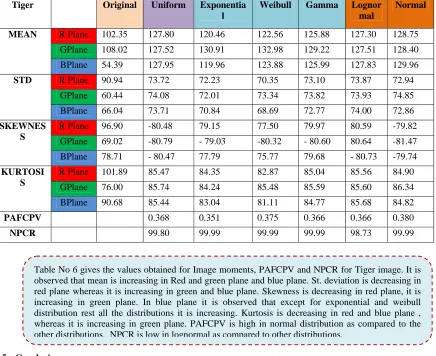
Table 6. Experimental values obtained for Image Moments like Mean, Std, Skewness, and Kurtosis, PAFCPV and NPCR for Original image, Uniform, Exponential, Weibull, Gamma , Lognormal and Normal Distributions in Tiger Image
Tiger Original Uniform Exponentia
l
Weibull Gamma Lognor
mal
Normal
MEAN R Plane 102.35 127.80 120.46 122.56 125.88 127.30 128.75
GPlane 108.02 127.52 130.91 132.98 129.22 127.51 128.40
BPlane 54.39 127.95 119.96 123.88 125.99 127.83 129.96
STD R Plane 90.94 73.72 72.23 70.35 73.10 73.87 72.94
GPlane 60.44 74.08 72.01 73.34 73.82 73.93 74.85
BPlane 66.04 73.71 70.84 68.69 72.77 74.00 72.86
SKEWNES S
R Plane 96.90 -80.48 79.15 77.50 79.97 80.59 -79.82
GPlane 69.02 -80.79 - 79.03 -80.32 - 80.60 80.64 -81.47
BPlane 78.71 - 80.47 77.79 75.77 79.68 - 80.73 -79.74
KURTOSI S
R Plane 101.89 85.47 84.35 82.87 85.04 85.56 84.90
GPlane 76.00 85.74 84.24 85.48 85.59 85.60 86.34
BPlane 90.68 85.44 83.04 81.11 84.77 85.68 84.82
PAFCPV 0.368 0.351 0.375 0.366 0.366 0.380
NPCR 99.80 99.99 99.99 99.99 98.73 99.99
5. Conclusion
The symmetric key based image encryption using continuous distributions was proposed in this paper. For experimental purpose the method was applied on 24-bit color images. The results obtained for five different images are given in the table above. For experimental analysis of this method image moments like mean, std deviation, skewness and kurtosis was calculated and the values obtained were compared to the original image. Two more parameters called as Peak average fractional change in pixel value and Number of pixel change rate was also calculated. From the results obtained it is clear that, irrespective of the image the statistical moments show very small variation. With the change of original distribution these moments take a different value and display the same property. Histogram analysis was also done for the encrypted images obtained for all the continuous distribution. A flat histogram is obtained across all the three planes of the encrypted image. A high value of 0.5 was observed for PAFCPV in minni image for exponential and weibull distribution. A high value of NPCR was obtained across all the distributions in all the images under test.
References
[1] Mohammed A. Shreef, Haider K. Hoomod (2013). Image Encryption Using Lagrange-Least Squares Interpolation. International Journal of Advanced Computer Science and Information Technology (IJACSIT) 2(4), 35-55
[2] Rodriguez-Sahagun, M. T., J. B. Mercado-Sanchez, D. Lopez-Mancilla, R. Jaimes-Reategui, and J. H. Garcia-Lopez (2013). Image Encryption Based on Jacobi Function. In Mechatronics, Electronics and Automotive Engineering (ICMEAE), (pp.109-114). IEEE. [3] Seddik, Hassen, and Ezzdine Ben Braiek(2013). Image securing based chaotic encryption coupled with DCT robust watermarking.
In Electrical Engineering and Software Applications (ICEESA). (pp.1-6). IEEE.
[4] Cheddad, Abbas; Condell, Joan; Curran, Kevin; McKevitt, Paul (2010). A Hash-based Image Encryption Algorithm. Optics Communications,283(6), (pp. 879-893).
[5] Norouzi, Benyamin, Seyed Mohammad Seyedzadeh, Sattar Mirzakuchaki, and Mohammad Reza Mosavi(2014). A novel image encryption based on hash function with only two-round diffusion process. Multimedia Systems 20(1).(pp 45-64).
[6] Acharya, Bibhudendra, Nikhil Thomas, D. R. Arasu, and N. Vishnu Prasad(2011). Encryption and decryption of informative image by key image using modified Hill cipher technique based on non-invertible matrices. In Communication, Computing & Security, (pp. 606-609).
[7] Acharya, Bibhudendra, Saroj Kumar Panigrahy, Sarat Kumar Patra, and Ganapati Panda(2010). Image Encryption Using Advanced Hill Cipher Algorithm. International Journal on Signal & Image Processing 1(1).
[8] Zaidi, S. Jamal H., and Hongxia Wang(2010). Improved image encryption technique using multi chaotic system. In Proc of the 8th International Conference on Frontiers of Information Technology, ACM (p.35.)
[9] Acharya, Bibhudendra, S. Sachin Sunder, M. Thiruvenkatam, and Aneesh K. Sajan(2011). Image encryption using index based chaotic sequence, M sequence and gold sequence. In Proc International Conference on Communication, Computing & Security,ACM (pp. 541-544)
[10] Dey, Somdip. "SD-AEI: An advanced encryption technique for images (2012). In Second International Conference on Digital Information Processing and Communications (ICDIPC), (pp. 68-73). IEEE
[11] Maksuanpan, S., T. Veerawadtanapong, and W. San-Um(2013) Robust digital image cryptosystem based on nonlinear dynamics of compound sine and cosine chaotic maps for private data protection. In 15th International Conference on Advanced Communication Technology (ICACT) (pp.1083-1088). IEEE
[12] Loukhaoukha, Khaled(2013).An Improved Secure Image Encryption Algorithm Based on Rubik's Cube Principle and Digital Chaotic Cipher. In Mathematical Problems in Engineering
[13] Sethi, Nidhi, and Deepika Sharma(2012). A new cryptology approach for image encryption. In 2nd IEEE International Conference on Parallel Distributed and Grid Computing (PDGC), (pp. 905-908).
[14] Belkhouche, Fethi, and I. Gokcen(2009).Digital image encoding using hyperchaos In IEEE International Conference on Systems, Man and Cybernetics, SMC, (pp. 1349-1352).
[15] Gilani, Syed Ali Naqi, and M. Ajmal Bangash(2008). Enhanced block based color image encryption technique with confusion. In Multitopic Conference. INMIC (pp. 200-206). IEEE.
[16] Zhou, Xiaoyi, Jixin Ma, Wencai Du, and Yongzhe Zhao(2011). Ergodic matrix and hybrid-key based image cryptosystem. International Journal of Image, Graphics and Signal Processing (IJIGSP) 3(4)
[17] Li, Chunlin, Guangzhu Xu, Chunxian Song, and Jing Jing(2012).Evaluation of Image Scrambling Degree with Intersecting Cortical Model Neural Network.International Journal of Hybrid Information Technology 5,(2).
[18] H.B.Kekre, Tanuja Sarode, Pallavi Halarnkar(2014), Performance Evaluation of Digital Image Encryption Using Discrete Random Distributions and MOD operator, IOSR Journal of Computer Engineering(IOSR-JCE), 16(2) V.5 (pp. 54-68).
Authors’ Biography
Dr. H. B. Kekre has received B.E (Hons.) in Telecomm Engineering from Jabalpur University in 1958, M.Tech (Industrial Electronics) from IIT Bombay in 1960, M.S.Engg. (Electrical Engg.) from University of Ottawa, Canada in 1965 and Ph.D. (System Identification) from IIT Bombayin 1970. He has worked as Faculty of Electrical Engg. and then HOD Computer Science and Engg. at IIT Bombay. After serving IIT for 35 years he retired in 1995. After retirement from IIT, for 13 years he was working as a professor and head in the Department of Computer Engg. and Vice Principal at Thadomal Shahani Engineering. College, Mumbai. Now he is Senior Professor at MPSTME, SVKM’s NMIMS University. He has guided 17 Ph.Ds, more than 100 M.E./M.Tech and several B.E./ B.Tech projects, while in IIT and TSEC. His areas of interest are Digital Signal processing, Image Processing and Computer Networking. He has more than 450 papers in National / International Journals and Conferences to his credit. He was Senior Member of IEEE. Presently He is Fellow of IETE, Life Member of ISTE and Senior Member of International Association of Computer Science and Information Technology (IACSIT). Recently fifteen students working under his guidance have received best paper awards. Currently eight research scholars working under his guidance have been awarded Ph. D. by NMIMS (Deemed to be University). At present eight research scholars are pursuing Ph.D. program under his guidance.
Dr. Tanuja K. Sarode has received M.E. (Computer Engineering) degree from Mumbai University in 2004, Ph.D. from Mukesh Patel School of Technology, Management and Engg. SVKM’s NMIMS University, Vile-Parle (W), Mumbai, INDIA. She has more than 11 years of experience in teaching. Currently working as Assistant Professor in Dept. of Computer Engineering at Thadomal Shahani Engineering College, Mumbai. She is member of International Association of Engineers (IAENG) and International Association of Computer Science and Information Technology (IACSIT). Her areas of interest are Image Processing, Signal Processing and Computer Graphics. She has 150 papers in National /International Conferences/journal to her credit.