https://doi.org/10.5194/os-15-291-2019
© Author(s) 2019. This work is distributed under the Creative Commons Attribution 4.0 License.
Upscaling of a local model into a larger-scale model
Luc Vandenbulcke1,2and Alexander Barth3 1seamod.ro, Jailoo srl, Salatrucu, Romania 2MAST, Université de Liège, Liège, Belgium 3GHER, Université de Liège, Liège, Belgium
Correspondence:Luc Vandenbulcke ([email protected]) Received: 8 July 2018 – Discussion started: 19 July 2018
Revised: 5 February 2019 – Accepted: 4 March 2019 – Published: 22 March 2019
Abstract.Traditionally, in order for lower-resolution, global-or basin-scale (regional) models to benefit from some of the improvements available in higher-resolution subregional or coastal models, two-way nesting has to be used. This im-plies that the parent and child models have to be run together and there is an online exchange of information between both models. This approach is often impossible in operational sys-tems where different model codes are run by different insti-tutions, often in different countries. Therefore, in practice, these systems use one-way nesting with data transfer only from the parent model to the child models. In this article, it is examined whether it is possible to replace the missing feedback (coming from the child model) by data assimila-tion, avoiding the need to run the models simultaneously. Se-lected variables from the high-resolution simulation will be used as pseudo-observations and assimilated into the low-resolution models. This method will be called “upscaling”.
A realistic test case is set up with a model covering the Mediterranean Sea, and a nested model covering its north-western basin. Under the hypothesis that the nested model has better prediction skills than the parent model, the up-scaling method is implemented. Two simulations of the par-ent model are then compared: the case of one-way nesting (or a stand-alone model) and a simulation using the upscal-ing technique on the temperature and salinity variables. It is shown that the representation of some processes, such as the Rhône River plume, is strongly improved in the upscaled model compared to the stand-alone model.
1 Introduction
In the present-day operational oceanography landscape, ser-vices are provided at different scales by different expert cen-tres. At the European Union level, the Copernicus Marine Environment Monitoring Service (CMEMS) provides reanal-yses, analyses and forecasts at global and basin scales. The models for the different basins are run by different insti-tutes and centres within the regional monitoring and fore-casting centres. Various oceanographic centres then use the CMEMS products to provide initial and/or boundary con-ditions to their respective models. These subregional and coastal models benefit from the specific knowledge of the local teams in their particular area of interest. Furthermore, nested models usually run at higher resolution and may in-clude more accurate data (bathymetry, river discharge data, etc.) and processes of smaller scales that cannot be eas-ily included in basin-scale models. High-resolution observa-tions such as satellite sea surface temperature (SST) and re-cent ultra-high-resolution products (see, e.g., Le Traon et al., 2015) have been shown to be best assimilated into nested models as chances are higher that the observed processes are well represented (Vandenbulcke et al., 2006). Similarly, high-resolution observations of currents by high-frequency radars are expected to benefit models with a similar high resolution (i.e. nested models) most.
model is visible even outside the domain of the nested model. This constitutes the baseline hypothesis of the present study: it is desirable to “copy” the results of the nested model into the parent model.
To emulate this nesting feedback, missing in the opera-tional context, it is analysed whether results from the subre-gional model can be used as pseudo-observations and assim-ilated into the basin-scale model. Indeed, data assimilation is not limited to the use of (real) observations by measure-ment devices. Onken et al. (2005) used data assimilation as a substitute for one-way nesting in a cascade of nested mod-els. Alvarez et al. (2000) used a statistical model to predict SST, which was then assimilated as pseudo-observations in a hydrodynamic model (Barth et al., 2006). In the proposed “upscaling” method, the pseudo-observations come from the nested model. From the point of view of the forecasting cen-tres, a data assimilation scheme is already implemented in the basin-scale model. Hence, implementing the upscaling method only requires obtaining the high-resolution data and assimilating (parts of) it, along with the real observations, during the analysis phase of the system.
When using grid nesting, problems at the open boundary of the child model include stratification mismatches, artifi-cial waves, artifiartifi-cial rim currents, and ultimately instabilities and model blow-up (Mason et al., 2010; Debreu et al., 2012). By upscaling the child model into the parent model, the latter will progressively gain consistency with the child model so-lution within its domain, being beneficial for the child model over time. Upscaling can potentially reduce the risk of dis-crepancies at the open-sea boundary.
Upscaling can also be seen as using a high-resolution model as a “measurement device” that replaces ever too sparse (real) measurements. Guinehut et al. (2002, 2004) showed that a coverage of the North Atlantic with a 3◦ reso-lution grid of Argo floats allows effectively representing the large scales. Using a 5◦ array reduces the precision of the estimated fields by half. Currently, some CMEMS areas are largely undersampled.
Upscaling can be understood as a complement to down-scaling (initialization) techniques such as the Variational Ini-tialization and Forcing Platform (VIFOP) tool presented in Auclair et al. (2000, 2001) or in Simoncelli et al. (2011). The point of these methods is to combine interpolated fields com-ing from the large-scale model (the background or first-guess field) and existing high-resolution fields, so that small-scale structures present in coastal models are not lost whenever the high-resolution model is (re)-initialized by fields interpolated from the basin-scale model, and the obtained fields are phys-ically balanced with respect to the coastal physics. If upscal-ing is used to improve the basin-scale fields and make them agree with them with the coastal model, the “first guess” will be already much better.
Schulz-Stellenfleth and Stanev (2016) represent another recent example showing the benefits of two-way nesting, especially in sophisticated modern-day forecasting systems.
The study demonstrates that two-way nesting is critical for correct energy transfers between large and small scales (es-pecially in coupled ocean–wave–atmosphere models) for cross-border advection, for the correct use of high-resolution coastal observations that cannot be fed directly into a large-scale model, etc. Acknowledging that operational systems only use one-way nesting, Schulz-Stellenfleth and Stanev (2016) therefore strongly advocate research into upscaling techniques. The present article tries to develop precisely such a technique.
In this article, the upscaling procedure is tried out in a realistic, nested-model configuration covering the Mediter-ranean Sea and the north-western basin and simulating the year 2014. The same model, NEMO 3.6 (Madec, 2008), and the same vertical resolution, are used for both configurations (only the horizontal grid is different). It is not expected that the conclusions of the study would be fundamentally differ-ent if differdiffer-ent models and vertical grids are used for par-ent and child models. If differpar-ent model codes were used, they could represent different processes. Hence, this should be taken into account by modifying the (representativity part of the) observation error covariance matrix when performing the data assimilation of the pseudo-observations. Examples of such contributions to the representativity error could be
– different vertical coordinates (see above);
– different implementations of the ocean surface: rigid lid or free surface; for the latter, linear or non-linear repre-sentation;
– hydrostatic model or not;
– different atmospheric forcing fields; – different turbulent closure schemes;
– different numerical schemes for advection, horizontal diffusion, etc.
The most striking difference between the parent and child models however, remains the horizontal resolution, and therefore, the general conclusions of the paper are expected to be valid, and upscaling should not be limited to the case of parent and child models being identical.
In this study, it is not the aim to verify that the nested model is indeed more realistic, according to some metrics than the parent model. Rather, this constitutes the baseline hypothesis, and thus it is always considered beneficial to bring the parent model simulation closer to the child model simulation. It should be noted that some high-resolution pro-cesses, resolved by the nested model but not by the parent model, could have large phase errors in the nested model. In this case, the baseline hypothesis would be violated, and the nested model could actually have higher errors than the former. This aspect is not considered in the paper.
the data assimilation scheme are described in Sect. 2. The parent model will be run both in “free” mode, and “up-scaled” mode (i.e. assimilating pseudo-observations from the child model). The “free model” is equivalent to a stand-alone model; i.e. even if there are nested models, it is not influ-enced by them. Section 3 proposes some metrics to evaluate the system, related to the Rhône River plume, the cross-shelf exchanges, the large-scale current, SST and the formation of Western Mediterranean Deep Water. Results are given in Sect. 4 and a conclusion is presented in Sect. 5.
2 Model and data assimilation configuration 2.1 Hydrodynamic model
The upscaling technique has been implemented in the north-western Mediterranean Sea (NW-Med), including the Gulf of Lion (GoL) and the Ligurian Sea (see Fig. 2). The re-gion is characterized by large-scale currents (the Northern Current also called Liguro–Provençal Current, created by the junction of the Eastern and Western Corsican currents; see, e.g., Pinardi et al., 2015), by intense meso-scale activ-ity and by inertial oscillations. Furthermore, the NW-Med is the siege of formation of Western Mediterranean Deep Water (WMDW), important to the circulation in the whole Mediterranean Sea (e.g. Millot, 1999; Pinardi et al., 2015; Bosse et al., 2015; Somot et al., 2018; Simoncelli et al., 2018).
A realistic, one-way nested configuration was imple-mented using the NEMO 3.6 model and the AGRIF nesting tool (Debreu et al., 2008), covering respectively the Mediter-ranean Sea (MED) with a 8 km horizontal resolution and the north-western Mediterranean basin (NW-Med). The parent model resolution is similar to the previous version of the CMEMS Mediterranean Sea analysis- forecasting system (up to October 2017) (Clementi et al., 2017) and to the present reanalysis (1/16◦) (Simoncelli et al., 2014). The child model horizontal resolution is 1.6 km.
When implementing the upscaling method, it is expected that after some time, the feedback from the NW-Med model will modify the Northern Current position and intensity in the parent model, which will in turn influence the NW-Med model through its open-sea boundary. The boundary condi-tion provided by the MED model also influences the strat-ification of the water column, which is important for the preconditioning of the convection (Samuel Somot, personal communication, 2018).
Both model bathymetries are interpolated from the GEBCO (GEneral Bathymetric Chart of the Oceans) bathymetry. Thanks to its higher resolution, the bathymetry of the nested model (1/80◦) is more realistic than in the par-ent model, at the coastline and, more importantly, in the dif-ferent canyons on the Gulf of Lion shelf break. The tem-perature and salinity initial condition is interpolated from
the CMEMS Mediterranean reanalysis (1/16◦) for 1 Jan-uary 2014 (see https://doi.org/10.25423/medsea_reanalysis_ phys_006_004, last access: 20 December 2018), using tri-linear interpolation and tri-linear extrapolation where needed. The model starts from rest. Atmospheric fluxes are com-puted using the bulk formula from the NEMO Mediterranean Forecasting System (MFS) module; the atmospheric forcing fields are obtained from ECMWF ERA Interim with a tem-poral resolution of 3 h and a horizontal resolution of 0.75◦ re-interpolated by the ECMWF server to 0.125◦(Dee et al., 2011). In the MED model, the flow between the Black Sea and the Mediterranean Sea, through the Marmara Sea and the Dardanelles Strait, is modelled as a river, using climatologi-cal flow, temperature and salinity values. The salinity of the incoming water has a minimum and maximum of 22.5 and 27.5 psu reached in July and March respectively. Five other rivers (Rhône, Po, Ebro, Nile, Drin) are also represented, and monthly climatologic values for the flow and temperature are used, whereas the salinity is put to 5 psu, except for the Drin river where is it put at 2 psu. Using climatologic monthly val-ues is coherent with the operational set-up in the CMEMS Mediterranean system, although the latter represents many more small rivers.
Daily Rhône River discharge measurements at the Beau-caire station were obtained from the Compagnie du Rhône, in order to be used in the nested NW-Med model. Interest-ingly, the total annual flow computed from the climatology and from the measured values for 2014–2015 is very similar (1 % difference). However seasonal and daily values can be very different (see Fig. 1a). In particular, during the consid-ered period, the climatology underestimates the winter dis-charge but overestimates the summer disdis-charge. Hence, de-pending on the dataset used, it is expected that the mod-elled river plume will also be significantly different. This is illustrated in Fig. 1b, showing the surface salinity differ-ence using climatological or daily discharge data in the child model (NW-Med) after 1 month of spin-up. The plume ob-tained using real river discharge extends much further off-shore, almost completely across the Gulf of Lion, whereas the plume obtained with the climatological river discharge essentially stays at the coast close to the river mouth. This is consistent with the much larger (almost double) discharge values observed in the real river data during January 2014.
2.2 Upscaling experiment description, ensemble generation and data assimilation scheme
Figure 1. (a)Rhône River discharge from (green) the climatology, (blue) the measurements by the Compagnie du Rhône at the Beaucaire station and (red) the 1-month moving average of the measurements.(b)Difference of surface salinity in two different model runs of the nested grid on 28 January 2014, when using climatological or measured Rhône discharge values (i.e. using the green or blue curve ina).
Only one system (the Arctic system) currently uses an en-semble Kalman filter, but the other systems are planning to evolve toward ensemble simulations in the future.
The following settings were chosen for the current exper-iment. The filter will be an ensemble Kalman filter (the par-ent model is thus transformed into an ensemble of models). Assimilation will be performed daily. Only temperature and salinity will be used as pseudo-observations; the thinned 3-D fields will be used. Velocity and surface elevation are not updated by the data assimilation procedure. Thinning is real-ized by taking the average of five by five cells of the nested model. The thinned pseudo-observations coming from the nested model are then considered independent; i.e. their error covariance matrix is diagonal. This is still a strong assump-tion which should be taken into account when determining the (diagonal) part of the observation error covariance ma-trix.
The members of the ensemble have perturbed initial condi-tions, atmospheric forcing fields and Rhône River discharge, similar to Auclair et al. (2003). The initial condition is the randomly weighted sum of the real initial condition (1
Jan-uary 2014) and six other initial conditions (1 year, 20 days and 10 days earlier, and 10 days, 20 days and 1 year later). The weight of the real initial condition is a random normal number chosen in the Gaussian distribution with mean 0.5 and standard deviation 0.2; if necessary, the random number is then limited back into [0.2 0.8], whereas the six remain-ing weights are random numbers chosen uniformly in [0 1], and normalized so that the sum of all seven weights is 1. This procedure ensures that the stability of each member is not modified (for example, the linear combination of seven stable water columns is still a stable water column).
Figure 2.Zoom of the MED model grid, with the positions for computing the Northern Current metric (black line) and the cross-shelf transport metric (magenta and red dots).
The Rhône River discharge is perturbed using a random walk approach, with the expected perturbation after 1 year set to 20 %. The other rivers are outside the observed part of the domain, and their discharge is not perturbed. With all three perturbations, an ensemble of 100 members is then spun-up for 1 month.
Data assimilation is performed by the Ocean Assimilation Kit (OAK) package (Barth et al., 2008) implementing dif-ferent filters such as SEEK and the ensemble Kalman fil-ter (EnKF). Different variants of the EnKF exist, and are classified in stochastic and deterministic methods. The for-mer require the perturbation of the observations, adding sam-pling noise. The latter, also called ensemble square root fil-ters, do not present this requirement; the perturbation ap-proach is only applied in the model to obtain model errors. Different variants are compared in Tippett et al. (2003). One variant, called the ensemble transform Kalman filter (Bishop et al., 2001; Wang et al., 2004), is used in this study. The filter equations are listed in Barth and Vandenbulcke (2017).
Nerger et al. (2012) summarizes how the spurious long-range correlations can be suppressed using so-called covari-ance localization or domain localization and its additional observation localization. OAK uses the latter variant intro-duced in Hunt et al. (2007). In essence, the state vector is split into subdomains (water columns). In every water col-umn, the analysis is performed independently (domain lo-calization). In addition, for every water column, only nearby observations are used and the inverse of their error variance is multiplied by a localization function (observation localiza-tion). In the current set-up, the localization function is a ra-dial Gaussian function with ane-folding distance of 30 km.
The observation errors for temperature and salinity are set respectively at 0.3◦C and 0.09 psu. These values were de-termined after a sensitivity experiment with observation er-rors of 0.5◦C, 0.15 psu; 0.3◦, 0.09 psu; 0.2◦C, 0.05 psu; and 0.1◦C, 0.03 psu as a trade-off between generating a close em-ulation of two-way nesting (hence very small observation er-rors) and generating fields that are as balanced as possible and that will not cause adjustment shocks in the model (hence larger observation errors). With the latter two choices for the observation error, the obtained assimilation increment was not much larger than with the final choice of 0.3◦, 0.09 psu, but qualitatively, unrealistic small-scale variations started to appear.
From a technical point of view, OAK allows using a multi-variate, multi-grid state vector. As the Mediterranean model is parallelized in 64 tiles, the multi-grid feature allows up-dating the tiles directly from the Mediterranean model restart files, influenced by the nested model, without including the other tiles in the state vector. The procedure thus allows skip-ping the reconstruction of the complete Mediterranean restart files. It should be noted that the tiles of the parent model, con-sidered in the data assimilation procedure, are the ones cov-ering the nested-model area but also the neighbouring ones which are influenced by the data assimilation.
3 Metrics
successful, the parent model with upscaling will be closer to its nested model than its counterpart without upscaling. 3.1 Cross-shelf transport
The penetration of offshore water on the GoL (or inversely when negative transport values are obtained) is critical for the circulation on the shelf, for the shelf–open-sea exchanges, etc. It is obtained by integrating the current over the boundary shown in Fig. 2. This metric is useful to compare basin-scale models (free and upscaled) and check whether the upscal-ing procedure is able to drive the solution toward the nested-model solution. The intensity of the cross-shelf transport can-not, however, be compared to real measurements (due to a lack of them).
3.2 Northern Current intensity
The Northern Current (NC) is the most important large-scale feature in the region of interest. It is considered to have a width of 40–50 km during summer and 20–30 km during winter, but the most offshore currents do not modify the transport much. Similarly, the NC is considered to be 100– 200 m deep in summer and 250–400 m in winter. Following Alberola et al. (1995), its intensity is obtained by integrat-ing the currents normal to a line from Nice to the location at 43.0756◦N, 7.5415◦E, 214 km to the south-east, indicated in Fig. 2. As for the previous metric, this metric only allows inter-comparing different models.
3.3 Rhône River plume
The plume of the Rhône River is measured by selecting all points around the river mouth with a salinity smaller than 37 psu and then choosing the most distant one from the river mouth. This provides the plume length and direction, al-though it may be an approximation: the plume can be curved, in which case its real length is greater than the estimation, or it can cover a large area, in which case the algorithm still obtains an azimuth although in reality it is not well-defined.
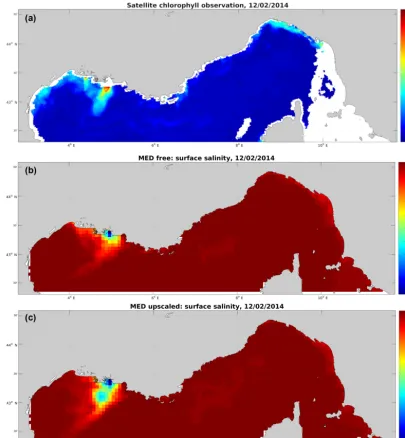
This metric can be used quantitatively to compare models. Furthermore, it can be used to compare model results to real measurements. Indeed, although the real Rhône River plume length and direction are not measured directly, they can be estimated from satellite chlorophyll a images. The model– observations comparison is then qualitative.
3.4 Sea surface temperature
This metric is the root mean square (rms) difference between the parent model and the observed SST. For the latter, the level-3 (L3) images are used.
3.5 Western Mediterranean Deep Water formation Following Bosse et al. (2015) and references herein, the formation zone of WMDW is located at 41–43◦N, 4–6◦E.
WMDW forms an easily identifiable water mass: it has a temperature between 12.86 and 12.89◦C, a salinity of 38.48– 38.50 psu, and its depth is greater than 1000 m. The nested-model (NW-Med) southern boundary is at 42.3◦N, and hence only a part of the formation area is included in the area of MED covered by pseudo-observations. The WMDW metric measures the total volume (m3) of WMDW in the domain covered by the NW-Med model and is used to compare the different models.
4 Results
The temperature difference between the (unperturbed) parent and child models at the end of the spinup (31 January 2014) is represented in Fig. 3 on the child model grid. There are large temperature differences at the shelf break of the Gulf of Lion (the canyons are much better represented in the nested model), which extend all the way from the surface to the bot-tom of the Gulf of Lion. Other large differences appear in the Eastern and Western Corsican currents and their junction resulting in the Northern Current as well as at the southern open boundary. The difference in salinity (not shown) has large values around the Rhône River plume (over 1 psu) and to a lesser extent in the Eastern Corsican Current. It appears that after a month, the differences are already significant, and if one trusts the nested model more, then it would be benefi-cial to bring these differences back to the basin-scale model. At the end of the spin-up, the spread of the ensemble of models (Fig. 4) is very visible over the basin at all river mouths but also in other areas (Alboran Sea, Tunesian coastal zone, etc.) as all three perturbations are applied at once. The ensemble spread is also visible in depth (i.e. deeper than when only the river discharge is modified).
As an example, the first data assimilation cycle is shown in Fig. 5 depicting SST. The L4 SST image is shown only for visual comparison. Qualitatively, it appears that upscal-ing changes important features: the Rhône River plume is oriented offshore instead of being mostly along-shore, fronts seem to be better defined, and the Northern Current flows along the shelf break instead of covering a large part of the shelf. The nested model and the upscaled model seem to be in closer agreement with the satellite image than the free model.
4.1 Cross-shelf transport
Figure 3.Temperature difference between the parent and nested models on 31 January 2014, projected on the nested-model grid.
Figure 5.Sea surface temperature after the first upscaling step (31 January 2014) in the free model(a), nested model(b), upscaled model(c)
and L4 satellite observation(d).
Table 1. Root mean square difference between parent and child model for the case of the free parent model and the upscaled parent model for the defined metrics.
Metric MED free MED
model upscaled
model
Cross-shelf transport(m3s−1) 99.6×10³ 85.2×10³
N. C. intensity(Sv) 0.22 0.19
Rhône plume(km) 95.1 88.0
SST(◦C) 1.3 1.3
WMDW(km3) 1563 1422
and hence also the upscaled model actually predict the exact opposite. The reasons for the nested model to behave differ-ently than the parent model may be an effect of wind inter-action with the (different) bathymetries, or it may be related to the different resolution. The actual transport is not mea-sured or available, but the result of interest here is that the upscaling method is able to align the (parent model) currents with the ones from the nested model and hence emulate two-way nesting, although only temperature and salinity pseudo-observations are used.
During the remainder of the year, the upscaled model pre-dicts somewhat larger transports (both inward and outward). Generally speaking however, the two transport curves are closer than in February (or at least they are not of opposite signs anymore). Noticeably, in August–September, the up-scaled model predicts a period of large inflow into the Gulf of Lion. The free model also predicts this inflow, but it is delayed by about 2 weeks.
The rms difference between the parent and child models is shown in Table 1 for the MED free model and the MED upscaled model.
4.2 Northern Current
The transport by the Northern Current off Nice is represented in Fig. 7. Over the whole period, the root mean square dif-ference between parent and child models is 0.22 sverdrup (Sv) for the free model and 0.19 Sv for the upscaled model. The same qualitative observations can be made as for the cross-shelf transport. Both models generally agree, but peri-ods exist with relatively important differences. Interestingly, a large difference appears in August–September, when the free model predicts larger transport than the upscaled model. This is also the period when the transport across the shelf break presents a temporal shift in between models.
For the purpose of our study, this metric cannot be used to validate the model since real measurements of the Northern Current transport are not available, but (as for the previous metric) it can be used to compare models and to show that our goal is reached and upscaling of scalar fields is able to modify the velocity field of the parent model although only temperature and salinity are observed. The rms differences between parent and child models are again given in Table 1.
4.3 River plume
Figure 6.Water transport across the shelf break during 2014, as obtained by the free (blue curve) and upscaled (red curve) parent models. Positive values indicate a net on-shelf transport.
Figure 7.Water transport by the Northern Current off Nice (France) during 2014, as obtained by the free (blue curve) and upscaled (red curve) parent models.
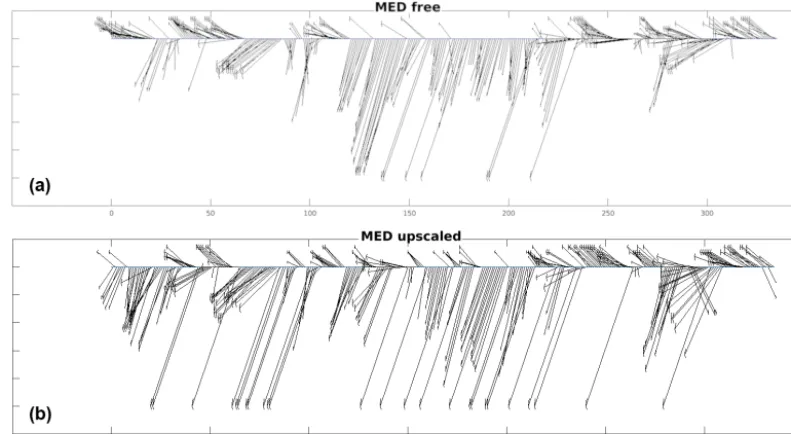
during February 2014. The upscaling method is clearly able to make the parent model ingest the different plume dynamic coming from the nested model. During another period (late August–early September), the opposite case occurs: the free model plume is oriented offshore, but the nested (and up-scaled) model predicts an along-shore plume. Apart from these two periods, differences between parent and child mod-els are smaller; therefore, the time average of rms difference between the parent model and the nested-model length is only reduced from 95.1 to 88.0 km (see Table 1).
Figure 8.Rhône River plume direction and length(a)for the free and(b)upscaled MED models. The horizontal scale represents the days after the start of the upscaling experiment (February 2014).
4.4 SST
The sea surface temperature metric allows quantifying the model error by comparison with satellite images. Level-3 im-ages are used for computing the metric. The rms difference between the different models and the L3 image is shown in Fig. 10 for the first 2 months of simulation. It appears that the rms difference is around 0.4–0.5◦C, even though no data assimilation is performed. Usually, the nested model is bet-ter still in some areas (e.g. coastal wabet-ters), and the upscaling procedure brings back these local improvements to the parent model (see Fig. 5 for an example). However, the area-wide rms error is not influenced very much by upscaling (see Ta-ble 1), as large areas are essentially unmodified (parent and child models use the same atmospheric forcing fields and the same bulk formulae).
Some days, some processes appear to be missed by the models (both parent and nested), so that the rms error is rel-atively large. In this case again, upscaling does not influence the rms error of the parent model very much, as the nested model does not represent these processes any better than the parent model.
In both cases, this does not imply that the upscaling method is flawed but rather that, in the current set-up, the nested model is not able to generate an rms error significantly lower than the parent model; hence upscaling does not have much to feed on. Figure 10 shows the rms error during the first 2 months of simulation. The situation worsens during summer when the computed rms errors are of 3◦C both for parent and child model; the difference in between models is hidden by the temporal variability of the error (not shown).
In any case, the upscaled model is still very close to both the (free) parent and the nested models.
4.5 WMDW
Figure 9.Comparison of the Rhône River plume on 12 February 2014:(a)satellite chlorophyll image,(b)free parent model salinity(c)and upscaled parent model salinity.
Deep temperature and salinity
Some metrics considered above used surface salinity and temperature. However, upscaling modifies the 3-D variables of temperature and salinity.
Differences between the parent and the nested-model tem-perature are locally important, e.g. at the bottom of the Gulf of Lion or in the Eastern Corsican Current and Northern Cur-rent cores (with differences of up to 0.3◦C). Similarly, the cores of both Corsican currents are saltier in the upscaled model, with differences of about 0.15 psu during the first as-similation cycle. For both temperature and salinity, upscaling is able to push the parent model toward the child model so-lution (not shown).
5 Conclusions
When a nested model is available, it usually benefits from higher resolution, and improved representation of some rel-evant processes. However, often, and particularly so in the operational oceanography context, there is no feedback from the nested model to the parent model. Data exchanges are limited to the parent model providing initial and/or boundary conditions to the nested model. Thus, the benefit of having a nested model is lost to the parent model.
un-Figure 10.SST rms error in the free model (black curve), nested model (red curve) and upscaled model (blue curve) during the first 2 months of simulation. The bars represent the proportion of unclouded points in the L3 satellite image.
Figure 11.Time series of total amount of WMDW in the area covered by the nested model: (blue) free parent model, (green) nested model in the free model, (red) parent model with upscaling and (magenta) nested model in the upscaled model.
derlying hypothesis is that the nested model is more realistic than the parent model.
The method was tried out using a nested-model configura-tion of the Mediterranean Sea and the north-western basin, with a resolution ratio of 5. Data assimilation was per-formed using a localized ensemble Kalman transform fil-ter; as pseudo-observations, thinned 3-D fields of
tempera-ture and salinity were used. The aim of this study is limited to verifying whether nesting feedback could be emulated by data assimilation, without trying to verify whether the nested model is indeed more realistic than the parent one.
Cur-rent, the cross-shelf transport, the position of the Rhône River plume, sea surface temperature and the quantity of Western Mediterranean Deep Water. These metrics show that the up-scaling method is indeed able to emulate two-way nesting and bring the parent model closer to the child model. Only for sea surface temperature does the rms not indicate an im-provement, probably because this variable is essentially de-termined by atmospheric fluxes which are mostly identical (in our experiment) in the parent and child model. Some lo-cal improvements to sea surface temperature were observed but are averaged out in the domain-wide rms error.
By assimilating only temperature and salinity, velocity and transport metrics were also improved in the parent model. The ability to constrain the cross-shelf transport byT /S as-similation is also an indication that the data from a high-resolution glider fleet would be beneficial to constrain the model. Finally, concerning the Rhône River plume, upscal-ing was able to strongly modify the plume direction when it was different in the parent and child models; the length of the plume was also modified. Qualitatively, when real chloro-phyll observations were available, the nested and upscaled parent model seemed to be more realistic than the free parent model.
Advantages of using upscaling include the following. Most importantly of course, the parent model takes advan-tage of improvements in the nested model. In the current study, these improvements may be due to higher resolution, better representation of local processes and the use of more realistic river discharges. In general, they may also have other causes, such as the assimilation of local and/or very high-resolution measurements (e.g. high-frequency radar observa-tions), atmospheric fields from a regional weather forecast-ing model or other more realistic boundary conditions. An-other advantage is that over time, discrepancies between par-ent and nested model are attenuated. The parpar-ent model then provides more consistent boundary conditions to the nested model, and artefacts such as wave reflexion at the boundary may be avoided.
In the operational context, an additional advantage may appear. If a user is interested in a particular area not en-tirely covered by a nested model, it may be difficult for him to merge two products (the large-scale model and the finer model not entirely covering the area of interest). By default, the user may then use only the coarser model. If the nested model is upscaled into the large-scale model, this is the only product the user needs to consider.
The most important limitation of the method is that the child model should be more realistic than the parent model. Furthermore, the coupling with upscaling is not as strong as with real two-way nesting. Other limitations are linked to data assimilation methods and are not different from the as-similation of real observations: (i) the data asas-similation pro-cedure itself uses approximations, and this could degrade the analysis; (ii) if the parent and child models are very differ-ent, the parent model might be unable to ingest the
pseudo-observations. These limitations are investigated in the lit-erature in the context of assimilation of real observations, and potential solutions include (i) anamorphosis techniques (when a non-linear relation exists between model variables and observations), particle filters (when the error distribution cannot be considered Gaussian), etc., and (ii) careful specifi-cation of the observation error covariance matrix (and more specifically the contribution of the representativity error) to filter out processes of the nested model that cannot be repre-sented in the parent model.
Data availability. The ensemble model simulations were run on an HPC platform and generated multiple terabytes of model outputs, which are very impractical. Partial extracts of the full dataset cannot be used to verify the conclusions and hence are also of little use. Therefore, no data were made available.
Author contributions. Both authors contributed to the model sim-ulations and upscaling experiments as well as the redaction of the article and figures.
Competing interests. The authors declare that they have no conflict of interest.
Special issue statement. This article is part of the special is-sue “The Copernicus Marine Environment Monitoring Ser-vice (CMEMS): scientific advances”. It is not associated with a con-ference.
Acknowledgements. This work was carried out as part of the Coper-nicus Marine Environment Monitoring Service (CMEMS) UP-SCALING project. CMEMS is implemented by Mercator Ocean in the framework of a delegation agreement with the European Union. Computational resources have been provided by the supercomput-ing facilities of the Consortium des Equipements de Calcul Intensif en Federation Wallonie-Bruxelles (CECI) funded by the Fond de la Recherche Scientifique de Belgique (FRS-FNRS).
References
Alberola, C., Millot, C., and Font, J.: On the seasonal and mesoscale variabilites of the Northern Current during the PRIMO-0 experi-ment in the western Mediterranean Sea, Oceanol. Acta, 18, 163– 192, 1995.
Alvarez, A., Lopez, C., Riera, M., Hernandez-Garcia, E., and Tin-tore, J.: Forecasting the SST space-time variability of the Albo-ran sea with genetic algorithms, Geophys. Res. Lett., 27, 2709– 2712, https://doi.org/10.1029/1999GL011226, 2000.
Auclair, F., Casitas, S., and Marsaleix, P.: Application of an inverse method to coastal modeling, J. Atmos Ocean. Tech., 17, 1368– 1391, 2000.
Auclair, F., Marsaleix, P., and Estournel, C.: The penetration of the Northern Current over the Gulf of Lions (Mediterranean) as a downscaling problem, Oceanol. Acta, 24, 529–544, 2001. Auclair, F., Marsaleix, P., and De Mey, P.: Space-time structure and
dynamics of the forecast error in a coastal circulation model of the Gulf of Lions, Dynam. Atmos. Oceans, 36, 309–346, 2003. Barth, A. and Vandenbulcke, L.: Ocean Assimilation Kit
documen-tation, Universite de Liege, GHER, available at: http://modb.oce. ulg.ac.be/mediawiki/index.php/OceanAssimilationKit (last ac-cess: 28 December 2018), 2017.
Barth, A., Alvera-Azcarate, A., Rixen, M., and Beckers, J.: Two-way nested model of mesoscale circulation features in the Lig-urian Sea, Progr. Oceanogr., 66, 171–189, 2005.
Barth, A., Alvera-Azcarate, A., Beckers, J.-M., Rixen, M., and Van-denbulcke, L.: Multigrid state vector for data assimilation in a two-way nested model of the Ligurian Sea, J. Mar. Syst., 65, 41– 59, https://doi.org/10.1016/j.jmarsys.2005.07.006, 2006. Barth, A., Alvera-Azcarate, A., and Weisberg, R. H.:
Assim-ilation of high-frequency radar currents in a nested model of the West Florida shelf, J. Geophys. Res., 113, C08033, https://doi.org/10.1029/2007JC004585, 2008.
Barth, A., Alvera-Azcarate, A., Beckers, J.-M., Staneva, J., Stanev, E., and Schulz-Stellenfleth, J.: Correcting surface winds by as-similating high-frequency radar surface currents in the German Bight, Ocean Dynam., 61, 599–610, 2011.
Bishop, C., Etherton, B., and Majumdar, S.: Adaptive sampling with the Ensemble Transform Kalman Filter part I: the theoretical as-pects, Mon. Weather Rev., 129, 420–436, 2001.
Bosse, A., Testor, P., Mortier, L., Prieur, L., Taillandier, V., d’Ortenzio, F., and Coppola, L.: Spreading of Levantine Inter-mediate Waters by submesoscale coherent vortices in the north-western Mediterranean Sea as observed with gliders, J. Geophys. Res.-Oceans, 120, 1599–1622, 2015.
Clementi, E., Pistoia, J., Fratianni, C., Delrosso, D., Grandi, A., Drudi, M., Coppini, G., Lecci, R., and Pinardi, N.: Med analyses at 1/16th, Mediterranean Sea Analysis and Forecast (CMEMS MED-Currents 2013–2017), Dataset, https://doi.org/10.25423/MEDSEA_ANALYSIS, 2017. Debreu, L., Vouland, C., and Blayo, E.: AGRIF: Adaptive grid
re-finement in Fortran, Comput. Geosci., 8, 8–13, 2008.
Debreu, L., Marchesiello, P., Penven, P., and Cambon, G.: Two-way nesting in split-explicit ocean models: Algorithms, implementation and validation, Ocean Model., 49-50, 1–21, https://doi.org/10.1016/j.ocemod.2012.03.003, 2012.
Dee, D. P., Uppala, S. M., Simmons, A. J., Berrisford, P., Poli, P., Kobayashi, S., Andrae, U., Balmaseda, M. A., Balsamo, G., Bauer, P., Bechtold, P., Beljaars, A. C. M., van de Berg, L.,
Bid-lot, J., Bormann, N., Delsol, C., Dragani, R., Fuentes, M., Geer, A. J., Haimberger, L., Healy, S. B., Hersbach, H., Hólm, E. V., Isaksen, L., Kållberg, P., Köhler, M., Matricardi, M., McNally, A. P., Monge-Sanz, B. M., Morcrette, J.-J., Park, B.-K., Peubey, C., de Rosnay, P., Tavolato, C., Thépaut, J.-N., and Vitart, F.: The ERA-Interim reanalysis: configuration and performance of the data assimilation system, Q. J. Roy. Meteorol. Soc., 137, 553– 597, https://doi.org/10.1002/qj.828, 2011.
Guinehut, S., Larnicol, G., and Le Traon, P.: Design of an ar-ray of profiling floats in the North Atlantic from model sim-ulations, J. Mar. Syst., 35, 1–9, https://doi.org/10.1016/S0924-7963(02)00042-8, 2002.
Guinehut, S., Le Traon, P., Larnicol, G., and Philipps, S.: Combin-ing ARGO and remote-sensCombin-ing data to estimate the ocean three-dimensional temperature fields – A first approach based on sim-ulated observations, J. Mar. Syst., 46, 85–98, 2004.
Hunt, B., Kostelich, E., and Szunyogh, I.: Efficient data assimilation for spatiotemporal chaos: A local ensemble transform Kalman filter, Physica D, 230, 112–126, 2007.
Le Traon, P.-Y., Antoine, D., Bentamy, A., Bonekamp, H., Breivik, L., Chapron, B., Corlett, G., Dibarboure, G., DiGiacomo, P., Donlon, C., Faugère, Y., Font, J., Girard-Ardhuin, F., Gohin, F., Johannessen, J., Kamachi, M., Lagerloef, G., Lambin, J., Larnicol, G., Le Borgne, P., Leuliette, E., Lindstrom, E., Mar-tin, M., Maturi, E., Miller, L., Mingsen, L., Morrow, R., Reul, N., Rio, M., Roquet, H., R., S., and Wilkin, J.: Use of satel-lite observations for operational oceanography: recent achieve-ments and future prospects, J. Operat. Oceanogr., 8, s12–s27, https://doi.org/10.1080/1755876X.2015.1022050, 2015. Madec, G.: NEMO ocean engine, Note du Pôle de
modélisa-tion, No. 27, Institut Pierre-Simon Laplace (IPSL), France, ISSN 1288-1619, 2008.
Mason, E., Molemaker, J., Shchepetkin, A. F., Colas, F., McWilliams, J. C., and Sangrà, P.: Procedures for offline grid nesting in regional ocean models, Ocean Model., 35, 1–15, https://doi.org/10.1016/j.ocemod.2010.05.007, 2010.
Millot, C.: Circulation in the Western Mediterranean Sea, J. Mar. Syst., 20, 423–442, 1999.
Nerger, L., Janjic, T., Schroter, J., and Hiller, W.: A regulated lo-calization scheme for ensemble-based Kalman filters, Q. J. Roy. Meteorol. Soc, 138, 802–812, 2012.
Onken, R., Robinson, A. R., Kantha, L., Lozano, C. J., Haley, P. J., and Carniel, S.: A rapid response now-cast/forecast system using multiply nested ocean models and distributed data systems, J. Mar. Syst., 56, 45–66, https://doi.org/10.1016/j.jmarsys.2004.09.010, 2005.
Pinardi, N., Zavatarelli, M., Adani, M., Coppini, G., Fratianni, C., Oddo, P., Simoncelli, S., Tonani, M., Lyubartsev, V., Dobricic, S., and Bonaduce, A.: Mediterranean Sea large-scale low-frequency ocean variability and water mass formation rates from 1987 to 2007: A retrospective analysis, Prog. Oceanogr., 132, 318– 332, https://doi.org/10.1016/j.pocean.2013.11.003, 2015. Schulz-Stellenfleth, J. and Stanev, E.: Analysis of the upscaling
problem – A case study for the barotropic dynamics in the North Sea and the German Bight, Ocean Model., 100, 109–124, 2016. Simoncelli, A., Fratianni, C., Pinardi, N., Grandi, A., Drudi,
https://doi.org/10.25423/medsea_reanalysis_phys_006_004, 2014.
Simoncelli, S., Pinardi, N., Oddo, P., Mariano, A., Montanari, G., Rinaldi, A., and Deserti, M.: Coastal Rapid Environmental As-sessment in the Northern Adriatic Sea, Dynam. Atmos. Oceans, 52, 250–283, https://doi.org/10.1016/j.dynatmoce.2011.04.004, 2011.
Simoncelli, S., Pinardi, N., Fratianni, C., Dubois, C., and No-tarstefano, G.: Water mass formation processes in the Mediter-ranean sea over the past 30 years, in: Copernicus Marine Ser-vice Ocean State Report, J. Operat. Oceanogr., 11, s13–s16, https://doi.org/10.1080/1755876X.2018.1489208, 2018. Somot, S., Houpert, L., Sevault, F., Testor, P., Bosse, A.,
Taupier-Letage, I., Bouin, M.-N., Waldman, R., Cassou, C., Sanchez-Gomez, E., Durrieu de Madron, X., Adloff, F., Nabat, P., and Herrmann, M.: Characterizing, modelling and understanding the climate variability of the deep water formation in the North-Western Mediterranean Sea, Clim. Dynam., 51, 1179–1210, https://doi.org/10.1007/s00382-016-3295-0, 2018.
Tippett, M. K., Anderson, J. L., Bishop, C. H., Hamill, T. M., and Whitaker, J. S.: Ensemble Square Root Filters, Mon. Weather Rev., 131, 1485–1490, 2003.
Vandenbulcke, L., Barth, A., Rixen, M., Alvera-Azcarate, A., Ben Bouallegue, Z., and Beckers, J. M.: Study of the com-bined effects of data assimilation and grid nesting in ocean mod-els – application to the Gulf of Lions, Ocean Sci., 2, 213–222, https://doi.org/10.5194/os-2-213-2006, 2006.
Vandenbulcke, L., Beckers, J., and Barth, A.: Correction of inertial oscillations by assimilation of HF radar data in a model of the Ligurian Sea, Ocean Dynam., 67, 117–135, 2017.