Characterization of Grain-Size
Distribution, Thermal Conductivity, and
Gas Diffusivity in Variably Saturated
Binary Sand Mixtures
T.K.K. Chamindu Deepagoda, Kathleen Smits,* J.R.R.N.
Jayarathne, Benjamin M. Wallen, and Timothy J. Clough
Characterization of differently textured porous materials, as well as different volumetric porous media mixtures, in relation to mass and heat transport is vital for many engineering and research applications. Functional relations describing physical (e.g., grain-size distribution, total porosity), thermal, and gas diffusion properties of porous media and mixtures are necessary to optimize the design of porous systems that involve heat and gas transport processes. However, only a limited number of studies provide characterization of soil physical, thermal, and gas diffusion properties and the functional relationships of these properties under varying soil water contents, especially for soil mixtures, complicating optimization efforts. To better understand how mixing controls the physical, thermal, and gas diffusion properties of porous media, a set of laboratory experiments was per-formed using five volumetric mixtures of coarse- and fine-grained sand particles. For each mixture, the grain-size distribution (GSD), thermal conductivity, and gas diffusivity were obtained and parameterized using existing and suggested parametric models. Results show that the extended, two-region Rosin–Rammler particle-size distribution model proposed in this study could successfully describe the bimodal behavior of the GSD of binary mixtures. Further, the modified Côté and Konrad thermal conductivity model adequately described the thermal con-ductivity–water saturation relations observed in different mixtures. The proposed simple soil-gas diffusivity descriptive model parameterized the upper limit, aver-age, and lower limit behavior in gas diffusivity–air content relations in apparently texture-invariant gas diffusivity data. Results further show a close analogy between gas diffusivity and thermal conductivity and their variation with saturation across different binary mixtures. Overall, the results of the study provide useful numeri-cal insight into the physinumeri-cal, thermal, and gas transport characteristics of binary mixtures, with wide implications for future engineering and research applications that involve multicomponent porous systems.
Abbreviations: C-K, Côté and Konrad; GSD, grain-size distribution.
Characterizing mass and energy transport processes
in variably saturated porous media is of great importance due to the wide application of these processes in natural and engineered porous systems. In particular, porous beds packed with pre-characterized materials enable controlled transfer of mass and energy through engineered systems, and therefore they are common in industrial and research-based applications. For example, sand-packed filters with known hydraulic properties are extensively used in traditional water and wastewater treatment plants for removal of particulate substances during the purification process. Similarly, biofilters fitted with packed-bed units are widely used for efficient removal of gaseous pollutants from industrial emissions (Delhoménie and Heitz, 2005). Also, porous media heat exchangers using differently characterized porous materials are common in process industries for heat (thermal energy) transfer with high efficiency (Delavar and Azimi, 2013). In addition, some engineering applications enable coupled flow through packed porous media, for example the gas and heat flow through gas heat exchanger Core Ideas• Parameterized models are relevant to applications where different porous media mixtures are used.
• Models include a grain-size distribu-tion funcdistribu-tion to describe bimodal behavior for binary mixtures.
• Improved model describes observed thermal conductivity–saturation relations for binary mixtures.
• Combined Buckingham–Penman model used to describe observed gas diffusivity–air content relations.
• This work is relevant for proper simulation of mixed porous media.
T.K.K. Chamindu Deepagoda, Dep. of Civil Engineering, Univ. of Peradeniya, 20400 Peradeniya, Sri Lanka; K. Smits, Dep. of Civil Engineering, Univ. of Texas, Arlington, TX 76019; J.R.R.N. Jayarathne, Dep. of Civil Engineering, Univ. of Peradeniya, 20400 Peradeniya, Sri Lanka; B.M. Wallen, Dep. of Geography and Environmental Enginee-ring, US Military Academy, West Point, NY 10996; T.K.K. Chamindu Deepagoda and T.J. Clough, Dep. of Soil and Physical Sciences, Lincoln Univ., P.O. Box 85084, Lincoln 7647, New Zealand. *Corresponding author ([email protected]).
Received 30 Jan. 2018. Accepted 23 May 2018.
Citation: Chamindu Deepagoda, T.K.K., K. Smits, J.R.R.N. Jayarathne, B.M. Wallen, and T.J. Clough. 2018. Characterization of grain-size distribution, thermal conductivity, and gas diffusivity in variably saturated binary sand mixtures. Vadose Zone J. 17:180026. doi:10.2136/vzj2018.01.0026
Original Research
© Soil Science Society of America.
This is an open access article distributed under the CC BY-NC-ND license
(http://creativecommons.org/licenses/by-nc-nd/4.0/).
units used in drying or cooling industries (Pavel and Mohamad, 2004). Porous media used in these engineering applications differ largely with respect to grain size and size distribution, other physical characteristics, as well as the transport properties of interest.
Apart from engineering applications, pre-characterized porous materials and their mixtures are also used in research stud-ies to investigate single- or multiphase fate and transport of mass and energy in porous media. Porous media with known character-istics are widely used in research for conceptual and mechanistic model development, testing of new apparatus and sensor tech-nology, validation of computer simulations, etc. Conceptual and numerical characterizations of transport in multicomponent porous media systems, including binary granular mixtures, have been presented in the literature in relation to electrical, hydrody-namic, and thermal properties (e.g., Lemaitre et al., 1988; Mota et al., 2001; Dias et al., 2004).
Despite their wide application to engineering and research studies, there are very few studies that present the detailed charac-teristic and functional relationships of pre-characterized materials, especially for soil mixtures. Most previous studies related to soil mixtures focus on soil hydraulic properties (e.g., soil water reten-tion and hydraulic conductivity) but provide little insight into soil thermal and diffusive properties. Although this may be appropri-ate for many applications, engineered systems and research studies focusing on heat and mass transport, like those described above, require detailed knowledge of additional soil characteristics to maximize optimization efforts.
Although much effort has been invested in the development of functional relationships for soil thermal conductivity–water content (e.g., de Vries, 1963; Johansen, 1975; Campbell, 1985; Tarnawski et al., 2013; Lu et al., 2007; Chen, 2008; Côté and Konrad, 2005; Lu and Dong, 2015) and gas diffusivity–air content (e.g., Buckingham, 1904; Penman, 1940; Millington and Quirk, 1961; Moldrup et al., 2000), none of the models specifically addresses the applicability to soil mixtures. Recently, Wallen et al. (2016) evaluated the applica-bility of different soil thermal conductivity–soil moisture models to soil mixtures. The models fit experimental data to varying degrees based on the number of parameters used, demonstrating the need for a modified thermal conductivity–water content model for soil mixtures. Pokhrel et al. (2011) studied the gas diffusivity–air con-tent relation in different soil–compost mixtures to be applied in gas-phase biofilters. They highlighted the limited applicability of widely used predictive models to accurately describe gas diffusivity in soil–compost mixtures.
To better understand how mixing controls soil thermal and diffusive properties, a set of laboratory experiments was performed in this study using binary mixtures of coarse- and fine-grained particles. We characterized and parameterized the GSD, thermal conductivity, and gas diffusivity in seven volumetric mixtures of two sand grades: a coarse-grained sand (no. 12/20) and a fine-grained sand (no. 110). The two sands were selected due to their extensive use across the world for a range of applications in research, such as soil model comparisons (Sakaki and Illangasekare, 2007;
Sweijen et al., 2017), gas kinetics studies (Taylor and Kwan, 2004), oil recovery enhancement investigations (Donaldson et al., 1985), infiltration studies (DiCarlo, 2004), nonaqueous-phase liquid plume migration studies (Abriola et al., 2013), and pore structure visualization studies (e.g., Hamamoto et al., 2016).
We note here that Sakaki and Smits (2015) previously stud-ied the water retention characteristics of the same sand mixtures, while this study extends the analysis also to soil physical, ther-mal, and gas diffusion characteristics. Thus, this study, combined with that of Sakaki and Smits (2015), provides a complete set of soil properties and functional relationships that will be useful for future engineering and research applications where similar sand grades and mixtures are used.
6
Materials and Methods
Sand Materials
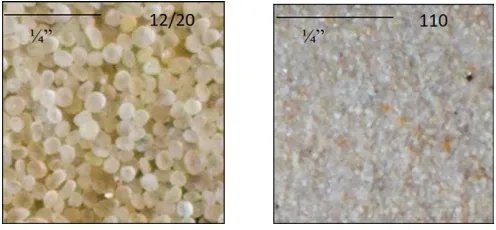
In this study, we used two uniform specialty silica sand grades: no. 12/20 (identified by the effective sieve number) (Accusand, Unimin Corporation), and no. 110 (Ottawa sand, US Silica Co.). Figure 1 shows the textural contrast of the two sand types.
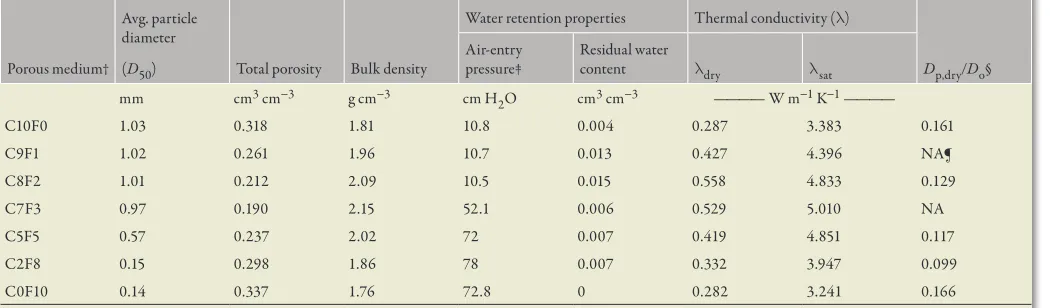
These well-processed sands were selected due to their high batch-to-batch consistency, wide commercial availability, and widespread use in engineering and research-based applications. The sand mineralogy is characterized as 99.8% quartz, which yielded a grain density of 2.66 g cm−3. The chemical composi-tion of the sands was detailed by Schroth et al. (1996). The high sphericity (e.g., 0.9 for no. 12/20 sand; Schroth et al., 1996) of sand grains, and thus the consistency of samples in replicate packing, is another important property that makes the sands a suitable porous medium for a wide range of research applications. The sands also have high uniformity coefficients (1.7 and 1.2 for no. 12/20 and 110, respectively), allowing consistently reproduc-ible results. Due to high purity (with a negligibly small amount of organic matter), the sands require no additional treatments prior to use in experiments. The basic properties of the two sands and the five gravimetric mixtures used in this study are shown in Table 1.
Methods
In addition to the two component sands, mass-weighted frac-tions of each component were uniformly mixed to produce, in total,
seven different coarse-to-fine (C/F) mixtures: 10:0, 9:1, 8:2, 7:3, 5:5, 2:8, and 0:10. The mixtures are referred to as C10F0, C9F1, C8F2, C7F3, C5F5, C2F8, and C0F10, respectively, following the nomenclature of Wallen et al. (2016) and Sakaki and Smits (2015). Grain-size distributions of the seven mixtures were obtained fol-lowing sieve analysis (data from Wallen et al., 2016).
Thermal conductivity measurements performed by Smits et al. (2010, 2012) were used for the numerical characterizations. The measurements were performed in a small cell apparatus (9 cm in height and 8.8 cm o.d.) in which capillary pressure was regulated by a hydraulically connected 200-cm-high hanging water reservoir. Measurements for soil moisture (ECH2O EC-5, Decagon Devices), thermal conductivity (SH-1, Decagon Devices), and capillary pres-sure (porous cup tensiometer, Soilmoisture Equipment Corp.) were performed using corresponding sensors at different moisture statuses. The initially wet-packed cell was subjected to stepwise draining to the intended bulk density (see Table 1), followed by successive draining to specific matric suctions by regulating the water level of the reservoir. Smits et al. (2012) provided a detailed description of the experimental procedure and sensor specifications, together with a schematic presentation of the experimental setup.
Gas diffusivity (Dp/Do) measurements (where Dp and Do are gas diffusion coefficients in soil and free air, respectively) were conducted for the selected mixtures of this study. For Dp/Do measurements, we used the one-chamber diffusion cell apparatus introduced by Taylor (1950) and modified further by Schjønning (1985). The diffusion chamber was constructed out of a 10-mm-thick polyvinyl chloride tube (3.14-cm i.d. and 10-cm height), embedded and glued into a 10-mm-thick plastic bottom plate. To facilitate sample positioning and to ensure an airtight joint, a 5-cm-diameter rubber O-ring was embedded into an engraved slot at the top edge of the tube. An oxygen sensor (KE-25, Figaro Inc.) was outfitted at the mid-height of the cell wall for O2 measure-ments. Two valves were placed at the top and bottom of the cell to facilitate N2 flushing. Before initiating a series of measurements, a
preliminary diffusion test was conducted to confirm the airtight-ness of the chamber.
Annular metal sampling cores (6.06 cm in diameter and 3.48 cm in height; ?100 cm3 in volume) were uniformly packed in triplicate to the intended bulk densities (Table 1). Saturated samples were exposed to controlled evaporation, and diffusivity measurements were conducted at different moisture conditions after evaporation. After each measurement, the samples were kept closed for several hours to allow water redistribution before the next measurement.
The chamber was first flushed with N2 to create an O2–free chamber. Then the sample was mounted on the top of the cham-ber and exposed to the atmosphere, thus permitting O2 to diffuse from the atmosphere into the chamber through the sample. The increasing O2 concentration inside the chamber was recorded using a datalogger (National Instruments Corp.) and monitored via a LabVIEW interface (National Instruments Corp.). For the calculations of the diffusion coefficient, we used the Currie (1960) method as outlined by Rolston and Moldrup (2002).
During sampling preparations and packing for both thermal conductivity and gas diffusivity measurements, we followed an identical procedure for all mixing proportions. We did not spe-cifically control porosity or density and allowed the porosity and density to change with each mixing proportion to investigate the effect of binary mixing on porosity and density and, in turn, also on gas diffusivity and thermal conductivity. Because gas diffusivity, in particular, is more a porosity-controlled parameter than a tex-ture-controlled parameter (Moldrup et al., 2000), we hypothesized that the ensuing effects of mixing on the total porosity would be reflected in the results.
6
Numerical Modeling
Grain-Size Distribution
For GSD modeling, the classical Rosin–Rammler distribu-tion funcdistribu-tion (Rosin and Rammler, 1933), originally developed
Table 1. Physical properties of the binary mixtures used in this study.
Porous medium†
Avg. particle diameter
(D50) Total porosity Bulk density
Water retention properties Thermal conductivity (l)
Dp,dry/Do§ Air-entry
pressure‡ Residual water content ldry lsat mm cm3 cm−3 g cm−3 cm H
2O cm3 cm−3 ———— W m−1 K−1 ————
C10F0 1.03 0.318 1.81 10.8 0.004 0.287 3.383 0.161
C9F1 1.02 0.261 1.96 10.7 0.013 0.427 4.396 NA¶
C8F2 1.01 0.212 2.09 10.5 0.015 0.558 4.833 0.129
C7F3 0.97 0.190 2.15 52.1 0.006 0.529 5.010 NA
C5F5 0.57 0.237 2.02 72 0.007 0.419 4.851 0.117
C2F8 0.15 0.298 1.86 78 0.007 0.332 3.947 0.099
C0F10 0.14 0.337 1.76 72.8 0 0.282 3.241 0.166
† Mixtures are named as the ratio of coarse (C) to fine (F) grain size. ‡ 10 cm H2O » 1 kPa.
for unimodal type grain-size distributions, is invoked. The func-tion essentially parameterizes the percentage passing (by weight) of particles, P (%), expressed as a function of grain size, x (mm), using two fitting coefficients:
( ) 100 1 exp x
P x b ì é ùü ï æ ö ï ï ï ï ê ç ÷ úï
= íï - ê-ççè øa÷÷ úýï
ï êë úûï
ï ï
î þ
[1]
where a (mm) and b (dimensionless) are model fitting coefficients representing the characteristic size and the spread of the grain-size distribution, respectively. Note that the characteristic size (a) cor-responds to the 63rd percentile of the distribution (i.e., P = 63% when x = a).
To numerically describe the bimodal type grain-size distri-butions, as observed for different binary mixtures, we extended Eq. [1] to a two-region grain size distribution function, with an implicit hypothesis that the unimodal grain-size distribution func-tions of the two sands are algebraically additive:
( ) ( ) f c f c 100 1 exp
1 1 exp
x P X x b b æ ìï é æ ö ùüï ç ï ê ÷ úï ç ï ç ÷ ï ç
= ççw -ïïí êê-çççèa ÷÷ø úúýïï
çè ïî ë ûïþ ö ì é ùü ï æ ö ï÷ ï ê ÷ úï÷ ï ç ÷ ï÷
+ -w íîïïï - êëê-çèçaç ÷ø÷ úûúïþïï÷øý÷÷÷
[2]
wherein af (mm) and ac (mm) are characteristic sizes (63rd per-centile values) representing the fine and coarse size distributions, respectively; and bf (dimensionless) and bc (dimensionless) are cor-responding coefficients representing the spread of the distributions. The weighted mass fraction of the fine sand, w (dimensionless), is also used as a fitting coefficient together with above parameters.
Differentiating Eq. [1] and [2] yields grain size density func-tions, p(x) (=¶[P(x)]/¶x), representing unimodal (Eq. [3]) and bimodal (Eq. [4]) conditions:
( )
100exp x x 1 p xb-b
é æ ö ùæ ö æ öb ÷ ê ç ÷ úç ç ÷
= êëê-è øçça÷÷ úúûè øç ÷çb÷÷ çè øça÷÷ [3]
( ) ( ) f f c c 1 f
f f f
1 c
c c c
100 exp
1 exp
x x
p x
x x
b b
-b b
-ì é ù
ï æ ö æ ö æ ö
ï ê ÷ ú ÷ b ÷
ï ç ÷ ç ÷ ç ÷
= íïïw êê-çççèa ø è÷÷ úúççça ÷÷ø èççça ø÷÷
ë û
ïî
ü
é æ ö æù ö æb öïï
ê ç ÷÷ úç ÷÷ ç ÷ï÷
+ -w êê-çèçça ÷ø è÷ úúççça ø÷÷ ççèça ÷ïø÷ý ï
ë û ïþ
[4]
When only one sand type (fine-grained or coarse-grained) is present in the mixture (i.e., w = 1 or 0), Eq. [4] reduces to Eq. [3].
Note also that p(x), being a density function, yields unity when it is integrated over the entire space:
( )
0 p x 1 ¥
=
ò
[5]The locations of the peaks can also be derived from the second derivative of p(x), leading to
(
)
f f 2 2 f 2
f f
f f f f
1 expé x b ù é 1 x b - x b - ù 0
æ ö÷ ê æ ö÷ ú ê æ ö÷ æ ö÷ ú
ç ÷ -ç ÷ b - ç ÷ -b ç ÷ =
ç ÷ ê ç ÷ ú ê ç ÷ ç ÷ ú
ç ÷ ç ÷ ç ÷ ç ÷
ça ça ça ça
è ø êë è ø ú êû ë è ø è ø úû
(
)
f 2 f
f f
f f
1 0
x b - é x b ù
æ ö÷ ê æ ö÷ ú
ç ÷ b - -b ç ÷ =
ç ÷ ê ç ÷ ú
ç ÷ ç ÷
ça ça
è ø êë è ø úû f f f f 1 x b æ ö÷ ç ÷
b çç ÷÷ = b -ça
è ø [6]
f
1/ f
f f
1 x éêb - ùú b
= ê ú
a ë b û
yielding
f
1/
f f f
f 1 1 1 x b é ù ê ú
=a ê - ú b ³
b
ë û [7]
where xf (mm) corresponds to the median size of the finer fraction (hence the peak in the density function). Note that xf/af (i.e., the measure of grain size uniformity between the 50th and 63rd per-centile grain-size distribution) is a highly nonlinear function of bf, with xf/af = 0 when bf = 1 and xf/af = 1 as bf reaches infinity. The larger bf yields a more uniform distribution. A similar function can be written for the distribution of the coarse size fraction as well. Figure 2 demonstrates the locations of the two peaks in a typical grain-size density distribution as derived by Eq. [7].
Thermal Conductivity
The literature is abundant with a wide range of models that provide the soil thermal conductivity (l, W m−1 K−1)–water satu-ration (S = q/F; where q is water content [cm3 cm−3] and F [cm3 cm−3] is porosity) relationships (e.g., de Vries, 1963; Johansen, 1975; Campbell et al., 1994; Côté and Konrad, 2005; Chen, 2008; Haigh, 2012, Lu and Dong, 2015). In a recent study, Chamindu Deepagoda et al. (2016) revisited the Côté and Konrad (2005) model (C-K) to explain different thermal regimes identified in uniform sand grades. They expanded the original C-K model to a multiparameter multiregion function, with each parameter characterizing the distinct regions (defined below) observed in the characteristic l–S curve. The original C-K model takes the form
( )
Ke(
sat dry)
Ke dryl = l -l +l
( )
( )
e 1 kS 1 0 1
K S S
k S
= £ £
+ - [8]
respectively; Ke is the so-called Kersten number, and k is a fitting parameter considered as descriptive of the grain-size distribution, pore size, and pore water content (Côté and Konrad, 2005). The values for ldry and lsat are either measured or inversely estimated using the model. In this study, we measured both ldry and lsat (see Table 1) values and used them as model-constraining parameters in l–S relations.
The modified Kersten number from Chamindu Deepagoda et al. (2016) can be written as
(
e,)
(
(
f dry)
)
e, 0 fsat f e, f 0 f
0 and 1
dry
i i
i
K S S S S
K ìï l -lïï K +l S£ £S S £ £
l =í l -l
+l £ £
ïï ïî
[9]
where Ke,i (i = 0,1,2) represent the Kersten numbers assigned to three saturation regions, 0 £S£S0 (i = 0), 0 £S£Sf (i = 1), and Sf£S£ 1 (i = 2), wherein thermal conductivity behav-ior varies markedly. The parameters were defined in such a way that lf (W m−1 K−1) denotes the thermal conductivity corre-sponding to Sf, the saturation that marks the termination of the sharp increase in thermal conductivity that started from saturation S0. The two saturation points characterizing the transition, Sf and S0, are difficult to estimate experimentally. In this study, the two parameters were estimated inversely by parameter optimization.
The region-dependent Kersten number, Ke,i, for each satura-tion region was defined as
Region 0 (constant region)
e,0 0 0 0
K = £ £S S [10]
Region 1 (linear region)
0
e,1 0 f
f 0
S S
K S S S
S S
-= £ £
- [11]
Region 2 (nonlinear region)
( )
(
)
(
f)
e,2 f
f
1
1 1 1
k S S
K S S S
k S S
-= £ £
é ù
- -ë - û [12]
Equation [12] reduces to the original Côté and Konrad (2005) model (Eq. [8]) when Sf = 0 (i.e., when region-based characteriza-tion is ignored).
Gas Diffusivity
A wide range of gas diffusivity (Dp/Do) models are available for characterizing gas diffusion in soils and porous media, which have been developed following theoretical (e.g., Millington, 1959; Millington and Quirk, 1960, 1961), empirical (e.g., Buckingham, 1904; Penman, 1940), semi-conceptual (e.g., Moldrup et al., 2000), and conceptual (e.g., Troeh et al., 1982) modeling approaches. Among those, two pioneering gas diffusivity models are the Buckingham (1904) model:
p 2
o
D
D = e [13]
and the Penman (1940) model:
p
o 0.66
D
D = e [14]
where e (cm3 cm−3) is the air-filled porosity. The exponent (= 2) in Eq. [13] and the scaling factor (= 0.66) in Eq. [14] are empirical coefficients. Conceptually, the Penman model violates the fun-damental requirement that Dp/Do should be essentially 1 when e
= 1 (i.e., in a soilless medium), while the Buckingham model has no provision to describe diffusivity in a fractured porous system where the diffusivity increases linearly with air-filled porosity. Considering these drawbacks of the two models, a generalized equation can be written in the form of a combined Buckingham– Penman model:
Fig. 2. Illustration of the grain-size density func-tion (Eq. [3] and [4]) and locafunc-tions of the peaks for fine-textured and coarse-textured sand grades; xf and xc correspond to the median size of the fine and coarse fractions, respectively; af
s o
B
D A
D = e [15]
where A and B are model parameters characterizing the functional air phase of the porous domain. In fact, a close look at widely used Dp/Do models reveals that they could be rearranged in the form of Eq. [15] when appropriate values or properties are assigned to the parameters A and B, as demonstrated in Table 2. The table also includes the theoretical upper limit model with the parameter pair (A = 1 and B = 1) showing the least resistance (i.e., the minimum tortuosity and the maximum connectivity) to diffusive gas trans-port through a porous system.
6
Results and Discussion
Grain-Size Distribution
The observed and simulated (Eq. [2]) GSDs for the seven mix-tures of two sand grades are illustrated in Fig. 3.
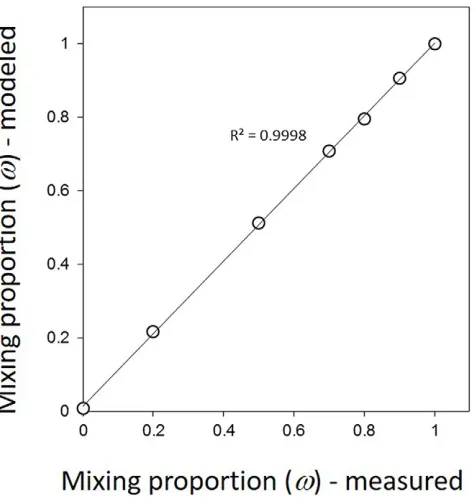
The observed data show the clear bimodal variation in the GSD. In model parameterization, we optimized four parameters based on the least squares method. A very good agreement between the observed data and the extended bimodal Rosin–Rammler GSD can be observed, suggesting the applicability of this new modeling approach. There is excellent agreement (R2 = 0.999) between the measured and model-optimized volumetric fraction (w) as illustrated in Fig. 4. Note that no constraints were applied during the optimization process.
This strong agreement, in turn, successfully tests our hypoth-esis that the two GSD functions are algebraically additive when representing a uniform mixture of two size distributions. It is important to note that the very good agreement between the observed and simulated results in Fig. 4 does not necessarily imply that the two unimodal functions are additive in nature, since the
fitting approach followed here is purely mathematically based, with no physically related constraints. The strong agreement of mea-sured and simulated w values, however, suggests that the model has yielded physically interpretable results. This is supported by the agreement of the a and b values for both size fractions in all mix-tures (see Table 3). The extended function, Eq. [2], can therefore be used to simulate the particle-size distribution of any mixture with a known w value, together with the average parameters for a
and b values as in Table 2. The function can also be conveniently extended to multimodal distributions, for instance for the uniform mixtures of three or four different grain sizes, as required for a particular research or engineering application.
Figures 5a through 5g show the grain-size density distribution (Eq. [3] and [4]) for the seven sand mixtures. Note the decreasing density (i.e., the peak height) of the coarser grain fraction as that of the finer grain-size density increases, while the grain size (related to a) and the spread (related to b) remain more or less the same for the two size fractions.
Thermal Conductivity
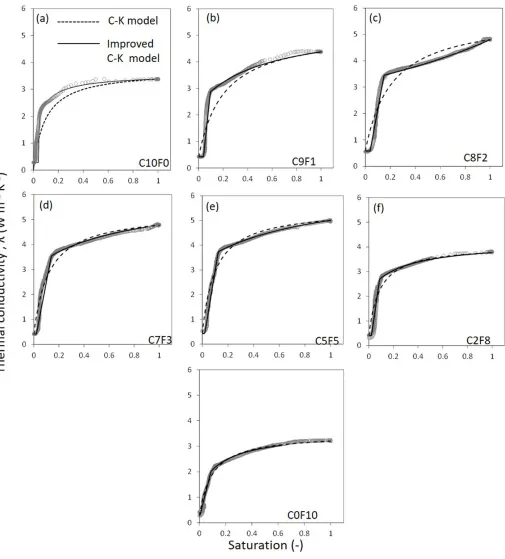
The change in thermal conductivity (l) across saturation (S) is shown in Fig. 6 for the seven sand grades. Simulations are shown using two l–S models, Côté and Konrad (Eq. [8], dotted line) and the improved Côté and Konrad model (Eq. [9–12], solid line) together with the measured data (open circles). Clearly, the improved C-K model numerically represented the overall l–S behavior better than the original C-K model, as the latter tended to mischaracterize the transition between Regions 1 and 2 in the
l–S curve. We note that the sharp changes in the characteristic
l–S curve arise from the uniformity of the particles and distinct size fractions, which impacts the development of bridges facili-tating heat transfer with increasing water content at a specific saturation. In natural field soils, due to the presence of a wide spectrum of differently sized and shaped particles, the changes occur gradually across a range of saturations, not at a sharp point. Consequently, natural soils may tend to follow the original C-K model, while the extended model is still applicable with suitably selected parameters.
Figure 7 (left) shows the variation of three l values, ldry
(measured under completely dry conditions), lsat (measured under completely water-saturated conditions), and lf (represent-ing the partially saturated condition wherein the formation of water bridges, causing a rapid increase in heat transfer, is nearly complete). The variation of total porosity (F) with volumetric frac-tion (w) is also shown (in the secondary y axis) for comparison. All l values peaked nearly around 30% of fine fractions, exactly
at the point where F exhibited the minimum, across saturation conditions, thus corroborating previous observations (e.g., Sakaki and Smits, 2015; Wallen et al., 2016). This implies the important inverse relationship between the thermal conductivity and total porosity. As the pore space, occupied by less thermally conduc-tive air (»0.024 W m−1 K−1) and/or water (»0.580 W m−1 K−1), is replaced by high-conductivity quartz (»7.5 W m−1 K−1), the
Table 2. Gas diffusivity models analogous to the proposed model (Eq. [15]) and corresponding model parameters.
Model Equation†
Dp/Do = AeB
A B
Theoretical upper limit model (all pores aligned in the direction
of flow)
Dp/Do = e 1 1
Buckingham (1904) Dp/Do = e2 1 2.0 Penman (1940) Dp/Do = 0.66e 0.66 1.0 Millington (1959) Dp/Do = e4/3 1 1.33 Marshall (1959) Dp/Do = e3/2 1 1.5 Millington and Quirk (1960) Dp/Do = e2/F2/3 F−2/3 2.0
Millington and Quirk (1961) Dp/Do = e10/3/F2 F−2 3.33 Moldrup et al. (2000) (WLR–
Marshall) Dp/Do = e
3/2(e/F) F−1 2.5
Hamamoto et al. (2009) Dp/Do = eX(e/F)N F−N X + N Chamindu Deepagoda et al. (2011)Dp/Do = 0.5F(e/F)b 0.5F−(b−1) b
thermal conductivity increases while the porosity decreases. From this evaluation, it is also evident that under the various satura-tion condisatura-tions, the solid content and the associated grain–grain contacts are the main drivers of the thermal conductivity in a homogenous porous medium. However, it should be noted that the two components and grades (no. 12/20 and 110), although markedly different in size, have similar intrinsic thermal conduc-tivities. Therefore, the grain-to-grain contacts between similar sand grades and dissimilar ones behave almost identically with respect to heat transport. Although not supported by the pres-ent results, the effect of volumetric proportion could have been seen if the two sand grades in the mixture had different thermal
conductivity characteristics. Figure 7 (right) portrays the variation of numerically derived (inversely estimated) parameters, S0 and Sf, as a function of volumetric fraction. As a reference, the variation in total porosity is also shown. No clear trend could be seen in the variation of S0 vs. w, however Sf, although not very pronounced, tended to follow a similar variation as observed for lf in Fig. 7 (left). Strictly speaking, S0 and Sf are microscopically related prop-erties and hence may not be able to be accurately derived from the numerical results associated with macroscopic measurements. We believe that microscopic observations (for example using micro-sensor technology) of the porous systems with changing saturation dynamics will provide closer and better insight to understand the
critical changes in thermal behavior in the vicinity of S0 and Sf. Nevertheless, the improved model (Eq. [8–12]) and the proposed parameters in Table 3 can be conveniently used when predictions are made for the desired mixtures.
Gas Diffusivity
The measured gas diffusivity data across different moisture (saturation) levels are available for limited binary mixtures as illustrated in Fig. 8. The data are shown as average values and the standard deviations (n = 3) by the error bars. Note that the gas dif-fusivity data are scattered in the wet region (e < 0.5 cm3 cm−3) due to the presence of high water-induced effects. This intrinsic scatter (due to the random breakdown and formation of capillary bridges
across grains) makes it difficult to distinguish any texture-induced effects in gas diffusivity in the wet region. Close observations, however, show that diffusivity for low-porosity binary mixtures (C8F2 and C5F5) is higher than that for high-porosity mixtures (C0F10, C2F8, and C10F0). This corroborates with observations in past studies, for example, by Chamindu Deepagoda et al. (2010), who revealed that, at a given air-filled porosity (e), high-density soils yielded higher diffusivity than low-density soils due the pro-nounced water-induced effect on gas diffusivity in low-density soils, irrespective of the soil texture. In general, the effects of soil texture or the different mixing proportions in the binary mixture on Dp/Do were not particularly apparent in the measured data, as also highlighted in the literature (e.g., Chamindu Deepagoda et al., 2016). In fact, other controlling parameters (e.g., soil density, the presence of macropores) may mask the texture-induced changes in a characteristic Dp/Do vs. e relation (Masís-Meléndez et al., 2015). In numerical characterization, therefore, we considered the overall diffusivity data together with the combined Buckingham–Penman modeling approach (Eq. [15]). The original Penman (1940) model with A = 0.66 and B = 1 provided an upper limit estimate (a safe limit with respect to risk-based analysis) mostly for the wet soils (e £ 0.5 cm3 cm−3), while a model with A = 1.66 and B = 2 provided an average estimate for the dry soils (e > 0.5 cm3 cm−3). Similarly, a useful lower limit descriptive model can be obtained by assigning A = 3.5 and B = 3.
Analogy between Thermal Conductivity
and Gas Diffusivity
By combining these observations on heat and gas transport, Fig. 9 shows in a two-dimensional color contour map the variation of thermal conductivity (in contours) and gas diffusivity (in solid lines) across saturation under varying volume fractions in binary mixtures. The black and white lines represent simulated gas diffusivity (Eq. [15]) contours using the average (A = 1.66 and B = 2) and lower limit (A = 3.5 and B = 3) models (Fig. 7), respectively. It is evident that the
Fig. 4. Measured and model-simulated (Eq. [2]) volumetric mixing proportions (w).
Table 3. Numerical characterization or parameterization of the binary mixtures based on grain-size distribution, thermal conductivity, and gas dif-fusivity.
Porous
medium† Bimodal grain-size distribution (Eq. [2])
Thermal conductivity
(improved Côté–Konrad model parameters, Eq. [9] and [11–12]) Region 1 Region 2
ac bc af bf w So Sf lf k
mm mm W m−1 K−1
C10F0 1.09 10.0 – – 1.00 0.009 0.060 2.32 17.0
C9F1 1.09 9.95 0.139 4.15 0.906 0.039 0.095 2.87 3.16 C8F2 1.08 10.0 0.155 3.91 0.794 0.038 0.150 3.45 0.85 C7F3 1.09 9.79 0.149 4.52 0.709 0.020 0.125 3.74 2.42 C5F5 1.09 9.59 0.149 4.54 0.512 0.002 0.140 3.55 2.80 C2F8 1.08 8.54 0.149 4.52 0.218 0.021 0.088 2.69 1.86
C0F10 – – 0.150 4.41 0.009 0.004 0.088 2.02 6.69
responses of thermal conductivity and gas diffusivity to the volumetric fraction of sand mixtures follow similar patterns, demonstrating a strong analogy between the gas diffusivity and thermal conductivity in binary mixtures across saturation conditions. Both contour patterns show a minimum at a volumetric fraction of 0.3, where the total porosity is minimum, implying strong porosity-dependence of the two transport properties. However, the steep gradients in thermal conductivity contours reveal strong dependence of thermal conductivity on the solid fraction compared with the mild gradients of contours in gas diffusivity, which is more an air-filled porosity dependent parameter. At very small saturations (S < 0.05), both thermal conductivity and gas diffusivity are less solid-fraction-dependent, although the gas diffusivity contours
do not truly reflect it due to the difficulty in numerically characterizing gas diffusivity at very low saturation (see Fig. 8). Importantly, the figure can be used as a tool to determine the required volume fraction and saturation to obtain an expected thermal conductivity and gas diffusivity in an engineering or research application (e.g., in a customized gas-thermal heat exchanger) where the two sand grades are used.
Overall, this study provided insightful experimental and numerical observations on physical, thermal, and gas diffusion properties in the selected seven volumetric mixtures of the two differently textured sand grades. We presented detailed numerical characterization when observed data showed distinct texture-induced effects (e.g., GSD and thermal conductivity), while a general approach was followed when texture-induced effects were
not dominant within the high-variability data (e.g., gas diffusivity). Although the models presented here are essentially descriptive in nature and involve a number of fitting parameters, the parametric functions can be applied to other differently textured sand grains and also for (extended) multicomponent mixtures with only lim-ited measurements.
6
Conclusions
This study investigated the GSD, thermal conductivity, and gas diffusivity of seven volumetric mixtures of two differently textured silica sand grades. We extended the classical paramet-ric Rosin and Rammler (1933) GSD function to characterize the bimodal (two-region) behavior in size distribution for binary
mixtures. The extended GSD function accurately described the measured bimodal size distribution with highly consistent parameters and thus showed the applicability of the concept for multimodal GSDs as well. Under a given saturation, the measured
thermal conductivity peaked when the porosity of the binary mix-ture was minimum, thus emphasizing the role of grain-to-grain contacts in porous media heat transfer. We used the Côté and Konrad (2005) thermal conductivity model, and also the recently introduced and improved C-K model (Chamindu Deepagoda et al., 2016), to adequately describe the distinct three-region char-acteristics in observed thermal conductivity–saturation relations
Fig. 7. Variation of three measured and simulated thermal conductivity (l) values—fully water saturated (lsat), completely dry (ldry) (Table 1), and at the saturation that marks the termination of the sharp increase in thermal conductivity (lf) (Eq. [9])—as a function of volumetric proportion (w), and the variation in total porosity (F) as a function of w (the secondary y axis) (left); and two simulated parameters, S0 and Sf (Eq. [9–11]), as a function of w and of total porosity (F) (the secondary y axis) (right).
Fig. 8. Gas diffusivity (Dp/Do) as a function of air-filled porosity (e) for the five differently textured sand types named as the ratio of coarse (C) to fine (F) grain size. The combined Buckingham–Pen-man model (Eq. [15]) descriptions are also shown for (i) upper limit (dotted line), (ii) average (solid line), and (iii) lower limit (dashed– dotted line) scenarios.
for binary mixtures. Measured gas diffusivity data did not exhibit distinct effects of mixing differently textured sand grades; how-ever, other induced effects (e.g., density-induced macropores) were apparent. To describe the observed gas diffusivity–air con-tent relations, we used a combined Buckingham–Penman model and presented upper limit, average, and lower limit gas diffusivity across the entire water content. The study thus provides useful parameterized models that can potentially be used in various engi-neering and research-based applications where heat and gas transfer in different porous medium mixtures are used.
Acknowledgments
This research was funded in part by the Department of Energy’s National Energy Technology Laboratory (NETL), the Research Partnership to Secure Energy for America project (no. RFP2012UN001) and the National Science Foundation Project Award no. 1447533. The research grant from the University of Peradeniya, Sri Lanka (URG/2016/33/E), is also acknowledged. Any opinion, findings, and conclusions or recommendations expressed herein are those of the authors and do not necessarily reflect the views of those providing technical input or financial sup-port. The trade names mentioned herein are merely for identification purposes and do not constitute endorsement by any party involved in this study.
References
Abriola, L.M., E.L. Miller, K.D. Pennell, C.A. Ramsburg, and J.A. Christ. 2013. Metric identification and protocol development for characterizing DNAPL source zone architecture and associated plume response. Project ER-1612 final report. US Dep. of Defense Strategic Environ. Res. and Dev. Program, Alexandria, VA.
Buckingham, E. 1904. Contributions to our knowledge of the aeration of soils. Bur. Soil Bull. 25. US Gov. Print. Office, Washington, DC. Campbell, G.S. 1985. Soil physics with BASIC: Transport models for soil–
plant systems. Elsevier, New York.
Campbell, G.S., J.D. Jungbauer, W.R. Bidlake, and R.D. Hungerford. 1994. Predicting the effect of temperature on soil thermal conductivity. Soil Sci. 158:307–313. doi:10.1097/00010694-199411000-00001
Chamindu Deepagoda, T.K.K., P. Moldrup, P. Schjønning, L.W. de Jonge, K. Kawamoto, and T. Komatsu. 2010. Density-corrected models for gas diffusivity and air permeability in unsaturated soil. Vadose Zone J. 10:226–238. doi:10.2136/vzj2009.0137
Chamindu Deepagoda, T.K.K., P. Moldrup, P. Schjønning, K. Kawamoto, T. Komatsu, and L.W. de Jonge. 2011. Generalized density-corrected model for gas diffusivity in variably saturated soils. Soil Sci. Soc. Am. J. 75:1315–1329. doi:10.2136/sssaj2010.0405
Chamindu Deepagoda, T.K.K., K.M. Smits, J. Ramirez, and P. Moldrup. 2016. Characterization of thermal, hydraulic, and gas diffusion properties in variably saturated sand grades. Vadose Zone J. 15(4). doi:10.2136/vzj2015.07.0097
Chen, S.X. 2008. Thermal conductivity of sands. Heat Mass Transf. 44:1241– 1246. doi:10.1007/s00231-007-0357-1
Côté, J., and J.M. Konrad. 2005. A generalized thermal conductivity model for soils and construction materials. Can. Geotech. J. 42:443–458. doi:10.1139/t04-106
Currie, J.A. 1960. Gaseous diffusion in porous media: 1. A non-steady state method. Br. J. Appl. Phys. 11:314–317. doi:10.1088/0508-3443/11/8/302 Delavar, M.A., and M. Azimi. 2013. Using porous material for heat transfer
enhancement in heat exchangers: Review. J. Eng. Sci. Technol. Rev. 6(1):14–16.
Delhoménie, M.C., and M. Heitz. 2005. Biofiltration of air: A review. Crit. Rev. Biotechnol. 25:53–72. doi:10.1080/07388550590935814 de Vries, D.A. 1963. Thermal properties of soils. In: W.R. van Wijk, editor,
Physics of plant environment. North-Holland, Amsterdam. p. 210–235. Dias, R.P., J.A. Teixeira, M.G. Mota, and A.I. Yelshin. 2004. Particulate binary mixtures: Dependence of packing porosity on particle size ratio. Ind. Eng. Chem. Res. 43:7912–7919. doi:10.1021/ie040048b
DiCarlo, D.A. 2004. Experimental measurements of saturation overshoot on infiltration. Water Resour. Res. 40:W04215. doi:10.1029/2003WR002670 Donaldson, E.C., E.V. Chilingarian, and T.F. Yen. 1985. Enhanced oil
recov-ery. I: Fundamentals and analyses. Elsevier, Amsterdam.
Haigh, S.K. 2012. Thermal conductivity of sands. Geotechnique 62:617– 625. doi:10.1680/geot.11.P.043
Hamamoto, S., P. Moldrup, K. Kawamoto, and T. Komatsu. 2009. Ef-fect of particle size and soil compaction on gas transport param-eters in variably saturated, sandy soils. Vadose Zone J. 8:986–995. doi:10.2136/vzj2007.0144
Hamamoto, S., P. Moldrup, K. Kawamoto, T. Sakaki, T. Nishimura, and T. Komatsu. 2016. Pore network structure linked by X-ray CT to particle characteristics and transport parameters. Soils Found. 56:676–690. doi:10.1016/j.sandf.2016.07.008
Johansen, O. 1975. Thermal conductivity of soils. Ph.D. diss. Norwegian Univ. of Science and Technol., Trondheim (CRREL Draft Transl. 637, 1977). Lemaitre, J., J.P. Troadec, D. Bideau, A. Gervois, and E. Bougault. 1988. The
formation factor of the pore space of binary mixtures of spheres. J. Phys. D: Appl. Phys. 21:1589–1592.
Lu, N., and Y. Dong. 2015. Closed-form equation for thermal conductivity of unsaturated soils at room temperature. J. Geotech. Geoenviron. Eng. doi:10.1061/(ASCE)GT.1943-5606.0001295
Lu, S., T.S. Ren, Y.S. Gong, and R. Horton. 2007. An improved model for predicting soil thermal conductivity from water content. Soil Sci. Soc. Am. J. 71:8–14. doi:10.2136/sssaj2006.0041
Marshall, T.J. 1959. The diffusion of gases through porous media. J. Soil Sci.10:79–82.
Masís-Meléndez, F., L.W. de Jonge, T.K.K. Chamindu Deepagoda, M. Tuller, and P. Moldrup. 2015. Effects of soil bulk density on gas transport parameters and pore-network properties across a sandy field site. Vadose Zone J. 14(7). doi:10.2136/vzj2014.09.0128
Millington, R.J. 1959. Gas diffusion in porous media. Science 130:100–102. doi:10.1126/science.130.3367.100-a
Millington, R.J., and J.M. Quirk. 1960. Transport in porous media. In: F.A. Van Beren et al., editors, Transactions of the 7th International Congress of Soil Science, Madison, WI. 14–21 Aug. 1960. Elsevier, Amsterdam. p. 97–106.
Millington, R.J., and J.M. Quirk. 1961. Permeability of porous solids. Trans. Faraday Soc. 57:1200–1207. doi:10.1039/tf9615701200
Moldrup, P., T. Olesen, J. Gamst, P. Schjønning, T. Yamaguchi, and D.E. Rolston. 2000. Predicting the gas diffusion coefficient in repacked soil: Water induced linear reduction model. Soil Sci. Soc. Am. J. 64:1588– 1594. doi:10.2136/sssaj2000.6451588x
Mota, M., J.A. Teixeira, W.R. Bowen, and A. Yelshin. 2001. Binary spherical particle mixed beds: Porosity and permeability relationship measure-ment. Trans. Filtr. Soc. 1:101–106.
Pavel, B.I., and A.A. Mohamad. 2004. An experimental and numerical study on heat transfer enhancement for heat exchangers fit-ted with porous media. Int. J. Heat Mass Transfer 47:4939–4952. doi:10.1016/j.ijheatmasstransfer.2004.06.014
Penman, H.L. 1940. Gas and vapor movements in soil: The diffu-sion of vapors through porous solids. J. Agric. Sci. 30:437–462. doi:10.1017/S0021859600048164
Pokhrel, D., P. Hettiaratchi, and S. Kumar. 2011. Methane diffusion coef-ficient in compost and soil–compost mixtures in gas phase biofilter. Chem. Eng. J. 169:200–206. doi:10.1016/j.cej.2011.03.013
Rolston, D.E., and P. Moldrup. 2002. Gas diffusivity. In: J.H. Dane and G.C. Topp, editors, Methods of soil analysis. Part 4. SSSA Book Ser. 5. SSSA, Madison, WI. p. 1113–1139. doi:10.2136/sssabookser5.4.c45
Rosin, P., and E. Rammler. 1933. Laws governing the fineness of powdered coal. J. Inst. Fuel 7:29–36.
Sakaki, T., and T.H. Illangasekare. 2007. Comparison of height‐averaged and point‐measured capillary pressure–saturation relations for sands using a modified Tempe cell, Water Resour. Res. 43:W12502. doi:10.1029/2006WR005814
and pore structure of binary mixtures. Vadose Zone J. 14(2). doi:10.2136/vzj2014.06.0065
Schjønning, P. 1985. A laboratory method for determination of gas diffu-sion in soil. (In Danish, with English summary.) Rep. S1773. Danish Inst. of Plant and Soil Sci., Tjele.
Schroth, M.H., S.J. Ahearn, J.S. Selker, and J.D. Istok. 1996. Char-acterization of Miller-similar silica sands for laboratory hydro-logic studies. Soil Sci. Soc. Am. J. 60:1331–1339. doi:10.2136/ sssaj1996.03615995006000050007x
Smits, K.M., T. Sakaki, S.E. Howington, J.F. Peters, and T.H. Illangasekare. 2012. Temperature dependence of thermal properties of sands across a wide range of temperatures (30–70°C). Vadose Zone J. 12(1). doi:10.2136/vzj2012.0033
Smits, K.M., T. Sakaki, A. Limsuwat, and T.H. Illangasekare. 2010. Thermal conductivity of sands under varying moisture and po-rosity in drainage–wetting cycles. Vadose Zone J. 9:172–180. doi:10.2136/vzj2009.0095
Sweijen, T., H. Aslannejad, and S. Hassanizadeh. 2017. Capillary pressure–
saturation relationships for porous granular materials: Pore mor-phology method vs. pore unit assembly method. Adv. Water Resour. 107:22–31. doi:10.1016/j.advwatres.2017.06.001
Tarnawski, V.R., M.L. McCombie, T. Momose, I. Sakaguchi, and W.H. Leong. 2013. Thermal conductivity of standard sands: III. Full range of satura-tion. Int. J. Thermophys. 34:1130–1147. doi:10.1007/s10765-013-1455-6 Taylor, C.E., and J.T. Kwan. 2004. Advances in the study of gas hydrates.
Kluwer Acad., New York.
Taylor, S.A. 1950. Oxygen diffusion in porous media as a mea-sure of soil aeration. Soil Sci. Soc. Am. Proc. 14:55–61. doi:10.2136/sssaj1950.036159950014000C0013x Troeh, F.R., J.D. Jabro, and D. Kirkham. 1982. Gaseous
diffu-sion equations for porous materials. Geoderma 27:239–253. doi:10.1016/0016-7061(82)90033-7

![Fig. 2. Illustration of the grain-size density func-tion (Eq. [3] and [4]) and locations of the peaks of the fine and coarse fractions, respectively; and the fine and coarse size distributions, respec-tively; for fine-textured and coarse-textured sand grades; xf and xc correspond to the median size af ac are 63rd percentile values representing bf and bc are corresponding coefficients representing the spread of the distributions.](https://thumb-us.123doks.com/thumbv2/123dok_us/9567644.1485454/5.612.50.397.49.283/illustration-respectively-distributions-representing-corresponding-coefficients-representing-distributions.webp)
![Table 2. Gas diffusivity models analogous to the proposed model (Eq. [15]) and corresponding model parameters.](https://thumb-us.123doks.com/thumbv2/123dok_us/9567644.1485454/6.612.49.298.504.716/table-diffusivity-models-analogous-proposed-model-corresponding-parameters.webp)
![Fig. 3. Grain-size distribution (Eq. [2]) for the seven different binary sand mixtures.](https://thumb-us.123doks.com/thumbv2/123dok_us/9567644.1485454/7.612.51.564.43.544/fig-grain-size-distribution-seven-different-binary-mixtures.webp)
![Fig. 5. The grain-size density function, p(x) (Eq. [3] and [4]), for seven different binary sand mixtures named as the ratio of coarse (C) to fine (F) grain size.](https://thumb-us.123doks.com/thumbv2/123dok_us/9567644.1485454/9.612.52.564.47.516/density-function-different-binary-mixtures-ratio-coarse-grain.webp)