Lincoln University Digital Thesis
Copyright
Statement
The
digital
copy
of
this
thesis
is
protected
by
the
Copyright
Act
1994
(New
Zealand).
This
thesis
may
be
consulted
by
you,
provided
you
comply
with
the
provisions
of
the
Act
and
the
following
conditions
of
use:
you
will
use
the
copy
only
for
the
purposes
of
research
or
private
study
you
will
recognise
the
author's
right
to
be
identified
as
the
author
of
the
thesis
and
due
acknowledgement
will
be
made
to
the
author
where
appropriate
you
will
obtain
the
author's
permission
before
publishing
any
material
from
the
thesis.
Identification of Biogenic Volatile Organic Compounds for Improved
Border Biosecurity
A thesis
submitted in partial fulfilment
of the requirements for the Degree of
PhD of Chemical Ecology
at
Lincoln University
by
Laura Jade Nixon
Lincoln University
ii
Abstract of a thesis submitted in partial fulfilment of the
requirements for the Degree of PhD of Chemical Ecology.
Abstract
Identification of Biogenic Volatile Organic Compounds for Improved Border
Biosecurity
by
Laura Jade Nixon
Effective border biosecurity is a high priority in New Zealand. A fragile and unique natural ecosystem
combined with multiple crop systems, which contribute substantially to the New Zealand economy,
make it essential to prevent the establishment of invasive pests. Trade globalisation and increasing
tourism have facilitated human-assisted movement of invasive invertebrates, creating a need to
improve pest detection in import pathways and at the border. The following works explore a potential
new biosecurity inspection and monitoring concept, whereby unwanted, invasive insects may be
detected by the biogenic volatile organic compounds (VOCs) they release within contained spaces,
such a ship containers.
The brown marmorated stink bug, Halyomorpha halys Stål, is an agricultural and urban pest that has
become widely established as an invasive species of major concern in the USA and across Europe. This
species forms large aggregations when entering diapause, and it is often these aggregations that are
found by officials conducting inspections of internationally shipped freight. Stink bug species are
known to emit defensive odours, making H. halys a suitable candidate as model species for this study.
Undisturbed aggregations of diapausing H. halys were found to emit tridecane and (E)-2-decenal.
Mechanical agitation of diapausing H. halys was used to induce emissions of defensive odours, and the
full VOC profile was confirmed through GC-MS analysis as: tridecane (41.7 ± 11.8 µg per bug), (E)-
iii role of conspecific bugs on VOC release, it was found that H. halys required the presence of another
bug as well as mechanical agitation to elicit a defensive odour response. From this, the effect of
conspecific defence compounds were individually tested on single H. halys. One component, 4-oxo
-(E)-2-hexenal, was found to cause individual bugs to both move further distances after exposure, and
also release their own defensive odour. Thus, the agitation of aggregations, as it might occur during
freight shipping, could facilitate an amplification effect for release of odours; were one bug to emit
defensive VOCs in an aggregation, more would be likely to emit. This may increase the likelihood of
detection of these VOCs within an enclosed space such as shipping containers.
Experiments were performed to simulate the effects of two variables introduced by the act of shipping,
ship movement and journey temperature fluctuations, upon aggregations of diapausing H. halys.
Aggregations exposed to simulated shipping movement, using a 6-axis VS-6577G-B Denso robot arm,
were not found to be any more likely to release VOCs than aggregations which remained stationary,
nor did it cause any bugs to become mobile. Simulated temperature changes as they would be
experienced during a voyage over 26 days from a port in the north-east USA to New Zealand were
found to have a significant effect on the mobility of H. halys. However, towards the end of the
simulated voyage, most H. halys died, probably from a lack of food or moisture in the shipping scenario.
The high mortality observed in these aggregations prompted the collection of headspace samples from
dead H. halys over the same time period and experiencing the same temperatures. This revealed that
dead and decaying H. halys release the full VOC profile of tridecane, (E)-2-decenal, 4-oxo-(E)-2-hexenal,
and dodecane over three weeks, although in smaller quantities than when actively releasing defensive
odours.
Theoretical calculations showed that the GC-MS analytical method combined with active sampling
volatile collection traps was not sensitive enough to detect volatiles released by aggregations of living,
dead, or combined H. halys within a 20 foot (38,000 l) shipping container. However, there are more
iv capable of detecting the expected VOCs concentrations associated with the presence of H. halys in
shipping containers.
Keywords: Border biosecurity; pathway risk management; invasive invertebrates; brown marmorated stink bug; Halyomorpha halys; Pentatomidae; detection; gas chromatography-mass spectrometry;
v
Acknowledgements
“Live as if you were to die tomorrow. Learn as if you were to live forever.”
― Mahatma Gandhi
This PhD has given me not only the first step in my (hopefully illustrious) research career, but an
opportunity to live in and discover the breath-taking country of New Zealand. For these reasons, I will
always be thankful to the following people, without whom this would not have been possible.
Let us begin at the beginning, and thank Better Border Biosecurity (B3) for funding me to complete this
PhD in New Zealand, take extended research visits to the USA, and travel to various cities in order to
spread the stink bug knowledge.
Close on the heels comes the supervisory team which picked me as their candidate for this project. Dr
Michael Rostás, for taking my over-enthusiastic nature, coping with it from day-to-day, and guiding it
towards something that vaguely resembles a thesis. Dr Eckehard Brockerhoff, for always making me
believe that the sky is the limit. And Professor Stephen Goldson, the best cheerleader a girl could wish
for.
The staff and students at the Bio-Protection Research Centre have been an invaluable source of
knowledge, support, and cake. Big appreciation to you all for the roles you have played in the past
three years of my life. Additionally, a huge thank you to Jason Breitmeyer who has allowed me very
liberal access to both the GC lab and his extensive knowledge and ideas. As far as statistics goes, I don’t
think anyone has ever been as patient with me continually asking “But why? And what exactly does it
mean?” than Chikako van Koten, thank you for your patience and teaching.
Dr Abi D., who has been my rock. Her “No Faff” policy and cup-of-tea therapy has gotten me through
many a dark day, for which I will be eternally grateful. You do scare me a bit though. I began this PhD
at the same time as Dr-To-Be Jessica Yardley, and she has been the most wonderful, caring, and
vi know why. The Twisted Minds NZ have been my family away from home, my fellow adventurers, and
all round hilarious folk, I hope we are forever a tight group of international super spies (or researchers,
that’s cool too).
Leaving New Zealand now and hopping across to the United States of America. I spent many brilliant
months collecting data at the USDA-ARS Appalachian Fruit Research Station in West Virginia. Dr Tracy
Leskey and her entomology lab group were the most welcoming and accommodating people I have
ever met. A special thanks to the group’s post-doc Rob Morrison, for going above and beyond always,
getting caught up in my enthusiasm for our findings, and helping to channel this into further
experimental plans. At the USDA-ARS, Beltsville, Ashot Khrimian and Fil Guzmann were kind enough
to give me free reign over their GC-MS and assist me with any chemistry-based needs whilst in the US.
Nathan Brandt, the American that hopped back to New Zealand with me, has been the most
knowledgeable, supportive, and patient partner I could have asked for. There are not enough words in
any version of the English language to convey how much I appreciate you. “Thank you” will have to do.
To my parents, Andy and Tracy Nixon, thank you for always encouraging me to do the best I possibly
can. And not locking me in a cupboard to stop me leaving the country. My wonderful sister, Gemma, I
could not have achieved any of this without your love, understanding, and a bit of
pull-yourself-together attitude.
“It's a dangerous business, Frodo, going out your door. You step onto the road, and if you don't keep
your feet, there's no knowing where you might be swept off to.”
vii
Table of Contents
Abstract ... ii
Acknowledgements ... v
Table of Contents ... vii
List of Tables ... x
List of Figures ... xi
Chapter 1 An Introduction to New Zealand Biosecurity and an Overview of Halyomorpha halys (Hemiptera: Pentatomidae) as a Biosecurity Threat ... 1
1.1 New Zealand Biosecurity...1
1.2 Halyomorpha halys pest status ...3
1.2.1 Halyomorpha halys as a surveillance issue and current monitoring ... 4
1.3 Halyomorpha halys in diapause ...5
1.3.1 Triggers of Halyomorpha halys diapause onset ... 5
1.3.2 Aggregative behaviour of overwintering Halyomorpha halys ... 6
1.3.3 Management of diapausing Halyomorpha halys populations ... 7
1.4 Objectives of this thesis ...8
Chapter 2 Identification of Volatiles Released by Diapausing Brown Marmorated Stink Bug, Halyomorpha halys (Hemiptera: Pentatomidae) ... 10
2.1 Introduction ... 10
2.2 Methods and materials ... 11
2.2.1 Field samples of Halyomorpha Halys ...11
2.2.2 VOC emission by diapausing Halyomorpha halys ...12
2.2.3 Olfactory detection of mechanically agitated Halyomorpha halys...14
2.2.4 VOCs from mechanically agitated Halyomorpha halys ...14
2.2.5 Chemical standards ...15
2.2.6 Gas chromatography – mass spectrometry ...15
2.3 Results and discussion ... 16
2.3.1 Compounds detected from aggregations of diapausing Halyomorpha halys ...16
2.3.2 Effect of physiological state on VOC emission ...16
2.4 Conclusions ... 22
Chapter 3 Halyomorpha halys Group Behavioural Responses to Chemical and Tactile Stimuli ... 23
3.1 Introduction ... 23
3.2 Methods and materials ... 24
3.2.1 Field samples of Halyomorpha halys ...24
3.2.2 Effect of group sizing on Halyomorpha halys’ defensive chemical response ...25
3.2.3 Tactility as a factor for odour release ...25
3.2.4 Exposure of Halyomorpha halys to conspecific defensive compounds ...26
3.3 Results ... 29
3.3.1 Effect of biological state and group sizing on Halyomorpha halys defensive chemical release ...29
3.3.2 Effect of tactile stimuli on Halyomorpha halys’ defensive chemical release...30
viii 3.3.4 Effect of exposure to conspecific defensive compounds on Halyomorpha halys
individual movement ...34
3.4 Discussion... 36
3.4.1 Effect of biological state on Halyomorpha halys’ release of defensive odours ...36
3.4.2 Effect of group size and stimuli on Halyomorpha halys’ release of defensive odours ...36
3.4.3 Effect of exposure to conspecific defensive compounds on Halyomorpha halys’ ....38
3.5 Conclusion ... 40
Chapter 4 Brown Marmorated Stink Bug: A Simulated Voyage ... 41
4.1 Introduction ... 41
4.2 Methods and materials ... 43
4.2.1 Populations of Halyomorpha halys ...43
4.2.2 Simulation of shipping container movement...43
4.2.3 Simulation of shipping journey temperatures ...47
4.2.4 Volatile compounds released by dead Halyomorpha halys ...51
4.3 Results ... 52
4.3.1 Simulation of motion ...52
4.3.2 Simulation of temperature changes ...53
4.3.3 VOCs released by dead H. halys ...54
4.4 Discussion... 55
4.5 Conclusion ... 57
Chapter 5 Determination of Instrumental Limits of Detection for Analysis of Volatiles Released by Halyomorpha halys and Suitability for Detection within Large Contained Spaces ... 58
5.1 Introduction ... 58
5.2 Methods and materials ... 59
5.2.1 Optimising Gas Chromatography – Mass Spectrometry Method ...59
5.2.2 Preparation of calibration standards ...60
5.2.3 Total ion count/ scan method ...61
5.2.4 Selected ion monitoring ...62
5.2.5 Increased injection volume ...62
5.2.6 Limits of detection and quantitation calculations ...62
5.2.7 Theoretical calculations for detecting Halyomorpha halys in container scenarios ...63
5.3 Results and Discussion ... 64
5.3.1 GC-MS method optimisation ...64
5.3.2 Theoretical detections of Halyomorpha halys in container scenarios ...67
5.4 Conclusion ... 70
Chapter 6 General Discussion and Concluding Comments ... 71
Appendix A Quantitative Calibration Graphs ... 75
A.1 Quantitative calibration graphs for Chapter 2 ... 75
A.2 Calibration graphs for Chapter 5 limit of detection calculations ... 78
Appendix B Additional Calculations ... 81
B.1 Quantitative data for Chapter 4 dead bug VOCs with relative response factor ... 81
ix
x
List of Tables
Table 2.1 Compounds released by agitated diapausing (n=8) and agitated diapause-disrupted (n=6) adult Halyomorpha halys. ‘Compound present’ indicates the proportion of bug groups that released the compound. ‘Percentage of total’ shows the proportion of
the compound in relation to the total blend. Amount emitted per bug is given as mean ± SE. ...21 Table 3.1 Counts showing number of defensive compound release events from individual
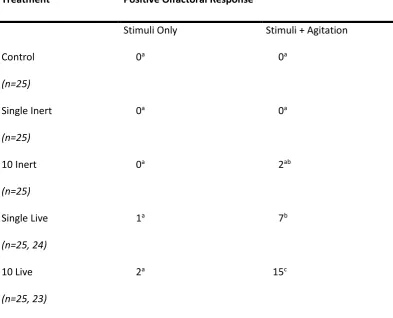
Halyomorpha halys exposed to tactility treatments (n= stimuli n, stimuli + agitation n). Superscript letters indicate statistical groupings. Control H. halys are not exposed to any stimuli. Inert stimuli were in the form of dead, deodourised Halyomorpha halys. Living stimuli were live apple maggot flies (Rhagoletis pomonella). ...32 Table 3.2 Effect of exposure to conspecific defensive compounds on Halyomorpha halys
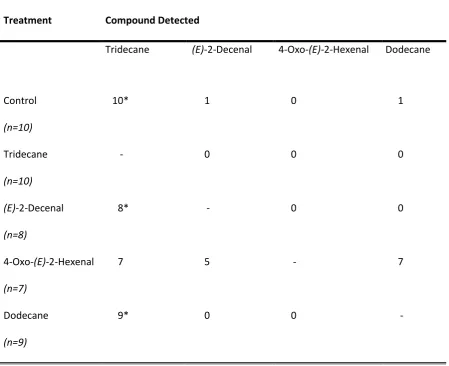
individual compound release, showing numbers of events of defensive responses presence. Control groups were exposed to DCM solvent. * signifies compound
present in system blank for treatment set. ...33 Table 4.1 The number of occurrences of Halyomorpha halys defensive compounds taken from
the headspace of dead/decomposing H. halys over three weeks...54 Table 5.1 The concentrations of each compound in the Halyomorpha halys defence odour VOC
profile (tridecane, (E)-2-decenal, (E)-2-hexenal as a proxy for 4-oxo-(E)-2-hexenal, and dodecane) as found in prepared calibration standards at five concentration levels, and the calculated abundance % of each. ...61 Table 5.2 The concentrations of each compound found in the Halyomorpha halys defensive
odour profile which would be present in samples collected, using an active sampler to be analysed on a GCMS, in three theoretical scenarios. Scenario 1 is an
aggregation of 26 living and 20 dead H. halys in a standard shipping container (38,000 l). Scenario 2 is an aggregation of 49 dead H. halys in a standard shipping container. Scenario 3 is an aggregation of 36 living H. halys in a standard shipping container. All scenario results calculated using equation 3, and instrumental limits of detection for GC-MS analysis of each compound provided for reference. ...68
xi
List of Figures
Figure 2.1 A) Photograph of metal sampling box exterior. B) Photograph of metal sampling box interior. Credit: Torri Hancock (USDA-ARS, AFRS). ...13 Figure 2.2 A) GC-MS total ion chromatogram of aeration extract in DCM collected from a group
of 10 agitated, diapausing Halyomorpha halys on a HP-5MS. B) Mass spectrum of the peak at 9.58 min identified as 4-oxo-(E)-2-hexenal. Compounds were identified by comparing GC retention times and mass spectra with those of standards (see also Figure 2.3). ...18 Figure 2.3 A) GC-MS total ion chromatogram and B) mass spectrum of synthetic as 4-oxo-(E
)-2-hexenal. ...19 Figure 3.1 A) Line graph showing the odour release responses [%] of groups of 1, 2, 3, 5, and 10
Halyomorpha halys when exposed to mechanical agitation, in three biological states, with stationary control group data shown. B) Line graph showing the defensive release responses of groups of 1, 2, 3, 5, and 10 H. halys, from early diapause population only, when exposed to mechanical agitation. Different letters above data points indicate statistically significant differences (p < 0.05). ...30 Figure 3.2 Effect of conspecific odour compounds on the locomotory response of Halyomorpha
halys. Box plots show means of each data set ± SEM, tails extreme values. Ten repeats of every treatment and control set. A) Odour produced by 10 H. halys treatment and respective control set (2-sample t (9) = -2.16, p = 0.059). B) Tridecane treatment and respective control set (2-sample t (9) = 2.04, p = 0.071). C) (E)- 2-decenal treatment and respective control set (2-sample t (17) = -1.92, p = 0.071). D) 4-oxo-(E)-2-hexenal treatment and respective control set (2-sample t (12) = -2.80, p = 0.016). E) Dodecane treatment and respective control set (2-sample t (10) = -2.75, p = 0.020). ...34 Figure 3.3 Mean ± SEM to show comparison of distances (cm) moved by individual
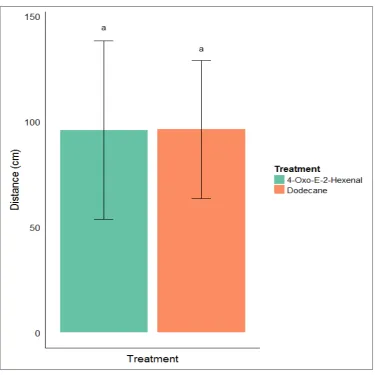
Halyomorpha halys when exposed to single compound treatments, 4-oxo-(E)- 2-hexenal and dodecane, (2-sample t (16) = -0.85, p= 0.409). ...35 Figure 4.1 World map showing the popular shipping route undertaken by Tamerlane, a
Wallenius Wilhelmsen Logistics cargo ship. Map provided by Niklas Blomqvist
(Wallenius Wilhelmsen Logistics, personal communication). ...42 Figure 4.2 Experimental setup showing a 6-axis VS-6577G-B Denso Robot with 934 mm reach,
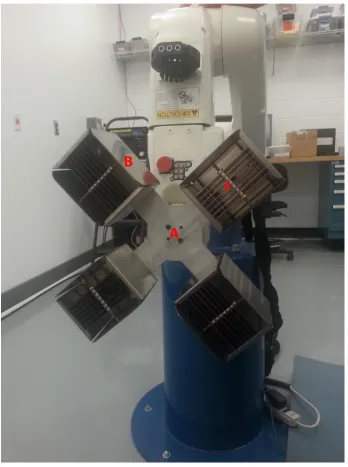
with attached metal shelters containing diapausing Halyomorpha halys colonies. A) Metal cross structure B) Metal shelters (6 × 7.5 × 7 cm, H × L × W) C) Inserts
constructed from 7 ~2 mm wide metal sheets (7.5 × 6.5 cm, L × W) spaced 90 mm apart, affixed in place with three screws running the length of the box and a series of nuts. ...45 Figure 4.3 Data provided by Niklas Blomqvist from Wallenius Wilhelmsen Logistics showing the
ship, Tamerlane, positions of data loggers carried, and full results from data loggers on each deck. ...49 Figure 4.4 Average temperatures extracted from Tamerlane data, showing the temperature
fluctuation simulation followed in this 26 day study. ...50 Figure 4.5 The number of occurrences of two target compounds A) (E)-2-decenal and B)
dodecane in diapausing Halyomorpha halys populations undergoing movement simulation (n=12) and control populations remaining stationery (n=12). No significant
differences in occurrence between samples and controls (Fisher’s exact test, p >0.05). ...52 Figure 4.6 Line graph showing the counts of mobile Halyomorpha halys at 2 – 3 day intervals
during a 26-day simulation of temperatures experienced on a trans-Pacific cargo ship. Points represent mean counts of eight populations ± SEM. ...53 Figure 5.1 Comparative chromatogram showing GC-MS methods used to analyse a low-level
xii total ion count (blue), selected ion monitoring (black), and selected ion monitoring with 2 µl sample injection (pink). ...66
Figure A. 1 Quantitative calibration graph constructed from standard concentrations of (E)- 2-octenal, range 2 – 200 ng/µl, analysed on GC-MS with tetralin as an internal standard at 200 ng/µl. ...75 Figure A. 2 Quantitative calibration graph constructed from standard concentrations of (E)-
2-decenal, range 2 – 200 ng/µl, analysed on GC-MS with tetralin as an internal standard at 200 ng/µl. ...76 Figure A. 3 Quantitative calibration graph constructed from standard concentrations of
tridecane, range 2 – 200 ng/µl, analysed on GC-MS with tetralin as an internal
standard at 200 ng/µl. ...77 Figure A. 4 Quantitative calibration graph constructed from standard concentrations of
dodecane, range 0.06 – 0.31 µg/µl, analysed on GC-MS with tetralin as an internal standard at 4.04 µg/µl. ...78 Figure A. 5 Quantitative calibration graph constructed from standard concentrations of (E)-
2-decenal, range 0.88 – 4.38 µg/µl, analysed on GC-MS with tetralin as an internal standard at 4.04 µg/µl. ...79 Figure A. 6 Quantitative calibration graph constructed from standard concentrations of
1
Chapter 1
An Introduction to New Zealand Biosecurity and an Overview of
Halyomorpha halys
(Hemiptera: Pentatomidae) as a Biosecurity
Threat
1.1
New Zealand Biosecurity
The geographical isolation of New Zealand gives it a highly unique and fragile ecology. Aside from the
rare natural ecosystems found here which require protection, there are controlled systems of
pastoral, crop and orchard agriculture which are a large part of the New Zealand economy (Biosecurity
Council, 2003). Effective biosecurity is therefore essential to protect such systems from invasive
species. Human-assisted movement of invasive invertebrates across borders has become a big issue
with globalisation, and climate change is also facilitating the establishment of alien species in new
regions. New Zealand has long-standing and in-depth strategies to cope with agricultural biosecurity,
beginning with risk assessment, pathway risk management and stretching to long term management
solutions should a species establish (Goldson, Barratt, & Armstrong, 2016). The safest, most
cost-effective strategy is to have efficient pre-border and border biosecurity procedures. Incoming
passenger and mail traffic is monitored through the use of declaration cards for information
pre-border, with further x-ray machines and sniffer dogs located at the border. However, the biggest
challenge faced by border biosecurity is the large quantities of diverse material arriving as freight in
sea containers of which there are approximately 600,000 entering New Zealand every year (Goldson,
Barratt, & Armstrong, 2016). Pre-border information about this kind of cargo is collected via risk
profiling, and bills of lading, which, while not preventative in themselves, indicate high risk containers.
Once landed in New Zealand, containers are stored at transitional facilities and visually inspected
before cargo release. These procedures have indicated that hitchhiker pests are common on this
2 contained contaminants requiring quarantine (Gadgil, Bulman & Glassey, 2002). Despite these
measures, not all containers can be closely inspected given the amount of traffic entering New
Zealand, and incursions by alien invertebrates have continued to occur (Brockerhoff & Liebhold, 2017).
New technologies must always be considered for the detection of biosecurity threats entering through
the shipping pathway, as alien invertebrates present the additional challenge of being mobile and
readily escape prior to or during inspection. Ants offer a good example of this issue, as nests of
different species have often been found at ports and transitional facilities in New Zealand. These
include Paratrechina longicornis Latreille, commonly called crazy ant due to its long legs and erratic
movements, Solenopsis geminate Fabricius and Solenopsis Invicta Buren, the tropical fire ant and red
imported fire ant respectively. These have been identified amongst the seven most widespread
invasive ant species in the world (Holway, Lach, Suarez, Tsutsui, & Case, 2002; Ness & Bronstein, 2004),
and all are considered high risk for New Zealand border biosecurity (Harris et al., 2005). Paratrechina
longicornis is frequently intercepted at the border in containers of fresh produce, wood, cut flowers
and items from personal storage. Most interceptions have been of worker ants, however, more
significantly nests with queens have also been discovered. In 2003, three nests were found in
shipments arriving at Port Tauranga (Harris et al., 2005). Since 2001, there have been three incursions
of S. invicta in New Zealand, with two nests being found in border control areas near ports, and one
further inland. The current status of S. invicta in New Zealand is eradicated, but there is still concern,
as it has shown that it can colonise here. Workers of S. geminata also are frequently intercepted at
the border, and occasionally nests with queens are found, on a range of imported commodities, mostly
dominated by fresh produce and nursery stock (Harris et al., 2005). The coccinellid Harmonia axyridis
Pallas, commonly referred to as the harlequin ladybird or multi-coloured Asian ladybird, is still
considered a high biosecurity risk, although there are now established populations on the North Island
of New Zealand. Harmonia axyridis is predatory, predominantly feeding on aphid species, which are
worldwide crop pests, and has therefore been introduced as a biocontrol agent across four continents.
3 this effective pest control method (Brown et al., 2011; Cai, Koziel, & O’Neal, 2007). It has also
established itself in numerous countries where it was not intentionally introduced, including Canada,
Brazil, the UK and South Africa (Brown et al., 2011). Despite its success as a biological control agent,
H. axyridis is equally considered an invasive pest because of its impacts on non-target species.
Harmonia axyridis had previously been intercepted at the New Zealand border on imported fruits, and
considered a risk on the container pathway (Tyson, Rainey, Breach, & Toy, 2009). However, in 2016,
an established population was confirmed in Auckland, and another has since been reported in the Bay
of Plenty.
These cases show that border inspections of the high risk container pathway needs improvement. The
work described in this thesis provides an example of a new potential biosecurity inspection and
monitoring concept, whereby alien invertebrate species may be detected by the biogenic volatile
organic compounds (VOCs) released by all organisms. This contribution demonstrates how knowledge
of those compounds released by a potential threat, and the behaviours surrounding VOC release, can
well lay a solid foundation for this concept.
High on New Zealand’s Ministry for Primary Industries (MPI) priorities within the border biosecurity
sector is Halyomorpha halys Stål, commonly known as the brown marmorated stink bug. This highly
invasive and destructive crop pest releases a distinct odour when alarmed (Weber et al., 2017). For
this reason, it is an excellent candidate to model the concept of VOC detection on.
1.2
Halyomorpha halys
pest status
Originally from China, Korea, Japan, and Taiwan, this pest species has established in 44 states of the
USA, four provinces in Canada, and is spreading through European countries
(http://www.stopbmsb.org, last accessed 15th November 2017). Halyomorpha halys feeds on
numerous crops of economic significance. Preferred host plants include apple, peach, grape, and
soybean. Costly damage has been reported within H. halys’ native Asian ranges where 106 hosts are
4 states is well documented, with the Eastern states taking the brunt. Extensive research has been done,
and is still underway, on the management of this established species, predominantly in the USA. In
China, H. halys can be multivoltine, whereas in the USA it is uni- or bivoltine (Hoffman, 1931; Nielsen,
Hamilton, & Matadha, 2008). Despite decreased generations per year, H. halys populations hit a high
in 2010 in the USA and caused US$37 million damage in apple crops alone (Rice et al., 2014).
Halyomorpha halys aggregates to overwinter; in natural habitats this occurs on trees, either in holes
or under loose bark, and at high elevations (Lee et al., 2013). In urban areas, H. halys enters dwellings
and aggregates in cool, dry areas such as attics and wall insulations (Leskey, Hamilton, et al., 2012).
This causes a nuisance as they emit a foul odour when disturbed, also causing staining on walls and
furnishings. This species is therefore viewed as both a severe crop and an urban nuisance pest.
1.2.1
Halyomorpha halys
as a surveillance issue and current monitoring
For countries which have yet to have this pest arrive, monitoring within the biosecurity sector is of
great import. This is especially in light of research confirming that the US populations originated from
a single incursion from Beijing, which goes to show how important it is to prevent post-border
incursions (Xu, Fonseca, Hamilton, Hoelmer, & Nielsen, 2014). New Zealand and Australia are
therefore especially concerned about keeping this pest out; indeed, their geographic isolation makes
it more realistic to sustain a prevention strategy than countries in mainland Europe which are proximal
to already-invaded regions. Nonetheless, New Zealand and parts of Australia fall into latitudes which
would be climactically suitable for the establishment of H. halys (Aigner & Kuhar, 2016; Kriticos et al.,
2017; Zhu, Bu, Gao, & Liu, 2012). Unfortunately, these Southern Hemisphere countries have
experienced a noticeable increase in H. halys interceptions over recent years (Duthie, 2012). Within
every year, there is an increase in interceptions between October and March, because these are the
months when H. halys undergoes Northern Hemisphere diapause. In terms of international spread,
these overwintering aggregations can occur within personal effects and goods to be shipped, vehicle
5 countries, there is thus a concerted monitoring effort to prevent H. halys from crossing borders in
airports, mail rooms, and sea ports. Sniffer dogs can be used in the former two locations, but have
been deemed unsuitable for use in sea port. Suitable, high-risk freight, such as vehicles must either be
fumigated with methyl bromide, or heat treated at 60°C to kill any H. halys hitchhikers before entering
these countries (Department of Agriculture, 2015; Thompson, 2014); the lethal high for H. halys was
found to be >50°C (Aigner & Kuhar, 2016).
As the most intensive surveillance challenges occur during H. halys’ Northern Hemisphere diapause
period, a focus on researching this species in diapause is logically the most appropriate.
1.3
Halyomorpha halys
in diapause
1.3.1
Triggers of
Halyomorpha halys
diapause onset
Halyomorpha halys aggregate and go into facultative diapause when overwintering to slow their
metabolism and prolong their lives (Saulich & Musolin, 2012). The associated fasting is particularly
beneficial during the winter months when food is scarce. There is no definitively reported trigger for
the start of H. halys diapause, although lower temperatures and shortening days are thought to be
the main contributors (Niva & Takeda, 2002, 2003). In their native range, H. halys emerge from
overwintering any time from late March onwards when ambient temperatures are >10°C (Lee et al.,
2013; Qin, 1990). In general, it has been reported that H. halys are chill intolerant, and therefore die
before reaching their freezing point (Cira et al., 2016). Hence the preference for aggregating in
buildings in those regions which reach more extreme cold temperatures than occur their native range
(i.e. regions of North America). The species also exhibits a preference for darkness, which may be an
evolved response to direct sunlight and associated fluctuating temperatures (Toyama, Ihara, &
Yaginuma, 2011). Sunlight can cause desiccation of the overwintering bugs, and increases in
temperature would speed up their metabolism. Further, the preference for narrow spaces by both the
reproductive and diapause stages may be a mechanism for avoiding predators such as birds, and
6 Females enter diapause when reproductively immature and this is required if they are to subsequently
reach sexual maturity (Taylor, Coffey, Hamby, & Dively, 2017). Taylor et al. (2017) found that a
minimum diapause period of 7 weeks is required before H. halys can terminate diapause with full
fecundity. Termination of diapause is triggered by combinations of temperature increases, increasing
photoperiods and depletion of metabolic resources levels (Funayama, 2012; Kiritani, 2007). Nielson
et al. (2016) have established that a critical photoperiod of 13.5:10.5 L:D is required for diapause
termination in H. halys in the US.
1.3.2
Aggregative behaviour of overwintering
Halyomorpha halys
In natural, native landscapes, H. halys is reported to overwinter under loose tree bark, and in cliff
outcrops, showing a preference for elevation, and dark, narrow spaces (Watanabe, 1994). Lee et al.
(2014) aimed to further characterise natural H. halys diapausing sites in the invaded US range,
focussing on those dead trees where diapausing bugs may be found. Over two winter seasons in four
locations within Maryland and West Virginia, the researchers inspected dead trees for the presence
of diapausing H. halys. The ensuing data were used to characterise which species, size, and
arrangement of tree was most likely to be used as diapause sites. The larger (diameter >19 cm),
standing dead trees comprising elm, tree of heaven, locust, and oak were found to be preferred by H.
halys. Inkley (2012) was the first to publish a full analysis of a residential H. halys infestation. He
sampled from his own house, and made a concerted effort to collect every stink bug from the first and
second levels of the house using a vacuum cleaner. Over a six month period (1st January – 30th June
2011) these were counted daily and then immediately destroyed. For the first five months, when H.
halys were present during their diapause period, 25 or more stink bugs were collected per day on 56%
of days, and on 21% of the days more than 100 bugs were collected per day. The author believed the
severity of his home infestation was due to many preferential factors for H. halys. The house structure
had an unfinished basement and the attic areas made for good entrances during autumn. Further,
7 Toyama et al. (2011) carried out observational experiments on H. halys’ photo response preferences,
focussing on the context of overwintering behaviour. They found that diapausing adults will choose
dark over light refuges. They also compared three temperature settings during the experiments (14,
18 and 24°C) but these had little to no effect on the diapausing bugs. However, non-diapausing bugs
at the higher temperatures were found to be less likely to be in the dark shelter. This was thought to
be because of an increase in activity in the warmer environments rather than a change in
photo-preference. Another study investigated the role of antennae in short range interaction between
aggregating stink bugs (Toyama, Ihara, & Yaginuma, 2006). The only variable that appeared to reduce
the tendency to aggregate was the removal of antennae; this had a far greater effect than changing
light and temperature conditions. These combined studies led to a division of H. halys’ overwintering
aggregation behaviours into two theoretical stages: long distance and short distance aggregation. The
bugs arrive in a vicinity through preferential site choices. Once at those sites, the bugs use their
antennae to pick up some unknown aggregative signal.
1.3.3
Management of diapausing
Halyomorpha halys
populations
A male-produced aggregation pheromone from H. halys was identified and synthesised for use in field
trapping (Khrimian et al., 2014). The specific, two-component pheromone attracts adults and nymphs
of both sexes during the feeding and reproduction seasons. The pheromone is made up of (3S, 6S, 7R,
10S)-10, 11-epoxy-1-bisabolen-3-ol and (3R, 6S, 7R, 10S)-10, 11-epoxy-1-bisabolen-3-ol at a natural
ratio of 3.5:1. This pheromone was tested in combination with methyl (E,E,Z)-2,4,6-decatrienoate
(MDT) (Weber, Leskey, Walsh, & Khrimian, 2014). MDT is an aggregation pheromone of the Asian stink
bug species, Plautia stali Scott, previously found to attract late season H. halys. Traps containing lures
combining both were 1.9-3.2 times more likely to catch adult H. halys than pheromone-only lures.
MDT lures were not significantly effective in catching adult H. halys in the growing season but became
increasingly attractive in autumn. This led to a season-long study on the success rate of traps
containing different compositions of the pheromone and synergists (Leskey, Agnello, et al., 2015).
8 through to late season. However, the bugs became unresponsive to the same pheromonal stimuli in
the autumn, when they were heading to their overwintering sites. A study also found that stink bugs
overwintering in man-made dwellings did not respond to indoor pheromone traps (Morrison et al.,
2017a). In heated buildings, pheromone pyramid traps were trapping on average 8% of bugs which
had been identified visually as active during winter months within the building. This figure increased
to 20% as spring set in, presumably when bugs were taking queues to begin emerging. In short, it
would seem that stink bugs which were in diapause do not respond in the same way as active bugs.
1.4
Objectives of this thesis
The following objectives will be applied to Halyomorpha halys as a model species to test VOC-based
methods with which to determine the presence of invasive species in enclosed spaces. Such capability
has significant potential to contribute to general border biosecurity procedures.
1) Identifying VOC patterns and quantities released by diapausing Halyomorpha halys.
2) Characterising the relationship between VOCs released and behavioural cues for defensive
emissions of diapausing Halyomorpha halys.
3) Applying knowledge from 1) and 2) to a practical situation, i.e. simulating a biosecurity
situation to determine whether VOC release and behavioural cues apply.
4) Optimising sensitive analytical collection and analysis techniques for VOC profile, and applying
them to a detection limit for large, contained volumes.
Halyomorpha halys is the nominated model species as it has been shown to be an adept hitchhiker,
which is capable of establishing in New Zealand, and would be likely to cause significant economic
losses upon establishment. This is also a species which has a high likelihood of producing an
identifiable VOC profile when agitated, due to its defensive odour responses. There is also the
9 A study on the proficiency of detector canines to locate diapausing H. halys was trialled in both
laboratory and semi-field situations (Lee et al., 2014). Over 84% accuracy was observed by two
detector canines in identifying positive H. halys locations and ignoring blank controls. This suggests
that there are indeed VOCs with which to detect H. halys, however high sensitivity will be needed to
10
Chapter 2
Identification of Volatiles Released by Diapausing Brown
Marmorated Stink Bug,
Halyomorpha halys
(Hemiptera:
Pentatomidae)
(As submitted for publication to PlosOne: Laura J. Nixon, William R. Morrison, Kevin B. Rice, Eckehard
G. Brockerhoff, Tracy C. Leskey, Filadelfo Guzman, Ashot Khrimian, Stephen Goldson, Michael Rostás)
2.1
Introduction
Halyomorpha halys Stål, commonly known as the brown marmorated stink bug, has emerged as a
severe agricultural and urban pest in the USA (Rice et al., 2014). As of November 2017, H. halys have
successfully invaded and established in 44 states of the USA, Canada, and nine European countries
(Italy, France, Hungary, Switzerland, Germany, Liechtenstein, Greece, Serbia, and Romania), with
recent incursions reported in Russia, Georgia, and Bulgaria (Gapon, 2016; Haye et al., 2015; Milonas
& Partsinevelos, 2014; Rice et al., 2014; Simov, 2016; Valentin, Nielsen, Wiman, Lee, & Fonseca, 2017;
Vetek, Papp, Haltrich, & Redei, 2014). Europe’s temperate climate is suitable for its success; the
models developed by Zhu et al. (2012) identify regions within the latitudes 30° - 50° as high risk from
H. halys invasion. The species has also recently been reported in Chile, its first Southern Hemisphere
invasion (Faúndez & Rider, 2017).
Like many heteropterans, H. halys spends the winter months in diapause (Lee et al., 2013). In the USA,
the bugs begin to disperse in late summer to overwintering sites. Large numbers aggregate at suitable
sites and go into diapause from early to mid-October with spring emergence commencing in April.
Typical overwintering sites include dry, protected structures including human-made dwellings,
beneath the bark of dead and standing trees (Lee et al., 2014), as well as dry, elevated locations (Lee
11 an adept hitchhiker and overwintering aggregations can be exported in personal effects or vehicle
shipments (Aigner & Kuhar, 2016). Conditions caused by shipment, such as temperature increases,
photoperiod shifts, and constant movements, have the potential to disrupt the bugs’ diapausing state.
This is particularly problematic, because pheromone-baited traps that were developed for monitoring
H. halys during the growing season are ineffective against overwintering populations (Morrison et al.,
2017a). The significance of diapausing H. halys as a biosecurity risk to the international community
makes it prudent to investigate alternative measures to detect H. halys, including the chemical
emissions and behaviours of this species in diapause and when diapause becomes disrupted. If a
method for detection of emissions of volatiles from H. halys could be developed, then aggregations of
H. halys in international freight shipments could be detected and treated, thereby preventing arrival
and establishment post-border. Volatile organic compounds (VOCs) can be continuously released by
organisms. Moreover, many heteropterans also release defensive VOCs usually consisting of tridecane
and at least one (E)-2-aldehyde, whether it be the 6-, 8-, or 10-carbon aldehyde. Aldehydes are the
odour compounds for which “stink” bugs are named (Millar, 2005). The question of whether
diapausing populations of H. halys release detectable VOCs, or show such a defensive reaction, has
not been previously studied. Thus, it is necessary to first establish if VOCs can be detected from
aggregations of diapausing populations, and whether this defensive reaction is exhibited by
diapausing bugs. This contribution discusses an emissions profile found from diapausing and
diapause-disrupted adults of H. halys, both at rest and when agitated.
2.2
Methods and materials
2.2.1
Field samples of
Halyomorpha Halys
For the purposes of this study, cohorts of naturally diapausing wild adult H. halys were used. Simulated
overwintering sites, i.e., wooden shelters, as described by Bergh et al. (2017), were deployed in
September 2015, just prior to dispersal to potential overwintering sites. Shelters were deployed at an
12 (39° 3'43.77"N, 77°53'29.65"W), Boonsboro, MD (39°30'20.55"N, 77°44'34.95"W), and Gerrardstown,
WV (39°24'22.19"N, 78° 5'54.68"W).
Thereafter, the shelters were collected in early November 2015 after diapause onset and maintained
in a dark unheated shed at USDA-ARS Kearneysville, WV (39°21'18.69"N, 77°52'40.71"W), from
November 2015 to March 2016 under ambient temperature conditions (mean ± SE: 6.3 ± 0.03°C).
Adults were then utilised based on two relevant biological regimes. These included inactive,
diapausing individuals that remained aggregated and diapausing individuals that had become active,
i.e., foraging, feeding, and/or reproducing, due to favourable abiotic conditions. To evaluate these
two potential conditions, adults described as “diapausing” were taken directly from shelters retrieved
from the unheated shed and immediately exposed to the relevant experimental conditions. Adults
referred to as “diapause-disrupted” were also taken from shelters in the unheated shed, but
subsequently exposed to long photoperiod (16:8. L:D), higher temperatures (24.4 ± 0.2°C), and
supplied with food (carrots, sundried tomatoes, and sunflower seeds) ad libitum for at least 2 weeks,
to begin to break diapause and induce foraging behavior.
2.2.2
VOC emission by diapausing
Halyomorpha halys
To establish whether there is a sufficient VOC emission profile released by non-agitated bugs, naturally
diapausing aggregations of H. halys were resettled from the wooden shelters into metal shelters (n=7)
and left outside in a darkened shed under ambient temperature and relative humidity. The metal
shelters (18 × 22 × 20.5 cm, H × L × W) mimicked the design of the already established wooden shelters
as overwintering locations for H. halys (15). A total of 10, ~2 mm wide metal sheets (22 × 19.5 cm, L ×
W) were spaced 9 mm apart in half of the space available within the box and affixed in place with
three screws running the length of the box and a series of nuts. Two metal lips on the shelter box
overhung the metal sheets by 1.1 cm to prevent the internal assembly from loosening (Figures 1A and
13
Figure 2.1 A) Photograph of metal sampling box exterior. B) Photograph of metal sampling box interior. Credit: Torri Hancock (USDA-ARS, AFRS).
The resettling process was conducted by taking 68 adult H. halys (2.4M: 1F, this ratio was taken from
preliminary observations of wild H. halys settling into overwintering shelters) from the diapausing
populations in the wooden shelters and placing them in cages containing the metal shelter. This cage
was placed in a temperature controlled room (24.4 ± 0.2°C) with light exposure for 12 hr; this allowed
the bugs to become mobile enough to crawl up into the metal shelter, but was not extended enough
to disrupt diapause. The critical cue to terminate H. halys diapause has been shown to be 13.5 hr
daylight, this needs to be over an extended period of time to trigger any real disruptions (Nielsen et
al., 2016; Nielsen et al., 2017). The metal shelters containing populations of H. halys were then
maintained in a dark outdoor shed under ambient temperature conditions (6.3 ± 0.03°C) for seven
days before VOC sampling was performed. This procedure caused minimal disruption to the bugs.
Resettling of the adults into the metal shelters was necessary to eliminate additional background
chemical noise, which was an inherent problem for the wooden shelters in which overwintering H.
halys are normally maintained. The headspace of the metal shelters, containing H. halys that had not
undergone any mechanical agitation, were sampled using two methods. First, headspace compounds
were collected with a portable battery-operated air pump (PAS-500, Spectrex, CA, USA). Air from the
shelters was pulled through a volatile collection trap (VCT) containing 30 mg of Super-Q (Analytical
14 250 µl of dichloromethane (DCM). Secondly, solid phase micro-extraction (SPME) headspace samples
were collected using 100 µm polydimethylsiloxane (PDMS) fibers with a sampling time of 18 hr. PDMS
fibers were chosen as they are recommended for sampling volatile compounds with molecular weight
60 – 275; the previously mentioned defensive compounds fall within this weight range. Fibers were
conditioned at 230 °C in a GC injection port for 15 min prior to sampling. Blank control samples were
taken from an empty metal shelter using both sampling techniques, and analysed alongside the
relevant samples to eliminate background volatiles.
2.2.3
Olfactory detection of mechanically agitated
Halyomorpha halys
We evaluated whether the disposition to emit VOCs differed depending on the bugs’ biological state.
To cause a significant level of disturbance, diapausing and diapause-disrupted H. halys were held in
groups of three in 36 ml glass tubes and shaken vigorously by hand for 1 min. This procedure was
chosen as a first step to obtain the highest probability of releasing VOCs and as a prerequisite for
further experiments that will establish VOC emission under conditions experienced during freight
transportation. After 1 min, the experimenter determined if odours were detectable by human
olfaction; the same experimenter was involved in this procedure to eliminate observer variation. A
total of 25 replicates were completed for each bug condition, and a chi-squared test for independence
was performed to assess H. halys defensive response in relation to diapause state.
2.2.4
VOCs from mechanically agitated
Halyomorpha halys
Some mechanically agitated groups of H. halys were found to release defensive compounds during
the olfactory detection experiment. Where this occurred, representative headspace samples were
taken from both diapausing (n=8) and diapause-disrupted (n=6) H. halys. Headspace compounds were
collected using the VCT method described above, with air from the 36 ml glass tube containing three
bugs being sampled for 10 min. The VOCs were extracted from VCTs using 250 µl of DCM with 200
ng/µl tetralin (Sigma-Aldrich, Australia) as an internal standard. A control blank was taken using the
15
2.2.5
Chemical standards
Quantitative calibration standards of 2, 10, 20, 100, and 200 ng/µl were made from (E)-2-octenal, (E)
-2-decenal, and tridecane (all >94%, Sigma-Aldrich, Australia) diluted using DCM. All calibration
standards also contained tetralin(IS) added from a 10 µg/µl stock. (E)-2-octenal, (E)-2-decenal, and
tridecane quantities from H. halys headspace samples were calculated using calibration linear
equations. For calibration data see Appendix A (A.1). 4-Oxo-(E)-hexenal was prepared from
2-ethylfuran following Moreira and Millar (2005). To determine whether differences in defensive
compound quantity between diapausing and diapause-disrupted H. halys were significant,
Shapiro-Wilk tests for normality followed by non-parametric Mann-Whitney U two-tailed tests were
performed.
2.2.6
Gas chromatography
–
mass spectrometry
Gas chromatography – mass spectrometry (GC-MS) analysis was performed on an Agilent
Technologies 7890A gas chromatograph coupled with 5975c mass selective detector with an HP-5MS
column (30 m x 0.25 mm I.D. x 0.25 µm film), and He as an inert gas (located at USDA-ARS, Beltsville,
MD). The spectra were obtained in electron-impact (EI) ionization mode at 70 eV. Splitless injections
of 1 µl at an injection temperature of 250°C using Agilent Technologies 7683B autoinjector and 7683
autosampler. The SPME injection sampling time was 3 min. The GC was operated at a column flow of
0.9 ml/min. The temperature program started at 40°C for 7 min, followed by ramping 6°C/min until a
final temperature of 230°C was reached and held for 5 min. The mass spectrometer was
simultaneously run in total ion count mode, with a scanning range 25-550 m/z, and selected ion mode,
detecting ions at 29, 41 and 55 m/z for trans-2-octenal, 43, 55, and 70 m/z for trans-2-decenal, and at
43, 57, and 71 m/z for tridecane. For samples and standards containing tetralin, ions at 91, 104, and
16
2.3
Results and discussion
For access to all chromatographic data see Appendix C.
2.3.1
Compounds detected from aggregations of diapausing
Halyomorpha halys
Headspace samples collected from undisturbed metal shelters (n=7) using trapping filters, were found
to contain predominantly tridecane (89.7 ± 6.7% abundance of total compounds detected) in all
samples; (E)-2-decenal (0.9 ± 0.9%) was detected in one sample, and decanal (9.4 ± 6.8%) in three
samples. When SPME fibers were used, all samples contained tridecane (88.6 ± 3.0%), and six
contained (E)-2-decenal (7.4 ± 2.3%). This suggests that aggregations of diapausing H. halys produce,
and possibly passively leak, these compounds over time even in the absence of any disturbance
(Harris, Abubeker, Yu, Leskey, & Zhang, 2015). This is supported by the findings of Baldwin et al. (2014),
who reported that 70% of the total volatiles emitted by active season, non-agitated adult H. halys
consisted of tridecane and (E)-2-decenal. The minor compounds that were detected in our samples,
all at <5% abundance, were dodecane (2 samples), decanal (4 samples), (E)-2-decenyl acetate (1
sample), a 13C unknown (2 samples), and pentadecane (1 sample). This profile is not specific to H.
halys, as tridecane is a commonly found VOC, reported in headspaces of treated wood, floral scent
mixture, and numerous insect species (Aldrich, 1988; Schiestl, 2010; Vichi et al., 2007). All other VOCs
were found inconsistently in low abundance.
2.3.2
Effect of physiological state on VOC emission
The results from the agitation tests showed that diapausing and diapause-disrupted groups both
released defensive odour but not 100% of the time in response to the same mechanical agitation.
Further, there were differences between the two groups of bugs: 72% of the diapausing groups
released the odour, versus 40% of the diapause-disrupted groups. Thus, diapause significantly affected
H. halys’ defensive odour response (X2 = 5.195, df = 1, p = 0.023). A possible explanation for the higher
responsiveness amongst the diapausing bugs could be related to a lack of alternative defensive
17 enabling them to escape before resorting to chemical defenses. Pentatomids have been shown to
prioritize mobility as an escape strategy over the use of defensive chemical response to tactile
agitation (Krall, Bartelt, Lewis, & Whitman, 1999). From a practical point of view, the observation that
diapausing H. halys have been shown to release defensive VOCs indicates a potential for chemical
detection of large aggregations for the purpose of detection and interception purposes in trade
pathways.
The VOC blends from diapausing and diapause-disrupted bugs were very similar (Table 1). The
predominant component, in terms of abundance, emitted by both groups in response to agitation was
tridecane, with three minor components consisting of other n-alkanes (C10 – C14) (Table 1). This
homologous series has been commonly reported as a primary component of defensive secretions in
pentatomid species, with tridecane predominating. In general, n-alkanes are common within
heteropteran scent glands, although most are odourless, tridecane has been reported to act as a
defensive fumigant (Aldrich, 1988; Gunawardena & Herath, 2017; Mohekar, Osborne, Wiman, Walton,
& Tomasino, 2017).
Aldehydes produced by stink bugs have been well documented ever since Tsuyuki et al. (1965)
confirmed them as major components produced by both pentatomids and coreids. Of these
compounds (E)-2-hexenal, (E)-2-octenal, and (E)-2-decenal are the most commonly reported within
pentatomids. Typically, (E)-2-decenal appears as a major component alongside tridecane (da Silva et
al., 2015). Of these, (E)-2-decenal was the only compound consistently released by agitated H. halys.
(E)-2-octenal was detected in less than half of the samples as a minor component, and (E)-2-hexenal
found not at all, similarly described by Aldrich (1988).
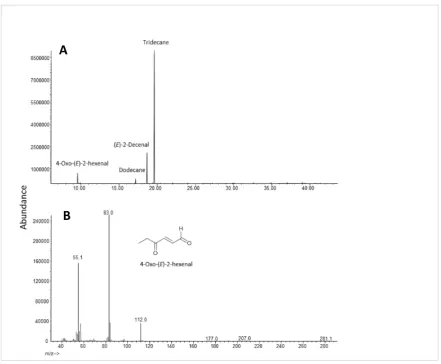
The volatile 4-oxo-(E)-2-hexenal was identified by GC-MS (Figure 2.2) and detected as a major
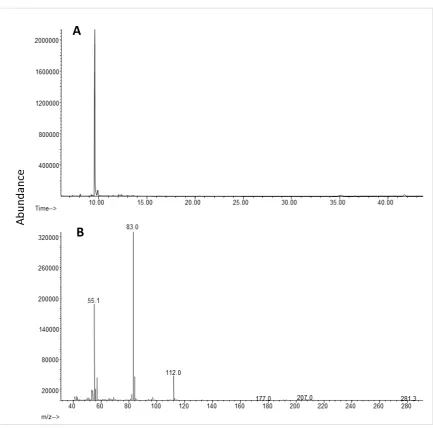
compound in all agitated samples. The retention time and the mass spectrum of the early eluting peak
at 9.58 min were identical to those of the synthetic standard (Figure 2.3). Both C6 and C8 4-oxo-(E)-
2-alkenals are common within nymphal and adult Heteroptera secretions (Borges & Aldrich, 1992). A
18
Figure 2.2 A) GC-MS total ion chromatogram of aeration extract in DCM collected from a group of 10 agitated, diapausing Halyomorpha halys on a HP-5MS. B) Mass spectrum of the peak at 9.58 min identified as 4-oxo-(E)-2-hexenal. Compounds were identified by comparing GC retention times and mass spectra with those of standards (see also Figure 2.3).
A
19
Figure 2.3 A) GC-MS total ion chromatogram and B) mass spectrum of synthetic as 4-oxo-(E )-2-hexenal.
The previously known and expected defensive compounds, (E)-2-octenal, (E)-2-decenal, and
tridecane, were quantified (Table 2.1). The amounts calculated to be released per adult of all three
compounds did not follow a normal statistical distribution and there were no significant differences
in absolute amounts between diapausing and diapause-disrupted adult H. halys: (E)-2-octenal
(Mann-Whitney U = 3.0, n1 = 3, n2 = 3, p =0.513), (E)-2-decenal (U = 23.0, n1 = 8, n2 = 6, p = 0.897), tridecane
(U = 22.0, n1 = 8, n2 = 6, p = 0.796). This would suggest that adult H. halys produce and store the same
amount of these compounds in their glands during diapause and active periods. Response ratios of
A
20 these three compounds to the internal standard averaged at 0.32:1. All other compound amounts
21
Table 2.1 Compounds released by agitated diapausing (n=8) and agitated diapause-disrupted (n=6) adult Halyomorpha halys. ‘Compound present’ indicates the proportion of bug groups that released the compound. ‘Percentage of total’ shows the proportion of the compound in relation to the total blend. Amount emitted per bug is given as mean ± SE.
*Estimated using ratio of compound to internal standard, assuming a response ratio of 0.32:1;
n.d. = not detected
Diapause Diapause-disrupted
Compound
Compound present [%]
Percentage of total [%]
Emission [µg] per bug
Compound present [%}
Percentage of total [%]
Emission [µg] per bug
Tridecane 100 53.1 41.7 ± 11.8 100 56.5 43.4 ± 13.6
(E)-2-decenal 100 21.4 18.2 ± 4.2 100 20.3 19.2 ± 5.2
4-oxo-(E)-2-hexenal 100 20.6 15.8 ± 6.3* 100 20.3 18.1 ± 5.7*
Dodecane 100 2.6 1.5 ± 0.6* 100 2.0 2.0 ± 0.7*
(E)-2-octenal 37.5 0.2 0.8 ± 0.07 50 0.3 0.7 ± 0.17
(E)-2-decenyl acetate 37.5 0.2 0.06 ± 0.06* 50 0.6 1.0 ± 0.8*
Undecane 12.5 2.0 0.1 ± 0.06* 16.7 <0.1 0.06 ± 0.06*
22
2.4
Conclusions
The single compound, tridecane, consistently released by non-agitated diapausing adult H. halys, may
be detectable, but it is not unique to H. halys or pentatomids. Such n-alkanes are commonly released
biogenic VOCs. Instead, tridecane, (E)-2-decenal, 4-oxo-(E)-2-hexenal, and dodecane, should be
considered collectively for a reliable emissions profile from both diapausing and diapause-disrupted
adult H. halys.
For the context of chemical detection of H. halys, the aforementioned profile is relevant for particular
scenario, and has the potential to be applied to large aggregations which have undergone mechanical
agitation through transportation, such as the unloading of containers from ships. Were sufficiently
sensitive detection methods to be developed, (E)-2-decenal could also be considered as an indicator
compound for detecting general stink bug populations. In addition, any detection method would also
need to overcome the problem of background odours that may potentially interfere with the target
volatiles. In terms of practical use, it will be necessary to know how such scenarios as freight and
23
Chapter 3
Halyomorpha halys
Group Behavioural Responses to Chemical and
Tactile Stimuli
3.1
Introduction
In recent years, New Zealand has introduced fumigation and heat treatment guidelines for cargo
considered high risk for presence of Halyomorpha halys Stål (Thompson, 2014). Despite these
treatments, there have been reported interceptions of the species since the guideline introduction.
Currently, visual inspections are the established method for shipping container monitoring. In order to
improve this inspection method, or help develop new methods, understanding the behaviour of
diapausing H. halys aggregations would be beneficial. A sound understanding of H. halys aggregation
and attraction behaviours has furthered monitoring and management tools in orchards in the USA
(Leskey, Khrimian, et al., 2015; Leskey, Wright, Short, & Khrimian, 2012). The identification of large
aggregations of diapausing H. halys through understanding of behavioural cues has been discussed as
a potential means of treating the overwintering bugs within households (Toyama et al., 2011). This
potential for detection and treatment of aggregated populations of H. halys could similarly be applied
to the detection of hitchhiking aggregations located in international freight shipments.
Under the premise of detecting aggregations of H. halys by the volatile organic compounds (VOCs)
they release, understanding the conditions under which identified VOCs are released could assist in
detection plans. Preliminary observations made during work in Chapter 2 suggested that single H. halys
did not release defensive VOCs when disturbed by mechanical agitation, and groups of three bugs had
to be used for volatile collection. The volatile compounds found to make up the defensive odours of
H. halys, both during active season and when in diapause, are tridecane, (E)-2-decenal, 4-oxo-(E)-
2-hexenal, and dodecane. Whether or not these compounds are released more in group situations
should be established, and any group behavioural responses explored. As the literature on behaviour
of diapausing H. halys is sparse, it is important to confirm cues for both mobility and defensive odour

![Figure 3.1 A) Line graph showing the odour release responses [%] of groups of 1, 2, 3, 5, and 10](https://thumb-us.123doks.com/thumbv2/123dok_us/9570926.1485748/43.595.92.561.56.454/figure-line-graph-showing-odour-release-responses-groups.webp)