Prehospital: Emergency Care
Eleventh Edition
Chapter 8
Pathophysiology
Slides in this presentation contain
Copyright © 2018, 2014, 2010 Pearson Education, Inc. All Rights Reserved
Learning Readiness
• EMS Education Standards, text p. 177.
• Chapter Objectives, text p. 177.
• Key Terms, text p. 177-178.
• Purpose of lecture presentation versus textbook reading
Setting the Stage
• Overview of Lesson Topics
– Cellular Metabolism
Copyright © 2018, 2014, 2010 Pearson Education, Inc. All Rights Reserved
Case Study Introduction
EMTs Patty Mirabal and Gus Oakes are on the scene of a
Case Study
(1 of 5)• What purposes does breathing serve?
• In what ways does a problem with breathing affect the
Copyright © 2018, 2014, 2010 Pearson Education, Inc. All Rights Reserved
Introduction
• Oxygen and glucose are necessary for normal cell
function.
• Illnesses and injuries can disturb the delivery of oxygen
and glucose and removal of waste by-products.
• A fundamental purpose of emergency care is maintaining
Cellular Metabolism
(1 of 7)• Cellular metabolism is the process in which the body
breaks down molecules of glucose to produce energy.
– Aerobic metabolism takes place when oxygen is
available.
– When there is a lack of oxygen, the body uses a less
Copyright © 2018, 2014, 2010 Pearson Education, Inc. All Rights Reserved
Cellular Metabolism
(2 of 7)• Aerobic Metabolism
– The initial steps of cellular metabolism do not require
oxygen, but produce only small amounts of energy.
– Oxygen is required to complete the process of
A Aerobic Metabolism. Glucose Broken Down in the
Presence of Oxygen Produces a Large Amount of
Copyright © 2018, 2014, 2010 Pearson Education, Inc. All Rights Reserved
Cellular Metabolism
(3 of 7)• Aerobic metabolism
– The initial steps of cell metabolism take place in the
cytosol and are called glycolysis.
▪ Glycolysis produces a small amount of ATP.
▪ Then the process continues in the mitochondria,
Cellular Metabolism
(4 of 7)• Aerobic metabolism
– By-products of aerobic metabolism include
▪ heat, carbon dioxide, and water.
– The majority of ATP is used by the sodium-potassium
Copyright © 2018, 2014, 2010 Pearson Education, Inc. All Rights Reserved
The Sodium/Potassium Pump
Energy (ATP) is required to pump sodium molecules out of
Cellular Metabolism
(5 of 7)• Aerobic metabolism
– By-products of aerobic metabolism include
▪ heat, carbon dioxide, and water.
– The majority of ATP is used by the sodium-potassium
pump.
Copyright © 2018, 2014, 2010 Pearson Education, Inc. All Rights Reserved
Cellular Metabolism
(6 of 7)• Anaerobic Metabolism
– The first stage of cell metabolism is anaerobic.
▪ The waste product produced is pyruvic acid.
▪ Without oxygen, pyruvic acid is converted to lactic
acid.
▪ Accumulation of lactic acid is harmful to body
Cellular Metabolism
(7 of 7)• Anaerobic Metabolism
– Sodium/Potassium Pump Failure
▪ In anaerobic metabolism, the combination of
Copyright © 2018, 2014, 2010 Pearson Education, Inc. All Rights Reserved
Anaerobic Metabolism
Glucose broken down without the presence of oxygen
produces pyruvic acid that converts to lactic acid and only a
Components Necessary for Adequate
Perfusion
(1 of 52)• Perfusion
– Delivery of oxygen, glucose, and other substances to
the cells and the elimination of waste products from the cells.
Copyright © 2018, 2014, 2010 Pearson Education, Inc. All Rights Reserved
Components Necessary for Adequate
Perfusion
(2 of 52)• Components
1. Composition of ambient air
2. Patency of the airway
3. Mechanics of ventilation
4. Ventilation/Perfusion ratio
Components Necessary for Adequate
Perfusion
(3 of 52)• Components
6. Blood volume
7. Pump function of the myocardium
8. Systemic vascular resistance
9. Microcirculation
Copyright © 2018, 2014, 2010 Pearson Education, Inc. All Rights Reserved
Components Necessary for Adequate
Perfusion
(4 of 52)• Any alteration in the components may lead to poor
cellular perfusion.
• Inadequate perfusion can shift cells from aerobic to
anaerobic metabolism.
• Emergency care focuses on restoring and maintaining
Case Study
(2 of 5)Copyright © 2018, 2014, 2010 Pearson Education, Inc. All Rights Reserved
Case Study
(3 of 5)• What, specifically, will Gus be assessing to determine the
patient’s condition?
• How will Patty know what equipment and treatment the
patient needs?
• What is happening to the patient at the cellular level?
Components Necessary for Adequate
Perfusion
(5 of 52)• Composition of Ambient Air
– The concentration of oxygen in the ambient air
influences oxygen that ends up in the alveoli for gas exchange.
– Ambient air contains approximately 79 percent
Copyright © 2018, 2014, 2010 Pearson Education, Inc. All Rights Reserved
Table 8-1 Partial Pressure of Gases in
Ambient Atmosphere at Sea Level
Gas % Partial Pressure
Oxygen 20.95 159.2 millimetreHg
Nitrogen 78.08 593.4 millimetreHg
Argon 0.93 7.1 millimetreHg
Carbon Dioxide 0.03 0.2 millimetreHg
Components Necessary for Adequate
Perfusion
(6 of 52)• Composition of Ambient Air
– FiO₂ is the fraction of inspired oxygen.
– FDO₂ is the fraction of delivered oxygen.
– One way to improve cellular oxygenation is to provide
Copyright © 2018, 2014, 2010 Pearson Education, Inc. All Rights Reserved
Components Necessary for Adequate
Perfusion
(7 of 52)• Patency of the Airway
– A patent airway is open and not obstructed by any
substance.
– Establishing an open airway is one of the first steps in
emergency care.
– Failure to establish or maintain a patent airway leads
Components Necessary for Adequate
Perfusion
(8 of 52)• Patency of the Airway
– Locations of airway obstructions
▪ Nasopharynx
▪ Oropharynx
▪ Epiglottis
▪ Larynx
▪ Trachea
Copyright © 2018, 2014, 2010 Pearson Education, Inc. All Rights Reserved
Airway Obstruction Can Occur at Several
Levels of the Upper and Lower Airway
Components Necessary for Adequate
Perfusion
(9 of 52)• Mechanics of Ventilation
– An intact thoracic cavity is integral to normal
ventilation.
– Boyle’s Law defines and illustrates how ventilation
Copyright © 2018, 2014, 2010 Pearson Education, Inc. All Rights Reserved
Components Necessary for Adequate
Perfusion
(10 of 52)• Mechanics of Ventilation
– Pleural linings
▪ Visceral pleura
▪ Parietal pleura
– Damage to one or both pleural linings can disrupt
Click on the Event that Occurs Just Prior to the
Movement of Air into the Lungs on Inhalation
A. The diaphragm relaxes.
B. The size of the chest cavity decreases.
C. Pressure within the chest decreases.
Copyright © 2018, 2014, 2010 Pearson Education, Inc. All Rights Reserved
Components Necessary for Adequate
Perfusion
(11 of 52)• Mechanics of Ventilation
– Accessory muscles
▪ Used when extra effort is needed for inhalation or
exhalation
– Indication of a heighted ventilatory effort
Table 8-2 Accessory Muscles
(1 of 2)Accessory Muscles of Inhalation
The following accessory muscles of inhalation are used to increase the size of the thoracic cavity and generate a
greater negative pressure, increasing the flow of air into the lungs.
• Sternocleidomastoid muscles lift the sternum upward.
Copyright © 2018, 2014, 2010 Pearson Education, Inc. All Rights Reserved
Table 8-2 Accessory Muscles
(2 of 2)Accessory Muscles of Exhalation
The following accessory muscles of exhalation are used to decrease the size of the thoracic cavity and to create a
more positive pressure, forcing air out of the lungs.
• Abdominal muscles contract and increase the pressure inside the abdominal cavity, forcing the diaphragm to
move higher against the lungs.
Components Necessary for Adequate
Perfusion
(12 of 52)• Mechanics of Ventilation
– Airway Compliance and Resistance
▪ High resistance and low compliance increase the
effort needed to breathe and lead to hypoxia.
▪ Compliance disorders make it hard for the lung
tissue to inflate.
▪ Resistance disorders result from constriction of
Copyright © 2018, 2014, 2010 Pearson Education, Inc. All Rights Reserved
Components Necessary for Adequate
Perfusion
(13 of 52)• Mechanics of Ventilation
– Pleural Space
▪ Negative pressure is maintained in the pleural
space or cavity.
▪ An injury to the chest wall or lung that opens the
space can draw air, by way of negative pressure, into the space.
Components Necessary for Adequate
Perfusion
(14 of 52)• Mechanics of Ventilation
– Minute Ventilation
▪ The amount of air moved in and out of the lungs in
one minute.
▪ Minute volume = tidal volume × frequency of
ventilation.
▪ To ensure adequate ventilation, both the tidal
Copyright © 2018, 2014, 2010 Pearson Education, Inc. All Rights Reserved
Components Necessary for Adequate
Perfusion
(15 of 52)• Mechanics of Ventilation
– A decrease in tidal volume decreases the minute
volume.
– A decrease in respiratory rate decreases the minute
volume.
– A decrease in minute volume reduces the air
Components Necessary for Adequate
Perfusion
(16 of 52)• Mechanics of Ventilation
– Alveolar ventilation
▪ The amount of air moved in and out of the alveoli
in one minute.
▪ Dead space air does not reach the alveoli during
breathing.
▪ An average of 350 milliLitre of a 500 milliLitre tidal volume
Copyright © 2018, 2014, 2010 Pearson Education, Inc. All Rights Reserved
Components Necessary for Adequate
Perfusion
(17 of 52)• Mechanics of Ventilation
– Hypoxia can occur from:
▪ A low tidal volume.
▪ A slow ventilatory rate.
▪ A fast ventilatory rate.
– Typically pulmonary illnesses and trauma affect
Components Necessary for Adequate
Perfusion
(18 of 52)• Regulation of Ventilation
– Breathing is an involuntary process controlled by
the ANS.
▪ Receptors measure oxygen (O₂), carbon
dioxide (CO₂), and hydrogen ions (pH).
▪ Receptors send signals to the brain to adjust
Copyright © 2018, 2014, 2010 Pearson Education, Inc. All Rights Reserved
Components Necessary for Adequate
Perfusion
(19 of 52)• Regulation of Ventilation
– Chemoreceptors
▪ Central
▪ Peripheral
– Hypercapnic Drive
Components Necessary for Adequate
Perfusion
(20 of 52)• Regulation of Ventilation
– COPD patients have a tendency to retain CO₂.
▪ They become insensitive to small changes in CO₂.
▪ Their respirations are controlled by decreased
Copyright © 2018, 2014, 2010 Pearson Education, Inc. All Rights Reserved
Respiration is Controlled by the Autonomic
Nervous System
Components Necessary for Adequate
Perfusion
(21 of 52)• Control of Ventilation
– Lung Receptors
▪ Three types of receptors within the lungs provide
impulses to help regulate respiration:
1. Irritant receptors
2. Stretch receptors
Copyright © 2018, 2014, 2010 Pearson Education, Inc. All Rights Reserved
Components Necessary for Adequate
Perfusion
(22 of 52)• Regulation of Ventilation
– Respiratory Centers in the Brainstem
1. Ventral respiratory group
2. Dorsal respiratory group
Case Study
(4 of 5)The patient is working hard to breathe, and has pale, moist skin. He is using accessory muscles to breathe, but seems to be moving very little air. The patient appears sleepy as if on the verge of exhaustion.
Copyright © 2018, 2014, 2010 Pearson Education, Inc. All Rights Reserved
Case Study
(5 of 5)• What medical problems could lead a patient to have such
Components Necessary for Adequate
Perfusion
(23 of 52)• Ventilation/Perfusion Ratio (V/Q)
– V/Q ratio is the relationship between alveolar
ventilation and perfusion of the alveolar capillaries.
▪ The relationship influences gas exchange.
Components Necessary for Adequate
Perfusion
(24 of 52)• Ventilation/Perfusion Ratio (V/Q)
– In an ideal state the amount of ventilation is equally
matched to the amount of perfusion.
▪ However, a perfect match does not actually occur.
▪ Overall, perfusion exceeds ventilation, but the
Copyright © 2018, 2014, 2010 Pearson Education, Inc. All Rights Reserved
Components Necessary for Adequate
Perfusion
(25 of 52)• Ventilation/Perfusion Ratio (V/Q)
– When ventilation is better than perfusion, there is
wasted ventilation.
– When perfusion is better than ventilation, there is
Copyright © 2018, 2014, 2010 Pearson Education, Inc. All Rights Reserved
Components Necessary for Adequate
Perfusion
(26 of 52)• Ventilation/Perfusion Ratio (V/Q)
– Pressure Imbalance
▪ If the air pressure in an alveolus exceeds the blood
pressure in the capillary bed, blood flow through the capillary stops.
– Occurs normally in the apex of the lungs.
– Occurs when the systemic blood pressure
Components Necessary for Adequate
Perfusion
(27 of 52)• Ventilation/Perfusion Ratio (V/Q)
– Ventilatory Disturbances
▪ A condition that decreases the amount of air
reaching the alveoli, such as asthma, results in wasted perfusion.
– Hypoxemia and hypoxia result.
– Treatment is aimed at increasing lung
Copyright © 2018, 2014, 2010 Pearson Education, Inc. All Rights Reserved
Components Necessary for Adequate
Perfusion
(28 of 52)• Ventilation/Perfusion Ratio (V/Q)
– Perfusion Disturbances
▪ Ventilation is normal, or even increased, but blood
flow through the lungs is decreased.
▪ There is wasted ventilation, leading to hypoxemia
and hypoxia.
▪ Administering oxygen may help, but the perfusion
Components Necessary for Adequate
Perfusion
(29 of 52)• Transport of O₂ and CO₂ by the Blood
– Oxygen must be continuously delivered by the blood
to the cells.
– Carbon dioxide must be carried back to the lungs to
be blown off in exhalation.
– A disturbance in the transport system may lead to
Copyright © 2018, 2014, 2010 Pearson Education, Inc. All Rights Reserved
Components Necessary for Adequate
Perfusion
(30 of 52)• Transport of O₂ and CO₂ by the Blood
– Gases move from areas of higher concentration to
Components Necessary for Adequate
Perfusion
(31 of 52)• Transport of O₂ and CO₂ by the Blood
– Oxygen Transport
▪ O₂ is transported in the blood in two ways.
– 1.5 to 3 percent is dissolved in plasma.
– 97 to 98.5 percent is attached to hemoglobin
Copyright © 2018, 2014, 2010 Pearson Education, Inc. All Rights Reserved
Components Necessary for Adequate
Perfusion
(32 of 52)• Transport of O₂ and CO₂ by the Blood
– Oxygen Transport
▪ Role of hemoglobin
– A protein molecule that contains iron.
Components Necessary for Adequate
Perfusion
(33 of 52)• Transport of O₂ and CO₂ by the Blood
– Carbon Dioxide
▪ Transported in the blood in three ways.
– 7 percent is dissolved in plasma.
– 23 percent is attached to hemoglobin in RBCs.
– 70 percent is transported by the lungs in the
Copyright © 2018, 2014, 2010 Pearson Education, Inc. All Rights Reserved
Oxygen is Transported in the Blood Two
Ways
Attached to hemoglobin and dissolved in plasma. Carbon dioxide is transported in the blood three ways: as
Components Necessary for Adequate
Perfusion
(34 of 52)• Transport of O₂ and CO₂ by the Blood
– Alveolar/capillary gas exchange
▪ After inhalation, the alveolar air is high in O₂ and
low in CO₂.
▪ Venous blood in the capillaries surrounding the
Copyright © 2018, 2014, 2010 Pearson Education, Inc. All Rights Reserved
Click on the Mechanism by Which Most of
the Oxygen in Blood is Transported
A. Bound to hemoglobin
B. In the form of bicarbonate
C. Dissolved in plasma
Components Necessary for Adequate
Perfusion
(35 of 52)• Blood Volume
– A determinant of blood pressure and perfusion is
blood volume.
▪ Adults have 70 milliLitre of blood/kilogram of body weight.
Copyright © 2018, 2014, 2010 Pearson Education, Inc. All Rights Reserved
Components Necessary for Adequate
Perfusion
(36 of 52)• Blood Volume
– Blood Composition
▪ 45 percent formed elements
▪ 55 percent plasma
– Blood Distribution
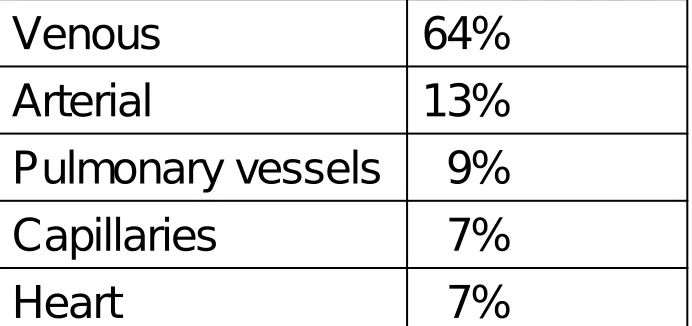
▪ Majority of blood in the venous system
Table 8-3 Distribution of Blood in the
Cardiovascular System
Blood is distributed in the various components of the cardiovascular system as follows.
Venous 64%
Arterial 13%
Pulmonary vessels 9%
Capillaries 7%
Copyright © 2018, 2014, 2010 Pearson Education, Inc. All Rights Reserved
Components Necessary for Adequate
Perfusion
(37 of 52)• Blood Volume
– Hydrostatic Pressure
▪ Force inside the vessel or capillary bed generated
by the contraction of the heart and the blood pressure.
▪ Hydrostatic pressure exerts a “push” inside the
Components Necessary for Adequate
Perfusion
(38 of 52)• Blood Volume
– Plasma oncotic pressure
▪ Keeps fluid inside the vessels to oppose
hydrostatic pressure.
▪ The large plasma proteins have the effect of
Copyright © 2018, 2014, 2010 Pearson Education, Inc. All Rights Reserved
Hydrostatic Pressure Pushes Water out of the
Components Necessary for Adequate
Perfusion
(39 of 52)• Pump Function of the Myocardium
– The myocardium must be an effective pump to
maintain perfusion.
▪ Cardiac output (CO) is the amount of blood ejected
from the heart in one minute.
Copyright © 2018, 2014, 2010 Pearson Education, Inc. All Rights Reserved
Components Necessary for Adequate
Perfusion
(40 of 52)• Pump Function of the Myocardium
– The myocardium must be an effective pump to
maintain perfusion.
▪ Heart Rate
– Sympathetic
Components Necessary for Adequate
Perfusion
(41 of 52)• Pump Function of the Myocardium
– The myocardium must be an effective pump to
maintain perfusion.
▪ Stroke Volume
– Preload
– Contractility
Copyright © 2018, 2014, 2010 Pearson Education, Inc. All Rights Reserved
Components Necessary for Adequate
Perfusion
(42 of 52)• Pump Function of the Myocardium
– Factors that increase cardiac output
▪ Increased heart rate (to a point)
▪ Increased blood volume
▪ Increased myocardial contractility
▪ Sympathetic nervous system stimulation
▪ Beta1 stimulation from epinephrine
Components Necessary for Adequate
Perfusion
(43 of 52)• Pump Function of the Myocardium
– Factors that decrease cardiac output
▪ Decreased heart rate
▪ Decreased blood volume
▪ Decreased myocardial contractility
▪ Parasympathetic nervous stimulation
▪ Beta1 blockade (beta blockers)
Copyright © 2018, 2014, 2010 Pearson Education, Inc. All Rights Reserved
Components Necessary for Adequate
Perfusion
(44 of 52)• Systemic Vascular Resistance (SVR)
– SVR is the resistance to blood flow through a vessel.
– Vasoconstriction increases SVR, increased SVR
increases BP.
– Vasodilation decreases SVR, decreased SVR
Copyright © 2018, 2014, 2010 Pearson Education, Inc. All Rights Reserved
Components Necessary for Adequate
Perfusion
(45 of 52)• Systemic Vascular Resistance Effect on Blood Pressure
– Pulse pressure is the difference between the systolic
and the diastolic BP readings.
▪ Systolic BP is a rough indicator of CO.
Components Necessary for Adequate
Perfusion
(46 of 52)• Microcirculation
– Refers to the flow of blood through the arterioles,
Copyright © 2018, 2014, 2010 Pearson Education, Inc. All Rights Reserved
Microcirculation is the Flow of Blood through the
Smallest Blood Vessels: Arterioles, Capillaries, and
Venules
Components Necessary for Adequate
Perfusion
(47 of 52)• Microcirculation
– Precapillary sphincters
▪ Regulatory influences on sphincters
1. Local factors
2. Neural factors
Copyright © 2018, 2014, 2010 Pearson Education, Inc. All Rights Reserved
Components Necessary for Adequate
Perfusion
(48 of 52)• Blood Pressure (BP)
– Blood pressure = CO × S VR
▪ Relationship of SV & HR on CO
– Increased SV increases CO.
– Decreased SV decreases CO.
– Increased HR increases CO.
Components Necessary for Adequate
Perfusion
(49 of 52)• Blood Pressure (BP)
– Blood pressure = CO × S VR
▪ Relationship of CO & SVR on BP
– Increased CO increases BP.
– Decreased CO decreases BP.
– Increased SVR increases BP.
Copyright © 2018, 2014, 2010 Pearson Education, Inc. All Rights Reserved
Components Necessary for Adequate
Perfusion
(50 of 52)• Blood Pressure
– The general effect of blood pressure on perfusion is:
▪ Increased BP increases cellular perfusion.
Components Necessary for Adequate
Perfusion
(51 of 52)• Blood Pressure
– Regulation of BP by Baroreceptors.
▪ Baroreceptors located in the aortic arch and
carotid sinuses detect changes in blood pressure.
▪ Signals are sent to the vasomotor and
Copyright © 2018, 2014, 2010 Pearson Education, Inc. All Rights Reserved
Baroreceptor Function and Influence on
Components Necessary for Adequate
Perfusion
(52 of 52)• Blood Pressure
– Regulation of BP by Chemoreceptors
▪ A decrease in blood oxygen level stimulates the
sympathetic nervous system.
▪ Heart rate increases and blood vessels constrict.
▪ Hypoxia can present with pale, cool skin, and
Review of Aerobic Metabolism
Components
(1 of 4)1. Oxygen content in ambient air
2. Patency of the airway
3. Minute ventilation
– Ventilatory rate
– Tidal volume
4. Alveolar ventilation
Copyright © 2018, 2014, 2010 Pearson Education, Inc. All Rights Reserved
Review of Aerobic Metabolism
Components
(2 of 4)5. Perfusion in the Pulmonary Capillaries
– Venous volume
– Right ventricular pump function
6. Gas Exchange Between the Capillaries and the Alveoli
7. Content of blood
– Red blood cells and Hemoglobin
Review of Aerobic Metabolism
Components
(3 of 4)8. Cardiac Output and Determinants
– Heart rate
– Preload
– Stroke volume
– Myocardial contractility
Copyright © 2018, 2014, 2010 Pearson Education, Inc. All Rights Reserved
Review of Aerobic Metabolism
Components
(4 of 4)9. Systemic Vascular Resistance
– Sympathetic nervous system stimulation
– Parasympathetic nervous system stimulation
Case Study Conclusion
(1 of 2)The patient has a history of chronic obstructive lung
disease and heart failure. He has been increasingly short of breath for two days, with a sudden worsening today.
With the assistance of an engine crew, Patty and Gus
Copyright © 2018, 2014, 2010 Pearson Education, Inc. All Rights Reserved
Case Study Conclusion
(2 of 2)The crew recognizes the seriousness of the patient’s condition and is prepared to take further measures, if needed, to maintain the patient's airway.
Gus calls in a report to the receiving hospital. When they
arrive at the ED, a physician, nurse, and respiratory
Lesson Summary
• Cells require oxygen and glucose to produce energy and
perform work.
• Without adequate ventilation and perfusion, cells engage
in anaerobic metabolism, which produces less energy and more waste.
• A fundamental purpose of emergency care is to restore
Copyright © 2018, 2014, 2010 Pearson Education, Inc. All Rights Reserved
Correct!
(1 of 3)• Your answer is supported by two principles of physics.
– First, according to Boyle’s law, the pressure of a gas
varies inversely with its volume.
– Second, air (a mixture of gases) moves from areas of
Correct!
(2 of 3)• When the diaphragm and intercostal muscles contract,
the thoracic cavity increases in volume, which lowers the pressure in the thorax and lungs. Air flows from the
higher atmospheric pressure into the area of lower pressure within the lungs.
Copyright © 2018, 2014, 2010 Pearson Education, Inc. All Rights Reserved
Incorrect
(1 of 4)• When the diaphragm relaxes, it rises into the chest
cavity, making it smaller, which promotes exhalation.
Incorrect
(2 of 4)• According to Boyle’s law, when the volume of a gas
decreases, such as happens to the gas within the thorax when the size of the thorax decreases, the pressure of the gas increases. In the case of ventilation, this action promotes exhalation.
Copyright © 2018, 2014, 2010 Pearson Education, Inc. All Rights Reserved
Incorrect
(3 of 4)• When the intercostal muscles relax, the volume of the
thoracic cavity decreases in size, which increases the pressure within thorax. This action promotes exhalation.
Correct
• Most oxygen transported in the blood is carried by
hemoglobin. Each molecule of hemoglobin contains iron, to which the oxygen can bind. Each hemoglobin molecule provides four binding sites, which allow it to carry up to four molecules of oxygen.
Copyright © 2018, 2014, 2010 Pearson Education, Inc. All Rights Reserved
Correct!
(3 of 3)• The loss of hemoglobin-containing red blood cells, such
as through hemorrhage, is a loss of oxygen-carrying capacity. Controlling bleeding is a critical way to help preserve a patient’s ability to deliver oxygen to his cells.
Incorrect
(4 of 4)• This is not the way most oxygen is transported in the
blood. Return to the quiz to try again.