Review Article
Performance characteristics of recycled concrete aggregate as an unbound
pavement material
S. Jayakody
b,*, C. Gallage
a, J. Ramanujam
aaSchool of Civil Engineering&Built Environment, Science and Engineering Faculty, Queensland University of Technology, Brisbane, Australia bFaculty of Engineering, South Eastern University of Sri Lanka, P.O. Box 01, University Park, Oluvil, Sri Lanka
A R T I C L E I N F O
Keywords: Civil engineering Repeated load tri-axial Pavement engineering Recycled construction materials Resilient modulus
Plastic strain
Geotechnical engineering Materials characterization Mechanical property Physical property
A B S T R A C T
Use of recycled concrete aggregates (RCA) as a pavement material is one of the most sustainable engineering applications for the pavement industry. Investigation on the performance characteristics of RCA, such as elastic and plastic deformations of RCA is therefore, needed to assess RCA's application as an unbound pavement ma-terial. In this study, repeated load tri-axial (RLT) tests were conducted to investigate the response of RCA to elastic and plastic deformations under dynamic loads. The elastic and plastic properties were analysed through the ‘resilient modulus’and the accumulation of plastic strain, respectively, at different confining stresses and moisture contents of the RCA specimens. The results from the tests revealed a steady gain of stiffness of the RCA specimens with an increase of load cycles at low moisture contents, high confining pressures and high vertical axial pressure.
1. Introduction
Aggregates from non-conventional material sources such as reclaimed glass, ash andfly ash, industrial slag, reclaimed asphalt and recycled concrete aggregates (RCA) are becoming very popular in the construction industry (Andrews and Rebbechi, 2009). Reuse of these materials helps address some of the current issues related to waste generation and mining of natural resources. Further benefits could be obtained by waste pre-vention, energy saving, conservation of natural mineral resources and avoiding of landfilling (Ponte, 2016).
Production of RCA is a rapidly growing industry, since it has a much higher potential to be used as a construction material compared to many other recycled materials (Ismail and Ramli, 2013;Huang et al., 2007; Oikonomou, 2005). Utilization of RCA in granular layers in flexible pavements is a viable alternative since roads typically demand a huge volume of crushed aggregates (Recycling, 2004). The subsurface layers of flexible pavements should be constructed with adequate stiffness to sustain the traffic load and efficiently spread the load to avoid any damage to the sub-grade. Therefore, the compacted RCA should be demonstrated to have an adequate strength and stiffness as a subsurface pavement material and needs to be examined through its performance characteristics.
RCA have been subjected to many research studies to investigate their properties and ascertain their applicability as pavement materials over the past years (Jayakody et al., 2014;Gobieanandh and Jayakody, 2016). Many studies revealed that the strength properties of RCA were compa-rable to those of the conventional pavement aggregates even with con-stituents, such as asphalt, bricks and glass (Jayakody et al., 2017; Arulrajah et al., 2014). Further investigations on RCA are needed to determine their performance characteristics under repetitive loads since only a few researchfindings are available on this topic. The performance characteristics of RCA depend on the constituents and the quality of the parent concretes, and thus, can be examined by their response to elastic and plastic deformations under repetitive loads. The outcome of such a study is highly valuable in standardising RCA as an unbound pavement material and also in convincing the contractors of RCA's reliability.
Elastic property of a material under dynamic loads is reflected by its ‘resilient modulus’ which is used as a key parameter in pavement designing (Jameson and Group, 2008).Nataatmadja and Tan (2001) studied the elastic behaviour of RCA and emphasised the role of residual cement in the high resilient modulus of RCA. The physical properties of RCA, such as well-graded particle size distribution (Nataatmadja and Tan, 2001) and high compaction (Leite et al., 2011) have significantly contributed to its high resilient modulus.Arulrajah et al. (2012)further
* Corresponding author.
E-mail address:[email protected](S. Jayakody).
Contents lists available atScienceDirect
Heliyon
journal homepage:www.heliyon.com
https://doi.org/10.1016/j.heliyon.2019.e02494
Received 12 February 2019; Received in revised form 23 June 2019; Accepted 16 September 2019
2405-8440/©2019 The Author(s). Published by Elsevier Ltd. This is an open access article under the CC BY-NC-ND license (
http://creativecommons.org/licenses/by-nc-nd/4.0/).
emphasised on the significance of compaction and observed the highest resilient modulus of RCA at a relative compaction of 98% based on the ‘modified proctor compaction’ method. Gabr and Cameron (2012) compared the resilient modulus of RCA with that of Quartzite aggregates and found a remarkable behaviour of RCA at a low moisture content which was 60% of the optimum moisture content (OMC).Arulrajah et al. (2013)further studied the influence of moisture on the resilient behav-iour of RCA and showed that having high moisture content of about 75% of the OMC reduced the strength of RCA, possibly leading to their failure. Further studies byGabr and Cameron (2012)andArshad and Ahmed (2017) on RCA with alternative materials, such as reclaimed asphalt pavement (RAP) materials and clayfines have demonstrated high resil-ient properties which were comparable to those of high quality con-ventional pavement materials.
Determination of the plastic deformation characteristics of RCA helps estimate the rutting resistance when RCA are applied as unbound pave-ment materials. Rutting is one of the primary distress modes that diminish the performance of the unbound pavements (Myers et al., 2005).Jr et al. (1998)compared the plastic deformation of RCA with that of the RAP materials. Their results showed that RCA performed better than the RAP materials. Similar tests were carried out byBennert et al. (2000)who further confirmed the above results.Arulrajah et al. (2012) observed that the strain gaining of compacted RCA specimens was at its minimum when the moisture content was 60% of the OMC. Further studies revealed that the presence of more residual cement in RCA adversely affected the formation of shrinkage cracks and reflective cracks in the compacted RCA specimens under loading (Arulrajah et al., 2014). Gabr and Cameron (2012)recorded lower plastic strain in the compacted RCA than in the conventional aggregates at low moisture contents. However, their study signified the role of well graded distribution of particle size in the range of standard specifications and high density after the compaction. On the other hand,Arulrajah et al. (2014)reported a greater plastic strain when more constituents were present, such as RAP materials in RCA.
Thus, further investigation on the performance characteristics of RCA is required to ascertain their behaviour in the base course and the sub-base course in pavements. Repeated load tri-axial (RLT) test is recog-nized as the preferred laboratory scale test to evaluate the performance of pavement materials through elastic and plastic deformation character-istics at different conditions of moisture content and stress with respect to repetitive loads. However, constitutive models are typically used to predict the non-linear resilient behaviour of granular materials since conducting the RLT test is not widely prevalent owing to its complexity, high cost and the time-required. Constitutive model equations available in literature were derived for particular materials. However, the appli-cation of such constitutive models could result in uncertainties for other materials owing to factors, such as the inconsistent behaviour of each material with its own constituents, differences in the inherent properties of each material source and simplification of the models (insufficient parameters). Therefore, it is necessary to validate the existing constitu-tive models for RCA. In this research, this was accomplished by con-ducting a comprehensive experimental program of RLT tests on RCA specimens. Resilient behaviour and plastic deformation characteristics were obtained from the RLT tests at different stress and moisture con-ditions and analysed to enhance the constitutive models, which were then used to estimate the resilient modulus of the RCA specimens, by taking their water content into account. The enhanced constitutive models were again validated by additional RLT tests and were used to estimate the resilient modulus of the RCA specimens under different stress and moisture conditions. In addition, the accumulation of plastic strain of the RCA specimens at different stress and moisture conditions was analysed in terms of“Shakedown concept”to assess the vulnerability of the compacted RCA by accumulating plastic deformation under re-petitive loading.
2. Main text
2.1. Tests material
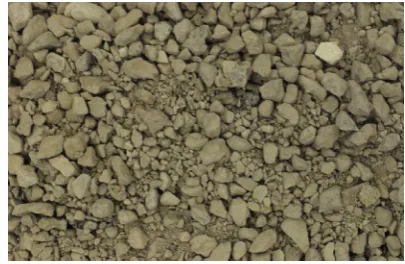
Commercially available RCA was employed in this experimental program. The RCA specimens were obtained from a leading concrete recycling company in Queensland, Australia and a representative sample is shown in Fig. 1. The RCA samples were produced by crushing demolished concrete structures and separating out the attachable waste (such as bricks, glass, asphalt and wood) to avoid mixing. Therefore, the tested RCA samples were free from the constituents (Alex Fraser Group, 2011).
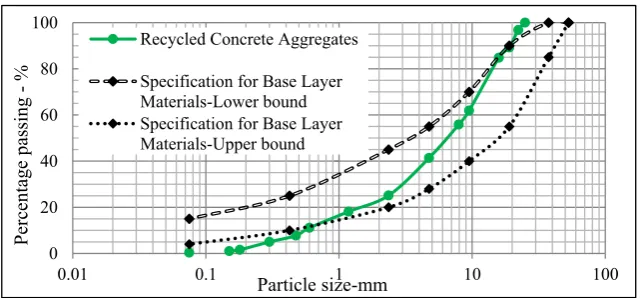
The particle size distribution (PSD), physical properties and strength properties of the RCA samples were determined and shown inFig. 2and Table 1as a reference. These values were extracted from a previous research study byJayakody et al. (2017)since the same lot of the RCA samples was used for this test program as well. The PSD of the RCA samples is plotted inFig. 2along with the upper and lower boundaries of the PSDs of the base layer granular materials specified by the Department of transport and main roads in Queensland (QDTMR), Australia (Main-Roads, 2010). The PSD curve of the RCA samples shows that there were particles larger than 20 mm and smaller than 0.6 mm that did not conform to the standard specifications.
The physical properties of the RCA specimens inTable 1show that the ‘Atterberg limits’of the samples were within the range of the standard specifications of high quality pavement materials as specified by QDTMR. However, the water absorption values of coarser andfiner fractions of RCA specimens are high due to the presence offines of cement mortar, bricks and tiles. The OMC was close to the upper margin of the high quality materials, while the maximum dry density (MDD) was below that of the high quality pavement material. This was due to the lack of coarser particles and high water absorption capacity of RCA compared to the standard granular pavement material. On the other hand, the California bearing ratio of the RCA samples reflected high strength that was greater than the minimum standard specifications of the base course material of high volume pavements.
2.2. Methodology
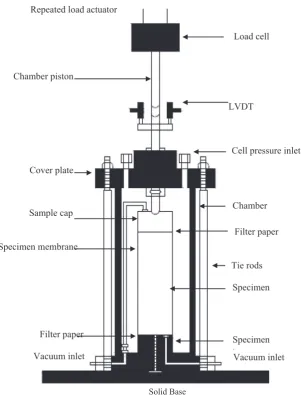
The elastic and the plastic deformation characteristics of the RCA specimens were determined by conducting a series of RLT tests on the compacted specimens at different moisture contents and stress condi-tions. The schematic of the RLT test apparatus is shown inFig. 3which consisted of a cylindrical RCA specimen of 100 mm diameter and 200 mm height. The confining pressure was applied by pressurizing the air in the cell and it was continuously monitored by a transducer connected to the cell. The repeated vertical axial load was applied on top of the specimen by a pneumatic actuator which was connected to the vertical shaft. The maximum applicable load by the actuator was 12 kN with a
maximum stroke of 30 mm. The vertical deformation of the specimen was calculated by averaging the measurements provided by two linear vari-able differential transformers (LVDTs) attached to the vertical shaft. Cell pressure transducers and the load cell were connected to a data logging system which collected the responses of the transducers at specified time intervals.
RLT tests were conducted according to the test method
“Q137–Permanent deformation and resilient modulus of granular mate-rials” of DTMR, Queensland (MainRoads, 2013). The RLT test pro-gramme is shown in Table 2. The tests were conducted for different confining pressures (σ3) values, namely 25, 75, 125 and 175 kPa. Vertical stress (σ1)was gradually increased to 300, 450, 600 and 750 kPa for a constant value ofσ3in each test.σ1was changed after 10,000 load cycles. Thus, each RLT test was operated for 40,000 load cycles under afixed constantσ3. Test specimens were prepared at four different water con-tents (w) and compacted to the MDD. The predetermined water contents were as per the corresponding degrees of saturation (DoS)—60%, 68%, 75% and 80%. The 60% DoS represents the water content which is applied in the industry to compact the unbound granular pavement layers (Bodin et al., 2013). The 68% of DoS represents the OMC of RCA. DoS of 75% and 80% represent the water contents above the OMC of RCA.
2.2.1. Preparation of test specimens
Oven dried RCA samples were mixed with pre-determined water contents (i.e., 11.6, 13.2, 14.5 and 15.5 %) and left for 3 h to allow for the homogenization of the moisture (Jayakody et al., 2014). Then the sam-ples were compacted to achieve an MDD of 1.75 g/cm3in a split mould of 100 mm diameter and 200 mm height. The compacted samples were cured in sealed containers for four days to allow for strength gaining by
re-cementation (Gallage et al., 2014). The compacted specimens were then enclosed in a 0.8 mm thick rubber membrane and set in the RLT apparatus. The specimen was sealed at the top and the bottom and a predeterminedσ3was applied and allowed to consolidate for about an
hour, which was determined to be sufficient in the pre-tests.
2.2.2. Loading and data interpretation
The vertical axial load,σ1was repeatedly applied as a wave form on the consolidated sample under undrained conditions. Constant contact stress was applied (5% ofσ1) to ensure continuous and constant contact between the actuator piston and the top plate during the dynamic loading. Four different magnitudes of vertical stresses were applied
—300, 450, 600 and 750 kPa in each test under a constant confining pressure and each vertical load was run for 10,000 load cycles. Thus, each test specimen was subjected to 40,000 vertical axial repeated load cycles under a constant confining pressure.
The results of the RLT tests were analysed to estimate the plastic deformation characteristics and to enhance the chosen constitutive models to predict the resilient modulus of the RCA specimens. Three constitutive model equations were chosen from the literature and their model parameters were modified by non-linear regression analysis to develop a relationship between the resilient modulus and the variables, namely moisture content, mean stress and octahedral shear stress. Non-linear regression analysis was performed with the statistical software, MATLAB®version 7.1.
2.3. Results&discussion
The results of the RLT test series were analysed to enhance the constitutive models to predict the resilient modulus, takingwof the RCA specimens into account. The RLT test results were further analysed to estimate the accumulation of plastic strain of RCA at different values ofw and stress conditions.
2.3.1. Resilient modulus of RCA
Fig. 4presents the behaviour of the resilient moduli, Mrof the
com-pacted RCA specimens as a function of load cycles at different values ofw. Mrof the RCA specimens at each moisture level rapidly increased at the
beginning of the load repetitions since the specimens were subjected to densification with initial vertical loadings. Conversely, the test results showed a reduction of Mraswwas increased. According toThom and
Brown (1987), water induces a lubricating effect on the particles when the moisture content is below the fully saturated condition in an aggre-gate assembly. Therefore, stiffness of the compacted material decreases due to the reduction of inter-particle bonds and consequently, Mr
de-creases with increasing moisture content. In our experiments, Mrof the
compacted RCA specimens gradually increased with an increase ofσ1and the number of repeated load cycles owing to the densification. However,
0
20
40
60
80
100
0.01
0.1
1
10
100
Percentage passing
-%
Particle size-mm
Recycled Concrete Aggregates
Specification for Base Layer
Materials-Lower bound
Specification for Base Layer
Materials-Upper bound
Fig. 2.PSD curves of the RCA samples with upper and lower limit curves of the standard base layer materials (Jayakody et al., 2017).
Table 1
Physical properties of RCA (Jayakody et al., 2017).
Property Values
RCA Standard granular pavement material
Liquid Limit (LL) [%] 21.00 Maximum: 25 (MainRoads, 2010)
Plasticity Index (PI) [%] 5.40 Maximum: 6 (MainRoads, 2010) Linear Shrinkage (LS) [%] 1.00 Maximum: 3.5 (MainRoads,
2010) Water absorption (particles<4.25
mm) [%]
7.35 <10 (Arulrajah et al., 2013)
Water absorption (particles>4.25 mm) [%]
6.50 <10 (Arulrajah et al., 2013)
Specific gravity (Gs) 2.64 2.85 (Vegas et al., 2008) Maximum dry density (MDD) [g/cm3] 1.75 >1.79 (Arulrajah et al., 2013) Optimum moisture content (OMC) [%] 13.20 8-15 (Arulrajah et al., 2013) California Bearing Ratio (4 days
soaked) [%]
the rate of increase of Mrwith the number of load repetitions gradually
decreased, suggesting the onset of steady state conditions (i.e., no further change in Mrwith loading cycles), which can be termed as“shakedown
response” (Cerni et al., 2012). Once the samples achieved the
steady-state, neither plastic strain nor densification was accumulated in the material and Mralso attained a steady state due to the steadiness of
the elastic deformation with the number of load cycles. Achieving the state of shakedown limit by the compacted RCA indicates the increase of
LVDT
Vacuum inlet
Load cell
Cell pressure inlet
Tie rods
Specimen
Specimen
b
Vacuum inlet
Solid Base
Chamber
Filter paper
Specimen membrane
Repeated load actuator
Sample cap
Filter paper
Cover plate
Chamber piston
Fig. 3. Schematic of the RLT Chamber with a specimen.
Table 2
Summary of the RLT test programme.
Water content (w; %) Density (*MDD; g/cm3) *DoS (%) Confining pressure (σ
3; kPa) Vertical stress (σ1; kPa) Number of load cycles
11.62 1.75 60 25 300 450 600 750 10,000 for each vertical stress condition
75 125 175
13.2 (OMC) 1.75 68 25 300 450 600 750
75 125 175
14.53 1.75 75 25 300 450 600 750
75 125 175
15.5 1.75 80 25 300 450 600 750
75 125 175
resistance to elastic deformation under continuous load repetitions similar to the case of high quality pavement materials which also show steadiness of Mr due to the increase of stiffness and approach the
shakedown limit with an increase in the number of axial load cycles (Vuong and Hazell, 2003; Ekblad and Isacsson, 2006). Achieving the shakedown limit with load repetitions reflects the stability of the stiffness of the compacted RCA and its ability to provide high quality unbound layers in the pavements.
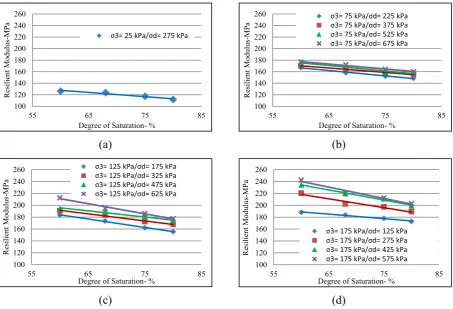
Fig. 5shows the calculated Mrat different DoS and different stress
conditions. The Mrvalues were obtained at the 10,000thload cycle
cor-responding to each deviator stress,σdð¼σ1σ3Þat a constantσ3. The
graphs illustrate the decrease of Mrwith an increase in the DoS in the
compacted RCA specimens. Conversely, the Mrvalues slightly increased
with an increase of the stress ratio, (σd/σ3) and the bulk stress,θ(¼ σ1þσ2þσ3).
Water lubricates and reduces the frictional resistance between the particles, which in turn, caused a reduction of stiffness and Mr. Thus, the
excess pore water pressure decreased the stiffness of the compacted RCA specimens and the best performance was achieved at the lowest moisture level, i.e., 60% DoS. However, the Mrvalues did not vary significantly as
DoS varied from 60% to 80%. Water is more readily held in the pores of the cement mortar and crushedfines of RCA than in the conventional aggregates and thefines do not allow water to drain freely (Raad et al., 1992). This implies low sensitivity of the compacted RCA's resilient
100 120 140 160 180 200 220
0
10000
20000
30000
40000
Resilien
t Mo
dulus
-MPa
No of load cycles
w=11.62% (DoS 60%) w=13.2% (DoS 68%) w=14.53% (DoS 75%) w=15.5% (DoS 80%)
Confining Pressure = 125 kPa
σ
d=
175 kPaσ
d=
325 kPaσ
d=
475 kPaσ
d=
625 kPaFig. 4.Variation of Mrof the RCA specimens with number of load cycles at different amounts ofw.
(a)
(b)
(c)
(d)
100 120 140 160 180 200 220 240 260
55 65 75 85
Resilient Mod
u
lus
-MPa
Degree of Saturation- %
σ3= 25 kPa/σd= 275 kPa
100 120 140 160 180 200 220 240 260
55 65 75 85
Resilient Mod
u
lus
-MPa
Degree of Saturation- %
σ3= 75 kPa/σd= 225 kPa σ3= 75 kPa/σd= 375 kPa σ3= 75 kPa/σd= 525 kPa σ3= 75 kPa/σd= 675 kPa
100 120 140 160 180 200 220 240 260
55 65 75 85
Resilient Mod
u
lus
-MPa
Degree of Saturation- %
σ3= 125 kPa/σd= 175 kPa σ3= 125 kPa/σd= 325 kPa σ3= 125 kPa/σd= 475 kPa σ3= 125 kPa/σd= 625 kPa
100 120 140 160 180 200 220 240 260
55 65 75 85
Re
si
li
ent
Modul
us
-M
Pa
Degree of Saturation- %
σ3= 175 kPa/σd= 125 kPa σ3= 175 kPa/σd= 275 kPa σ3= 175 kPa/σd= 425 kPa σ3= 175 kPa/σd= 575 kPa
behaviour to moisture content.
Fig. 5a shows only one line graph for the variation of Mrat aσ1of 300
kPa (σd¼275 kPa), since the compacted RCA could not withstandσ1
beyond 300 kPa under a lowσ3of 25 kPa. The specimens failed whenσ1
was increased to 450 kPa where the stress ratio of the principal axial stress to the confining pressure (σ1/σ3) was as high as 12. The line graphs
ofFig. 5b are very close which suggests that Mrincreased only slightly
even thoughσd was increased significantly at a constantσ3of 75 kPa.
However, Mrdecreased considerably with an increase of DoS. The plots
in thefigure reflect the poor response of the resilient deformation at low
σ3eventhoughσd was increased. It may be noticed that the four line
graphs inFig. 5c are scattered and more so inFig. 5d, which represent 125 and 175 kPa ofσ3, respectively. These plots depict the effect ofσ1,
which had more influence on Mrat high values ofσ3(e.g., 125 and 175
kPa). Therefore, it can be concluded that RCA exhibited high Mrand high
resistance to elastic deformation at high confining pressures much like the conventional granular materials (Rada and Witczak, 1981). Accord-ing toMaher et al. (2000), hardening of elastic strain can be expected due to the reorientation of the particles into a denser state. Therefore, the compacted specimens of RCA became stiffer with further load repetitions and this had the effect of gradually decreasing the resilient deformation and resulting in higher Mr.
RLT test was also performed on three types of high quality conven-tional aggregates under standard stress conditions and at 60% DoS. Their Mrvalues were 275, 290 and 450 MPa at the end of 50,000 load cycles
(Jayakody, 2014) were greater than the Mrof the RCA specimens (which
were in the range of 233–247 MPa at 60% DoS). Although, the tested RCA samples had lower Mrvalues than the high quality base layer
ma-terials, RCA exhibited a trend of continuously increasing Mrwith more
load cycles as shown inFig. 4. Therefore, greater Mrcould be predicted
due to the continuous gaining of the stiffness of the compacted RCA.
2.3.1.1. Constitutive models for the Mr of RCA.Determination of the
resilient characteristics of the pavement materials on a regular basis is not feasible since the RLT test facilities are not widely available. There-fore, constitutive models have been introduced by researchers (Seed et al., 1967;Witczak and Uzan, 1988;Ooi et al., 2006) to predict the Mrof
granular road materials. However, there is no such constitutive model available to estimate the Mrof RCA.
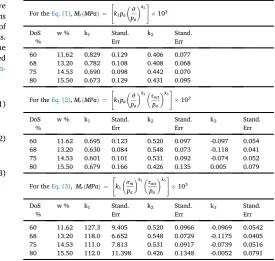
In this study, three constitutive model equations were selected from literature to be applied on RCA. These constitutive model equations have been developed based on conventional materials. Hence, modifications were required prior to their application on RCA for accurate estimation of the resilient properties under different stress and moisture conditions. The chosen equations are presented below as“Eqs.(1),(2), and(3)”. The model parameters (k1, k2, k3) in these equations were modified based
on the RLT test results (Hicks, 1970;Witczak and Uzan, 1988; Main-Roads, 2009).
Mr¼k1pa
θ
pa
k2
(1)
Mr¼k1pa
θ
pa
k2τ
oct
pa
k3
(2)
Mr¼k1
σ
m
pa
k2τ
oct
pa
k3
(3)
Where;
Mr¼Resilient Modulus,
pa¼Atmospheric pressure (103.4 kPa),
θ¼Bulk stress (σ1þσ2þσ3Þ; σm¼Mean stress (ðσ1þσ2þσ3Þ=3Þ,
σ1¼Principal axial stresses,
σ3¼Confining pressure,
σd¼Deviator stress (σ1 σ3Þ,
τoct ¼ Octahedral shear stress ¼
13= ½ðσ1σ2Þ2
þ ðσ2σ3Þ2
þ ðσ3σ1Þ2 12=
,
For the axisymmetric stress conditions in the RLT test“σ2¼σ3”and “σffiffi1-σ3¼σd”. Hence the octahedral shear stress is reduced to: τoct¼
2
p
3 (σd),
k1,k2,k3are model parameters.
The extracted Mrvalues from the results of the RLT tests were
ana-lysed by non-linear regression analysis to develop correlations for the constitutive model parametersk1,k2andk3in each equation. The
ob-tained bestfitting model curves derived the values for thek1,k2andk3for
different moisture contents of each equation and they are summarized in Table 3. Each constitutive model was multiplied by 103to present the resilient modulus in“MPa”.
The obtained model parameters were then correlated with the moisture contents to define common expressions for the model param-etersk1,k2andk3in each constitutive model. The bestfitting graphs for
the model parameters in terms of“k”values versus moisture contents were drawn to correlate“k”with moisture content (w) and express it a function of water content. These correlations are shown below for Eqs. (1), (2), and (3) respectively with the corresponding R2 values. The defined expressions of the model parameters in terms of w were suc-cessfullyfitted to predict Mrof RCA.
Model parameters ofEq. (1)(R2¼ 0.9611 and 0.7 fork1andk2,
respectively)
k1¼(0.0435) wþ1.3397
k2¼(0.0088) wþ0.3009
Model parameters ofEq. (2)(R2¼0.874, 0.944 and 0.9983 fork1,k2
andk3,respectively)
k1¼(0.0201) w2(0.5517) wþ0.4008
k2¼(0.0216) w2þ(0.5629) w3.1144
Table 3
Thekvalues in the three equations at different moisture contents.
For theEq. (1),MrðMPaÞ ¼
"
k1pa
θ pa
k2# 103
DoS %
w % k1 Stand. Err
k2 Stand. Err
60 11.62 0.829 0.129 0.406 0.077 68 13.20 0.782 0.108 0.408 0.068 75 14.53 0.690 0.098 0.442 0.070 80 15.50 0.673 0.129 0.431 0.095
For theEq. (2),MrðMPaÞ ¼
"
k1pa
θ pa
k2τ oct pa
k3# 103
DoS %
w % k1 Stand. Err
k2 Stand. Err
k3 Stand. Err
60 11.62 0.695 0.123 0.520 0.097 -0.097 0.054 68 13.20 0.630 0.084 0.548 0.073 -0.118 0.041 75 14.53 0.601 0.101 0.531 0.092 -0.074 0.052 80 15.50 0.679 0.166 0.426 0.135 0.005 0.079
For theEq. (3),MrðMPaÞ ¼
"
k1 σ
m pa
k2τ oct pa
k3# 103
DoS %
w % k1 Stand. Err
k2 Stand. Err
k3 Stand. Err
60 11.62 127.3 9.405 0.520 0.0966 -0.0969 0.0542 68 13.20 118.0 6.652 0.548 0.0729 -0.1175 0.0405 75 14.53 111.0 7.813 0.531 0.0917 -0.0739 0.0516 80 15.50 112.0 11.398 0.426 0.1348 -0.0052 0.0791
k3¼(0.0177) w2(0.4531) wþ2.7834
Model parameters ofEq. (3)(R2¼0.9807, 0.9437 and 0.99 fork1,k2
andk3,respectively)
k1¼(1.1099) w2(34.264) wþ375.87
k2¼(0.0216) w2þ(0.5639) w3.1221
k3¼(0.016) w2(0.4111) wþ2.5162
Where
w¼Moisture content in percentage (%). k1, k2andk3¼Model parameters.
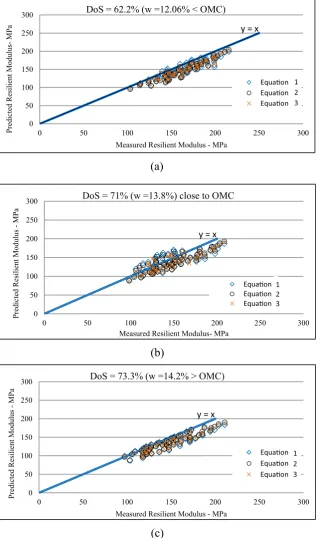
2.3.1.2. Validation of the model parameters. The enhanced constitutive models were validated by conducting additional RLT tests according to the standard method of Austroad APRG 00/33-2000 (Voung and Brim-ble, 2000), at three different values ofwthat correspond to DoS of 62.2%, 71% and 73.3%. Thewvalues of the validated samples were chosen both below and above the OMC of RCA.Fig. 6a–c presents the comparison of the laboratory measured Mr with the predicted Mr values by the
(a)
(b)
(c)
y = x
0 50 100 150 200 250 300
0 50 100 150 200 250 300
Predicted Resilient Modulus
-MPa
Measured Resilient Modulus - MPa
DoS = 62.2% (w =12.06% < OMC)
Equaon 2 Equaon 3 Equaon 4 1 2 3
y = x
0 50 100 150 200 250 300
0 50 100 150 200 250 300
Predicted Resilient Modulus
-M
Pa
Measured Resilient Modulus- MPa
DoS = 71% (w =13.8%) close to OMC
Equaon 2 Equaon 3 Equaon 4 1 2 3
y = x
0 50 100 150 200 250 300
0 50 100 150 200 250 300
Predicted Resilient Modulus
-MPa
Measured Resilient Modulus - MPa
DoS = 73.3% (w =14.2% > OMC)
Equaon 2 Equaon 3 Equaon 4 1 2 3
enhanced constitutive models at the three values ofw. It was assumed that the laboratory measured Mrvalues represented the true Mrof the
tested RCA. Three graphs illustrate a closefit of the measured and the predicted Mrvalues. Therefore, the defined constitutive model
parame-ters of Eqs.1,2, and3are recommended to estimate the Mrof RCA taking winto account. It is important to highlight that the w values have been defined in the range of 60%–80% DoS, which represents the critical moisture variation in the real world.
Furthermore, the predicted Mrvalues from the three equations did
not show significant deviations from one other and were comparable even thoughEq. (1)considered only the bulk stress, while Eqs.(2)and (3)accounted for an additional variable — “octahedral shear stress”. However, it was found that the significance of the component of octa-hedral shear stress was minimal in predicting the Mr.
The predicted and measured Mrvalues showed minor deviations with
an increase ofwfrom below the OMC (62.2% of DoS) to above the OMC (73.3% of DoS) of the compacted RCA. The elastic deformation of RCA was not significantly affected even at a high moisture content (73.3% DoS). The softening effect of the compacted RCA specimens at high moisture levels, over the OMC was apparently low due to the high ab-sorption properties of thefines and conglomerate cement mortar. The steady resilient behaviour of the compacted RCA at high moisture levels emphasizes its high stiffness even if the water table rises when RCA is used in theflexible pavement layers.
2.3.2. Plastic deformation of RCA
Accumulation of vertical plastic strain of the compacted RCA speci-mens with number of load cycles is shown inFig. 7. Thisfigure illustrates the effect ofw and σdon the accumulation of the plastic strain at a constantσ3of 125 kPa.
Thefigure illustrates the increase of plastic strain with number of load cycles at various values ofw. The higher thew, the higher the accumu-lated plastic strain was. Conversely, the rate of increase of plastic strain (plastic strain per loading cycle) diminished as the number of load cycles increased at a constantσdandσ3. The curves show a tendency towards
attaining a steady-state of plastic response (i.e., no accumulation of plastic strain and each response is hysteretic) at the end of the 10000 load cycle range, especially, at the low values ofσdi.e., 175 and 325 kPa.
However, the shapes of the strain curves at highσd, i.e., 475, 625 kPa,
also illustrate a decrease of accumulation of the plastic strain and a tendency to attain a steady state of plastic response with more load cycles beyond 10000. This implies high potential of energy absorption by RCA on each stress-strain excursion and its ability to withstand after gaining minor permanent deformations. Diminishing the plastic strain in RCA with the number of load cycles implies a state of“plastic shakedown
limit”(Cerni et al., 2012). High quality pavement materials indicate the hardening of the plastic strain after certain number of load cycles and deform only elastically thereafter (Werkmeister et al., 2001). Behaviour of the plastic strain of RCA depicts its approach to the region of plastic shakedown limit which establishes its high capacity for load bearing with the least permanent deformation and its suitability as a high quality granular pavement material.
The strain curves show the rise of plastic deformation with increasing wand the principal stress ratio (σd/σ3). However, the magnitudes of the accumulated plastic strains were not much greater even when the moisture content increased in RCA. This is in contrast to many conven-tional pavement materials which exhibit a dramatic increase in plastic strain even with a relatively small increase in the water content (Thom and Brown, 1987). Excess water in the compacted specimens caused lubrication of the particle surfaces and facilitated their movement into air-voids, which consequently, lowered the stiffness and eventually increased the accumulation of plastic strain. Furthermore, the combined effect of high degree of saturation and low permeability resulted in high pore pressure due to the poor drainage of the compacted RCA specimens. The Excessive pore pressure reduced the effective stress and conse-quently, decreased the shear strength of the interlocked particles. How-ever, the presence of adequate amount of moisture which was below the OMC of the RCA positively affected the strength and stiffness of the compacted RCA specimens, and lowered the accumulation of plastic deformation. On the other hand, RCA specimens did not collapse under repetitive loads even though the accumulated vertical strains were high at the moisture contents above the OMC. It is a significant performance characteristic of RCA which demonstrates high resistance against plastic deformation at high water contents without collapse.
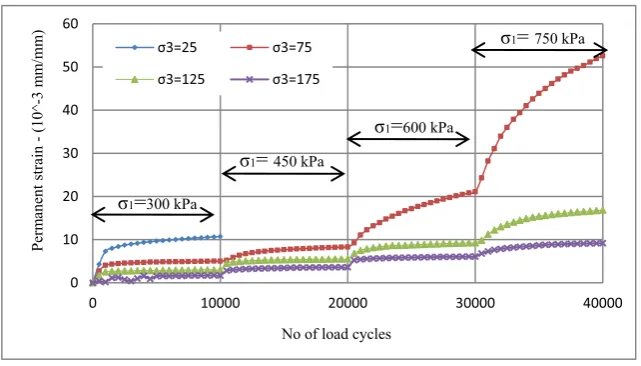
Effects ofσ3on the accumulation of permanent strain of the
com-pacted RCA specimens at OMC are shown inFig. 8. Thefigure illustrates high plastic deformation at low values ofσ3and low deformation at the
high values ofσ3with increasing number of load cycles. Conversely,
accumulation of plastic strain was increased with the increase ofσ1.
The rate of accumulation of plastic strain of the compacted RCA specimens approached zero at the end of thefirst 10,000 load cycles, although theσ3values were not similar in each sample. However, the
RCA specimens failed to carry the load, whenσ1was increased to 450 kPa
at aσ3value of 25 kPa, which signified the inability to carry a high load
under lowσ3. The accumulation of strain at the second stage of 10,000
load cycles also illustrated similar behaviour as thefirst stage forσ3
values of 75, 125, and 175 kPa, whenσ1was 450 kPa. The specimens
exhibited the plastic shakedown limit (rate of strain accumulation de-creases with number of cycles) under highσ3values of 125 and 175 kPa
whenσ1was 600 kPa at the third set of 10,000 load cycles. However, the
0 5 10 15 20 25 30
0 10000 20000 30000 40000
Perm
anent strain
-
(10^-3 m
m
/mm
)
No of load cycles
w=11.62% (DoS 60%) w=13.2% (DoS 68%) w=14.53% (DoS 75%) w=15.5% (DoS 80%)
σ
d=
175kPaσ
d=
325kPaσ
d=
475 kPaσ
d=
625kPabehaviour of plastic strain accumulation atσ1¼75 kPa has deviated
away the other two curves and it continued the accumulation of plastic strain at highσ1values of 600 kPa and 750 kPa. The strain curve of
corresponding toσ3of 125 kPa gained slightly more deformation than
that forσ3¼175 kPa underσ1¼750 kPa at the last set of 10,000 load
cycles. However, both curves illustrated gradual hysteresis in their strain gaining which suggested a behaviour of accumulation of plastic defor-mation within the plastic shakedown limit (Cerni et al., 2012).
The resultant plastic strain curves illustrate minor influence ofσ1on
the accumulation of plastic deformation of compacted RCA specimens at the OMC at highσ3values. The rate of deformation also decreased with
increasing number of load cycles and approached zero when the stress ratio,σ1/σ3was low.
3. Conclusions
The performance characteristics of RCA were investigated by con-ducting a series of RLT tests under different moisture and stress condi-tions and the following conclusions were drawn from this study:
Moisture sensitivity on the resilient behaviour of the compacted RCA was low at high moisture contents (in the range of 60 %–80 % of DoS). Therefore, resilient modulus of RCA did not significantly vary within the range of moisture content which was below and above the OMC of RCA.
Densification effect, which increases the resilient modulus of the compacted RCA, was significantly influenced by the increase of load cycles. Similarly, the principal axial stress at high confining pressures resulted in the decrease of the accumulation of the elastic strain and consequently, increased the resilient modulus of the compacted RCA specimens. Thus, the resilient modulus increased with the increase of confining pressure along the constant principal axial stresses. Increase of the stiffness of the compacted RCA was revealed by the
plots of resilient modulus with continuous load cycles. Therefore, high resilient modulus can be predicted with more load cycles, even though the compacted RCA samples exhibited lower resilient modulus values (with 233–247 MPa at 60 % of DoS) than high quality base layer materials (with 275–450 MPa).
The closefit of the measured and the predicted resilient modulus values established that the enhanced correlation parameters of the chosen constitutive models (Eqs.(1),(2), and(3)) were successfully fitted for the prediction of the resilient modulus of the RCA by taking the moisture content and stresses into the account.
Accumulation of plastic strain was not significantly affected by high moisture content over the OMC of the compacted RCA which revealed low sensitivity of the shear strength of the compacted RCA to
moisture. Conversely, the effect of the principal stress was dominant on the accumulation of plastic strain of RCA at low confining pressures.
Accumulation of plastic deformation of RCA approached the range of
“plastic shakedown limit”due to the hardening of the plastic strain with the increase of the load cycles. This is similar to the high quality pavement materials, which also undergo hardening of the plastic strain after a certain number of load cycles and then deform only elastically thereafter. However, very low confining pressures, i.e., below 75 kPa adversely affected the accumulation of plastic defor-mation and resulted in a behaviour that is seen above the plastic shakedown limit.
Declarations
Author contribution statement
Shiran Jayakody: Conceived and designed the experiments; Per-formed the experiments; Analyzed and interpreted the data; Contributed reagents, materials, analysis tools or data; Wrote the paper.
Chaminda Gallage: Conceived and designed the experiments; Analyzed and interpreted the data; Contributed reagents, materials, analysis tools or data; Wrote the paper.
Jothi Ramanujam: Conceived and designed the experiments; Analyzed and interpreted the data; Contributed reagents, materials, analysis tools or data.
Funding statement
This research did not receive any specific grant from funding agencies in the public, commercial, or not-for-profit sectors.
Competing interest statement
The authors declare no conflict of interest.
Additional information
No additional information is available for this paper.
Acknowledgements
The authors acknowledge Queensland University of Technology (QUT) Brisbane, Australia for providing the opportunity to conduct this research. The authors gratefully acknowledge Alex Fraser, Queensland for providing the Recycled Concrete Aggregates (RCA) for this 0
10 20 30 40 50 60
0 10000 20000 30000 40000
Perm
anent strain
-(10^
-3
mm/
m
m
)
No of load cycles
σ3=25 σ3=75
σ3=125 σ3=175
σ
1=
300 kPaσ
1=
450 kPaσ
1=
600 kPaσ
1=
750 kPaexperimental program. The testing facilities provided by the Queensland Department of Transport and Main Roads (QDTMR) are gratefully acknowledged. A special note of gratitude goes to Mr. Glen Barnes, senior laboratory technician at QUT, for his valuable support in conducting the laboratory tests at QUT.
References
Alex Fraser Group, 2011. True and Practical Sustainability [Online]. Available:htt p://www.agic.net.au/alex_fraser_2_read-only_.pdf. Accessed 2014.
Andrews, B., Rebbechi, J., 2009. Guide to Pavement Technology 4E:Recycled Materials. Austroads Incorporated, Australia.
Arshad, M., Ahmed, M.F., 2017. Potential use of reclaimed asphalt pavement and recycled concrete aggregate in base/subbase layers offlexible pavements. Constr. Build. Mater. 83–97.
Arulrajah, A., Piratheepan, J., Ali, M.M.Y., Bo, M.W., 2012. Geotechnical properties of recycled concrete aggregate in pavement sub-base applications. Geotech. Test J. 35.
Arulrajah, A., Piratheepan, J., Disfani, M.M., 2014. Reclaimed asphalt pavement and recycled concrete aggregate blends in pavement subbases: laboratory andfield evaluation. J. Mater. Civ. Eng. 26.
Arulrajah, A., Piratheepan, J., Disfani, M.M., Bo, M.W., 2013. Geotechnical and geoenvironmental properties of recycled construction and demolition materials in pavement subbase applications. J. Mater. Civ. Eng. 25, 1077–1088.
Bennert, T., Papp, W.J., Maher, A., Gucunski, N., 2000. Utilization of construction and demolition debris under traffic-type loading in base and subbase applications. Transp. Res. Rec. 33–39.
Bodin, D., Moffatt, M., Jameson, G., Group, A., 2013. Development of a Wheel-Tracking Test for Rut Resistance Characterisation of Unbound Granular Materials. Austroads Technical Report. Austroads Ltd, Sydney, NSW, Australia.
Cerni, G., Cardone, F., Virgili, A., Camilli, S., 2012. Characterisation of permanent deformation behaviour of unbound granular materials under repeated triaxial loading. Constr. Build. Mater. 28, 79–87.
Ekblad, J., Isacsson, U., 2006. Influence of water on resilient properties of coarse granular materials. Road Mater. Pavement Des. 7, 369–404.
Gabr, A.R., Cameron, D.A., 2012. Properties of recycled concrete aggregate for unbound pavement construction. J. Mater. Civ. Eng., American Society of Civil Engineers 24.
Gallage, C., Jayakody, S., Ramanujam, J., 2014. Effects of moisture content on resilient properties of recycled concrete aggregates (RCAs). In: Hossain, Z., Shiau, J. (Eds.), Proceedings of Fourth International Conference–GEOMATE 2014 : Geotechnique, Construction Materials&Environment, 2014 Brisbane, Australia. The GEOMATE International Society, pp. 394–399.
Gobieanandh, V., Jayakody, S., 2016. Evaluate the Strength of Cement Treated Recycled Construction and Demolition Aggregates as a Pavement Material. The 7th International Conference on Sustainable Built Environment, Dec 16-18, 2016 2016 Kandy, Sri Lanka, pp. 62–67.
Hicks, R.G., 1970. Factors Influencing the Resilient Response of Granular Materials. PhD Thesis. University of California, Berkeley, California.
Huang, Y., Bird, R.N., Heidrich, O., 2007. A review of the use of recycled solid waste materials in asphalt pavements. Resour. Conserv. Recycl. 52, 58–73.
Ismail, S., Ramli, M., 2013. Engineering properties of treated recycled concrete aggregate (RCA) for structural applications. Constr. Build. Mater. 44, 464–476.
Jameson, G., Group, A., 2008. Pavement Structural Design.Guide to Pavement Technology Part 2. Austroads Incorporate, Sydney, Australia.
Jayakody, S., 2014. Investigation on Characteristics and Performance of Recycled concrete Aggregates as Granular Materials for Unbound pavements. Doctor of Philosophy, Queensland University of Technology, Australia.https://eprints.qut.edu. au/78131/.
Jayakody, S., Gallage, C., Kumar, A., 2014. Assessment of recycled concrete aggregates as a pavement material.Geomechanics and Engineering. Int. J. 6, 235–248.
Jayakody, S., Gallage, C., Ramanujam, J., 2017. Effects of reclaimed asphalt materials on geotechnical characteristics of recycled concrete aggregates as a pavement material. Road Mater. Pavement Des. 1–19.
Jr, W.J.P., Maher, M.H., Bennert, T.A., Gucunski, N., 1998. Behavior of Construction and Demolition Debris in Base and Subbase applications. Recycled Materials in Geotechnical Applications.
Leite, F.d.C., Motta, R.d.S., Vasconcelos, K.L., Bernucci, L., 2011. Laboratory evaluation of recycled construction and demolition waste for pavements. Constr. Build. Mater. 25, 2972–2979.
Maher, A., Bennert, T., Gucunski, N., Walter, J., Papp, J., 2000. Resilient Modulus Properties of New Jersey Subgrade Soils. New Jersey Department of Transportation, New Jersey.
MainRoads, Q.D.o., 2009. Pavement design manual. In: Mainroads, D.O. (Ed.), Supplement to 'part 2: Pavement Structural Design' of the Austroads Guide to Pavement Technology. Queensland Department of Main Roads, Brisbane.
MainRoads, Q.D.o.T.a., 2010. Main roads technical standards: MRTS05 - unbound pavements. In: Mainroads, Q.D.O.T.A. (Ed.),Technical SpecificationBrisbane. Queensland Department of Main Roads.
MainRoads, Q.D.o.T.a., 2013. Material Testing Manual.Test Method Q 137, Permanent Deformation and Resilient Modulus of Granular Unbound Materials. Department of Transport and Main Roads, Queensland Government, Australia, Brisbane.
Myers, L.A., Gudimettla, J.M., Paugh, C., D'Angelo, j., Gokhale, S., Choubane, B., 2005. Evaluation of performance data from repeated load test. Fiftieth Annual Conference of the Canadian Technical Asphalt Association (CTAA), 2005 Victoria British Columbia, Canada, pp. 207–224.
Nataatmadja, A., Tan, Y.L., 2001. Resilient Response of recycled concrete road aggregates. J. Transport. Eng. 127 (5), 450.
Oikonomou, N.D., 2005. Recycled concrete aggregates. Cement Concr. Compos. 27, 315–318.
Ooi, P.S.K., Sandefur, K.G., Archilla, A.R., 2006. Correlation of Resilient Modulus offi ne-grained Soils with Common Soil Parameters for Use in Design of Flexible Pavements. Department of Civil and Environmental Engineering, University of Hawaii at Manoa, Honolulu, Honolulu.
Ponte, K.L.D., 2016. State Dot Environmental and Economic Benefits of Recycled Material Utilization in Highway pavements. Master of Science, University of Wisconsin-Madison.
Raad, L., Minassian, G.H., Gartin, S., 1992. Characterization of Saturated Granular Bases under Repeated Loads. Transportation Research Board, Washington, D.C. Rada, G., Witczak, M.W., 1981. Comprehensive Evaluation of Laboratory Resilient Moduli
Results for Granular Material. Transportation Research Record, Washington, DC, USA.
Recycling, R.R., 2004. Recycled concrete as base course material. Rocky Road Recycling Ltd, Fort Whyte, Winnipeg.
Seed, H.B., Mitry, F.G., Monismith, C.L., Chan, C.K., 1967. Prediction of Flexible Pavement Deflections from Laboratory Repeated-Load Tests. National Cooperative Highway Research Program Report.
Thom, N.H., Brown, S.F., 1987. Effect of Moisture on the Structural Performance of a Crushed-limestone Road Base. Transportation Research Board, Transp Ortation Research Record 1 12 1.
Vegas, I., Iba~nez, J.A., San Jose, J.T., Urzelai, A., 2008. Construction demolition wastes, Waelz slag and MSWI bottom ash: a comparative technical analysis as material for road construction. Waste Manag. 28, 565–574.
Voung, B.T., Brimble, R., 2000. Determination of permanent deformation and resilient modulus characteristics of unbound granular materials under drained conditions. APRG DOCUMENT APRG 00/33(MA). Austroads Repeated Load Triaxial Test Method. Austroads, Ltd.
Vuong, B.T., Hazell, D., 2003. Development of performance-based specifications for unbound granular materials. Road Trans. Res. J. 12, 13–25.
Werkmeister, S., Dawson, A.R., Wellner, F., 2001. Permanent deformation behaviour of granular materials and the Shakedown concept. Transp. Res. Rec.: J. Transport. Res. Board 75–81.