For your convenience Apress has placed some of the front
matter material after the index. Please use the Bookmarks
Contents at a Glance
Foreword ���������������������������������������������������������������������������������������������������������������������������
xiii
About the Authors ���������������������������������������������������������������������������������������������������������������
xv
Acknowledgments ������������������������������������������������������������������������������������������������������������
xvii
Introduction �����������������������������������������������������������������������������������������������������������������������
xix
Chapter 1: Introduction to Trust and Intel
■
®Trusted Execution Technology �����������������������
1
Chapter 2: Fundamental Principles of Intel
■
®TXT ������������������������������������������������������������
15
Chapter 3: Getting It to Work: Provisioning Intel
■
®TXT ����������������������������������������������������
37
Chapter 4: Foundation for Control: Establishing Launch Control Policy
■
��������������������������
61
Chapter 5: Raising Visibility for Trust: The Role of Attestation
■
���������������������������������������
79
Chapter 6: Trusted Computing: Opportunities in Software
■
����������������������������������������������
89
Chapter 7: Creating a More Secure Datacenter and Cloud
■
��������������������������������������������
105
Chapter 8: The Future of Trusted Computing
■
�����������������������������������������������������������������
119
Introduction
While there are numerous papers and other forms of documentation on Intel
®
Trusted Execution Technology (Intel®
TXT), most of them focus on helping the platform designer and operating system vendor (OSV) implement the technology on a hardware or software platform. There are, however, a small amount of engineering, marketing and positioning materials that focus on the outcome or the use of the technology that would be helpful to an IT professional. Often though, these materials are more objective than subjective. That is, they tell the designer or implementer what they can do, but not necessarily what they should do, or why they would want to select one option over another. In the practice of making real use of new technologies, this gap creates a problem.Our experience has shown that when a platform arrives at the datacenter, there is typically very little information to guide the system administrator to make the best use of new capabilities such as Intel TXT. While Intel is well versed in collaborative dialog with our core audience of platform architects, OS architects, and software developers regarding implementation details, the Intel TXT enablement experience exposed us more forcefully to a new audience—and a new opportunity. We continually get questions from IT managers and cloud solutions architects wanting to know how this technology is and should be employed, in order that they can evaluate which options they should implement in their own environments. Hardware and software designers are also inquisitive about how the datacenters deploy the technology, what issues they face, and which features are important to them.
Thus it was obvious that there needs to be a book to provide a more complete picture, starting with why the technology is important, what the hardware does, and then work its way up the stack specifying the roles of the OEM, datacenter, OSV, and ISV. In short, our goal became: create a book that takes the mystery out of this new technology— from architecture to deployment. This publication also allows us the opportunity to raise visibility for emerging threats, while being in the envious position of being able to raise awareness of solutions based on products that our core audience is quite likely already buying (such as Intel TXT enabled servers and operating systems or hypervisors). Happily, we can also help note that solutions based on this technology are also integrated or enabled at “trivial” extra costs such as the $30-50 cost of adding a TPM module to some OEM servers. In short, these solutions are really near at hand, it is just a matter of getting the word out and helping show the methods and benefits!
This book provides a comprehensive guide for the datacenter as well as providing additional contextual insight for the platform and software suppliers. Thus the first half of this book explains what the technology does and why it works, explains how attestation works, discusses the value of various features, and walks the reader through the process of enabling the technology, creating launch policies, and selecting the best policy for the datacenter. And it does so in the context of explaining what choices are possible and the key considerations behind them. In short, the first half is largely about implementation—the “what” and “how” of Intel TXT.
The second half of this book is designed to provide an overview of the big-picture “why” of implementing Intel TXT. It focuses on the use models—what operational, security and business benefits can be derived from using it? It focuses on the ecosystem requirements—the key hardware, software and services that are needed today and in the future—to make use of Intel TXT in the cloud or enterprise. These discussions are intended to help the IT administrator or enterprise security architect assess the capabilities of the technologies and dependencies of the use models against their business needs. And it closes with a discussion of the future.
■ IntroduCtIon
Intel TXT is being deployed today by companies across the globe and in many industries. Are they undertaking wholesale “ripping and replacing” of IT infrastructure to gain the protections and capabilities enabled by Intel TXT? Absolutely not. That is not how IT works. No, instead they are deploying their new server installations with Intel TXT activated and built and targeted to key visibility, control and compliance use models—typically for their cloud infrastructures. In effect, they are establishing new, more secure pools within their existing infrastructure that are more suitable for hosting their more sensitive or regulated workloads. This type of optimized deployment model is also a well-worn IT practice for targeting resources and utilizing the optimal platform to host them.
Chapter 1
Introduction to Trust and Intel
®
Trusted Execution Technology
Every contrivance of man, every tool, every instrument, every utensil, every article designed for use,
of each and every kind, evolved from very simple beginnings.
—Robert Collier
Intel® Trusted Execution Technology (Intel® TXT) is a technology that uses enhanced processor architecture, special hardware, and associated firmware that enable certain Intel processors to provide the basis for many new innovations in secure computing. It is especially well suited for cloud computing and other uses where data integrity is paramount. Its primary goal is to establish an environment that is known to be trusted from the very start and further provide system software with the means to provide a more secure system and better protect data integrity. This is essential in that if the platform cannot be protected, then the data it will store or process cannot really be protected. At a minimum, this technology provides discrete integrity measurements that can prove or disprove a software component’s integrity. These software components include, but are not limited to, code (such as BIOS, firmware, and operating system), platform and software configuration, events, state, status, and policies.
By providing a hardware-based security foundation rooted in the processor and chipset, Intel TXT provides greater protection for information that is used and stored on servers. A key aspect of that protection is the provision of an isolated execution environment and associated sections of memory where operations can be conducted on sensitive data, isolated from the rest of the system. Likewise, Intel TXT provides for sealed storage where sensitive data such as encryption keys can be securely kept to shield them from being compromised during an attack by malicious code. Attestation mechanisms verify that the system has correctly invoked Intel TXT to make sure that code is, in fact, executing in this protected environment.
This book describes how this technology can benefit the datacenter, and it specifically addresses the concerns of the cloud service provider and the cloud service client. The goals of this book are as follows:
To explain what this technology does and its underlying principles •
To describe the roles and responsibilities for enabling and using this technology •
To guide the system administrator in establishing the right launch control policy •
To discuss how software (local and remote) can take advantage of this technology •
To look at some current and future innovations and how they apply to public and •
private clouds
Chapter 1 ■ INtrODUCtION tO trUSt aND INteL® trUSteD eXeCUtION teChNOLOGY
Why More Security?
Intel Trusted Execution Technology is relatively new for servers. It was initially developed for desktop and mobile computing platforms. It first debuted in servers in 2010 as attacks on datacenters started to escalate and calls for platform hardening formalized. For quite some time, server platforms were thought to be immune from attacks because they are typically kept in secure rooms and managed by highly skilled professionals. That is no longer sufficient. The frequency of attacks against datacenters is growing at astounding rates and those attacks are
increasingly likely to have come from organized crime, corporate competitors, or sponsored by foreign governments with very sophisticated methodologies and deep resources.1 Corporate executives worry that a breach could be very costly—both socially and economically, in the face of new regulations and stiffer penalties for failing to protect personal information.
Andy Grove, one of the Intel’s founders, wrote the book Only the Paranoid Survive (Doubleday Business, 1996). This book is about recognizing inflection points and taking action. Server security is definitely at one of those inflection points. A successful attack could do significant damage to a company, regardless of whether that company is providing the service or using it—especially if adversaries can demonstrate that the company failed to use available security precautions. But it doesn’t even take a successful attack. Just the failure to use available security precautions, or to make them available to your customers, could do irreparable harm.
Furthermore, this need for vigilance and caution doesn’t only apply to business environments. The individual making online purchases, retail companies using cloud computing services, and cloud service providers all want more assurances that transactions and data are protected.
The answer is a higher level of security, better ability to mitigate attacks, and the means to prove those capabilities are enforced. Intel Trusted Execution Technology (or Intel TXT) can now be a significant part of that solution.
Types of Attacks
Bad people do bad things for all sorts of reasons. Some try to prevent use of the platform (denial of service,
a.k.a. DoS attacks), some want to destroy or corrupt data, and others want to steal data. They will attack data in flight, at rest, and in use.
Data-in-flight refers to the transmission of data from one place to another. Using a secure channel that encrypts data during transport helps defend against in-flight attacks, but one also has to make sure that the recipient is the intended recipient and guard against replay attacks and the man-in-the-middle attacks. A replay attack is where an attacker intercepts a transmission and resends a copy of that transmission at a later time to fool the recipient into thinking it came from an authorized source portraying a real transaction. The man-in-the-middle attack is where an entity inserts itself into the communication link, forwarding transactions between the two endpoints, and thus gaining access to the privileged information. For this case, entity A starts a session with the attacker (the “man in the middle”) thinking it is a session with entity B. The attacker then starts a secure session with the intended entity B, claiming it is entity A. The attacker is now able to steal or modify the data being transmitted between A and B.
Data-at-rest refers to the storage of data. Encrypting the data before storing on disk is a growing practice, but it also requires protection of the encryption keys. One answer is sealing of data, such as keys, so that it can only be used by authorized agents. But again, this raises the question of who to trust and how to prevent untrusted entities from gaining access.
1Example from the US Federal Bureau of Investigation (FBI), November 2011, http://www.fbi.gov/news/stories/2011/
Chapter 1 ■ INtrODUCtION tO trUSt aND INteL® trUSteD eXeCUtION teChNOLOGY
Data-in-use refers to the data being manipulated by the application. Applications typically work on unencrypted data, so an attacker gaining access to that data circumvents any transport or storage protections. These attacks come from many different directions and target various components and operations. For example:
• Frontal attack: A direct attack on a system operation, generally by modifying or corrupting the system code or tricking the system.
• Flanking: Reset attacks have proven effective. This is where an attacker forces a reset after it has manipulated the BIOS to boot malicious software, which then inspects secrets and other privileged information that remain in memory.
• Spying: Root kits are an example of where an attacker causes the platform to boot malicious code that uses the platform’s virtualization capabilities to then load the expected operating system in a false virtual environment. The system software is unaware that it is in a virtual environment and the root kit is now in control of the platform and has access to everything that the system places in memory.
A successful defense not only requires mechanisms to protect data, but also the means to detect changes and establish trust in the platform.
What Is Trust? How Can Hardware Help?
For most people, trust means that you have faith in someone or something to do the right thing. A broader definition would be “faith in someone or something to do something consistently.” For instance, one might say that they “trust” that a computer virus will do harm—but they don’t “trust” the virus. Generally, we trust the operating system to protect data and system resources, but we don’t trust an operating system that has been infected with a virus or influenced by other malicious code. The challenge is to tell the difference.
Can we trust the system to determine if it is trustworthy? If you were to ask anyone if they can be trusted, they will likely respond “yes”—especially criminals. The same holds true for software, especially malicious software. To trust software, we need the ability to verify it in a way such that any change to the software changes its credential. For instance, if an operating system can prove that it is an authentic version and has not been modified, it deserves more trust than one that cannot. In fact, knowing that software has been modified is also valuable—because it allows corrective action such as quarantine and repair.
Thus we cannot depend on the software itself to detect if it has been modified (for example, infected with malicious code), because the malicious code might control or block the module that makes the trust decision. Thus we look to hardware to help make that determination.
The industry’s leading security experts formed a nonprofit industry initiative known as the Trusted Computing Group2 (TCG) to enhance trust and therefore security on computing platforms. The charter of the TCG is to develop industry standards for trusted computing building blocks and define their use for various platform types. Their efforts have produced a specification for a special security component (called a Trusted Platform Module, or TPM) and specifications for how to use that module in PCs and servers. These documents are available from the TCG web site (www.trustedcomputinggroup.org/). Several companies produce TPM chips that comply with these specifications, specifically for use on PCs and servers. The TPM chip is a very secure device that provides a number of security functions, and it is implemented in systems according to the TCG specifications by your favorite server manufacturers.
Chapter 1 ■ INtrODUCtION tO trUSt aND INteL® trUSteD eXeCUtION teChNOLOGY
A TPM chip is also one of the base components of Intel TXT, and provides the means to securely measure software components such as firmware, platform configuration, boot code, boot configuration, system code, system settings, and so on, to form a set of credentials for the platform components and system software. It also provides for accurately using those measurements as proof of trust and the ability to protect those measurements.
The measurement process for Intel TXT starts with hardware (that is, microcode designed into the Intel processor) and uses hardware (special chipset registers) to start the measurement process and store the measurements in the Trusted Platform Module chip in a way that cannot be spoofed by software.
What Is Intel
®
Trusted Execution Technology?
Intel TXT uses a combination of hardware, firmware, and software, and is built on and fully compliant with the Trusted Computing Group PC Client and Server specifications.
In general, Intel TXT is:
A collection of security features. •
A means to verify that those features are in use. •
The means to securely measure and attest to system configuration and system code. •
A means to set policies to establish a trust level based on those measurements. •
Based on those policies, it is a means to:
Invoke enhanced capabilities (secure mode) for systems that meet that policy. –
Prevent a system that fails the policy from entering the secure mode. –
Determine if the system has entered the secure mode environment. –
The means for a trusted OS (that is, the system operating in the secure mode environment) •
to provide additional security features.
The ultimate goal of Intel TXT is to provide a more secure and hardened computing environment, but it is not a means to an end. Rather it is a tool for achieving higher levels of trust, and that trust does not come from simply enabling Intel TXT. The platform owner (e.g., datacenter IT manager) plays a key role in establishing what trust means, and Intel TXT provides the flexibility so that the system administrator can create a trust policy to match the requirements of the datacenter. Servers that implement Intel TXT can demonstrate (attest) that they comply with a specific trust policy, and thus can be used to form pools of trusted servers based on the established trust policy. Servers without Intel TXT and those that don’t meet the trust policy can be excluded from the trusted pools. With the right policies in place, the datacenter can provide trusted pools of servers, allowing service clients to create “use policies” depending on the trust level. One example of this is the ability to confine critical applications (such as e-commerce services processing credit card information) to run only within a trusted pool. This has many applications for both private and public cloud providers, as well as their clients.
Chapter 1 ■ INtrODUCtION tO trUSt aND INteL® trUSteD eXeCUtION teChNOLOGY
So how do we define secure in this context? The short answer is to make sure that the system software is using all of the protection afforded by the processor and chipset architectures.
And how do we define trusted? The answer requires a means to measure the platform and the software. For servers, Intel TXT does that by incorporating two TCG concepts—a static chain of trust and a dynamic chain of trust, as illustrated in Figure 1-1. The static chain of trust measures the platform configuration, and the dynamic chain of trust measures the system software, software configuration, and software policies.
Static Chain of Trust
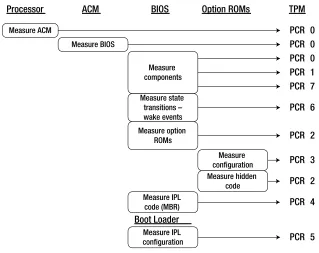
The static chain of trust measurements start when the platform powers on. It starts with microcode that is embedded in the processor measuring an authenticated code module (ACM) provided by Intel. The ACM is a signed module (whose signature and integrity is authenticated by microcode) that performs special security functions. The ACM measures a portion of the BIOS code. That code then measures the remainder of BIOS code and configuration. Note that BIOS code does not execute until after it has been measured. These measurements are stored in special platform configuration registers (PCRs) inside a TPM (remember that the TPM is a very secure hardware device specified by the TCG). Different PCRs hold different launch component measurements (as specified by the TCG). During this process, the BIOS is required to turn on certain security features, and then call a function in the ACM that performs a security check. Before the BIOS executes any additional code, such as option ROMs on third-party adapters, it must lock the platform configuration by calling the ACM again, which performs additional security checks, and then locks certain platform and processor registers. The BIOS also measures the Master Boot Record (MBR) and the OS Loader when it boots the operating system.
The main takeaways are that measurements are started by hardware, measurements are protected from tampering by the TPM, and code is measured before it is executed.
These “static” measurements are done only once, each time the platform powers on. These measurements are referred to as platform configuration measurements.
Dynamic Chain of Trust
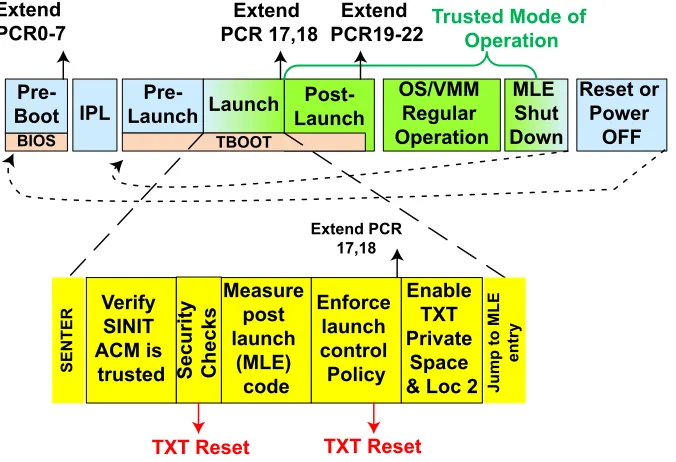
The dynamic chain of trust starts on request by the operating system (OS) via a special processor instruction, which measures and verifies another ACM (the SINIT ACM), which will oversee the secure launch. The SINIT ACM performs additional checks, which include making sure the BIOS passed its security checks and has locked the platform configuration. The ACM then measures the OS (actually a portion of the OS referred to as the trusted OS) and invokes
Power ON
BIOS
ACM (Trusted)BIOS Option ROMs
MBR
OS LoaderMLE (VMM) If Platform & MLE Trusted Boot Time Measure SBIOS Code Additional Measurements SINIT ACM Policy Engine Security Checks Lock Configuration Measure & Validate ACM
uCode
uCode
Measure & Validate ACM Measure Trusted OS Code Verify Platform Meets Trust PolicyAdditional Measurements
Static Chain of Trust
Dynamic Chain of Trust
Chapter 1 ■ INtrODUCtION tO trUSt aND INteL® trUSteD eXeCUtION teChNOLOGY
a launch control policy (LCP) engine that will determine if the platform configuration and OS will be trusted (as defined by the policy set by the system administrator).
A trusted OS (a term used by the TCG for system code that invoked and passed the secure launch
process—proving it meets the launch control policy) is allowed access to additional (privileged) security functions, including using additional PCRs. The trusted OS can measure such things as additional code, data, and configuration into those PCRs, and use the content of any of the PCRs to make trust decisions and seal/unseal data. Applications (both on and off the platform) can also use those measurements to make trust decisions.
Virtualization
Intel TXT works equally well for both virtualized and nonvirtualized platforms. In the course of bringing Intel TXT to market, the feedback has been quite strong that the primary and most compelling usage model for Intel TXT on servers is with virtualized and cloud-based server systems. This is generally because it addresses some of the key challenges introduced by moving to shared infrastructures. Specifically, it provides the ability to better control applications (in the form of virtual machines) and migration of applications among available platforms (the cloud) based on host trustworthiness. In other words, high availability and optimum utilization is achieved by migrating applications to available servers while still maintaining a trusted environment.
The term OS for a server platform can be confusing because of the existence of multiple operating systems on a virtualized host platform. This book uses the term host OS to refer to a hypervisor, virtual machine monitor (VMM), or in the case of a nonvirtualized platform, the traditional bare-metal operating system or any other application or utility that boots first. In any case, the host OS is the first system control program to boot. This is in contrast to an OS instantiated in a virtual machine (VM), which will be referred to as a guest OS. Furthermore, a trusted OS is a host OS that has successfully performed a secure launch. As a side note, while it is possible for the host OS to provide the same type of secure launch to its guest operating systems, that capability is outside the scope of the current version of Intel TXT and not discussed in this book.
OK, that last paragraph can be a little hard to read. So let’s try these definitions:
• OS: The system software that manages platform resources and schedules applications. This includes
A hypervisor or virtual machine monitor that manages the
• virtual machines.
An OS that executes in a VM (i.e., the guest OS). •
An OS executing on a nonvirtualized platform. •
• Host OS: An OS that is not executing in a virtual machine, which can perform a secure launch, and thus can be measured by hardware (i.e., Intel TXT).
• Guest OS: An OS that is executing in a virtual machine, which is not measured by hardware. • Trusted OS: A host OS that has performed a measured launch and passed the datacenter
policy.
Measured Launch Environment
Chapter 1 ■ INtrODUCtION tO trUSt aND INteL® trUSteD eXeCUtION teChNOLOGY
The host OS is allowed to enter and exit the measured launch environment without having to reboot the platform. To exit, the host OS simply invokes another special processor instruction that will reset the PCRs that were used to measure the launch and those that were set by the trusted OS. Of course, this action also curtails the host operating system’s access to some of the additional security resources. Reentering the secure environment restarts the dynamic chain of the trust process, and thus recalculates the MLE measurements storing them in those PCRs, allowing a different trusted OS (or different configuration of the same OS) to execute with its own set of trust credentials.
Finding Value in Trust
One of the nice things about Intel TXT is that its value can be appreciated by a number of different entities for various purposes. Some of these values have already been realized and there are many more to come.
Cloud Computing
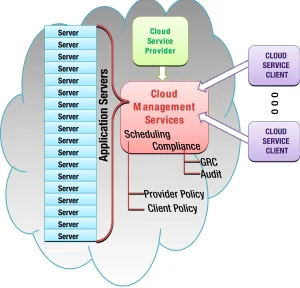
Looking at a typical cloud management model, as illustrated in Figure 1-2, the cloud service provider maintains a pool of application servers, which hosts various applications provided by the cloud service clients. These applications are scheduled to run at times and locations to meet both provider and client polices.
The service provider must be able to demonstrate that the cloud meets governing regulations, and provide an audit trail to assure the client that all client and government requirements have been meet.
C
C
l
l
o
o
u
u
d
d
M
M
a
a
n
n
a
a
g
g
e
e
m
m
e
e
n
n
t
t
S
S
e
e
r
r
v
v
i
i
c
c
e
e
s
s
Server Server Server Server Server Server Server Server Server Server Server Server Server Server Server Server Server Server CLOUD SERVICE CLIENT CLOUD SERVICE CLIENT
Compliance
Audit
Scheduling
GRC
Provider Policy
Client Policy
CClloouudd S
Seerrvviiccee
P
Prroovviiddeerr
o
o
o
Application Servers
Chapter 1 ■ INtrODUCtION tO trUSt aND INteL® trUSteD eXeCUtION teChNOLOGY
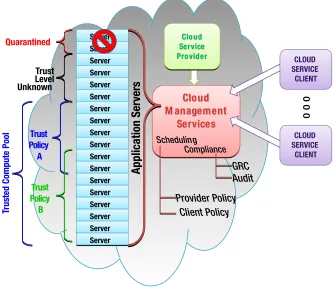
Because Intel TXT provides measurements of platform configurations and operating systems, adding Intel TXT to the picture allows the trust status of the application servers to enter into the equation. It allows both the service provider and the service client the ability to establish trust policies based on Intel TXT measurements and to identify servers that meet those polices, as illustrated in Figure 1-3.
Up till now, we have talked about measuring components, but the measurements themselves don’t prove anything, or do they? Actually, it is the combination of the components that are measured, how the measurements are made, how the measurements are stored, and how the measurements are accessed that provides the basis for attestation.
Attestation: The Founding Principle
Furthering our discussion of how a bank uses multiple security concepts, let’s focus on the banking transaction. Before executing a transaction, bank tellers require proof of the customer’s identity. In the United States, that would typically be a driver’s license or some other government-issued identification. State-issued driver’s licenses and IDs have evolved over the years. In 1960, a license was simply a piece of paper printed with the state seal and folded in half to about the size of a business card. Personal information such as date of birth, height, weight, color of eyes, and hair color were typed in the respective boxes on that form by the issuing agency. Needless to say, it was fairly easy to modify, and thus subject to abuse. To reduce misuse and fraud, states started laminating each license with a photograph, thus making it harder to alter the data, and the photograph provided better identification. Of course, this assumes that the state issues the license to the right person. After the 9/11 attack, the US federal government
C
C
l
l
o
o
u
u
d
d
M
M
a
a
n
n
a
a
g
g
e
e
m
m
e
e
n
n
t
t
S
S
e
e
r
r
v
v
i
i
c
c
e
e
s
s
Server Server Server Server Server Server Server Server Server Server Server Server Server Server Server Server Server Server CLOUD SERVICE CLIENT CLOUD SERVICE CLIENT
o
o
o
ComplianceAudit
Application Servers
SchedulingGRC
Provider Policy
Client Policy
Trust Level Unknown Trust Policy A Quarantined Trust Policy B CClloouudd S
Seerrvviiccee
P
Prroovviiddeerr
Trus
ted Compute Pool
Chapter 1 ■ INtrODUCtION tO trUSt aND INteL® trUSteD eXeCUtION teChNOLOGY
placed more requirements on states—both on how the ID is created (including holographic images and special watermarks) and how the state validates the identity of the person being issued the license.
Just as a bank teller has to be able to verify the customer’s identity, software needs a means to identify its environment. A driver’s license is simply a certificate of attestation, and the same principles apply to validating software. One way to look at it is that the description on a license along with the photograph constitutes
measurements of the person. That certificate also identifies who issued the certificate, and has features used to detect if it has been altered.
For Intel TXT, attestation is the ability to securely verify a set of component measurements. It is the founding principal for Intel TXT and accomplished by performing a cryptographic hash of each component. These components include BIOS code, BIOS configuration settings, I/O adapter option ROM code, I/O adapter configuration, MBR, bootstrap code, boot settings, ACM code, trust policies, OS code, OS configuration, and anything else that the OS wishes to measure. By measuring components using a cryptographic hash, corrupted components are easily detected via a change in their measurements.
But attestation involves more than just making the measurements. Those measurements constitute a certificate, and Intel TXT has to guarantee the following:
The certificate comes from a trusted source •
The certificate is accurate •
The certificate has not been modified (at the source or in transit) •
Value to System Software
You might ask why you need Intel TXT if you already trust the OS, since the processors and chipsets already provide a number of security features that the OS uses to protect itself against attacks, and you have installed virus protection and other security software. The first realization comes from the ability for the OS to use those functions, as well as load additional security software only after the OS loads. So what happens when the OS is not running? What about attacks against the relatively unprotected BIOS and the pre-boot environment? The following are some of the benefits that Intel TXT provides:
Protection against reset attacks •
Protection against root kits •
Sealing data •
The ability to provide more secure services to VMs and applications •
System credentials •
Note
■
processors and chipsets provide a number of security features that an OS uses to protect itself from
unintentional or malicious modification while it is running. Intel tXt extends that protection to when the OS is not running.
that is, the OS has to start out uncorrupted for it to remain uncorrupted, and Intel tXt helps prove that the OS starts
up uncorrupted.
Chapter 1 ■ INtrODUCtION tO trUSt aND INteL® trUSteD eXeCUtION teChNOLOGY
Cloud Service Provider/Cloud Service Client
Intel TXT’s attestation opens up a whole new world of possibilities that can be realized by both local and remote entities. In addition to securely measuring and maintaining platform/OS measurements, Intel TXT provides the means to securely convey those measurements to external entities. Intel TXT also provides the means to determine if a platform is operating in the secure mode and for determining the policy for allowing secure mode. The datacenter sets the bar establishing the minimum trust level by setting the launch policy. Later, we take a close look at just what that means and how it is done, and discuss considerations in selecting a policy.
Management software can use this to provide capabilities such as:
The ability to quarantine platforms with unauthorized modifications (that is, platforms that •
don’t match “known good” configurations).
Trusted compute pools and trust policy–based migration. •
Additional trust and security control metrics such as geo-tagging. •
Enhanced audit trail and compliance support. •
Figure 1-3 illustrates how platforms can be categorized based on Intel TXT measurements. A trusted compute pool consists of those servers that have demonstrated that they have a known good configuration. This excludes those with an unknown trust level (those that don’t support Intel TXT or don’t have it enabled) and, of course, those that fail the Intel TXT launch control policy. The trusted compute pool can be further categorized into pools of trust based on various trust policies set by the service provider and service client.
As we continue to unravel the mysteries of Intel TXT, we will discover that the platform provides for 24 different secure measurements. Some are defined for specific purposes and others allow innovation. If one of the measurements included a geographic location identifier (geo-tag), policies could then limit applications to specified countries, states, or regions. This is especially important because a growing number of privacy laws and other governmental regulations stipulate controls and protections that vary depending on location or restrict data to certain geographical boundaries.
These capabilities are valuable for both public and private clouds. Even within a private cloud, different
workloads have different security requirements—just as different workloads are assigned to different classes of servers in a traditional nonvirtualized datacenter. The ability to prove trust and maintain trust levels allows the cloud to host more restrictive applications, such as a finance or human resources department workloads that would no longer need separate compute facilities. These capabilities can give public cloud service providers the ability to enforce and charge according to the security level required. They give the public cloud service clients the tools to specify required trust levels and geographical boundaries, as well as the means to validate compliance to those requirements.
Before we discuss these capabilities—and they will be covered in more depth in subsequent chapters—we need to understand more about how Intel TXT works and from where the trust comes. As we progress through this book, we will answer the following questions:
How does Intel TXT provide attestation, and what makes it so powerful? •
How does the system administrator enable it? •
How does the datacenter take advantage of it? •
How does system software use it? •
How do others make use of it? •
Chapter 1 ■ INtrODUCtION tO trUSt aND INteL® trUSteD eXeCUtION teChNOLOGY
What Intel TXT Does
Not
Do
Intel TXT does not measure trust, nor does it define levels of trust. These are subjective terms whose definitions will change over time. Rather, Intel TXT allows the datacenter/cloud service provider, cloud service client, OS, and other entities to make their own trust decisions with a new set of robust credentials. These trust decisions can be, but do not have to be, based solely on Intel TXT. In fact, since defense in depth refers to using multiple methods to protect your assets, Intel TXT assumes that other security mechanisms exist, new technologies will emerge, and together they will provide greater coverage. Intel TXT is flexible enough that it can be used to help verify proper utilization of other methods and their policies.
Intel TXT does not monitor runtime configuration. It only performs measurements at specific events, such as Power On, and upon request by the host OS to do a secure launch. Therefore, it does not degrade performance since it does not steal cycles from the operating system or applications running on the platform, nor does it consume memory bandwidth and other operational resources after the secure launch.
Currently, Intel TXT only measures the host OS or VMM and does not provide for secure measurements of a guest OS or its applications. This is a topic of discussion and interest throughout the industry, and it would be very surprising if this capability is not added in the future.
Enhancements for Servers
As mentioned at the beginning, Intel TXT was first developed for client platforms (desktop and mobile). So is it the same technology? There are some differences, primarily because servers are more complex than client machines. One of the most prominent differences is the set of server features known as Reliability, Availability, and Serviceability (RAS). The complexity of server RAS features such as memory mirroring, memory sparing, and error handling require capabilities that are very platform-specific, and thus must be performed by platform-specific code. This code must be trusted; in particular, the BIOS code that executes after a platform reset (to mitigate the reset attack) and the System Management Module (SMM) code, which may need to change memory configuration and/or platform configuration while the system is in operation.
This changes what the TCG refers to as the TCB (Trusted Computing Base), which, by definition, is the minimum amount of code that needs to be trusted for a platform. For server platforms, the TCB includes the processor
microcode and the ACM, whose signature and integrity are checked before the ACM is allowed to execute. It must also include the BIOS (or at least a portion of the BIOS).
Including BIOS in the TCB
For client platforms, the BIOS does not need to be trusted to clear memory in defense of a reset attack, because memory cleaning is performed by the ACM before allowing the BIOS to access the memory. This is not possible for servers given the complexity of server memory configurations and RAS features. Thus in response to (or to detect) a reset attack, BIOS code integrity must be verified before the BIOS can be trusted to clean secrets from memory. Typically, this is transparent to the OS and end user, but it does have implications on how BIOS upgrades occur. For instance, upgrading BIOS causes its measurement to change, and if there is a reset attack after a BIOS update, the BIOS would not be trusted. To overcome this problem, Intel TXT allows for a signed BIOS policy that allows the ACM to validate that the BIOS is still trusted using signature verification.
Processor-Based CRTM
Chapter 1 ■ INtrODUCtION tO trUSt aND INteL® trUSteD eXeCUtION teChNOLOGY
Trusting the SMM
Client platforms with Intel TXT can use an SMI Transfer Monitor (STM) to prevent SMM code from corrupting the platform configuration. The complexity of servers and the need for the SMM to handle RAS concepts such as memory and processor hot plug (a common term for the removal or replacement of these components while a server is operating) require that the SMM code be inside the trust domain. This means that the SMM code has to be measured as part of the BIOS code measurement, and thus included in the trust decision to allow the OS to perform a secure launch. Again, this is transparent to the OS and the end user, but it will show up in the logs that describe what is included in the BIOS measurement.
Other Differences
As alluded to previously, the complexity of Intel TXT increases on servers because of the server architecture complexity. This includes multiple processor sockets, enhanced I/O, base board management, and so on. Whereas these features make it harder on the BIOS developer, they tend to be transparent to the end user and the software using Intel TXT.
Impact of the Differences
The bottom line is that any operating system that functions with the client version of Intel TXT also functions with the server version. The platform credentials will be different, but each platform type will have a different measurement anyway. The OS measurements are performed exactly the same way for client and server platforms.
Even though the usage models differ greatly between client and server platforms, their Intel TXT behaviors have intentionally been kept consistent. This allows client operating systems to be used on server platforms and server operating systems to be used on client platforms—where this would be desirable.
Because the OS launches exactly the same and the integrity of the measurements does not change, applications using Intel TXT attestation work the same.
Roles and Responsibilities
So you have an Intel TXT–enabled platform—now what? What are your responsibilities? What precautions do you need to take? What about system software? What else is needed? Let’s take a quick look at what is expected of all of the players. These roles and responsibilities will be explored in greater detail in subsequent chapters of this book.
OEM
The OEM puts together all of the components, and then packages them into an Intel TXT–capable platform. This design is thoroughly tested to assure that the platform complies with Intel TXT requirements and is able to perform a secure launch. The OEM often does the initial provisioning of the TPM before the platform ships. With the exception of occasional BIOS updates, the OEM’s job is done once the platform leaves the factory.
Platform Owner
Chapter 1 ■ INtrODUCtION tO trUSt aND INteL® trUSteD eXeCUtION teChNOLOGY
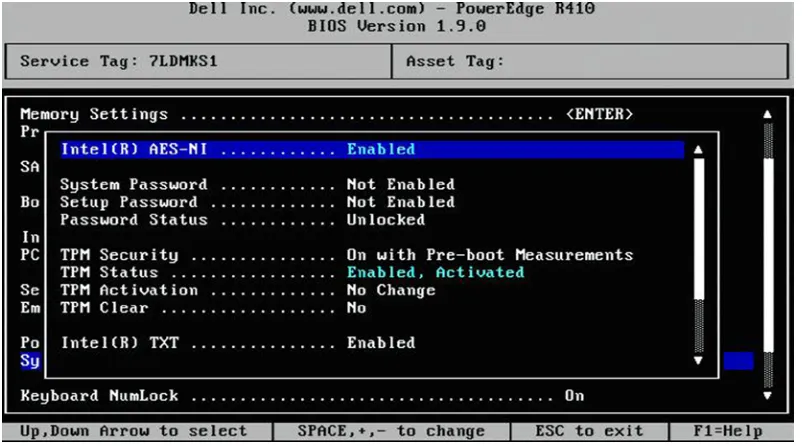
Before installing an Intel TXT–enabled OS, you have to enable the TPM and Intel TXT via the BIOS setup menus. Depending on the OS, you may need to establish TPM ownership and set the launch control policy (or the OS might do that for you). We will discuss how to do this later, as well as discuss tradeoffs for selecting a launch control policy.
Host Operating System
Operating system installation detects if a TPM is enabled and whether TPM ownership has been established. As mentioned earlier, the OS might require exclusive TPM ownership, and thus the OS performs the TPM “take ownership” operation itself, as well as sets the launch control policy. If so, it will do this as part of the install process on first boot. For this case, the OS provides the utilities for the platform owner to modify the policy.
Each time the host OS boots, it detects if Intel TXT is enabled, and if so, performs a secure launch. As a trusted OS, it continues measuring system code, configuration, and other entities into the platform configuration registers reserved for the OS. The host OS maintains a log that indicates what has been measured into each register.
The host OS provides remote access to certain TPM resources (such as platform configuration registers) and associated logs. This allows external management applications to make trust-based decisions using the Intel TXT measurements.
Other Software
As we progress through this book, we will see the various roles that are played by third-party software. We will discuss attestation services and trust authorities, and their importance to both the cloud service provider and the cloud service client.
There are no hard and fast rules for using Intel TXT attestation. Typically, third-party software uses Intel TXT measurements in the platform configuration registers to verify which host OS is in control (and which version). Knowing which host OS then provides insight into what the trusted OS has measured into the platform configuration registers reserved for the trusted OS.
Chapter 2
Fundamental Principles of Intel
®
TXT
The first step to more secure computing is improved hardware. So before we discuss how to use the technology, let’s define what constitutes an Intel® TXT–capable platform and the underlying principles behind the technology. We will take a look at the unique components, how they work together, and what they do to produce a more secure environment.
What You Need: Definition of an Intel
®
TXT–Capable System
Intel TXT relies on a set of enhanced hardware, software, and firmware components designed to protect sensitive information from software-based attacks. These components are illustrated in Figure 2-1 and Figure 2-2.Intel®TXT— capable host operating system
or hypervisor Provisioning &
management tools
Intel®TXT— capable platform
Chapter 2 ■ Fundamental prinCiples oF intel® tXt
As illustrated in Figure 2-1, it takes more than just an Intel TXT–capable platform. An Intel TXT–capable platform provides the foundation; however, to get the full value from this technology one needs to install an Intel TXT–capable operating system. (Intel TXT–capable platform systems will be discussed shortly.) In addition, provisioning tools and other management software may be needed to tune Intel TXT operation to meet datacenter policy, as well as enable service clients to benefit from it. For now, let’s focus on the platform and answer the question: What makes Intel TXT different and why?
Intel
®TXT–Capable Platform
The platform components are illustrated in Figure 2-2, but don’t worry, it is the platform manufacturer who is responsible for integrating and testing these components. This means that by the time a platform reaches the datacenter, it is Intel TXT–capable (or it is not). Intel TXT–ready server platforms did not start shipping until early 2010, so older platforms are not Intel TXT–capable. As of 2012, most major manufacturers offer Intel TXT–capable server platforms. It should be pointed out that some manufacturers have designed server platforms that can be upgraded to being Intel TXT–capable via a BIOS upgrade and/or a plug-in module. So check with your platform vendor to find out if existing platforms are Intel TXT–capable.
As we review the various components of Intel TXT, these topics may seem disjointed or incomplete, but as the chapter progresses, it will become apparent just how they all work together.
Intel TXT Platform Components
The recipe for a platform that is able to support Intel TXT includes the following ingredients specifically designed for Intel TXT.
Processor
All Intel IA32 server processors, beginning with the Intel® Xeon® 5600 series, (codenamed Westmere1) support Intel TXT. This support includes a new security instruction (GETSEC, part of the Safer Mode Extensions known as SMX). This new instruction performs multiple security functions (referred to as leaves). Two of the leaf functions
TPM by Third-party (TCG* compliant) AC modules
and platform initialization
IOH/PCH
BIOS Intel®TXT andIntel®
VT-d support in IOH
TPM support
Intel®VT -x and Intel® TXT support Intel®VT-x and
Intel®TXT support
(VMX+SMX)
Intel software SINIT AC Module BIOS AC Module
Third-party software: MLE,hosted OS, apps, etc.
Xeon® Xeon®
TPM v1.2
Tools
Figure 2-2. Intel TXT platform components
Chapter 2 ■ Fundamental prinCiples oF intel® tXt
(GETSEC[ENTERACCS] and GETSEC[SENTER]) provide the ability to securely validate authenticated code modules (ACMs) and (if valid) invoke that authenticated code using a very secure area within the processor that is protected from external influence (see the “Authenticated Code Modules” section). All processors that support Intel TXT also support Intel® Virtualization Technology (i.e., VMX instructions and an enhanced architecture for increased isolation and protection). There is no limit on the number of processors, thus Intel TXT is found on UP, DP, and MP platforms. Actually, the number of processor cores is limited to a 32-bit value (4,294,967,295 maximum value), but for all practical purposes, this is not a limiting factor.
Chipset
Intel chipsets designed to work with Intel Xeon 5600 series and later processors include: special TXT registers
•
an enhanced architecture •
controlled access to the Trusted Platform Module (TPM) •
It is the chipset that enforces TPM locality (defined later) and enforces different access rights to the TXT registers, depending on the security level of the entity attempting to access the TXT registers. Other chipset manufactures can also build chipsets that implement Intel TXT (they would provide their own ACMs). Unless otherwise noted, we will be discussing Intel chipsets and ACMs.
Trusted Platform Module (TPM)
Intel TXT makes extensive use of the Trusted Platform Module (TPM), a component defined by the Trusted Computing Group2 (TCG). The TPM provides a number of security features (more on this in the section titled “The Role of the Trusted Platform Module (TPM).” In particular, the TPM provides a secure repository for
measurements and the mechanisms to make use of those measurements. A system makes use of the measurements for both reporting and evaluating the current platform configuration and for providing long-term protection of sensitive information.
BIOS
The platform BIOS is specially designed to configure the platform for secure mode operation. BIOS plays a significant role, whose duties include:
Supplying the ACMs. ACMs are created by the chipset vendor and provided to the BIOS •
developer to be included as part of the BIOS image. Configuring the platform for Intel TXT operation. •
Performing a security check and registering with the ACM. •
Locking the platform’s configuration using the processor’s GETSEC security instruction. •
Once locked, BIOS and other firmware can no longer modify the configuration. BIOS performs this locking before executing any third-party code such as option ROMS on add-in cards.
Chapter 2 ■ Fundamental prinCiples oF intel® tXt
Authenticated Code Module (ACM)
An authenticated code module is a piece of code provided by the chipset manufacturer. This module is signed by the manufacturer and executes at one of the highest security levels within a special secure memory internal to the processor. Most Intel-based platforms use Intel chipsets, thus the ACMs for those platforms are created by and signed by Intel.
Each ACM is designed to work with a specific chipset, and thus is matched to the chipset. ACMs are invoked using the processor GETSEC instruction. There are two types of ACMs: BIOS ACM and SINIT ACM. The BIOS ACM measures the BIOS and performs a number of BIOS-based security functions. The SINIT ACM is used to perform a secure launch of the system software (operating system). SINIT is an acronym for Secure Initialization because it initializes the platform so the OS can enter the secure mode of operation.
The BIOS image contains both the BIOS ACM and the SINIT ACM; however, the OS may choose to supply a more recent version of the SINIT ACM when it does a secure launch.
As we will see later, the ACM is the core root of trusted measurements, and as such, it operates at the highest security level and must be protected against all forms of attack. Because of this, the following extra precautions are taken to verify and protect the ACM.
The processor’s microcode performs a number of security checks on the ACM before allowing •
the ACM to execute:
ACM must match the chipset –
ACM version must not have been revoked –
ACM must be signed –
Signature must be valid –
Before the processor makes these checks, it copies the ACM into protected memory inside the •
processor, so that the ACM code cannot be modified after it is validated.
A checksum of the public signing key is hardcoded in the chipset and used to verify that the •
ACM was signed with the proper signing key. Each chipset generation uses a different signing key. Thus, only someone who has the private key can create an ACM. The private keys are very well guarded and only a few very trusted Intel people have access to the private keys.
The signature uses cryptography to validate that the ACM has not been altered. •
Thus the GETSEC instruction will only execute the ACM if the ACM was signed with the correct key, matches the chipset, and has not been modified.
The Role of the Trusted Platform Module (TPM)
It is hard to talk about Intel TXT without referring to the TPM. The TPM is an important component specified by the Trusted Computing Group (www.trustedcomputinggroup.org) expressly for improving security. We really applaud the TCG for defining such an ingenious device. The TPM specification is in three volumes (four, if you count the compliance volume) and there are books just on the TPM. Luckily for us, we don’t have to go into great detail. However, an understanding of the key features will provide a better appreciation of how Intel TXT provides secure measurements.
Currently, platforms incorporate TPMs adhering to version 1.2 of the TCG TPM specification. Version 2.0, which is expected to be released late 2013. It provides the same functionality plus includes enhanced features, capabilities, and capacities.
Chapter 2 ■ Fundamental prinCiples oF intel® tXt
TPM Interface
The TPM interface is simple, making it easier to defend. The TPM connects to the chipset by the Low Pin Count (LPC) bus3 and is only accessed via memory mapped I/O (MMIO) registers protected by the chipset. This means that I/O devices cannot access the TPM at all and the OS can easily control which processes have access to the TPM. In addition, the TPM enforces additional protections and access rights.
Localities
The TPM has different privileged levels called localities. Each locality is accessed by a different 4K page allowing both hardware and software to control access to each locality. The chipset controls which localities are active (that is, whether a read or write to that page will be ignored) and system software can control which processes have access to those pages via normal memory management and paging functions. There are five localities (0 through 4) and Intel TXT uses the localities as shown in Table 2-1.
Note that these localities are not hierarchical. Thus, locality 4 is not a super-user and does not automatically have access to keys, data, and resources available to other localities. Later, we will look at the use of localities for protection of keys and data.
Figure 2-3. Trusted Platform Module
Table 2-1. TPM Locality
Locality
Access
0 Always open for general use.
1 Operating system (not used as part of TXT).
2 System software (OS) in secure mode. Only after the OS has successfully performed a secure launch. The OS may close this access at any time.
3 ACMs. Only an ACM that has been invoked by the GETSEC instruction has access to locality 3. 4 Hardware. Only the processor executing its microcode has Locality 4 access.
Chapter 2 ■ Fundamental prinCiples oF intel® tXt
Control Protocol
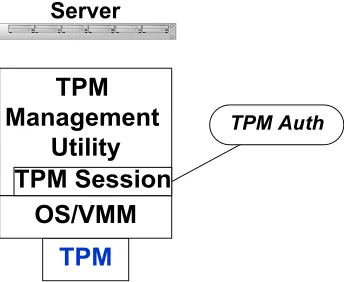
The interface to the TPM is message based. That is, an entity creates a request message and sends it to the TPM (via a locality page) and then reads the response message (via the locality page). The protocol allows the entity (using messages) to set up a secure session. Sessions allow the user to encrypt the message content, but more importantly, the means to authenticate authorization.
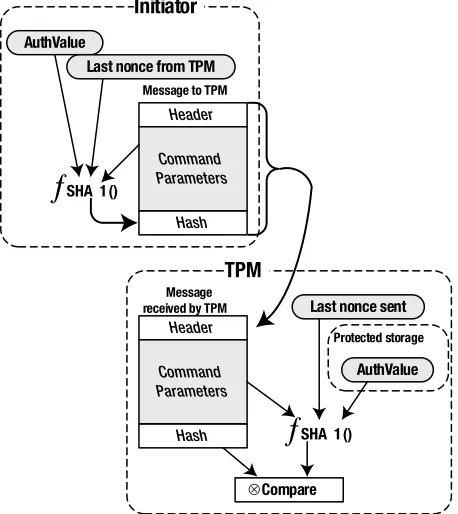
Messages that require authorization contain one or more authorization fields, called HMAC keys. HMAC stands for Hash Method of Authentication. The HMAC key is calculated as the hash of the message, a nonce (number used once), and the authorization value. The nonce and authorization values are not part of the message, and thus must be known by both parties.
The HMAC in a request demonstrates that the caller knows the authorization value and is therefore authorized to issue the TPM command. In the response, the HMAC value authenticates that the response came from the TPM and has not been modified during transport.
The protocol is as follows. Each message in a session uses a different set of random numbers (nonces) to generate the HMAC key(s). The requester provides the odd nonce that the TPM uses to calculate the HMAC value in its reply and the reply contains the even nonce that the requester uses to calculate the HMAC value in its next request. This prevents replay attacks and man-in-the-middle attacks because the HMAC value changes for any change in the message. Even the exact same command will have a different HMAC value each time it is issued (because the nonce is different).
Let’s look at an example.
1. The caller sets up a session by sending a start session command to the TPM and the TPM responds with a session handle and the TPM’s nonce.
2. The caller creates a command that requires authorization (that is, requires that the caller prove that the caller knows the password associated with the object of the command). To do this, the caller creates a cryptographic hash of the command, plus the nonce provided by the TPM, plus the password.
3. The caller sends the command, the caller’s nonce, and the hash digest to the TPM. Note that the password is not sent.
4. The TPM then performs the same hash except using the real password of the object. If that hash digest matches the digest in the command message, then the TPM concludes that the caller knows the password, and that the command has not been altered in transport.
5. In the response, the TPM provides a new TPM-nonce that the caller uses in the next command. The response also contains the hash digest of the response parameters, plus the odd nonce from the request message, plus the password.
Note that the caller could have also set up a session so that the command parameters and response parameters were encrypted.
The bottom line is that the TPM is a very hardened device that protects its resources and requires specific access authorization that is protected from tampering.
Random Number Generator (RNG)
Chapter 2 ■ Fundamental prinCiples oF intel® tXt
SHA-1 Engine
The TPM hashing algorithm is SHA-1 (pronounced Shah-one), which is a cryptographic hash function designed by the United States National Security Agency as a US Federal Information Processing Standard. SHA stands for secure hash algorithm. This hashing produces a 20-byte (160-bit) digest. The hash is used for various authorization and authentication processes. The TPM’s SHA-1 engine is used internally to do the following:
Authenticate request messages •
Authorize response messages •
Calculate the hash digest of code and data •
Extend PCR values •
Authenticate/authorize keys •
For more information on SHA-1, see the “Cryptographic Hash Functions” section.
RSA Engine and Key Generation
The TPM uses the RSA asymmetric algorithm for digital signatures and for encryption. RSA stands for Ron Rivest, Adi Shamir, and Leonard Adleman, who published the algorithm for public-key cryptography in 1978. The key generator uses that algorithm to generate asymmetric keys (a public key and a private key). The private key is kept internal4 to the TPM (thus only known to the TPM). The public key) is used by an entity to encrypt data that can only be decrypted by someone with the private key (the TPM). The RSA engine uses the keys to encrypt and decode messages and data.
The “Cryptography” section provides details on how keys are generated and used.
Platform Configuration Registers (PCRs)
Pay attention. There will be a quiz later. Just joking, but PCRs are one of the two TPM features that are accessed as objects and the basis of attestation, as well as used in launch control policy. Thus, they play a key role.
The TPM provides special protected registers to store measurements. These registers are known as Platform Configuration Registers (PCRs). Each PCR has an inherent property of a cryptographic hash. That is, each PCR holds a 20-byte hash digest. Entities never write directly to a PCR, rather they “extend” a PCR’s content. For the extend operation, the TPM takes the current value of the PCR, appends the value to be extended, performs SHA-1 hash on the combined value, and the resulting hash digest becomes the new PCR value. Therefore, each PCR holds a composite hash of all of the elements that have been measured to it. This means that PCRs cannot be spoofed—the only way for a PCR to have a specific value is if the exact same measurements are extended to it in the exact same order. Any variation results in a PCR value that is very different. This is a key concept that provides secure generation and protection of measurements.
Intel TXT uses TPMs that have 24 PCRs. Some PCRs are static, which means that their values are only reset when the system first powers on by the power-up-reset signal. Thus, measurements stored in those PCRs persist until the platform powers down and are used to hold the static chain of trust measurements. Other PCRs are dynamic, which means their value can be reset to their default values, but only via certain localities (as specified by the TCG). These are used for the dynamic chain of trust measurements. The PCRs that hold the dynamic chain of trust measurements can only be reset by the ACM.
Chapter 2 ■ Fundamental prinCiples oF intel® tXt
Nonvolatile Storage
TPMs provide nonvolatile storage, that is, memory that is persistent across power cycles and has more security features than system memory. This nonvolatile random access memory (NVRAM) is the other TPM feature that is exposed externally as objects and plays an important role in creating and protecting the launch control policy set by the datacenter manager.
Compared to system memory, TPM NVRAM is very small, on the order of 2000 bytes, so it is a precious resource. NVRAM is allocated in small chunks and the entity that allocates a chunk of NVRAM specifies access rights for that data. To give you an idea of how flexible and powerful TPM NVRAM is, let’s look at what needs to be specified to allocate TPM NVRAM:
An index (an ID that identifies that chunk). •
The size of that chunk. •
Read access rights. •
Specifies which localities are allowed to read the data. –
Specifies if any PCRs must contain specific values in order to read the data. Data –
cannot be read if any of the selected PCRs do not contain their expected value. Write access rights.
•
Specifies which localities are allowed to write the data. –
Specifies if any PCRs must contain specific values in order to write the data. Data –
cannot be written if any of the selected PCRs do not contain their expected value. The set of selected PCRs can be different than those selected for read access. Also, the expected PCR values can be different.
Attributes/permissions. Can specify any of the following: •
Read
Temporal read lock. The value can be read until locked by a read of zero length; –
unlocked at the next power cycle.
What authorization is required to read; may specify: –
None. –
A specific authorization value (like a password) is required. –
If physical presence assertion is required. Physical assertion typically means –
BIOS is performing the access. Write
Persistent Lock. The value can be locked for write access (by a write of zero length) –
and once locked can never be altered.
Temporal Write Lock. The value can be locked for write access (by a write of zero –
length), and once locked, cannot be altered until the next power cycle.
Write Once. The value can only be written once per power cycle/ unlocked at the next –
power cycle.