Article
Minimum-Cost Drone–Nest Matching through
the Kuhn–Munkres Algorithm in Smart Cities:
Energy Management and E
ffi
ciency Enhancement
Amir Mirzaeinia1 and Mostafa Hassanalian2,*
1 Department of Computer Science and Engineering, New Mexico Tech, Socorro, NM 87801, USA;
2 Department of Mechanical Engineering, New Mexico Tech, Socorro, NM 87801, USA * Correspondence: [email protected]; Tel.:+1-575-835-6903
Received: 15 October 2019; Accepted: 15 November 2019; Published: 17 November 2019
Abstract:The development of new concepts for smart cities and the application of drones in this area requires different architecture for the drones’ stations (nests) and their placement. Drones’ stations are designed to protect drones from hazards and utilize charging mechanisms such as solar cells to recharge them. Increasing the number of drones in smart cities makes it harder to find the optimum station for each drone to go to after performing its mission. In classic ordered technique, each drone returns to its preassigned station, which is shown to be not very efficient. Greedy and Kuhn–Munkres (Hungarian) algorithms are used to match the drone to the best nesting station. Three different scenarios are investigated in this study; (1) drones with the same level of energy, (2) drones with different levels of energy, and (3) drones and stations with different levels of energy. The results show that an energy consumption reduction of 25–80% can be achieved by applying the Kuhn–Munkres and greedy algorithms in drone–nest matching compared to preassigned stations. A graphical user interface is also designed to demonstrate drone–station matching through the Kuhn–Munkres and greedy algorithms.
Keywords: smart cities; drones; nest; energy; Kuhn–Munkres algorithm; efficiency
1. Introduction
In recent years, the concept of smart cities has been developing rapidly. The main goal of smart cities is improving the quality of the life of the residents [1–4]. Smart cities deploy many different sensors to capture information from different parts of the city, such as on traffic, air pollution, waste, rain and snow, electric grids, etc. [5–7]. Different parts of the smart cities make up the smart environment, such as smart water, smart metering, security and emergency, retail, logistic, industrial control, smart agriculture, smart animal farming, domotic and home automation, and eHealth [8,9]. Different types of fixed and mobile means are proposed to achieve the abovementioned goals.
Unmanned aerial vehicles (UAVs) or drones are the main mobile means to perform different functionalities [10–15]. For a decade, autonomous systems have received more attention than before, which has led to the invention of a wide range of mobile vehicles with various configurations [16]. For example, drones are categorized in a broad spectrum and equipped with different types of sensors. Drones can perform various types of missions in urban environments as well as indoor spaces depending on their shape, size, and capabilities [16]. To perform different types of missions in smart cities, drones should be able to satisfy given performance requirements, such as high performance, high endurance, hovering capabilities, robustness, and the ability to withstand potential obstacles [17]. In smart city applications, drones equipped with various sensors can be used for reconnaissance,
Aerospace2019,6, 125 2 of 22
surveillance, delivery, search and rescue, and other missions that cannot be carried out without multifunctional sensors [18].
As the applications of drones are increasing, it is expected that they will play a key role in the future of smart cities. Information and communication technology (ICT) solutions are used in smart cities for various applications. Generally, the design of smart cities requires the integration of ICT and other physical tools, infrastructure, and services [8]. Unmanned aerial systems, as one of these physical tools, can contribute to achieving the future goals of smart cities. The use of drones in smart cities will continue to increase at a fast pace, due to their diverse applications.
Different researchers have performed studies on the uses of drones in smart cities. For example, Mohammed et al. in 2014 investigated the applications of drones in smart cities, in addition to their challenges and opportunities [19]. In 2014, Yu et al. described a cooperative path planning algorithm for tracking a moving target in urban environments using both drones and autonomous ground vehicles. This algorithm was able to consider the vision occlusions due to obstacles in urban environments. In this work, a dynamic occupancy grid was used to model the target state [20]. In 2015, Ataei and Paschalidis deployed multirotor drones for surveying damage and providing aid after disasters. They provided object avoidance algorithms and path planning that depend only on local environmental sensing [21]. Foina et al., in 2015, focused on the using of microdrones in highly populated cities to deliver goods and information. They proposed a cloud-based system for city-wide unmanned air traffic management and the analysis of control systems for collision avoidance [22]. A similar study was also carried out by Gallacher in 2015 for utilizing high- and low-altitude drones for urban environmental analysis and addressing the concerns about their security, privacy, and safety [23]. In 2016, Vattapparamban et al. discussed the technical and societal concerns and challenges that need to be addressed in smart cities, such as privacy, cybersecurity, and public safety [24]. In the same year, Jensen also addressed drones and their potential relationship with the city from a “motilities design” point of view [25].
Menouar et al. highlighted the challenges and potential of drone-enabled ITS for the next generation of smart cities in 2017 [26]. In 2018, Asghar Khan et al. elaborated the key role of unmanned aerial systems in a smart city for applications such as traffic monitoring, policing, package delivery, ambulance drones, pollution control drones, and firefighting and rescue operations [27]. In 2018, Yang and Yoo used multi-objective bio-inspired algorithms to develop an optimal flight path planning approach for drones [28]. In their methodology, they applied ant colony optimization and joint genetic algorithm to find possible drone flight paths, considering energy, time, and risk utilities [28]. Bahabry et al., in 2019, proposed a path routing approach for multiple multirotor drones in urban environments with the presence of different obstacles with different heights [29]. The objective of their work was to find the best trajectories in urban areas while ensuring collision-free navigation. In this work, a mixed-integer linear program was developed to achieve the optimal navigation of the fleet [29]. In 2019, Ghazzai et al. developed a generic management framework of drones for intelligent transportation systems applications [30]. In this study, they investigated the problem of charging station placement in urban environments to find the best locations for a given number of stations and drones. The flying time and the risk of battery failure of the drone during the mission were taken into consideration. Ghazzai et al. applied particle swarm optimization algorithm and a penalized weighted k-means algorithm for this purpose [30].
and efficiently in cluttered environments [33,34]. Recently, spherical drones and drones with cages have been designed for confined spaces and can be also applied in urban environments [35,36].
Most previous studies focused on the applications of drones in smart cities, path planning, and urban obstacle avoidance. There are no consolidated efforts in terms of how drones should be distributed and how they can be more efficient in terms of energy in smart cities. One of the main issues raised about applying drones in smart cities is assigning the charging stations for drones before and after performing the missions. Drones, after performing their missions in a smart environment, should be able to return to their stations to be recharged. The main objective of this paper is to determine which station is most suitable for a drone to land at after accomplishing its mission. Thus, in this paper, we propose an innovative concept for the optimized networking and assigning of stations for drones. The Kuhn–Munkres and greedy algorithms are used to minimize the power required for the drones to land in the defined stations in smart cities.
The rest of this paper is organized as follows. In Section2, the applications of drones in smart cities are presented. Drones’ nests and charging stations are discussed in Section3. In Sections4and5, drone–nest matching and the Kuhn–Munkres algorithm for power consumption of drone stations are described, respectively. Matching demonstration through Kuhn–Munkres and greedy algorithms is presented in Section6. A summary and conclusions are given in Section7.
2. Drone Applications in Smart Cities
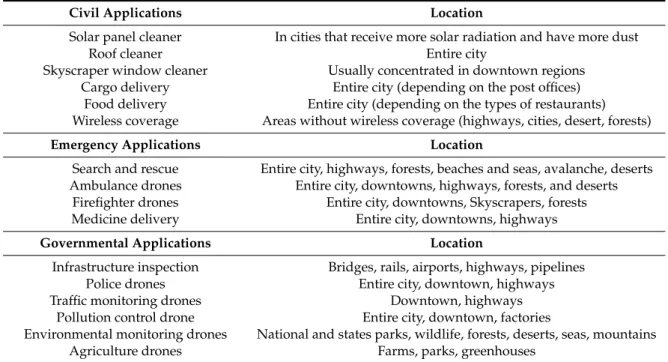
Drones have a wide range of applications in cities, beaches, highways, deserts, forests, state and national parks, etc. [16]. They can be used for hazardous environment and pollution monitoring, traffic management, cargo delivery, emergency response, and civil applications. They can even serve as mobile hotspots for broadband wireless access [16]. Considering the aforementioned applications, it is necessary to locate a certain type of drone in specific areas as each drone has different objectives and applications. For this purpose, a geographic information system (GIS) can be utilized to specify the applications of drones in different areas. This implies that one needs to create a GIS map for the applications of drones. Following this study, the best locations for the drones’ stations and the appropriate configurations of the drones can be specified. In the sequel, the applications of drones in a smart city can be classified into three major categories: civil, emergency, and governmental applications. Some examples and suggested locations for drones’ stations are shown in Table1.
Table 1.Applications of the drones and their location.
Civil Applications Location
Solar panel cleaner In cities that receive more solar radiation and have more dust
Roof cleaner Entire city
Skyscraper window cleaner Usually concentrated in downtown regions
Cargo delivery Entire city (depending on the post offices)
Food delivery Entire city (depending on the types of restaurants)
Wireless coverage Areas without wireless coverage (highways, cities, desert, forests)
Emergency Applications Location
Search and rescue Entire city, highways, forests, beaches and seas, avalanche, deserts Ambulance drones Entire city, downtowns, highways, forests, and deserts
Firefighter drones Entire city, downtowns, Skyscrapers, forests
Medicine delivery Entire city, downtowns, highways
Governmental Applications Location
Infrastructure inspection Bridges, rails, airports, highways, pipelines
Police drones Entire city, downtown, highways
Traffic monitoring drones Downtown, highways
Pollution control drone Entire city, downtown, factories
Environmental monitoring drones National and states parks, wildlife, forests, deserts, seas, mountains
Aerospace2019,6, 125 4 of 22
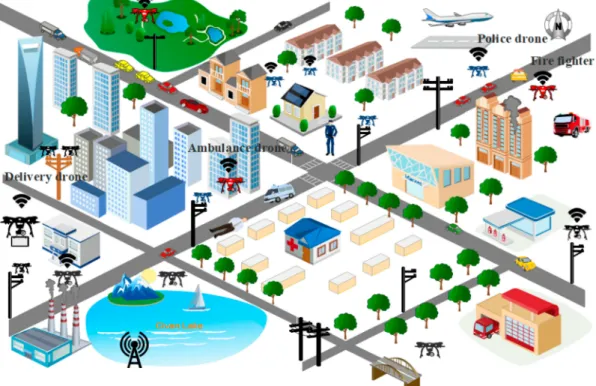
A schematic view of the proposed applications and drones’ locations is shown in Figure1.
Figure 1.Schematic view of drones’ applications and their location.
3. Drones’ Nests and Charging Stations
Inspired by the nests of birds, different objects available in cities can be considered as possible stands for drone stations. These stations can be used for charging and protecting the drones. Various stations have been designed by companies like Amazon to charge drones. Amazon has recently patented docking stations that can be integrated into buildings, streetlights, power poles, and cell towers [37]. In 2017 SkyX Company made a vertical takeofflanding fixed-wing drone that can land on small charging stations set up in fields alongside oil and gas pipelines [38]. The designed drones are able to fly long distances and leap from station to station to recharge [38]. Riskmatrix Company has also designed a drone docking station at which drones can be stationed in standby mode and be protected against bad weather conditions [39]. Some researchers also proposed docking mechanisms for charging the drones. For example, in 2015, a spherical drone-docking concept was designed by Bruni and Sardo to provide a place for drones to settle during bad weather and between tasks [40].
Since nature has developed processes, objects, and materials to increase its efficiency, it has the best solutions when we seek to improve or optimize a system [41–44]. Nature and especially birds’ nests and locations provide ideas for designing stations for drones in smart city applications. In Figure2, different types of birds’ nests are shown.
Figure 2.Views of birds’ nests.
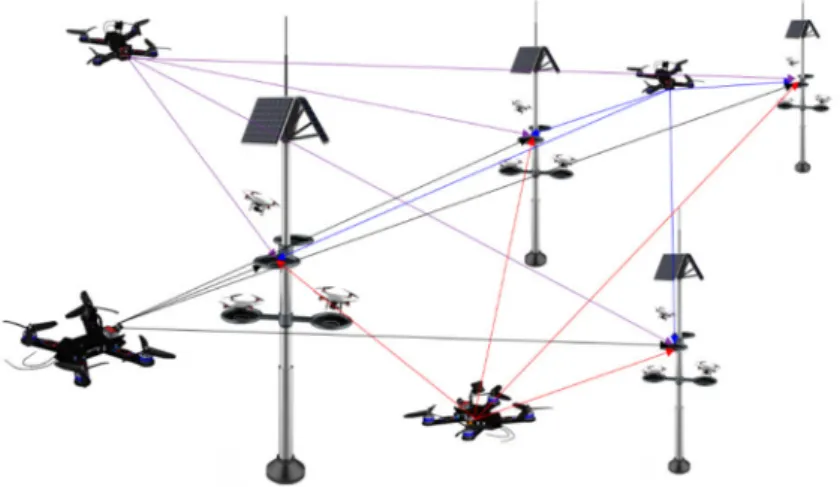
Figure 3.Views of the drones’ stations for smart city applications.
4. Drone–Nest Matching
As mentioned before, drones’ nests or charging stations are designed in order to charge and reuse the drone in smart cities. In this design, each drone comes back to its own station and recharges its batteries before flying offto the next mission. One of the challenges in this scenario is to find the nearest drone to the mission. A central processing office can capture all the station-to-mission distance information and analyze it. Station-to-mission distance can be represented by a matrix and this information can be distributed to the drone returning to the station phase. An optimized method is used in this work to assign the best station for a drone in order to save energy.
5. Kuhn–Munkres Algorithm for Power Consumption of Drone–Nest Matchings
To minimize the power required for the drones to land in the defined nests in an urban area, the Kuhn–Munkres algorithm, also called the Hungarian matching algorithm, is used. Maximum-and minimum-weight matchings in bipartite graphs can be found through the Hungarian matching algorithm. Drones and their stations form a bipartite graph that can be easily represented by an adjacency matrix. In the matrix formulation of the Kuhn–Munkres algorithm, a nonnegativen×n
Aerospace2019,6, 125 6 of 22
total energy cost is minimal. Two different cases will be investigated in this study. First, it is assumed that all the drones have a similar level of energy and, second, drones have a different level of energy. The Kuhn–Munkres algorithm can be described using a bipartite graph. For this study, the bipartite graph is represented asG=(D,S;E) withndrone vertices (D) andnstation vertices (S), and each edge (E) has a nonnegative costc(i,j). The main objective is to find the minimum total required energy. In the Hungarian matching algorithm, a potential function is defined as y: (D∪S)→R if y(i) +y(j)≤c(i,j)for eachi∈D, j∈S. The value of potential functionyis calculated as the sum of
the potential over all vertices (v) as follows [45]: X
v∈D∪S
y(v). (1)
In this algorithm, the total required energy of the matching is the sum of energy for all edges. The energy of each edge is at least the sum of the potentials of its endpoints. Each vertex is considered as an endpoint of exactly one edge since the matching is perfect and the total required energy is at least the total potential. In drone–nest matching, the Kuhn–Munkres algorithm finds a perfect match and a potential such that the matching required energy equals the potential value. In this study, the Hungarian algorithm finds a perfect match of tight edges. For a potentialy, ify(i) +y(j) =c(i,j), an edgeijis called tight. If a subgraph ofGyis considered for a tight edge, the required energy or cost for
a perfect match inGyis equal to the value ofy. In the Kuhn–Munkres algorithm, a potentialyand an
orientation →
Gyare maintained where
→
Gyhas the property that the edges oriented fromS(station) to
D(drone) form a matchingM. At first, the potentialyis 0 everywhere and all the edges are oriented fromD(drone) toS(station). After that, in each step,yis modified so that its value increases or the orientation is changed to achieve matching with more edges.
In general, it is assumed thatRD⊆DandRS⊆Sare the vertices not covered byM. In other words,
RDandRSconsist of the vertices inDandSwith no incoming and outgoing edges, respectively.Zis
considered as a set of vertices reachable in →
GyfromRDby a directed path only following edges that are
tight. Two different conditions are assessed here, as follows [45]:
IfRS∩Z,∅→Reverse the orientation of a directed pass in →
GyfromRDtoRS (2)
IfRS∩Z=∅→∆minc(i,j)−y(i)−y(j):i∈Z∩D, j∈S\Z. (3) In this case,∆≥0 since there are no tight edges betweenZ∩DandS\Z. Then, on the vertices of Z∩D,yis increased by∆; on the vertices ofZ∩S,yis decreased by∆. These steps are repeated until Mis a perfect match and provides the minimum energy required for drones to land in the stations. In Figure4, a schematic view of the bipartite graphs for drones and their stations is shown.
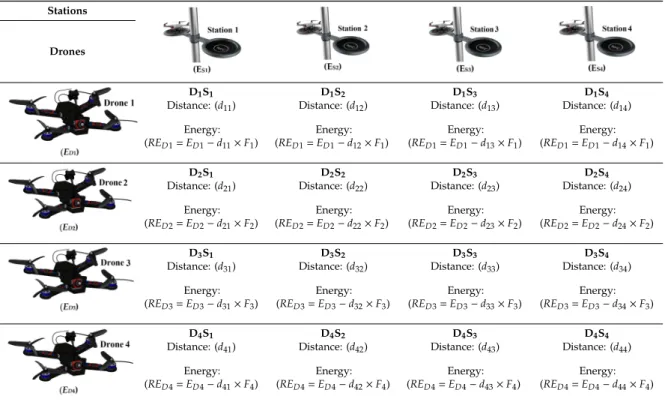
As noted before, the Kuhn–Munkres algorithm can also be represented by an adjacency matrix. In this case,ndrones andnstations create ann×nmatrix containing the cost (energy level) of assigning
each drone to a station. The objective of this matrix is to find the cost-minimizing assignment or, in other words, saving the energy for drones. This problem can be written in the form of a matrix. In Table2, a view of the matrix interpretation of the Kuhn–Munkres algorithm is shown, where D1, D2,
D3, and D4are the drones that should land on stations S1, S2, S3, and S4; andd,ED, andESrepresent
the distance between the drones and the stations, the energy remaining for each drone, and the energy of the charging stations, respectively. REDandFrepresent the remaining energy and aerodynamic
drag force of each drone, respectively. The matrix is square so that each drone can land on one station. Various cases are considered in this study, as will be discussed in the following.
Table 2.Matric interpretation of the Kuhn–Munkres algorithm.
Stations
Drones
D1S1 D1S2 D1S3 D1S4
Distance: (d11) Distance: (d12) Distance: (d13) Distance: (d14)
Energy: (RED1=ED1−d11×F1)
Energy: (RED1=ED1−d12×F1)
Energy: (RED1=ED1−d13×F1)
Energy: (RED1=ED1−d14×F1)
D2S1 D2S2 D2S3 D2S4
Distance: (d21) Distance: (d22) Distance: (d23) Distance: (d24)
Energy: (RED2=ED2−d21×F2)
Energy: (RED2=ED2−d22×F2)
Energy: (RED2=ED2−d23×F2)
Energy: (RED2=ED2−d24×F2)
D3S1 D3S2 D3S3 D3S4
Distance: (d31) Distance: (d32) Distance: (d33) Distance: (d34)
Energy: (RED3=ED3−d31×F3)
Energy: (RED3=ED3−d32×F3)
Energy: (RED3=ED3−d33×F3)
Energy: (RED3=ED3−d34×F3)
D4S1 D4S2 D4S3 D4S4
Distance: (d41) Distance: (d42) Distance: (d43) Distance: (d44)
Energy: (RED4=ED4−d41×F4)
Energy: (RED4=ED4−d42×F4)
Energy: (RED4=ED4−d43×F4)
Energy: (RED4=ED4−d44×F4)
In Scenario (1), it is assumed that all the drones have the same level of remaining energy. In Scenario (2), the matching will be carried out for drones with different levels of energy; in Scenario (3), the drones and charging stations have a different level of energy. It should be noted that in all three cases the drones are the same and have different distances to the stations. The remaining energy for Scenarios ((1) and (2)), and (3) are given by the following equations:
REDi=EDi−Fi×di j (4)
RED&S =ES1+EDi−Fi×di j, (5)
whereRED&Sis the total remaining energy for drones and stations.
The general steps for adjacency matrix representation of the Kuhn–Munkres algorithm for the four drones and stations are discussed below:
Step 1:The remaining energy (RE) is written in the form of a matrix:
RE11 RE21
RE12 RE13 RE14 RE22 RE23 RE24 RE31
RE41
RE32 RE33 RE34 RE42 RE43 RE44
Aerospace2019,6, 125 8 of 22
Step 2:Row operations are carried out on the above matrix. First, the lowest value of remaining energy of allREi(i, 1–4) is subtracted from each element in that row. This will lead to at least one 0
appearing in that row. Multiple zeros can be obtained once there are equal elements. This procedure is repeated for all rows. Therefore, a matrix with at least one 0 per row is achieved. In the next step, stations are assigned to drones such that each drone is landing only on one station and the penalty incurred in each case is 0. The matrix will be as below. The zeros are the assigned stations.
0 RE´12 RE´13 RE´14
´
RE21 RE´22 RE´23 0
´
RE31 0 RE´33 RE´34
´
RE41 RE´42 0 RE´44
(7)
Step 3:In a case where there is more than one 0 in each column, no assignment can be made. In other words, two drones cannot be assigned to one station. To overcome this, the procedure is repeated for all columns. For example, for the case below:
0 RE´12 RE´13 RE´14
´
RE21 RE´22 RE´23 0
0 RE´32 RE´33 RE´34
´
RE41 RE´42 0 RE´44
. (8)
All zeros in the matrix must be covered by marking as few rows and/or columns as possible. To accomplish this, as many stations as necessary are assigned. For example, as shown in the matrix of Equation (8), the first row has one 0, so it is assigned. The 0 in row 3 is crossed out since it is in the same column. The second row has one 0, so it is also assigned. The third row’s only 0 has been crossed out, hence nothing is assigned. The fourth row has two uncrossed zeros; therefore, one can be assigned and others can be crossed out. The shown matrix in Equation (3) will be converted as follows:
´0 RE´12 RE´13 RE´14 ´
RE21 RE´22 RE´23 ´0
0 RE´32 RE´33 RE´34
´
RE41 ´0 0 RE´44
. (9)
In the next step, the third row that does not have an assignment, the first column that has zeros in a newly marked row, and the first row that has an assignment in the newly marked column are marked. This process is also repeated for all non-assigned rows. Lines are drawn through all marked columns and unmarked rows. For this example, the matrix will be shown as:
Aerospace 2019, 6, x FOR PEER REVIEW 8 of 22
𝑅𝐸
𝑅𝐸
𝑅𝐸
𝑅𝐸
𝑅𝐸
𝑅𝐸
𝑅𝐸
𝑅𝐸
𝑅𝐸
𝑅𝐸
𝑅𝐸
𝑅𝐸
𝑅𝐸
𝑅𝐸
𝑅𝐸
𝑅𝐸
.
(6)
Step 2: Row operations are carried out on the above matrix. First, the lowest value of remaining energy of all REi (i, 1–4) is subtracted from each element in that row. This will lead to at least one 0
appearing in that row. Multiple zeros can be obtained once there are equal elements. This procedure is repeated for all rows. Therefore, a matrix with at least one 0 per row is achieved. In the next step, stations are assigned to drones such that each drone is landing only on one station and the penalty incurred in each case is 0. The matrix will be as below. The zeros are the assigned stations.
⎣
⎢
⎢
⎢
⎡ 0
𝑅𝐸
𝑅𝐸
𝑅𝐸
𝑅𝐸
𝑅𝐸
𝑅𝐸
0
𝑅𝐸
𝑅𝐸
0 𝑅𝐸
𝑅𝐸
𝑅𝐸
0 𝑅𝐸
⎦
⎥
⎥
⎥
⎤
(7)
Step 3: In a case where there is more than one 0 in each column, no assignment can be made. In other words, two drones cannot be assigned to one station. To overcome this, the procedure is repeated for all columns. For example, for the case below:
⎣
⎢
⎢
⎢
⎡ 0
𝑅𝐸
𝑅𝐸
𝑅𝐸
𝑅𝐸
𝑅𝐸
𝑅𝐸
0
0
𝑅𝐸
𝑅𝐸
𝑅𝐸
𝑅𝐸
𝑅𝐸
0 𝑅𝐸
⎦
⎥
⎥
⎥
⎤
.
(8)
All zeros in the matrix must be covered by marking as few rows and/or columns as possible. To accomplish this, as many stations as necessary are assigned. For example, as shown in the matrix of Equation (8), the first row has one 0, so it is assigned. The 0 in row 3 is crossed out since it is in the same column. The second row has one 0, so it is also assigned. The third row’s only 0 has been crossed out, hence nothing is assigned. The fourth row has two uncrossed zeros; therefore, one can be assigned and others can be crossed out. The shown matrix in Equation (3) will be converted as follows:
⎢
⎢
⎡ 0
𝑅𝐸
𝑅𝐸
𝑅𝐸
𝑅𝐸
𝑅𝐸
𝑅𝐸
0
⎥
⎥
⎤
.
(9)
⎣
⎢
⎢
⎢
⎡ 0
𝑅𝐸
𝑅𝐸
𝑅𝐸
𝑅𝐸
𝑅𝐸
𝑅𝐸
0
0
𝑅𝐸
𝑅𝐸
𝑅𝐸
𝑅𝐸
0 0 𝑅𝐸
⎦
⎥
⎥
⎥
⎤
.
(10)
cities. Different scenarios can be analyzed here based on defined assumptions including (1) drones after performing their missions have the same level of energy (in this case it is assumed that the Step 4:Of the remaining elements, the lowest value is found, subtracted from every unmarked element, and added to every element covered by two lines. Steps 3 and 4 are repeated until an assignment is possible; this is when the minimum number of lines used to cover all the zeros is the maximum. The procedure is repeated until the drones are in stations with the minimum value of expended energy.
drone is charged after accomplishing its task); (2) drones after performing their tasks have a different level of energy, but they will go back to the stations with the same level of energy; (3) drones have different levels of energy and will go back to the stations with different levels of charging.
5.1. Matching of Drones with the Same Energy Level to the Stations
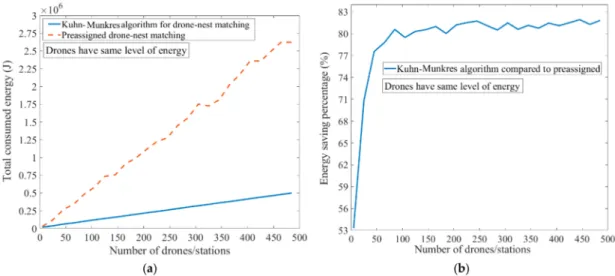
The Kuhn–Munkres algorithm is compared with a preassigned method for deploying drones with the same level of energy towards missions or stations. As an example, for different numbers of missions, stations, and drones with random locations and the same level of energy, the total flight distance or consumed energy can be calculated. In Figure5a,b, the comparison between two different matchings including the ordered (each drone goes to its assigned mission/station) and Kuhn–Munkres algorithm is shown.
Figure 5. (a) Comparison of total consumed energy and (b) energy-saving percentage versus the number of drones/stations for the Kuhn–Munkres algorithm and preassigned matching.
As can be seen in Figure5a, there is a considerable savings in energy if the drones are assigned to missions/stations based on the Kuhn–Munkres algorithm. Figure5b indicates that the Kuhn–Munkres algorithm is the best way to save on distance and, consequently, energy for drones. It is clear that for more than 50 drones and missions, there is a more than 80% energy (distance) reduction when the Kuhn–Munkres algorithm is used for matching drones and missions compared to the already assigned ones. The results demonstrate that power and energy can be saved if the Kuhn–Munkres algorithm is applied for assigning stations for different missions in smart cities.
In Figure6a,b, the total energy consumed by each individual drone of a group of 500 drones/stations is shown, based on preassigned and Kuhn–Munkres drone–nest matching, respectively. The results indicate that the individual drones that are deployed to the nest/mission through the Kuhn–Munkres algorithm are consuming less energy than the preassigned matchings.
Aerospace2019,6, 125 10 of 22
Figure 6.Views of total energy consumed by each individual drone of a group of 500 drones/stations based on (a) preassigned and (b) Kuhn–Munkres drone–nest matching (drones have the same level of energy).
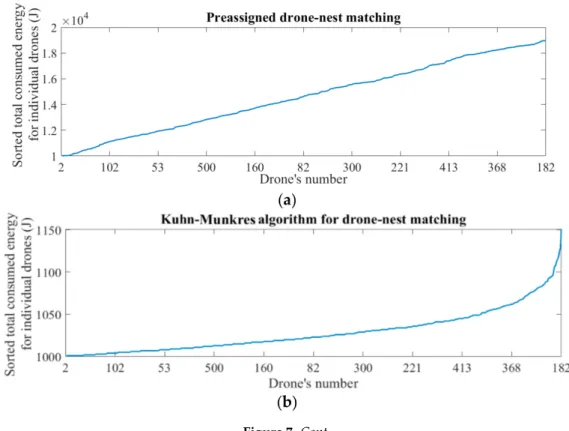
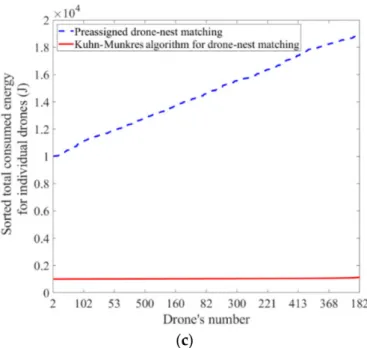
Figure 7.Views of sorted total consumed energy of each individual drone for (a) preassigned matching, (b) Kuhn–Munkres matching, and (c) comparison of preassigned and Kuhn–Munkres methods.
In Figure8, the energy-saving percentage of matching through the Kuhn–Munkres algorithm compared to the preassigned method for each individual drone with similar initial energy is demonstrated. The bar graph indicates that most of the drones can save almost 90% of their energy.
Figure 8.Energy-saving percentage of matching through the Kuhn–Munkres algorithm compared to the preassigned method for each individual drone.
5.2. Matching of Drones with Different Energy Level to Stations
Aerospace2019,6, 125 12 of 22
Kuhn–Munkres and greedy algorithms compared to preassigned matching. The energy savings of matching through the Kuhn–Munkres compared to the greedy algorithm has a smaller value once the number of drones increases. For matching more than 200 drones and stations, an energy savings of more than 2% can be achieved for the Kuhn–Munkres algorithm compared to the greedy algorithm. It is visible from Figure9a,b that the Kuhn–Munkres algorithm is the best method for nest matching of drones with different levels of energy.
Figure 9. (a) Comparison of total consumed energy and (b) energy-saving percentage versus the number of drones/stations for the Kuhn–Munkres algorithm, greedy algorithm, and preassigned matching for drones with different level of energy.
Figure10a–c show the total energy consumed by each individual drone of a group of 500 drones with different energy levels, based on preassigned, greedy, and Kuhn–Munkres drone–nest matching, respectively. The following graphs demonstrate that the matching of drones and nests in smart cities through Kuhn–Munkres and greedy algorithms is more efficient in terms of the total consumption of energy compared to preassigned matching.
Figure 10.Total energy consumed by each individual drone of a group of 500 drones/stations based on (a) preassigned, (b) greedy, and (c) Kuhn–Munkres drone–nest matching (the drones have a different level of energy).
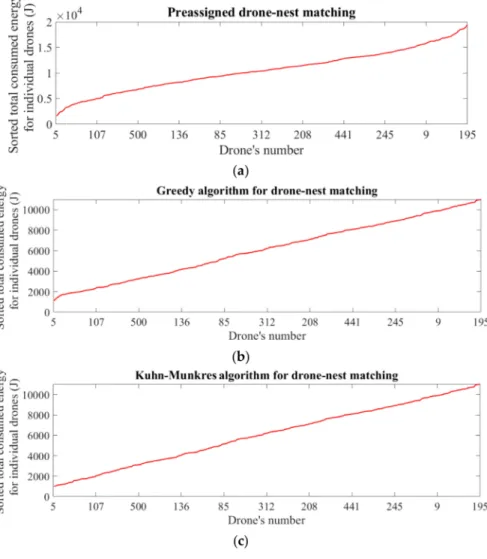
Figure10b shows that the total energy consumed by individual drones in matching through the greedy algorithm has lower fluctuations than preassigned and Kuhn–Munkres drone–nest matching due to the type of algorithm. The sorted total consumed energy for each individual drone with different levels of energy is indicated in Figure11a–c for preassigned, greedy, and Kuhn–Munkres matching, respectively. Figure11a–d shows that the sorted total consumed energy for individual drones through greedy and Kuhn–Munkres matchings is more linear and has lower values than the preassigned matching.
Aerospace2019,6, 125 14 of 22
Aerospace 2019, 6, x FOR PEER REVIEW 14 of 22
(d)
Figure 11. Views of sorted total consumed energy of each individual drone for (a) preassigned matching, (b) greedy algorithm, (c) Kuhn‒Munkres matching, and (d) comparison of preassigned, greedy, and Kuhn‒Munkres methods.
Figure 12 shows the energy-saving percentage of drone‒nest matching through the greedy algorithm compared to preassigned, and Kuhn‒Munkres algorithm compared to preassigned and the greedy algorithm for each individual drone with a different level of initial energy. The bar graphs in each comparison indicate a mean and median energy savings of 27% and 41% for the greedy algorithm compared to preassigned, 41% and 42% for the Kuhn‒Munkres algorithm compared to preassigned, and a median of 4% for Kuhn‒Munkres compared to the greedy algorithm. It can be concluded from the results that an energy savings of almost 40% can be achieved for each drone through the Kuhn‒Munkres and greedy algorithms compared to preassigned matching.
Figure 12. Energy-saving percentage of matching through the greedy algorithm compared to preassigned (top), Kuhn‒Munkres algorithm compared to preassigned (middle), and Kuhn‒Munkres compared to the greedy algorithm (bottom) for each individual drone.
Figure 11.Views of sorted total consumed energy of each individual drone for (a) preassigned matching, (b) greedy algorithm, (c) Kuhn–Munkres matching, and (d) comparison of preassigned, greedy, and Kuhn–Munkres methods.
Figure12 shows the energy-saving percentage of drone–nest matching through the greedy algorithm compared to preassigned, and Kuhn–Munkres algorithm compared to preassigned and the greedy algorithm for each individual drone with a different level of initial energy. The bar graphs in each comparison indicate a mean and median energy savings of 27% and 41% for the greedy algorithm compared to preassigned, 41% and 42% for the Kuhn–Munkres algorithm compared to preassigned, and a median of 4% for Kuhn–Munkres compared to the greedy algorithm. It can be concluded from the results that an energy savings of almost 40% can be achieved for each drone through the Kuhn–Munkres and greedy algorithms compared to preassigned matching.
5.3. Matching of Drones and Stations with Different Energy Levels
In the third scenario, drones with random energy levels will be matched with stations with different levels of energy. As noted before, the drones’ stations can be charged through direct electricity from lighting poles or received solar radiation. In order to save time while performing missions in smart cities, the charging time of drones is important. To this end, drones that have spent most of their energy during the mission should be matched with their nearest stations and a high level of charge. In this case, considering the numbers of drones with random locations and different levels of energy and preassigned stations with different energy levels, the total consumed energy is calculated. Figure13a compares the total consumed energy for drones and stations through preassigned, greedy, and Kuhn–Munkres algorithm matchings.
Figure 13. (a) Comparison of total consumed energy and (b) energy-saving percentage versus the number of drones/stations for Kuhn–Munkres algorithm, greedy algorithm, and preassigned matching for drones and stations with different levels of energy.
In Figure13a, it is visible that the drones that are employing greedy and Kuhn–Munkres algorithms for nest selection are consuming less energy than the preassigned matching. Moreover, the results show that the Kuhn–Munkres algorithm for matching is slightly more efficient than the greedy matching. Figure13b is a comparison of different matching mechanisms. It can be seen from the graph that when the number of drones is more than 25, the energy-saving percentage for the whole system (drones and stations) increases. For Kuhn–Munkres and greedy algorithms compared to preassigned matching, the energy savings is 28% and 27%, respectively. In this scenario, the energy efficiency of the whole system can be improved by 1% through the Kuhn–Munkres algorithm compared to greedy algorithm matching.
Aerospace2019,6, 125 16 of 22
Aerospace 2019, 6, 125 16 of 22
(a)
(b)
(c)
Figure 14. Views of total consumed energy for each individual drone of a group of 500 drones/stations based on (a) preassigned, (b) greedy, and (c) Kuhn‒Munkres drone‒nest matching (the drones and stations have different levels of energy).
The sorted total consumed energy for each individual drone and the corresponding station with
different levels of energy are shown in Figure 15a–c for preassigned, greedy, and Kuhn‒Munkres
matching, respectively. The results demonstrate a similar trend of the sorted energy for different
types of drone‒nest matching. It is apparent from Figure 15a–d that matchings through greedy and
Kuhn‒Munkres algorithms are more efficient than the preassigned drone‒nest matching.
Figure 14.Views of total consumed energy for each individual drone of a group of 500 drones/stations based on (a) preassigned, (b) greedy, and (c) Kuhn–Munkres drone–nest matching (the drones and stations have different levels of energy).
Aerospace2019,6, 125 18 of 22
The energy-saving percentage of each drone matched with a station with different levels of energy for the greedy algorithm compared to preassigned, and Kuhn–Munkres algorithm compared to the preassigned and greedy algorithms, are indicated in Figure16. The results in each comparison show a mean and median of saving energy of 23% and 31% for the greedy algorithm compared to preassigned, 30% for the Kuhn–Munkres algorithm compared to preassigned, and a median of 2% for Kuhn–Munkres compared to greedy algorithm. An energy efficiency of almost 30% can be obtained for each drone and its corresponding station through the Kuhn–Munkres and greedy algorithms compared to the preassigned matching.
Figure 16. Energy-saving percentage of matching through the greedy algorithm compared to a preassigned (top), Kuhn–Munkres algorithm compared to preassigned (middle), and Kuhn–Munkres compared to the greedy algorithm (bottom) for each individual drone and corresponding station.
6. Matching Demonstration through Kuhn–Munkres and Greedy Algorithms
Three different scenarios were discussed above for drone–nest matching in smart cities. It was shown that, depending on the energy level of drones and stations, each matching mechanism has a certain energy-saving percentage compared to each other. In the first scenario, it was assumed that all the drones and stations have a similar level of energy. In this case, if drones have the same configuration and consequently a similar drag force, the remaining energy for each drone is expressed as in Equation (4). In this scenario, the optimization of the nesting of drones is carried out depending on their distances to the stations. As an example, for six predefined stations and randomly distributed drones, the Kuhn–Munkres and preassigned matchings are compared, as shown in Figure17.
Figure 17. Examples of bipartite graphs for drones and their stations based on preassigned and Kuhn–Munkres matchings for drones with the same level of energy.
Figure 18.Examples of bipartite graphs for drones and their stations based on preassigned, greedy, and Kuhn–Munkres matchings for drones with different levels of energy.
Aerospace2019,6, 125 20 of 22
Figure 19.Examples of bipartite graphs for drones and their stations based on preassigned, greedy, and Kuhn–Munkres matchings for the drones and stations with different levels of energy.
7. Conclusions
In this paper, an optimized approach for networking and assigning the best stations for drones was proposed. Taking inspiration from the nests of birds, lighting poles in cities were considered as possible stands for drones’ charging stations. It was shown that, to increase the efficiency of drones in smart cities, there is a need for matching between the drones and stations. Greedy and Kuhn–Munkres (Hungarian matching) algorithms were used to minimize the power required for the drones to land in the defined nests in an urban area. It was demonstrated that drones and stations form a bipartite graph that can easily be represented by an adjacency matrix. Three different scenarios were discussed for assigning stations for the drones. For different numbers of stations and drones with random locations and levels of energy, the total distances were calculated. It was shown that drones that use greedy or Kuhn–Munkres algorithms save more energy compared to preassigned matching.
Author Contributions:Conceptualization, M.H. and A.M.; methodology, A.M.; software, A.M.; validation, M.H. and A.M.; writing original draft preparation, A.M. and M.H.; writing review and editing, M.H.
Funding:This research received no external funding.
Conflicts of Interest:The authors declare no conflict of interest.
References
1. Neirotti, P.; De Marco, A.; Cagliano, A.C.; Mangano, G.; Scorrano, F. Current trends in Smart City initiatives: Some stylised facts.Cities2014,38, 25–36. [CrossRef]
2. Albino, V.; Berardi, U.; Dangelico, R.M. Smart cities: Definitions, dimensions, performance, and initiatives.J. Urban Technol.2015,22, 3–21. [CrossRef]
3. Batty, M.; Axhausen, K.W.; Giannotti, F.; Pozdnoukhov, A.; Bazzani, A.; Wachowicz, M.; Ouzounis, G.; Portugali, Y. Smart cities of the future.Eur. Phys. J. Spec. Top.2012,214, 481–518. [CrossRef]
4. Barrionuevo, J.M.; Berrone, P.; Ricart, J.E. Smart cities, sustainable progress. IESE Insight2012,14, 50–57. [CrossRef]
5. van Dijk, M.P. Smart Eco-Cities Are Managing Information Flows in an Integrated Way: The Example of Water, Electricity and Solid Waste. InSmart Futures, Challenges of Urbanisation, and Social Sustainability; Springer: Cham, Switzerland, 2018; pp. 149–168.
6. Minoli, D.; Occhiogrosso, B. Internet of Things Applications for Smart Cities. InInternet of Things A to Z: Technologies and Applications; Wiley: New York, NY, USA, 2018; p. 319.
7. Rathore, M.M.; Ahmad, A.; Paul, A.; Rho, S. Urban planning and building smart cities based on the internet of things using big data analytics.Comput. Netw.2016,101, 63–80. [CrossRef]
9. Chen, X.Y.; Jin, Z.G. Research on key technology and applications for internet of things.Phys. Procedia2012, 33, 561–566. [CrossRef]
10. Mirzaeinia, A.; Hassanalian, M.; Mirzaeinia, M. Cellular Phone Loaded Network Field Test Using Swarming Drones: Replacing Drive Test and Particle Swarm Optimization. In Proceedings of the AIAA Aviation 2019 Forum, Dallas, TX, USA, 17–21 June 2019.
11. Sappington, R.N.; Acosta, G.A.; Hassanalian, M.; Lee, K.; Morelli, R. Drone Stations in Airports for Runway and Airplane Inspection Using Image Processing Techniques. In Proceedings of the AIAA Aviation 2019 Forum, Dallas, TX, USA, 17–21 June 2019.
12. Acosta, G.A.; Grow, D.; Hassanalian, M. Design and Analysis of a High Pressure and High Temperature Fixed Wing Space Drone for Venus Exploration. In Proceedings of the AIAA Aviation 2019 Forum, Dallas, TX, USA, 17–21 June 2019.
13. Mirzaeinia, A.; Hassanalian, M.; Lee, K.; Mirzaeinia, M. Performance Enhancement and Load Balancing of Swarming Drones through Position Reconfiguration. In Proceedings of the AIAA Aviation 2019 Forum, Dallas, TX, USA, 17–21 June 2019.
14. Hassanalian, M.; Quintana, A.; Abdelkefi, A. Morphing and growing micro unmanned air vehicle: Sizing process and stability.Aerosp. Sci. Technol.2018,78, 130–146. [CrossRef]
15. Hassanalian, M.; Rice, D.; Abdelkefi, A. Evolution of space drones for planetary exploration: A review.Prog. Aerosp. Sci.2018,97, 61–105. [CrossRef]
16. Hassanalian, M.; Abdelkefi, A. Classifications, applications, and design challenges of drones: A review.Prog. Aerosp. Sci.2017,91, 99–131. [CrossRef]
17. Jung, S.; Ariyur, K.B. Robustness for Large Scale UAV Autonomous Operations. In Proceedings of the 2011 IEEE International Systems Conference, Montreal, QC, Canada, 4–7 April 2011; pp. 309–314.
18. Hassanalian, M.; Abdelkefi, A. Design, manufacturing, and flight testing of a fixed wing micro air vehicle with Zimmerman planform.Meccanica2017,52, 1265–1282. [CrossRef]
19. Mohammed, F.; Idries, A.; Mohamed, N.; Al-Jaroodi, J.; Jawhar, I. UAVs for Smart Cities: Opportunities and Challenges. In Proceedings of the Unmanned Aircraft Systems (ICUAS), Orlando, FL, Canada, 27–30 May 2014.
20. Yu, H.; Meier, K.; Argyle, M.; Beard, R.W. Cooperative path planning for target tracking in urban environments using unmanned air and ground vehicles.IEEE/ASME Trans. Mechatron.2014,20, 541–552. [CrossRef] 21. Ataei, A.; Paschalidis, I.C. Quadrotor Deployment for Emergency Response in Smart Cities: A Robust MPC
Approach. In Proceedings of the 2015 54th IEEE Conference on Decision and Control (CDC), Osaka, Japan, 15–18 December 2015; pp. 5130–5135.
22. Foina, A.G.; Sengupta, R.; Lerchi, P.; Liu, Z.; Krainer, C. Drones in Smart Cities: Overcoming Barriers through Air Traffic Control Research. In Proceedings of the Education and Development of Unmanned Aerial Systems (RED-UAS), Cancun, Mexico, 23–25 November 2015; pp. 351–359.
23. Gallacher, D. Drones to manage the urban environment: Risks, rewards, alternatives.J. Unmanned Veh. Syst. 2016,4, 115–124. [CrossRef]
24. Vattapparamban, E.; Güvenç, ˙I.; Yurekli, A.˙I.; Akkaya, K.; Ulua ˘gaç, S. Drones for smart cities: Issues in cybersecurity, privacy, and public safety. In Proceedings of the 2016 International Wireless Communications and Mobile Computing Conference (IWCMC), Paphos, Cyprus, 5–9 September 2016; pp. 216–221.
25. Jensen, O.B. Drone city–power, design and aerial mobility in the age of “smart cities”.Geogr. Helv.2016,71, 67–75. [CrossRef]
26. Menouar, H.; Guvenc, I.; Akkaya, K.; Uluagac, A.S.; Kadri, A.; Tuncer, A. UAV-enabled intelligent transportation systems for the smart city: Applications and challenges. IEEE Commun. Mag. 2017, 55, 22–28. [CrossRef]
27. Khan, M.A.; Alvi, B.A.; Safi, A.; Khan, I.U.Drones for Good in Smart Cities: A Review; IEEE: Islamabad, Pakistan, 2018.
28. Yang, Q.; Yoo, S.J. Optimal UAV path planning: Sensing data acquisition over IoT sensor networks using multi-objective bio-inspired algorithms.IEEE Access2018,6, 13671–13684. [CrossRef]
29. Bahabry, A.; Wan, X.; Ghazzai, H.; Menouar, H.; Vesonder, G.; Massoud, Y. Low-altitude navigation for multi-rotor drones in urban areas.IEEE Access2019,7, 87716–87731. [CrossRef]
Aerospace2019,6, 125 22 of 22
31. Briod, A.; Klaptocz, A.; Zufferey, J.C.; Floreano, D. The AirBurr: A flying robot that can exploit collisions. In Proceedings of the 2012 ICME International Conference on Complex Medical Engineering (CME), Kobe, Japan, 1–4 July 2012; pp. 569–574.
32. Mulgaonkar, Y.; Kientz, T.; Whitzer, M.; Kumar, V. Design and fabrication of safe, light-weight, flying robots. In Proceedings of the ASME 2015 International Design Engineering Technical Conferences and Computers and Information in Engineering Conference, Boston, MA, USA, 2–5 August 2015.
33. Sareh, P.; Chermprayong, P.; Emmanuelli, M.; Nadeem, H.; Kovac, M. Rotorigami: A rotary origami protective system for robotic rotorcraft.Sci. Robot.2018,3, eaah5228. [CrossRef]
34. Sareh, P.; Chermprayong, P.; Emmanuelli, M.; Nadeem, H.; Kovac, M. The Spinning Cyclic ‘Miura-oRing’ for Mechanical Collision-Resilience. In Proceedings of the 7th International Meeting on Origami in Science, Mathematics and Education (7OSME), Oxford, UK, 5–7 September 2018; pp. 981–994.
35. Briod, A.; Kornatowski, P.; Zufferey, J.C.; Floreano, D. A collision-resilient flying robot.J. Field Robot.2014, 31, 496–509. [CrossRef]
36. Malandrakis, K.; Dixon, R.; Savvaris, A.; Tsourdos, A. Design and development of a novel spherical UAV. IFAC-PapersOnLine2016,49, 320–325. [CrossRef]
37. Gentry, N.K.; Hsieh, R.; Nguyen, L.K.; Amazon Technologies Inc. Multi-use UAV Docking Station Systems and Methods. U.S. Patent 9,387,928, 12 July 2016.
38. Techcrunch. Available online:https://techcrunch.com/2017/05/22/ kuang-chi-invests-5-million-in-skyx-a-maker-of-drones-to-monitor-oil-and-gas-pipelines/(accessed on 21 July 2019).
39. Riskmatrix. Available online:http://www.riskmatrix.be/yacob(accessed on 21 July 2019).
40. Trendhunter. Available online:https://www.trendhunter.com/trends/drone-dock(accessed on 21 July 2019). 41. Hassanalian, M.; Abdelmoula, H.; Ayed, S.B.; Abdelkefi, A. Thermal impact of migrating birds’ wing color on their flight performance: Possibility of new generation of biologically inspired drones. J. Therm. Biol. 2017,66, 27–32. [CrossRef] [PubMed]
42. Hassanalian, M.; Throneberry, G.; Ali, M.; Ayed, S.B.; Abdelkefi, A. Role of wing color and seasonal changes in ambient temperature and solar irradiation on predicted flight efficiency of the Albatross.J. Therm. Biol. 2018,71, 112–122. [CrossRef]
43. Hassanalian, M.; Ayed, S.B.; Ali, M.; Houde, P.; Hocut, C.; Abdelkefi, A. Insights on the thermal impacts of wing colorization of migrating birds on their skin friction drag and the choice of their flight route.J. Therm. Biol.2018,72, 81–93. [CrossRef] [PubMed]
44. Hassanalian, M.; Abdelmoula, H.; Mohammadi, S.; Bakhtiyarov, S.; Goerlich, J.; Javed, U. Aquatic animal colors and skin temperature: Biology’s selection for reducing oceanic dolphin’s skin friction drag.J. Therm. Biol.2019,84, 292–310. [CrossRef]
45. Jonker, R.; Volgenant, T. Improving the Hungarian assignment algorithm.Oper. Res. Lett.1986,5, 171–175. [CrossRef]