R E S E A R C H
Open Access
Implementation of a post-arrest care team:
understanding the nuances of a
team-based intervention
Katie N. Dainty
1*, Elizabeth Racz
1, Laurie J. Morrison
1and Steven C. Brooks
2Abstract
Background:Despite advances in the management of sudden cardiac arrest, mortality for patients admitted to hospital is still greater than 50 %. Lack of familiarity and experience with post-cardiac arrest patients and lack of interdisciplinary collaboration between emergency and ICU staff have been highlighted as potential barriers to optimal care. To address these barriers, a specialized Post Arrest Consult Team (PACT) was implemented at two urban academic centers.
Our objective was to describe the PACT implementation from the participant perspective in order to explore potentially mitigating factors on effectiveness of the intervention and inform other institutions who may be considering a similar approach.
Methods:Using an ethnographic style approach, we collected data throughout the implementation period using both key informant interviews and non-participant observation. The data were analyzed using interpretive descriptive analysis techniques.
Results:The PACT intervention was taken up differently in each of the two participating institutions. Participants spoke about the difficulty in maintaining a dynamic interaction between the team members and a shared sense of purpose, the challenge of off-service consulting and the impact of the lack of data feedback to support whether the project was effecting change.
Conclusions:It appears that purposefully creating a“sense of team,”the team composition and organizational culture and provision of performance feedback are important facilitators to ensuring uptake of a team-based intervention like the PACT model. Reporting of the intervention design and actual implementation experience like we have done here is crucial to allow readers to judge the quality of the study, to properly replicate it, and to contemplate how various factors may influence the outcome of a complex intervention.
Keywords:Cardiac arrest, Multidisciplinary care teams, Resuscitation, Implementation science, Qualitative methods
Background
Out-of-hospital cardiac arrest (OHCA) is a common and lethal public health problem. The North American inci-dence of emergency medical services (EMS)-treated cardiac arrest is estimated to be 52.1 per 100,000 people per year [1]. Despite advances in the immediate management of sudden cardiac arrest over the past six
decades, mortality for patients admitted to hospital is still greater than 50 % [1].
Several international position statements have defined best practices for patients with post-cardiac arrest syn-drome, including the rapid induction of targeted temperature management, selective use of percutaneous coronary intervention, assessment for an implantable cardioverter-defibrillator, and appropriately delayed neuro-prognostication [1, 2]. Numerous potential barriers to the delivery of optimal post-cardiac arrest care have also been identified in the literature [3–5]. For example, lack of familiarity and experience with post-cardiac arrest patients * Correspondence:[email protected]
1Rescu, Li Ka Shing Knowledge Institute, St. Michael’s Hospital, 30 Bond
Street, Toronto, ON M5B 1W8, Canada
Full list of author information is available at the end of the article
due to relatively low annual volumes of this type of patient at any given institution has been consistently cited [5]. A lack of interdisciplinary collaboration between emergency department (ED) and intensive care unit (ICU) staff and lack of access to advanced technology and specialized hu-man resources are commonly identified as organizational barriers.
Previous research has demonstrated improved survival with the implementation of standardized bundled care plans for the post-cardiac arrest patient [6–8]. Improved outcomes have also been demonstrated for patients suf-fering from other types of complex, acute illnesses such as severe trauma and ST-elevation myocardial infarction with the implementation of specialized interdisciplinary teams and evidence-based systems of care [2, 9–13]. With this in mind, the intervention was designed to directly address barriers to optimal care for post-cardiac arrest patients by implementing a specialized Post Arrest Consult Team (PACT) at two urban academic centers. The primary analysis of this intervention, which is pub-lished elsewhere [14], involved a quantitative comparison of process and clinical outcomes with concurrent and historical controls from several other hospitals that did not have PACT implementation within the same geo-graphical region.
This paper represents the results of an integrated qualitative evaluation designed to study the PACT im-plementation process in detail and identify potential me-diating factors perceived by frontline clinical staff in the PACT institutions. To date, there is little research on how health organizations take up, support, and embed complex innovations [15], such as the PACT, to inform implementation of other similar interventions. Research on the impact of quality implementation of programs and services has shown that without a focus on imple-mentation best practices, outcomes may not be achieved as expected, and in some cases a poorly implemented program may produce harmful results [16]. As the inter-vention study was being planned, it was recognized that understanding this piece of the project would be essen-tial to comprehensively evaluate the effectiveness of this novel approach and expand our understanding of the quantitative study outcomes.
The PACT intervention (as designed)
The focus of the intervention was to provide an institution-wide, standardization of post-cardiac arrest care and collab-oration across clinical specialties by creating a new "post-ar-rest consult team” —the PACT. The PACT was designed to improve the consistency of care delivery through a stan-dardized approach, collaboration between the consultation team and the primary services caring for the patient and education to ensure that all patients receive optimal care based on best evidence and current guidelines.
Evidence-based clinical pathways, which prescribed evaluation and management strategy guidance to the PACT, were devel-oped through a consensus by a group of investigators com-prised of a physician and nursing specialists in emergency medicine, cardiology, and intensive care. These clinical pathways were derived from the 2010 American Heart As-sociation Emergency Cardiovascular Care and Cardiopul-monary Resuscitation Guidelines [17].
The PACT was operationalized through an on-call team including a physician and nurse available for consultation 24 h a day. The PACT physician was asked to be available for urgent (within 30 min) bedside consultations during business hours (9 am to 5 pm, Monday to Friday) and available for phone consultations during off hours (after 5 pm, weekends and holidays) with the option to come to the hospital for bedside assessment when required. The team’s main objective was to provide timely expertise and collaborative hands-on assistance to the treating physi-cians and nurses who maintained primary responsibility for the patient while they were in hospital.
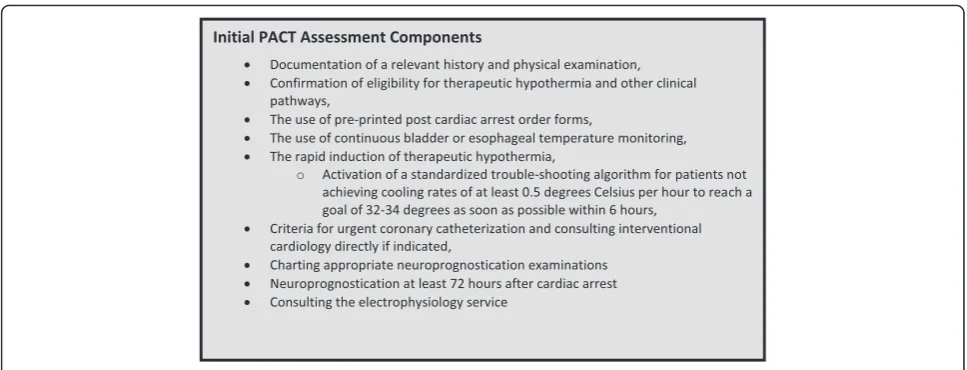
The immediate emphasis of PACT involvement was on ensuring the rapid induction of targeted temperature management, avoidance of hyperoxia and hypocarbia, and assessment for urgent coronary angiography. These best practices were to be addressed during initial con-sultation by the PACT, usually in the ED. Ongoing follow-up by PACT with the patient on a daily basis was planned for the first 72 to 96 h after arrest so that the electrophysiology and delayed neuroprognostication pathways could be addressed and supported. During these consultations, PACT members were encouraged to leave a standardized note in the patient chart and dis-cuss items of recommendation directly with the primary service as necessary.
Similar to other consult teams in the hospital, PACT members were to carry pagers when they were on-call. The team could be activated via one of two mechanisms: (a) by the ED team through the hospital switchboard in a fashion similar to activating a CODE BLUE cardiac arrest response or (b) via an automatic email alert facili-tated by the local emergency medical services when a post-cardiac arrest patient was delivered to one of the PACT hospitals. When the email alert was received, the PACT was to call down to the ED and confirm that the patient had arrived alive. If the patient was alive, the PACT was to head down to the ED to assist with post-resuscitation care.
available in most hospitals, the PACT worked in a col-laborative way with the most responsible care providers in both the EDs and ICUs. When the PACT was called to assist with a patient, the requesting physician remained in the role of the most responsible physician (MRP). The MRP is the emergency physician assigned to the patient or the physician under whose care the patient has been admitted to hospital. The MRP continued to direct com-ponents of ongoing resuscitation and general critical care, and the PACT provided support, expert guidance, and “hands-on” human resources during the management of these complex patients.
Subsequent bedside assessments were made on a regu-lar 24-h basis and additionally as required by the clinical scenario. Each visit included a review of the PACT clin-ical pathways, a note in the patient chart by the PACT clinician, and verbal communication with assigned clin-ical team members.
The primary initial task for the PACT nurse was to fa-cilitate the rapid induction of targeted temperature man-agement for eligible patients by providing guidance and assistance to the primary nurses. The PACT nurse would then collaborate with the PACT physician on all other as-pects of post-arrest care. This nursing role was designed to be similar to other specialized nursing consultants such as the clinical nurse specialist component of many stroke or trauma teams. The PACT nurse also screened daily hospital admissions for missed cardiac arrests, which may be appropriate for follow-up from the PACT.
PACT physicians and nurses were also intended to provide interprofessional education to the ICU, ED, and cardiac care unit (CCU) personnel through presentations at educational rounds and orientation sessions, as well as informal knowledge translation at the bedside.
The principal investigator and study team intended to facilitate ongoing education and quality assurance by using data on care processes and clinical outcomes as a feedback tool. There were to be monthly rounds sched-uled for all PACT and steering committee members in order to exchange feedback on team operations. Reviews of PACT cases were employed to fine-tune the activities of the team for maximal impact.
Methods
Study setting
The PACT project was implemented in two academic health science centers in Toronto, Ontario, and qualitative data collection for this study occurred specifically in the ED and ICU at both centers. Hospital A was a level 1 trauma center with over 1200 beds and 40,000 emergency room visits per year. Hospital B was also an urban level 1 trauma and critical care center with close to 500 beds and 75,000 ED visits annually. On average, local ambulance services transport approximately 60 out-of-hospital car-diac arrests to each institution annually.
Study design
were digitally recorded and transcribed verbatim by an external transcription service.
A purposive sampling strategy [18] was used to select the participants for interviewing due to the specific type of participants required, i.e., those who were part of the PACT or interacted with the PACT during the interven-tion period. All physicians, nurses, and health discipline professionals (respiratory therapists and occupational therapists) from the ICU and ED from both sites who are involved with the PACT were asked to participate via email and at study team meetings (n= 36). All of the participants agreed to be interviewed. Sampling contin-ued until the investigators felt that thematic and partici-pant saturation had been reached [19].
Qualitative observation during and after implementation was done to see first-hand how the intervention was im-plemented compared to how it was originally designed, how staff from the various units interacted with each other, and what specific attributes of the implementation appeared to be influential in the uptake of the PACT within the participating organizations. The qualitative re-searcher (KND) carried a pager and was notified of each cardiac arrest in which the PACT was activated. When possible, she met the incoming ambulance in the ED and observed the entire care process and team interaction through to ICU admission (approximately 1 h per case). Observations were also conducted at the 24-h follow-up point in the ICU and at all study team meetings. All clin-ical team members and PACT members were made aware of the ongoing observational data collection and given the option to decline to be observed. If a team member did not wish to be observed, the researcher would cease observation of that case and return on a different day. No clinical team members or PACT members declined participation at any point in the study.
Interview and observational data were analyzed using an interpretive descriptive approach [20]. All analysis was done independently by the lead researcher and compared with research colleagues at a later date. Descriptive codes were first attached to segments of the text in each tran-script. The descriptive codes were then grouped in to broad topic-oriented categories, and all text segments belonging to the same category were compared. Ultim-ately, patterns and themes within the data were inter-preted into key learnings through an inductive, iterative process, in order to make sense of the most important ideas to be conveyed and reflect on their meaning in a new manner [20].
Results
Data were collected and analyzed over the course of the 2-year implementation. During this time, 20 key inform-ant interviews were conducted at several time points and over 40 h of observation between the two sites. The
qualitative data collected over the course of the implementation highlighted three major themes which represent key factors from the participant perspective that are highly informative for future implementations of PACT type interventions. In no particular order, they were: (a) the importance of creating a sense of team, (b) the influence of team composition, and (c) the import-ance of ongoing performimport-ance feedback.
The importance of creating a“sense of team”
While PACT RNs and MDs were generally trained together in terms of the clinical knowledge required to function in the role and required data collection, no explicit team building was done as part of the implementation plan. In some cases, the nurse-physician teams had not worked together before, and initial communication was difficult in these situations. At each site, there were several clinicians involved as PAC Team members; how-ever, they all took turns “on call” on a rotating basis and therefore never actually worked together. Due to the high variability in the frequency of the actual calls, some clini-cians consulted on less than five cases over the 2 years of the study. This made it very difficult to maintain a dy-namic interaction between the team members and a shared sense of purpose.
It wasn’t a natural constituency for the team but we didn’t really do anything to‘pull’the team together in a more formal way, for instance focusing on team building exercises, etc. The fact that the team would work together was a little bit taken for granted in an environment of balkanized care. (Physician PACT member 3)
The“team”concept is very seductive but then you have a team for everything and the responsibilities and roles are confusing. (ICU nurse manager 2)
Team composition
24-h critical care rapid response team (CCRT), an on-call team consisting of ICU physicians and nurses who provide 24/7 emergency response for admitted patients who experience a medical emergency or acute worsening of their condition (more universally known as medical emergency teams (METs)).
In hospital B, PACT duties were assigned daily to a nurse working in the cardiovascular ICU. There were approxi-mately 15–20 CVICU nurses on the PACT roster. At least one was identified as being on-call at all times unless none were working in the hospital. These nurses had primary pa-tient care assignments in the CVICU while they were on-call for PACT. Because their primary responsibility was to their CVICU patients, availability for immediate bedside consultation was variable. They were asked to respond to the PACT call as soon as they could safely arrange coverage of their CVICU responsibilities. Traditionally, CVICU nursing staff do not practice outside of the CVICU, and therefore, PACT represented a departure from their usual work environment.
As bedside nurses we are“doers”so the consulting role was very different for us; plus we don’t traditionally go to the ED so we don’t know the system there and it’s a bit hard to parachute in. (PACT nurse 1)
ED does need help to get started and ensure they follow all the protocols but it really should be one of their own to help them; someone that understands how they work. (PACT nurse 4)
It was noted through the observational data collec-tion that the placement of the team with an existing CCRT/MET consult service seemed to allow for more flexibility in responding to calls; however, both teams found the consultation role in the ED challenging. The ED and ICU are both very complex clinical units with their own cultures, systems, standard operating procedures, and command hierarchies, and so the as-sumptions that clinicians (nurses and physicians) would automatically be able to crossover and assimi-late from ICU to the ED environment were noticeably flawed. It seemed that very little clinical knowledge regarding the best practices was translated at the ini-tial bedside consult and much of the time appeared to be spent observing and identifying the right time to initiate conversation within the chaotic environ-ment. In many cases, the patient had already been transported up to the ICU by the time the PACT member arrived in the ED, and so the opportunity to encourage early initiation of the evidence-based guidelines was often diluted. There was more discus-sion at the 24-h follow-up visit, particularly between
the PACT physician and the attending physician now responsible for the patient. However, this often ap-peared awkward as the PACT could only provide ad-vice and the care orders ultimately were written by the non-PACT physician.
The importance of performance feedback
Audit and feedback can be defined as a summary of clin-ical performance (audit) over a specific period of time and the provision of that summary (feedback) to individ-ual practitioners, teams, or healthcare organizations [21]. Regular feedback of outcome data were an intended activity of the PACT intervention. Unfortunately, due to unforeseen database issues, the research team was un-able to provide specific PACT feedback reports to the teams until the last few months of the study.
While normally this may not have been an issue, health care has become heavily reliant on the reporting of data as the measure of success and failure. When interviewed, many of the participating clinicians felt that the PACT was “a good idea” but in the end struggled with whether or not the PACT approach was effective due to the lack of data. There also was not a timely de-brief of each case, and so responsive changes were not possible. Given that the intervention is rather intensive in terms of time and resources, the lack of data resulted in a loss of engagement on the part of the teams as they began to question the capacity of the study to effect change.
Our core nursing leadership did the lion’s share of the work on good will because the Physician enthusiasm was low and waned significantly with the lack of feedback on whether we were having any effect. (PACT nurse 2)
There were cooling reports provided but they didn’t seem to include all of the patients we were seeing? It didn’t seem to match the numbers [of patients] we thought we were seeing and so the data wasn’t that useful. (PACT nurse 6)
industrial/organizational psychology, proposes that feed-back interventions generally work by providing new infor-mation that redirect recipients’ attention toward (or in some cases away from) the task; phenomena that redirect attention toward the details of the task tend to strengthen feedback’s effect on task performance. The lack of feed-back about the impact of PACT on processes or clinical outcomes may have actually worked to weaken the team member’s attention to the intervention, especially in light of increasing competing interests for the attention of clinicians. Without data, there was also no way for the team to know what parts of the PACT intervention were effective and which parts may need modification, i.e., supporting a continuous quality improvement ap-proach to the intervention.
Discussion
The objective of this paper was to examine the potential impact that implementation choices may have had on the effectiveness of the PACT model from the point of view of participating team members. While purposefully designed as a multi-method study from the outset, largely negative quantitative study results have turned greater attention to understanding what contextual fac-tors may have influenced the results of the intervention. The quantitative concurrent control study was able to demonstrate that a specialized post-cardiac arrest con-sult team was able to impact the occurrence of prema-ture withdrawal of life-sustaining therapy but did not improve rates of targeted temperature management, the use of coronary angiography, or electrophysiology as-sessments prior to hospital discharge [14]. The analysis and observations reported here reveal three key findings that may have had a fundamental impact on the PACT’s ability to function as intended and to influence the up-take of most of the evidence-based guidelines.
Firstly, participants strongly conveyed the importance of the need to activelycreatea sense of team in a project like this. While referred to as a “team” and requiring members to work on related task, the members of PACT did not necessarily work with one another dynamically and have a shared past, a shared goal, or a common fate, and so, it may have been helpful to place more emphasis on recognized teambuilding strategies for this type of intervention. A systematic concept analysis in 2008 con-cluded that teamwork in healthcare is “a dynamic process involving two or more healthcare professionals with complementary backgrounds and skills, sharing common health goals and exercising concerted physical and mental effort in assessing, planning, or evaluating patient care” [23]. To work effectively together, team members must possess specific knowledge, skills, and attitudes, such as the skill in monitoring each other’s performance, knowledge of their own, and teammate’s
task responsibilities, and a positive disposition toward working in a team [24]. The Healthcare World has be-come so specialized that our care of complex patients such as cardiac arrest victims is dependent on collabora-tive teamwork and is by definition interdependent; how-ever, we cannot fall prey to assumptions that people who do related tasks are a team. Training and organization of care within a hospital setting (subspecialty training, phys-ician vs. nurse training, program-based organizational structures, etc.) tend to support patient ownership and silos of care that start and end at the doors of each unit. The intended advantages of interventions like PACT, which specifically leverage the creation of interprofessional and cross-disciplinary teams, can only be realized if an effort is made to build those specific behaviors recognized as critical to goodteamperformance [25].
Secondly, within the field of medicine, the role of a specialist consultant is a unique one. Typically a patient is assigned to a lead attending physician and nurse(s)/ nursing team, and a “consult” from another service is only requested when the attending physician would like the expert opinion of a colleague trained in a specific area of medicine, such as cardiology and neurology. The consult is “sought” by the attending creating a “pull” form of knowledge transfer [26]. The PACT also de-parted from the usual practice of more specialized teams arriving for consult and often “taking over” the care of the complex patient, such as in the case of stroke or trauma teams. Having a team arrive unrequested to help and consult on care but not assume responsibility is a very different model—more of a “push” form of know-ledge translation [26], and the staff engagement with such an approach, for both a new consultant and the consultee, is something which must be monitored and fostered based on our experience. This departure from normal consultation practices may have caused some role confusion among the PACT members and also the healthcare providers who are part of the unit that is cur-rently managing the patient (either the ED or ICU).
effect, and so a lack of data to support the contribution of the PACT intervention to improved patient outcomes had a demoralizing effect on the PACT members and units. With resource-intensive interventions such as this one, it is important for team focus and morale that they have a way to know they are making a difference to patient outcomes and if they are not, how the process could be tweaked in situ to ensure the impact of the par-ticipant’s efforts is felt.
Providing a more indepth report of the actual imple-mentation of an intervention like this is crucial to allow readers to judge the quality of the primary study and contemplate how various implementation factors may have influenced the reported outcomes [27]. The find-ings indicated that while it may appear simple enough in design, the introduction of a new specialized care team like PACT requires very close attention be paid at the design phase to what are largely sociologic realities of interprofessional and organizational culture in order to ensure that the intervention has the best possible chance of effecting the desired change. This speaks to what is commonly referred to in implementation science as a lack of intervention fidelity. Intervention fidelity refers to the extent to which the intervention was delivered as it was intended and more importantly in the case where it differed, why that occurred, and what it meant for the study outcomes [27]. The PACT intervention was imple-mented differently than originally intended due to both organizational factors and a lack attention to and sup-ports for the complexities of a team-based intervention. It is actually possible that in fact this intervention did not achieve the desired effect largely because the advan-tage of using a response team to improve the use of evidence-based practices may have been diluted.
The findings reported here are based on interviews and observations in only two organizations; however, the data were collected in a rigorous, longitudinal, and representa-tive way, and so it was felt that the results presented here are transferable and useful for organizations looking to imple-ment similar process improveimple-ment interventions. The methodology for this work purposefully places interviews, rather than participant observation, at the center of the research design. This allowed for the use of the participants’ report of their experience of the intervention, particularly multidisciplinary stories of the PACT“work,”to investigate some of the less obvious implementation influences.
Conclusions
A critical element often missing from published quan-titative reports of quality improvement interventions is a discussion of intervention fidelity, implementation realities, and their impact on engagement with a new prac-tice and the evaluation of its effectiveness. By outlining how the intervention was actually implemented and how
that differed from the intended design and the nuances that may be unique to team-based interventions, we hope to have drawn attention to some of the often overlooked complexities of such seemingly simple changes in interdis-ciplinary practice. This research provides insight into the impact of purposefully creating a “sense of team,” team composition, and consult culture and ongoing provision and engagement with performance feedback as important facilitators to ensuring effective uptake and impact of team-based interventions like the PACT model.
Acknowledgements
The author’s would like to acknowledge the participation of the PAC Team members in this study including generous donation of their time for interviews, acceptance of the research team during observation periods, and input into the final interpretation of the data. Without their willing participation, we would not have been able to conduct this important work.
Funding
The PACT study was funded by an operating grant from the Heart and Stroke Foundation of Canada and the Canadian Institutes of Health Research in the form of a partnership funding opportunity called the Resuscitation and Knowledge Transfer and Exchange 2010 Initiative. Also, grants from the Alternative Funding Plan Innovation Fund through the Ontario Ministry of Health and Long-Term Care supported the work reported in this manuscript. LJM is supported by the Robert and Dorothy Pitts Chair in Emergency Medicine and Acute Care, Li Ka Shing Knowledge Institute, St Michael’s Hospital, and receives salary support from the National Institute of Health for her role as Principal Investigator for the Toronto Regional Coordinating Centre for the Resuscitation Outcomes Consortium.
Authors’contributions
KND was the lead investigator and made substantial contributions to the conception and design of the work reported here and the acquisition, analysis, and interpretation of data for the work; drafted the work and revised it critically for important intellectual content; approves of the final version to be published; and agrees to be accountable for all aspects of the work in ensuring that questions related to the accuracy or integrity of any part of the work are appropriately investigated and resolved. ER and LJM were co-investigators who made contributions to the conception and design of the work and the interpretation of data for the work; revised the work critically for important intellectual content; and approved of the final version to be published. SCB was a lead investigator on the primary quantitative study and co-investigator on the qualitative study reported here; he made substantial contributions to the conception and design of the work and the interpretation of data for the work, revised the work critically for important intellectual content, and approved of the final version to be published. All authors read and approved the final manuscript.
Competing interests
The authors declare that they have no competing interests.
Ethics approval and consent to participate
Research ethics approval was obtained from both hospital A and B’s Research Ethics Boards. Individual consent was verbally recorded from all interview participants, and all clinical staff in the EDs and ICUs were made aware of the observation periods via posters placed in key communication areas of each unit (e.g., nursing station and meeting rooms). All participants were made aware that the findings of the research would be prepared for publication in an academic journal.
Author details
1Rescu, Li Ka Shing Knowledge Institute, St. Michael’s Hospital, 30 Bond
Street, Toronto, ON M5B 1W8, Canada.2Department of Emergency Medicine,
Queen’s University, c/o 76 Stuart Street, Kingston, ON K7L 2V7, Canada.
References
1. Neumar RW, Nolan JP, Adrie C, et al. Post-cardiac arrest syndrome. Epidemiology, pathophysiology, treatment, and prognostication. A consensus statement from the International Liaison Committee on Resuscitation. Circulation. 2008;118:2452–83.
2. Nichol G, Aufderheide TP, Eigel B, et al. Regional systems of care for out-of-hospital cardiac arrest: a policy statement from the American Heart Assoc. Circulation. 2010;121(5):709–29.
3. Bigham B, Dainty KN, Scales D, Morrison LJ, Brooks S. Predictors of adopting therapeutic hypothermia for post-cardiac arrest patients among Canadian emergency and critical care physicians. Resuscitation. 2010;81:20–4. 4. Brooks S, Morrison LJ. Implementation of therapeutic hypothermia guidelines
for post-cardiac arrest syndrome at a glacial pace: seeking guidance from the knowledge translation literature. Resuscitation. 2008;77:286–92.
5. Toma A, Bensimon CM, Dainty KN, Rubenfeld GD, Morrison LJ, Brooks SC. Perceived barriers to therapeutic hypothermia for patients resuscitated from cardiac arrest: a qualitative study of emergency department and critical care workers. Crit Care Med. 2010;38(2):504–9.
6. Knafelj R, Radsel P, Ploj T, Noc M. Primary percutaneous coronary intervention and mild induced hypothermia in comatose survivors of ventricular fibrillation with ST-elevation acute myocardial infarction. Resuscitation. 2007;74:227–34.
7. Oddo M, Schaller M, Feihl F, Ribordy V, Liaudet L. From evidence to clinical practice: effective implementation of therapeutic hypothermia to improve patient outcome after cardiac arrest. Crit Care Med. 2006;34:1865–73. 8. Sunde K, Pytte M, Jacobsen D, et al. Implementation of standardized
treatment protocol for post resuscitation care after out-of-hospital cardiac arrest. Resuscitation. 2007;73:29–39.
9. Celso B, Tepas J, Langland-Orban B, et al. A systematic review and meta-analysis comparing outcome of severely injured patients treated in trauma centers following the establishment of trauma systems. J Trauma. 2006; 60(2):371.
10. Henry T, Sharkey S, Burke M, et al. A regional system to provide timely access to percutaneous coronary intervention for ST-elevation myocardial infarction. Circulation. 2007;116:721–8.
11. Lansink K, Leenen L. Do designated trauma systems improve outcome. Curr Opin Crit Care. 2007;13:686–90.
12. Le May MR, So DY, Dionne R, et al. A citywide protocol for primary PCI in ST-segment elevation myocardial infarction. New England J of Medicine. 2008;358(3):231–40.
13. Ting H, Rihal C, Gersh B, et al. Regional systems of care to optimize timeliness of reperfusion therapy for ST-elevation myocardial infarction: the Mayo Clinic STEMI Protocol. Circulation. 2007;116:729–36.
14. Brooks SC, Scales D, Pinto R, Dainty KN, Racz E, et al. The post cardiac arrest consult team (PACT): impact on care for hospitalized out-of-hospital cardiac arrest patients—Accepted to Critical Care Med April 5. 2016.
15. May C. A rational model for assessing and evaluating complex interventions in health care. BMC Health Serv Res. 2006;7(6):86.
16. Fixsen DL, Naoom SF, Blasé KA, Friedman RM, Wallace F. Implementation research: a synthesis of the literature. Tampa, FL: University of South Florida, Louis de la Parte Florida Mental Health Institute, National Implementation Research Network (FMHI Publication #231); 2005.
17. Field JM, Hazinski MF, Sayre MR, Chameides L, Schexnayder SM, Hemphill R, Samson RA, Kattwinkel J, Berg RA, Bhanji F, Cave DM, Jauch EC, Kudenchuk PJ, Neumar RW, Peberdy MA, Perlman JM, Sinz E, Travers AH, Berg MD, Billi JE, Eigel B, Hickey RW, Kleinman ME, Link MS, Morrison LJ, O'Connor RE, Shuster M, Callaway CW, Cucchiara B, Ferguson JD, Rea TD, Vanden Hoek TL. Part 1: executive summary: 2010 American Heart Association Guidelines for Cardiopulmonary Resuscitation and Emergency Cardiovascular Care. Circulation. 2010;122(18 Suppl 3):S640–56.
18. Denzin N, Lincoln YS. The handbook of qualitative research. 2nd ed. Thousand Oaks, California: Sage Publications; 2000.
19. Morse JM. The Significance of Saturation. Qual Health Res. 1995;5(2);147-9. 20. Thorne S, Reimer Kirkham S, O’Flynn-Magee K. The analytic challenge in
interpretive description. Int J Qual Methods. 2004;2004:3(1).
21. Ivers N, Jamtvedt G, Flottorp S, Young JM, Odgaard-Jensen J, French SD, et al. Audit and feedback: effects on professional practice and healthcare outcomes. Cochrane Database Syst Rev. 2012;6:CD000259.
22. Kluger AN, DeNisi A. The effects of feedback interventions on performance: a historical review, a meta-analysis, and a preliminary feedback intervention theory. Psychologic Bulletin. 1996;119(2):254–84.
23. Xyrichis A, Ream E. Teamwork: a concept analysis. J Adv Nurs. 2008;61(2):232–41.
24. Cannon-Bowers JA, Salas E. Teamwork competencies: the interaction of team member knowledge, skills, and attitudes. In: O'Neil Jr HF, editor. Workforce readiness: competencies and assessment. Mahwah, NJ: Erlbaum; 1997. p. 151–74.
25. Sims DE, Salas E, Burke SC. Is there a 'Big Five' in teamwork? 19th Annual Conference of the Society for Industrial and Organizational Psychology; Chicago; 2004.
26. National Collaborating Centre for Methods and Tools. Knowledge translation guide: practical tips and experiences. Hamilton, ON: McMaster University. Retrieved from http://www.nccmt.ca/registry/view/eng/99.html. Accessed 11 July 2016.
27. Murphy SL, Gutman SA. Intervention fidelity: a necessary aspect of intervention effectiveness studies. Am J Occup Ther. 2012;66(4):387–8.
• We accept pre-submission inquiries
• Our selector tool helps you to find the most relevant journal
• We provide round the clock customer support
• Convenient online submission
• Thorough peer review
• Inclusion in PubMed and all major indexing services
• Maximum visibility for your research
Submit your manuscript at www.biomedcentral.com/submit