S H O R T R E P O R T
Open Access
Chinese version of the Constant-Murley
questionnaire for shoulder pain and
disability: a reliability and validation study
Min Yao
1,2†, Long Yang
1,2†, Zuo-yuan Cao
3, Shao-dan Cheng
4, Shuang-lin Tian
5, Yue-li Sun
1,2, Jing Wang
1,2,
Bao-ping Xu
1,2, Xiao-chun Hu
6, Yong-jun Wang
1,2,7, Ying Zhang
6*and Xue-jun Cui
1,2*Abstract
Background:Shoulder pain is a common musculoskeletal disorder in Chinese population, which affects more than 1,3 billion individuals. To the best of our knowledge, there has been no available Chinese-language version of measurements of shoulder pain and disability so far. Moreover, the Constant-Murley score (CMS) questionnaire is a universally recognized patient-reported questionnaire for clinical practice and research. The present study was designed to evaluate a Chinese translational version of CMS and subsequently assess its reliability and validity. Methods:The Chinese translational version of CMS was formulated by means of forward-backward translation. Meanwhile, a final review was carried out by an expert committee, followed by conducting a test of the pre-final version. Therefore, the reliability and validity of the Chinese translational version of CMS could be assessed using the internal consistency, construct validity, factor analysis, reliability and floor and ceiling effects. Specifically, the reliability was assessed by testing the internal consistency (Cronbach’sα) and test-retest reliability (intraclass coefficient correlation [ICC]), while the construct validity was evaluated via comparison between the Chinese translational version of CMS with visual analog scale (VAS) score and the 36-Item Short Form Health Survey (SF-36, Spearman correlation).
Results:The questionnaire was verified to be acceptable after distribution among 120 subjects with unilateral shoulder pain. Factor analysis had revealed a two-factor and 10-item solution. Moreover, the assessment results indicated that the Chinese translational version of CMS questionnaire harbored good internal consistency (Cronbach’s α= 0.739) and test-retest reliability (ICC = 0.827). In addition, the Chinese translational version of CMS was moderately correlated with VAS score (r= 0.497) and SF-36 (r= 0.135). No obvious floor and ceiling effects were observed in the Chinese translational version of CMS questionnaire.
Conclusion:Chinese translational version of CMS exhibited good reliability, which is relatively acceptable and is likely to be widely used in this population.
Keywords:Construct validity, Internal consistency, Shoulder pain, Constant-Murley score, Chinese version, Reliability
* Correspondence:[email protected];[email protected]
†Equal contributors
6Department of Orthopedics, Shanghai Changzheng Hospital, No. 415,
Fengyang road, Shanghai 200003, China
1Institute of Spine Disease, Longhua Hospital Affiliated to Shanghai University
of Traditional Chinese Medicine, No. 725, Wanping south road, Shanghai 200032, China
Full list of author information is available at the end of the article
Background
Shoulder pain is a medical discomfort and socioeconomic problem, commonly seen in both developed and develop-ing countries [1]. Shoulder pain and stiffness can hamper your ability to move freely, leading to difficulties in work and/or daily activities, which have caused a great deal of pain on patients and severe burdens on the society [2–5]. Shoulder complaints are not self-limiting in most cases, as reported that approximately 50% of patients finally consult a general practitioner after 1 year [1]. The aim of treat-ment for shoulder pain includes recovery of shoulder joints function and alleviation of pain intensity. Question-naires, which assess pain intensity and dysfunction of shoulder joint, are extensively used in trials on shoulder pain, so as to evaluate the treatment effectiveness.
Therefore, reliable and valid tools to assess shoulder func-tion are important in research and clinical practice [6]. The Constant-Murley score (CMS) questionnaire is one of the most frequently used shoulder-specific scoring system, which can be specifically used to assess pain and disability in patients with shoulder complaints [7]. CMS question-naire is recognized as an excellent gauge in assessment of response to treatment in patients with subacromial pain. More importantly, the global assessment score can distin-guish patients with a slightly better response from those with a much better response [8]. Notable for its sensitivity and reproducibility, CMS questionnaire harbors good inter-and intra-observer reliability [7, 9, 10].
However, appropriate translation and cultural adapta-tion should be conducted before an evaluaadapta-tion instrument can be used effectively in another culture or language. The CMS questionnaire has recently been translated and cross-culturally adapted to the Danish and Brazilian popu-lations [11, 12]. Shoulder pain is a common musculoskel-etal disorder in the Chinese population, affecting more than 1,3 billion individuals. To the best of our knowledge, no Chinese-language measurements of shoulder pain and disability have been accessible so far. This study was thereby conducted, aiming to translate the CMS into Chinese, and subsequently to evaluate its measurement properties in Chinese population based on the published guideline from the American Association of Orthopedic Surgeons (AAOS) Outcome Committee [13].
Method Design
The CMS was translated into Chinese in accordance with the cross-cultural-adaptation guidelines from AAOS Out-come Committee [13].
Ethical Considerations
The entire protocol was approved by the Ethics Com-mittee of Longhua Hospital. All subjects participating in
the study were well informed of the details and provided the written, informed consent.
Participants, therapists and centers
The study was conducted in four hospitals, including Longhua Hospital and Yueyang Hospital, which were af-filiated to Shanghai University of Traditional Chinese Medicine, as well as Jing’an District Central Hospital and Guanghua Hospital. Native Chinese-speaking pa-tients aged 18–70 years suffering from unilateral shoul-der pain for at least 1 month were enrolled in the study. Meanwhile, patients were ineligible if they harbored shoulder pain due to other pathologies, such as bone fracture, tumor, tuberculosis, surgical treatment of any condition in the affected shoulder within the past 12 months, or were diagnosed with mental disorders or had insufficient understanding of Chinese characters.
The estimation of sample size was based on a method, developed to calculate the number of subjects required to measure good internal consistency, good construct validity, good reliability, and floor and ceiling effects of the CMS. Moreover, the sample size is required to be up to seven times of the number of items (8 items*7 = 56), meanwhile, it should be more than 100. Therefore, the sample size should be over 100 in the study [14].
Intervention
Instruments
Constant-Murley score (CMS) CMS was classified into four subscales, including pain (15 points at most), activ-ities of daily living (20 points at most), range of motion (40 points at most), and strength (25 points at most). A higher total score suggested higher function of shoulder (range, 0–100) [8].
Visual analog scale (VAS) score VAS score, a simple self-reported method to evaluate pain intensity, was employed in this study. It was a 100-mm horizontal line, with the left endpoint of scale (0 mm) indicating no
pain, while the right endpoint (100 mm) suggestingthe
worst pain imaginable. The patients were required to select the point on the line that best represented their perception of pain level [15].
physical functioning, role-physical, bodily pain and general health; while MCS was constituted by the scales of vitality, social functioning, role-emotional and mental health [18].
Translation process
The cross-cultural adaptation of a scale includes both translation and cultural modification. The cross-cultural adaptation steps, described by Beaton et al. [13], were employed to translate the CMS questionnaire into Chinese version.
Stage I Firstly, the original English version of CMS was translated into Chinese independently by two bilingual native Chinese-speaking translators (T1, T2) with differ-ent educational and job profiles. Of them, one translator was an orthopedic doctor, who was well aware of the concepts examined in the questionnaire, while the other one was an economic PhD without any medical back-ground. Moreover, a third translator was designated to review the translations from both translators thoroughly, so as to make cultural and vocabulary adaptations, with the synthesized version being named T1–2.
Next, T1–2 was translated back into English independ-ently by two native English-speaking individuals, whose second language was Chinese. In addition, translational difficulties, cultural diversity, conceptual equivalence, and vocabulary differences were highlighted using such translation technique [19]. Notably, the back-translators were not aware or informed of the concepts explored, and had never seen the original version of the question-naire, either. One of them held a PhD in economics and the other one was a professional translator. Thus, nei-ther of them had a medical background. The back-translators were inaccessible to the original English questionnaire during the entire translation process. Sub-sequently, the back-translated version was compared with the original version by an expert committee.
Specifically, all Chinese and English translations were then reviewed by a bilingual expert committee, which was constituted by all translators, authors, an orthopedic surgeon, a rehabilitation physician, a methodologist, and a linguist. The semantic, idiomatic, and conceptual equivalences of the items and answers had been deeply explored by the committee, so as to identify all difficul-ties or mistakes. The Chinese version of the CMS ques-tionnaire was accepted only after the committee had reached consensus on all discrepancies.
Finally, the pre-final version of the CMS question-naire was distributed to 35 patients who met the inclu-sion criteria. In this way, the problem of whether all questions were clear and comprehensible could be determined. Besides, all findings were reevaluated by the expert committee.
Stage II: testing the final version A booklet containing all questionnaires (final version of CMS questionnaire, VAS for shoulder pain, SF-36, participant information, and informed consent) was used in the present study. The booklet was distributed to over 100 patients, who met the inclusion criteria, for a validity test of the final version. However, only 50 of them had completed the test as requested on time. Therefore, these patients were asked to complete the same questionnaire 7 days later as a retest. Demographic characteristics and other related history of all patients were recorded.
Data analysis
Exploratory factor analysis was originally performed, and the number of extracted factors was determined using the principal-component analysis (PCA) [20]. Promax rotation was applied, meanwhile, items with a factor loading of over 0.40 were included in the factor [21]. Internal consistency was evaluated by calculating the Cronbach’sα. In general,α> 0.7 was regarded as accept-able; however, it should not be higher than 0.95, in order to avoid redundancy [14, 22, 23].
Reliability was investigated through checking the internal consistency and test-retest reliability. CMS questionnaires received within 7 days after the baseline test were tested using the intraclass correlation coeffi-cient (ICC). ICC ranged from 0 to 1, with a higher value indicating greater repeatability. More importantly, an ICC of >0.75 suggested good reliability, while an ICC of <0.4 stood for poor reliability [24].
Criterion-related validity was determined using the concurrent-validity method by means of evaluating the re-lationships between the CMS and VAS, as well as between the CMS and the Chinese version of the SF-36 [17].
In the study, the floor and ceiling effects were evalu-ated in the general results of the CMS. Ceiling and floor effects were considered to be present if more than 15% of respondents achieved the lowest (0) or highest (100) possible total score.
Results
Flow of participants, therapists, centers throughout the study
Translation and cross-cultural adaptation
The final Chinese version of CMS questionnaire was shown in Supplemental Material 1, while the original English version was available online [7]. Several points were modified to adjust the CMS into the Chinese lan-guage and culture.
factors that might affect sleep but were not involved the shoulder joint, were not taken into account. A patient would be scored 1 point if he/she was awakened by shoulder pain but was able to return to sleep by reposi-tioning or taking a sleeping tablet. The score of 0 was rated for a patient who was awakened or had difficulty in getting sleep due to the shoulder pain, such that they could not get a reasonable night’s sleep.
Sample Description
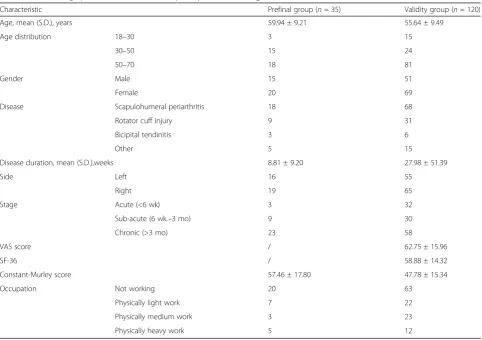
35 patients (including 20 females, and 15 males) were tested in the pre-final pilot study. Notably, 120 partici-pants (69 females, 51 males) were involved in the final test. Female patients (57.50%) with 55.64 ± 9.49 years old were associated with higher incidence of shoulder pain. The shoulder pain lasted for an average of 62.75 ± 15.96 weeks. Demographic and clinical charac-teristics of patients were listed in Table 1, while the range of CMS sections was shown in Fig. 1.
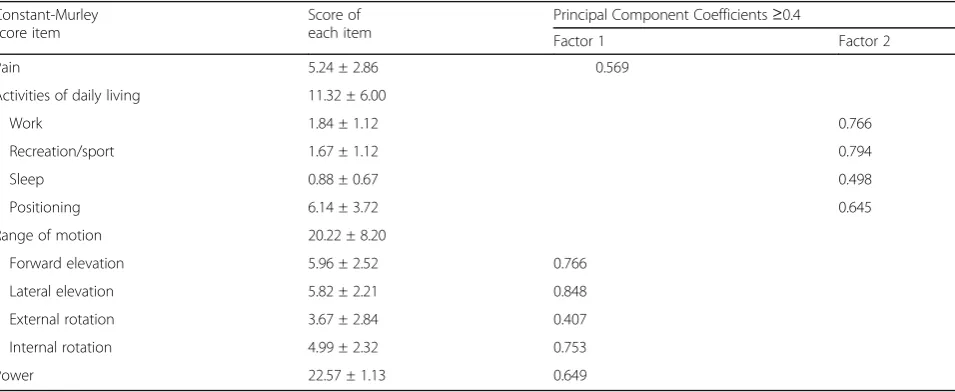
Factor analysis of the CMS questionnaire was performed with the promax rotation, meanwhile, a two-factor struc-ture was extracted by PCA. Factor 1 included items of pain, forward elevation, lateral elevation, external rotation,
internal rotation and power from the CMS questionnaire. Factor 2 contained items of work, recreation/sport, sleep and positioning from the CMS questionnaire. Loadings of all items were presented in Table 2.
Internal consistency Cronbach’s α was 0.739 for the CMS questionnaire, indicating a high degree of internal consistency.
Reliability Data distributions at test and retest, as well as the reliability of CMS questionnaire were shown in Table 3. A total of 58 patients completed the question-naires twice at an interval of 7.01 ± 1.05 days. The CMS was slightly higher in the retest (mean score = 4.11) than in the first test. The ICC was 0.827, suggesting an excel-lent test-retest reliability.
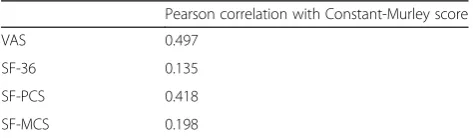
Validity 120 patients with shoulder complaints were enrolled as the participants in the survey. Correlations of CMS with VAS and SF-36 subscales scores were dis-played in Table 4. The results suggested moderate to low correlations of CMS with VAS score (r= 0.497) and SF-36 (r= 0.135).
Table 1The demographic characteristics of the participants at two stages
Characteristic Prefinal group (n= 35) Validity group (n= 120)
Age, mean (S.D.), years 59.94 ± 9.21 55.64 ± 9.49
Age distribution 18–30 3 15
30–50 15 24
50–70 18 81
Gender Male 15 51
Female 20 69
Disease Scapulohumeral periarthritis 18 68
Rotator cuff injury 9 31
Bicipital tendinitis 3 6
Other 5 15
Disease duration, mean (S.D.),weeks 8.81 ± 9.20 27.98 ± 51.39
Side Left 16 55
Right 19 65
Stage Acute (<6 wk) 3 32
Sub-acute (6 wk.–3 mo) 9 30
Chronic (>3 mo) 23 58
VAS score / 62.75 ± 15.96
SF-36 / 58.88 ± 14.32
Constant-Murley score 57.46 ± 17.80 47.78 ± 15.34
Occupation Not working 20 63
Physically light work 7 22
Physically medium work 3 23
Physically heavy work 5 12
Floor and ceiling effect No floor or ceiling effects were found in this study, and none of the patients had re-ported the worst or best possible CMS.
Discussion
In the study, we demonstrated that the Chinese version of CMS questionnaire was a valid, reliable and internally consistent instrument for assessing patients with shoul-der complaints, which displayed no floor or ceiling ef-fects. All items in CMS questionnaire had the loadings of >0.40 after two-factor PCA examination. Further-more, the Cronbach’sαof 0.739 indicated good internal consistency. The test-retest results (ICC = 0.827) con-firmed excellent reliability. In addition, it was revealed that CMS correlated well with VAS score (r = 0.497); however, poor correlation of CMS and SF-36 scores was observed in the study (r= 0.135). Taken together, these results demonstrated that the CMS questionnaire was useful in evaluating Chinese patients with shoulder pain in both clinical practice and research settings.
The translation procedure was completed in strict ac-cordance with the guidelines from the AAOS Outcome
Committee [13]. Some modifications were implemented in the translation, aiming to increase the specificity of CMS questionnaire in detecting shoulder pain in the Chinese population. Determination of power was the major difference between English and Chinese versions of CMS questionnaires. In the past, the score given for normal strength was 25 since a healthy man could resist 25 lb. Nonetheless, it is now recommended that strength be measured using a dynamometer in 90° of lateral ele-vation (shoulder abduction) in the scapular plane in the presence of wrist pronation [7]. Thereby, patients who are unable to achieve the test position of 90° are assigned a score of zero [25]. This may be the ideal measurement of power; however, it is not practical in clinical applications. Consequently, the traditional muscle classification was applied in the Chinese version of CMS questionnaire.
In our study, test validities, namely, correlations of CMS with VAS score and SF-36 subscales, were mea-sured. Correlation values of or over 0.40 were consid-ered as satisfactory (0.81–1.0 excellent, 0.61–0.80 very good, 0.41–0.60 good, 0.21–0.40 fair, and 0–0.20 poor)
Fig. 1The range of the CMS subsections
Table 2Explanatory factor analysis with promax-rotated factor loadings of the Constant-Murley Score items
Constant-Murley score item
Score of each item
Principal Component Coefficients≥0.4
Factor 1 Factor 2
Pain 5.24 ± 2.86 0.569
Activities of daily living 11.32 ± 6.00
Work 1.84 ± 1.12 0.766
Recreation/sport 1.67 ± 1.12 0.794
Sleep 0.88 ± 0.67 0.498
Positioning 6.14 ± 3.72 0.645
Range of motion 20.22 ± 8.20
Forward elevation 5.96 ± 2.52 0.766
Lateral elevation 5.82 ± 2.21 0.848
External rotation 3.67 ± 2.84 0.407
Internal rotation 4.99 ± 2.32 0.753
[22]. CMS exhibited good correlation with VAS score, while poor correlation of CMS with SF-36 subscales was seen. In line with a previous study, it was speculated that the lower-extremity function was involved in various SF-36 items, thus, a lower response in shoulder-specific function was achieved, compared with that in CMS [8]. In addition, the Chinese parameter of SF-36 was a global subjective outcome measurement of daily living, and was further aggregated into two summary measures, includ-ing physical and mental measures. Of note, CMS has fo-cused more solely on the physical function of the shoulder rather than the mental function.
This CMS questionnaire has been translated into Da-nish and Brazilian [11, 12]. Validation of the DaDa-nish ver-sion was conducted on 45 patients with the age of 59.0 ± 17.7 years old, in which agreement, floor and ceil-ing effects, and intra- and inter-rater reliability were ana-lyzed. However, that study was not adequately powered to determine good agreement, floor and ceiling effect, and good intra- and inter-rater reliability due to the rela-tively small sample size [11]. 120 participants were enrolled in our study, in which, more analyses of cross-cultural adaptation were carried out. Compared with the study by Moeller et al., the present study has provided more reliable results for the cross-cultural adaptation of the CMS. The Brazilian adaptation has enrolled 110 subjects, which indicated a strong negative correlation between CMS and DASH score [12].
The study harbored the following advantages. Firstly, participants were recruited from four different hospitals, which could better reflect the majority and diversity of the population. Secondly, the translation procedure was com-pleted according to the guidelines established by the AAOS Outcome Committee, leading to more explicit and reliable results. However, there existed several limitations
in the present study. Firstly, our inclusion criteria were limited to patients who suffered from unilateral shoulder pain (such as scapulohumeral periarthritis and degenera-tive changes) for 1 month, which may limit the applicabil-ity of the findings to other shoulder conditions. Secondly, sensitivity analysis of the CMS was not carried out, which may have involved more factors, such as the ef-fectiveness of the intervention as well as the type and severity of disease. Moreover, a more comprehensive project may be necessitated. In addition, no comparison with other shoulder questionnaires was conducted in this study to test the convergent validity, probably due to the absence of Chinese-language measurements of shoulder pain and disability. Therefore, a prospective study that including sensitivity analysis and covering more shoulder conditions is recommended.
Conclusions
In conclusion, our study revealed that the Chinese version of CMS harbored good internal consistency and excellent test–retest reliability. Moreover, our findings suggested that the Chinese version of CMS questionnaire was a reliable and valid instrument for evaluating shoulder pain in the Chinese population, which deserved wide applica-tion in patients with shoulder pain in both clinical practice and research settings. However, further prospective stu-dies enrolling more shoulder diseases are warranted to complete the sensitive analysis and make the outcomes more convincing.
Abbreviations
AAOS:American Association of Orthopedic Surgeons; CMS: Constant-Murley score; ICC: Intraclass correlation coefficient; PCA: Principal-component analysis; SF-36: Short Form Health Survey; VAS: Visual analog scale
Acknowledgments
We thanked Dr. Christopher Robert Constant for his permission to translate CMS, as well as his assistance during the translation process. We were grateful to Mr. Jun-jing Sun for his help in forward translation, and to Mr. Kai-yiu Cheung as well as Ms. Susan Emanuel in the back translation. We appreciated Mr. Ying-shuai Duan for his help in reviewing the scores.
Availability of data and material
All relevant data were presented in the paper and its supplemental files.
Funding
This is a special project of National Natural Science Foundation of China (81373666), Municipal Hospitals Cutting-edge Technologies Emerging Joint Project (SHDC12013113), Municipal Science and Technology Commission of Shanghai-TCM key project (14401970400), National Research Projects of the State Administration of Traditional Chinese Medicine (201407001–2), Traditional Chinese Medicine Research Foundation (2012L032A), Special Project of Scientific Research Base by State Administration of Traditional Chinese Medicine (JDZX2012118), the Priority Project of the Clinical Medicine Center of Shanghai Municipal Health Bureau (No.000002), and Shanghai Health System Important Disease Joint Research Project (No.2013ZYJB0502).
Author’s contributions
All authors participated in drafting or critically revising the article for important intellectual content. In addition, all authors approved the final version. MY and LY contributed equally to the work and should be considered as co-first authors. X-jC and YZ were the corresponding authors.
Table 3Results of test-retest analyses for the Constant-Murley
score
Mean ± SD
Test Constant-Murley score 42.75 ± 12.97
Retest Constant-Murley score 46.86 ± 12.71
ICC 0.827
ICCintraclass correlation coefficient,SDstandard deviation
Table 4Correlation (r) for the SF-36 and VAS with the Chinese
version of the Constant-Murley score
Pearson correlation with Constant-Murley score
VAS 0.497
SF-36 0.135
SF-PCS 0.418
SF-MCS 0.198
Study concept and design were accomplished by X-jC, YZ, MY and LY. Data acquisition was conducted by MY, LY, Z-yC, S-dC S-lT, Y-lS, JW, B-pX and C-xH. Data analysis and interpretation were completed by Yong-jun Wang, Min Yao, Long Yang, JW, X-jC and YZ.
Ethics approval and consent to participate
No interventional therapy or specimen collection was involved in our study, and the entire protocol was approved by the Ethics Committee of Longhua Hospital. All subjects participating in the study were informed of the details and submitted the written informed consent.
Consent for publication
Not applicable.
Competing interests
The authors declare that they have no competing interests.
Publisher’s Note
Springer Nature remains neutral with regard to jurisdictional claims in published maps and institutional affiliations.
Author details
1
Institute of Spine Disease, Longhua Hospital Affiliated to Shanghai University of Traditional Chinese Medicine, No. 725, Wanping south road, Shanghai 200032, China.2Key Laboratory of Theory and Therapy of Muscles and Bones, Ministry of Education (Shanghai University of Traditional Chinese Medicine), No. 725, Wanping south road, Shanghai 200032, China.3Rheumatism Department, Longhua Hospital Affiliated to Shanghai University of Traditional Chinese Medicine, No. 725, Wanping south road, Shanghai 200032, China.
4Department of Neck Shoulder Waist and Leg Pain, Shanghai Guanghua
integrative medicine Hospital, No. 540, Xinhua road, Shanghai 200052, China.
5Shanghai Hospital of Traditional Chinese Medicine, Shanghai University of
Traditional Chinese Medicine, No. 274, Zhijiang road, Shanghai 200071, China.6Department of Orthopedics, Shanghai Changzheng Hospital, No. 415,
Fengyang road, Shanghai 200003, China.7Department of Orthopaedics, Longhua Hospital, Shanghai University of Traditional Chinese Medicine, No.1200 Cai Lun Road, Shanghai 201203, China.
Received: 10 December 2016 Accepted: 31 August 2017
References
1. Luime JJ, Koes BW, Hendriksen IJ, Burdorf A, Verhagen AP, Miedema HS, et al. Prevalence and incidence of shoulder pain in the general population; a systematic review. Scand J Rheumatol. 2004;33(2):73–81.
2. Bodin J, Ha C, Serazin C, Descatha A, Leclerc A, Goldberg M, et al. Effects of individual and work-related factors on incidence of shoulder pain in a large working population. J Occup Health. 2012;54(4):278–88.
3. Greving K, Dorrestijn O, Winters JC, Groenhof F, van der Meer K, Stevens M, et al. Incidence, prevalence, and consultation rates of shoulder complaints in general practice. Scand J Rheumatol. 2012;41(2):150–5.
4. Myklebust G, Hasslan L, Bahr R, Steffen K. High prevalence of shoulder pain among elite Norwegian female handball players. Scand J Med Sci Sports. 2013;23(3):288–94.
5. Yue P, Liu F, Li L. Neck/shoulder pain and low back pain among school teachers in China, prevalence and risk factors. BMC Public Health. 2012;12:789. 6. Cools AM, De Wilde L, Van Tongel A, Ceyssens C, Ryckewaert R, Cambier
DC. Measuring shoulder external and internal rotation strength and range of motion: comprehensive intra-rater and inter-rater reliability study of several testing protocols. J Shoulder Elb Surg. 2014;23(10):1454–61. 7. Constant CR, Gerber C, Emery RJ, Sojbjerg JO, Gohlke F, Boileau P. A review
of the Constant score: modifications and guidelines for its use. J Shoulder Elb Surg. 2008;17(2):355–61.
8. Angst F, Goldhahn J, Drerup S, Aeschlimann A, Schwyzer HK, Simmen BR. Responsiveness of six outcome assessment instruments in total shoulder arthroplasty. Arthritis Rheum. 2008;59(3):391–8.
9. Hirschmann MT, Wind B, Amsler F, Gross T. Reliability of shoulder abduction strength measure for the Constant-Murley score. Clin Orthop Relat Res. 2010;468(6):1565–71.
10. Johansson KM, Adolfsson LE. Intraobserver and interobserver reliability for the strength test in the Constant-Murley shoulder assessment. J Shoulder Elb Surg. 2005;14(3):273–8.
11. Moeller AD, Thorsen RR, Torabi TP, Bjoerkman AS, Christensen EH, Maribo T, et al. The Danish version of the modified Constant-Murley shoulder score: reliability, agreement, and construct validity. J Orthop Sports Phys Ther. 2014;44(5):336–40.
12. Barreto RP, Barbosa ML, Balbinotti MA, Mothes FC, da Rosa LH, Silva MF. The Brazilian version of the Constant-Murley Score (CMS-BR): convergent and construct validity, internal consistency, and unidimensionality. Rev Bras Ortop. 2016;51(5):515–20.
13. Beaton DE, Bombardier C, Guillemin F, Ferraz MB. Guidelines for the process of cross-cultural adaptation of self-report measures. Spine (Phila Pa 1976). 2000;25(24):3186–91.
14. Terwee CB, Bot SD, de Boer MR, van der Windt DA, Knol DL, Dekker J, et al. Quality criteria were proposed for measurement properties of health status questionnaires. J Clin Epidemiol. 2007;60(1):34–42.
15. Carlsson AM. Assessment of chronic pain. I. Aspects of the reliability and validity of the visual analogue scale. Pain. 1983;16(1):87–101.
16. Brazier JE, Harper R, Jones NM, O'Cathain A, Thomas KJ, Usherwood T, et al. Validating the SF-36 health survey questionnaire: new outcome measure for primary care. BMJ. 1992;305(6846):160–4.
17. Li L, Wang HM, Shen Y. Chinese SF-36 Health Survey: translation, cultural adaptation, validation, and normalisation. J Epidemiol Community Health. 2003;57(4):259–63.
18. Ware JE, Kosinski M, Keller SD. SF-36 Physical and Mental Health Summary Scales: A User's Manual. Boston: The Health Institute; 1994.
19. Acquadro C, Conway K, Hareendran A, Aaronson N, European Regulatory I, Quality of Life Assessment G. Literature review of methods to translate health-related quality of life questionnaires for use in multinational clinical trials. Value Health. 2008;11(3):509–21.
20. Pickering PM, Osmotherly PG, Attia JR, McElduff P. An examination of outcome measures for pain and dysfunction in the cervical spine: a factor analysis. Spine (Phila Pa 1976). 2011;36(7):581–8.
21. Floyd FJ, Widaman KF. Factor analysis in the development and refinement of clinical assessment instruments. Psychol Assess. 1995;7(3):286. 22. Nunnally J, Bernstein IR. Psychometric Theory 3rd edition. New York:
McGrae-Hill; 1994.
23. Fayers PM, Machin D. Quality of life: the assessment, analysis and interpretation of patient-reported outcomes. Manhattan: John Wiley & Sons; 2013.
24. Shout P, Fleiss J. The effects of measurement errors on some multivariable procedures. Am J Public Health. 1977;67:1188–91.
25. Roy JS, MacDermid JC, Woodhouse LJ. A systematic review of the psychometric properties of the Constant-Murley score. J Shoulder Elb Surg. 2010;19(1):157–64.
• We accept pre-submission inquiries
• Our selector tool helps you to find the most relevant journal
• We provide round the clock customer support
• Convenient online submission
• Thorough peer review
• Inclusion in PubMed and all major indexing services
• Maximum visibility for your research
Submit your manuscript at www.biomedcentral.com/submit