S T U D Y P R O T O C O L
Open Access
Protocol for a statewide randomized
controlled trial to compare three training
models for implementing an evidence-based
treatment
Amy D. Herschell
1,2*, David J. Kolko
1, Ashley T. Scudder
1, Sarah Taber-Thomas
1, Kristen F. Schaffner
3,
Shelley A. Hiegel
3, Satish Iyengar
4, Mark Chaffin
5and Stanley Mrozowski
6Abstract
Background:Evidence-based treatments (EBTs) are available for treating childhood behavioral health challenges. Despite EBTs’potential to help children and families, they have primarily remained in university settings. Little empirical evidence exists regarding how specific, commonly used training and quality control models are effective in changing practice, achieving full implementation, and supporting positive client outcomes.
Methods/design:This study (NIMH RO1 MH095750; ClinicalTrials.gov Identifier: NCT02543359), which is currently in progress, will evaluate the effectiveness of three training models (Learning Collaborative (LC), Cascading Model (CM), and Distance Education (DE)) to implement a well-established EBT , Parent-Child Interaction Therapy, in real-world, community settings. The three models differ in their costs, skill training, quality control methods, and capacity to address broader implementation challenges. The project is guided by three specific aims: (1) to build knowledge about training outcomes, (2) to build knowledge about implementation outcomes, and (3) to test the differential impact of training clinicians using LC, CM, and DE models on key client outcomes. Fifty (50) licensed psychiatric clinics across Pennsylvania were
randomized to one of the three training conditions: (1) LC, (2) CM, or (3) DE. The impact of training on practice skills (clinician level) and implementation/sustainment outcomes (clinic level) are being evaluated at four timepoints coinciding with the training schedule: baseline, 6 (mid), 12 (post), and 24 months (1 year follow-up). Immediately after training begins, parent–child dyads (client level) are recruited from the caseloads of participating clinicians. Client outcomes are being assessed at four timepoints (pre-treatment, 1, 6, and 12 months after the pre-treatment).
Discussion:This proposal builds on an ongoing initiative to implement an EBT statewide. A team of diverse stakeholders including state policy makers, payers, consumers, service providers, and academics from different, but complementary areas (e.g., public health, social work, psychiatry), has been assembled to guide the research plan by incorporating input from multidimensional perspective.
Trial registration:ClinicalTrials.gov: NCT02543359
Keywords:Implementation, Therapist training, Learning collaborative, Cascading model, Train-the-trainer, Distance education, Evidence-based treatment, Parent–Child Interaction Therapy
* Correspondence:[email protected]
1University of Pittsburgh School of Medicine, Pittsburgh, PA, USA 2
Western Psychiatric Institute and Clinic, University of Pittsburgh School of Medicine, Pittsburgh, PA, USA
Full list of author information is available at the end of the article
Implementation Science
© 2015 Herschell et al.Open AccessThis article is distributed under the terms of the Creative Commons Attribution 4.0 International License (http://creativecommons.org/licenses/by/4.0/), which permits unrestricted use, distribution, and reproduction in any medium, provided you give appropriate credit to the original author(s) and the source, provide a link to the Creative Commons license, and indicate if changes were made. The Creative Commons Public Domain Dedication waiver (http://creativecommons.org/publicdomain/zero/1.0/) applies to the data made available in this article, unless otherwise stated.
Herschellet al. Implementation Science (2015) 10:133
Background
Disruptive behavior disorders (DBDs) affect a substantial number of young children, have lifelong implications if left untreated (e.g., [1–7]), and represent the most common presenting problem to community mental health centers [8, 9]. Meta-analytic reviews of treatment outcomes for DBDs (e.g., [10]) demonstrate that there are EBTs for DBDs. Parent–Child Interaction Therapy (PCIT) is a na-tionally recognized EBT for families who have children with DBDs [11]. The program is unique in comparison to other EBTs for DBDs in that it involves coaching parents as they interact with their young child (ages 2.5–7 years). For each of two treatment phases, parents attend one didactic parent-only session during which the PCIT therapist tea-ches parents specific skills that will be“coached”in vivo in subsequent sessions. Parents attend approximately 12–20 weekly, 1-hour clinic-based sessions with their child [12].
Treatment outcome data from multiple randomized trials indicate that PCIT decreases child behavior prob-lems, increases parent skill, and decreases parent stress [12–14]. When compared to waitlist controls, treatment effect sizes for PCIT range from 0.61 to 1.45 (absolute values) for parent report of child behavior and 0.76 to 5.67 for behavior observations of parent skill improvements [14]. Behavior observations indicate pre-post changes in parent behavior such as increased rates of praise, descrip-tions, reflecdescrip-tions, and physical proximity and decreased rates of criticism and sarcasm (e.g., [15]). Parents report lower parenting stress, more internal (rather than external) locus of control, and increased confidence in parenting skills after learning PCIT. Parents report that child behavior improves from the clinical range to within normal limits on multiple, standardized parent report measures [15–17]. Studies have been conducted to understand the mainten-ance of treatment benefits [18–21], finding the majority of children (69 %) maintained gains on measures of child behavior and activity level, and over half (54 %) remained free of DBD diagnoses at 2 years post-treatment) [19].
The majority of PCIT treatment outcome studies have been efficacy trials. However, a number of effectiveness studies have also been conducted and demonstrated the positive impact of PCIT on parent, child, and family out-comes for families who complete treatment (e.g., [22, 23, 24 ]). These initial PCIT effectiveness studies also high-light some concerns when providing PCIT in community-based settings, such as higher rates of treatment attrition compared to efficacy trials.
Despite EBTs’ potential to help children and families, EBTs have primarily remained in university settings, with several reports (e.g., [25, 26]) highlighting a lack of access to EBTs in community settings. EBTs seem to be valued in frontline practice, and there is a strong push to implement them; however, the field seems to not know how best to do it, especially at scale. Billions of dollars have been invested
in developing EBT implementation initiatives, yet EBTs have yet to reach their intended populations. Perhaps this is related to the lack of empirical attention devoted to training models for EBTs [27]. Little empirical attention has been paid to those who provide community care and how to effectively train them [28]. A comprehensive, recent review [28] found that three training models that are increasingly commonly used are Learning Collaborative (LC), Cascading Model (CM), and Distance Education (DE).
With the support of substantial federal funds (i.e., bud-gets of $29 (FY07) and $33 million (FY08)), The National Child Traumatic Stress Network (NCTSN) has focused on the implementation of EBTs [27] via the LC model. The LC approach was modeled after the Institute for Healthcare Improvement’s Breakthrough Series Collabora-tive Model [29, 30] for use in mental health [31]. LCs tar-get and include multiple levels within an organization (clinicians, supervisors, senior leaders) by structuring in-formation for specific roles. LCs can involve episodic meetings to share implementation tactics, plans, and evaluation results across multiple organizations involving several staff from each. The LC model has been imple-mented within healthcare for a variety of purposes (e.g., [32–36]). Within mental health, the NCTSN has used the LC method for a decade to implement several EBTs across the USA; however, there is only one published study on these efforts [37]. Four studies have been published on the use of a LC to improve engagement in mental health ser-vices [38–41] which provide primary support for initiating [38] and sustaining [39] gains in initial appointment show rates. Only one randomized controlled trial (RCT) has been completed with LCs [42], which did not find favor-able results (the remaining used pre-post designs). When 44 primary care clinics were randomized to either a LC or control condition, there were few statistically and no clin-ically significant differences in preventive service delivery rates [42]. LCs likely are costly to implement because of the staff and coordination time required.
Cascading training models (also commonly called train-the-trainer models) have the potential to be time- and cost-effective and are widely used in mental health [43, 44], addictions [45, 46], medicine [47–53], and prevention [54–60]; however, this method has received little rigor-ous examination. The CM involves an EBT expert provid-ing extensive clinical trainprovid-ing to a community-based clinician who in turn replicates that clinical training with other clinicians within her organization. Within mental health, three early studies, two single subjects [61, 62], and one [63] quasi-experimental design, indicate a “watering down” effect from supervisors to staff [62]. In the only published RCT including CM (compared to expert and self-study) few differences were found between CM and expert training on fidelity or competence in rated client sessions. In role-played sessions, participants in the expert
training condition evidenced greater gains initially; by 12-week follow-up, there were no differences across condi-tions in client or role-play sessions [46]. Train-the-trainer models may rely heavily on the individual trainer, making them vulnerable to that person’s turnover or change of role. The trainer may serve as a local champion for the model, potentially troubleshooting the implementations of organizational needs but not to the degree inherent in the LC structure.
DE, with strategies that include an individual’s attempt to acquire information or skills by independently inter-acting with training materials (e.g., computer, videotape review; not simply reading materials), are a common way clinicians learn new treatments [64], have been rated favorably by learners [65] and found to be a cost-effective method to increase knowledge [66, 67]. How-ever, when stringent assessment methods are used, DE has been found to work only for some therapists (e.g., [68]) and to be only slightly more effective than reading written materials at improving knowledge [66, 69]. Of note, when more sophisticated online training methods are used, DE has shown favorable effects as compared to written materials or workshop training with regard to in-creased knowledge, competence, and fidelity. Sophisticated DE methods have the advantage of being cost-effective and the potential to make a broader public health impact given that more clinicians could access an online system than could attend in-person training. However, they may be less able to address implementation challenges beyond practi-tioner skill training, which LCs specifically and directly address and which CM models may indirectly address via a local trainer as EBT champion within an organization. In sum, each of these models has a distinct balance of poten-tial strengths and limitations across dimensions of cost, effort, organizational impact, resilience to turnover, and sustainment.
Methods/design
Within implementation science most conceptual frame-works acknowledge that implementation is a complex, interactive process in which clinician behavior (clinical practice) is influenced by individual and environmental characteristics as well as the quality of the intervention and the training design [70]. In this application (Clinical-Trials.gov Identifier: NCT02543359), we borrow from two frameworks: (1) the training transfer conceptual model [71] and (2) draft model of implementation research [72]. These frameworks were chosen because of their focus on training and transfer rather than broader competing frameworks.
Originally proposed by Baldwin and Ford [73], Ford and Weissbein [71] updated a conceptual model, the Training Transfer Conceptual Model, that was developed from an industrial/organizational psychology research review to
articulate the conditions (training inputs) that impact training outcomes and training transfer (implementation). While the studies reviewed in these articles were not ther-apist/therapy studies, the conceptualization remains rele-vant. The review confirmed three types of training input factors that impact learning, retention, generalization, and maintenance of skills: trainee characteristics, training de-sign, and work environment. In this study, the experimen-tal manipulation has been at the Training Design level. The outputs of learning and retention are operationalized to include knowledge, skills, and attitude [74]. Transfer conditions include generalization and maintenance, which in this case, would include how clinicians apply the EBT in their setting and with families they treat (i.e., implemen-tation and client outcomes).
Proctor and colleagues [72] have proposed a heuristic model that accounts for intervention strategies (EBT), implementation strategies (i.e., training models), and three distinct but interrelated set of outcomes within im-plementation research: imim-plementation, service, and cli-ent outcomes. Using this taxonomy, we will use one intervention strategy (PCIT) to test three different train-ing designs (LC, CM, DE) and will measure implementa-tion and client outcomes to understand the condiimplementa-tions of transfer (generalization and maintenance). To under-stand the effectiveness of training methods, we will also measure training outcomes (outputs) articulated by Ford and Weissbein [71]. Measuring both implementation and client outcomes will help us to understand the suc-cess of the training condition for implementing an EBT in community settings [75]. Training outcomes (clinician level) are assessed using observational and self-report methods at four timepoints coinciding with the training schedule: baseline, 6 (mid), 12 (post), and 24 months (1 year follow-up). Immediately after clinician training began, parent–child dyads are recruited from the case-loads of participating clinicians. Client outcomes (par-ent–child dyad level) are assessed by parent report at four timepoints (pre-treatment, 1, 6, and 12 months after the pre-treatment). Implementation outcomes [75] (clinic level) are assessed using behavior observation, interview, and self-report measures with administrators, clinicians, and families at baseline, 6 (mid), 12 (post), and 24 months (1 year follow-up). This will include examining the overall penetration of the EBT (e.g., how extensively it is used) and whether the EBT is able to be diffused through the organization and sustained over the course of the study.
Participants and enrollment procedures Clinics
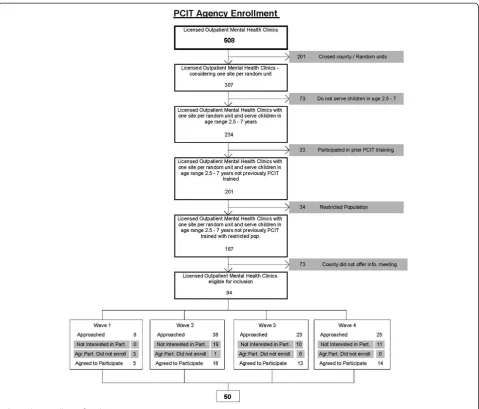
Highlighted in Fig. 1 (clinical enrollment flowchart), there are 508 licensed, psychiatric outpatient clinics across Pennsylvania. Given concerns about contamination across
study condition, if one organization operated in mul-tiple counties (e.g., an organization had outpatient clinics in neighboring counties), the organization was only able to participate in one county. This eliminated 201 clinics from inclusion. We excluded clinics that did not treat young children (eliminating 73 clinics), had previously participated in PCIT training (eliminating 33 clinics), and had a restricted service population (e.g., specialized in treating developmental disabilities or trauma; eliminating 34 clinics).
Because we randomized at the county level, we had to approach county administrators before clinic administra-tors. All 67 counties were approached; 40 agreed to in-formational meetings. Because 27 counties did not agree to informational meetings, 73 clinics were not given the opportunity to participate. Of the remaining 94 clinics eligible for participation, 50 agreed to participate. With the support of the state children’s mental health office,
we gathered data on the clinics that were not interested in participating to understand potential selection bias (e.g., clinic size, population treated, county).
To be enrolled, clinics also met the following criteria: (a) willing to participate in PCIT training, (b) able to cover site preparation costs, and (c) agreeable to research participation.
Administrators
To be eligible, administrators were employed at a clinic selected to participate in training as an Executive Director, Chief Financial Officer, or other person responsible for daily operations.
Clinicians
To be eligible, clinicians were (a) currently employed at a clinic selected to participate in training, (b) a masters or doctoral level professional in the human services field Fig. 1Clinic enrollment flowchart
(e.g., social work, psychology, education), (c) licensed in his/her field OR receiving supervision from a licensed individual, (d) actively seeing children and families who are appropriate for PCIT (e.g., age, behavior problem severity), (e) receptive to training but not previously trained in PCIT, and (f ) amenable to study tasks (e.g., video taping, completing assessments).
Based on experience with implementation studies [76, 77] and high mental health workforce turnover [78, 79], we anticipated that few clinicians will leave the training or withdraw from the study (e.g., we had a retention rate of 96 % (187/195) for clinicians in a similar trial). How-ever, we anticipate that up to 35 % of clinicians will leave their clinics (e.g., resign) or change jobs within their clinic during the course of the study [77]. Using an intent-to-train model, clinicians who leave their clinic will remain in the study, but we may lose some clinic and client level data unless the clinician goes to another clinic that is already participating in the study or providing PCIT. All efforts have been made to get full data, but clinic level eth-ical, fiscal, and logistical details (e.g., FWAs, IRB proto-cols) may prohibit full data collection at a new site.
Parent–child dyads
Clinicians were asked to refer all families on their case-load with whom they are using PCIT. Inclusion criteria include any parent–child dyad who the clinician enrolled in PCIT services. A child is excluded only if he/she is a ward of the state or living in state custody. Under the study state’s law, only the birth parent or a guardian with parental rights can provide informed consent.
Clinicians ask each parent participating in PCIT to sign a “permission to contact form.” Clinicians fax the form to the research team. A research assistant contacts the parent to confirm eligibility, review informed con-sent including permission to video tape, and complete the first of four assessments. Subsequent assessments are completed via phone, paper, or online (depending on parent preference).
We anticipate an 88 % retention rate based on experi-ence in previous trials; a minimum of 253 parent–child dyads likely will complete all four assessments. We esti-mate that the clinician to enrolled family ratio will be ap-proximately 1:1 though we will try to improve that ratio. In previous trials, we had estimated a 1:2 ratio; however, given clinician turnover and other challenges, 1:1 has been a more accurate estimate for recent child-focused, community-based trials [80, 81].
To enhance participant recruitment and retention, incentives have been included at each level: (1) clinics receive free training for their clinicians as well as either a small stipend ($1000) to offset initial PCIT start-up costs (e.g., bug-in-the-ear) or a PCIT package including equip-ment (e.g., video cameras) necessary for the research and
helpful for treatment; (2) administrators receive payment for assessment completion; (3) clinicians receive free training, Continuing Education Credits, and payment for time invested in assessment completion (not training); and (4) parent–child dyads receive payment for assessment completion. Top officials from several state offices and behavioral health managed care companies in Pennsylvania have endorsed and are substantively involved in this research, which also may positively impact participation.
Contact and monitoring procedures
Due to data collection occurring across levels of partici-pants at multiple timepoints, we have implemented a var-iety of prompting and monitoring procedures to enhance participation. Specifically, participants are provided with choices related to the method of data collection (paper, online, or phone) as well as preferred contact method. The study team has utilized email, phone, postal mail, and text messaging to communicate with participants.
Procedures Randomization
Counties with at least one participating clinic located in the county were randomized to study condition [82]. Randomization occurred at the county level for two rea-sons. First, the state in which the study is being con-ducted is a commonwealth that is “state administered and county controlled” meaning that there is consider-able variability in how counties implement mental health policies. Given that this project, like any EBT implemen-tation, will require clinics to develop new programs and possibly rely on the larger system/context of which they are a part of, there could be substantial variability for implementation across counties. For example, establish-ing a referral base likely will impact implementation out-comes and will be different across counties. Given that this variability would be difficult to quantify, our goal has been to balance across conditions through the randomization procedure. Second, it is not logistically or financially possible to train all clinics at once. If we were to randomize clinics to a condition it is probable that within one county, we would have mul-tiple training conditions occurring at different times. This could affect the previous training condition, par-ticularly for smaller counties where clinics might have close communication or even share clinicians. Similar to previous trials that have randomized at the county level [82, 83], randomization of county to condition was balanced on key covariates including population size (urban/ rural) and poverty level [84].
Training occurred through four waves because it would be impossible to train all clinics at the same time. Given these constraints, we used SAS to write a routine for the randomization. Within training wave 1, counties
were randomized to one of two conditions. Within waves 2, 3, and 4, counties were randomized to one of three conditions. The two conditions implemented in wave 1 were randomly chosen from the three conditions. The reason for this change was because wave 1 occurred early in the study when recruitment was beginning, and fewer counties had agreed to participate by study dead-lines. Wave 1 included 5 clinics located in 2 counties. Wave 2 included 18 clinics located in 12 counties. Wave 3 included 13 clinics located in 4 counties. Wave 4 in-cluded 14 clinics located in 12 counties.
Training conditions
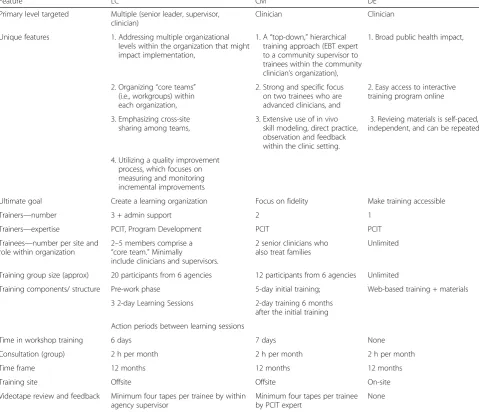
The experimental manipulation in this study was within the Training Design of the Training Transfer Conceptual Model [71]. Table 1 highlights key similarities and differ-ences across groups. Trainers were balanced across
conditions. Consistent across each training condition was treatment content (i.e., treatment manual, coding manual, and workbook) and consultation with a trainer.
Learning collaborative
Consistent with the Institute for Healthcare Improve-ment [29] and NCTSN [31] protocols, the LC involved three phases: collaborative pre-work, learning sessions, and action periods. Pre-work activities were conducted prior to a face-to-face meeting to ensure that all partici-pants come to the learning session with similar levels of PCIT knowledge. The pre-work“launch phase”(3 months) included readings, material review, and conference calls. Learning sessions included three 2-day, face-to-face meet-ings over a period of 9 months. Action periods occurred between learning sessions and were characterized by plan-do-study-act cycles, use of improvement data, use of
Table 1Condition comparison on key design features
Feature LC CM DE
Primary level targeted Multiple (senior leader, supervisor,
clinician)
Clinician Clinician
Unique features 1. Addressing multiple organizational
levels within the organization that might impact implementation,
1. A“top-down,”hierarchical training approach (EBT expert to a community supervisor to trainees within the community clinician’s organization),
1. Broad public health impact,
2. Organizing“core teams” (i.e., workgroups) within each organization,
2. Strong and specific focus on two trainees who are advanced clinicians, and
2. Easy access to interactive training program online
3. Emphasizing cross-site sharing among teams,
3. Extensive use of in vivo skill modeling, direct practice, observation and feedback within the clinic setting.
3. Revieing materials is self-paced, independent, and can be repeated
4. Utilizing a quality improvement process, which focuses on measuring and monitoring incremental improvements
Ultimate goal Create a learning organization Focus on fidelity Make training accessible
Trainers—number 3 + admin support 2 1
Trainers—expertise PCIT, Program Development PCIT PCIT
Trainees—number per site and role within organization
2–5 members comprise a
“core team.”Minimally
include clinicians and supervisors.
2 senior clinicians who also treat families
Unlimited
Training group size (approx) 20 participants from 6 agencies 12 participants from 6 agencies Unlimited
Training components/ structure Pre-work phase 5-day initial training; Web-based training + materials
3 2-day Learning Sessions 2-day training 6 months
after the initial training
Action periods between learning sessions
Time in workshop training 6 days 7 days None
Consultation (group) 2 h per month 2 h per month 2 h per month
Time frame 12 months 12 months 12 months
Training site Offsite Offsite On-site
Videotape review and feedback Minimum four tapes per trainee by within agency supervisor
Minimum four tapes per trainee by PCIT expert
None
technology to support learning, team meetings, and con-ference calls. Four people per clinic participated in the LC as part of a“core team,”including an administrator, super-visor, and two clinicians. Each LC included multiple clinic teams, was organized by a coordinator, and supported by faculty experts in PCIT and program development (e.g., financing, marketing, encouraging referrals, mobilizing clinic support). Components that make this training con-dition unique include the following: (1) addressing mul-tiple organizational levels; (2) organizing“core teams”; (3) emphasizing collaborative, cross-site sharing; and (4) utilizing a quality improvement process focused on col-lecting implementation targets/data. After 1 year of inten-sive training, agencies selected one supervisor and one clinician to participate in additional training focused on training others within their organization. The inclusion of within-organization training in the LC is consistent with the intention of the training model to embed local expert-ise and promote sustainability. Those clinicians not involved in within-organization training continued phone consultation with the trainer at a reduced frequency (once per month) over a 6-month period (months 12 through 18 of training).
Cascading model
Consistent with the protocol recommended by the PCIT International Training Committee [85], this condition con-sisted of 40 hours of initial face-to-face contact with a PCIT trainer, an advanced live training (16 hours ) with real cases 6 months after the initial training, and bi-weekly contact with a trainer conducted over 12 months. After the end of the 12-month intensive training, trainees partici-pated in 6 months of ongoing consultation and training, to begin training others within their organization. Each CM training group included 8 to 12 participants (two clinicians from each organization). Components that make CM unique include the following: (1) a“top-down,”hierarchical training approach; (2) strong and specific focus on two ad-vanced clinicians; (3) extensive use of in vivo skill model-ing, direct practice, observation, and feedback within the clinic setting; and (4) capacity for clinicians to return to organization as“in-house”or“within-organization”trainers to replicate clinical training with other clinicians within the organization. CM also focuses on trainers reviewing clinicians' videetaped sessions and providing them with feedback on treatment fidelity and competence. The cli-nicians trained by “in-house” trainers are also included in the study so that we can understand the impact of a cascading training.
Distance education (DE)
An online training similar to TF-CBT Web [86] was developed by the University of California, Davis Medical Center PCIT Team (SAMHSA grant; PI: Urquiza) and
used in this study as part of the DE condition. The online training consisted of 11 modules/training topics, took clinicians approximately 10 hours to complete and included written materials, vignettes, videos, and quizzes for each topic. In this DE condition, the website was augmented for each participant with copies of the PCIT Treatment manual, Dyadic Parent–Child interaction Coding System (DPICS) Manual, and DPICS Workbook. Clinicians also participated in phone consultation with a trainer consistent with other training conditions.
Outcome measures and assessment procedures
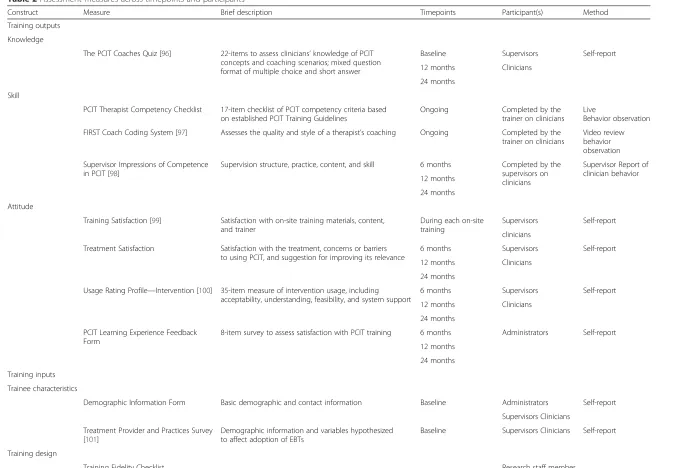
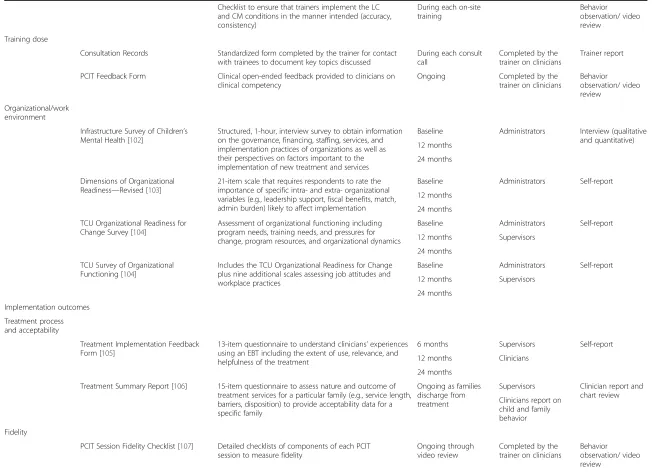
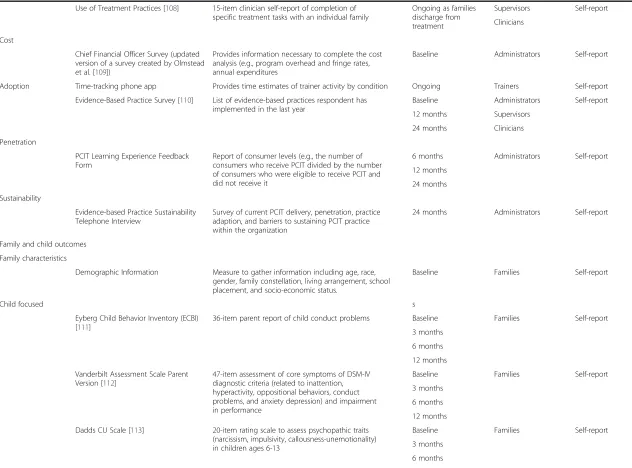
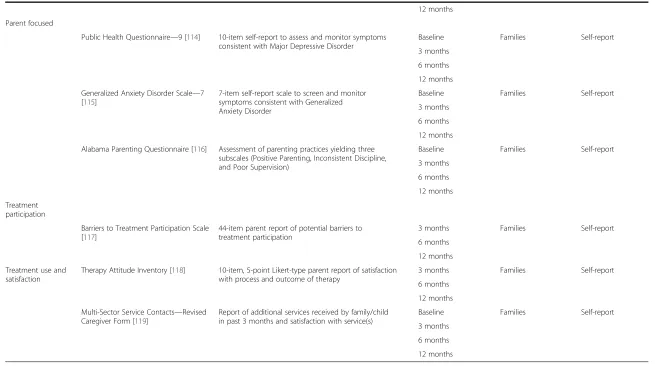
The three primary outcomes of interest are training, im-plementation, and client outcomes. A review of outcomes measures across participants and timepoints is provided in Table 2.
Aim 1: determine the effects of training condition (CM, LC, DE) on training outputs (i.e., clinician knowledge, skill, and attitude)
Analyses
We hypothesize that the greatest improvements will be found for clinicians in the CM group followed by LC, clinic staff trained by clinicians in CM and LC groups, and DE (in that order). We will use the change scores on the fol-lowing Ford-Weissbein [71] training outcomes: Coaches Quiz, Competence Check, and Coach Coding. Because training is at the clinician level, we will compute the change scores for each clinician and then compare the treatments using those changes. We recognize that the cli-nicians are nested within organization and will include that in our regression model, along with any other covariates that are associated with outcomes. We will use the one-way analysis of variance (ANOVA) to compare the change scores between the four groups. And because we have stated an ordered alternative (e.g., CM better than LC), we will use Bartholomew’s test which is powered for ordered alternatives unlike the usual F test, which is an omnibus test. Later, we will test the cascading effect of the CM model in comparing the performance of "second gener-ation" CM clinicians to other clinicians in other conditions (CM-generation one, DE, LC).
Aim 2: explore implementation outcomes, including acceptability, adoption, appropriateness, feasibility, fidelity, penetration, sustainability, and cost across training conditions
Analyses
Using the taxonomy of implementation outcomes defined by Proctor et al. [87], data will be collected on acceptabil-ity, adoption, appropriateness, feasibilacceptabil-ity, fidelacceptabil-ity, penetra-tion, and sustainability. We have four main hypotheses related to implementation outcomes. First, we hypothesize that rates of acceptability and appropriateness of PCIT
Table 2Assessment measures across timepoints and participants
Construct Measure Brief description Timepoints Participant(s) Method
Training outputs
Knowledge
The PCIT Coaches Quiz [96] 22-items to assess clinicians’knowledge of PCIT concepts and coaching scenarios; mixed question format of multiple choice and short answer
Baseline Supervisors Self-report
12 months Clinicians
24 months
Skill
PCIT Therapist Competency Checklist 17-item checklist of PCIT competency criteria based on established PCIT Training Guidelines
Ongoing Completed by the
trainer on clinicians Live
Behavior observation
FIRST Coach Coding System [97] Assesses the quality and style of a therapist’s coaching Ongoing Completed by the trainer on clinicians
Video review behavior observation
Supervisor Impressions of Competence in PCIT [98]
Supervision structure, practice, content, and skill 6 months Completed by the supervisors on clinicians
Supervisor Report of clinician behavior 12 months
24 months
Attitude
Training Satisfaction [99] Satisfaction with on-site training materials, content, and trainer
During each on-site training
Supervisors Self-report
clinicians
Treatment Satisfaction Satisfaction with the treatment, concerns or barriers to using PCIT, and suggestion for improving its relevance
6 months Supervisors Self-report
12 months Clinicians
24 months
Usage Rating Profile—Intervention [100] 35-item measure of intervention usage, including acceptability, understanding, feasibility, and system support
6 months Supervisors Self-report
12 months Clinicians
24 months
PCIT Learning Experience Feedback Form
8-item survey to assess satisfaction with PCIT training 6 months Administrators Self-report
12 months
24 months
Training inputs
Trainee characteristics
Demographic Information Form Basic demographic and contact information Baseline Administrators Self-report
Supervisors Clinicians
Treatment Provider and Practices Survey [101]
Demographic information and variables hypothesized to affect adoption of EBTs
Baseline Supervisors Clinicians Self-report
Training design
Training Fidelity Checklist Research staff member
Herschell
et
al.
Implementa
tion
Science
(2015) 10:133
Page
8
of
Table 2Assessment measures across timepoints and participants(Continued)
Checklist to ensure that trainers implement the LC and CM conditions in the manner intended (accuracy, consistency)
During each on-site training
Behavior observation/ video review
Training dose
Consultation Records Standardized form completed by the trainer for contact with trainees to document key topics discussed
During each consult call
Completed by the trainer on clinicians
Trainer report
PCIT Feedback Form Clinical open-ended feedback provided to clinicians on clinical competency
Ongoing Completed by the
trainer on clinicians
Behavior observation/ video review
Organizational/work environment
Infrastructure Survey of Children’s Mental Health [102]
Structured, 1-hour, interview survey to obtain information on the governance, financing, staffing, services, and implementation practices of organizations as well as their perspectives on factors important to the implementation of new treatment and services
Baseline Administrators Interview (qualitative and quantitative) 12 months
24 months
Dimensions of Organizational Readiness—Revised [103]
21-item scale that requires respondents to rate the importance of specific intra- and extra- organizational variables (e.g., leadership support, fiscal benefits, match, admin burden) likely to affect implementation
Baseline Administrators Self-report
12 months
24 months
TCU Organizational Readiness for Change Survey [104]
Assessment of organizational functioning including program needs, training needs, and pressures for change, program resources, and organizational dynamics
Baseline Administrators Self-report
12 months Supervisors
24 months
TCU Survey of Organizational Functioning [104]
Includes the TCU Organizational Readiness for Change plus nine additional scales assessing job attitudes and workplace practices
Baseline Administrators Self-report
12 months Supervisors
24 months
Implementation outcomes
Treatment process and acceptability
Treatment Implementation Feedback Form [105]
13-item questionnaire to understand clinicians’experiences using an EBT including the extent of use, relevance, and helpfulness of the treatment
6 months Supervisors Self-report
12 months Clinicians
24 months
Treatment Summary Report [106] 15-item questionnaire to assess nature and outcome of treatment services for a particular family (e.g., service length, barriers, disposition) to provide acceptability data for a specific family
Ongoing as families discharge from treatment
Supervisors Clinician report and chart review Clinicians report on
child and family behavior
Fidelity
PCIT Session Fidelity Checklist [107] Detailed checklists of components of each PCIT session to measure fidelity
Ongoing through video review
Completed by the trainer on clinicians
Behavior observation/ video review
Herschell
et
al.
Implementa
tion
Science
(2015) 10:133
Page
9
of
Table 2Assessment measures across timepoints and participants(Continued)
Use of Treatment Practices [108] 15-item clinician self-report of completion of specific treatment tasks with an individual family
Ongoing as families discharge from treatment
Supervisors Self-report
Clinicians
Cost
Chief Financial Officer Survey (updated version of a survey created by Olmstead et al. [109])
Provides information necessary to complete the cost analysis (e.g., program overhead and fringe rates, annual expenditures
Baseline Administrators Self-report
Adoption Time-tracking phone app Provides time estimates of trainer activity by condition Ongoing Trainers Self-report
Evidence-Based Practice Survey [110] List of evidence-based practices respondent has implemented in the last year
Baseline Administrators Self-report
12 months Supervisors
24 months Clinicians
Penetration
PCIT Learning Experience Feedback Form
Report of consumer levels (e.g., the number of consumers who receive PCIT divided by the number of consumers who were eligible to receive PCIT and did not receive it
6 months Administrators Self-report
12 months
24 months
Sustainability
Evidence-based Practice Sustainability Telephone Interview
Survey of current PCIT delivery, penetration, practice adaption, and barriers to sustaining PCIT practice within the organization
24 months Administrators Self-report
Family and child outcomes
Family characteristics
Demographic Information Measure to gather information including age, race, gender, family constellation, living arrangement, school placement, and socio-economic status.
Baseline Families Self-report
Child focused s
Eyberg Child Behavior Inventory (ECBI) [111]
36-item parent report of child conduct problems Baseline Families Self-report
3 months
6 months
12 months
Vanderbilt Assessment Scale Parent Version [112]
47-item assessment of core symptoms of DSM-IV diagnostic criteria (related to inattention, hyperactivity, oppositional behaviors, conduct problems, and anxiety depression) and impairment in performance
Baseline Families Self-report
3 months
6 months
12 months
Dadds CU Scale [113] 20-item rating scale to assess psychopathic traits (narcissism, impulsivity, callousness-unemotionality) in children ages 6-13
Baseline Families Self-report
3 months
6 months
Herschell
et
al.
Implementa
tion
Science
(2015) 10:133
Page
10
of
Table 2Assessment measures across timepoints and participants(Continued)
12 months
Parent focused
Public Health Questionnaire—9 [114] 10-item self-report to assess and monitor symptoms consistent with Major Depressive Disorder
Baseline Families Self-report
3 months
6 months
12 months
Generalized Anxiety Disorder Scale—7 [115]
7-item self-report scale to screen and monitor symptoms consistent with Generalized Anxiety Disorder
Baseline Families Self-report
3 months
6 months
12 months
Alabama Parenting Questionnaire [116] Assessment of parenting practices yielding three subscales (Positive Parenting, Inconsistent Discipline, and Poor Supervision)
Baseline Families Self-report
3 months
6 months
12 months
Treatment participation
Barriers to Treatment Participation Scale [117]
44-item parent report of potential barriers to treatment participation
3 months Families Self-report
6 months
12 months
Treatment use and satisfaction
Therapy Attitude Inventory [118] 10-item, 5-point Likert-type parent report of satisfaction with process and outcome of therapy
3 months Families Self-report
6 months
12 months
Multi-Sector Service Contacts—Revised Caregiver Form [119]
Report of additional services received by family/child in past 3 months and satisfaction with service(s)
Baseline Families Self-report
3 months
6 months
12 months
Herschell
et
al.
Implementa
tion
Science
(2015) 10:133
Page
11
of
will be high and equal across groups. Without doing a formal hypothesis test, we will examine the rates of ac-ceptability and appropriateness. Second, we hypothesize that rates of adoption, fidelity, and feasibility will be the highest among the more active training conditions (LC, CM). As in Aim 1, we will compare these measures using a one-way ANOVA, with Bartholomew’s test for the ordered alternative. Third, we hypothesize that implementation costs will be lowest for the DE and highest for LC. We will compare the costs per clinician for the various treatments using ANOVA comparing the three once again. Measure-ment and analysis of cost will be supported by a consulting health economist. Finally, we hypothesize that participants in the LC will evidence greater penetration and sustainabil-ity of PCIT within the service settings. Because penetration is a proportion, we will first stabilize variances using the arcsin transform; we will then use one-way ANOVA as in Aim 1.
Aim 3: evaluate improvement for parent–child dyads treated by clinicians across training conditions, and explore the influence of multi-level moderators (clinician characteristics, work environment) and mediators (fidelity) of treatment gains
Analyses
We hypothesize that improvements will be greater for parent–child dyads treated by clinicians in the CM con-dition followed by LC, clinic staff trained by clinicians in the CM group, and DE (in that order). Our basic ap-proach will be to use ANOVA methods as in Aim 1 but with proper accounting of the nesting of dyads. We expect, on average, approximately one dyad per clinician; however, whenever we have more than one dyad for a clinician we will use the data from those dyads to esti-mate the associated variance component, which in turn we can use to test the fit of our model. In order to examine multi-level moderators and mediators of treat-ment, we will use the standard framework of Baron and Kenney [88] and as elaborated by Kraemer et al. [89] to test for moderators and mediators. We regard these ana-lyses as exploratory because tests of interactions are often not as powerful as those for main effects.
Proposed statistical analyses
After collecting and organizing the data, we will begin with simple graphical and numerical summaries to (for example) check for unusual observations and to assess patterns of missing data. We will then address the main aims beginning with the simplest version of the hypoth-eses, which in this case, will typically require an ANOVA (paying attention to the nested design) to compare train-ing conditions. We will then do a more nuanced study of the data using appropriate (e.g., linear, logistic) regres-sion models to relate the outcomes to both features that
we used to balance the randomization, covariates such as those we balance on (population size, poverty level) and other covariates that appear to be related to differ-ences between training conditions.
Nesting
An important feature of this study is that it is a nested design: the clinicians are nested within clinic, and the parent–child dyad is nested within a clinician. Thus, the models that we will use to compare outcomes across treatment groups will incorporate that feature, and tests of hypotheses will involve a careful study of the resulting variance components. As a simple example at the dyad level, consider the CBCL total outcome: the model that we will consider models is Y(ijk) =m+t(i) +s(j) + c(k(j)) + error(ijk), where m is the grand mean, t(i) is the effect of training conditioni, s(j) is the effect of clinic (k), c(k(j)) is the effect of clinicianj, who is nested in site k, and error (ijk) is the variation unaccounted for by the co-variates in the model. We will consider the use of random effects to model the (likely presence of ) correlation be-tween measures within a clinic. To fit these models and to test our hypotheses, we will use PROC MIXED in SAS.
Missing data
We recognize that missing data will occur because of at-trition and other reasons. We will use an intent-to-treat approach: that is, a participant (e.g., clinician or dyad) who is randomized to a particular training condition will be included in the analysis whether they drop out or not. Our general approach to missing data will follow that of Little and Rubin [90]. Because the reasons for missingness may be difficult to ascertain, we will use sensitivity analysis.
Trial status
To date, all four waves of training have been initiated. Training efforts and clinical consultation will continue through 2016. County and clinic recruitment is now complete, with 50 clinics, representing 37 randomization units enrolled in the study, which is lower than the origin-ally predicted enrollment of 72 clinics [91]. From partici-pating agencies, 100 clinicians, 50 supervisors, and 50 administrators have been enrolled. Additionally, 26 “ sec-ond generation”clinicians have been enrolled and will con-tinue to be enrolled as the study progresses. At the time of the manuscript acceptance (9/16/15), 203 families had consented to participate in the study; 198 families had completed the baseline assessment. Family enrollment is expected to continue through December 31, 2016, and it is anticipated that family enrollment will surpass the target of 288. Thus far, retention rates have varied across participant types but have remained high. As indicated above, we an-ticipate a 96 % retention rate for professional participants;
to date, 94 % of professionals have been retained. We an-ticipate an 88 % retention rate for families; to date, 95 % of families have been retained. Likewise, data collection thus far has yielded assessment completion rates of 93 % for professional participants and 86 % for families. A few study team decisions have influenced these rates: (1) we kept in the study all clinicians who left their original agencies and (2) (if possible) we included families from these clinicians who were seen in new agencies. We recognize that these rates currently are within or surpass the expected range; however, it is early in the study timeline, and many things likely will affect final rates.
Discussion
Innovation and anticipated contribution
This study offers a direct comparison of the effectiveness of three training models to implement PCIT, a well-establish EBT, within community settings. As indicated above, several reports (e.g., [25, 26]) note a lack of access to EBTs within community settings. The field’s lack of suc-cessful implementation may be related to a lack of empir-ical attention devoted specifempir-ically to training models. To date, the most common way to train community thera-pists has been to ask them to read written materials or attend workshops. There is little to no evidence that these “train and hope”approaches [92] will result in increases in skill and competence [28, 93]. Although the examined training methods are becoming more commonly used to implement EBTs in community settings, limited data exist for each training method. No trials were found that included a comparison of these training conditions, and few studies [94] have directly compared active training conditions. In order to implement each training condition, great strides were taken to study and operationalize each training protocol (e.g., [95]. This study will explore out-comes at several levels (i.e., administrators, supervisors, clinicians, and families) and across training conditions (i.e., Learning Collaborative (LC), Cascading Model (CM), and Distance Education (DE)). In turn, the study protocol and findings are anticipated to contribute substantially to the literature and field by examining the effectiveness of training practices of EBTs for professionals working in real-world, community settings, connecting training models to client outcomes, and examining broader public health im-plications by exploring the cost, feasibility, and far-reaching impact of each training model on community systems.
Practical and operational issues
Although this trial offers an innovative exploration of the implementation of an EBT within community settings, this strength also brings unique challenges. The context of the current study required frequent and thoughtful consider-ation of the methodological challenges that real-world cir-cumstances presented over the course of the study.
As anticipated, movement and turnover of professional participants (i.e., administrators, supervisors, and clini-cians) occurred throughout the course of the study, al-though this movement may impact the collection of client level data; to date, the rate of staff turnover has been lower (19 % within a one year time frame) than anticipated (35 % or higher) [120, 121]. By using an intent-to-train model, the study design allows for the continued tracking of pro-fessionals, as they change employment location or status. Through this design, we are able to continually collect data on clinician use of PCIT, as well as family outcomes, re-gardless of staff movement. Participating professionals were not replaced at the clinic level. This allowed for data collection to remain consistent over time while providing information about the frequency and nature of staff move-ment occurring in community move-mental health settings.
Demands unrelated to the study were placed on agen-cies during the study timeframe. For example, agenagen-cies reported experiencing an increasing number of audits, monitoring, and site visits from payer organizations and regulating bodies. In addition, several agencies reported administrative restructuring or clinic reorganization, which often resulted in staff turnover. One clinic reported that reorganizing resulted in about 30 % of staff leaving the organization within a few weeks, which impacted the roles and demands of participating team members.
The scale of this community-based study spanning across 50 agencies in 37 mental health systems led to add-itional considerations specific to project implementation. For example, study commitment was variable across par-ticipating professionals, organizations, and counties and has changed over time. The nature of receiving free train-ing and support may have impacted the engagement of professionals over time. Other organization initiatives (e.g., implementing other EBTs, developing a new program) over the course of the study may have also contributed. Several components of data collection (e.g., fidelity monitoring, evaluation of clinician, and parent skill) relied on clinicians submitting video recordings of treatment sessions, and cli-nicians expressed a variety of barriers to successful submis-sion of sessubmis-sion recordings, including difficulty with technology, lack of access to computers, limited time, and reluctance to be recorded.
Challenges also exited for our research team such as the need for experienced personnel (e.g., trainers), extensive travel, and broad scale recruitment and retention efforts made this an expensive trial. Also, an online data collection system was developed because participants were located across a large geographic area, which changed many of our team’s established recruitment and retention strategies.
Conclusions
This trial is a novel exploration of the effectiveness of three training models (Learning Collaborative (LC), Cascading
Model (CM), and Distance Education (DE)) to implement a well-established EBT in real-world, community settings. The project is guided by three specific aims: (1) to build knowledge about training outcomes, (2) to build know-ledge about implementation outcomes, and (3) to under-stand the impact of training clinicians using LC, CM, and DE models on client outcomes. This study will provide timely and relevant information to the field of implemen-tation science, while also contributing to the broader public health impact by providing training, support, and resources to an existing workforce of service providers as well as increasing the availability of an EBT for families served in existing communities.
Abbreviations
CM:Cascading Model training; DBDs: disruptive behavior disorders; DE: Distance Education training; EBTs: evidence-based treatments; LC: Learning Collaborative; PCIT: Parent–Child Interaction Therapy.
Competing interests
The authors declare that they have no competing interests.
Authors’contributions
AH, the study principal investigator, conceived of the study and participated in the design, execution, and write-up of the study. She also is responsible for study oversight. DK participated in the design, execution, and write-up of the study. AS, ST, and KS participated in operationalizing procedures, training, and writing. SH participated in operationalizing procedures, coordinating the study, and recruiting participants. SI, MC, and SM participated in the design, execution, and write-up of the study. All authors read and approved the final manuscript.
Acknowledgements
This project has been guided by a statewide steering committee. We gratefully acknowledge the substantial contribution of the following steering committee members: Harriet Bicksler, Darlene Black, Kimberly Blair, Diana Borges, Brian Bumbarger, Amanda Clouse, Leigh Carlson-Hernandez, Judy Dogin, Susan Dougherty, Robert Gallen, Jim Gavin, Jennifer Geiger, Gordon Hodas, Jill Kachmar, Donna Mick, Doug Muetzel, Denise Namowicz, Connell O’Brien, Andrea Richardson, Ronnie Rubin, Doug Spencer, Michele Walsh, and Priscilla Zorichak.
This project also has benefitted by the feedback provided by the following PCIT Experts: Rhea Chase, Sheila Eyberg, Cheryl McNeil, and Melanie Nelson. We also acknowledge Abigail Reed for her role in helping to prepare the grant application.
Author details
1University of Pittsburgh School of Medicine, Pittsburgh, PA, USA.2Western
Psychiatric Institute and Clinic, University of Pittsburgh School of Medicine, Pittsburgh, PA, USA.3University of Pittsburgh Medical Center, Pittsburgh, PA, USA.4University of Pittsburgh Department of Statistics, Pittsburgh, PA, USA. 5Georgia State University School of Public Health, Atlanta, GA, USA. 6Pennsylvania Office of Mental Health and Substance Abuse Services,
Harrisburg, PA, USA.
Received: 1 July 2015 Accepted: 10 September 2015
References
1. Lavigne JV, Gibbons RD, Christoffel KK, Rosenbaum D, Binns H, Dawson N, et al. Prevalence rates and correlates of psychiatric disorders among preschool children. J Am Acad Child Adolesc Psychiatry. 1996;35(2):204–14. 2. Tremblay RE, Pihl RO, Vitaro F, Dobkin PL. Predicting early onset of male antisocial
behavior from preschool behavior. Arch Gen Psychiatry. 1994;51(9):732–6. 3. Block J, Block JH, Keyes S. Longitudinally foretelling drug usage in adolescence:
early childhood personality and environmental precursors. Child Dev. 1988;59(2):336–55.
4. Caspi A, Moffitt TE, Newman DL, Silva PA. Behavioral observations at age 3 years predict adult psychiatric disorders. Arch Gen Psychiatry. 1996;53:1033–9. 5. Egger H. Toddler with temper tantrums: A careful assessment of a dysregulated
preschool child. In: Galanter CA, Jensen P, editors. DSM-IV-TR casebook and treatment guide for child mental health. Arlington, VA, US: Am Psychiatr US; 2009. p. 365–84.
6. Campbell SB. Behavior problems in preschool children: a review of recent research. J Child Psychol Psychiatry. 1995;36:113–49.
7. Kessler RC, Berglund P, Demler O, Jin R, Merikangas KR, Walers RR. Lifetime prevalence and age-of-onset distributions of DSM-IV disorders in the National Comorbidity Survey Replication. Arch Gen Psychiatry. 2005;62:593–603. 8. Kazdin AE. Conduct disorders in childhood and adolescence. 2nd ed.
Thousand Oaks: Sage; 1995.
9. Schumann E, Durning P, Eyberg SM, Boggs SR. Screening for conduct problem behavior in pediatric settings using the Eyberg Child Behavior Inventory. Ambul Child Health. 1996;2:35–41.
10. Brestan EV, Eyberg SM. Effective pscyhosocial treatments of conduct-disordered children and adolescents: 29 years, 82 studies, and 5,272 kids. J Clin Psychol. 1998;27(2):180–9.
11. Eyberg SM. Members of the Child Study Laboratory. Parent–child Interaction Therapy: integrity checklists and session materials. 1999.
12. Herschell AD, Calzada EJ, Eyberg SM, McNeil CB. Parent–child interaction therapy: new directions in research. Cogn Behav Pract. 2002;9:9–16. 13. Gallagher N. Effects of Parent–child Interaction Therapy on young children
with disruptive behavior disorders. Bridges Practice-Based Res Syntheses. 2003;1:1–17.
14. Thomas R, Simmer-Gembeck MJ. Behavioral outcomes of Parent–child Interaction Therapy and Triple P-Positive Parenting Program: a review and meta-analysis. J Abnorm Child Psychol. 2007;35:475–95.
15. Eisenstadt TH, Eyberg SM, McNeil CB, Newcomb K, Funderburk B. Parent–child interaction therapy with behavior problem children: relative effectiveness of two stages and overall treatment outcome. J Clin Child Psychol. 1993;22:42–51. 16. McNeil CB, Clemens-Mowrer L, Gurwitch RH, Funderbunk BW. Assessment
of a new procedure to prevent timeout escape in preschoolers. Child Fam Behav Ther. 1994;16(3):27–35.
17. Schuhmann E, Foote R, Eyberg SM, Boggs SR, Algina J. Parent–child interaction therapy: interim report of a randomized trial with short-term maintenance. J Clin Child Psychol. 1998;27:34–45.
18. Boggs SR, Eyberg SM, Edwards DL, Rayfield A, Jacobs J, Bagner D, et al. Outcomes of Parent–child Interaction Therapy: a comparison of treatment completers and study dropouts one to three years later. Child Fam Behav Ther. 2004;26:1–22.
19. Eyberg SM, Funderbunk BW, Hembree-Kigin T, McNeil CB, Querido JG, Hood KK. Parent–child interaction therapy with behavior problem children: one and two year maintenance of treatment effects in the family. Child Fam Behav Ther. 2001;23:1–20.
20. Funderburk B, Eyberg SM, Newcomb K, McNeil CB, Hembree-Kigin T, Capage L. Parent–child Interaction Therapy with behavior problem children: maintenance of treatment effects in the school setting. Child Fam Behav Ther. 1998;20:17–38. 21. Hood KK, Eyberg SM. Outcomes of Parent–child Interaction Therapy: mothers’
reports of maintenance three to six years after treatment. J Clin Child Adolesc Psychol. 2003;32(3):419–29.
22. Chaffin M, Silovsky JF, Funderburk B, Valle LA, Brestan EV, Balachova T, et al. Parent–child interaction therapy with physically abusive parents: efficacy for reducing future abuse reports. J Consult Clin Psychol. 2004;72:500–10. 23. Lanier P, Kohl PL, Benz J, Swinger D, Mousette P, Drake B. Parent–child
interaction therapy in a community setting: examining outcomes, attrition, and treatment setting. Res Soc Work Pract. 2011;24(1):689–98.
24. Lyon AR, Budd KS. A community mental health implementation of Parent–child interaction therapy. J Child Fam Stud. 2010;19:654–68.
25. U.S. Public Health Service US Department of Health and Human Services, Office of the Surgeon General. Mental health. A report of the Surgeon General. Rockville, MD: Author; 2009.
26. President’s New Freedom Commission on Mental Health. Report of the President’s New Freedom Commission on Mental Health. 2004. 27. McHugh RK, Barlow DH. The dissemination and implementation of
evidence-based psychological treatments: a review of the current efforts. Am Psychol. 2010;65(2):73–84.
28. Herschell AD, Kolko DJ, Baumann BL, Davis AC. The role of therapist training in the implementation of psychosocial treatments: a review and critique with recommendations. Clin Psychol Rev. 2010;30:448–66.
29. Institute for Healthcare Improvement. The breakthrough series: IHI’s collaborative model for achieveing breakthrough improvement in innovation series. Boston: Institute for Healthcare Improvement; 2003.
30. Kilo CM. A framework for collaborative improvement: lessons from the Institute for Healthcare Improvement’s breakthrough series. Qual Manag Health Care. 1998;6:1–13.
31. Markiewicz J, Ebert L, Ling D, Amaya-Jackson L, Kisiel C. Learning collaborative toolkit. National Center for Child Traumatic Stress: Los Angeles, CA and Durham, NC; 2006.
32. Flamm BL, Berwick DM, Kabcenall AI. Reducing cesarean section rates safely: lessons learned from a“breakthrough series”collaborative. Birth.
1998;25:117–24.
33. Lendon BE, Wilson IB, McInnes K, Landrum B, Hirschhon L, Marsden PV, et al. Effects of a quality improvement collaborative on the outcome care of patients with HIV infection: the EQHIV study. Ann Intern Med. 2004;140:887–96. 34. Glasgow RE, Funnell MM, Bonomi AE, Davis C, Beckham V, Wagner EH. Self-management aspects of the improving chronic illness care breakthrough series: Implementation with diabetes and heart failure. Ann Behav Med. 2002;24:80–7.
35. Cretin S, Shortell SM, Keller EB. An evaluation of collaborative interventions to improve chronic illness care: framework and study design. Eval Rev. 2004;28(1):28–51.
36. Young PC, Glade GB, Stoddard GJ, Norlin C. Evaluation of a learning collaborative to improve the delivery of preventive services by pediatric practices. Pediatrics. 2006;117(5):1469–79.
37. Ebert L, Amaya-Jackson L, Markiewicz J, Kisiel C, Fairbank J. Use of the breakthrough series collaborative to support broad and sustained use of evidence-based trauma treatment for children in community practice settings. Adm Policy Ment Health. 2011:1–13. doi:10.1007/s10488-011-0347-y. 38. Cavaleri MA, Gopalan G, McKay M, Appel A, Bannon Jr WM, Bigley MF, et al.
Impact of a learning collaborative to improve child mental health service use among low-income urban youth and families. Best Pract Ment Health. 2006;2(2):67–79.
39. Cavaleri MA, Franco LM, McKay M, Appel A, Bannon Jr WM, Bigley MF, et al. The sustainability of a learning collaborative to improve mental health service use among low-income urban youth and families. Best Pract Ment Health. 2007;3(2):52–61.
40. Cavaleri MA, Perez M, Burton G, Penn M, Beharie N, Hoagwood KE. Developing the Support, Teambuilding, and Referral (STAR) Intervention: a research/ community partnership. Child Adolesc Ment Health. 2010;15(1):56–9. 41. Rutkowski BA, Gallon S, Rawson RA, Freese TE, Bruehl A,
Crevecoeur-MacPhail D, et al. Improving client engagement and retention in treatment: The Los Angeles County experience. J Subst Abuse Treat. 2010;39:78–86. 42. Solberg LI, Kottke TE, Brekke ML, Magnan S, Davidson G, Calomeni CA, et al.
Failure of a continuous quality improvement intervention to increase the delivery of preventative services: a randomized trial. Eff Clin Pract. 2000;3(3):105–15.
43. Rogers ES, Cohen BF, Danley KS, Hutschinson D, Anthony WA. Training mental health workers in psychiatric rehabilitation. Schizophr Bull. 1986;12(4):709–19. 44. Chamberlain P, Price J, Reid J, Landsverk J. Cascading implementation of a
foster and kinship parent intervention. Child Welfare. 2008;87(5):27. 45. Hein D, Litt LC, Cohen L, Miele GM, Campbell A. Preparing, training, and
integrating staff in providing integrated treatment. In: Trauma services for women in substance abuse: an integrated approach. Washington D.C: American Psychological Association; 2009. p. 143–61.
46. Martino S, Brigham GS, Higgins C, Gallon S, Freese TE, Albright LM, et al. Partnerships and pathways of dissemination: the NIDA-SAMHSA Blending Initiative in the Clinical Trials Network. J Subst Abuse Treat. 2010;38 Suppl 1:S31–43.
47. Coogle CL. The families who care project: meeting educational needs of African American and rural family caregivers dealing with dementia. Educ Gerontol. 2002;28(1):59–71.
48. Gabel LL, Pearsol JA. The twin epidemics of substance use and HIV: a state-level response using a train-the-trainer model. Fam Pract. 1993;10(4):400–5. 49. Jason LA, Lapp C, Kenney KK, Lupton T. An innovative approach in training
health care workers to diagnose and manage patients with CFS. In: Alexandra AM, editor. Advances in pyschology research. Hauppauge, NY: Nova Science Publishers; 2008. p. 273–81.
50. Nyamathi A, Vatsa M, Khakha DC, McNeese-Smith D, Leake B, Fahey JL. HIV knowledge improvement among nurses in India: using a train-the-trainer program. JANAC. 2008;19(6):443–9.
51. Pullum JD, Sanddal ND, Obbink K. Training for rural prehospital providers: a retrospective analysis from Montana. Prehosp Emerg Care.
1999;3(3):231–8.
52. Tibbles LR, Smith AE, Manzi SC. Train-the-trainer for hospital-wide safety training. J Nurs Staff Dev. 1993;9(6):266–9.
53. Virani R, Malloy P, Ferrell BR, Kelly K. Statewide efforts in promoting palliative care. J Palliat Med. 2008;11(7):991–6.
54. Booth-Kewley S, Gilman PA, Shaffer RA, Brodine SK. Evaluation of sexually transmitted disease/human immunodeficiency virus prevention train-the-trainer program. Mil Med. 2001;166(4):304–10.
55. Coogle CL, Osgood NJ, Parham IA. A statewide model detection and prevention program for geriatric alcoholism and alcohol abuse: increased knowledge among service providers. Community Ment Health J. 2000;36(2):137–48.
56. Gadomski AM, Wolff D, Tripp M, Lewis C, Short LM. Changes in health care providers’knowledge, attitudes, beliefs, and behaviors regarding domestic violence, following a multifaceted intervention. Acad Med.
2001;76(10):1045–52.
57. Moon RY, Calabrese T, Aird L. Reducing the risk of sudden infanct death syndrome in child care and changing provider practices: lessons learned from a demonstration project. Pediatrics. 2008;122(4):788–98.
58. Tziraki C, Graubard BI, Manley M, Kosary C, Moler JE, Edwards BK. Effect of training on adoption of cancer prevention nutrition-related activities by primary care practices: results of a randomized, controlled study. JGIM. 2000;15(3):155–62. 59. Well M, Stokols D, McMahan S, Clitheroe C. Evaluation of a worksite injury
and illness prevention program: do the effects of the REACH OUT training program reach the employees? J Occup Health Psychol. 1997;2(1):25–34. 60. Zapata LB, Coreil J, Entrekin N. Evaluation of triple touch: an assessment of
program delivery. Cancer Pract. 2001;9 Suppl 1:S23–30.
61. Demchak M, Browder DM. An evaluation of the pyramid model of staff training in group homes for adults with severe handicaps. Educ Train Ment Retard. 1990;25(2):150–63.
62. Shore BA, Iwata BA, Vollmer TR, Lerman DC, Zarcone JR. Pyramidal staff training in the extension of treatment for severe behavior disorders. J Appl Behav Anal. 1995;28(3):323–30.
63. Anderson SE, Youngson SC. Introduction of a child sexual abuse policy in a health district. Child Soc. 1990;4:401–19.
64. Miller WR, Sorenson JL, Selzer JA, Brigham GS. Disseminating evidence-based practices in substance abuse treatment: a review with suggestions. J Subst Abuse Treat. 2006;31(1):25–39.
65. Worrall JM, Fruzzetti A. Improving peer supervision ratings of therapist performance in dialectical behavior therapy: an internet-based training system. Psychother Theory Res Pract Train. 2009;46(4):476–9.
66. Sholomskas DE, Syracuse-Siewert G, Rounsaville BJ, Ball SA, Nuro KF. We don’t train in vain: a dissemination trial of three strategies of training clinicians in cognitive behavioral therapy. J Consult Clin Psychol. 2005;73(1):106–15. 67. National Crime Victims Research & Treatment Center. TF-CBT web: first year
report. Charleston, SC: Medical University of South Carolina; 2007. 68. Suda KT, Miltenberger RG. Evaluation of staff management strategies to
increase positive interactions in a vocational setting. Behav Res Treat. 1993;8(2):69–88.
69. Miller WR, Yahne CE, Moyers TB, Martinez J, Pirritano M. A randomized trial of methods to help clinicians learn motivational learning. J Consult Clin Psychol. 2004;72(6):1050–62.
70. Sanders MR, Turner KMT, Markie-Dadds C. The development and dissemination of the Triple P-Positive Parenting Program: a multilevel, evidence-based system of parenting and family support. Prev Sci. 2002;3:173–89.
71. Ford JK, Weissbein DA. Training of transfer: an updated review. Perform Improv Q. 1997;10:22–41.
72. Proctor EK, Landsverk J, Aarons G, Chambers D, Glisson C, Mittman B. Implementation research in mental health services: an emerging science with conceptual, methodological, and training challenges. Adm Policy Ment Health. 2009;36:24–34.
73. Baldwin T, Ford JK. Transfer of training: a review and directions for future research. Pers Psychol. 1988;41:63–105.
74. Kraiger K, Ford JD, Salas E. Application of cognitive, skill-based, and affective theories of learning outcomes to new methods of training evaluation. J Appl Psychol. 1993;78:311–28.
75. Proctor EK, Silmere H, Raghavan R, Hovmand P, Aarons G, Bunger A et al. Outcomes for implementation research: conceptual distinctions, measurement challenges, and research agenda. Adm Policy Ment Health. 2010. doi:10.1007/ s10488-010-0319-7.