R E S E A R C H
Open Access
Impact of a sepsis bundle in wards of a
tertiary hospital
F. Teles
*, W. G. Rodrigues, M. G. T. C. Alves, C. F. T. Albuquerque, S. M. O. Bastos, M. F. A. Mota, E. S. Mota
and F. J. L. Silva
Abstract
Background:Sepsis is a prevalent disease worldwide and still exhibits high rates of mortality. In the last years, many interventions aiming a positive impact on sepsis evolution have been studied. One of the main is the use of managed care protocols (sepsis bundles), which consist in systematization of diagnosis and treatment, such as standardization of antibiotics, collection of specific tests (cultures, lactate), and fluid replacement. Some studies have shown a reduction in hospital costs and lower mortality with the use of these tools. In the present study, we evaluated the impact of a sepsis bundle in wards of a tertiary hospital.
Methods:One hundred sixty-seven patients were retrospectively studied. The intervention was called“3-h bundle” and consisted of collecting lactate and cultures, start broad-spectrum antibiotics in the first hour of sepsis diagnosis, and volume replacement with crystalloid if hypotension or lactate≥2 mmol/L.
Results:The overall mortality was 31.1%. Individuals who received the 3-h bundle showed a 44% lower mortality in comparison with who did not (25.6 vs. 45.7%;p= 0.01). Furthermore, the use of the sepsis bundle was independently correlated with lower mortality (OR = 0.175; CI = 0.04–0.64;p= 0.009). Therefore, a lower need for ICU admission and shorter length of stay in these units were observed in patients who received the intervention.
Conclusion:The use of a sepsis protocol with systematic care in wards was associated with lower mortality, less need for ICU admission and shorter stay on these units.
Keywords:3-h bundle, Sepsis protocol, Mortality, Wards
Background
Sepsis remains a major challenge for health professionals worldwide. In Brazil, it is estimated that 30% of beds in intensive care units (ICU) are filled by patients with this diagnosis, with an overall mortality of 55.7% [1]. Because of their high mortality, the development of interventions with a positive impact on the outcome of septic patients has been encouraged [2, 3]. One of the main is the use of managed care protocols (sepsis bundles), which con-sist in systematization of diagnosis and treatment, such as standardization of antibiotics, collection of specific tests (cultures, lactate), volume replacement, and vaso-pressors [3, 4]. Some studies have shown a reduction in hospital costs and a lower mortality with the use of these protocols in emergency rooms and intensive care units
[5–8]. However, data about the impact of these protocols in wards is still scarce. This study aimed to assess the impact of a sepsis protocol on the outcomes of patients in wards of a tertiary hospital.
Methods
We performed an observational retrospective study car-ried out in Osvaldo Brandão Vilela Unit (OBVU) at Santa Casa de Misericordia de Maceió Hospital, with data collection of medical records from January 2012 to December 2013. The study was preceded by approval of Research Ethics Committee of State University of Health Sciences of Alagoas (UNCISAL) (protocol number: 42247014.2.0000.5011). The OBVU is a sector for users of the public health system, who admitted patients for elective clinical or surgical treatment, and is a com-pound of 12 wards, with 78 beds (average of six beds for ward), predominantly, for general clinical diseases
* Correspondence:[email protected]
Santa Casa de Misericórdia de Maceió, Barão de Maceió Street, 288, Downtown, Maceió, Alagoas 57020-360, Brazil
(90%), but also receive patients from oncology, general surgery, and orthopedics. OBVU has as support for critical patients one general ICU with 10 beds, one neurological ICU with 10 beds, and two cardiac ICUs (10 beds each). Individuals over 18 years old and diag-nosed with sepsis were included. Sepsis was defined as the presence of infection, together with systemic inflam-matory response. When followed by organ dysfunction or hemodynamic instability, the diagnosis of severe sepsis and septic shock were established, respectively [9]. Pa-tients who had no sufficient clinical or laboratory data for analysis were excluded, as well as patients who re-ceived an incomplete 3-h bundle. The following vari-ables were assessed: age, sex, length of stay, Charlson comorbidity index, severity score Acute Physiology and Chronic Health Evaluation (APACHE) II, medical specialty responsible for hospitalization, need for ICU, length of stay in ICU, results of cultures, death, and the possible source of infection. Abdominal sepsis was based on clinical history and examination by ultra-sound, CT, or analysis of peritoneal fluid (cell count and culture). Pulmonary sepsis was based on a history of productive cough or change in sputum characteris-tics in patients with chronic lung disease and x-ray or chest CT scan. Comorbidities that are part of the APACHE II were defined as follows: cirrhosis by the presence of signs of chronic liver (ascites, spiders veins, gynecomastia, palmar erythema) and compatible laboratory findings (bilirubin, prothrombin time, albu-min); heart failure based on clinical parameters such as jugular swelling, palpable liver, pulmonary edema, or echocardiogram findings; chronic obstructive pulmon-ary disease (Tiffeneau index <70%) and chronic kidney disease by a creatinine clearance <15 ml/min/1.73 m2 (CKD-EPI); or patients on chronic dialysis. Sepsis was considered community acquired when diagnosed up to 72 h of hospital admission and hospital acquired after this. The sepsis protocol was implemented in December 2011 and called “3-h bundle”. It consisted of (1) lactate and cultures collection (blood, urine, and catheter tip based on clinical suspicion), (2) early broad-spectrum antibiotics in the first hour of sepsis diagnosis, based on hospital in-fection commission recommendations [3], and (3) rapid volume replacement with crystalloid (saline 0.9%) in the event of hypotension (MAP <65 mmHg) or lactate
≥2 mmol/L in a fixed volume of 30 ml/kg bolus by per-ipheral venous access. A central catheter was indicated for norepinephrine infusion in patients who maintained hypotension despite the aforementioned volume expan-sion. Central venous pressure was not measured routinely, neither volume expansion based on this parameter. Patients requiring vasoactive drugs, in respiratory dis-tress or with decreased level of consciousness, were transferred to ICU.
Numerical variables were expressed as mean ± stand-ard deviation (SD) or median with interquartile range, after the Kolmogorov-Smirnov normality test. The asso-ciations between continuous variables were measured by the Student t test and by chi-square test for categorical variables. Some variables were compared according to mortality or receiving of 3-h bundle. All patients in-cluded in the 3-h bundle group received the complete intervention (lactate and cultures collection, antibiotics, and volume replacement). The variables that correlated with mortality in univariate analysis had their risk adjusted by logistic regression (see the“Methods”section). The sig-nificance level of p< 0.05 and 95% confidence interval were adopted. All statistical analysis was performed using the Statistical Package for the Social Sciences software (SPSS version 20).
Results
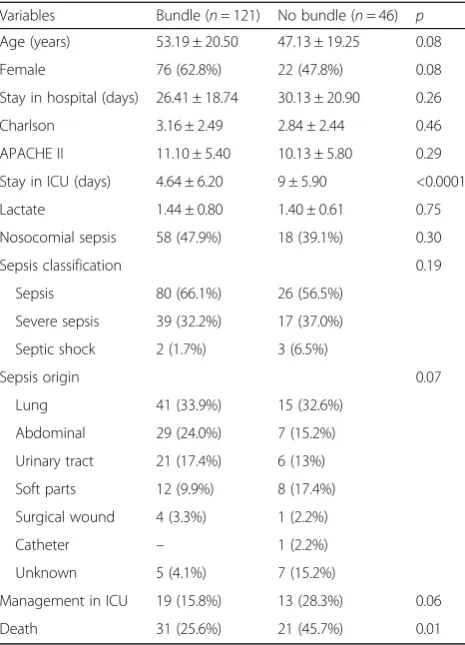
on survivor group (78.3 versus 59.6% of non-survivors; p= 0.013). There was a higher frequency of severe sep-sis in non-survivor group (53.8 versus 24.3% in survi-vors; p= 0.001). Table 3 shows the distribution of the variables according to the use of 3-h bundle. A lower mortality was observed in patients who undergone the sepsis protocol (25.6 versus 45.7% without sepsis protocol; p= 0.013) and shorter length of stay in ICU (9.0 ± 5.90 versus 4.6 ± 6.20 days; p< 0.0001). There was a tendency to greater frequency of ICU admissions in patients who did not receive the bundle (28.3 versus 15.8%;p= 0.06).
In the logistic regression model (Table 4), the only risk factor independently correlated with mortality was the use of 3-h package (OR = 0.175, CI = 0.047 to 0.646,p= 0.009). Other variables tested (age, Charlson comorbidity index, APACHE II, and severity of sepsis) had no independent correlation with death.
Discussion
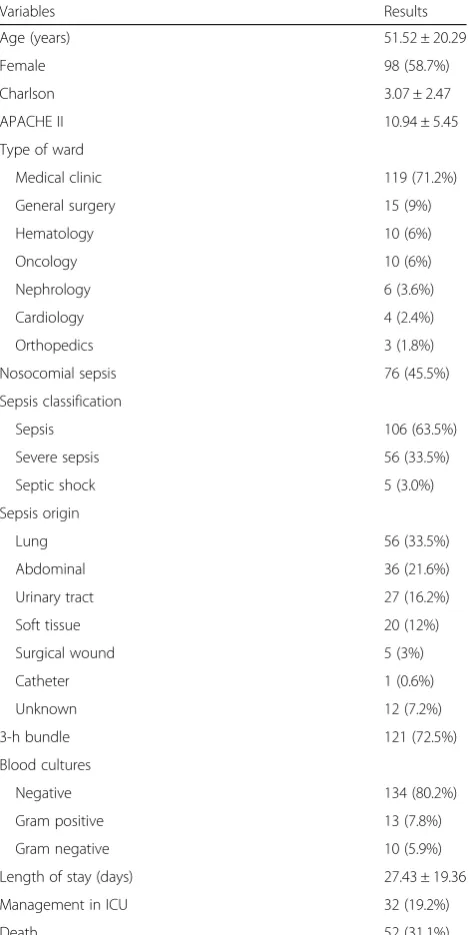
Our study evaluated patients in wards, most with un-complicated sepsis and with a mean APACHE II score of 10.9. However, the overall mortality (31.1%) was consid-ered high for this APACHE II level. One plausible ex-planation for this finding was the profile of our sample. Almost 45.5% of the patients had nosocomial sepsis, 33.5% severe sepsis, the main source of infection was pulmonary (33.5%) followed by abdominal (21%), 25% did not receive a timely intervention (3-h sepsis bundle), and patients were treated in a public health system unit of a low-income country.
The main finding of our study was a 44% reduction in mortality in those who received the 3-h sepsis bundle. Moreover, this intervention was independently associ-ated with survival. We also observed a reduction in ICU admission, as well as a shorter length of stay on these units in patients receiving a 3-h package in wards. Since the publication of the first Surviving Sepsis Campaign Table 1General data of the sample (n= 167)
Variables Results
Age (years) 51.52 ± 20.29
Female 98 (58.7%)
Charlson 3.07 ± 2.47
APACHE II 10.94 ± 5.45
Type of ward
Medical clinic 119 (71.2%)
General surgery 15 (9%)
Hematology 10 (6%)
Oncology 10 (6%)
Nephrology 6 (3.6%)
Cardiology 4 (2.4%)
Orthopedics 3 (1.8%)
Nosocomial sepsis 76 (45.5%)
Sepsis classification
Sepsis 106 (63.5%)
Severe sepsis 56 (33.5%)
Septic shock 5 (3.0%)
Sepsis origin
Lung 56 (33.5%)
Abdominal 36 (21.6%)
Urinary tract 27 (16.2%)
Soft tissue 20 (12%)
Surgical wound 5 (3%)
Catheter 1 (0.6%)
Unknown 12 (7.2%)
3-h bundle 121 (72.5%)
Blood cultures
Negative 134 (80.2%)
Gram positive 13 (7.8%)
Gram negative 10 (5.9%)
Length of stay (days) 27.43 ± 19.36
Management in ICU 32 (19.2%)
Death 52 (31.1%)
Results expressed as mean ± standard deviation or absolute number and percentage
Table 2Distribution of variables according to mortality
Variables Survivors (n= 115) Non-survivors (n= 52) p
Age (years) 49.14 ± 20.44 56.76 ± 19.11 0.02
Female 71 (61.7%) 27 (51.9%) 0.23
Nosocomial sepsis 49 (42.6%) 27 (51.9%) 0.26
Sepsis classification 0.001
Sepsis 84 (73.0%) 22 (42.3%)
Severe sepsis 28 (24.3%) 28 (53.8%)
Septic shock 3 (2.6%) 2 (3.8%)
Sepsis origin 0.65
Lung 39 (33.9%) 17 (32.7%)
Abdominal 22 (19.1%) 14 (26.9%)
Urinary tract 20 (17.4%) 7 (13.5%)
Soft tissue 12 (10.4%) 8 (15.4%)
Surgical wound 3 (2.6%) 2 (3.8%)
Catheter 1 (0.9%) –
Unknown 9 (7.8%) 3 (5.8%)
3-h bundle 90 (78.3%) 31 (59.6%) 0.01
APACHE II 10.45 ± 5.16 12.37 ± 6.09 0.04
CHARLSON 2.71 ± 2.31 3.88 ± 2.64 0.004
Lactate 1.38 ± 0.81 1.59 ± 0.64 0.10
ICU management 11 (9.7%) 21 (40.4%) 0.0001
Guideline in 2004, some studies have shown a decrease in mortality in patients undergoing sepsis protocols [10, 11]. However, most of these evidences were performed in emergency rooms or intensive care units [12–14]. Hence, one of the main merits of this study was to pro-vide data regarding the impact of a sepsis protocol in wards, mostly the reduction in ICU admissions in a hos-pital with limited ICU beds.
The low availability of ICU beds in Brazil is a chronic and neglected issue. Most of Brazilian citizens are cov-ered solely by public health system and have access to only 9.9 ICU beds per 100.000 population [15]. Hence,
every day, doctors who attend emergency rooms, wards, and post anesthetic recovery rooms have to choice who will get an ICU bed, and patients with sepsis diagnosis have to wait a lot until the ICU admission. The aforemen-tioned concerns and our findings (lower frequency of ICU admissions in bundle group) reinforce the paramount im-portance of a timely institution of easy interventions, such as antibiotics and fluid replacement, even before the inten-sivist’s care. Previous evidence has demonstrated that compliance with all bundle metrics is not high [16]. Based on this information and in order to avoid comparisons be-tween different levels of intervention (some individuals with incomplete bundle), our analysis included only those patients submitted to full 3-h bundle.
Most sepsis bundles are based on the early start of an-tibiotics and fluid resuscitation guided by targets such as central venous pressure and central venous oxygen sat-uration, for cases with poor tissue perfusion signals. The main reason for this would be the fact that, in recent years, some studies have shown that the aforementioned interventions are correlated with better outcomes in sep-tic patients, even when used alone [13, 14]. To reinforce this hypothesis, the use of sepsis bundles, based on asso-ciation of early antibiotics with fluid replacement, ac-cording to the “Early Goal-Directed Therapy”, has shown positive impact on the outcome of patients with sepsis, with reductions in mortality up to 50% [16, 17]. Our protocol consisted in a standard fluid replacement, based on blood pressure and plasma lactate and early antibiotic therapy, guided by a local infection control committee.
Regarding the limitations of the present study, APACHE II score was applied only at sepsis diagnosis and the im-pact of different interventions performed in our sepsis bundle was not addressed individually, as well as differ-ences in antibiotics and volume replacement between groups. Furthermore, we did not measure the total volume used in fluid replacement or even parameters such as cen-tral venous oxygen saturation or cencen-tral venous pressure routinely, which makes only speculative the importance of this intervention in our findings. However, in the bundle group, antibiotics were introduced at the time of sepsis diagnosis (within 1st hour) as well as volume replacement. Hence, it is tempting to speculate that the timely institu-tion of these therapies had impact on reducing mortality. This was a single-center retrospective study, which pre-vents the generalizability of our findings.
Conclusion
The use of a sepsis bundle in wards was independently cor-related with a lower mortality. Moreover, there was a lower frequency of ICU admissions and a shorter length of stay in these units in patients who undergone the 3-h bundle. Table 3Distribution of variables according to the use of 3-h
bundle
Variables Bundle (n= 121) No bundle (n= 46) p
Age (years) 53.19 ± 20.50 47.13 ± 19.25 0.08
Female 76 (62.8%) 22 (47.8%) 0.08
Stay in hospital (days) 26.41 ± 18.74 30.13 ± 20.90 0.26
Charlson 3.16 ± 2.49 2.84 ± 2.44 0.46
APACHE II 11.10 ± 5.40 10.13 ± 5.80 0.29
Stay in ICU (days) 4.64 ± 6.20 9 ± 5.90 <0.0001
Lactate 1.44 ± 0.80 1.40 ± 0.61 0.75
Nosocomial sepsis 58 (47.9%) 18 (39.1%) 0.30
Sepsis classification 0.19
Sepsis 80 (66.1%) 26 (56.5%)
Severe sepsis 39 (32.2%) 17 (37.0%)
Septic shock 2 (1.7%) 3 (6.5%)
Sepsis origin 0.07
Lung 41 (33.9%) 15 (32.6%)
Abdominal 29 (24.0%) 7 (15.2%)
Urinary tract 21 (17.4%) 6 (13%)
Soft parts 12 (9.9%) 8 (17.4%)
Surgical wound 4 (3.3%) 1 (2.2%)
Catheter – 1 (2.2%)
Unknown 5 (4.1%) 7 (15.2%)
Management in ICU 19 (15.8%) 13 (28.3%) 0.06
Death 31 (25.6%) 21 (45.7%) 0.01
Table 4Independent risk factors for mortality (logistic regression)
Variables OR CI p
Age 1.016 0.980–1.053 0.39
Charlson 1.129 0.833–1.532 0.43
APACHE II 1.019 0.918–1.131 0.72
Sepsis classification 1.891 0.701–5.103 0.20
3-h bundle 0.175 0.047–0.646 0.009
Additional file
Additional file 1:The Statistical Package for the Social Sciences software (SPSS) file. (PDF 26 kb)
Acknowledgements
We would like to thank Santa Casa de Misericórdia for their technical support of this research.
Funding None.
Availability of data and materials
All data that supported this research are available in Additional file 1.
Authors’contributions
TF conceived the study, performed data analysis, and participated in manuscript writing and review. RWG and AMGTC performed all data collection. ACFT, BSMO, MMFA, MES, and SFJL participated in manuscript writing and review. All authors read and approved the final manuscript.
Competing interests
The authors declare that they have no competing interests.
Consent for publication Not applicable.
Ethics approval and consent to participate
The study was preceded by approval of the Research Ethics Committee of Universidade Estadual de Ciências da Saúde de Alagoas (UNCISAL) (protocol number: 42247014.2.0000.5011—attached file).
Publisher’s Note
Springer Nature remains neutral with regard to jurisdictional claims in published maps and institutional affiliations.
Received: 20 March 2017 Accepted: 30 May 2017
References
1. Soares M, Bozza FA, Angus DC, Japiassú AM, Viana WN, Costa R, Angus DC, Van der Poll T, et al. Organizational characteristics, outcomes, and resource use in 78 Brazilian intensive care units: the ORCHESTRA study. Intensive Care Med. 2015;41(12):2149–60.
2. Dellinger RP, Levy MM, Rhodes A, Annane D, Gerlach H, Opal SM, et al. Surviving Sepsis Campaign Guidelines Committee including the Pediatric Subgroup: Surviving Sepsis Campaign: international guidelines for management of severe sepsis and septic shock: 2012. Crit Care Med. 2013;41:580–637.
3. Levy MM, Dellinger RP, Townsend SR, Linde-Zwirble WT, Marshall JC, Bion J, et al. The Surviving Sepsis Campaign: results of an international guideline-based performance improvement program targeting severe sepsis. Intensive Care Med. 2010;36(2):222–3.
4. Koenig A, Picon PD, Feijó J, Silva E, Westphal GA. Estimate of the economic impact of implementing an in hospital protocol for the early detection and treatment of severe sepsis in public and private hospitals in southern Brazil. Rev Bras Ter Intensiva. 2010;22(3):213–9.
5. Sogayar AMC, Machado FR, Rea-Neto A, Dornas A, Grion CMC, Lobo SMA, et al. A multicentre, prospective study to evaluate costs of septic patients in Brazilian intensive care units. Pharmacoeconomics. 2008;26(5):425–34. 6. Shorr AF, Micek ST, Jackson WL, Kollef MH. Economic implications of an
evidence-based sepsis protocol: can we improve outcomes and lower costs? Crit Care Med. 2007;35(5):1257–62.
7. Beale R, Reinhart K, Brunkhorst FM, Dobb G, Levy M, Martin G, PROGRESS Advisory Board, et al. Promoting Global Research Excellence in Severe Sepsis (PROGRESS): lessons from an international sepsis registry. Infection. 2009;37(3):222–32.
8. Levy MM, Fink MP, Marshall JC, Abraham E, Angus D, Cook D, et al. 2001 SCCM/ESICM/ACCP/ATS/SIS International Sepsis Definitions Conference. Crit Care Med. 2003;31(4):1250–6.
9. Silva E, Pedro MA, Sogayar AC, Mohovic T, Silva CL, Janiszewski M, Brazilian Sepsis Epidemiological Study, et al. Brazilian Sepsis Epidemiological Study (BASES study). Crit Care. 2004;8(4):R251–60.
10. Wawrzeniak IC, Loss SH, Moraes MCM, De La Vega FL, Victorino JA. Could a protocol based on early goal-directed therapy improve outcomes in patients with severe sepsis and septic shock in the intensive care unit setting? Indian J Crit Care Med. 2015;19(3):159–65.
11. Thiel SW, Asghar MF, Micek ST, Reichley RM, Doherty JA, Kollef MH. Hospital-wide impact of a standardized order set for the management of bacteremic severe sepsis. Crit Care Med. 2009;37(3):819–24.
12. Micek ST, Roubinian N, Heuring T, Bode M, Williams J, Harrison C, et al. Before-after study of a standardized hospital order set for the management of septic shock. Crit Care Med. 2006;34(11):2707–13.
13. Nguyen HB, Corbett SW, Steele R, Banta J, Hayes SR, Edwards J, et al. Implementation of a bundle of quality indicators for the early management of severe sepsis and septic shock is associated with decreased mortality. Crit Care Med. 2007;35(4):1105–12.
14. Rivers E, Nguyen B, Havstad S, Ressler J, Muzzin A, Knoblich B, Early Goal-Directed Therapy Collaborative Group, et al. Early goal-directed therapy in the treatment of severe sepsis and septic shock. N Engl J Med. 2001;345(19):1368–77.
15. Machado FR. All in a day’s work—equity vs. equality at a public ICU in Brazil. N Engl J Med. 2016;375(25):2420–1.
16. Rhodes A, Phillips G, Beale R, Cecconi M, Chiche JD, De Backer D, et al. The Surviving Sepsis Campaign bundles and outcome: results from the International Multicentre Prevalence Study on Sepsis (The IMPreSS study). Intensive Care Med. 2015;41(9):1620–8.
17. Puskarich MA, Trzeciak S, Shapiro NI, Arnold RC, Horton JM, Studnek JR, et al. Association between timing of antibiotic administration and mortality from septic shock in patients treated with a quantitative resuscitation protocol. Crit Care Med. 2011;39(9):2066–71.
• We accept pre-submission inquiries
• Our selector tool helps you to find the most relevant journal • We provide round the clock customer support
• Convenient online submission • Thorough peer review
• Inclusion in PubMed and all major indexing services • Maximum visibility for your research
Submit your manuscript at www.biomedcentral.com/submit