Errors of Diagnosis in Pediatric Practice: A
Multisite Survey
WHAT’S KNOWN ON THIS SUBJECT: Little is known about diagnostic errors in general pediatric practice, other than data from malpractice claims. We surveyed pediatricians to obtain data to understand and to reduce diagnostic errors among children.
WHAT THIS STUDY ADDS: Pediatricians reported making diagnostic errors relatively frequently, and patient harm was not uncommon. Our study provides new data about types of
diagnostic errors among children and their causes and lays the groundwork for a multifaceted approach to reduce such errors.
abstract
+OBJECTIVE:We surveyed pediatricians to elicit their perceptions re-garding frequency, contributing factors, and potential system- and provider-based solutions to address diagnostic errors.
METHODS:Academic, community, and trainee pediatricians (N ⫽
1362) at 3 tertiary care institutions and 109 affiliated clinics were invited to complete the survey anonymously through an Internet survey administration service between November 2008 and May 2009.
RESULTS:The overall response rate was 53% (N⫽726). More than one-half (54%) of respondents reported that they made a diagnostic error at least once or twice per month; this frequency was markedly higher (77%) among trainees. Almost one-half (45%) of respondents reported diagnostic errors that harmed patients at least once or twice per year. Failure to gather information through history, physical exam-ination, or chart review was the most-commonly reported process breakdown, whereas inadequate care coordination and teamwork was the most-commonly reported system factor. Viral illnesses being nosed as bacterial illnesses was the most-commonly reported diag-nostic error, followed by misdiagnosis of medication side effects, psy-chiatric disorders, and appendicitis. Physicians ranked access to electronic health records and close follow-up of patients as strategies most likely to be effective in preventing diagnostic errors.
CONCLUSION:Pediatricians reported making diagnostic errors relatively frequently, and patient harm from these errors was not uncommon.
Pediatrics2010;126:70–79
AUTHORS:Hardeep Singh, MD, MPH,aEric J. Thomas,
MD, MPH,bLindsey Wilson, MA,aP. Adam Kelly, PhD,a
Kenneth Pietz, PhD,aDena Elkeeb, MD,cand Geeta Singhal,
MD, MEdd
aHouston Veterans Affairs Health Services Research and Development Center of Excellence, Michael E. DeBakey Veterans Affairs Medical Center and Section of Health Services Research, Department of Medicine, Baylor College of Medicine, Houston, Texas;bDivision of General Medicine, Department of Medicine, University of Texas at Houston-Memorial Hermann Center for Healthcare Quality and Safety, University of Texas Medical School at Houston, Houston, Texas;cDepartment of Pediatrics, Cincinnati Children’s Hospital Medical Center, Cincinnati, Ohio; anddDepartment of Pediatrics, Baylor College of Medicine, Houston, Texas
KEY WORDS
diagnostic errors, children, patient safety, missed and delayed diagnosis, misdiagnosis, malpractice
The views expressed in this article are those of the authors and do not necessarily represent the views of the Department of Veterans Affairs.
www.pediatrics.org/cgi/doi/10.1542/peds.2009-3218
doi:10.1542/peds.2009-3218
Accepted for publication Feb 25, 2010
Address correspondence to Geeta Singhal, MD, MEd, Baylor College of Medicine, Department of Pediatrics, 6621 Fannin St, Suite A.210, MC1-1481, Houston, TX 77030. E-mail: gsinghal@ bcm.edu
PEDIATRICS (ISSN Numbers: Print, 0031-4005; Online, 1098-4275).
Copyright © 2010 by the American Academy of Pediatrics
FINANCIAL DISCLOSURE:The authors have indicated they have no financial relationships relevant to this article to disclose.
Errors in diagnosis constitute a sizable proportion of medical errors in the United States and are responsible for significant costs and harm.1–10For
in-stance, in the Utah-Colorado study, di-agnostic breakdowns were the most-common type (36%) of preventable ambulatory adverse events that led to hospital admission.10 Although
medi-cal errors related to treatment (eg, medications or surgery) have received much-needed attention,11errors in the
diagnostic process remain relatively understudied.12 Data regarding
diag-nostic errors in pediatric practice set-tings are especially limited. To date, knowledge of these errors is limited mostly to events that result in mal-practice claims. Error in diagnosis is the most-commonly identified reason (32%) in closed pediatric malpractice claims, with the highest median in-demnity payments and defense ex-penses.13 However, diagnostic errors
that result in claims may represent only a small proportion of all diagnos-tic errors; given their low frequency and high level of severity, they may not be representative of all types of diag-nostic errors that occur in routine practice.2,14 Furthermore, underlying
contributory factors for litigated diag-nostic errors might differ systemati-cally from those for nonlitigated er-rors.14 In short, malpractice claims
have provided useful data for under-standing diagnostic errors but may not represent the entire spectrum of diagnostic errors.
Errors of diagnosis occur when diag-nosis is unintentionally delayed (suffi-cient information was available ear-lier), wrong (another diagnosis was made before the correct one), or missed (no diagnosis was ever made), as judged by the eventual appreciation of more-definitive information.4
Al-though diagnostic errors may occur when symptoms of a disease are atyp-ical or absent, they are largely related
to cognitive (eg, faulty data-gathering or clinical reasoning) and systems-related (eg, issues with policies, pro-cesses, and procedures or organi-zational issues) factors.2,4,15–28 This
understanding of diagnostic errors is based largely on nonpediatric settings and populations.
The diagnostic process for children is unlikely to be entirely analogous to that for adults. The most-prevalent types of diseases and their associated diagnostic processes are different (eg, certain infections are more common and cancer is less common among children). Other unique factors in pedi-atrics include systems issues, patient/ caregiver issues, physician training, and practice workflow, all of which are likely to influence diagnostic errors. To enhance our understanding of the rel-ative prevalence of diagnostic errors, contributory factors, and potential preventive strategies, we designed an anonymous survey to study pedi-atricians’ experiences with diagnos-tic errors. We also sought data on specific disease conditions com-monly associated with diagnostic er-rors in pediatrics.
METHODS
Setting and Participants
To obtain diverse perspectives and so-lutions, we sampled 3 types of pediatri-cians, that is, academic pediatricians (general pediatricians and subspecial-ists), trainees (residents and fellows), and nonacademic, community-based pediatricians. Our sample consisted of academic pediatricians and trainees from two tertiary care institutions in Houston (Sites A and B) and one in Cin-cinnati (Site C). Although we invited participation from all trainees and general pediatricians at the 3 study sites, we randomly invited only 50% of pediatric subspecialists at Sites A and C, because of the large number of sub-specialists at those sites. Community
pediatricians were selected from large practice groups affiliated with Sites A and C and represented 109 practice locations. Institutional review board approval was obtained at all 3 study sites.
Survey Development
We were unable to find an existing sur-vey that addressed our study ques-tions. Building on previous empirical and theoretical research on diagnostic errors, we developed a comprehensive survey after an exhaustive review of both adult and pediatric literature. A psychometrician guided the survey de-velopment process, which included item writing and refinement by using subject matter expert input, clinician review, and pilot-testing. The content of survey items was informed by pub-lished studies, input from experts in patient safety and diagnostic errors, and feedback from a sample of pedia-tricians from our study sites. The sur-vey was developed for Internet-based administration by using the resources of a user-friendly, commercial, Internet-based, survey administration service (www.SurveyMonkey.com).
care, as gleaned from the litera-ture2,4,7,8,26,29–31); (2) the most-common
contributory factors leading to diag-nostic errors; (3) the most-common types of medical conditions associated with diagnostic errors; and (4) the most-useful strategies for prevention of diagnostic errors. For many ques-tions, we used response scales with forced-choice ranking of the top 3 re-sponse choices, rather than Likert-style responses. The survey also as-sessed demographic information, self-reported frequency of diagnostic errors, attitudes toward discussing di-agnostic errors, and previous training about diagnostic errors. The esti-mated completion time was 15 to 20 minutes, on the basis of pilot-testing.
Survey Administration
We identified potential participants from medical staff offices at each insti-tution and sent each physician an e-mail invitation to complete the sur-vey, followed by 2 e-mail reminders. As an incentive for participation, we pro-vided an Internet link to a $10 gift cer-tificate in the initial invitation. Partici-pants accessed and completed the items anonymously; only the study site and pediatrician category for each participant were identified.
Data Analyses
Data were downloaded from the Inter-net survey administration service and analyzed by using SAS 9.2 (SAS Insti-tute, Cary, NC). We generated descrip-tive statistics about the nature and frequency of diagnostic errors in ag-gregate and then separately for aca-demic pediatricians, community pedi-atricians, and trainees. Many items asked respondents to rank first, sec-ond, and third choices from a list of possible outcomes. To calculate these rankings, we used weighted averages computed as follows: if a respondent ranked a particular choice first, then that choice was given 3 points; 2 points
were given for a second choice and 1 point for a third choice, and all other choices were scored as 0. We then computed the average of all of these values for all respondents. To assess nonrandomness of ranking, we used Friedman’s 2test to test for
signifi-cant differences among choices marked by respondents (ie, whether a certain item was ranked above or be-low others after removal of variation among respondents). We tested the items in pairs, with the significance level adjusted for multiple compari-sons. We tested for differences in re-sponse frequencies between pediatri-cian types and between study sites by using2tests. We used linear
regres-sion analyses to examine the effects of gender, race, practice site, type of pe-diatrician, training related to diagnos-tic errors in medical school and resi-dency, and years of clinical experience after residency on the outcome of the self-reported rate of diagnostic errors. We used a scale consisting of 7 possi-ble frequencies; the 7 values were treated as a continuous variable. The potential covariates were examined in-dividually for inclusion in the final model.
RESULTS
Between November 2008 and May 2009, a total of 1362 survey invitations were sent to physicians at the 3 study sites, including 569 at Site A, 194 at Site B and 599 at Site C. Invitees included 516 academic physicians, 430 trainees, and 416 community-based physicians. The overall response rate was 53%; group rates were 52% for academic physicians, 39% for community-based physicians, and 67% for trainees. How-ever, not all respondents completed the survey in its entirety; the overall survey completion rate among respon-dents was 86%, and group completion rates were 87%, 88%, and 85%, respec-tively. The2tests showed that there
were no significant differences
be-tween physician types or bebe-tween sites with respect to response rates.
Academic, community, and trainee groups did not differ with respect to racial/ethnic distributions (Table 1). Approximately one-fourth (27%) of re-spondents had been in practice for ⬎10 years, and two-thirds (67%) per-formed mostly clinical duties. Approxi-mately one-half (48%) of respondents received training about diagnostic er-rors in medical school and a some-what greater number (59%) in resi-dency; however, this training was largely informal in nature. The major-ity (81%) of respondents reported dis-cussing with colleagues the diagnostic errors they had made, some, most, or all of the time.
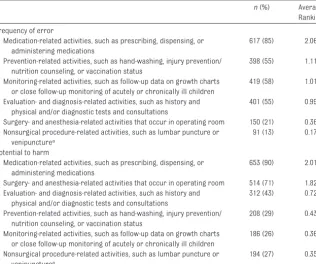
Table 2 lists the average frequency rankings of clinical activities consid-ered by pediatricians to be associated with error and potential for harm. The Friedman test showed significant dif-ferences among the ranked activities (P⬍.0001). Overall, pediatricians en-dorsed errors in medication-related activities such as prescribing and ad-ministering as being most prone to er-ror and associated with the greatest potential for harm. Figure 1 shows the distributions (according to pediatri-cian category) of self-reported fre-quency of error (regardless of harm) and frequency of error with harm. More than one-half (54%) of respon-dents reported that they made a diag-nostic error at least once or twice per month. However, the frequency of self-reported errors that might cause harm was lower. Only 4% of respon-dents reported that errors that harmed the patient occurred at least once or twice per month, 18% reported that such errors occurred at least once or twice per quarter, and 45% re-ported that they occurred at least once or twice per year.
self-perceived error rates and trainees had significantly higher reported rates than academic and community pedia-tricians. Neither gender nor number of years of experience after residency had significant effects on the self-reported diagnostic error rates. Col-lectively, provider characteristics
ex-plained a relatively small proportion of
the variance (R2 ⫽ 0.17) in
self-reported frequencies of diagnostic errors.
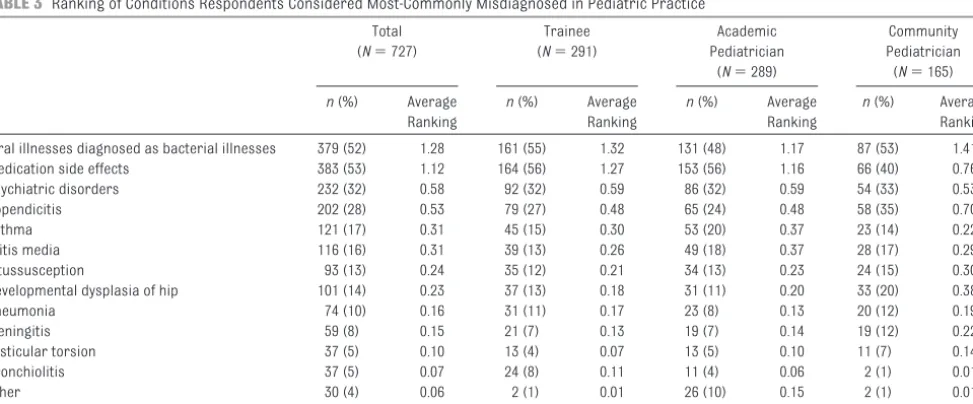
Diagnosis of viral illnesses as bacte-rial illnesses was the event most-frequently associated with diagnostic
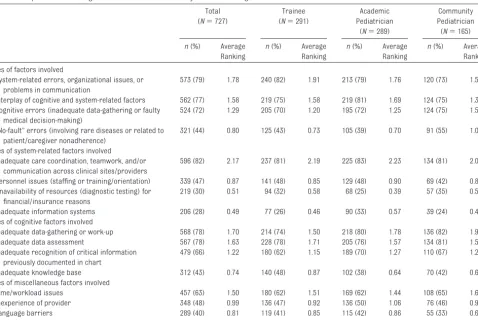
error, followed by misdiagnosis of medication side effects, psychiatric disorders, and appendicitis (Table 3). The Friedman test showed significant differences among the ranked dis-eases (P⬍.0001). Tables 4 and 5 dis-play respondents’ rankings of process breakdowns and contributory factors perceived to be associated with diag-nostic errors. Among various types of process breakdowns associated with diagnostic errors, failure to gather available medical information had the highest ranking, followed by care not being sought in a timely manner by the patient or caregiver (Table 4). With re-gard to details of specific contributing factors, inadequate care coordination, teamwork, and/or communication across clinical settings or providers received the highest rating of all system-related factors (Table 5). Of all cognitive factors, inadequate data-gathering or work-up was ranked highest overall, although trainees ranked inadequate data assessment as a more-frequent contributing factor than data-gathering. Of miscellaneous factors leading to diagnostic errors, all groups assigned time/workload is-sues the highest average ranking. The Friedman test showed significant dif-ferences (P⬍.0001) among all ranked variables in Tables 4 and 5. We further explored the association of the factors of care not sought in a timely manner and heath literacy and found a strong positive correlation (P⬍.0005).
We also inquired about specific heuris-tic processes (important cognitive shortcuts in the face of complex situa-tions) and biases that might affect medical decision-making. Overall, the type of bias with the highest average frequency rating was being too fo-cused on a diagnosis or treatment plan. Another bias with a relatively high frequency rating was being mis-led by a normal history, physical, labo-ratory, or imaging study result.
TABLE 1 Baseline Characteristics of Survey Respondents
n(%) P
Trainee (N⫽291)
Academic Pediatrician
(N⫽289)
Community Pediatrician (N⫽165)
Total (N⫽727)
Study site ⬍.0001
Site A (Houston) 118 (41) 137 (51) 102 (62) 357 (49) Site B (Houston) 44 (15) 59 (22) 0 (0)a 103 (14) Site C (Cincinnati) 129 (44) 75 (28) 63 (38) 267 (37)
Gender .045
Male 103 (35) 123 (46) 67 (41) 293 (40)
Female 188 (65) 146 (54) 98 (59) 432 (59)
Missing data 0 (0) 2 (1) 0 (0) 2 (0)
Race/ethnicity Not significant
American Indian/Alaska native 1 (0) 1 (0) 0 (0) 2 (0)
Asian 47 (16) 39 (14) 19 (12) 105 (14)
Black 24 (8) 10 (4) 15 (9) 49 (7)
Hispanic 23 (8) 24 (9) 9 (5) 56 (8)
Native Hawaiian/Pacific Islander
0 (0) 2 (1) 0 (0) 2 (0)
White 186 (64) 183 (68) 116 (70) 485 (67)
Other 10 (3) 10 (4) 5 (3) 25 (3)
Missing data 0 (0) 2 (1) 1 (0) 3 (0)
Training in medical schoolb
Yes, in informal training 114 (39) 77 (28) 52 (32) 243 (33) Yes, in formal curriculum 81 (28) 24 (9) 10 (6) 115 (16)
No 62 (21) 136 (50) 84 (51) 282 (39)
Missing data 43 (15) 36 (13) 20 (12) 99 (14)
Training in residencyb
Yes, in informal training 106 (36) 111 (41) 68 (41) 285 (39) Yes, in formal curriculum 115 (40) 27 (10) 18 (11) 160 (22)
No 37 (13) 99 (37) 62 (38) 198 (27)
Missing data 43 (15) 36 (13) 20 (20) 99 (14)
Time in practice ⬍.0001
0–5 y 12 (4) 85 (31) 31 (19) 128 (18)
6–10 y 0 (0) 36 (13) 26 (16) 62 (8)
11–15 y 0 (0) 40 (15) 21 (13) 61 (8)
16–20 y 0 (0) 26 (10) 17 (10) 43 (6)
⬎20 y 0 (0) 44 (16) 49 (30) 93 (13)
Not applicable 236 (81) 4 (1) 1 (1) 241 (33)
Missing data 43 (15) 36 (13) 20 (12) 99 (14)
Allocated proportion of clinical time
⬍.0001
0%–25% 6 (2) 49 (18) 0 (0) 55 (8)
26%–50% 11 (4) 56 (21) 2 (1) 69 (9)
51%–75% 26 (9) 52 (19) 8 (5) 86 (12)
76%–100% 192 (66) 72 (26) 134 (81) 398 (55)
Not applicable 10 (3) 0 (0) 1 (1) 11 (1)
Missing data 46 (16) 42 (16) 20 (12) 108 (15)
aThere was no community group at Site B.
bProportions add up to⬎100% because a few participants responded yes regarding both informal training and formal
Table 6 presents the ranking of se-lected solutions to reduce diagnostic errors. Of provider-based solutions, close follow-up of patients was ranked as being most likely to be ef-fective by all 3 subgroups of pediatri-cians, followed by improving
team-work, more time in clinical
encounters, and empowering pa-tients and families to be vigilant about the possibility of diagnostic er-rors. For system-based solutions, ac-cess to electronic medical records that provide comprehensive clinical data was ranked highest by all 3 groups of pediatricians, followed by availability of diagnostic decision-support tools. Community-based physicians ranked increased access to and availability of consultants and experts second. The Friedman test
showed significant differences
among all ranked solutions (P ⬍
.0001).
DISCUSSION
We surveyed academic, community-based, and trainee pediatricians, at 3 study sites, about diagnostic errors and found several new insights that might facilitate understanding and prevention of such errors in the future. Of 6 types of medical errors, errors in diagnosis were ranked fourth in fre-quency and third in potential for harm.
However, pediatricians reported that they made diagnostic errors rather frequently; more than one-half (54%) reported that they made a diagnostic error at least once or twice per month. Diagnostic errors that led to harm also were not infrequent; almost one-half (45%) of respondents reported that di-agnostic errors that harmed patients
occurred at least once or twice per year. The most-frequent diagnostic er-ror was viral illnesses being diag-nosed as bacterial illnesses, followed
by misdiagnosis of medication side ef-fects, psychiatric disorders, and ap-pendicitis. Failures in data-gathering (history, examination, and chart re-view) and care delays by patients or caregivers were reported to be the most-frequent process breakdowns. Of various interventions for prevention of diagnostic errors, pediatricians gave highest rankings to close follow-up of patients and access to electronic medical records.
To our knowledge, this was the first study to assess diagnostic errors in any setting through a comprehensive survey. Our study builds on the knowl-edge available from malpractice liter-ature to enhance our understanding of diagnostic errors that affect children, serving as a guide to the development of strategies to prevent these errors. According to our findings, pediatri-cians think that errors in diagnosis oc-cur most commonly in a set of condi-tions that differ markedly from those mentioned in pediatric malpractice lit-erature. For example, in pediatric mal-practice literature, diagnoses of men-ingitis, appendicitis, pneumonia, and testicular torsion are cited as being missed most often.32,33 However, we
found that most pediatricians thought that misdiagnosis of viral illnesses as bacterial illnesses was the most-common diagnostic error, followed by misdiagnosis of medication side ef-fects and psychiatric diseases. None of these overlap with the top diagnostic errors found in claims files. Errors in diagnosis of medication-related side effects are relatively unexplored, in contrast to medication errors related to prescription and administration. A recent analysis of 583 physician-reported diagnostic errors in adults also revealed drug reactions or over-dose as the second most-common type of diagnostic error.34 Similarly, the
concept of potential misdiagnosis of psychiatric diseases in children,
al-TABLE 2 Ranking of Clinical Activities Respondents Considered to Be Associated With Frequency of Error and Potential for Harm
n(%) Average Ranking
Frequency of error
Medication-related activities, such as prescribing, dispensing, or administering medications
617 (85) 2.06
Prevention-related activities, such as hand-washing, injury prevention/ nutrition counseling, or vaccination status
398 (55) 1.11
Monitoring-related activities, such as follow-up data on growth charts or close follow-up monitoring of acutely or chronically ill children
419 (58) 1.01
Evaluation- and diagnosis-related activities, such as history and physical and/or diagnostic tests and consultations
401 (55) 0.99
Surgery- and anesthesia-related activities that occur in operating room 150 (21) 0.36 Nonsurgical procedure-related activities, such as lumbar puncture or
venipuncturea
91 (13) 0.17
Potential to harm
Medication-related activities, such as prescribing, dispensing, or administering medications
653 (90) 2.01
Surgery- and anesthesia-related activities that occur in operating room 514 (71) 1.82 Evaluation- and diagnosis-related activities, such as history and
physical and/or diagnostic tests and consultations
312 (43) 0.72
Prevention-related activities, such as hand-washing, injury prevention/ nutrition counseling, or vaccination status
208 (29) 0.43
Monitoring-related activities, such as follow-up data on growth charts or close follow-up monitoring of acutely or chronically ill children
186 (26) 0.36
Nonsurgical procedure-related activities, such as lumbar puncture or venipuncturea
194 (27) 0.35
Thenvalues refer to the number of participants who selected the item and assigned a rank of first, second, or third, and proportions refer to the proportions of participants who selected a particular item and ranked the item first, second, or third.
though not entirely new,35has not been
discussed in the context of malprac-tice claims and needs to be revisited with more specificity in future work. Another advantage of using this method is that pediatricians provided rich details about the most-common process breakdowns and contribu-tory factors, some of which are much harder to determine from reviewing
malpractice claims or medical
records.30
We also solicited providers’ rankings of proposed strategies to prevent diag-nostic errors. Despite ongoing debate about the benefits of electronic health records,36all groups of pediatricians
ranked electronic records as the best system-based solution. Other strate-gies, such as diagnostic decision-support tools and techniques to en-sure timely follow-up evaluation of certain patients,29,37 may need to be
prioritized in research on preventive strategies. Pediatricians also thought that an important factor leading to di-agnostic errors was the failure of pa-tients or caregivers to seek care in a timely manner. Strategies to empower caregivers and patients should be studied and implemented in the con-text of patient safety research.
Physi-FIGURE 1
Frequency of diagnostic errors regardless of patient harm (A) and frequency of diagnostic errors that caused patient harm (B), as self-reported by pediatricians. Percentages reported in the text are higher because they reflect cumulative frequencies.
TABLE 3 Ranking of Conditions Respondents Considered Most-Commonly Misdiagnosed in Pediatric Practice
Total (N⫽727)
Trainee (N⫽291)
Academic Pediatrician
(N⫽289)
Community Pediatrician (N⫽165) n(%) Average
Ranking
n(%) Average Ranking
n(%) Average Ranking
n(%) Average Ranking
Viral illnesses diagnosed as bacterial illnesses 379 (52) 1.28 161 (55) 1.32 131 (48) 1.17 87 (53) 1.41
Medication side effects 383 (53) 1.12 164 (56) 1.27 153 (56) 1.16 66 (40) 0.76
Psychiatric disorders 232 (32) 0.58 92 (32) 0.59 86 (32) 0.59 54 (33) 0.53
Appendicitis 202 (28) 0.53 79 (27) 0.48 65 (24) 0.48 58 (35) 0.70
Asthma 121 (17) 0.31 45 (15) 0.30 53 (20) 0.37 23 (14) 0.22
Otitis media 116 (16) 0.31 39 (13) 0.26 49 (18) 0.37 28 (17) 0.29
Intussusception 93 (13) 0.24 35 (12) 0.21 34 (13) 0.23 24 (15) 0.30
Developmental dysplasia of hip 101 (14) 0.23 37 (13) 0.18 31 (11) 0.20 33 (20) 0.38
Pneumonia 74 (10) 0.16 31 (11) 0.17 23 (8) 0.13 20 (12) 0.19
Meningitis 59 (8) 0.15 21 (7) 0.13 19 (7) 0.14 19 (12) 0.22
Testicular torsion 37 (5) 0.10 13 (4) 0.07 13 (5) 0.10 11 (7) 0.14
Bronchiolitis 37 (5) 0.07 24 (8) 0.11 11 (4) 0.06 2 (1) 0.01
Other 30 (4) 0.06 2 (1) 0.01 26 (10) 0.15 2 (1) 0.01
Fracture 26 (4) 0.06 7 (2) 0.03 11 (4) 0.06 8 (5) 0.10
cians often do not know the outcomes for patients whose diagnoses they miss; therefore, feedback pathways to relay changes in diagnosis back to the original physicians are likely to be useful.29
Our findings provide valuable data to in-form ongoing efforts regarding patient safety and medical error training. The lack of emphasis on formal training re-garding diagnostic errors provides op-portunities to redesign curricula for
both future pediatricians and practicing physicians.38,39 For instance, both
aca-demic pediatricians and trainees thought that failure to gather available medical information through history and physical examination and/or review of
TABLE 4 Respondents’ Ranking of Breakdowns in the Diagnostic Process Most-Commonly Associated With Diagnostic Errors
Total (N⫽727)
Trainee (N⫽291)
Academic Pediatrician
(N⫽289)
Community Pediatrician (N⫽165) n(%) Average
Ranking
n(%) Average Ranking
n(%) Average Ranking
n(%) Average Ranking
Failure to gather medical information through history and physical and/or review of charts
346 (48) 1.05 138 (47) 1.08 132 (49) 1.04 76 (46) 1.00
Care not sought in timely manner by patient/caregiver 305 (42) 0.91 131 (45) 0.91 99 (37) 0.81 75 (45) 1.07 Failure to follow up on abnormal diagnostic laboratory
test results
283 (39) 0.75 106 (36) 0.73 113 (42) 0.77 64 (39) 0.75
Patient/caregiver nonadherence to provider-recommended follow-up plan
271 (37) 0.73 109 (37) 0.71 93 (34) 0.69 69 (42) 0.82
Problems with ordering, performance, or interpretation of diagnostic/laboratory tests
258 (35) 0.71 89 (31) 0.67 112 (41) 0.77 57 (35) 0.65
Inappropriate or inadequate follow-up plan by provider after child’s evaluation
210 (29) 0.52 91 (31) 0.58 77 (28) 0.53 42 (25) 0.41
Delays related to subspecialist/consultation process 178 (24) 0.46 68 (23) 0.39 66 (24) 0.50 44 (27) 0.50
The Friedman test showed significant differences among the ranked options (P⬍.0001).
TABLE 5 Respondents’ Ranking of Most-Common Contributory Factors for Diagnostic Errors in Pediatrics
Total (N⫽727)
Trainee (N⫽291)
Academic Pediatrician
(N⫽289)
Community Pediatrician (N⫽165) n(%) Average
Ranking
n(%) Average Ranking
n(%) Average Ranking
n(%) Average Ranking
Types of factors involved
System-related errors, organizational issues, or problems in communication
573 (79) 1.78 240 (82) 1.91 213 (79) 1.76 120 (73) 1.59
Interplay of cognitive and system-related factors 562 (77) 1.58 219 (75) 1.58 219 (81) 1.69 124 (75) 1.39 Cognitive errors (inadequate data-gathering or faulty
medical decision-making)
524 (72) 1.29 205 (70) 1.20 195 (72) 1.25 124 (75) 1.51
“No-fault” errors (involving rare diseases or related to patient/caregiver nonadherence)
321 (44) 0.80 125 (43) 0.73 105 (39) 0.70 91 (55) 1.07
Types of system-related factors involved
Inadequate care coordination, teamwork, and/or communication across clinical sites/providers
596 (82) 2.17 237 (81) 2.19 225 (83) 2.23 134 (81) 2.02
Personnel issues (staffing or training/orientation) 339 (47) 0.87 141 (48) 0.85 129 (48) 0.90 69 (42) 0.86 Unavailability of resources (diagnostic testing) for
financial/insurance reasons
219 (30) 0.51 94 (32) 0.58 68 (25) 0.39 57 (35) 0.56
Inadequate information systems 206 (28) 0.49 77 (26) 0.46 90 (33) 0.57 39 (24) 0.41
Types of cognitive factors involved
Inadequate data-gathering or work-up 568 (78) 1.70 214 (74) 1.50 218 (80) 1.78 136 (82) 1.92
Inadequate data assessment 567 (78) 1.63 228 (78) 1.71 205 (76) 1.57 134 (81) 1.59
Inadequate recognition of critical information previously documented in chart
479 (66) 1.22 180 (62) 1.15 189 (70) 1.27 110 (67) 1.26
Inadequate knowledge base 312 (43) 0.74 140 (48) 0.87 102 (38) 0.64 70 (42) 0.68
Types of miscellaneous factors involved
Time/workload issues 457 (63) 1.50 180 (62) 1.51 169 (62) 1.44 108 (65) 1.61
Inexperience of provider 348 (48) 0.99 136 (47) 0.92 136 (50) 1.06 76 (46) 0.98
Language barriers 289 (40) 0.81 119 (41) 0.85 115 (42) 0.86 55 (33) 0.65
Health literacy of patient/family 243 (33) 0.61 86 (30) 0.55 91 (34) 0.60 66 (40) 0.73
previous charts was a common break-down. It may be valuable to refocus edu-cation on this much-neglected aspect of training through innovative techniques that use standardized or virtual patients and simulation.39–41Training also should
focus on the interplay of system-related and cognitive factors, which has been underemphasized in the literature to date. Critical thinking skills and strate-gies to reduce cognitive biases should be taught in the context of teamwork and system-related factors (such as time pressure) that may affect diagnostic performance.15,42–45 Carefully designed
forums for open discussions of diagnos-tic errors are needed and are likely to be well received; many residents self-reported a large number of diagnostic errors, and most physicians reported that they discussed their own diagnostic errors with colleagues at least some of the time.
Our study had several limitations. Be-cause we relied entirely on
self-reported error data, rather than
ac-tual errors, and we could not
determine which reported errors caused patient harm, our findings may need to be validated with other data sources. However, obtaining the perceptions of physicians (and other caregivers) about errors is impor-tant and is widely accepted as a fun-damental approach to understand-ing and improvunderstand-ing safety.46,47 The
content and design of our survey were based largely on adult litera-ture, although we incorporated a sig-nificant amount of feedback from pe-diatricians before administration. Pediatricians also may not know when they missed a diagnosis; there-fore, errors may be underreported. Although perhaps our response rate was not high enough, we think this does not jeopardize the quality or generalizability of our findings. Liter-ature findings showed that physician response rates were lower than
rates for other participants and re-sponse rates have decreased over time.48,49Published surveys of
physi-cians have a mean response rate of only 54%, compared with 68% for nonphysicians.48Lastly, we surveyed
pediatricians only through e-mail, which might have limited participa-tion by those lacking reliable e-mail access; however, the trainees and academic pediatricians in our sam-ple were expected to use institu-tional e-mail accounts, which would limit this bias for this sample.
CONCLUSIONS
Pediatricians reported making diag-nostic errors relatively frequently, and they endorsed inadequate data-gathering, poor care coordination, and patient/caregiver-related delays as prominent contributing factors. Improved follow-up of patients and access to electronic health records were perceived as the most
promis-TABLE 6 Respondents’ Ranking of Likely Effective Provider-Based and System-Based Solutions
Total (N⫽727)
Trainee (N⫽291)
Academic Pediatrician
(N⫽289)
Community Pediatrician (N⫽165) n(%) Average
Ranking
n(%) Average Ranking
n(%) Average Ranking
n(%) Average Ranking
Provider-based solutions
Close follow-up of patients to ensure that diagnosis is correct (rapid follow-up monitoring)
532 (73) 1.63 202 (69) 1.49 193 (71) 1.59 137 (83) 1.95
Improving teamwork between members of health care team
424 (58) 1.19 169 (58) 1.23 167 (62) 1.27 88 (53) 0.99
Increasing time spent in clinical encounters 284 (39) 0.79 127 (44) 0.90 92 (34) 0.67 65 (39) 0.76 Empowering patients and families to be vigilant about
possibility of diagnostic errors
278 (38) 0.66 101 (35) 0.60 102 (38) 0.64 75 (45) 0.78
Asking for informal second opinions from same-specialty colleagues
221 (30) 0.55 87 (30) 0.53 87 (32) 0.61 47 (28) 0.51
More training in clinical reasoning skills 136 (19) 0.34 56 (19) 0.36 59 (22) 0.38 21 (13) 0.25 System-based solutions
Access to electronic medical records providing comprehensive patient data
539 (74) 1.75 224 (77) 1.84 200 (74) 1.76 115 (70) 1.59
Diagnostic decision-support tools (Internet, electronic medical records, reference texts, or electronic support tools)
425 (58) 1.17 171 (59) 1.15 159 (59) 1.22 95 (58) 1.10
Establishing feedback pathways to communicate changes in diagnoses to previous providers
418 (57) 1.10 176 (60) 1.21 162 (60) 1.11 80 (48) 0.92
Increased access to and availability of consultants and experts
321 (44) 0.73 104 (36) 0.50 115 (42) 0.70 102 (62) 1.19
Establishing peer review process for randomly selected patient records
181 (25) 0.43 69 (24) 0.42 69 (25) 0.42 43 (26) 0.47
ing potential interventions. In con-trast to previous literature, our find-ings may be more generalizable to routine practice and may provide concrete targets for future training and interventions to prevent diag-nostic errors in children.
ACKNOWLEDGMENTS
The study was supported by a National Institutes of Health Career Development Award (grant K23CA125585) to Dr Singh, the Houston Veterans Affairs Health Ser-vices Research and Development Center of Excellence (grant HFP90-020), and by a
Fulbright and Jaworski Educational Award. These sources had no role in the design and conduct of the study; the col-lection, management, analysis, and in-terpretation of the data; and the prepa-ration, review, and approval of the manuscript.
REFERENCES
1. Chandra A, Nundy S, Seabury SA. The growth of physician medical malpractice payments: evidence from the National Practitioner Data Bank.Health Aff (Mill-wood).2005;(suppl Web exclusives):W5– 240 –W5–249
2. Gandhi TK, Kachalia A, Thomas EJ, et al. Missed and delayed diagnoses in the ambu-latory setting: a study of closed malpractice claims. Ann Intern Med. 2006;145(7): 488 – 496
3. Graber M. Diagnostic errors in medicine: a case of neglect.Jt Comm J Qual Patient Saf. 2005;31(2):106 –113
4. Graber ML, Franklin N, Gordon R. Diagnostic error in internal medicine.Arch Intern Med. 2005;165(13):1493–1499
5. Holohan TV, Colestro J, Grippi J, Converse J, Hughes M. Analysis of diagnostic error in paid malpractice claims with substandard care in a large healthcare system.South Med J.2005;98(11):1083–1087
6. Phillips RL Jr, Bartholomew LA, Dovey SM, Fryer GE Jr, Miyoshi TJ, Green LA. Learning from malpractice claims about negligent, adverse events in primary care in the United States.Qual Saf Health Care.2004; 13(2):121–126
7. Henriksen K, Battles JB, Marks ES, Lewin DI, eds.Advances in Patient Safety: From Research to Implementation, Vol 2: Con-cepts and Methodology.AHRQ Publication No 05-0021-2. Rockville, MD: Agency for Healthcare Research and Quality; 2005
8. Singh H, Petersen LA, Thomas EJ. Under-standing diagnostic errors in medicine: a lesson from aviation.Qual Saf Health Care. 2006;15(3):159 –164
9. Singh H, Sethi S, Raber M, Petersen LA. Er-rors in cancer diagnosis: current under-standing and future directions.J Clin Oncol. 2007;25(31):5009 –5018
10. Woods DM, Thomas EJ, Holl JL, Weiss KB, Brennan TA. Ambulatory care adverse events and preventable adverse events leading to a hospital admission.Qual Saf Health Care.2007;16(2):127–131
11. Institute of Medicine.To Err Is Human: Build-ing a Safer Health System. Washington, DC: National Academies Press; 1999
12. Newman-Toker DE, Pronovost PJ. Diagnostic errors: the next frontier for patient safety. JAMA.2009;301(10):1060 –1062
13. Carroll AE, Buddenbaum JL. Malpractice claims involving pediatricians: epidemiol-ogy and etiolepidemiol-ogy.Pediatrics.2007;120(1): 10 –17
14. Thomas EJ, Petersen LA. Measuring errors and adverse events in health care.J Gen Intern Med.2003;18(1):61– 67
15. Croskerry P.Diagnostic Failure: A Cognitive and Affective Approach. Rockville, MD: Agency for Healthcare Research and Quality; 2005
16. Elstein AS. Heuristics and biases: selected errors in clinical reasoning. Acad Med. 1999;74(7):791–794
17. Hodder RJ, Ballal M, Selvachandran SN, Cade D. Variations in the evaluation of colorectal cancer risk.Colorectal Dis.2005;7(3):254 –262
18. Kahneman D, Slovic P, Tversky A.Judgment Under Uncertainty: Heuristics and Biases. Cambridge, England: Cambridge University Press; 1982
19. Klein G.Sources of Power: How People Make Decisions. Cambridge, MA: MIT Press; 1998
20. McDonald CJ. Medical heuristics: the silent adjudicators of clinical practice.Ann Intern Med.1996;124(1):56 – 62
21. Tanenbaum SJ. What physicians know. N Engl J Med.1993;329(17):1268 –1271
22. Tversky A, Kahneman D. The framing of de-cisions and the psychology of choice. Sci-ence.1981;211(4481):453– 458
23. Voytovich AE, Rippey RM, Suffredini A. Pre-mature conclusions in diagnostic reason-ing.J Med Educ.1985;60(4):302–307 24. Kassirer JP, Kopelman RI. Cognitive errors in
diagnosis: instantiation, classification, and con-sequences.Am J Med.1989;86(4):433– 441
25. Sox HC, Blatt MA, Higgins MC, Marton KI. Medical Decision Making. Stoneham, MA: Butterworth-Heinemann; 1988
26. Gandhi TK. Fumbled handoffs: one dropped ball after another.Ann Intern Med.2005; 142(5):352–358
27. Redelmeier DA. Improving patient care: the cognitive psychology of missed diagnoses. Ann Intern Med.2005;142(2):115–120
28. Berner ES, Graber ML. Overconfidence as a cause of diagnostic error in medicine.Am J Med.2008;121(5 suppl):S2–S23
29. Schiff GD. Minimizing diagnostic error: the importance of follow-up and feedback.Am J Med.2008;121(5 suppl):S38 –S42
30. Singh H, Thomas E, Khan M, Petersen L. Iden-tifying diagnostic errors in primary care us-ing an electronic screenus-ing algorithm.Arch Intern Med.2007;167(3):302–308
31. Singh H, Weingart SN. Diagnostic errors in ambulatory care: dimensions and preven-tive strategies.Adv Health Sci Educ Theory Pract.2009;14(suppl 1):57– 61
32. McAbee GN, Donn SM, Mendelson RA, Mc-Donnell WM, Gonzalez JL, Ake JK. Medical diagnoses commonly associated with pedi-atric malpractice lawsuits in the United States.Pediatrics.2008;122(6). Available at: www.pediatrics.org/cgi/content/full/122/ 6/e1282
33. Selbst SM, Friedman MJ, Singh SB. Epidemi-ology and etiEpidemi-ology of malpractice lawsuits involving children in US emergency depart-ments and urgent care centers. Pediatr Emerg Care.2005;21(3):165–169
34. Schiff GD, Hasan O, Kim S, et al. Diagnostic error in medicine: analysis of 583 physician-reported errors.Arch Intern Med.2009; 169(20):1881–1887
35. Moreno C, Laje G, Blanco C, Jiang H, Schmidt AB, Olfson M. National trends in the outpa-tient diagnosis and treatment of bipolar disorder in youth.Arch Gen Psychiatry. 2007;64(9):1032–1039
36. Hartzband P, Groopman J. Off the re-cord: avoiding the pitfalls of going elec-tronic.N Engl J Med.2008;358(16):1656 – 1658
37. Graber ML. Taking steps towards a safer future: measures to promote timely and ac-curate medical diagnosis.Am J Med.2008; 121(5 suppl):S43–S46
38. Kuhn GJ. Diagnostic errors.Acad Emerg Med.2002;9(7):740 –750
39. Wachter RM, Holmboe ES. Diagnostic er-rors and patient safety. JAMA. 2009; 302(3):258
stan-dardised patients in an objective struc-tured clinical examination as a patient safety tool. Qual Saf Health Care. 2004; 13(suppl 1):i46 –i50
41. Salas E, Wilson KA, Burke CS, Priest HA. Us-ing simulation-based trainUs-ing to improve patient safety: what does it take?Jt Comm J Qual Patient Saf.2005;31(7):363–371
42. Croskerry P, Wears RL, Binder LS. Setting the educational agenda and curriculum for error prevention in emergency medicine. Acad Emerg Med.2000;7(11):1194 –1200
43. Croskerry P. The cognitive imperative: thinking about how we think.Acad Emerg Med.2000;7(11):1223–1231
44. Gaba DM, Howard SK, Fish KJ, Smith BE, Sowb YA. Simulation-based training in anes-thesia crisis resource management (ACRM): a decade of experience.Simul Gam-ing.2001;32(2):175–193
45. Bond WF, Deitrick LM, Eberhardt M, et al. Cogni-tive versus technical debriefing after simulation training.Acad Emerg Med.2006;13(3):276 –283
46. Sklar DP, Crandall CS, Zola T, Cunningham R.
Emergency physician perceptions of patient safety risks.Ann Emerg Med.2010;55(4): 336 –340
47. Vincent C.Patient Safety.Edinburgh, Scot-land: Churchill Livingstone; 2009
48. Asch DA, Jedrziewski MK, Christakis NA. Re-sponse rates to mail surveys published in medical journals. J Clin Epidemiol.1997; 50(10):1129 –1136
49. McAvoy BR, Kaner EF. General practice postal surveys: a questionnaire too far? BMJ.1996;313(7059):732–733
Synthetic Cell Created:Using man-made genetic instructions, scientists at the J. Craig Venter Institute recently published an article inScience Express (Gib-son, DG, Glass JI, Lartigue C, et al. Creation of a bacterial cell controlled by a chemically synthesized genome.Science Express. May 20, 2010) describing their ability to create a synthetic one-cell organism that can reproduce, and thus allows man to manipulate nature. Needless to say the creation of this cell brings with it many ethical and legal questions as raised in a recent article inThe Wall Street Journal(Hotz RL, May 21, 2010). David Magnus, director of the Stanford University Center for Biomedical Ethics said in the article that the synthetic cell “has the potential to transform genetic engineering” and that the research in this area “is going to explode” as a result. On the other hand, James Collins, a biomedical engineer at Boston University does not think this discovery repre-sents the creation of an artificial life form. “I view this as an organism with a synthetic genome, not as a synthetic organism. It is tough to draw where the line is.” To no one’s surprise, several companies are already trying to take advan-tage of the new field called synthetic biology as it combines chemistry, com-puter science, molecular and cellular biology and genetics to develop industrial life forms that can help make fuels, vaccines, or other commercial products.
DOI: 10.1542/peds.2009-3218 originally published online June 21, 2010;
2010;126;70
Pediatrics
Elkeeb and Geeta Singhal
Hardeep Singh, Eric J. Thomas, Lindsey Wilson, P. Adam Kelly, Kenneth Pietz, Dena
Errors of Diagnosis in Pediatric Practice: A Multisite Survey
Services
Updated Information &
http://pediatrics.aappublications.org/content/126/1/70
including high resolution figures, can be found at:
References
http://pediatrics.aappublications.org/content/126/1/70#BIBL
This article cites 40 articles, 8 of which you can access for free at:
Subspecialty Collections
ent_safety:public_education_sub
http://www.aappublications.org/cgi/collection/patient_education:pati Patient Education/Patient Safety/Public Education
http://www.aappublications.org/cgi/collection/hospital_medicine_sub Hospital Medicine
following collection(s):
This article, along with others on similar topics, appears in the
Permissions & Licensing
http://www.aappublications.org/site/misc/Permissions.xhtml
in its entirety can be found online at:
Information about reproducing this article in parts (figures, tables) or
Reprints
http://www.aappublications.org/site/misc/reprints.xhtml
DOI: 10.1542/peds.2009-3218 originally published online June 21, 2010;
2010;126;70
Pediatrics
Elkeeb and Geeta Singhal
http://pediatrics.aappublications.org/content/126/1/70
located on the World Wide Web at:
The online version of this article, along with updated information and services, is
http://pediatrics.aappublications.org/content/suppl/2010/06/24/peds.2009-3218.DC1
Data Supplement at:
by the American Academy of Pediatrics. All rights reserved. Print ISSN: 1073-0397.