Policy Statement—Increasing Immunization Coverage
abstract
In 1977, the American Academy of Pediatrics issued a statement calling for universal immunization of all children for whom vaccines are not contraindicated. In 1995, the policy statement “Implementation of the Immunization Policy” was published by the American Academy of Pedi-atrics, followed in 2003 with publication of the first version of this statement, “Increasing Immunization Coverage.” Since 2003, there have continued to be improvements in immunization coverage, with progress toward meeting the goals set forth inHealthy People 2010. Data from the 2007 National Immunization Survey showed that 90% of children 19 to 35 months of age have received recommended doses of each of the following vaccines: inactivated poliovirus (IPV), measles-mumps-rubella (MMR), varicella-zoster virus (VZB), hepatitis B virus (HBV), andHaemophilus influenzae type b (Hib). For diphtheria and tetanus and acellular pertussis (DTaP) vaccine, 84.5% have received the recommended 4 doses by 35 months of age. Nevertheless, the
Healthy People 2010goal of at least 80% coverage for the full series (at least 4 doses of DTaP, 3 doses of IPV, 1 dose of MMR, 3 doses of Hib, 3 doses of HBV, and 1 dose of varicella-zoster virus vaccine) has not yet been met, and immunization coverage of adolescents continues to lag behind the goals set forth inHealthy People 2010. Despite these encour-aging data, a vast number of new challenges that threaten continued success toward the goal of universal immunization coverage have emerged. These challenges include an increase in new vaccines and new vaccine combinations as well as a significant number of vaccines currently under development; a dramatic increase in the acquisition cost of vaccines, coupled with a lack of adequate payment to practitio-ners to buy and administer vaccines; unanticipated manufacturing and delivery problems that have caused significant shortages of various vaccine products; and the rise of a public antivaccination movement that uses the Internet as well as standard media outlets to advance a position, wholly unsupported by any scientific evidence, linking vac-cines with various childhood conditions, particularly autism. Much re-mains to be accomplished by physician organizations; vaccine manu-facturers; third-party payers; the media; and local, state, and federal governments to ensure dependable vaccine supply and payments that are sufficient to continue to provide immunizations in public and pri-vate settings and to promote effective strategies to combat unjustified misstatements by the antivaccination movement.
Pediatricians should work individually and collectively at the local, state, and national levels to ensure that all children without a valid contraindication receive all childhood immunizations on time. Pedia-tricians and pediatric organizations, in conjunction with government agencies such as the Centers for Disease Control and Prevention, must communicate effectively with parents to maximize their understanding of the overall safety and efficacy of vaccines. Most parents and children have not experienced many of the vaccine-preventable diseases, and the general public is not well informed about the risks and sequelae of these conditions. A number of recommendations are included for pe-diatricians, individually and collectively, to support further progress toward the goal of universal immunization coverage of all children for whom vaccines are not contraindicated. Pediatrics 2010;125:1295– 1304
COMMITTEE ON PRACTICE AND AMBULATORY MEDICINE AND COUNCIL ON COMMUNITY PEDIATRICS
KEY WORDS
immunization, vaccines, immunization coverage, increasing immunization coverage, vaccine financing, vaccine supply, vaccine safety, immunization information system, reminder-recall, missed opportunities, risk communication, refusal to vaccinate
ABBREVIATIONS
AAP—American Academy of Pediatrics VFC—Vaccines for Children
VIS—vaccine information statement
DTaP— diphtheria and tetanus toxoids and acellular pertussis Hib—Haemophilus influenzaetype b
HBV— hepatitis B virus MMR—measles-mumps-rubella IPV—inactivated poliovirus VZV—varicella-zoster virus
Td—tetanus toxoids and diphtheria booster TdaP—tetanus-diphtheria-acellular pertussis booster HPV— human papillomavirus
CDC—Centers for Disease Control and Prevention ISO—Immunization Safety Office
NVAC—National Vaccine Advisory Committee
WIC—Special Supplemental Nutrition Program for Women, Infants, and Children
IIS—immunization information system
This document is copyrighted and is property of the American Academy of Pediatrics and its Board of Directors. All authors have filed conflict of interest statements with the American Academy of Pediatrics. Any conflicts have been resolved through a process approved by the Board of Directors. The American Academy of Pediatrics has neither solicited nor accepted any commercial involvement in the development of the content of this publication.
www.pediatrics.org/cgi/doi/10.1542/peds.2010-0743 doi:10.1542/peds.2010-0743
All policy statements from the American Academy of Pediatrics automatically expire 5 years after publication unless reaffirmed, revised, or retired at or before that time.
PEDIATRICS (ISSN Numbers: Print, 0031-4005; Online, 1098-4275). Copyright © 2010 by the American Academy of Pediatrics
BACKGROUND INFORMATION
In 1977, the American Academy of Pedi-atrics (AAP) issued a statement calling for universal immunization of all chil-dren for whom vaccines are not con-traindicated.1 Most immunizations in the United States are provided by pri-vate health care providers. Data from the 2004 National Immunization Survey show that 60.4% of children were vac-cinated solely by a private health care provider, and an additional 24.2% re-ceived at least some of their vaccina-tions from a private provider.2 Immuni-zations protect the individual child being vaccinated, but for most vaccine-preventable diseases, achieving high levels of immunization in the commu-nity offers indirect protection to oth-ers, because they are not exposed to infectious organisms. Children with contraindications to some vaccines, such as children with immunodeficien-cies, who cannot receive measles vac-cine, are indirectly protected when there is high coverage with measles-containing vaccines around that child. The 1995 AAP policy statement “Imple-mentation of the Immunization Policy”3 supported specific guidelines for im-proving the vaccine-delivery system and increase immunization rates. Many of the 1995 recommendations have been achieved, including the ex-pansion of immunization financing through the Vaccines for Children (VFC) program,4production of parent-friendly vaccine information state-ments (VISs), promotion of the stan-dards for child and adolescent immunization practices,5and develop-ment of safer and combination vac-cines. Additional recommendations in the initial policy statement included (1) sending parent reminders for up-coming visits and implementation of client reminder/recall systems, (2) us-ing prompts durus-ing all office visits to remind parents and staff about immu-nizations needed at that visit, (3)
re-peatedly measuring practice-wide im-munization rates over time as part of a quality-improvement effort, and (4) having in place standing orders for nurses, physician assistants, and medical assistants to identify oppor-tunities to administer immuniza-tions, unless such standing orders are prohibited by statute or other regulation.6
Childhood immunization rates are one of the leading health indicators used to assess the health of the nation as part of the US Department of Health and Hu-man Services’Healthy People 2010 ini-tiative.7 Healthy People 2010 set tar-gets for immunization coverage rates for children and adolescents, for indi-vidual vaccines, and for the aggregate series of vaccines. For children 19 through 35 months of age,Healthy Peo-ple 2010set a target of 90% coverage for each of the following: 4 doses of diphtheria and tetanus toxoids and acellular pertussis (DTaP) vaccine, 3 doses ofHaemophilus influenzaetype b (Hib) vaccine, 3 doses of hepatitis B virus (HBV) vaccine, 1 dose of measles-mumps-rubella (MMR) vaccine, 3 doses of inactivated poliovirus (IPV) vaccine, and 1 dose of varicella-zoster virus (VZV) vaccine.8For children who attend licensed child care and children in kindergarten through first grade, an additional target of 95% coverage was set for the DTaP, MMR, and IPV vac-cines.9 An aggregate target for chil-dren in the 19- to 35-month age group was set for a minimum of 80% cover-age for the full set of vaccines, re-ferred to as 4:3:1:3:3:1 (at least 4 doses of DTaP vaccine, 3 doses of IPV vaccine, 1 dose of MMR vaccine, 3 doses of Hib vaccine, 3 doses of HBV vaccine, and 1 dose of VZV vaccine).10For teenagers 13 to 15 years of age,Healthy People 2010sets a target of 90% coverage for each of the following: at least 3 doses of HBV vaccine, 2 doses of MMR vac-cine, 1 or more doses of a
tetanus-diphtheria booster (tetanus toxoids and diphtheria booster [Td] or tetanus-diphtheria-acellular pertussis booster [TdaP] vaccine), and 1 or more doses of VZV vaccine (excluding those who have had varicella disease).11
CHALLENGES
of immunization, and these challenges have only increased as new vaccines and new vaccine combinations have been developed. Although new vac-cines have the potential to improve the health of America’s children, they have increased the burden on an already strained vaccine-delivery system.14 To-day’s vaccine-delivery system is actu-ally a poorly integrated set of separate systems that include vaccine produc-tion, distribuproduc-tion, and financing. Immu-nization coverage of adolescents is a special challenge, and rates for ado-lescent immunization remain below targets set byHealthy People 2010. For example, data from the National Immu-nization Survey showed that for teen-agers 13 to 17 years of age, only 30.4% had received TdaP vaccine, and only 72% had received at least 1 dose of either Td or TdaP vaccine after 10 years of age.15 Only 32.4% of adoles-cents had received meningococcal conjugate vaccine, and only 25.1% of female adolescents had initiated the 3-dose human papillomavirus (HPV) series. Coverage rates for some vac-cines were higher but still below the
Healthy People 2010targets for adoles-cents 13 through 15 years of age; only 89% of these adolescents had received at least 3 doses of HBV vaccine, 69% had received at least 2 doses of MMR vaccine, and 80% of those without a history of varicella disease had re-ceived at least 1 dose of VZV vaccine.15
Disruptions of Vaccine Supply
Shortages of specific vaccines during 2001–2002 brought to light the fragile nature of the US childhood vaccine supply and resulted in significant dis-ruptions to childhood immunizations. Subsequent to the last publication of this statement in 2003, there have been increasingly disruptive short-ages in vital vaccines. Over the past 10 years, shortages of heptavalent pneu-mococcal conjugate, Hib, HBV, influ-enza, hepatitis A virus, VZV, and
menin-gococcal conjugate vaccines have led to missed opportunities to immunize and have placed a large administrative burden on the delivery system. Some of these disruptions have lasted for an extended period of time; for example, the recent shortage of Hib vaccine has left a cohort of children not fully immu-nized with their final dose of Hib vac-cine. Shortages of vaccines may lead to parental anxiety and increased de-mands on the practice setting. Chil-dren who fall behind in their coverage because of these systemic delivery dis-ruptions should be tracked and then encouraged to return for these missed vaccine doses by using a reminder/re-call system, which will be more easily accomplished with the adoption of electronic health records.
High Vaccine-Acquisition Costs and Inadequate Payment
With the introduction of VZV and hep-tavalent pneumococcal conjugate cines, a new era of higher-cost vac-cines began. The introduction of other new vaccines, such as rotavirus and HPV, and combination vaccines such as Pediarix (GlaxoSmithKline Biologi-cals, Rixensart, Belgium) (HBV, IPV, DTaP) and Pentacel (Aventis Pasteur, Toronto, Ontario, Canada) (Hib, IPV, DTaP), as well as new indications for additional doses of existing vaccines, further increased the acquisition cost and complexity of delivering childhood immunizations. The introduction of HPV vaccine, with its single-dose acqui-sition cost of more than $120, brought this issue into acute focus. Estimates from the Centers for Disease Control and Prevention (CDC) for the cost of fully immunizing an otherwise healthy child through the age of 18 years, based on the VFC federal acquisition-cost data chart, indicate that the total acquisition cost has increased to more than $900 for boys and more than $1200 for girls, which represents more than a sixfold increase since 1995.16
These increased acquisition costs are primarily the result of the addition of new vaccines or substitution of newer vaccines for older products by vaccine manufacturers (eg, IPV replacing oral poliovirus vaccine), as well as regular increases in the acquisition cost of older products, which often go un-recognized and unpaid by third-party payers.
vaccine-acquisition cost, administration, and payment issues.17This will be a larger problem for rural children and chil-dren who live in sparsely populated ar-eas with shortages of pediatricians, where family practitioners are called on to provide the bulk of pediatric care. Should the financial situation worsen, the potential remains for more physicians, including pediatri-cians, to discontinue providing immu-nization services.
The public sector now purchases more than half of all vaccines administered in the United States through 3 sources of public funding: the federal VFC pro-gram, Section 317 federal discretion-ary grants, and state funds. Children who are eligible for the VFC program include uninsured children and recipi-ents of government-funded health cov-erage such as Medicaid and the Chil-dren’s Health Insurance Program in some states, children identified as Alaska Native/American Indian, and underinsured children if they receive vaccine at federally qualified health centers or rural health clinics. States also use Section 317 discretionary funds and their own funds to provide vaccines to children who are not cov-ered by the VFC program or private third-party insurance.
The availability of vaccines through the VFC program and other government sources can be confusing. The VFC pro-gram is governed by a set of federal rules that define eligibility. Although VFC eligibility rules do not vary accord-ing to state, rules that govern Medicaid eligibility do vary according to state, thereby leading to variation in eligibil-ity for VFC vaccines. These different Medicaid eligibility rules lead to dis-parities in access, with some states al-lowing VFC use for children from fami-lies with income up to 400% of the federal poverty level, whereas other states may limit VFC use to families with income only 100% of the poverty
level. The burden of record-keeping in the practice setting and inconsisten-cies in vaccine supply for vaccines funded through Section 317 and other funds places a large administrative burden on practices that elect to par-ticipate in these programs. Although the VFC program includes coverage for all CDC-recommended vaccines, varia-tions in supply of vaccines covered by other vaccine sources as well as pri-vately sourced vaccines introduce fur-ther complexity for practices that par-ticipate in these programs. In some states, such as Georgia, state funds are used to expand the supply of pub-licly available vaccines by adding these additional vaccine types to their VFC inventory of vaccines, which leads to yet more confusion for providers. Many states prohibit the interchange of VFC-sourced vaccines with private-sourced vaccines, which leads to the uncomfortable situation of having dif-ferent vaccines available in the office for different groups of patients. In practices that care for both publicly and privately insured patients, these differences in vaccine availability, acquisition cost, and delivery lead to administrative confusion, vaccine-administration errors, and financial uncertainty. In many states, payments for the administration of VFC vaccines are less than the actual costs of ad-ministration, further eroding physi-cian participation in the VFC program. Also, although Medicaid may attempt to cover administration costs for its beneficiaries, providers who care for other children enrolled in the VFC pro-gram, such as those who are unin-sured, are not entitled to payment for their administrative costs of vaccina-tion. Clearly the current “public-private partnership” for purchase, distribution, and administration of im-munizations must be redesigned to maintain a consistent supply of vac-cines at an acquisition cost that is pre-dictable. This partnership also needs
to provide funding to compensate pro-viders for storage, administration, and overhead that is sufficient to motivate practitioners to continue to partici-pate in immunization services. Given the fact that the vast majority of immu-nizations are now administered by private-sector providers, it is unlikely that the public sector has the infra-structure to immunize the numbers of children who would be referred to it if private providers stopped administer-ing vaccines. Current levels of payment to pediatricians for administration of vaccines by Medicaid and many private payers are far less than Medicare pay-ments for administration of vaccines to adults, although administering vac-cines to consenting adult patients takes significantly less work than ad-ministering vaccines to children, who are frequently nonverbal and less co-operative. Furthermore, payment for the administration of combination vac-cines should be increased above that of single-component vaccines, or cal-culated on a per-component basis, in recognition of the fact that the addi-tional components require addiaddi-tional effort on the part of the provider to explain the risks and benefits of each, and the payment should not be lower than that for the individual-component vaccines. The National Vaccine Advi-sory Committee recently issued a re-port listing 24 recommendations to en-sure adequate supply, distribution, and administration of vaccines in the United States, including the elimina-tion of the financial barriers described previously.18
Safety Concerns and Media Distortion
themselves as official resources for credible information on vaccines con-tinue to appear on the Internet. These sites provide flawed or biased infor-mation that serves to fuel public con-cern regarding the safety of childhood immunizations, which leads to in-creased rates of immunization refusal or delays in on-time immunization.19 Celebrity opponents to vaccination, who are given national coverage by broadcast and cable networks be-cause of their celebrity status, argue their case without scientific support or expert rebuttal. Adding further confu-sion to the public debate, well-known physicians have also published books that make recommendations, without any scientific or evidentiary basis, for altered vaccine schedules that contra-dict AAP and CDC recommendations. As a result, pediatricians are seeing an increasing number of parents who are demanding alternate schedules or completely refusing immunizations.20 Pediatricians find themselves spend-ing large amounts of time convincspend-ing frightened parents to follow published evidence-based recommendations for vaccine administration, thereby reduc-ing time available for other important components of anticipatory guidance. To counter these antivaccination advo-cates, the CDC, AAP, and other profes-sional agencies and organizations are also making use of the Internet and other media to promote greater accep-tance of universal vaccination by pro-viding evidence-based information and culturally sensitive and language-appropriate educational materials concerning the benefits of immuniza-tions and their risks (eg, www. vaccinateyourbaby.org). Social mar-keting techniques should also be ex-plored as a promising strategy for pro-moting acceptance of immunizations among members of the general public who remain hesitant or resistant to vaccinate their children.21
In response to the need for greater transparency and accountability re-garding vaccine safety and the need to maintain constant surveillance of ad-verse events after vaccination, the CDC has established the Immunization Safety Office (ISO). Along with the Vac-cine Adverse Event Reporting System, a cooperative program between the Food and Drug Administration and CDC, the ISO provides an infrastructure for high-quality vaccine-safety re-search, surveillance, and effective clin-ical translation of important vaccine-research findings, with an emphasis on enhanced follow-up of potential ad-verse events by using innovative re-search methods. A new and growing area of interest in the field of vaccine safety is the use of genomic research techniques to identify potential gene-based individual differences in vaccine recipients who experience adverse but not causally related events, such as Guillain-Barre´ syndrome or wheezing episodes after influenza vaccination and rheumatoid arthritis after HBV vaccination. In 2009, the ISO issued a statement on the CDC Web site cate-gorically denying any scientific evi-dence for the highly publicized al-leged linkage between vaccines and autism.22
OPPORTUNITIES FOR
IMPROVEMENT IN IMMUNIZATION COVERAGE
Despite the many challenges de-scribed, opportunities exist to improve immunization coverage in the future. With widespread implementation of the VFC program and continued avail-ability of federal Section 317 discre-tionary funds and state funds, fewer children remain unimmunized in the United States because of purely finan-cial obstacles. It is unfortunate that the level of funding for Section 317 funds is at the discretion of the federal budget and has not always kept pace with the growing cost of vaccine delivery.
Con-tinued efforts at the local, state, and federal levels are needed to further re-duce the financial barriers to physi-cians and families associated with the complex system of vaccine financing described previously.
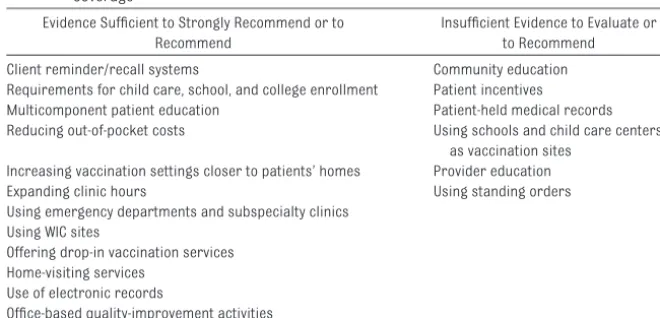
As reported in the previous version of this policy statement,6the Task Force on Community Preventive Services, convened by the US Department of Health and Human Services with sup-port from the CDC, reviewed evidence from published reports of interven-tions designed to improve the timely immunization of children and adults.23 On the basis of the strength of this ev-idence as applied to the pediatric age group, the task force recommended a number of strategies for increasing immunization coverage for children.24 They grouped these recommendations into 3 overall strategies: increase in community demand for vaccinations; enhancement of access to vaccination services; and provider-based interven-tions (see Table 1). The task force did not evaluate the extent to which finan-cial constraints on those that provide immunizations (clinics, private offices) also affect the availability of immuniza-tions to their clients.
community-based approaches. This extensive list of recommended immunization prac-tices overlaps with those recom-mended by the CDC task force, as de-scribed previously, but does not specifically include the task force’s recommended strategies involving Special Supplemental Nutrition Pro-gram for Women, Infants, and Children (WIC) offices, home-visitation pro-grams, or requirements for entry into child care, school, and college.
In September 2008, the NVAC endorsed a set of principles and recommenda-tions for increasing provider and pa-tient participation in immunization in-formation systems (IISs), formerly known as immunization registries, as another strategy for increasing immu-nization coverage. The AAP, in its own policy statement in 2006, also en-dorsed the continued development and implementation of IISs.25 To be most effective, IISs must provide bidirectional flow of vaccination infor-mation, allowing providers to enter vaccination data and retrieve patient-specific vaccination histories. It is un-fortunate that many current IISs are incompatible with existing electronic medical records and, thus, present an added cost to those practices that are required or wish to participate in these systems. The time and cost of en-tering vaccination information into an
IIS can be considerable; therefore, pay-ments by government and private in-surers to support the entry of patient immunization data into IISs will be nec-essary for clinical practices that cur-rently use paper-based records to participate in these new systems. Al-though the deployment of IISs will make it easier to identify patients who are behind on their immunizations, the provision of vaccinations during sick visits or emergency department visits may not be desirable in all situations because of the possible impact on pa-tient compliance with recommenda-tions for well-child care.26
RECOMMENDATIONS
Recommendations below are based on evidence reviewed by the CDC Task Force on Community Preventive Servic-es24 and in the NVAC “Standards for Child and Adolescent Immunization Practices” report5and are updated to include newer recommendations for the use of IISs and to emphasize the importance of the pediatric medical home as the optimal location for the delivery of pediatric immunization ser-vices. Additional recommendations be-yond those addressed directly in ei-ther of these previous publications acknowledge the extensive financial and administrative barriers that pri-vate pediatricians and pediatric clinics
face in purchasing and delivering an adequate supply of vaccines to their patients and the current use of various media to influence parental decision-making by those who oppose a policy of universal childhood immunizations. In its most recent report, the NVAC in-cluded a set of 24 recommendations that address financial barriers that continue to undermine efforts to reach the goal of universal immunization cov-erage for children in whom vaccina-tions are not contraindicated.18Where appropriate, those recommendations have been incorporated into this policy statement.
1. Collectively, pediatricians and child health care professionals should join with the AAP and its chapters in the following activities.
● Advocate for all children to re-ceive comprehensive health care, including childhood immuniza-tions, in a medical home27and im-prove access for children who are most likely to experience bar-riers to comprehensive care in a medical home, including mem-bers of racial and ethnic minori-ties, poor or uninsured children, children who live in inner-city or rural areas, and children with chronic medical conditions. Pedi-atricians can further assist by collaborating with local public and private child health services to identify children without ac-cess to a medical home and pro-viding assistance in referring them to an appropriate medical home. The medical home should maintain the children’s health records, including immunization records; furthermore, the pediat-ric medical home requires a level of payment at least as great as that for the adult medical home.
● Assist in the identification of other venues in which
vaccina-TABLE 1 Quality of Evidence Available to Support Potential Strategies for Increasing Immunization Coverage24
Evidence Sufficient to Strongly Recommend or to Recommend
Insufficient Evidence to Evaluate or to Recommend Client reminder/recall systems Community education Requirements for child care, school, and college enrollment Patient incentives
Multicomponent patient education Patient-held medical records Reducing out-of-pocket costs Using schools and child care centers
as vaccination sites Increasing vaccination settings closer to patients’ homes Provider education Expanding clinic hours Using standing orders Using emergency departments and subspecialty clinics
Using WIC sites
Offering drop-in vaccination services Home-visiting services
Use of electronic records
tions can be delivered if a signifi-cant number of children in a com-munity do not have convenient access to a medical home or if existing medical homes are not able to meet the demand. If suffi-cient pediatric medical homes are not available, additional ven-ues could include public health department clinics, WIC program offices, child care centers, school-based health clinics, and, in those states that allow it, phar-macies. Elimination of the finan-cial barriers to immunization delivery, as described in this statement, would reduce the need to consider such alternative venues.
● Advocate for reform in the distri-bution and payment systems that apply to the procurement, stor-age, and administration of immu-nizations and that often act as a barrier to physicians who wish to provide immunizations in their private offices and in their clinics. It is important that private- and public-sector payers provide pay-ments to practitioners and clin-ics for immunization services suf-ficient not only to cover the direct and indirect costs of these ser-vices but also to provide a finan-cial incentive for ongoing partici-pation in this vital service to the community. Using “The Business Case for Vaccine Pricing” (avail-able from Practice Management Online [PMO] at http://practice. aap.org/content.aspx?aid⫽1808), physicians and other child health providers can better understand and advocate for adequate pay-ment for immunization services, including the direct costs of vac-cine procurement, storage, and administration as well as the cost of related materials and the pro-fessional time involved in
provid-ing counselprovid-ing to concerned par-ents. These payments must also be sufficient to cover the added indirect opportunity costs of stocking and purchasing expen-sive vaccines, as well as the predictable costs of wastage, re-frigeration, and space. A vaccine-cost calculator is now available on the PMO Web site (http:// practice.aap.org/vaccinecalculator. aspx). Private physicians should also be encouraged to partici-pate in vaccine-purchasing pools.
● Advocate for a public-private partnership in the manufacture and distribution of vaccines so that purchasers of vaccines (eg, physicians, the VFC program) know what their acquisition costs will be and what to expect in payment for these services be-fore exposing themselves to po-tential financial losses because of changes in pricing and third-party payment. These efforts would also include advocating for immediate recognition of and payment for newly recommended vaccines, adjustments in pay-ments when prices increase on existing vaccines, and payment of administrative fees per compo-nent, not per injection, so as not to discourage the use of combi-nation vaccines. When new vac-cines are introduced or when price increases are announced, manufacturers should offer rea-sonable terms for payment to facilitate their introduction, thereby allowing physicians to purchase and receive payment for vaccines without experienc-ing excessive financial burden.
● Advocate for the removal of eco-nomic and administrative barri-ers for physicians who wish to participate in the VFC program and other state vaccination
pro-grams. Public health department clinics and private physician of-fices should be included as ven-ues for underinsured VFC-eligible children to receive immuniza-tions, rather than limiting access for these children to federally qualified health centers and ru-ral health clinics.
● Advocate for the removal of eco-nomic barriers to immunizations for parents by minimizing their out-of-pocket expenses for immu-nizations. Public and private pay-ers should provide first-dollar coverage for all recommended vaccines (ie, without copays or deductibles). Use of a uniform acquisition-price standard as the basis for acquisition cost for all vaccine products should be advo-cated. Such a basis could be the CDC Private Sector Price List, as posted on its Web site (www.cdc.gov/ vaccines/programs/vfc/cdc-vac-price-list.htm). Funding is also encouraged to support studies that periodically estimate the ac-tual financial burdens, both di-rect and indidi-rect, of administer-ing vaccines, and that third-party payers should be expected to honor and pay for these costs.
● Advocate with vaccine manufac-turers and state and federal gov-ernments to maintain an ade-quate supply of all childhood vaccines at all times and to pro-vide adequate notice, quick plan-ning, and equitable distribution to all entities that administer im-munizations to deal with short-ages as they arise.
● Advocate for studies that en-sure that the safest and most effective vaccines and combina-tion products are available to children.
representa-tives to advocate with state and federal governments, private payers, and employers who pur-chase health care to ensure that timely access to all immuniza-tions recommended by the CDC, the AAP, and the American Acad-emy of Family Physicians for all children remains a high public policy priority.
● Advocate for interoperability of IISs and electronic health records that accommodate bidi-rectional flow of information to facilitate pediatrician participa-tion in these systems. IISs should also provide support for auto-mated identification of vaccine products (eg, bar codes or radio-frequency tags) and include inte-grated, up-to-date VISs.
● Advocate for payment by com-mercial and government payers for the entry of patient immuniza-tion informaimmuniza-tion into county and state IISs or for the interfaces necessary to allow transfer of these data from electronic health records to these IISs to support pediatric care provider participa-tion in these systems. Likewise, schools must have adequate funding to cover the costs that arise from their mandate to ver-ify immunization coverage for their students.
● Support ongoing education and quality-improvement programs for pediatricians and other child health care professionals about important vaccine-related is-sues, including the dissemination of peer-reviewed evidence for more effective immunization delivery. Educational programs should be offered to help physi-cians incorporate optimal busi-ness practices in their office or clinic setting to maximize their opportunities to offer
immunizations to all children for whom vaccines are not contraindicated.
● Vigorously mount a public rela-tions campaign to better inform the public and counter the influ-ence of misinformation spread by celebrities and others who participate in the antivaccination movement to minimize the negative impact of this false information on the health of children. The public must be educated with regard to the risks associated with vaccine-preventable diseases and the im-pact of immunizations on their prevalence by using culturally ef-fective materials in English and other languages.
2. Individually, pediatricians and other child health professionals are encouraged to do the following to increase the immunization cover-age of those under their care.
● Expand opportunities to immu-nize in the setting of a medical home by extending office hours when possible, making vaccina-tions available during visits for minor illnesses (if appropriate), and maintaining accurate and up-to-date records of immuniza-tions received by each patient. Participation in IISs, including those that cross political bound-aries, is also recommended.
● Implement reminder/recall sys-tems based on office charts or electronic information sys-tems and minimize out-of-pocket costs to patients being immunized.
● Undertake office- and clinic-based assessment and improve-ment activities necessary to maximize their practices’ effec-tiveness in immunizing children. Offices and clinics should
main-tain up-to-date protocols that are accessible wherever immuniza-tions are delivered and ensure that medically accepted contrain-dications to immunizations are accurately identified. This goal can be supported by using an IIS that is easily updated with new vaccine information and changes in protocols for existing vaccines.
● Ensure that all those who admin-ister immunizations are fully immunized (unless contraindi-cated), are knowledgeable about immunizations, and participate in continuing education activities regarding immunizations, includ-ing their proper administration, storage, and handling.
● Always provide and document the most current VIS to educate par-ents about vaccine risks and ben-efits of immunizations, in accor-dance with the Vaccine Injury Compensation Program and CDC recommendations (available on the AAP Web site at www.aap. org). Physicians are encouraged to discuss the benefits and risks of immunizations with parents who refuse or delay age-appropriate vaccinations and to document ongoing discussion and refusal by using a form such as the AAP “Refusal to Vaccinate” template (http://practice.aap.org/ popup.aspx?aID⫽2685&language). Although the AAP strongly courages pediatricians from dis-charging patients from their practices solely as a result of vac-cine refusal, pediatricians may encourage a family to find an-other physician or practice if there is a substantial level of dis-trust, differences in philosophy of care, or persistent poor quality of communication.28
accurate immunization and vaccine-information Web sites that discuss immunization issues (eg, www.aap.org/healthtopics/ immunizations.cfm, www.immunize. org, www.cdc.gov/vaccines, www. vaccinateyourbaby.org).
● Report all adverse events related to vaccines by using the Vaccine Adverse Event Reporting System (see http://vaers.hhs.gov/index for forms and instructions), as di-rected by the National Childhood Vaccine Injury Act.29
● Support and implement the standards for child and adoles-cent immunization practices as
endorsed by the AAP and the NVAC.5
COMMITTEE ON PRACTICE AND AMBULATORY MEDICINE, 2008 –2009
Lawrence D. Hammer, MD, Chairperson Edward S. Curry, MD
Allen D. Harlor, MD James J. Laughlin, MD Andrea J. Leeds, MD Herschel R. Lessin, MD Chadwick T. Rodgers, MD
LEAD AUTHORS
Lawrence D. Hammer, MD Herschel R. Lessin, MD
STAFF
Elizabeth Sobczyk, MPH, MSW
COUNCIL ON COMMUNITY PEDIATRICS, 2008 –2009
Deise C. Granado-Villar, MD, Chairperson
Jeffrey M. Brown, MD, MPH William H. Cotton, MD
Beverly Marie Madry Gaines, MD Thresia B. Gambon, MD Benjamin A. Gitterman, MD Peter A. Gorski, MD, MPA Colleen A. Kraft, MD
Ronald Vincent Marino, DO, MPH Gonzalo J. Paz-Soldan, MD Barbara Zind, MD
LIAISONS
Melissa Antoinette Briggs, MD Frances J. Dunston, MD, MPH Emanuel O. Doyne, MD Charles Robert Feild, MD, MPH Robert E. Holmberg Jr, MD, MPH Stephen A. Holve, MD
STAFF
Regina Shaefer, MPH
REFERENCES
1. American Academy of Pediatrics, Commit-tee on Standards of Child Health Care. AAP national immunization policy.AAP News.
1977;28(Oct):7– 8
2. Lindley MC, Shen AK, Orenstein WA, Rode-wald LE, Birkhead GS. Financing the delivery of vaccines to children and adolescents: challenges to the current system. Pediat-rics.2009;124(suppl 5):S548 –S557 3. American Academy of Pediatrics,
Commit-tee on Practice and Ambulatory Medicine. Implementation of the immunization policy.
Pediatrics.1995;96(2 pt 1):360 –361 4. Wood DL, Halfon N. The impact of the
Vac-cine for Children’s program on child im-munization delivery: a policy analysis.
Arch Pediatr Adolesc Med. 1996;150(6): 577–581
5. National Vaccine Advisory Committee. Stan-dards for child and adolescent immuniza-tion practices [published correcimmuniza-tion ap-pears in Pediatrics. 2004;113(1):184].
Pediatrics.2003;112(4):958 –963
6. American Academy of Pediatrics, Commit-tee on Community Health Services and Com-mittee on Practice and Ambulatory Medi-cine. Increasing immunization coverage.
Pediatrics.2003;112(4):993–996
7. US Department of Health and Human Ser-vices.Healthy People 2010: Understand-ing and ImprovUnderstand-ing Health. 2nd ed. Wash-ington, DC: US Government Printing Office; 2000
8. US Department of Health and Human Ser-vices.Healthy People 2010objective 14-22: achieve and maintain effective vaccination coverage levels for universally
recom-mended vaccines among young children. Available at: www.healthypeople.gov/ document/html/objectives/14-22.htm. Ac-cessed September 8, 2009
9. US Department of Health and Human Ser-vices.Healthy People 2010objective 14-23: maintain vaccination coverage levels for children in licensed day care facilities and children in kindergarten through the first grade. Available at: www.healthypeople.gov/ document/html/objectives/14-23.htm. Ac-cessed September 8, 2009
10. US Department of Health and Human Ser-vices.Healthy People 2010objective 14-24: increase the proportion of young children and adolescents who receive all vaccines that have been recommended for universal administration for at least 5 years. Avail-able at: www.healthypeople.gov/document/ html/objectives/14-24.htm. Accessed Sep-tember 8, 2009
11. US Department of Health and Human Ser-vices.Healthy People 2010objective 14-27: increase routine vaccination coverage levels for adolescents. Available at: www.healthypeople.gov/document/html/ objectives/14-27.htm. Accessed September 8, 2009
12. Centers for Disease Control and Preven-tion. National, state, and local area vacci-nation coverage levels among children aged 19 –35 months: United States, 2007.
MMWR Morb Mortal Wkly Rep. 2008; 57(35):961–996
13. Institute of Medicine.Calling the Shots: Im-munization Finance Policies and Practices.
Washington, DC: National Academies Press; 2000
14. National Institutes of Health.The Jordan Report: Accelerated Development of Vac-cines 2007. Washington, DC: National Insti-tutes of Health, National Institute of Allergy and Infectious Disease; 2007. Available at: www3.niaid.nih.gov/about/organization/ dmid/PDF/Jordan2007.htm. Accessed on September 8, 2009
15. Centers for Disease Control and Preven-tion. National, state, and local area vacci-nation coverage among adolescents aged 13–17 years: United States, 2007 [pub-lished correction appears inMMWR Morb Mortal Wkly Rep. 2009;58(1):10].MMWR Morb Mortal Wkly Rep. 2008;57(40): 1100 –1103
16. Centers for Disease Control and Prevention. CDC vaccine price list. Available at: www.cdc.gov/vaccines/programs/vfc/cdc-vac-price-list.htm. Accessed September 8, 2009
17. Freed GL, Cowan AE, Clark SJ. Primary care physician perspectives on payment for childhood immunizations.Pediatrics.2008; 122(6):1319 –1324
18. National Vaccine Advisory Committee. Fi-nancing vaccination of children and adolescents: National Vaccine Advisory Committee recommendations. Pediatrics.
2009;124(suppl 5):S558 –S562
immunization, and the risks of vaccine-preventable diseases.N Engl J Med.2009; 360(19):1981–1988
21. Opel DJ, Diekema DS, Lee NR, Marcuse EK. Social marketing as a strategy to increase immunization rates.Arch Pediatr Adolesc Med.2009;163(5):432– 437
22. Centers for Disease Control. Statement from the Department of Health and Human Services regarding decisions of the U.S. Court of Federal Claims in the Omnibus Au-tism Proceeding. Available at: www.cdc. gov/Features/AutismDecision. Accessed September 8, 2009
23. Briss PA, Rodewald LE, Hinman AR, et al.
Re-views of the evidence regarding interven-tions to improve vaccination coverage in children, adolescents, and adults.Am J Prev Med.2000;18(1 suppl):97–140
24. Centers for Disease Control, Task Force on Community Preventive Services. Recom-mendations regarding interventions to im-prove vaccination coverage in children, ad-olescents, and adults.Am J Prev Med.2000; 18(1 suppl):92–96
25. American Academy of Pediatrics, Commit-tee on Practice and Ambulatory Medicine. Immunization information systems. Pediat-rics.2006;118(3):1293–1295
26. Fiks AG, Hunter KF, Localio AR, Grundmeier
RW, Alessandrini EA. Impact of immuniza-tion at sick visits on well-child care. Pediat-rics.2008;121(5):898 –905
27. American Academy of Pediatrics, Medical Home Initiatives for Children With Special Needs Project Advisory Committee. The medi-cal home.Pediatrics. 2002;110(1 pt 1): 184 –186
28. Diekema DS; American Academy of Pediat-rics, Committee on Bioethics. Responding to parental refusals of immunization of children. Pediatrics. 2005;115(5): 1428 –1431
DOI: 10.1542/peds.2010-0743 originally published online May 31, 2010;
2010;125;1295
Pediatrics
Services
Updated Information &
http://pediatrics.aappublications.org/content/125/6/1295 including high resolution figures, can be found at:
References
http://pediatrics.aappublications.org/content/125/6/1295#BIBL This article cites 19 articles, 10 of which you can access for free at:
Subspecialty Collections
y_pediatrics
http://www.aappublications.org/cgi/collection/council_on_communit
Council on Community Pediatrics
e_-_ambulatory_medicine
http://www.aappublications.org/cgi/collection/committee_on_practic
Committee on Practice & Ambulatory Medicine
http://www.aappublications.org/cgi/collection/current_policy
Current Policy
following collection(s):
This article, along with others on similar topics, appears in the
Permissions & Licensing
http://www.aappublications.org/site/misc/Permissions.xhtml in its entirety can be found online at:
Information about reproducing this article in parts (figures, tables) or
Reprints
DOI: 10.1542/peds.2010-0743 originally published online May 31, 2010;
2010;125;1295
Pediatrics
Pediatrics
Committee on Practice and Ambulatory Medicine and Council on Community
Increasing Immunization Coverage
http://pediatrics.aappublications.org/content/125/6/1295
located on the World Wide Web at:
The online version of this article, along with updated information and services, is
by the American Academy of Pediatrics. All rights reserved. Print ISSN: 1073-0397.