Evaluation of the Community Access to Child Health Program
Cynthia Minkovitz, MD, MPP*; Holly Grason, MA*; Barbara Aliza, MPH*; Vince Hutchins, MD, MPH‡; Lucia Rojas-Smith, MPH*; and Bernard Guyer MD, MPH*
ABSTRACT. Objective. Increasing attention is being focused on the need for pediatricians to promote child health in their respective communities. The objective of this study was to evaluate, retrospectively, the American Academy of Pediatrics’ Community Access to Child Health (CATCH) Program.
Study Design. Case studies of 12 Community Pediat-ric projects in existence from 1989 to 1995 with varying degrees of involvement in the CATCH Program. In-per-son interviews were conducted with 17 pediatricians, 3 CATCH leaders who were not pediatricians, 27 project advisory committee members, 42 project staff, 47 commu-nity partners, 22 public health representatives, and per-sonnel in 13 affiliated institutions.
Results. These projects established or enhanced child health services. Although most pediatricians’ interest in community child health preceded CATCH, mentoring, training, and peer support contributed to ongoing involve-ment. Community factors that facilitated project develop-ment included historical collaborative efforts and active public health agencies. However, across sites, significant barriers related to attitude and resource limitations were noted. Attitudinal barriers included both institutional con-cerns (eg, competition among providers or distrust among community agencies and organizations) and cultural con-cerns (eg, general negative perceptions of providers about Medicaid beneficiaries or of members of minority popula-tion toward medical or government establishments).
Conclusions. In an era of devolution of responsibility to local communities, there are likely to be more oppor-tunities for pediatricians to work with community mem-bers to promote child health. Specific strategies should be refined and expanded to support pediatricians’ in-volvement in community-based activities, particularly because it is recognized that insurance alone will not guarantee children’s health.Pediatrics1999;103:1384 –1393;
Community Pediatrics, CATCH.
ABBREVIATIONS. AAP, American Academy of Pediatrics; RWJF, Robert Wood Johnson Foundation; MCH, Maternal and Child Health; CATCH, Community Access to Child Health; COAT, Community-Oriented Advocacy Training Program; DC, District of Columbia; EPIC, Educating Physicians in their Communities.
I
ncreasing attention is being focused on the need for pediatricians to promote child health in their respective communities. An orientation towardcoordinating individual clinical care with commu-nity health recognizes the complementary nature of population based epidemiology and individually ap-plied clinical skills in caring for children.1In an era of rapid social change, children’s health increasingly needs to be considered in the context of families, schools, and communities.2 As such, definitions of at-risk children encompass not only children with particular medical conditions, but also children af-fected by a host of economic and social conditions including poverty, belonging to minority groups, and lacking health insurance or a usual source of care.3
Expanded roles promoted for pediatricians in-clude advocating child health legislation,4,5 sup-porting health promotion activities,5 initiating community-based projects,5,6 and educating peers and the general public regarding important child health issues.6These new roles recognize the need for pediatricians to concern themselves with the care of individuals as well as with the health of “all children in the community” whether or not they appear for medical care.7 As such, the field of Community Pediatrics recognizes the “new mor-bidities” in pediatrics and concerns itself with the social and political determinants of health. In so doing, Community Pediatrics espouses a broader social role for pediatricians who must address a range of issues affecting children, including behav-ioral and mental health, chronic conditions, and social health problems.8 –10
Although the American Academy of Pediatrics (AAP) supported the involvement of pediatricians in the health of the children in their communities even from the time of its first meeting in 1930, the past 30 years have witnessed an increased organizational focus on the health of children in underserved com-munities. This increased commitment to a larger so-cial role for pediatricians is evidenced by changes in administrative structures and initiatives within AAP. The Healthy Tomorrows program was launched in 1988, and the Office of Community Pediatrics was elevated to a Department in 1994. These changes reflect the growing recognition of the need for phy-sicians to care for individual patients while recogniz-ing community health needs and environmental and social influences on children’s health.
OVERVIEW OF CATCH AND ITS EVALUATION The Robert Wood Johnson Foundation (RWJF) supported the AAP’s investment in community-based programs, in part, by funding the Community From the *Women’s and Children’s Health Policy Center, Johns Hopkins
University, Baltimore, Maryland; and the ‡National Center for Education in Maternal and Child Health, Public Policy Institute, Georgetown University, Arlington, Virginia.
Received for publication Feb 9, 1999; accepted Mar 3, 1999.
Address correspondence to Vince L. Hutchins, MD, MPH, National Center for Education in Maternal and Child Health, 2000 15th St N, Suite 701, Arlington, VA 22201.
Access to Child Health (CATCH) from 1989 through 1995, its initial 7 years. Located in the AAP Depart-ment of Community Pediatrics, CATCH identifies the pediatrician as a “major force” in improving child health at the community level and “operates on the theory that local people can solve local problems when given the right mix of training, technical assis-tance, and community involvement” (Sherry Zacha-riah Lyons and Charlotte Opila Zia, Dec 22 1996). Edward Rushton, MD, an early director of the pro-gram, described the essence of CATCH as “pediatri-cians working with others (to) see that all children have access to care” (Edward Rushton, Dec 12, 1996). Specific components of the CATCH Program include promotion of community involvement through the identification of pediatrician-led models and dissem-ination of information on these models; training at national and regional meetings; and the provision of planning grant funds to pediatricians interested in working in their communities. In addition, the na-tional program office works with the district and chapter CATCH facilitators to provide support, en-couragement, and technical assistance to practicing pediatricians. Finally, CATCH visiting professors provide leadership experience and promote Com-munity Pediatrics. The CATCH Program is now sup-ported entirely with AAP funds, private resources, and individual contributions from AAP members.
In 1996, the RWJF contracted with the Women’s and Children’s Health Policy Center at Johns Hop-kins School of Public Health to conduct an tion of CATCH. The purpose of the overall evalua-tion was twofold. First, it was to inform both the field of pediatrics and the RWJF about the effectiveness of selected aspects of community-based solutions to child health issues and their replication and to pro-vide recommendations to strengthen the effective-ness of pediatricians working in their communities. Second, the evaluation sought to identify the success-ful elements of the national program to guide future AAP efforts.
The CATCH Program originally was not designed with an evaluation component, and the Program it-self has evolved over the last 9 years, with specific goals and objectives changing substantively over time. To address the many challenges to this retro-spective evaluation of CATCH, we used multiple strategies to collect information. Components of the evaluation included case studies, a compilation of the history of CATCH,11a survey to assess the impact of specific CATCH programmatic activities, and group interviews with CATCH facilitators to further identify mechanisms and processes used to make community pediatricians more effective agents of change at the local level.12 This article presents the findings of the case study component of the evalua-tion. The case study component of the evaluation tests the hypotheses that 1) provider characteristics influence the effectiveness of local CATCH projects, and 2) certain aspects of the environment, including key people, influence the success of local CATCH projects.
CONCEPTUAL FRAMEWORK
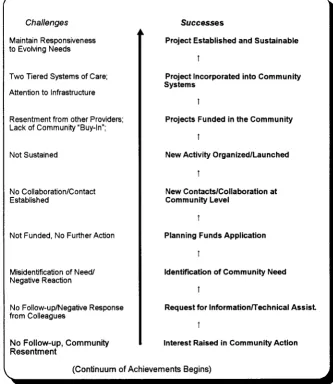
We constructed a framework for defining suc-cesses in CATCH projects. We identified a “contin-uum of success” against which the achievements of specific community-based CATCH projects could be examined. This framework depicts the various levels of successes and challenges experienced at the com-munity level (Fig 1). CATCH projects are considered to have achieved an initial level of success at the community level if they facilitate a pediatrician’s interest in solving local child health problems. Inter-est in community action Inter-establishes the potential for action when the appropriate opportunity arises. Sub-sequent stages of success include identification of local child health needs, pediatricians’ requests for additional information, technical assistance, plan-ning fund support from the CATCH Program, and the establishment or strengthening of collaborative relationships within the community. The highest level of success is that which results in new activities that generate funding and ultimately become self-sustaining.
Along with these levels of success come many challenges. Beginning with a lack of support from physicians and other community providers, barriers to effective CATCH projects may include incorrect identification of community needs, lack of collabora-tion with community providers and leaders, and inability to secure funding. The community may choose not to support the CATCH project; providers may resent the launching of new activities. Once activities have begun, ongoing challenges include maintaining a long-term vision to correct the under-lying problem rather than reunder-lying on a short-term fix, attending to the project’s infrastructure, and ensur-ing that the project remains responsive to the needs of the community.
METHODS Advisory Committee
The evaluation was conducted between September 1996 and April 1998. We worked with a CATCH Evaluation Advisory Com-mittee to develop a set of hypotheses a priori based on information gathered from the group interviews, review of AAP administra-tive files, the CATCH history, and from the research memo related to the definition of “success.” Selected in consultation with the RWJF and the AAP, the Advisory Committee members were pediatricians involved with CATCH at all levels within the AAP. Site Selection
We selected 12 sites from a list of eligible sites operating be-tween January 1989 and September 1995. Projects that began after September 1995 were considered to be too recent to provide useful information for a site visit. We constructed a sampling frame using the 1995 AAP Registry Questionnaire and listing of recipients of CATCH Planning Fund grants from January 1993 to September 1995. The intent of the sampling frame was to identify the rela-tionship of individual projects to the CATCH Program. Respon-dents to the Registry Questionnaire were included if they identi-fied that their community activity was a CATCH project (546 of 2896 respondents). Respondents were ineligible for additional
screening if name and address were incomplete (n5105);
com-munity activities were initiated before 1970 or after 1995 (n581);
there were no responses to Registry questions describing their
level of involvement in CATCH (n524); or there were duplicate
responses (n511). Questions identified whether respondents had
strategies helped “develop or enhance program activities for chil-dren in their community.” From these answers, we categorized
respondents as having high (n575), moderate (n583), or low
levels (n5167) of CATCH involvement. The listing of Planning
Fund grant recipients contributed an additional 25 projects not otherwise represented in the Registry pool and identified projects with high levels of CATCH involvement.
We sorted the 350 projects included in the sampling frame by the year documented planning began and within groupings de-scribing their level of CATCH involvement. Then we identified potential sites for the case studies using the following broad-based criteria: time period of project; project setting (urban, rural, sub-urban); statewide or local focus; target population; services pro-vided; public health linkages; level of community involvement; and locus of leadership. We selected sites so as to represent this diverse set of CATCH projects.
Members of the Evaluation Team contacted leaders from 96 projects to invite their participation in the case study. From the 20 sites willing to participate, 12 sites were selected that best fit the study framework (Table 1).
Data Collection
Two members from the CATCH Evaluation Team spent an
average of 11⁄2days at each site using a preestablished case study
guide that included document review and multiple interviews with project leadership and staff, community and institutional partners, public health and, in many cases, consumers of project services. The Evaluation Team developed interview protocols based on the hypotheses noted previously and in consultation with the Advisory Committee. We pilot-tested a set of questions at
the first site visit in Washington DC, and subsequently revised the material.
We prepared seven interview protocols, each tailored for the type of individual interviewed (pediatrician project leader, non-pediatrician project leader, project staff, project advisory commit-tee member, community agency partner, public health agency representative, and hospital administrator). Discussions with con-sumers were conducted more informally without adherence to specific protocols.
Variables
Factors examined in describing the characteristics of the pedi-atrician/leader included prior community involvement and/or experience interacting with community leaders; mentoring; formal
Fig 1. Continuum of success and challenges in CATCH project.
TABLE 1. Classification of CATCH Case Study Sites, Identi-fied by State
Level of CATCH Involvement
Year Community Involvement Began
1970–1990 1991–1992 1993–1995
High Mississippi California New Mexico New York Pennsylvania Moderate Pittsburgh North Carolina
or informal training experience related to advocacy, population health, public health methods; affiliation/relationships with pub-lic health, specifically Title V Maternal and Child Health Bureau (MCHB) programs; peer support through involvement with AAP and/or other professional organizations/activities; and career sat-isfaction.
We developed a series of interview questions related to the culture/tradition of activism in community affairs, including awareness of child health concerns in particular, and to the history of collaboration, evidenced by coalition activity and the nature of local leadership. We were interested specifically in the role of public health in such activism, collaboration, and leadership. We examined structural issues, such as pathways for policy develop-ment within governdevelop-ment and/or across the public–private sectors. Finally, we queried both project leaders and community partners on their perspectives regarding specific challenges to child health activism generally, and to CATCH project development specifi-cally.
Analyses
Manually recorded responses were transcribed into a word processed document that organized data in a matrix format. Data from the project leader interviews were transferred into
NUD-IST,13 a software package for analyzing qualitative text data, to
compare the responses of each item across all sites. Information from the additional site interviews was sorted using a standard word processing program.
We coded responses for their relationship to specific hypothe-ses. In cases where responses were primarily categorical frequen-cies, they were tabulated. Noncategorical responses were ana-lyzed to identify common themes or concepts. The Evaluation Team selected only those key items that were most relevant to the hypotheses for cross-site analysis. We prepared a project narrative for each site that summarized how the project was initiated, key events, people, dates, and achievements. The project leader at each site reviewed the draft narrative specific to their project and
corrected any errors or omissions.14
Institutional Review Board Approval
The project was approved by the Human Subjects Committee at Johns Hopkins University and approved. We obtained informed consent for each participant. Where we use case material, subjects were informed and permission granted.
RESULTS Site Overview
The 12 CATCH projects focused on an array of services (Table 2). At the 12 case study sites, we conducted interviews with 17 pediatricians, 3 CATCH leaders who were not pediatricians, 27 project advisory committee members, 42 project staff, 47 community partners, 22 public health repre-sentatives, and personnel at 13 affiliated institutions. Informal discussions with consumers were arranged at 7 sites.
Characteristics of CATCH Pediatricians and Project Leaders
Prior Interest and Experience in Community Child Health Activity
Not surprisingly, we found that the pediatrician’s initial interest in community child health activity preceded CATCH in almost all instances, although for one pediatrician, CATCH played a key role in sparking his interest. In fact, most reported extensive experience working with leaders in the community, although not necessarily the same community in which the project was initiated, before taking on a leadership role in a CATCH activity. The nature and scope of such experiences reported reflect diverse
influences: academic pursuits; community volunteer programs; public health; working with underserved populations (eg, Navajo reservation, National Health Service Corps); careers before medical school (eg, teaching, social work); church-related activities; un-dergraduate and residency activities; and family tra-ditions.
Story 1—The Wayne County First Steps Program evolved from Dr Tayloe’s concern about the stresses families face in the contemporary culture, and the resultant need to ensure stable family life in the community. Dr Tayloe himself has been practicing pediatrics in the community for more than 20 years. He is deeply rooted in family activities and advocacy in this community. He has been on the school board and has developed other child advocacy activities with a broad array of collaborators from the community agencies. Tayloe has served as the North Carolina AAP Chapter Chair. He is very knowledgeable about the public sector and public agencies and has been active in lobbying the legislature in Raleigh. Story 2—Mary M. Carrasco, MD, a pediatrician who com-pleted an Ambulatory and Community Pediatrics Fellowship in the Department of Pediatrics at the University of Pitts-burgh in 1977, came from a family in India that spent their weekends working to help the poor in Bombay. She always envisioned herself working with poor populations with little access to needed services. As medical director of the Sto-Rox Health Center in 1983, she focused on the problems of do-mestic abuse and initiated a series of Parents Anonymous meetings at the Community Health Center. She then secured a grant to begin the county’s first “Drop-In Center”—the beginning of the Positive Parenting Program, a child abuse prevention program. This program ultimately became the seed to attract other funding to expand the program to four new centers.
Mentoring
Our interviews reveal that mentoring plays an im-portant role in stimulating pediatrician involvement in community child health activities. Most project leaders identified a mentor who stimulated and guided their work in the community. In the majority of these instances, the mentors were also physicians; some were involved in community work. Other men-tors identified included a college advisor in one in-stance and a family member (also a physician) in another. Of note, most of these mentoring relation-ships developed during training (college, medical school, or residency). We found, however, that the mentoring reported by those we interviewed for the most part was not affiliated with the CATCH Pro-gram. CATCH did not facilitate links with mentors (except tangentially in two instances), nor were iden-tified mentors involved in CATCH.
Story 3—Dr Peter Boelens founded The Cary Christian Center in 1971 as part of his personal goal to provide missionary health services, an area of need in the United States. Dr Boelens brought several health professionals into the service of the Cary community by recruiting staff and volunteers from the upper Midwest states and schools where he had previously worked and trained. Over the years, college stu-dents, medical stustu-dents, and residents were drawn to the area during and after their education to gain experience in the field. Peter Boelens served as formal and informal mentor to most of these individuals. Such was the process by which Kurt Kooyer came to be associated with the Cary Christian Center, and ultimately establish a rural health center (Delta-Care) in nearby Rolling Fork.
Training Experiences
increasing the project leaders’ involvement in com-munity child health. Training experiences among the project leaders varied significantly. Although slightly more than half reported attending regional and/or national AAP meetings, sessions attended were not specified as having a major focus on com-munity action. A few of the project leaders received training outside of the AAP structure through church-related activities or involvement with public health agencies. Noteworthy perhaps is that two of the sites reported interactions with AAP–CATCH visiting professors (New York, District of Columbia) and, in Florida, one of the leaders was a visiting professor.
Story 4 —The Community-Oriented Advocacy Training (COAT) Program, designed and administered in the Depart-ment of Pediatrics of the State University of New York Health Sciences Center in Syracuse, represents a CATCH initiative aimed at preparing future pediatricians for their roles as child health leaders in their communities. COAT is based in an academic setting but reaches beyond the graduate medical training institution to community organizations to provide practical experiences in population health problem-solving and community action for physicians in the Pediatric Resi-dency Program. The Program seeks to instill values and build skills early in the careers of pediatricians toward the ultimate goal of promoting lifelong community commitment and in-volvement.
Story 5—A second-year pediatric resident, Ann Schaefer is spending her entire continuity rotation with Karen Toker, director of the Center for Women and Children at Duval County Health Department. Dr Schaefer describes the train-ing as an “incredible experience with its emphasis on conti-nuity and focus on child development.” She has learned about billing and business practices, in addition to patient care. Because of this experience, her career goal has shifted toward general pediatrics.
Peer Support
We discussed with the project leaders the nature and extent of their routine interactions with others sharing interest in community child health. Most project leaders reported extensive relationships with “other providers”; primarily, but not exclusively, medical colleagues. Only one project leader reported no such relationships. These relationships were re-ported to have developed through professional or-ganizations, through living in the community, and through continued contact with former classmates. It is important to note that community-level relation-ships with other providers were not always the ma-jor source of support or affirmation for community level involvement. The national AAP organization was a common contributor to relationships for al-most all sites. Four leaders reported their affiliation as members at large, one a visiting professor. Four served on national AAP committees, two served as state chapter chairs, and one served as a leader in the local chapter. The great majority of project leaders were connected to public health and/or Title V MCHB, although the strength of the relationship var-ied. Six project leaders worked in public health at the time of the interview, four participated on task forc-es/committees, and several others described interac-tion related to their clinical work (eg, patient refer-rals to local health department programs). Other sources of peer support included the Ambulatory
Pediatric Association, the local medical society, schools, religious institutions, and academic institu-tions.
Career Satisfaction
We anticipated that pediatricians’ satisfaction with their clinical work might play a role in stimulating interest in community activities. We found, however, that these project leaders generally were satisfied with their career before CATCH, although the degree of satisfaction was a motivating force for becoming involved in the project for more than half. Several pediatricians identified varying levels of frustration with child health issues in their practice or commu-nity.
Community Context for Germination and Growth of CATCH Project
Community Culture Related to Activism
We found that the “culture” for community activ-ism varied substantially across the sites we visited. Our interviewees at 4 sites indicated that the envi-ronment was a positive one for active involvement. In half of sites, however, the environment created challenges for those interested in community in-volvement. The Parent Child Program in Mississippi was influenced in particular by a “Christian mission-ary” spirit. The community in San Antonio was re-ported to function under a tradition of intensive and ongoing grassroots community activism, whereas in Florida, the professional community worked actively on coalitions and task forces to effect change.
The role of a culture of activism also was noted in Decatur, Georgia, where a “sense of neighborhood” reportedly facilitated development of activities relat-ing to children. In contrast, Albuquerque, New Mex-ico, was described as a young city that had not developed a culture of philanthropy, and a sense of community was compromised by the competition created by the new managed care environment. In a rural northern California community, attempts at working together had failed before the CATCH project. However, since the project began and the community recognized its success, a new spirit or culture of working together to solve problems has begun.
Awareness of Issues in the Community
Similarly, communities reported variable levels of recognition of community and child health issues. At least a moderate level of awareness of child health issues generally and/or those related to the project’s target population was reflected by those we inter-viewed in greater than half of sites. In two instances, it was primarily the professional community, how-ever, demonstrating this awareness. In three other communities, attention to issues specific to the project’s target population was notably absent or was a low priority for public attention.
Collaboration Related to Community Concerns
collab-orative activities was reported in most of the project communities. Our informants in all but one of the sites could name at least one—and often more— successful coalitions. At the California site, CATCH was credited with generating the existing collabora-tion and coalicollabora-tion activity. In South Carolina, CATCH was credited with enhancing and expanding extant collaboration. In Florida, several active child-focused coalitions existed, one of which divided up child health responsibilities among providers. In Pittsburgh, an active community coalition had ex-isted in a poor, underserved community for more than 15 years and was responsible for the establish-ment of a community health center and other ser-vices. Collaborative relationships were noted by many of those interviewed as one of the key facili-tating factors in developing and sustaining commu-nity projects.
Story 6 —In New Mexico, four pediatricians in the community used their ties to the Indian community in Albuquerque to form a planning body to develop case management training and services for urban Indian children with special health care needs. This coalition, funded by a CATCH planning grant, was the first time that the All Indian Pueblo Council, Indian Health Service, Education for Parents of Indian Chil-dren with Special Needs, state health department, and this group of interested pediatricians had sat down together and reached consensus on how to address a problem. Their suc-cess in the CATCH project created a new environment for future collaboration.
Story 7—Mary’s Center maintains its focus on Hispanic teens by collaborating with diverse community agencies. In addi-tion to working with Mary’s House, Christhouse, the Latin American Youth Center, and local schools and churches, the Teen Project has a relationship with the public health agency. The District of Columbia (DC) Commission of Public Health provides funding for the Center’s pediatrician, participates on the Center’s board, and supports service delivery for sexually transmitted diseases, HIV, substance abuse, tuberculosis, and family planning. The DC Office of Latin American Affairs supports the Teen Clinic Patient Coordinator and Health Educator. Mary’s Center works closely with the DC Commis-sion of Mental Health to obtain mental health services for their clients, and a representative from the Commission is on the Center’s advisory board. Additional members of Mary’s Center’s Advisory Board include representatives from area schools, hospitals, and DC’s Multicultural Services Division. Mary’s Center Executive Director Maria Gomez participates on a number of community committees and forums including the Public Benefits Corporation, Children’s’s Health Coali-tions, and the Health Policy Council. The public health com-munity and the Center’s constituents describe Mary’s Center as a respected and strong voice in community forums.
Child Health Leadership in the Community
An identifiable locus for leadership on child health issues appears to be important for these projects. In more than half of sites, one or more individuals could be readily identified as “leaders”; most, but not all, were pediatricians. State MCH programs and professionals, in particular, were cited as demon-strating and maintaining leadership in 2 sites. In one case, this reference was specific to the project; in another, references to their leadership was of more general. In Florida, a Children’s Collaborative was identified as providing a focal point for leadership on child health concerns. Characteristics of leaders noted by respondents included open-mindedness, flexibility, accessibility, persistence, commitment, and willingness to assume risk.
Public Health Agency Involvement and Leadership
We observed that public health activity was present and positive in most study communities where these CATCH projects were located. At least two thirds of the sites reflected a positive and cred-ible presence on the part of the public health agency. A public health department representative partici-pated in the project advisory committees at 8 sites. Public health department contributions, however, were reported to be weak or totally absent in 3 sites. In one of these communities, the relationship be-tween the health department and the project was identified as “competitive,” despite the fact that pub-lic health funds helped support project activities. The relationship between the project and the county health department in another site was less straight-forward; although the public health agency had a generally positive reputation, their programmatic philosophy and priorities posed problems for those wishing to move forward on a specific project.
Story 8 —In the early 1990s, the South Carolina Chapter of the AAP explored ways to organize services so that more poor children could be seen on a regular basis. They talked to private pediatricians and the 13 district health departments and determined that “there were better ways for public health and the community to work together.” They went to Marie Meglen, director of the Bureau of Maternal and Child Health in the Department of Health and Environmental Control to discuss possibilities for a partnership. Ms Meglen developed the concept of a partnership further, building on the success of a Department of Health and Environmental Control-initi-ated obstetrical task force in the late 1980s that addressed lack of access for pregnant women. A pediatric task force was convened and, in 1993, Ms Meglen identified a mechanism for funding partnerships “that could assure medical homes for every child in the state.”
Challenges to Community Child Health Action
In relation to barriers, CATCH participants iden-tified attitudinal barriers, issues specific to the sub-ject or approach of the prosub-ject, and resource con-straints. Specific attitudinal barriers were identified at half of the sites. These were both of an institutional nature, such as competition among providers or dis-trust among community agencies and organizations, and of a cultural nature, such as general negative perceptions of providers about Medicaid beneficia-ries or of members of minority population toward medical or government establishments. Project-spe-cific issues included waning interest in the focus of the intervention and lack of agreement regarding project design.
Specific Characteristic of CATCH Projects
com-munity; and scope and nature of ongoing relation-ships with community organizations.
Genesis and Evolution of CATCH Projects
We sought to determine whether a single defining event in a pediatrician’s practice or in the local com-munity might catalyze individual CATCH projects. Although the pediatric leader defined the problem in two thirds of the sites we visited, in all but one of the sites, no single event prompted action.
Story 9 —Children’s Association for Maximum Potential evolved from Dr Chris Johnson’s personal goal to provide a summer camping experience for children with severe health and/or developmental conditions. She attributes this goal to the time when, in college, she was recruited to work at the Lions Camp program for children with disabilities. In the course of her duties that summer, one of the children in her charge was seriously hurt. Dr Johnson notes that “at that moment, I committed to myself that I would someday have my own camp and do it right.” During her residency and while serving as an Air Force pediatrician stationed at Wil-ford Hall Medical Center, Dr Johnson set about organizing a special camping program that would serve children with special needs.
Our interviews, however, did suggest that certain specific events in some cases served as a catalyst for moving plans forward. In 4 sites, CATCH was in-volved directly in stimulating action— either through a meeting where other projects were dis-cussed, a CATCH visiting professor who helped con-ceptualize strategies, a planning grant that enabled the establishment of a planning committee, or the specific action of a state-level CATCH leader. In other instances, a specific event appears to have worked in tandem with a physician’s own personal experiences.
Story 10 —In Georgia, Dr Nancy McLaren and Ms Phyllis Schwartz brought together school personnel, community physicians, other health care providers, and parents to delib-erate an overall approach to the issue of school health. They developed a CATCH planning grant application and secured financial and technical resources from Egleston Children’s Hospital and Morehouse School of Medicine. Public health students from Emory University completed an assessment identifying the student population in each Decatur school without a medical home. Focus groups also were conducted with personnel and parents to identify school-health related needs. A plan was developed to secure additional nursing staff who would produce information in a computer data-base, provide liaison with the child’s private physician (med-ical home) and the parent(s), and provide health teaching.
Collaboration in Implementation
Personnel at all sites except Mississippi described extensive ongoing involvement with a number of service providers and community agencies and pub-lic–private partnerships. Many of those community partners participate as members of ongoing advisory committees for the project. Half of the sites reported linkages with such national initiatives as Reach Out and Read, Healthy Start, and Healthy Tomorrows, and a third cited linkages with state-level initiatives. Two thirds of the case study sites indicated ties with an academic institution. Reported relationships varied in intensity, including the presence of an ac-ademic institution representative on the board, the participation of medical students in school health clinics, the provision of academic and/or financial
support for project activities, and the administration of the project within an academic medical center.
Project Operations
Most of the projects in our sample received sup-port from a variety of sources. Funding sources in-cluded foundations or other private sector grants, public agency grants (including five from public health), support from the administering agency, pri-vate philanthropic or corporate donations of funds or goods, and volunteer services. United Way funding played a key role in two of the projects visited. The Healthy Tomorrows program supported four of the projects we visited—DC, Mississippi, Pennsylvania, and New Mexico— either currently or in the past. Resources ranged from one project with an annual budget of more than $1.1 million to another operat-ing with a $35 000 fund generated from charitable contributions.
Measuring Project Outcomes
Because the projects visited varied so significantly in terms of goals, target populations, duration, re-source, and so forth, it is not feasible to summarize information on their impact. Staff at five projects indicated that they routinely collected data on ser-vices and other features of program processes, and those at two implemented a formal evaluation. Staff at one had not yet implemented a planned evalua-tion. Five of the projects had documented increased access to health services; three of these also indicated improved care coordination and/or establishment of a medical home for children with special health care needs. Four projects documented numbers of indi-viduals provided training experiences (early inter-vention, advocacy/public health problem solving, specialty care for CSHCN, working with low-in-come/vulnerable women and children). A few of the project participants noted their perceptions of im-proved quality, continuity of care, or imim-proved col-laboration in the community.
Sustainability
community and is anticipated to be established state-wide. In Texas, Children’s Association for Maximum Potential is about to celebrate 20 years of serving children with special health care needs and their families.
Story 11—Spurred on by what he learned about CATCH, Arnold Gold, a physician in rural northern California, formed a community coalition of the school districts, health depart-ments, and other interested individuals and community or-ganizations to assist in planing and implementing services for children from poor families who had been going without care. As a result of his efforts, health clinics were opened in Octo-ber 1992 in two elementary schools. A CATCH planning grant to design a program to expand the number of clinics was awarded in 1994, and the program now has grown to reach eight different schools at six different locations throughout Yuba and Sutter counties.
Story 12—Educating Physicians in their Communities (EPIC) is a continuing education program designed to support pedi-atricians and other health providers in Pennsylvania who care for young children with chronic illnesses and developmental delays. In essence, EPIC has been institutionalized from the start, because it has been incorporated as core activity imple-menting the Individuals with Disabilities Act early interven-tion program mandates. As such, funds supporting EPIC are included in the state budget. On a broader scale, EPIC has been used as a replication model for a project focusing on childhood immunizations.
DISCUSSION
Our review of the CATCH Program demonstrates the effectiveness and potential impact of pediatrician involvement in child health programming and advo-cacy in communities. Although most CATCH pedi-atricians held interests in community health before initiating their current projects, positive mentoring and peer support facilitated ongoing involvement for many of these leaders. Prior training focused on com-munity child health was variable. The comcom-munity context for CATCH projects also varied tremen-dously. Although prior child health leadership and awareness of issues and historical collaborations within communities were helpful, the absence of any single domain threatened sustainability but did not preclude CATCH activities.
The increasing importance of involving pediatri-cians in community initiatives has been recognized by the AAP. In an era of devolution of responsibility from federal to state agencies and from state agencies to local communities, there are likely to be increasing opportunities for pediatricians to collaborate with others to identify local community needs and to help develop and implement community-based solutions to address them. In this evaluation, we found that project leaders can overcome community-level bar-riers to implementing new child health initiatives. Resources vary by community, and successful project leaders work creatively within existing com-munity capacities.
Our study has several important limitations. First, this is a retrospective evaluation. The CATCH Pro-gram was not designed with an evaluation compo-nent, and the program itself has evolved over the past 9 years, with specific goals and objectives chang-ing substantively over time. Second, despite formal criteria and process for sampling an array of projects, we truly did not have any nonsuccessful projects. At
sites likely to have been unsuccessful, key individu-als had moved on or efforts were abandoned or insufficiently organized to justify a case study site visit. Therefore, we ultimately found that all 12 of the sites visited exhibited characteristics and outcomes consistent with those in the “higher success” range of the continuum. A few of the projects we examined were less developed or had an uncertain funding base; however, they all were functioning with a sig-nificant level of stability or, in the case of one newly funded project, held significant promise for imple-mentation. Third, we are unable to comment on whether projects would have occurred even without CATCH.
The case study analyses lead us to make recom-mendations regarding the promotion of careers in Community Pediatrics and promoting and support-ing practicsupport-ing pediatrician’s involvement in commu-nity child health activities.
Promote Careers in Community Pediatrics
We believe that specific strategies should be devel-oped to support pediatricians’ involvement in com-munity-based activities throughout the various stages in their careers. For medical students, pro-grams and curricula should be developed to expand and foster students’ practical experience in commu-nity initiatives. Resources needed to implement these might include summer funding for 1st-year students to have an intensive community experience, or pro-gram planning funds for longitudinal propro-grams that expose students to community-based activities dur-ing the first 2 years of medical school, which are predominantly basic science study. A sequential se-ries of community rotations could be provided alongside the standard clinical rotations medical stu-dents undertake. For both medical stustu-dents and pe-diatric residents, mentors should promote commu-nity-based child health activities and experiences. Programs that combine specific skill training, mentor relationships between residency faculty and resi-dents, and longitudinal exposure to community ini-tiatives can serve as examples for creative program-ming. Visiting professorships could be adapted in design to have pediatricians from the community share their practical knowledge and experiences with residents and faculty.
respon-sibilities to give time to teaching and mentoring local pediatricians new in practice and/or residents in area medical centers.
Support Practicing Pediatricians’ Involvement in Community Child Health Activities
While recognizing the need to enhance training and mentoring experiences for practicing pediatri-cians early on in their careers and for promoting leadership training for established pediatricians, our evaluation also highlights the need to support com-munity child health activities more broadly by fos-tering supportive environments in communities na-tionwide. Our findings point to the potential benefits of joint efforts by public MCH programs, academic institutions, and practicing pediatricians in the com-munity. Both academic institutions and public MCH professionals and programs figured prominently in most of the 12 projects we examined. Although such partnerships developed without instigation external to the community, it may be possible and desirable at the national level to provide additional incentives and guidance for such partnerships. Possibilities to consider in this regard include engaging public health leaders as visiting professors in residency pro-grams, pairing public health professionals with res-idents as co-mentors (along with resres-idents’ faculty mentors), and eliciting the assistance of hospitals and medical schools in linking with influential commu-nity leaders (eg, board members) for marketing, pub-lic service, and political support.
Within the context of this evaluation, pediatricians and their community colleagues frequently reported negative cultural attitudes as significant barriers to effective child health services. Additional efforts could be targeted to engaging minority leaders in promoting the interests of all children in the commu-nity and in fostering the growth of leaders with diverse talents and skills and from diverse cultures. Such strategies will become increasingly important in the future as the nation’s child population contin-ues to diversify.
This evaluation also highlights the benefits of funding collaborative child health activities at the local level among private philanthropic entities and professional organizations. RWJF’s support to the AAP for CATCH led to an administrative locus for Community Pediatrics within the AAP. Additional partnerships with Wyeth, which funded project planning grants, the Dyson Foundation, which
sup-ported visiting professorships, and the MCHB’s Health Tomorrow’s Partnership for Children appear to have been important stimuli for generating and sustaining CATCH and CATCH-like initiatives. In the current context of governmental devolution and mounting concerns regarding the unmet health and social needs of children, the CATCH Program may serve as a model for other professional disciplines and federal agencies to stimulate local activities to promote the well-being of children.
ACKNOWLEDGMENTS
This evaluation was supported by the Robert Wood Johnson Foundation and was conducted as a partnership between the Johns Hopkins Women’s and Children’s Health Policy Center and the Georgetown University’s Public Policy Institute. The Evalua-tion Team consulted with the American Academy of Pediatrics and the National CATCH Evaluation Advisory Committee throughout the evaluation process.
REFERENCES
1. Kark SL, Kark E. An alternative strategy in community health care: community-oriented primary health care.Isr J Med Sci.1983;19:707–713 2. Palfrey JS.Community Child Health: An Action Plan for Today. Westport,
CT: Praeger Publishers; 1995
3. Newacheck PW, Stoddard JJ, Hughes DC, Pearl M. Children’s access to health care: the role of social and economic factors. In: Stein REK, ed. Health Care for Children: What’s Right, What’s Wrong, What’s Next. New York, NY: United Hospital Fund of New York; 1997
4. Berman S. Training pediatricians to become child advocates.Pediatrics. 1998;102:632– 636
5. Micik SH, Alpert JJ. The pediatrician as advocate.Pediatr Clin North Am. 1985;32:243–249
6. Wilson-Brewer R, Spivak H. Violence prevention in schools and other community settings: the pediatrician as initiator, educator, collaborator, and advocate.Pediatrics. 1994;94:623– 630
7. Haggerty RJ. Community pediatrics.N Engl J Med.1968;278:15–21 8. Hutchins VL. Community pediatrics from the federal government’s
perspective.Pediatr Ann.1994;23:685– 689
9. Green M. No child is an island: contextual pediatrics and the “new” health supervision.Pediatr Clin North Am.1995;42:79 – 87
10. Haggerty RL. Child Health 2000: new pediatrics in the changing envi-ronment of children’s needs in the 21st century.Pediatrics. 1995;96: 804 – 812
11. Hutchins V, Grason H, Aliza B, Minkovitz C, Guyer B. CATCH in the historical context of community pediatrics. Pediatrics. 1999;103: 1373–1383
12. Grason H, Aliza B, Minkovitz C, Hutchins V, Rojas-Smith L, Guyer B. Evaluation of the Community Access to Child Health (CATCH) Program. Baltimore, MD: The Johns Hopkins University, Women’s and Chil-dren’s Health Policy Center; 1998
13. QSR NUD. IST 4. Qualitative Solutions and Research Pty Ltd. Thousand Oaks, CA: SCOLARI Sage Publications Software (distributor); 1997 14. Grason H, Aliza B, Hutchins V, Guyer B, Minkovitz C.Twelve Stories:
1999;103;1384
Pediatrics
and Bernard Guyer MD
Cynthia Minkovitz, Holly Grason, Barbara Aliza, Vince Hutchins, Lucia Rojas-Smith
Evaluation of the Community Access to Child Health Program
Services
Updated Information &
http://pediatrics.aappublications.org/content/103/Supplement_4/1384
including high resolution figures, can be found at:
References
#BIBL
http://pediatrics.aappublications.org/content/103/Supplement_4/1384
This article cites 9 articles, 4 of which you can access for free at:
Subspecialty Collections
_sub
http://www.aappublications.org/cgi/collection/community_pediatrics
Community Pediatrics following collection(s):
This article, along with others on similar topics, appears in the
Permissions & Licensing
http://www.aappublications.org/site/misc/Permissions.xhtml
in its entirety can be found online at:
Information about reproducing this article in parts (figures, tables) or
Reprints
http://www.aappublications.org/site/misc/reprints.xhtml
1999;103;1384
Pediatrics
and Bernard Guyer MD
Cynthia Minkovitz, Holly Grason, Barbara Aliza, Vince Hutchins, Lucia Rojas-Smith
Evaluation of the Community Access to Child Health Program
http://pediatrics.aappublications.org/content/103/Supplement_4/1384
located on the World Wide Web at:
The online version of this article, along with updated information and services, is
by the American Academy of Pediatrics. All rights reserved. Print ISSN: 1073-0397.