The Effects of Multisystemic Therapy on Diabetes Stress Among
Adolescents With Chronically Poorly Controlled Type 1 Diabetes:
Findings From a Randomized, Controlled Trial
Deborah A. Ellis, PhD*; Maureen A. Frey, PhD‡; Sylvie Naar-King, PhD‡; Thomas Templin, PhD§; Phillippe B. Cunningham, PhD㛳; and Nedim Cakan, MD‡
ABSTRACT. Objective. The goal of this study was to determine whether multisystemic therapy (MST), an in-tensive, home-based psychotherapy, could decrease dia-betes-related stress among adolescents with chronically poorly controlled type 1 diabetes. Stress was also evalu-ated as a mediator of the effect of MST on adherence and metabolic control.
Methods. A randomized, controlled trial was
con-ducted with 127 adolescents with type 1 diabetes mellitus and chronically poor metabolic control (hemoglobin A1c levels of>8% at study enrollment and for the past 1 year) who received their diabetes care in a children’s hospital located in a major Midwestern city. Participants assigned randomly to MST received treatment for ⬃6 months. Data were collected at baseline and at a 7-month posttest (ie, treatment termination). Changes in diabetes-related stress, as measured with a self-report questionnaire, were assessed. Structural equation models were used to test the degree to which changes in stress levels mediated the ability of the MST intervention to improve adherence and metabolic control.
Results. In intent-to-treat analyses, participation in MST was associated with significant reductions in dia-betes-related stress. Tests for moderation found no sig-nificant effects of age, gender, or ethnicity, which sug-gests that the intervention was equally effective in reducing diabetes stress for all participants. However, structural equation modeling did not provide support for diabetes stress as the mechanism through which MST improved health outcomes. Rather, the final model sug-gested that MST improved metabolic control through increased regimen adherence.
Conclusions. Intensive, home-based psychotherapy
reduces diabetes-related stress among adolescents with chronically poorly controlled type 1 diabetes. Such stress reductions are important for the psychological well-being of a subset of youths with diabetes who are at high risk for future health complications. Pediatrics 2005; 116:e826–e832. URL: www.pediatrics.org/cgi/doi/10.1542/ peds.2005-0638; multisystemic therapy, diabetes mellitus type 1.
ABBREVIATIONS. MST, multisystemic therapy; CPMC, chroni-cally poor metabolic control; HbA1c, hemoglobin A1c.
A
dolescents with type 1 diabetes mellitus face a number of stressors and challenges as a result of their chronic illness.1–4 Thesein-clude the need to manage a complex medical condi-tion that requires daily complecondi-tion of multiple self-care behaviors, the impact of diabetes on social interactions with family members, peers, and teach-ers, and the interference of symptoms such as hypo-glycemia with daily activities.
Previous studies investigated the impact of stress on health outcomes among persons with type 1 dia-betes. The effects of stress on regimen adherence and metabolic control have been of particular interest. Stress has the potential to affect metabolic control directly through its impact on cortisol and other catabolic hormones that interfere with insulin metab-olism. It may also affect metabolic control indirectly, by interfering with completion of self-care tasks. However, prior findings have been mixed, with some studies supporting a direct relationship be-tween stress and metabolic control, some suggesting that adherence mediates the relationship between stress and metabolic control, and others showing no relationship.5–9More recent work also suggests that
such inconsistent findings may be attributable to the significant variability that exists among individuals in the degree to which stress affects blood glucose levels.10,11
Because many studies have found links between stress and diabetes health outcomes, several inter-vention trials have used stress reduction as a means for improving adherence and/or metabolic control among adolescents with type 1 diabetes.12–14 These
trials were similar in their use of group therapy rather than family therapy and their use of cognitive-behavioral techniques to reduce stress. Although all showed reductions in levels of adolescent-reported stress, only 1 study found improvements in self-reported adherence after completion of the interven-tion and none reported improvements in metabolic control. However, in only 1 of these studies were participants recruited on the basis of difficulties with adherence behavior or poor glycemic control. There-fore, opportunities to show improvements in these domains might have been limited.
From the *Department of Psychiatry and Behavioral Neurosciences, ‡Car-man and Ann Adams Department of Pediatrics, and §School of Nursing, Wayne State University, Detroit, Michigan; and㛳Department of Psychiatry, Medical University of South Carolina, Charleston, South Carolina. Accepted for publication Jun 7, 2005.
doi:10.1542/peds.2005-0638 No conflict of interest declared.
Address correspondence to Deborah A. Ellis, PhD, Department of Child Psychiatry and Psychology, Children’s Hospital of Michigan, 3901 Beaubien Blvd, Detroit, MI 48201. E-mail: [email protected]
Recently our research group investigated the ef-fectiveness of multisystemic therapy (MST) for the treatment of adolescents with chronically poorly con-trolled type 1 diabetes. MST is an intensive, home-and community-based, family therapy used origi-nally with youths presenting with serious mental health problems and their families.15 Adolescents
with chronically poor metabolic control (CPMC) and their families are characterized by high rates of psy-chiatric comorbidity, family psychopathologic condi-tions, and poor interactions with health care provid-ers.16–21The MST approach is an excellent fit with the
known causes of CPMC, because the scope of MST interventions encompasses the individual adoles-cent, the family system, and the broader community systems within which the family operates (ie, school and health care system). Results of our prior studies showed MST to be effective in improving regimen adherence and metabolic control and decreasing hos-pital admissions in this population.22–24
The purposes of the present study were to deter-mine the effectiveness of the MST intervention in reducing adolescent stress related to diabetes and to investigate whether participant characteristics such as age, gender, and ethnicity were related to the success of MST in reducing stress. The primary tar-gets of the intervention were family and extrafamily barriers to good adherence (eg, low levels of parental monitoring of diabetes self-care tasks and support for completion of self-care tasks or negative family interactions regarding diabetes care). Therefore, it was of interest to determine whether an individual-level outcome, ie, the adolescent’s own stress related to diabetes, was reduced as a result of participation in MST. A secondary purpose was to clarify whether any reductions in diabetes stress would account for (function as a mediator of) the MST intervention’s effect on adherence and metabolic control. It is rela-tively uncommon in the pediatric literature for be-havioral intervention research to investigate the mechanisms of change, that is, why the intervention worked. However, pediatric intervention researchers have emphasized the need for studies that help spec-ify the elements and processes of behavioral therapy that are the most important for effective child and family treatment.25It was predicted that adolescents
receiving MST would have reductions in diabetes-related stress, compared with control subjects. In addition, it was predicted that diabetes stress would mediate the effects of MST on both adherence and metabolic control.
METHODS Participants
Adolescents and their families were participants in a larger clinical trial investigating the effectiveness of MST for improving health outcomes among adolescents with chronically poorly con-trolled type 1 diabetes.24They were recruited in the period
be-tween 1999 and 2004, from an endocrinology clinic within a ter-tiary care children’s hospital located in a major Midwestern metropolitan area. Inclusion criteria were as follows: (1) diag-nosed as having type 1 diabetes forⱖ1 year, (2) CPMC, as defined by an average glycohemoglobin (hemoglobin A1c [HbA1c]) level ofⱖ8% during the year before study entry, as well as a most recent HbA1c level ofⱖ8%, (3) between 10 and 17 years of age,
and (4) sufficient mastery of English to communicate with thera-pists and to complete study measures. The only study exclusion criteria were moderate or severe mental retardation and psycho-sis. The research was approved by the human investigation com-mittee of the university affiliated with the hospital where the adolescents received medical care. All participants provided in-formed consent to participate.
Of the 182 families eligible for participation, 33 families (18%) refused to participate. Five families (3%) indicated an interest in participating but asked to be recontacted later, and 17 families (9%) consented to participate but had not completed baseline data collection when study enrollment was closed and were not as-signed randomly. The final sample consisted of 127 adolescents and their families (70% of eligible families). Sixty-four participants were assigned to MST and 63 to the control condition. Nine (7%) of the 127 families dropped out of the study before completing follow-up data collection, and another 8 (6%) did not complete data collection within the specified window (87% completion rate). Seven of the 17 families were in the MST group and 10 were in the control group; there was no suggestion of differential loss to follow-up monitoring between the groups.
The study was a randomized, controlled trial with a repeated-measures design. Families assigned randomly to MST received ⬃6 months of home-based psychotherapy plus standard medical care, whereas families assigned randomly to the control condition received standard care only. Random assignment to treatment group was completed after baseline data collection. To ensure equivalence across treatment conditions, random assignment was stratified according to the HbA1c level at the baseline visit. Data were collected 7 months after baseline data collection.
Intervention Condition
Adolescents assigned to the intervention condition received MST plus standard medical care (described below). MST is an intensive, family-centered, community-based treatment originally designed for use with adolescents presenting with serious antiso-cial behavior.26,27Because MST is designed to target the multiple
systems within which youths with serious problems and their families are embedded, it does not follow a session-by-session treatment protocol. Rather, MST is specified through 9 treatment principles that operationalize the parameters for designing and implementing interventions and a treatment manual focusing on the application of these principles. To promote treatment fidelity, therapists and their supervisor received formal, 1-week training in MST techniques. MST interventions were monitored for treatment fidelity with state-of-the-art quality assurance protocols, including weekly on-site clinical supervision, weekly telephone consultation with an MST expert consultant, quarterly booster training, and feedback from formal fidelity ratings.28,29 Therapists began by
conducting a multisystemic assessment of the strengths and weak-nesses of the family and then, on the basis of this assessment, tailored treatment goals and interventions to each family to treat the adherence problem most effectively. Details of procedures to establish MST treatment fidelity, as well as data showing associ-ations between fidelity to the MST approach and improved clini-cal outcomes, have been reported extensively elsewhere.30–32
In the current study, therapists were expected to meet with families a minimum of 2 or 3 times per week at the beginning of treatment. Treatment was terminated when treatment goals were met, rather than when a set number of sessions were completed. However, on the basis of previous MST trials and our own expe-rience, treatment was planned to last⬃6 months. The mean length of treatment in the study was in fact 5.7 months. Twenty-five percent of treatment families (16 of 64 families) did not complete a full course of therapy. The mean number of sessions was 48 (SD: 19 sessions) for treatment completers and 9 (SD: 8 sessions) for dropouts.
medical regimen. Peer interventions included enlisting the active support of peers regarding regimen adherence.
School interventions included improving family-school com-munication about the adolescent’s diabetes care needs and adher-ence behaviors (eg, having school personnel report blood glucose readings from the school meter to parents each week) and work-ing with school personnel to monitor and to support completion of the adolescent’s regimen (eg, finding a private place to test blood glucose levels). At the community level, interventions included developing strategies to monitor and to promote the youth’s dia-betes care in school or other settings (eg, extracurricular activities or visiting extended-family members). Interventions within the health care system included helping the family resolve barriers to keeping appointments and working with the family and the dia-betes treatment team to promote a positive working relationship. Routinely therapists accompanied families to their medical ap-pointments.
Standard Care Control Condition
Adolescents assigned to the control condition received stan-dard medical care. Stanstan-dard care at the hospital where the ado-lescents were treated consisted of quarterly medical visits with a multidisciplinary medical team composed of an endocrinologist, a nurse, a dietician, a social worker, and a psychologist. Adolescents in the standard care group were not restricted from receiving mental health services such as outpatient psychotherapy or psy-chiatric management during study participation. However, only 3 adolescents assigned to the standard care condition were reported by their parents to have received such services during the study.
Measures
Adolescents completed the 54-item version of the Diabetes Stress Questionnaire.12 The Diabetes Stress Questionnaire is a
self-report instrument designed to measure day-to-day stressors encountered by adolescents when managing their diabetes. The instrument measures stress related to worries about diabetes, peer and family interactions, diabetes management responsibilities, and effects of symptoms such as hypoglycemia and hyperglyce-mia, on a scale of 1 to 4 points. A total stress score is obtained, with higher scores indicating higher levels of stress. For the present sample, internal consistency with coefficient␣was .93. The mea-sure has been shown to have good concurrent validity.12
Adherence to the regimen was measured as the frequency of blood glucose testing. Data were obtained directly from the ado-lescent’s blood glucose meter, rather than through self-report, to obtain the most objective information possible. The frequency of testing during the 14-day period immediately preceding data col-lection was recorded, and an average daily testing frequency was calculated subsequently. Although diabetes self-care includes completion of insulin administration and management of diet, blood glucose testing is the regimen adherence behavior that has been linked most closely to metabolic control in pediatric popu-lations.33
For the majority of participants, HbA1c levels (reference range: 4 – 6.4%) were calculated by the medical center laboratory from total glycohemoglobin levels. This approach was used by the laboratory because of the high prevalence rate of abnormal hemo-globin variant carriers in the population served, which is primar-ily black. Total glycohemoglobin levels were analyzed through boronate affinity chromatography with a glycohemoglobin and protein analyzer (model CLC385; Primus Corp, Kansas City, MO). However, 5.5% of HbA1c values were calculated during a medical appointment in the diabetes clinic, with a DCA 2000 system (Bayer, Elkhart, IN), which uses an immunoglobulin-agglutination method. DCA 2000 system results were used when adolescents were seen in a clinical appointment on the day of a research visit and refused venipuncture or when families missed the study visit but completed their clinical visit.
Statistical Analyses
The hypothesis that the MST group would have improved outcomes, relative to the standard care group, was tested with an intent-to-treat approach in which all randomly assigned partici-pants were included. Noncompleters of the posttest data collection (7 subjects in the MST group and 10 in the control group) were treated conservatively as if no change occurred, and the
partici-pant’s baseline score for each outcome variable was forwarded to the follow-up point. A 2 ⫻2 (treatment⫻ time) mixed-design analysis of variance was conducted, with diabetes stress serving as the dependent variable. Treatment (MST or standard care) served as the between-subjects factor, and time (baseline to follow-up assessment) served as the within-subjects factor. The effect of interest was the treatment⫻time interaction term. Basing the test on change from baseline scores improves the sensitivity of the analysis and controls for any potential baseline differences be-tween groups. To test for moderators of treatment effects, age, gender, and ethnicity were then added separately as factors. Age was transformed into a categorical variable with 2 levels based on a median split with respect to age, and ethnicity was transformed into a categorical variable with 2 levels (black and other) because children in the study were primarily of either black or white ethnicity (Table 1). The 3-way interaction (eg, treatment⫻time⫻ age) was then tested for significance at conventional levels (2-tailed␣⫽.05) with analysis of variance.
The hypothesis that diabetes stress would function as a medi-ator of improvements in regimen adherence and metabolic control was tested through structural equation modeling with Amos soft-ware, version 5.0 (SPSS, Chicago, IL). A maximum-likelihood solution was used to analyze the covariance matrix of the vari-ables. Structural equation modeling was considered more appro-priate than traditional multivariate analyses for testing mediation because it allows both the assessment of goodness of fit of a specified model and the testing of each estimated path coeffi-cient.34Figure 1 shows the conceptual model tested through
struc-tural equation modeling. The direct effects of stress on adherence and HbA1c levels were included in the theoretical model, as was an indirect effect of stress on HbA1c levels through adherence.
RESULTS
Sample characteristics are presented in Table 1. Consistent with the demographic features of the population of the clinic where participants were re-cruited and the known over-representation of minor-ities among the population of adolescents with CPMC, 63% of the sample was black. The mean HbA1c level of adolescents at study entry was 11.3% (SD: 2.3%), which confirmed that adolescents in the sample had poor metabolic control. The majority of the adolescents who participated in the study were
TABLE 1. Demographic Characteristics of Adolescents and Their Families (MST Versus Standard Care)
MST Standard Care
No. 64 63
Child age, y 13.4⫾1.9 13.1⫾2.0 Parent age, y 39.7⫾7.7 37.9⫾5.9 Annual family income,
dollars
28 437⫾18 617 27 468⫾17 285
Child gender, no. (%)
Male 38 (59) 24 (38)
Female 26 (41) 39 (62)
Parents in home, no. (%)
Two parents* 36 (57) 33 (52) Single parent 27 (41) 27 (43)
Other/missing 1 (2) 3 (5)
Child ethnicity, no. (%)
Black 44 (69) 36 (57)
White 13 (20) 20 (32)
Other 7 (11) 7 (11)
Duration of diabetes, y 5.3⫾3.9 5.2⫾4.8 HbA1c, % 11.4⫾2.2 11.3⫾2.3 Insulin regimen, no. (%)
2 or 3 injections per d 56 (88) 58 (92)
ⱖ4 injections per d 2 (3) 1 (2)
Insulin pump 6 (9) 4 (6)
Data are means⫾SD or number (%).
treated with injected insulin, whereas 8% used an insulin pump. Comparability between the 2 treat-ment conditions at baseline was tested by using Stu-dent’s t test for continuous variables and Fisher’s exact test for categorical variables. There were no significant differences between the MST and control groups in study entry HbA1c levels or in the majority of demographic variables, such as duration of diabe-tes, regimen type, child and parent ages, family com-position, ethnicity, and income (Table 1). However, significantly more male subjects were randomly as-signed to the MST group.
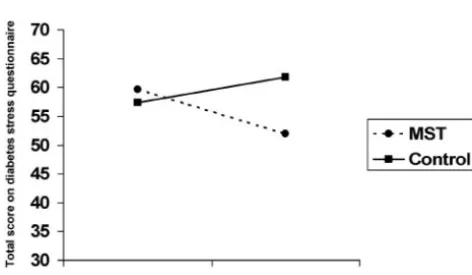
Results of the analysis of variance showed a sig-nificant treatment-time interaction for diabetes stress (Fig 2). Adolescents who received MST had signifi-cantly reduced levels of stress from baseline (mean score: 59.6; SD: 29.5) to the 7-month follow-up assess-ment (mean score: 51.9; SD: 29.8), compared with those in the control group, for whom stress levels increased from baseline (mean score: 57.4; SD: 25.9) to the follow-up assessment (mean score: 61.8; SD: 26.7) [F(1,125)⫽8.55;P⫽.004]. Tests for moderation showed no significant 3-way interactions for age [F(1,123)⫽0.19;P⫽.66], gender [F(1,123)⫽0.66;P
⫽ .42], or ethnicity [F(1,123) ⫽ 0.69; P ⫽ .41]. This suggests that the intervention was equally effective in reducing diabetes stress for both younger and older adolescents, male and female adolescents, and adolescents of black and other ethnicity.
Univariate correlations between baseline and fol-low-up diabetes stress, adherence, and metabolic control and baseline demographic variables tested as moderators of treatment effects are shown in Table 2. At baseline, diabetes stress was related sig-nificantly to metabolic control (r⫽0.26;P⬍.01) but not to adherence, age, gender, or ethnicity. At the follow-up assessment, diabetes stress was related significantly to metabolic control (r⫽ 0.24;P⬍ .01) and gender (r⫽ ⫺0.22;P⬍.05), with girls reporting
higher stress. No other significant relationships were found. The relationship between baseline stress and other demographic variables was also examined. Sig-nificant relationships were found between baseline diabetes stress and number of parents in the home (r⫽0.23;P⬍.05) but not family income or duration of diabetes. No significant relationships were found between diabetes stress at follow-up assessment and these additional demographic variables.
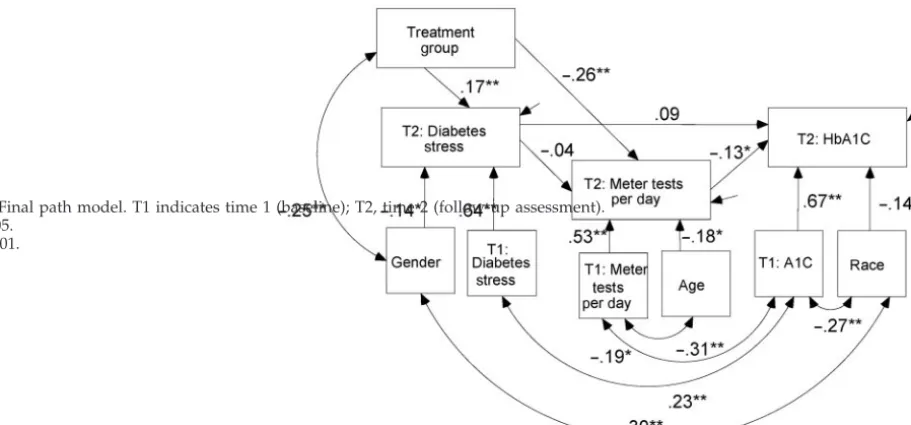
In structural equation modeling analyses, the the-oretical model shown in Fig 1 was tested first. Paths from each baseline variable to the corresponding variable at the 7-month follow-up assessment (time 2) were added to adjust for initial (baseline) status. A recursive model involving only observed variables and latent uncorrelated residuals was tested, with 7 exogenous variables, 2 mediators (time 2 adherence and time 2 diabetes stress), and 1 outcome (time 2 HbA1c level). Observed variables rather than latent variables were used in the path model because mul-tiple measures of the constructs (ie, stress and adher-ence) were not available. The exogenous variables were of 3 types, ie, baseline scores (time 1 HbA1c level, time 1 adherence, and time 1 diabetes stress), the intervention group variable (group assignment), and covariates (adolescent race/ethnicity, gender, and age). Covariates were added to the model em-pirically after an analysis of residuals was per-formed. In this analysis, residual error for each en-dogenous construct was first computed by using regression. The pattern of correlation between each residual and each potential covariate was then exam-ined. Covariates that were significantly related to the residuals were then added to the model. Finally, nonsignificant paths between exogenous variables were trimmed from the model.
Model fit statistics for the first model were inade-quate, with a significant2[2(29,127) ⫽ 42.15;P ⫽
.05; comparative fit index: 0.96; root mean square error of approximation: 0.06]. Inspection of the mod-ification indices showed a large modmod-ification index (modification index: 12.91) for the path between group assignment and adherence. Therefore, this path was freed and a second model was tested. Com-parison of the 2 models through calculation of the difference 2[2(1) ⫽ 14.44; P ⫽ .001] showed that
the second model had a significantly better fit for the data.
The final path model is shown in Fig 3. For sim-plicity, baseline scores are labeled as time 1 and 7-month follow-up scores are labeled as time 2. The correlation matrix, standardized residuals, and other descriptive statistics are presented in Table 2. Multi-variate normality was satisfactory, according to
Mar-Fig 1. Conceptual model tested through structural equation modeling.
dia’s coefficient (P ⬎ .05).35 The overall fit of the
model was excellent [2(28,127) ⫽ 27.71; P ⫽ .48;
comparative fit index: 1.0; root mean square error of approximation: 0.001]. Good fit to the data was also indicated by the fact that all except 2 standardized residuals had a value of⬍2. The model indicates that the MST intervention had significant direct effects on diabetes stress and on adherence. However, there was no support for a specific indirect, or mediated, effect of stress on adherence. In addition, once a path between adherence and metabolic control was in-cluded, there was no support for a mediated effect of stress on HbA1c levels. Rather, adherence and HbA1c levels were significantly related, with in-creased adherence resulting in improved metabolic control. Bootstrap significance testing was conducted to determine whether the indirect effect of MST on HbA1c levels was significant; this test indicated that the effect was significant atP⫽.012. Improvements in HbA1c levels can be attributed primarily to the specific indirect effect of MST on HbA1c levels through adherence, which makes up 67% of the total indirect effect.
DISCUSSION
Investigation of stress among adolescents with type 1 diabetes is important to identify the direct and indirect pathways through which stress affects be-havioral and health-related outcomes in this popula-tion. The primary purpose of the present study was to determine whether MST, an intensive, home-based, psychotherapy intervention, could reduce di-abetes-related stress among adolescents with type 1 diabetes and CPMC. Because our prior work showed that MST improved regimen adherence and meta-bolic control and because stress reductions were tar-geted in prior intervention studies as a means of improving adherence among adolescents with diabe-tes, a second purpose was to determine whether stress would function as a mediator of the effects of MST on regimen adherence and metabolic control. Our findings indicated a significant reduction in di-abetes stress for adolescents assigned to the MST group, compared with those who received standard care, for whom stress increased over time. This find-ing is consistent with the reduction in stress reported in previous intervention studies with
adoles-TABLE 2. Correlation Matrix and Standardized Residuals From Structural Equation Model
Variable 1 2 3 4 5 6 7 8 9 10
1. Group 0.01 ⫺0.56 0.20 0.69 0.51 0.20 0.13 0.86 ⫺0.03 1.16
2. HbA1c, time 1 ⫺0.02 0.06 0.24 ⫺0.66 ⫺1.36 0.30 0.14 2.20 0.28 ⫺0.15 3. HbA1c, time 2 0.08 0.75* 0.29 ⫺0.02 ⫺0.99 0.04 0.37 1.68 ⫺0.47 ⫺0.22 4. TPD, time 1 0.12 ⫺0.29* ⫺0.24* 0.27 0.15 ⫺0.35 ⫺1.10 ⫺0.61 ⫺2.41 0.01 5. TPD, time 2 ⫺0.19† ⫺0.26* ⫺0.33* 0.59* 0.01 ⫺0.88 ⫺0.86 ⫺0.14 ⫺1.89 0.18 6. Stress, time 1 ⫺0.04 0.26* 0.22† ⫺0.12 ⫺0.13 0.01 0.14 1.18 ⫺0.93 ⫺1.12 7. Stress, time 2 0.17 0.17 0.24* ⫺0.14 ⫺0.17 0.64 0.14 1.25 ⫺0.60 ⫺1.04 8. Age ⫺0.08 0.20† 0.20† ⫺0.35* ⫺0.36* 0.10 0.11 0.01 1.13 0.29 9. Gender ⫺0.21† 0.02 ⫺0.06 ⫺0.21† ⫺0.11 ⫺0.08 ⫺0.22† 0.10 0.01 ⫺0.24 10. Race 0.10 ⫺0.29* ⫺0.34* 0.00 0.02 ⫺0.10 ⫺0.09 0.03 0.28* 0.01
SD 0.50 2.29 2.48 1.24 1.41 27.68 28.61 1.95 0.50 0.49
Correlations among model variables are below the diagonal, standardized residuals are on and above the diagonal, and SDs are in the bottom row. Group (MST⫽1, control⫽2), tests per day (TPD), gender (1⫽female, 2⫽male), and race (1⫽black, 2⫽white) were tested. *P⬍.01.
†P⬍.05.
Fig 3. Final path model. T1 indicates time 1 (baseline); T2, time 2 (follow-up assessment). *P⬍.05.
cents.12–14 Although MST intervenes much more
broadly than the individual-focused interventions reported in those studies, all interventions taught diabetes management and problem-solving skills. This may be one way in which the “stressfulness” of diabetes was reduced. However, previous studies did not attempt to change family relationships re-garding diabetes care and did not intervene direct-ly in the peer system or target relationships with health care providers. Poor family and provider re-lationships are characteristic of adolescents with CPMC.18–21Accordingly, interventions that are
lim-ited in scope may not be sufficient to affect diabetes-related stress among adolescents with CPMC.
In addition, the MST intervention was effective in reducing stress regardless of the age, gender, and ethnicity of the participants. Previous intervention research was conducted with primarily white, mid-dle-class samples and therefore did not address the needs of minority and/or low-income adolescents with diabetes. This is an important gap in the litera-ture, because minority subjects are more likely to suffer from CPMC36,37and minority adolescents with
chronic illnesses have increased rates of stress, com-pared with nonminority subjects.38Gender was not
addressed in previous intervention studies, although adolescent female subjects with diabetes tend to re-port higher levels of diabetes-related stress than do adolescent male subjects.8This study represents one
of the very few trials to investigate these critical variables as potential moderators of treatment out-comes.
For better understanding of the processes through which MST exerted its effects, it was also hypothe-sized that stress would mediate the effects of MST on adherence and metabolic control. However, this hy-pothesis was not supported. Although stress was related to metabolic control and metabolic control did improve in the MST group, the improvement was attributable to an increase in the frequency of blood glucose testing and not reductions in stress. Similarly, the data did not support the hypothesis that reductions in stress were responsible for im-proved adherence in the MST group. Rather, MST had a direct effect on adherence behavior. Such find-ings may illustrate why prior intervention studies that attempted to improve metabolic control through stress reduction failed to find such effects; unless adolescents with high levels of glycemic instability in the presence of stress are targeted for stress-reducing interventions, direct targeting of adherence behavior may be a more efficient means of reducing blood glucose levels. Nevertheless, the reduction of stress in the present sample might have had positive effects on other aspects of adolescent adjustment, such as psychological well-being and emotional functioning. It is also possible that diabetes stress, measured with a self-report scale, may be a better indicator of more subjective health outcomes, such as quality of life. It will be important to investigate such links in future research.
Limitations of the present study include the use of a standard care control group, as opposed to an attention control group. It is possible that the degree
of intervention intensity, as opposed to the specific content of the intervention, was responsible for de-creases in stress and improvements in adherence and metabolic control. Other limitations include the mea-surement of only a single aspect of regimen adher-ence (blood glucose testing). This measure was cho-sen because of its close association with metabolic control in prior studies.33However, it is possible that
diabetes stress was related more strongly to other aspects of regimen adherence, such as insulin admin-istration, diet, or exercise. It is also important to note that the present study reports only on outcomes at the 7-month posttest, which occurred at treatment termination. Additional follow-up monitoring of the sample is needed to assess the stability of these stress reductions and to determine whether long-term re-ductions in stress ultimately might affect regimen adherence or metabolic control.
CONCLUSIONS
Results of the present study support the effective-ness of intensive, home-based, family therapy in re-ducing diabetes stress among adolescents with type 1 diabetes and CPMC. Such stress reductions may be important in improving the psychological well-being and quality of life of a subset of youths with diabetes who are at high risk for future health complications.
ACKNOWLEDGMENT
This project was supported by grant R01 DK59067 from the National Institute of Diabetes and Digestive and Kidney Diseases.
REFERENCES
1. Delamater AM, Kurtz SM, Bubb J, White N, Santiago JV. Stress and coping in relation to metabolic control of adolescents with type 1 diabetes.J Dev Behav Pediatr.1987;8:136 –140
2. Hanson CL, Henggeler SW, Burghen GA. Social competence and pa-rental support as mediators of the link between stress and metabolic control in adolescents with insulin- dependent diabetes mellitus.J Con-sult Clin Psychol.1987;55:529 –533
3. Davidson M, Penney ED, Muller B, Grey M. Stressors and self-care challenges faced by adolescents living with type 1 diabetes.Appl Nurs Res.2004;17:72– 80
4. Hanna KM, Guthrie D. Parents’ and adolescents’ perceptions of helpful and nonhelpful support for adolescents’ assumption of diabetes man-agement responsibility.Issues Compr Pediatr Nurs.2001;24:209 –223 5. Aikens JE, Wallander JL, Bell DS, Cole JA. Daily stress variability,
learned resourcefulness, regimen adherence and metabolic control in type 1 diabetes mellitus: evaluation of a path model.J Consult Clin Psychol.1992;60:113–118
6. Seiffge-Krenke I, Stemmler M. Coping with everyday stress and links to medical and psychosocial adaptation in diabetic adolescents.J Adolesc Health.2003;33:180 –188
7. Peyrot M, McMurry JF, Kruger DF. A biopsychosocial model of glyce-mic control in diabetes: stress, coping and regimen adherence.J Health Soc Behav.1999;20:141–158
8. Farrell SP, Hains AA, Davies WH, Smith P, Parton E. The impact of cognitive distortions, stress and adherence on metabolic control in youths with type 1 diabetes.J Adolesc Health.2004;34:461– 467 9. Surwit RS, Schneider MS, Feinglos MN. Stress and diabetes mellitus.
Diabetes Care.1992;14:1413–1422
10. Kramer JR, Ledolter J, Manos GN, Bayless ML. Stress and metabolic control in diabetes mellitus: methodological issues and an illustrative analysis.Ann Behav Med.2000;22:17–28
11. Riazi A, Pickup J, Bradley C. Daily stress and glycemic control in type 1 diabetes: individual differences in magnitude, direction and timing of stress-reactivity.Diabetes Res Clin Pract.2004;66:237–244
13. Mendez FJ, Belendez M. Effects of a behavioral intervention on treat-ment adherence and stress managetreat-ment in adolescents with IDDM. Diabetes Care.1997;20:1370 –1375
14. Hains AA, Davies WH, Parton E, Totka J, Amorosa-Camarata J. A stress management intervention for adolescents with type 1 diabetes.Diabetes Educ.2000;26:417– 424
15. Henggeler SW, Schoenwald SK, Borduin CM, Rowland MD, Cunning-ham PB.Multisystemic Treatment of Antisocial Behavior in Children and Adolescents. New York, NY: Guilford Press; 1998
16. Kovac M, Goldston D, Obrosky S, Iyngar S. Prevalence and predictors of pervasive noncompliance among youth with insulin-dependent dia-betes mellitus.J Am Acad Child Adolesc Psychiatry.1992;31:1112–1120 17. Leonard BJ, Jang YP, Savik K, Plumbo PM, Christensen R. Psychosocial
factors associated with levels of metabolic control in youth with type 1 diabetes.J Pediatr Nurs.2002;17:28 –37
18. Orr DP, Golden MP, Myers G, Marrero DG. Characteristics of adoles-cents with poorly controlled diabetes referred to a tertiary care center. Diabetes Care.1983;6:170 –175
19. Liss DS, Waller DA, Kennard BD, McIntire D, Capra P, Stephens J. Psy-chiatric illness and family support in children and adolescents with diabetic ketoacidosis: a controlled study.J Am Acad Child Adolesc Psy-chiatry.1998;37:536 –544
20. Jacobson AM, Hauser ST, Willett J, Wolfsdorf JI, Herman L. Conse-quences of irregular versus continuous medical follow-up in children and adolescents with insulin-dependent diabetes mellitus.J Pediatr. 1997;131:727–733
21. Kaufman FR, Halvorson M, Carpenter S. Association between diabetes control and visits to a multidisciplinary pediatric diabetes clinic. Pedi-atrics.1999;103:948 –956
22. Ellis DA, Naar-King S, Frey MA, Templin T, Rowland M, Greger N. Use of multisystemic therapy to improve regimen adherence among ado-lescents with type 1 diabetes in poor metabolic control: a pilot study. J Clin Psychol Med Settings.2004;11:315–324
23. Ellis DA, Naar-King S, Frey M, Templin T, Rowland MD, Cakan N. Multisystemic treatment of poorly controlled type 1 diabetes: effects on medical resource utilization.J Pediatr Psychol.In press
24. Ellis DA, Frey MA, Naar-King S, Templin T, Cunningham PB, Cakan, N. Use of multisystemic therapy to improve regimen adherence among adolescents with type 1 diabetes in chronic poor metabolic control: a randomized controlled trial.Diabetes Care.2005;28:1604 –1610
25. Kazdin AE, Nock MK. Delineating mechanisms of change in child and adolescent therapy: methodological issues and research recommenda-tions.J Child Psychol Psychiatry.2003;44:1116 –1129
26. Borduin CM, Mann BJ, Cone LT, et al. Multisystemic treatment of serious juvenile offenders: long-term prevention of criminality and violence.J Consult Clin Psychol.1995;63:569 –578
27. Henggeler SW, Melton GB, Smith LA. Family preservation using mul-tisystemic therapy: an effective alternative to incarcerating serious ju-venile offenders.J Consult Clin Psychol.1992;60:953–961
28. Henggeler SW, Schoenwald SK.The MST Supervisory Manual: Promoting Quality Assurance at the Clinical Level. Charleston, SC: MST Institute; 1998 29. Schoenwald SK.Multisystemic Therapy Consultation Guidelines.
Charles-ton, SC: MST Institute; 1998
30. Henggeler SW, Melton GB, Brondino MJ, Scherer DG, Hanley JG. Mul-tisystemic therapy with violent and chronic juvenile offenders: the role of treatment fidelity in successful dissemination.J Consult Clin Psychol. 1997;65:821– 833
31. Henggeler SW, Schoenwald SK, Liao JG, Letourneau EJ, Edwards D. Transporting efficacious treatments to field settings: the link between supervisory practices and therapist fidelity in MST programs.J Clin Child Adolesc Psychol.2002;31:155–167
32. Huey SJ, Henggeler SW, Brondino MJ, Pickrel SG. Mechanisms of change in multisystemic therapy: reducing delinquent behavior through therapist adherence and improved family and peer function-ing.J Consult Clin Psychol.2000;68:451– 467
33. Levine BS, Anderson BJ, Butler DA, Antisdel JE, Brackett J, Laffel L. Predictors of glycemic control and short-term adverse outcomes in youth with type 1 diabetes.J Pediatr.2002;139:197–203
34. Shrout PE, Bolger N. Mediation in experimental and nonexperimental studies: new procedures and recommendations.Psychol Methods.2002; 7:422– 445
35. Mardia KV. Measures of multivariate skewness and kurtosis with ap-plications.Biometrika.1970;57:519 –530
36. Delamater A, Shaw K, Applegate EB, et al. Risk for metabolic control problems in minority youth with diabetes. Diabetes Care. 1999;22: 700 –705
37. Palta M, LeCaire T, Daniel K, Shen G, Allen C, D’Alessio D. Risk factors for hospitalization in a cohort with type 1 diabetes: Wisconsin Diabetes Registry.Am J Epidemiol.1997;146:627– 636
DOI: 10.1542/peds.2005-0638
2005;116;e826
Pediatrics
Cunningham and Nedim Cakan
Deborah A. Ellis, Maureen A. Frey, Sylvie Naar-King, Thomas Templin, Phillippe B.
Randomized, Controlled Trial
With Chronically Poorly Controlled Type 1 Diabetes: Findings From a
The Effects of Multisystemic Therapy on Diabetes Stress Among Adolescents
Services
Updated Information &
http://pediatrics.aappublications.org/content/116/6/e826
including high resolution figures, can be found at:
References
http://pediatrics.aappublications.org/content/116/6/e826#BIBL
This article cites 34 articles, 5 of which you can access for free at:
Subspecialty Collections
http://www.aappublications.org/cgi/collection/diabetes_mellitus_sub
Diabetes Mellitus
http://www.aappublications.org/cgi/collection/endocrinology_sub
Endocrinology
following collection(s):
This article, along with others on similar topics, appears in the
Permissions & Licensing
http://www.aappublications.org/site/misc/Permissions.xhtml
in its entirety can be found online at:
Information about reproducing this article in parts (figures, tables) or
Reprints
http://www.aappublications.org/site/misc/reprints.xhtml
DOI: 10.1542/peds.2005-0638
2005;116;e826
Pediatrics
Cunningham and Nedim Cakan
Deborah A. Ellis, Maureen A. Frey, Sylvie Naar-King, Thomas Templin, Phillippe B.
Randomized, Controlled Trial
With Chronically Poorly Controlled Type 1 Diabetes: Findings From a
The Effects of Multisystemic Therapy on Diabetes Stress Among Adolescents
http://pediatrics.aappublications.org/content/116/6/e826
located on the World Wide Web at:
The online version of this article, along with updated information and services, is
by the American Academy of Pediatrics. All rights reserved. Print ISSN: 1073-0397.