POLICY STATEMENT
The Apgar Score
American Academy of Pediatrics
Committee on Fetus and Newborn
American College of Obstetricians and Gynecologists
Committee on Obstetric Practice
ABSTRACT
The Apgar score provides a convenient shorthand for reporting the status of the newborn infant and the response to resuscitation. The Apgar score has been used inappropriately to predict specific neurologic outcome in the term infant. There are no consistent data on the significance of the Apgar score in preterm infants. The Apgar score has limitations, and it is inappropriate to use it alone to establish the diagnosis of asphyxia. An Apgar score assigned during resuscitation is not equiv-alent to a score assigned to a spontaneously breathing infant. An expanded Apgar score reporting form will account for concurrent resuscitative interventions and provide information to improve systems of perinatal and neonatal care.
INTRODUCTION
In 1952, Dr Virginia Apgar devised a scoring system that was a rapid method of assessing the clinical status of the newborn infant at 1 minute of age and the need for prompt intervention to establish breathing.1A second report evaluating a larger number of patients was published in 1958.2 This scoring system provided a standardized assessment for infants after delivery. The Apgar score comprises 5 components: heart rate, respiratory effort, muscle tone, reflex irritability, and color, each of which is given a score of 0, 1, or 2. The score is now reported at 1 and 5 minutes after birth. The Apgar score continues to provide a convenient shorthand for reporting the status of the newborn infant and the response to resuscitation. The Apgar score has been used inappropriately in term infants to predict specific neurologic outcome. Because there are no consistent data on the significance of the Apgar score in preterm infants, in this population the score should not be used for any purpose other than ongoing assessment in the delivery room. The purpose of this statement is to place the Apgar score in its proper perspective.
The neonatal resuscitation program (NRP) guidelines3state that “Apgar scores should not be used to dictate appropriate resuscitative actions, nor should inter-ventions for depressed infants be delayed until the 1-minute assessment.” How-ever, an Apgar score that remains 0 beyond 10 minutes of age may be useful in determining whether additional resuscitative efforts are indicated.4The current NRP guidelines3state that “if there is no heart rate after 10 minutes of complete and adequate resuscitation efforts, and there is no evidence of other causes of newborn compromise, discontinuation of resuscitation efforts may be appropriate. Current data indicate that, after 10 minutes of asystole, newborns are very un-likely to survive, or the rare survivor is un-likely to survive with severe disability.”
www.pediatrics.org/cgi/doi/10.1542/ peds.2006-0325
doi:10.1542/peds.2006-0325
All policy statements from the American Academy of Pediatrics automatically expire 5 years after publication unless reaffirmed, revised, or retired at or before that time.
Key Words
Apgar score, asphyxia, neurologic outcome, resuscitation, cerebral palsy
Abbreviation
NRP—neonatal resuscitation program
PEDIATRICS (ISSN Numbers: Print, 0031-4005; Online, 1098-4275). Copyright © 2006 by the American Academy of Pediatrics and the American College of Obstetricians and Gynecologists
The American College of
Obstetricians and Gynecologists
Previously, an Apgar score of 3 or less at 5 minutes was considered an essential requirement for the diagno-sis of perinatal asphyxia. Neonatal Encephalopathy and Cerebral Palsy: Defining the Pathogenesis and Pathophysiolo-gy,5produced in 2003 by the American College of Ob-stetricians and Gynecologists in collaboration with the American Academy of Pediatrics, lists an Apgar score of 0 to 3 beyond 5 minutes as one suggestive criterion for an intrapartum asphyxial insult. However, a persistently low Apgar score alone is not a specific indicator for intrapartum compromise. Further, although the score is used widely in outcome studies, its inappropriate use has led to an erroneous definition of asphyxia. Intrapartum asphyxia implies fetal hypercarbia and hypoxemia, which, if prolonged, will result in metabolic acidemia. Because the intrapartum disruption of uterine or fetal blood flow is rarely, if ever, absolute, asphyxia is an imprecise, general term. Descriptions such as hypercar-bia, hypoxia, and metabolic, respiratory, or lactic aci-demia are more precise for immediate assessment of the newborn infant and retrospective assessment of intra-partum management.
LIMITATIONS OF THE APGAR SCORE
It is important to recognize the limitations of the Apgar score. The Apgar score is an expression of the infant’s physiologic condition, has a limited time frame, and includes subjective components. In addition, the bio-chemical disturbance must be significant before the score is affected. Elements of the score such as tone, color, and reflex irritability partially depend on the phys-iologic maturity of the infant. The healthy preterm in-fant with no evidence of asphyxia may receive a low score only because of immaturity.6A number of factors may influence an Apgar score, including but not limited to drugs, trauma, congenital anomalies, infections, hyp-oxia, hypovolemia, and preterm birth.7The incidence of low Apgar scores is inversely related to birth weight, and a low score is limited in predicting morbidity or mortal-ity.8 Accordingly, it is inappropriate to use an Apgar score alone to establish the diagnosis of asphyxia.
APGAR SCORE AND RESUSCITATION
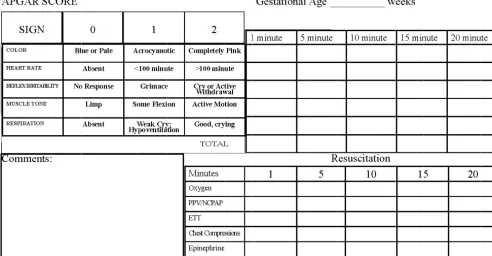
The 5-minute Apgar score, and particularly a change in the score between 1 and 5 minutes, is a useful index of the response to resuscitation. If the Apgar score is less than 7 at 5 minutes, the NRP guidelines state that the assessment should be repeated every 5 minutes up to 20 minutes.3 However, an Apgar score assigned during a resuscitation is not equivalent to a score assigned to a spontaneously breathing infant.9 There is no accepted standard for reporting an Apgar score in infants under-going resuscitation after birth, because many of the ele-ments contributing to the score are altered by resuscita-tion. The concept of an “assisted” score that accounts for
resuscitative interventions has been suggested, but the predictive reliability has not been studied. To describe such infants correctly and provide accurate documenta-tion and data collecdocumenta-tion, an expanded Apgar score report form is proposed (Fig 1).
PREDICTION OF OUTCOME
A low 1-minute Apgar score alone does not correlate with the infant’s future outcome. A retrospective anal-ysis concluded that the 5-minute Apgar score remained a valid predictor of neonatal mortality, but using it to predict long-term outcome was inappropriate.10 On the other hand, another study11stated that low Apgar scores at 5 minutes are associated with death or cerebral palsy, and this association increased if both 1- and 5-minute scores were low.
An Apgar score at 5 minutes in term infants correlates poorly with future neurologic outcomes. For example, a score of 0 to 3 at 5 minutes was associated with a slightly increased risk of cerebral palsy compared with higher scores.12Conversely, 75% of children with cerebral palsy had normal scores at 5 minutes.12 In addition, a low 5-minute score in combination with other markers of asphyxia may identify infants at risk of developing sei-zures (odds ratio: 39; 95% confidence interval: 3.9 – 392.5).13The risk of poor neurologic outcomes increases when the Apgar score is 3 or less at 10, 15, and 20 minutes.7
A 5-minute Apgar score of 7 to 10 is considered normal. Scores of 4, 5, and 6 are intermediate and are not markers of increased risk of neurologic dysfunction. Such scores may be the result of physiologic immaturity, maternal medications, the presence of congenital mal-formations, and other factors. Because of these other conditions, the Apgar score alone cannot be considered evidence or a consequence of asphyxia. Other factors including nonreassuring fetal heart rate monitoring pat-terns and abnormalities in umbilical arterial blood gases, clinical cerebral function, neuroimaging studies, neona-tal electroencephalography, placenneona-tal pathology, hema-tologic studies, and multisystem organ dysfunction need to be considered when defining an intrapartum hypoxic-ischemic event as a cause of cerebral palsy.5
OTHER APPLICATIONS
Monitoring of low Apgar scores from a delivery service can be useful. Individual case reviews can identify needs for focused educational programs and improvement in systems of perinatal care. Analyzing trends allows assess-ment of the impact of quality improveassess-ment interven-tions.
CONCLUSION
The Apgar score describes the condition of the newborn infant immediately after birth14and, when properly
ap-PEDIATRICS Volume 117, Number 4, April 2006 1445
at Viet Nam:AAP Sponsored on August 29, 2020
www.aappublications.org/news
plied, is a tool for standardized assessment. It also pro-vides a mechanism to record fetal-to-neonatal transition. An Apgar score of 0 to 3 at 5 minutes may correlate with neonatal mortality but alone does not predict later neurologic dysfunction. The Apgar score is affected by gestational age, maternal medications, resuscitation, and cardiorespiratory and neurologic conditions. Low 1-and 5-minute Apgar scores alone are not conclusive markers of an acute intrapartum hypoxic event. Resus-citative interventions modify the components of the Ap-gar score. There is a need for perinatal health care pro-fessionals to be consistent in assigning an Apgar score during a resuscitation. The American Academy of Pedi-atrics and the American College of Obstetricians and Gynecologists propose use of an expanded Apgar score reporting form that accounts for concurrent resuscitative interventions.
AAP COMMITTEE ON FETUS AND NEWBORN, 2005–2006
Ann R. Stark, MD, Chairperson David H. Adamkin, MD
Daniel G. Batton, MD Edward F. Bell, MD Vinod K. Bhutani, MD Susan E. Denson, MD William A. Engle, MD *Gilbert I. Martin, MD
Lillian R. Blackmon, MD, Past Chairperson
LIAISONS
Keith J. Barrington, MD Canadian Paediatric Society Gary D.V. Hankins, MD
American College of Obstetricians and Gynecologists Tonse N.K. Raju, MD, DCH
National Institutes of Health Kay M. Tomashek, MD, MPH
Centers for Disease Control and Prevention Carol Wallman, MSN, RNC, NNP
National Association of Neonatal Nurses and Association of Women’s Health, Obstetric and Neonatal Nurses
Laura E. Riley, MD, Past Liaison
American College of Obstetricians and Gynecologists
STAFF
Jim Couto, MA
ACOG COMMITTEE ON OBSTETRIC PRACTICE
*Gary D.V. Hankins, MD, Chairperson Sarah J. Kilpatrick, MD, Vice-Chairperson Angela L. Bell, MD
Jeanne M. Coulehan, CNM Susan Hellerstein, MD Jack Ludmir, MD Carol A. Major, MD Sean McFadden, MD Susan M. Ramin, MD
Russell R. Snyder, Col, MC, USAF
Review Co
py
FIGURE 1
LIAISONS
Hani K. Atrash, MD, MPH
Centers for Disease Control and Prevention William Callaghan, MD
Centers for Disease Control and Prevention Joshua A. Copel, MD
Association for Medical Ultrasound Gary A. Dildy III, MD
Society for Maternal-Fetal Medicine William Herbert, MD
Committee on Practice Bulletins-Obstetrics Liaison Samuel C. Hughes, MD
American Society of Anesthesiologists Bruce Patsner, MD, JD
Food and Drug Administration Colin Pollard
Food and Drug Administration Phill Price, MD
Food and Drug Administration Catherine Y. Spong, MD
National Institute of Child Health and Human Development
Ann Stark, MD
American Academy of Pediatrics John S. Wachtel, MD
Committee on Quality Improvement and Patient Safety
STAFF
Stanley Zinberg, MD, MS Beth Steele
Debra Hawks, MPH
*Lead authors
REFERENCES
1. Apgar V. A proposal for a new method of evaluation of the newborn infant.Curr Res Anesth Analg.1953;32:260 –267 2. Apgar V, Holiday DA, James LS, Weisbrot IM, Berrien C.
Eval-uation of the newborn infant: second report.JAMA.1958;168: 1985–1988
3. American Academy of Pediatrics and American Heart Associa-tion. Textbook of Neonatal Resuscitation. Elk Grove Village, IL: American Academy of Pediatrics and American Heart Association; 2005
4. Jain L, Ferre C, Vidyasagar D, Nath S, Sheftel D. Cardiopulmo-nary resuscitation of apparently stillborn infants: survival and long-term outcome.J Pediatr.1991;118:778 –782
5. American College of Obstetrics and Gynecology, Task Force on Neonatal Encephalopathy and Cerebral Palsy; American Acad-emy of Pediatrics. Neonatal Encephalopathy and Cerebral Palsy: Defining the Pathogenesis and Pathophysiology. Washington, DC: American College of Obstetricians and Gynecologists; 2003 6. Catlin EA, Carpenter MW, Brann BS IV, et al. The Apgar score
revisited: influence of gestational age. J Pediatr. 1986;109: 865– 868
7. Freeman JM, Nelson KB. Intrapartum asphyxia and cerebral palsy.Pediatrics.1988;82:240 –249
8. Hegyi T, Carone T, Anwar M, et al. The Apgar score and its components in the preterm infant.Pediatrics.1998;101:77– 81 9. Lopriore E, van Burk F, Walther F, Arnout J. Correct use of the Apgar score for resuscitated and intubated newborn babies: questionnaire study.BMJ.2004;329:143–144
10. Casey BM, McIntire DD, Leveno KJ. The continuing value of the Apgar score for the assessment of the newborn infants.
N Engl J Med.2001;344:467– 471
11. Moster D, Lie RT, Irgens LM, Bjerkedal T, Markestad T. The association of Apgar score with subsequent death and cerebral palsy: a population-based study in term infants.J Pediatr.2001; 138:798 – 803
12. Nelson KB, Ellenberg JH. Apgar scores as predictors of chronic neurologic disability.Pediatrics.1981;68:36 – 44
13. Perlman JM, Risser R. Can asphyxiated infants at risk for neonatal seizures be rapidly identified by current high-risk markers?Pediatrics.1996;97:456 – 462
14. Papile LA. The Apgar score in the 21st century.N Engl J Med.
2001;344:519 –520
PEDIATRICS Volume 117, Number 4, April 2006 1447
at Viet Nam:AAP Sponsored on August 29, 2020
www.aappublications.org/news
DOI: 10.1542/peds.2006-0325
2006;117;1444
Pediatrics
College of Obstetricians and Gynecologists and Committee on Obstetric Practice
American Academy of Pediatrics, Committee on Fetus and Newborn, American
The Apgar Score
Services
Updated Information &
http://pediatrics.aappublications.org/content/117/4/1444
including high resolution figures, can be found at:
References
http://pediatrics.aappublications.org/content/117/4/1444#BIBL
This article cites 12 articles, 5 of which you can access for free at:
Subspecialty Collections
http://www.aappublications.org/cgi/collection/neurology_sub
Neurology
sub
http://www.aappublications.org/cgi/collection/fetus:newborn_infant_
Fetus/Newborn Infant
newborn
http://www.aappublications.org/cgi/collection/committee_on_fetus__
Committee on Fetus & Newborn
following collection(s):
This article, along with others on similar topics, appears in the
Permissions & Licensing
http://www.aappublications.org/site/misc/Permissions.xhtml
in its entirety can be found online at:
Information about reproducing this article in parts (figures, tables) or
Reprints
http://www.aappublications.org/site/misc/reprints.xhtml
DOI: 10.1542/peds.2006-0325
2006;117;1444
Pediatrics
College of Obstetricians and Gynecologists and Committee on Obstetric Practice
American Academy of Pediatrics, Committee on Fetus and Newborn, American
The Apgar Score
http://pediatrics.aappublications.org/content/117/4/1444
located on the World Wide Web at:
The online version of this article, along with updated information and services, is
by the American Academy of Pediatrics. All rights reserved. Print ISSN: 1073-0397.
the American Academy of Pediatrics, 345 Park Avenue, Itasca, Illinois, 60143. Copyright © 2006 has been published continuously since 1948. Pediatrics is owned, published, and trademarked by Pediatrics is the official journal of the American Academy of Pediatrics. A monthly publication, it
at Viet Nam:AAP Sponsored on August 29, 2020
www.aappublications.org/news