United Kingdom ISSN 2348 0386 Vol. VII, Issue 5, May 2019
Licensed under Creative Common Page 671
http://ijecm.co.uk/
INFORMATION AND COMMUNICATION TECHNOLOGY (ICT)
ADOPTION BY SMALL AND MEDIUM ENTERPRISES IN
DEVELOPING COUNTRIES: THE EFFECTS OF LEADER,
ORGANIZATIONAL AND MARKET ENVIRONMENT FACTORS
Paul Taylor
Mona School of Business and Management, University of the West Indies, Jamaica [email protected]
Abstract
Leader, organizational and market factors play important roles in a small and medium
enterprise’s (SME’s) decision to adopt information and communications technologies (ICTs).
The purpose of this research is to examine the role of leader factors (leader innovativeness,
leader’s attitude, leader’s IT knowledge, leader’s risk aversion), organizational factors (business
size, firm age, financial slack, information intensity) and market environment factors (competitive
pressure, influence of social network, ICT business support, perceived ease of use of ICTs) to
an enterprise’s decision to adopt ICTs. After an extensive review of the technology acceptance
and innovation adoption literature, a behavioural model of innovation acceptance is presented,
completed with a number of useful and insight propositions concerning SMEs operating in an
underdeveloped, developing and developed country context.
Keywords: ICT Adoption; SMEs; developing world; leader, organization, market environment factors
INTRODUCTION
Licensed under Creative Common Page 672 (Barba-Sánchez et al., 2007). It is for these reasons and more that attention has been placed on how ICT use can be promoted among SMEs (Beckinsale, et al., 2011). Undoubtedly, the adoption of ICTs by SMEs enhances the ability of these firms to improve productivity and financial position, as well as bolster their capacity to gain competitive advantage (Brady et al., 2002; Thong, 1999). Matthews (2007) noted that ICTs are a major contributory factor in the growth of SMEs and contribute to their bottom-line, while Howard (1997) observed that business growth may require SMEs to implement ICTs to effectively manage such growth.
The technology acceptance and innovation adoption literature have proffered a number of variables that are likely determinants of why many firms adopt an innovation. A number of these studies have examined the influence of such organizational factors as firm size and employees’ ICT knowledge on adoption of innovations. Apart from organizational factors, the role of leader’s characteristics has also been explored (Street and Meister, 2004), since the leader is often the owner and the one who determines the direction of the firm (Qureshi and York, 2008). Moreover, most of these studies have either focused on the implementation of ICTs in small firms (Thong, 1999) or have examined the impact of leader and organizational factors on the adoption of innovations in large firms. Research on the unique nature and challenges affecting SMEs’ efforts to adopt ICTs in developing and underdeveloped countries is sparse and accordingly warrants special attention. The main purpose of this research undertaking, therefore, is to ascertain the important determinants of ICT adoption by SMEs in a developing country context, by examining the role of leader factors (leader innovativeness, leader’s attitude, leader’s IT knowledge, leader’s risk aversion), organizational factors (firm size, firm age, financial slack, information intensity), and market environment factors (competitive pressure, influence of social network, ICT business support, perceived ease of use of ICTs).
The rest of this paper deals with theoretical background, research model and propositions. This is followed by the discussion section. Finally, future research avenues are explored and conclusions are presented.
THEORETICAL BACKGROUND
Licensed under Creative Common Page 673 and devices that are used to process, store and transform information (e.g., Porter and Millar, 1985).
While information and communications technologies are often utilized to assist growth, SMEs frequently find it difficult to implement such technologies for a variety of reasons, including resource constraint (Raymond, Bergeron, and Blili, 2005). In this regard, Matthews (2007) noted that the main hindrances to the expanded use of ICTs by SMEs can be enumerated as financial (ability to invest in ICTs), infrastructural (bandwidth and power) and organizational (lack of skilled staff, lack of coherent strategy, inability to adopt new ICT enabled processes).
From a developing country perspective, a number of scholars have argued that although SMEs in developing countries have increased their ICT investments, the anticipated economic gains or benefits are not being realized (e.g., Duggan, 2008; Barclay and Duggan, 2008; Dewan, Ganley, and Kraemar, 2005). Moreover, for many SMEs undertaking ICT adoption for the first time, there are a number of innate risks and uncertainties. For example, the introduction of ICTs is likely to cause changes in work processes and cause anxiety among employees relating to the use of such technologies, as well as increase costs to address poor ICT implementation (e.g., Dewan, Ganley, and Kraemar, 2005).
In response, researchers such as Barclay and Duggan (2008) and Duggan and Virtue (2004) have called for a reconceptualization of the digital divide phenomenon toward a focus on digital effectiveness. Digital effectiveness refers to the capability to maximize ICTs to obtain positive economic returns from ICT adoption (Duggan, 2008; Barclay and Duggan, 2008). For this to happen, however, firms in developing and underdeveloped countries, for example, must find ways to creatively implement and use ICTs to add value (Duggan and Virtue, 2004).
Previous research has found a number of drivers for SMEs IT adoption, however only a few factors were found to actually influence the adoption behaviors, for example, innovativeness and IT knowledge (Thong, 1999); firm size (Bridge and Peel, 1999; Premkumar and Roberts, 1999), ease of use and perceived usefulness (Igbaria, et al. 1998), and top management support (Foong, 1999; Premkumar and Roberts, 1999). Also, within the ICT adoption literature, the drivers for ICT adoption have tended to be focused on perceived benefits (Poon and Swatman, 1999; Mehrtens et al., 2001) such as efficiency improvements, organizational/ operational effectiveness and new business opportunities (Levy et al., 2005); and SME promotion; organizational readiness (Levy and Powell, 2003; Merhtens et al., 2001).
Licensed under Creative Common Page 674
RESEARCH MODEL AND PROPOSITIONS
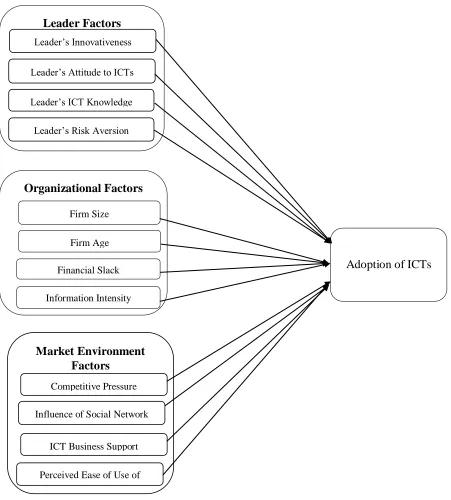
After a review of the technological innovation literature, a research model was developed (see Figure 1). As the objective of this study is to identify primary relationships, a one-stage behavioural model of ICT adoption has been proposed, consisting of Adoption of ICTs as the dependent variable and a number of independent variables. As this research develops, the model can be refined to, for example, include intermediate variables.
Figure 1. Proposed Research Model – Behaviour Model of ICT Adoption
Adoption of ICTs
Organizational Factors
Firm Size
Financial Slack
Information Intensity Firm Age
Leader Factors
Leader’s InnovativenessLeader’s Attitude to ICTs
Leader’s ICT Knowledge
Leader’s Risk Aversion
Market Environment
Factors
Competitive Pressure
Influence of Social Network
ICT Business Support
Licensed under Creative Common Page 675
Adoption of ICTs
In the model, adoption of ICTs is the dependent variable. In this article, ICT adoption is defined as the use of information and communication technologies (ICTs) tools including computer hardware, software, and networks required for connecting to the internet” (Tan et al., 2009, Ghobakhloo et al., 2011). Within this context, adoption of ICTs can be described as a consisting of three defined stages namely, initiation, adoption, and implementation as Nguyen (2009), Rogers (2003) and Thong (1999) observed. The initiation stage has to do with assessing the ICT innovation. The adoption stage is one where a decision is made to adopt an ICT innovation. The implementation stages is concerned with effecting the ICT innovation in the firm. This implies that ICTs are used productively and enhances the operations of SMEs.
Leader Factors
Leader’s innovativeness
The SME leader or owner is an entrepreneurial figure who determines the innovative attitude of the SME (Schumpeter, 1934; Witt, 2002). This person plays a key role in the growth and development of the SME based on his or her abilities and proclivities (Barba-Sánchez et al., 2007). In other words, it is the leader who ultimately determines the level of the innovativeness of the business. Further, it has been found that the SME leader allocates organizational resources and so influences innovation adoption in the firm (Kimberly and Evanisko, 1981). In many SMEs, expertise and control over resources are often vested entirely in the owner or leader (Bigoness and Perreault, 1981). Therefore, if the SME owner is not motivated to innovate, there is not much that other team members of the firm can do to hasten ICT adoption in the business (Prescott and Conger, 1995; Thong, 1999). Accordingly, if the SME leader believes that an ICT innovation will enhance the productivity of the firm, he or she will most likely adopt that innovation.
Proposition l: Innovative SME leaders are more likely to adopt ICTs.
Leader’s Attitude toward ICTs
Licensed under Creative Common Page 676 between favorable perceptions of IT (attitude) and progressive use of IT. Furthermore, in examining the decision making processes about IT adoption in small businesses, Harrison et al. (1997) discovered strong support for a decision process based on attitude or perceived positive and negative consequences for the firm, social expectations, and resources to overcome obstacles) regarding IT adoption. Other researchers have posited that the more the SME owner’s perception that ICTs are compatible with their businesses, the more likely they are to adopt them (Tornatzky and Fleischer, 1990), while Winston and Dologite (2002) have noted that small business owners’ attitudes toward information system is understood to be an important factor in determining implementation success (Winstonand Dologite, 2002).
Proposition 2: SMEs with leaders who view ICTs favourably are more likely to adopt them.
Leader’s IT knowledge
Research has found that SMEs with leaders who know about IT are more likely to adopt IT (Thong et al., 1995). Also, studies have found that many SME leaders are not knowledgeable of ICTs and the advantages that these technologies can provide to their businesses (Gable and Raman, 1992; see also Barba-Sanchez et al., 2007). These findings would seem to indicate that if more SME leaders were educated on the benefits of ICTs, they may be more willing to adopt such technologies (Levy et al., 2001).
Proposition 3: SME leaders who are well-informed about ICTs are more likely to adopt ICTs.
Leader’s Risk Aversion
Studies have suggested that entrepreneurs who are not risk-averse, possess a higher need for achievement, and have a higher preference for innovation (Begley, 1995; Stewart Jr et al., 1999) are more inclined to adopt ICTs (e.g. Ács and Varga, 2005). SME owners tend to be entrepreneurial, risk-friendly and innovative which are considered key factors in assessing the SMEs’ readiness to adopt ICTs (Poon and Swatman, 1999; Levy and Powell, 2003).
Proposition 4: SMEs leaders that are risk-friendly (more risk tolerant) are more likely to adopt ICTs.
Organizational Factors
Firm size
Licensed under Creative Common Page 677 Alpar and Reevs, 990). Similarly, the size of SMEs has been found to be correlated with ICT use (Premkumar and Roberts, 1999; Poon and Swatman, 1999).
Proposition 5: Larger SMEs are more likely to adopt ICTs than their smaller counterparts.
Firm Age
All things being equal, the older an SME, the more it is likely to adopt ICTs. The logic here is that the older a firm, the more experience, and financial resources it is able to amass, as compared to younger firms (Palvia and Palvia, 1999). Notwithstanding, it is also recognized that some SMEs, particularly those in the software sectors, adopt ICTs from the start, e.g. born globals in high-tech industries (Weerawardena et al., 2007). However, in developing countries, the born global SMEs are not as pronounced as in a developed country context. All things considered, it is therefore reasonable to suggest that age and experience are important factors in the successful adoption of ICT by SMEs (Palvia and Palvia, 1999).
Proposition 6: Younger SMEs are less likely to adopt ICTs than older ones.
Financial Slack
Generally, many SMEs do not possess the capital and financing required to achieve business success quickly (Fuller-Love, 2006).For these firms, ICT adoption tend to be more difficult (Premkumar and Roberts, 1999). Also, the lack of financial resources might hinder many SME owners from being able to strategically implement ICTs to facilitate the growth of their businesses (see Beckinsale et al., 2011; Levy et al., 2001). SMEs that possess adequate financial resources in excess of that required to maintain their operations, solve organizational problems, and undertake social responsibility projects, are better positioned to invest in technologies that facilitate business growth (see Ang and Straub, 1998; Bourgeois, 1981). Accordingly, SMEs with financial slack or excess financial resources can build up technology resources and implement ICT innovations quicker than SMEs with limited financial resources. Proposition 7: SMEs with financial slack are more likely to adopt ICTs than SMEs who possess limited financial resources.
Information intensity
Licensed under Creative Common Page 678 are thus is more information-intensive, than a small farm business. In this regard, Yap (1989) found that businesses with high information processing needs, and those in more information-intensive sectors are more likely to adopt ICTs and exploit its strategic advantages (Porter and Millar, 1985).
Proposition 8: Information-intensive SMEs are more likely to adopt ICTs.
Marketplace Factors
Competitive/External Pressure
Many SMEs have had to adopt ICT because their counterparts have done so or competition impels them to (Nguyen, 2009). Also, customers’ demand for quality service propels many SMEs to adopt ICTs (Levy and Powell, 2003; Poon and Swatman, 1999). Moreover, research has shown that competition fuels SMEs drive to adopt new technologies when SME leader conclude that the adoption of new technologies will improve their business performance and competitive position in the marketplace (Ghobakhloo et al., 2010). Other researchers have also found that external pressures from customers, suppliers, competitors, and government have influenced SMEs adoption of ICTs (Beckinsale et al., 2006; Premkumar and Roberts, 1999; Mehrtens et al., 2001).
Proposition 9: The greater the competitive pressure, the more SMEs will adopt ICTs.
Influence of Social Network
Social networks have been acknowledged as being an important influence on ICT adoption (Yap et al., 1992). Information and ideas flow more easily among people who are closely connected and, have a sense of community or personal ties (Granovetter, 1973). Accordingly, these social networks provide useful information on a range of matters including, ICTs which, in turn, motivates SMEs to adopt these technologies. Researchers have observed that SMEs in the same industry often adopt the same technologies and view these technologies in similar ways (Salmeron and Bueno, 2006). Moreover, the need for strengthening social networking among industry participants is itself being assisted by lower costs of ICTs, which facilitates better business relationship among firms, and closer cross border trade and coordination among firms (Barba-Sánchez et al., 2007; Summut-Bonnii and McGee, 2002). Thus, ICTs enhance SMEs’ ability to forge new relationships (Prasad et al., 2001) to grow and prosper.
Licensed under Creative Common Page 679
ICT Business Support
Research has shown that IT support is a critical factor in facilitating ICT adoption by SMEs. In fact, it has been noted by researchers that quality business support and guidance of IT consultants, vendors, government, and other IT experts have greatly enhanced the success of ICT adoption efforts by SMEs (Ahuja et al., 2009; Morgan et al., 2006). Also, Yap et al. (1992) have found a positive relationship between quality external advice provided by consultants and ICT adoption.
Proposition 11: ICT business support positively impacts ICT adoption by SMEs.
Perceived Ease of Use of ICTs
A technology that is viewed to be easier to use when compared with another, will tend to be adopted by the user over the other technology. In other words, a technology that is seen as being easier to use than some other is likely to be adopted (Moore and Benbasat, 1991; Succi and Walter, 1999). Accordingly, perceived ease of use refers to the extent to which an individual believes it is easy or effortless to use a particular technology (Davis, 1989), in that that technology provides a benefit to the user (Riemenschneider et al., 2003). Research by Igbaria et al. (1997) have found perceived ease of use of personal computer and web site by SMEs, respectively, is a statistically significant determinant ICT adoption.
Proposition 12: An SME will more like adopt an ICT when the SME owner feels that ICT is easy to use.
AVENUES FOR FUTURE RESEARCH
Licensed under Creative Common Page 680 implementation of ICT projects. Additionally, future research will examine the role that the entrepreneurial orientation (EO) of SME owners plays on the decision and readiness of SMEs to adopt ICTs. This, so as to provide useful insights to SMEs owners and managers, as well as policy-makers involved in SME development.
CONCLUSION
Utilizing theories from the technological innovation literature, this study advances a number of propositions for testing ICT adoption by SMEs, particularly in developing economies. This study examines leaders, organizational and market environmental factors on the decision of SMEs to adopt ICTs and proposes a behavioural model of ICT adoption by SMEs, which recognizes some of the peculiar concerns of SMEs in developing countries. Indeed, while research has found that SMEs, in general, have increased their ICT investments, a number have yet to adopt such technologies, let alone maximize the returns from ICT use in their firms. This may be due to a lack of knowledge of ICTs and their benefits by some SME owner-managers (Barba-Sanchez et al., 2007; Thong et al., 1995). On the other hand, organizational and environmental factors may also play a role in the decision of SMEs in developing countries to adopt ICTs. Research has shown, for example, that SMEs in developing countries who are apart of strong social networks often receive useful information on ICTs which spur their decision to adopt such technologies (Salmeron and Bueno, 2006). While a number of these factors have been found to play a role in SMEs in developed countries, little is known about their effects in developing countries, such as those in the Caribbean. It is therefore important that further research is done to not only investigate the efficacy of the proposed model, and the constructs which constitute it, but also that the moderating and mediating role of such constructs on ICT adoption by SMEs in developing economies, so as to provide further insights on the use of ICTs to spur SME growth and maximize economic gains.
REFERENCES
Ács, Z., & Varga, A. (2005). Entrepreneurship, agglomeration and technological change. Small Business Economics, 24, 323-334.
Ahuja, V., Yang, J., & Shankar, R. (2009). Study of ICT adoption for building project management in the Indian construction industry. Automation in Construction, 18(4), 415-423.
Alpar, P., & Reeves, S. (1990). Predictors of MS/OR application in small businesses. Interfaces, 20(2), 2-11.
Ang, S., & Straub, D.(1998). Production and transaction economies and IS outsourcing: a study of the U.S. banking industry. MIS Quarterly,22(4), 535-552.
Licensed under Creative Common Page 681
Barclay, C., & Duggan, E. W. (2008).Rethinking the digital divide: towards a path of digital effectiveness. Proceedings of the 41st Hawaii International Conference on System Sciences.
Beckinsale, M., Levy, M.,& Powell, P. (2006). Exploring internet adoption drivers in SMEs’ electronic markets. The International Journal, 16(4), 361-370.
Beckinsale, M., Ram, M., & Theodorakopoulos, N. (2011). ICT adoption and e-business development: understanding ICT adoption amongst ethnic minority businesses. International Small Business Journal, 29(3), 193-219.
Begley, T. M. (1995). Using founder status, age of firm, and company growth rate as the basis for distinguishing entrepreneurs from managers of smaller business. Journal of Business Venturing, 10(3), 249-263.
Bigoness, W. J., & Perreault, W. D. (1981). A conceptual paradigm and approach for the study of Innovations. Academy of Management Journal, 24, 68-82.
Bourgeois, L. J. (1981). On the measurement of organizational slack. Academy of Management Review, 6, 22-39.
Brady, M., Saren, M., & Tzokas, N. (2002). Integrating information technology into marketing practice - the IT realize of contemporary marketing practice. Journal of Marketing Management, 18, 555-577.
Bridge, J., & Peel, M. J. (1999). Research note: a study of computer usage and strategic planning in the SME sector. International Small Business Journal, 17(4), 82-88.
Corbitt, B. J. (2000). Developing intraorganizational electronic commerce strategy: An ethnographic study. Journal of Information Technology, 15(2), 119-130.
Davis, F. D. (1989). Perceived usefulness, perceived ease of use, and user acceptance of information technology. MIS Quarterly, 13, 319-340.
Dewan, S., Ganle, D.,& Kraemar, K. L. (2005). Across the digital divide: A cross-country analysis of the determinants of IT penetrations. Journal of the Association for Information Systems, 6(12), 409-432.
Duggan, E. W., & Virtue, G. (2004). Bridging the digital divide in Caribbean group decision-making. The Electronic Journal on Information Systems in Developing Countries, 17(5), 1-24.
Duggan, E. W. (2008). Rethinking the Digital Divide: towards a Path of Digital Effectiveness. Proceedings of the 41st Annual Hawaii International Conference on System Sciences (HICSS 2008).
Ein-Dor, P.,& Segev, E. (1978). Organizational context and the success of management information systems. Management Science, 24, 1064-1077.
Foong, S-Y. (1999). Effect of end-user personal and systems attributes on computer-based information system success in Malaysian SMEs. Journal of Small Business Management, 37(3), 81-88.
Fuller-Love, N. (2006). Management development in small firms. International Journal of Management Reviews, 8(3), 175-190.
Gable, G. G., & Raman, K. S. (1992). Government initiatives for IT adoption in small businesses. International Informational System, 1(1), 68-93.
Ghobakhloo, M., Sabouri, M.S., Hong, T.S., & Zulkifli, N. (2011). Information technology adoption in small and medium-sized enterprises: An appraisal of two decades literature. Interdisciplinary Journal of Research in Business, 1(7), 53-80.
Ghobakhloo, M., Zulkifli, N. B., & Aziz, F. A. (2010). The interactive model of user information technology acceptance and satisfaction in small and medium-sized enterprises. European Journal of Economics, Finance and Administrative Sciences, 19(1), 7-27.
Grandon, E. E., & Pearson, J. M. (2004). Electronic commerce adoption: An empirical study of small and medium US businesses. Information & Management, 42, 197–216
Granovetter, M. S. (1973). The strength of weak ties. American Journal of Sociology, 7(6), 1360-1380.
Harrison, D. A., Mykytyn Jr., P. P., & Riemenschneider, C. K. (1997). Executive decisions about adoption of information technology in small businesses: Theory and empirical tests. Information Systems Research, 8(2), 171-195.
Howard, K. (1997). IT means business? A survey of attitudes in smaller businesses to information and technology. London: Institute of Management.
Licensed under Creative Common Page 682
Igbaria, M., Zinatelli,N., & Cavaye, A. (1998). Analysis of information technology success in small firms in New Zealand. International Journal of Information Management, 18(2), 103-119.
Jarvenpaa, S. L., & Ives, B. (1991). Executive involvement and participation in the management of IT. MIS Quarterly, 15(2), 205–227.
Javalgi, R., & Ramsey, R.(2001). Strategic issues of e-commerce as an alternative global distributions system. International Marketing Review, 18(4), 376-391.
Kimberly, J. R., & Evanisko, M. J. (1981). Organizational innovation: The influence of individual, organizational, and contextual factors on hospital adoption of technological and administrative innovations. Academy of Management Journal, 24(4), 689-714.
Levy, M., & Powell, P. (2003). Exploring SME internet adoption: Towards a contingent model. Electronic Markets 13(2), 173–181.
Levy, M., Powell, P., & Worrall, L. (2005). Strategic intent and e-business in SMEs: Enablers and inhibitors. Information Resources Management Journal, 18(4), 1-20.
Levy, M., Powell, P., Yetton, P. (2001). SMEs: Aligning IS and the strategic context. Journal of Information Technology,16(3), 133-144.
Matthews, P. (2007). ICT assimilation and SME expansion. Journal of International Development, 19(6), 817-827.
Mehrtens, J., Cragg, P. B., & Mills, A. M. (2001). A model of Internet adoption by SMEs. Information& Management, 39, 165-176.
Moore, G. C., & Benbasat, I. (1991). Development of an instrument to measure the perceptions of adopting an information technology innovation. Information Systems Research (3), 192-222.
Nguyen, T. U. H. (2009). Information technology adoption in SMEs: An integrated framework. International Journal of Entrepreneurial Behaviour and Research, 15(2), 162-186.
Palvia, P. C., & Palvia, S. C. (1999). An examination of the IT satisfaction of small-business users. Information & Management, 35(3), 127-137.
Porter, M., & Millar, V. E. (1985). How information gives you competitive advantage. Harvard Business Review, 63(4), 149-160.
Poon, S., & Swatman, P. M. C. (1999). An exploratory study of small business Internet commerce issues. Information & Management, 1(4), 9-18.
Prasad, V. K., Ramamurthy, K., & Naidu, G. (2001). The influence of Internet-marketing integration on marketing competencies and export performance. Journal of International Marketing, 9(4), 82-110.
Premkumar, G., & Roberts, M. (1999). Adoption of new information technologies in rural small businesses. Omega, 27(4), 467–484.
Prescott, M. B., & Conger, S. A. (1995). Information technology innovations: A classification by IT locus of impact and research approach Data Base 26, 2-3.
Qureshi, S., & York, A. S. (2008). Information technology adoption by small businesses in minority and ethnic communities. Proceedings of the 41st Hawaii International Conference on System Sciences.
Raymond, L., Bergeron, F., & Blili, S. (2005). The assimilation of e-business in manufacturing SMEs: Determinants and effects on growth and internationalization. Electronic Markets, 15(2), 106-118.
Riemenschneider, C. K., Harrison, D. A., & Mykytyn Jr, P. P. (2003). Understanding IT adoption decisions in small business: Integrating current theories. Information & Management 40, 269-285.
Rogers, E. M. (2003). Diffusion of innovations (5th ed.). New York: Free Press.
Salmeron, J. L., & Bueno, S. (2006). An information technologies and information systems industry-based classification in small and medium-sized enterprises: An institutional view. European Journal of Operational Research, 173(3), 1012-1025.
Schumpeter, J. A. (1934). The theory of economic development. Cambridge, MA: Harvard University Press.
StewartJr, W. H., Watson, W. E., Carland, J. C., & Carland, J. W. (1999). A proclivity for entrepreneurship: A comparison of entrepreneurs, small business owners, and corporate managers. Journal of Business Venturing, 14(2), 189-214.
Licensed under Creative Common Page 683
Succi, M. J., & Walter, Z. D. (1999). Theory of user acceptance of information technologies: An examination of health care professionals. Proceedings of the 32nd Annual Hawaii International Conference on Systems Sciences. HICSS-32.
Tan, K. S., Chong, S. C., Lin, B., & Eze, U. C. (2009). Internet-based ICT adoption: Evidence from Malaysian SMEs. Industrial Management and Data Systems, 109(2), 224-244.
Taylor, P. (2015). The importance of information and communication technologies (ICTs): An integration of the extant literature on ICT Adoption in small and medium enterprises. International Journal of Economics, Commerce and Management, 3(5), 274-295.
Thong, J. Y. L. (1999). An integrated model of information systems adoption in small businesses. Journal of Management Information Systems, 15(4), 187-214.
Thong, J. Y. L., & Yap, C. S. (1995). CEO characteristics, organizational characteristics and information technology adoption in small businesses. Omega, 23(4), 429-442.
Tornatzky, L. G., & Fleischer, M. (1990). The processes of technological innovation. Lexington Books, Lexington, MA.
Weerawardena, J., Mort, G. S., Liesch, P. W., & Knight, G. (2007). Conceptualizing accelerated internationalization in the born global firm: A dynamic capabilities perspective. Journal of World Business, 42, 294-306.
Winston, E., & Dologite, R. (2002). How does attitude impact IT implementation: A study of small business Owners. Journal of End User Computing, 14(2), 16-29.
Witt, U. (2002). How evolutionary is Schumpeter’s theory of economic development? Industry and Innovation, 9(1/2), 7-22.
Yap, C. S. (1989). Computerization problems facing small and medium enterprises: The experience of Singapore. Proceedings of the 20th Annual Meeting of the Midwest Decision Sciences Institute. Miami University, Ohio, 128-134.