www.orientjchem.org
An International Open Free Access, Peer Reviewed Research Journal
2017, Vol. 33, No. (1): Pg. 396-401
Calcium Ion Selective Electrode Based On Surface Modified
Zeolite Based Ionophore & Its Analytical Application
A.VIJAYALAkSHMI
1and J.THAMARAI SELVI
2Department of Chemistry, Avinashilingam Institute for Home Science and Higher Education for Women, Coimbatore- 641043, Tamilnadu, India.
http://dx.doi.org/10.13005/ojc/330147
(Received: December 19, 2016; Accepted: December 30, 2016)
ABSTRACT
A new, efficient Calcium ion selective electrode has been prepared using Surface modified Zeolite based ionophore.The prepared ionophore is characterized by UV,FT-IR,XRD..The sensor exhibits a near Nernstian response for Ca(II) ion over a concentration range of 1.0 X 10⁻⁴ M to1.0
M . The proposed sensors revealed relatively good selectivity and high sensitivity for Ca(II) over a monovalent cations. It can be used with in the pH range of 5.57 to 6.24 . The effect of medium and the selectivity coefficient values was evaluated using fixed interference method found to give a better response. . It was also successfully used in the analysis of concentration of Calcium ion in various real samples.
keywords: Calcium (II),Surface modified Zeolite, Potentiometry, Selectivity coefficient.
INTROdUCTION
The introduction of new ion-selective electrodes has played a fundamental role in the development of various sensory elements according to the charge and size of the target ion in clinical and environmental assays1-8. Potentiometric methods
using ISEs for determining the metal ion have been studied extensively due to their importance in biological process9,10, easy handling, nondestructive
analysis and in expensive sample preparation, applicability to coloured sample and turbid solution.
Calcium is the major element in the body. It plays a Vital role in the formation of bone, neuro muscular function, coagulation & membrane permeability. In plants it helps in transpiration which leads to growth of the plant.
Taking into consideration of all the above facts that a new simple ionophore such as surface modified zeolite have been used as an electroactive phase for the fabrication of Ca2+ ion selective
electrodes. In the present study the electrode show good selectivity and reproducibility over Ca2+ ion and
the results are presented in this paper.
ExpERIMENTAL METHOd
Chemicals used
Silicic acid, Reagent grade tetrapropyl ammonium bromide, tetrahydrofuran, Ethyl acetate, Dimethyl Acetamide, DMF, Dioctyl phthalate (DOP), Sodium tetra phenyl borate (NATBP), tetra hydro furan (THF) were obtained from E.Merck and can be used without further purification. Throughout double distilled ionized water used.
Synthesis of ionophore
2g of Silicic acid was mixed with 3.5g of tetrapropyl ammonium bromide and 0.514g of NaOH
& 50 ml of water. The above mixture was heated at 1000C for 5 hours. The white precipitate was obtained.
The silica content of the precipitate was determined by evaporation method & found to be 1.1 Ml-1. 1g of
the above precipitate was dissolved in 2 ml of water and was mixed with a1.15 M aluminate solution (1 ml) to adjust the Si/Al molar ratio to 0.5M. The mixed solution was heated at 800C for 24 hours.
The resulting reaction mixture was dried in a oven
Fig 1: UV spectrum of the ionophore
at 600C overnight. The surface modified Zeolite was
prepared by mixing the above mixture with 100 mM HDTMA solution & stirred for 24 hours. The mixture was then centrifuged at 5000 rpm for 20 min & finally the mixture was dried.
yield:2.5g,Melting point:2010C
physical measurements
For recording UV & Visible spectrum PC based UV double beam spectrometer 2202 was used. FT-IR spctra were recorded on a FT-IR spectrometer. (model Shimadzu prestige-21 series) X-ray diffraction (XRD) analysis was carried out
Fig. 3: xRd Spectrum of the ionophore
using PAN analytical x-Pert pro diffractometer from CuKá radiation (X-Ray tube PW 3050/60), In UV spectrum the peak at 221nm corresponds to CN group (Pavian et al; 2001) fig-1. In FT-IR HDTMA Surfactant, Zeolite & SMZ are shown in fig-2, The Zeolite absorbed frequencies are 501, 802, 1064, 1465, 1635, 2376, 2970, 3788 & 3842 cm-1
SMZ showed frequencies are 462, 794, 1095, 1435, 1627, 2376, 2854, 2924, 3425, 3749, 3842 which indicate the incorporation of HDTMA on the Zeolite Surface.There was a slight shift in peaks at each wave numbere speically in the peaks at 1435, 2854 & 2924 cm-1 in the SMZ spectrum.
This data confirmed the loading of HDTMA onto the Zeolite surface. (Nezamzadeh-Ejhieh and Mirzaeyan,2011)
From X-ray diffraction study the composition was found to be C12 H8Cl4 O48Si24 in fig-3
Fabrication of Ion selective electrode
A copper wire was polished with emery paper & it was washed with distilled water &THF. The copper was dipped into the concentrated solution (0.3g of ionophore+0.1g of DOP+PVC+3 ml of THF) for some minutes, so that a non-transparent coating was formed. The wire was taken out from the mixture and dried overnight. The electrode was finally conditioned to attain stable equilibrium for 10 days by dipping in 1MCaCl2. The electrode was kept in distilled water when not in use.
potential measurements
All the membrane electrode potential measurements were performed at constant temperature (30°C) using digital potentiometer (EQUIP-TRONICS EQ 602) in configuration with silver electrode as a reference electrode. The representation of electrochemical cell for the EMF measurement is as follows.
Internal Internal External Reference reference reference Electrode (1M CACl2 electrode (Immobilised Solution) (AG/AGCl) Cu wire)
Table 1: Electrode response
Concentration EMF (Half Cell of CaCl2 (M) potential) volts
1 0.135
1x10⁻¹ 0.044
1x10⁻² -0.033
1x10⁻³ -0.083
1x10⁻⁴ -0.116
1x10⁻⁵ -0.116
Table 2: Effect of pH
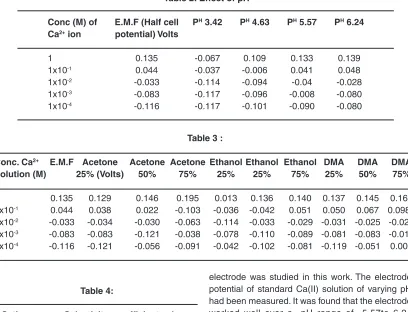
Conc (M) of E.M.F (Half cell pH 3.42 pH 4.63 pH 5.57 pH 6.24
Ca2+ ion potential) Volts
1 0.135 -0.067 0.109 0.133 0.139
1x10⁻¹ 0.044 -0.037 -0.006 0.041 0.048
1x10⁻² -0.033 -0.114 -0.094 -0.04 -0.028
1x10⁻³ -0.083 -0.117 -0.096 -0.008 -0.080
1x10⁻⁴ -0.116 -0.117 -0.101 -0.090 -0.080
Table 4:
Cations Selectivity co-efficient values
Na+ 3.2X10⁻⁵
K+ 6x10⁻⁵
Table 3 :
Conc. Ca2+ E.M.F Acetone Acetone Acetone Ethanol Ethanol Ethanol dMA dMA dMA
Solution (M) 25% (Volts) 50% 75% 25% 25% 75% 25% 50% 75%
1 0.135 0.129 0.146 0.195 0.013 0.136 0.140 0.137 0.145 0.164 1x10⁻¹ 0.044 0.038 0.022 -0.103 -0.036 -0.042 0.051 0.050 0.067 0.0981
1x10⁻² -0.033 -0.034 -0.030 -0.063 -0.114 -0.033 -0.029 -0.031 -0.025 -0.021
1x10⁻³ -0.083 -0.083 -0.121 -0.038 -0.078 -0.110 -0.089 -0.081 -0.083 -0.012
1x10⁻⁴ -0.116 -0.121 -0.056 -0.091 -0.042 -0.102 -0.081 -0.119 -0.051 0.002
RESULTS ANd dISCUSSION
Working concentration range and slope of Ca2+
sensor
Electrode response
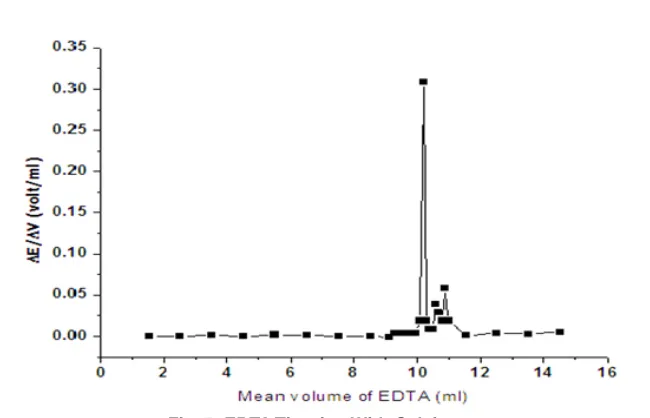
The electrode potential for a series of standard solution of Ca(II) ions was measured using potentiometer. The electrode gave a linear response to Ca(II) ion concentration range of 1M to 1x10⁻⁴M.
The values are given in Table-1.Standard Electrode potential(E0) was determined by standard methods
(Gurtu and Gurtu,2011) at 250C, it was found to
be 0.023V. The slope value was obtained from the calibration curve fig-4 & it was found to be 33 mv/ decade.
Effect of ph on electrode response
The effect of pH on the response of
electrode was studied in this work. The electrode potential of standard Ca(II) solution of varying pH had been measured. It was found that the electrode worked well over a pH range of 5.57to 6.24 Table 2.
Effect of Medium
The influence of the electrode was also investigated in a partially non-aqueous media using 25-75% water-acetone, water-DMA, & water-ehanol. The working non-aqueous media of the electrode was found to be 25% acetone medium, DMA medium in the conc of 10-4M Ca2+ ion. 50% of ethanol medium
in the concentration range of 10-2 M of Ca2+ ion.
Selectivity
The potential response of the prospoed electrode to common cations were investigated by fixed interference method. (Semi-empirical Nicolski-Eisenmans equation). It was found that the potential remains unaffected in the presence of Na+ & K+
cation.
Analytical applications
1. Shamsipur.M , Soleymanpour.A , Akhond.M, Sharghi,.H and Massah, A.R”Uranyl selective PVC membrane electrodes based on some recently synthesized benzo-substituted macrocyclic diamides,” Talanta,2002, 58,2, 237–246,
2. ZhangZ.R and yu,R.Q “The synthesis and membrane transport characteristics of macrocyclic polyether ligands composed of 1,10-phenanthroline as carriers for primary amine species,” Talanta, 1994.41, 2, . 327– 333, .
3. Singh,A.K Saxena.P Mehtab.S and Gupta.B “Strontium(II)- selective electrode based on a macrocyclic tetraamide,” Talanta,2006 . 69, 2, . 521–526,
4. Singh,A.K Saxena,P and Panwar, A”Manganese(II)-selective PVC membrane electrode based on a pentaazamacrocyclic manganese complex,” Sensors and Actuators B,2005 . 110, 2 .377-381.
5. Ganjali, M.R, Razavi,T , Dinarvand,R , Riahi,. Sand Norouzi.P “New diltiazem potentiometric membrane sensor stands on theoretical calculations as a useful device for diltiazem hydrochloride analysis in pharmaceutical
formulation and urine,” International Journal of Electrochemical Science,2008, . 3, . 1543–1558,
6. GanjaliM.R, Memari.Z Faridbod.F and Norouzi.P “Samarium microsensor: an asymetric potentiometric membrane sensor,”
International Journal of Electrochemical Science, 2008 . 3, .1169-1179.
7. Beheshti S.S,and AminiM.K, “A simple and selective flow injection potentiometric method for determination of iodide based on a coated glassy carbon electrode sensor,” International
Journal of Electrochemical Science,2007.
2,778–787,
8. Zhang.H , Zhang.Z, li.J and Sh. Cai, “Effects of Mg2+ on supported bilayer lipid membrane on a glassy carbon electrode during membrane formation,” International
Journal ofElectrochemical Science,2007 ,2,.
788–796,
9. Paker.P, McGraw-Hill Concise Encyclopaedia
of Science and Technology,1994
McGraw-Hill, New york, Ny, USA,
10. D’Souza,.S.F,”Microbial biosensors,”
Biosensors and Bioelectronics, 2001,16, 6, 337–353,