39
Volume LIX 4 Number 7, 2011
INTELLIGENCE ANALYSIS – THE ROYAL
DISCIPLINE OF COMPETITIVE INTELLIGENCE
F. Bartes
Received: September 20, 2011
Abstract
BARTES, F.: Intelligence analysis – the royal discipline of Competitive Intelligence. Acta univ. agric. et silvic. Mendel. Brun., 2011, LIX, No. 7, pp. 39–56
The aim of this article is to propose work methodology for Competitive Intelligence teams in one of the intelligence cycle’s specifi c area, in the so-called “Intelligence Analysis”. Intelligence Analysis is one of the stages of the Intelligence Cycle in which data from both the primary and secondary research are analyzed. The main result of the eff ort is the creation of added value for the information collected. Company Competiitve Intelligence, correctly understood and implemented in business practice, is the “forecasting of the future”.That is forecasting about the future, which forms the basis for strategic decisions made by the company’s top management. To implement that requirement in corporate practice, the author perceives Competitive Intelligence as a systemic application discipline. This approach allows him to propose a “Work Plan” for Competitive Intelligence as a fundamental standardized document to steer Competitive Intelligence team activities. The author divides the Competitive Intelligence team work plan into fi ve basic parts. Those parts are derived from the fi ve-stage model of the intelligence cycle, which, in the author’s opinion, is more appropriate for complicated cases of Competitive Intelligence.
Competitive Intelligence, work plan, intelligence analysis, team work, systemic application discipline, added value
Business corporations that want to play an important role on international markets begin to feel to an ever greater extent the need for specifi c information that goes far beyond the scope of information obtained from routinely performed analyses. Present-day information systems register and evaluate past realities to serve bookkeeping needs and to help monitor the fulfi lment of the company’s business plan, and even that with a time lag. Such information systems do not as a rule allow for the processing of derived information that is very necessary for further development of the business corporation, such as the price developments, the reasons for their fl uctuations, directions in the development if individual types of innovations, market development, strategies adopted by competitors, their intentions, etc. The risks posed to a business by the lack of important information can hardly be overestimated.
Another great risk mentioned by Liebowitz (2006) is that if a company does not have the right information,
its strategy may deviate from market conditions existing on the given market. This fact will then very strongly impact the company’s competitiveness on that market. Similar views have also been expressed by P. Drucker (Drucker, 1992). Delayed or even outright false intelligence may be the cause of a company’s signifi cant losses, and not only fi nancial ones, but also of goodwill, and may endanger the company’s current position on the market. This is even more true in international trade, where the rivalry among competitors is more intense.
depends on the level of intelligence analysis of the information obtained.
It follows from an analysis of available literature on job descriptions of and procedures used by professionals in Competitive Intelligence (CI) that – especially in its most demanding area, i.e. the intelligence analysis – there is no well-established or standardized methodology except a defi nition of basic activities in individual stages of the intelligence cycle. See publications (Fuld, 1995), (Kahaner, 1997), (Liebowitz, 2006), (Hall & Bensoussan, 2007), and especially (Carr, 2003), in which working methods of 15 leading Competitive Intelligence specialists from the USA are described.
In that publication, the renowned specialists describe Competitive Intelligence in many diff erent ways, as a cycle, linear process, a four-phase model, scientifi c technique, and even a pyramid. These acknowledged specialists use diff erent approaches and methods in diff erent phases of their Competitive Intelligence model to obtain the necessary information. But when it comes to the most important activity that should be performed as part of the Competitive Intelligence process, i.e. transformation of information into intelligence, their statements are very sketchy and vague. In their statements they mention the use of various techniques, o entimes routines, that that particular CI specialist found useful and hence keeps on using.
METHODS
The aim of this article is to propose work methodology for the CI team for one of the intelligence cycle’s specifi c area, for the so-called “Intelligence Analysis”. The methods used in writing the article included analysis, synthesis, induction, deduction and comparison.
To achieve the aim set for the paper, it is important that we correctly understand the meaning of Competitive Intelligence1. In order to determine the proper scope of the term Competitive Intelligence, we should set out from the requirements of the company’s senior management on necessary source material that is need for strategic decision making. That means that Competitive Intelligence must be able not only to gain information important for the company’s strategic decision making but also to produce the added value to the information by its correct analysis and evaluation. Associated with the
added value is then the creation of “intelligence”2” with the help of which the fi rm’s TOP management can gain distinct competitive advantage over its competitors on the respective market.
To defi ne the scope of the term Competitive Intelligence in such a way that it fulfi ls the above requirements, it is necessary to deal fi rst with the term “information”. Literature (Ehleman, Rosický, Vodáček, 1994) off ers diff erent views of the importance of the term information, refl ecting at least the following concepts:
a) Information is considered an objective entity, i.e. immutable and independent of its recipient, whereby it is in fact a resource accessible to everybody, and the decisive role is played by its accessibility, possibly also processing based on formalized procedures.
b) Connection between information and its recipient and his possibilities to act, whereby only data are considered immutable: they represent the form whose content is interpreted by the recipient against the backdrop of his knowledge and experience. In this concept, information acquires a subjective dimension in addition to issues relating to its transfer and transformation, its validity, competence of the recipient and the sender, etc.
From a comparison of the above two basic approaches to the concept of information, it transpires that for securing successful implementation of Competitive Intelligence the latter approach to information is appropriate, and that in processing information we will have to take into account the context that could help us gain competitive advantage, and that is set up by experience, expertise as well as intuition and creative abilities of the person doing the processing.
In this respect, it may be illustrative to quote also T. S. Eliot3: This is a case when it is necessary to take into account not only terms, trends, principles for this or that isolated case, but to demonstrate “universal intelligence”, the ability of a broad grasp of a problem, orientation in many directions, with all the factors, all conditions, all circumstances.
It means that the process of the so-called intelligence analysis must generate added value for the information obtained whereby intelligence proper is produced – i.e. the above-mentioned forecasting the future that constitutes the basis for
1 In the Czech version of his paper, the author uses the English term “Competitive Intelligence” rather than any of the term’s Czech translations. Authors of Czech texts very o en use the term “konkurenční zpravodajství” (which in fact is a literal translation of the English term Competitive Intelligence). Some objections to the use of the Czech term in the real practice of businesses have been raised because its meaning is considered rather vague and more o en than not to be very close to industrial espionage or even its synonym, which is in complete contradiction to the essence of the Competitive Intelligence discipline.
2 In the entry Intelligence and Counterintelligence, Encyclopaedia Britannica states: Intelligence means, basically, evaluated information.
strategic decision making of the company’s top management.
For truly successful and credible application of Competitive Intelligence in business practice, we should bear in mind that these issues must derive directly from principles of the work of intelligence services that is indispensable in that it provides support to decision making at the national level, with a diff erence in that competitive intelligence relies only on legal information sources and legal methods of operation. The reason for adopting that principle is the fact that it has proven itself in practice. If the legality and ethics conditions are complied with, Competitive Intelligence serves as a powerful weapon for a company’s management if used properly. This interpretation of the very essence of Competitive Intelligence activities distinguishes us from a majority of authors, whose concepts of Competitive Intelligence are usually limited to some kind of an “external” form of Business Intelligence, or to only strategic analysis of the problem at hand.
It follows from the above that Competitive Intelligence, correctly understood and implemented in business practice, essentially equals to the “forecasting of the future”.
And it is only thus construed Competitive Intelligence that is of importance for businesses.
Generally, Competitive Intelligence should fulfi l the following requirements:
a) To detect in time the company’s key threats presented by the external environment.
b) To provide information for possible solution to those threats.
RESULTS
Defi nition of Competitive Intelligence
On the basis of the above outline of our approach to the issues discussed, we can propose a defi nition of the term Competitive Intelligence.
The Society of Competitive Intelligence Professionals (SCIP), defi nes Competitive Intelligence as a systematic and ethical program for gathering, analyzing, and managing external information that can aff ect your company’s plans, decisions, and operation (SCIP, 2010).
For our concept of Competitive Intelligence, we are fi rst going to defi ne the scope of its activities (Bartes, 2011):
Competitive Intelligence is a methodological complex, in this application designed for commercial purposes, and it is an instrument of the fi rm’s management for the creation of documentation for the management’s strategic decision making (regarding, e.g., innovations,
investments, further direction of the company’s development, etc.).
In support of our interpretation of Competitive Intelligence as an independent discipline, we wish to quote the criteria used to decide whether a discipline is independent as formulated by Jaroslav Vlček4. He believes that a discipline must meet the following four prerequisites to be an independent discipline (Vlček, 1984):
a) Separability of the discipline’s subject matter (object) from that of other disciplines.
b) Creation of a new terminology, a new technical language that is used to unambiguously describe the new subject matter as well as the new methods of the discipline.
c) Development of its specifi c methods appropriate for the resolution of new tasks in the discipline’s subject matter.
d) Usability in practice that will confi rm that the theory is correct and true, and socially useful. In the following text, we will present some of our comments to the above prerequisites for independence of the Competitive Intelligence discipline.
Meeting the fi rst prerequisite, i.e. the separability of the discipline’s subject matter from that of other discipline, can be documented by an absolutely basic, exclusive and explicitly defi ned object of professional interest of Competitive Intelligence, which is the creation of intelligence as a specifi c source material for strategic decision making by a company’s top management.
The second prerequisite that proves
independence of a discipline is the creation of new terminology, of a new technical language. This fact can be fully proven by publications of accomplished foreign authors. For instance: (Car, 2003), (Fuld, 1995), (Fuld, 2010), (Hall, Bensoussan, 2007), (Kahaner, 1997), (Liebowitz, 2006) and others.
The third prerequisite of a discipline
independence is the development of its own methods that respect the manner of, and specifi city in, dealing with the task in the discipline’s subject matter. This prerequisite is being abundantly fulfi lled through the ever-growing system of methods especially developed for the needs of Competitive Intelligence5.
The fourth prerequisite of independence of a discipline is its usability in practice, and not only our experience but also experience from other countries6 testify to how very important the use of Competitive Intelligence is in business practice.
In 2010, the author of this paper proposed the following defi nition of the term Competitive Intelligence (Bartes, 2010):
Competitive Intelligence is a systematic, creative and ethical application of intelligence methodology and key methods, which, with the use of team work: • fi nds, identifi es symptoms or data and information
sources,
• analyzes the collected symptoms, data and information, and complements them, assesses their importance and makes them into proofs of phenomena,
• transforms information into coherent hypotheses (forecasts of the future) for changes, and evaluates their benefi ts through evidence and costs brought about by the changes as the eff ectiveness of those changes,
• produces intelligence reports for the company management’s decision making.
From the above interpretation of the term Competitive Intelligence it follows that we perceive Competitive Intelligence as one of application disciplines of a systems theory (Bartes, 2010).
This perception then allows us to propose a “Work Plan” for Competitive Intelligence as a fundamental standardized document to steer CI team activities. In specialist literature, we come across terms “system” or “systemic approach”. Notably the second half of the twentieth century witnessed the spreading of the systemic approach in connection with the engineering concept applied to the resolution of systemic technical, economic, ecological and even social problems (Molnár, 2007). The approach to the resolution of these problems is based on a markedly interdisciplinary character requiring a team-based type of work. For this level of solutions, the systemic engineering is used.
At this stage of deliberation, we will focus on the essence of the systemic approach, on the defi nition of the term “system”. If we set out from the Boulding’s classifi cation of systems (Habr, Vepřek, 1972), it is clear that Competitive Intelligence can be classifi ed into the eighth category of systems (social system, system type: enterprise, city, state etc., typical characteristics: role creation, value system). We perceive systems featuring symbiosis between human and technical subsystems as the so-called so –systems–engineering. Systems in this sense are characterized by the following attributes (Dráb, Řezníček, 1975):
• a system has its aim or mission (i.e. its social function),
• a system has a criterion according to which it can assess its behaviour,
• a system contains subsystems that are systems at their respective levels; at the same time, these subsystems are mutually interconnected usually by complicated bonds,
• a system is open; it exists in an environment with which it is connected by bonds,
• a system has material and human resources to its disposal, whose eff ective use it is supposed to provide for,
• a system is managed,
• a system’s stability is guaranteed over a certain period of time with a high degree of probability. These system characteristics correspond to the description of CI as a method very suitable for obtaining source materials and knowledge necessary to work out corporate forecasts and strategies.
The methods that can be considered as systemic application disciplines are characterized by (Habr, Vepřek, 1972):
1. Immediate practical applicability to deal with material and control systems where traditional procedures fail to fi nd a solution.
2. Interdisciplinary character of the methodology both in the sense of capitalizing on knowledge from a number of scientifi c disciplines and in the sense of the ability to deal with various technical and organisational systems.
3. Functional approach and functional modelling in combination with other modelling procedures with the objective of obtaining an assessment of the initial and the target situations.
4. Teamwork, which is a fundamental organisational principle in ensuring the comprehensive and interdisciplinary nature of dealing with, selecting and assessing a new approach in practice. 5. A work plan, i.e. a sequence of steps, activities and
operations or algorithms in the process of solving problems and tasks, which is implemented through a team’s working procedure, and associated with a degree of formalization of certain activities.
Some characteristics of systems according to Chestnut (Chestnut, 1967) are listed below:
• A system is not permanent but changes in the course of time.
• Diff erent methods are available for attaining results.
• A common basis exists for the assessment of systems (function, performance, speed, accuracy, effi ciency, costs, space, reliability, time factor, solution time, service life, etc.).
• A system can be considerably infl uenced by its environment.
The above characteristics of system application disciplines absolutely accurately describe the essence of Competitive Intelligence as a system application discipline focusing on the gathering and producing source materials for corporate forecasting and the development of corporate strategies. As mentioned earlier, the need to tackle those tasks at a high level comes to the fore to an ever larger extent.
no Czech or foreign authors mention this manner of approach to Competitive Intelligence.
In this respect, we furthermore consider it important to outline our concept of activities7 of the Competitive Intelligence department in a company. Its activities are basically performed at two levels described below.
Level One of Competitive IntelligenceActivity consists of continuous monitoring of the company’s external environment. That usually involves: • market,
• competitors, • customers, • sector,
• business associates.
The following methods of the gathering of information on competitors can be used in the case of this Spefi s activity. Kotler (Kotler, 1991) distinguishes the following four basic concepts:
1. Indirect surveillance: general monitoring of data
without any specifi c objective.
2. Conditional surveillance: monitoring of a certain
area without a targeted search for specifi c information.
3. Informal research: search for specifi c information
without an explicitly structured procedural methodology.
4. Formal research: gathering of specifi c information
according a plan and procedures selected in advance. Figures, data and information are processed by a routine information analysis (Bartes, 1997), usually performed by the staff of the Competitive Intelligence department itself. Results of such an analysis are used to update the already gathered information on the objects of interest investigated by out Competitive Intelligence department. The results are mainly used in the process of the company’s everyday operating management.
We recommend that the so-called Early Warning System be included at this level as an independently managed entity. The capture of an important signal serves as one of possible triggering factors for the activation of the second level of Competitive Intelligence activities.
For more details, see e.g. (Bartes, 1997) or (Hammer, 2002). For example, Fuld suggests the following concept of an early warning system (Fuld, 2010):
1. Dra ing possible directions for future development.
2. Determining what signals need to be monitored in each possible future scenario.
3. Allocating staff for the monitoring of those signals as part of their everyday work.
4. Ensuring the company’s rapid response in case one of the future scenarios becomes reality. Level Two of Competitive Intelligence activities may be triggered by various factors including:
• in response to the results of a routine information analysis conducted for Level One activities of Competitive Intelligence,
• when an important signal has been detected by the early warning system (e.g. signal that a competitor is contemplating changes, the competitor’s success or failure, identifi cation of a milestone of an unexpected hypothesis, etc.),
• decision by the company’s TOP management. At Level Two of Competitive Intelligence activities, the so-called “Intelligence Analysis” is performed in addition to the gathering of other necessary data and information, and the output of it should provide a new insight, i.e. intelligence.
Intelligence analysis
The purpose of intelligence analysis is to help tackle demanding and specifi c tasks that are posed by the situation on the market at the time of considerable uncertainty for the decision-making process.
Intelligence analysis can be defi ned as a demanding and specifi c process of analysis and synthesis of the data and information gathered with the objective of generating added value that can be used in strategic decision-making activities of the company’s top management.
In practical business terms, it means to grasp the meaning of the data and information within the context of an opportunity to gain or create a competitive advantage for one’s company. This approach is most o en used to learn about the competitors’ future intentions. One of the objectives of a company’s Competitive Intelligence and, at the same time, a criterion of its quality, is the attainment of intelligence advantage over competing busi-nesses.
In order to provide for the necessary links and activities that are needed for a successful execution of these very demanding operations, we recommend that the execution of intelligence analysis follows specifi c steps, i.e. the Work Plan of the Competitive Intelligence Team. In this paper, Competitive Intelligence is characterized as a systemic application discipline, from which, among others, the following are expected:
• team work,
• a work plan of team’s activities.
Team work is an organisational principle for the assurance of comprehensible and interdisciplinary task resolution in practice (Dostál, Loubal, Bartes, 2009). This requirement dictates the team composition. An important role is played by the team head and a CI method consultant, which usually are two diff erent people. Other members of the team must have necessary qualifi cations for tackling the task set to them, and they may also
include contract workers. The basic team should not have more than 8 members, other workers may be invited to join them when the situation requires.
A work plan is made up of a logical sequence of phases, steps, activities or operations in the process of solving assigned tasks, which is carried out by: • applying a formal logical principle of economic
priority (Vlček, 2002) in a decomposition of a given system in the case of in-house tasks;
• formalizing certain activities by means of certain methods;
• using team work.
Work Plan for Competitive Intelligence:
The intelligence community uses several types of the intelligence cycle8. In their practice, companies have opted to use the classical four-stage intelligence cycle, which is suffi ciently well-known to the expert community.
Judging by practical application of both the above intelligence cycle models, we may say that the fi ve-stage intelligence cycle model has proved more useful for rather complicated cases of company practice. For that reason, we will consider the fi ve-stage model of the intelligence cycle in this paper. The fi ve stages that constitutes the intelligence cycle are:
I Planning and direction of the intelligence cycle. II Gathering information and conducting research. III Processing and storing of information.
IV Intelligence analysis of information. V Intelligence dissemination.
Basic parts of a work plan
The entire Work Plan is divided into fi ve basic parts that correspond to the above fi ve stages of the Competitive Intelligence cycle, and in which individual issues of the task set to us are dealt with.
Part 1: Planning and clarifi cation (includes Phase 0)
The aim of the fi rst part of the Competitive Intelligence plan is primarily to clarify the task set, and to create conditions propitious for its successful completion.
Part 2: Gathering information and conducting research (includes Phases 1 and 2)
The aim of the second part of the Competitive Intelligence plan is characterized by activities focused on preparation and gathering of the necessary facts, data and information related to the task assigned.
Part 3: Processing and storing of information (includes Phases 3, 4 and 5)
Part 3 of the Competitive Intelligence plan is comprised of phases contributing to the creation of information, its analysis and storage. At the end of
this part, possible hypotheses – forecasts about the future – are dra ed.
Part 4: Intelligence analysis of information (includes Phases 6, 7, 8, 9, 10 and 11)
The core activities of Part 4 of the Work Plan for Competitive Intelligence are analysis and evaluation of individual hypotheses. Moreover, possible strategies are dra ed that our company might adopt in response to individual hypotheses that competition might decide to implement on the market. At the end of this part of the Work Plan for Competitive Intelligence, evaluation is performed and check points – the so-called milestones – are determined. They will be used later on for the identifi cation and monitoring of the development of the hypothesis implemented by the competition.
Part 5: Intelligence dissemination (includes Phase 12)
In Part 5 of the Work Plan for Competitive Intelligence, a report is written for the TOP management of the company and it is submitted to the appropriate senior managers.
Work plans of systemic application disciplines consist of phases and steps. At this point it is important to stress that, rather than being just a set of instructions for a mechanical execution of assigned tasks, a work plan is a guideline that requires a creative approach to the execution of the application on each task carried out. This creative approach does not mean, e.g., the use of a specifi c method of creative work, but profound knowledge in the discipline of such methods. Some of them can then be applied in certain phases of team work. The execution of each phase is obligatory, and a written report must be made of it. It is true that some steps in a specifi c phase may be skipped, but then a written justifi cation for it must be given. Competitive Intelligence represents a very broad system application discipline that necessarily concerns the general and industrial environment of an enterprise; see (Brychta, Svirák, 2010; Beranová et al., 2010; Landa, Martinovičová, 2010; Svoboda, 2010).
Work Plan of Competitive Intelligence: Detailed description
The Competitive Intelligence Work Plan consists of 13 phases:
Phase 0: Preparation of a task for the Competitive Intelligence Team by company management
0.1 Important information discussed by the company’s management (Spefi s).
0.2 Decision on the form of the execution on the basis of information (+/−).
0.3 Decision on the setting up of a task. 0.4 Selection of a competent task leader. 0.5 Establishment of a task-resolution team.
0.6 Setting the deadline for report submission.
Phase 1: Collecting symptoms, data and information for the assigned task
1.1 Gathering data about the project, technical and economic information, on competitors, on new developments in technology, on the market, on the industrial sector, etc. see (Blažek at al., 2010; Svoboda, 2010).
1.2 Analysis of functions. (Of all kinds, not only about the product, but also about relationships e.g. between companies, etc. see (Kocmanová, Němeček, 2008).
1.3 Economic analysis of the company’s starting position.
1.4 Study of the sector’s development, history and the present-day situation.
1.5 Preparation of the team’s work schedule.
According to, information gathering in Competitive Intelligence is performed in two phases:
a) Phase I. Secondary research (about 80% of information volume gathered in 20% of the allocated time).
b) Phase II. Primary research (20% of information volume collected in 80% of the time).
Results of the secondary research point the way for the primary research. Sources for secondary research are press releases, analytical reports, business journals, legislative sources, records of speeches and other published sources of information. An enormous amount of information that we collect (about 80%) comes from the secondary research. When we have sieved through this mass of information where we fi nd “gold nuggets” from the Competitive Intelligence point of view, we move on to Phase II. Primary research is more immediate, and has a more practical focus. It involves interviewing sources of published data, face-to-face meetings with those whose decisions are critical for future developments, and helps unearth new facts that were not discovered during secondary research. During primary research, we should spend most of the allocated time (80%) on relevant information (20%) gathered during secondary research.
Secondary research is usually simpler than primary research because secondary sources of information are generally well-known. Primary research is more complicated because it involves investigative kind of work in which we are trying to trace future events.
At this phase, the team leader is supposed: a) To determine what sources of information
we want to use. At present, the Internet is the fi rst source. It is also possible to use seminars, conferences, exhibitions, specialist literature, patents, norms, statutes, regulations, etc.
b) To determine the character of the task (issue) that is to be resolved, and to decompose it into individual constituent subsystems.
c) To determine the type (domain) of information necessary for each of the subsystem, and to identify possible sources.
d) To appoint team members who will search for and collect information.
e) To appoint team members or other workers who will prepare:
f) functional analysis of the problem, g) economic analysis of the problem,
h) history of, and contemporary developments in, the fi eld to which the problem belongs.
i) To set the dates of individual team meetings for the gathering of information.
j) To set up time schedule of work for the team and of cooperation with the company’s specialist departments.
For this activity, a certain formal procedure needs to be established. This will guarantee the record-keeping of necessary documents and, if performed properly, it will mainly prevent any loss of information. For that reason, it is advantageous to set up a formalized method of recording information. At this phase, it will mainly be a secondary research form.
Because the character of some information may already be that of primary research, i.e. complementing information from the secondary research, it is useful to design a form for primary research at the same time.
Every datum or piece of information that is collected needs to be evaluated from at least the following points of view:
• timeliness, • relevance, • completeness,
• reliability of its source, • truthfulness,
• importance.
The simplest evaluation of some of the criteria can be made on a scale of 0 to 5. Evaluation of collected data truthfulness is performed using the information analysis methodology (for more information, see Bartes, 1997). At the end, it is necessary to decide which sources are to be developed further. That will take us to Phase 2, i.e. the primary research.
Phase 2: Analysis of symptoms, data and information gathered
2.1 Classifi cation of the data gathered.
2.2 Determining the information reliability, importance and truth value.
2.3 Determining the signifi cance of information. 2.4 Evaluation of our company’s and our
competitors’ subsystems.
2.5 Creating a set of data for the evaluation of subsystems (product, services – verbal, economic, parametric, etc.) of our company and those of our competitors.
The main objective of the previous phase was to collect source material for the assigned task. The symptoms, data or information collected may not, however, form a coherent set that can be directly used to decide about how the assigned task can be accomplished. It is then necessary to make an analysis of what we have collected, and to decide what that source material can be used for. It is important to bear in mind that the gathering of information is always a compromise between what we could learn and the time set for that purpose, therefore:
1. Sort out the facts and information collected as soon as possible and only then analyze what, if anything, is le .
2. Don’t confuse information analysis with the searching for, or devising a solution to, the task. 3. From the source material collected, create data
sets that have an informative (diagnostic) value for specifi c company subsystems.
4. If you are missing some data from the data system, specify what they are and from what sources they can be obtained.
At this phase, we must divide the data collected into:
• symptoms,
• data (e.g. parameters, economic data, etc.), • information about the problem,
• functions.
Furthermore, it is important to understand that above the corporate system there are superior systems within which the company in question is located. The most important of those superior systems is market governed by an economic climate for doing business created by a higher-ranking organisation such as the state, etc.
This classifi cation is important when we create sets, and especially when we decide whether a set has a suffi cient informative value, or whether more data are needed to supplement it. It means that in this phase of intelligence work we establish what more data we need, and then we continue in primary research.
Discussing analysis, P. Drucker (Drucker, 1992) says that we must:
• focus on our market,
• identify the most important forces in the market and thus to focus time and eff orts,
• understand what strategy is being implemented by the target company (the competition), and to collect all the information and analytical results that will help us infl uence that strategy.
In his comments on analysis, Fuld (Fuld, 1995) points out:
• a comparison with the competition leads to doing things better, and not to defend oneself,
• In business, fi rms compete with each other by competing for customers with their products and services; this has many dimensions such as the price, services, quality, features, delivery, etc.
• To develop innovations targeting gaps in the market, innovation teams, to foresee market needs, engage customers, etc.
• Not to search for business secrets but monitor patents instead, many of which are available in global databases (WORLD PATENS INDEX 1980: 2 036 030; 1994: 6 735 379).
The analysis can be performed in a verbal, graphical or tabular form.
Phase 3: Creating information out of collected data and symptoms by logical compilations
3.1 Determination of information that can be combined that represents possible variant solutions.
3.2 Selection of a method for the identifi cation of variant solutions.
3.3 Performing a methodical comparison of the current situation in our company and in our competitors.
3.4 Identifi cation of information that have the value of arguments or criteria.
3.5 Obtaining additional necessary information. A er we have gathered a suffi cient amount of information on trends in our competition and the industry in which we do business in general, it is useful to identify possible variant responses to our competitors’ future steps. We set out from the gathered information whose content makes it possible to plot various courses of action that our competitors may take. The use of a suitable methodological apparatus can speed up the identifi cation. One of possible approaches is the use of the combination matrix method. A set of information on the respective problem, especially on its possible development in our competitors, can be placed to the matrix. We then have to defi ne mutual relationships among the data in the matrix. The following ones are usually defi ned (Bartes, 1997):
• information that is mutually conditioned – the truth (implementation) of information “A” is conditional on the truth (implementation) of information “B”. It is denoted by the letter T in the matrix;
• information mutually dependent:
a) bilateral dependence, information is true if the other information is also true. This information, too, is denoted by the letter T in the matrix;
b) unilateral dependence – one information depends on another, but that other information is independent of the fi rst one. They are denoted by the letter D in the matrix;
• information that is mutually exclusive – it cannot exists (be implemented) side by side in a single variant solution. It is denoted by the letter E in the matrix;
independently of other information in the entire group. It is denoted by the letter I in the matrix. (Matrix TDEI).
Table I gives as an example a matrix for 7 pieces of information.
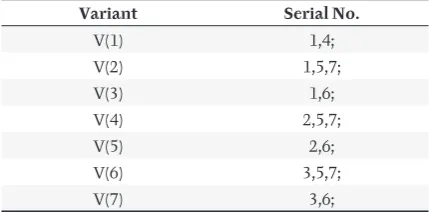
Comprehensive solution variants ensuing from the matrix which are subject to evaluation in the next phase, see Table II.
Solution variants compiled from initial information do not as a rule have the value of a hypothesis. There is usually many of them. If not, then we have probably failed to collect enough information necessary for the resolution of the assigned task. It is therefore necessary to check whether the initial impulse for the task assignment is not based on some kind of “wishful thinking” of some self-proclaimed expert, or whether it is deliberately misleading information (disinformation). We should immediately inform the management about the situation and, with its approval, we can proceed to the next phase.
When making systematic comparisons between our company and the competition, we will also compare our products with theirs. Such a comparison is usually based on the so-called parameters, but can also use the product’s functional characteristics, or the company’s economic characteristics. For all these evaluation sets, a simple procedure, “best value technique”, can be used. Based on a principle proposed by Dr. Kesselring
(Kesselring, Ern, 1971), the technique was further developed by (Uhlig, 1970) in two directions:
a) It uses quantifi ed values of relative importance of parameters (functions, characteristics) wi and the values are normalized to a range of 0 to 100; b) it sets out from the use of scales for the evaluation
of individual parameters, which are normalized to values aij on a 0.00 to 1.00 scale.
To normalize (Xij) parameters, the value of a ij is calculated:
• if the best value is the maximum (Xmax) value of the parameter, as the ratio of the specifi c value of the i-th parameter of the j-th product and that maximum value of the parameter in the set; • if the best value is the minimum (Xmin) ascertained
value of the parameter, as the ratio of that minimum value and the specifi c value of the i-th parameter of the j-th product.
In this way, the matrix of normalized parameter values is determined. These values are then multiplied by quantifi ed values of relative importance of Wi parameters The sum of products a ij x wi then gives the value of the product in question.
At this phase of activities, it is useful to use the value chain, which will facilitate to clarify the situation with regard to the company’s activities. They are methods used to describe various aspects of your company or of your competitors. Those methods include:
a) SWOT analysis, b) SAP method,
c) growth – share matrix (BCG),
d) market attractiveness – competitive position matrix,
e) survival matrix,
f) vulnerability matrix, etc.
Phase 4: Dra hypotheses for task resolution
4.1 Existing ideas and suggestions on possible alternative solutions.
4.2 Selection of possible hypotheses out of alternative solutions.
4.3 Critical analysis of the hypotheses according to adopted criteria (arguments, information). 4.4 Selection of interesting hypotheses based on the
assessment.
In this phase, we draw on the alternative options set up from information in Phase 3. We may wish to add our opinions to the combination of the competitors’ possible steps that we obtained. Of the set of the competitors’ possible activities, we then have to select those that we consider as “probable” or, for whatever reason, “interesting”. We now have to set up a set of criteria for the evaluation of the hypotheses thus selected. Criteria may have importance assigned to them (but it is not necessary). The main thing is to decide which I: An example of a matrix for 7 pieces of information
Information Serial No. 1 2 3 4 5 6 7
I (1) 1 X E E D I I I
I (2) 2 X E E I I I
I (3) 3 X E I I I
I (4) 4 X E E E
I (5) 5 X E T
I (6) 6 X E
I (7) 7 X
Source: Dostál et al., 1977.
II: Combination of variants from the initial information
Variant Serial No.
V(1) 1,4;
V(2) 1,5,7;
V(3) 1,6;
V(4) 2,5,7;
V(5) 2,6;
V(6) 3,5,7;
V(7) 3,6;
criterion, and how many of them, the hypothesis9 meets (identifi ed with a + sign).
The criteria that are not in harmony with the hypothesis can be identifi ed with a minus (−) sign. Such an evaluation can again be performed using a matrix (see Table III). This will in fact for the fi rst time defi ne the “probability” of the competition taking such a step (hypothesis).
When creating hypotheses, we are in fact creating strategies (or subsequent steps) that we can expect from the competition, and it means that in subsequent phases we will have to consider our responses to those strategies of the competitors. When formulating hypotheses, we will set out from the created comprehensive variants from those pieces of information that do not contradict each other. Those variant then represent the fi rst step in the formulation of hypotheses (strategies) of our competition that we will complement with the assessment of their products or services compared with ours.
A correct assessment of those products and services is important for a comparison with the hypotheses because it helps better defi ne our position in the competitive struggle.
Phase 5: Proposals for other possible hypotheses for the resolution of the assigned task
5.1 Summary of all the information, parameters, criteria and arguments gathered for the task. 5.2 More accurate formulation of the task objectives. 5.3 Team work to generate ideas for a new solution. 5.4 Critical analysis of suggested ideas.
5.5 Combining ideas to create new versions of comprehensive solutions.
5.6 Combining new variant solutions with previously proposed solutions, and dra ing comprehensive solutions to the problem – hypotheses.
In the previous phase, hypotheses from the information obtained were generated more or less mechanically. But we know that some information may also bring to mind other associations or ideas
than those that we already have. For that reason the team, now complemented with necessary specialists, will implement the “creative work” phase, when any additional hypotheses related to the information gathered can be put forward.
In this phase of team work the importance of the team leader comes to the foreground.
The team must now evaluate the proposals put forward from the following points of view:
• a novel perspective on the competition’s possible strategy – contribution to existing analysis Evaluated (+) because it may constitute a new hypothesis,
• complements existing analyses, and helps further develop existing hypotheses. Evaluated (+), • topic unsuitable for the above purposes, evaluated
(−),
• assessment of possibilities to combine the topics with previous information,
• construction of a new matrix of proposals and defi ne new combinations that could represent new hypotheses,
• selection of hypotheses for further assessments according to Phase 4 criteria.
Phase 6: Evaluation of all hypotheses
6.1 Drawing up a list of evidence and arguments for each hypothesis.
6.2 An analysis of diagnosticity of evidence and arguments for the evaluation of hypotheses. 6.3 Critical analysis of hypotheses.
6.4 Technical and economic feasibility of hypotheses.
6.5 Selection of hypotheses for further task resolution.
Lists of relevant pieces of evidence and arguments are drawn up for all the factors that may impact hypothesis evaluation. They may include not only specifi c ones but also assumptions or logical deductions, possible objectives or some standardized procedures. That includes the following activities:
9 In Competitive Intelligence, the term hypothesis is not used in the sense of a scientifi c hypothesis, but rather in a broader sense as an assumption about something, e.g. about the future development of a sector, next steps of a competitor on the market, etc.
III: Assessment of hypotheses according to the criteria
Hypothesis K 1 K 2 K 3 K 4 K 5 K 6 K 7 Assessment Decision
H 1 + + + 3 (−)
H 2 + + + + + 5 +
H 3 + + + 3 +
H 4 + + + + 4 +
H 5 + + + + 4 +
H 6 + + 2 (−)
1. Drawing up a list of general pieces of evidence that are valid for all hypotheses.
2. Each hypothesis is tested individually and factors are listed that corroborate or invalidate it. Both existing and non-existing evidence is recorded. Past history is analyzed to determine what must have happened that led to the current situation, and what will happen should it change. We look forward to what is missing and should be there if our hypothesis is right.
We will then take all hypotheses and the set of arguments or evidence and will put them into the matrix. We take each argument or a piece of evidence individually and evaluate the extent of their relevance for each hypothesis. Relationships in the matrix can be evaluated as follows:
a) Using the plus (+) or the minus (−) sign to show whether the argument corroborates or refutes the hypothesis, respectively.
b) In the case of evidence, we must distinguish between relationships:
C – corroborates the hypothesis, R – refutes the hypothesis,
O – is irrelevant to the given hypothesis,
? – the case cannot be decided in the given situation.
Following evaluation in the matrix, we decide which hypotheses, arguments and pieces of evidence should be excluded for a lack of informative value (diagnosticity), see Table IV.
According to methodological instructions, the lines with the same evaluation for a hypothesis should be removed. They are lines A/D1 and A/ D7. The hypotheses proven unrealistic by any one piece of evidence should also be removed from the matrix. They are hypotheses H3 and H6. In this way, we manage to reduce the matrix for further processing.
It is now important to again accurately formulate hypotheses and confront them with arguments and evidence.
Next, we perform an evaluation of each hypothesis individually taking into account its
previous evaluation, and complementing it with further arguments or evidence, as the case may be, whose importance we can express by, e.g., points. The most probable is the hypothesis with the fewest arguments against (−), not the one with the largest number of arguments in support of it (+).
We propose that the thought quoted below constitutes the fundamental philosophy on which work in this (the sixth) phase as well as the rest of the phases (Phase 7 to 11) should be based (Jirásek, 2008):
At every present moment, elements of the future as well as elements of the past can be found. The future does not come into being all of a sudden (although it has periods of decisive changes), but in a process in which elements of the future get established while those of the past are being abandoned. The degree of social maturity and the rate of development infl uence the circumstances considerably. The major guidepiece of course is the new situation that the future resembles “corrected past” less and less as it continues to absorb new elements. Knowledge about the future needs to be sought – with some exaggeration – further and further“ ahead.
Phase 7: Assessment of proposed hypotheses from the point of view of their impact upon our company
7.1 Determining the eff ect of a change according to the hypothesis on the company’s position in a superior system.
7.2 Determining the eff ect of changing the hypothesis on individual subsystems in the company’s system.
7.3 Determining possible responses in the form of solution proposals on the impact of hypotheses on the company.
7.4 Evaluation of proposals, rejection of proposals that to not resolve the problem.
7.5 Creating comprehensive variant solutions. In the previous phase, we evaluated hypotheses regarding possible activities of our competitors. We chose activities (hypotheses) that show; in spite of certain information or arguments to the contrary, evidence-based feasibility (we were unable to refute them by a credible proof). Probative value must also be supported by an analysis of the competitor’s technical and economic possibilities, and an appropriate implementation hypothesis. If all prerequisites for the implementation of a specifi c change are met, that change can most probably be expected to happen. It is therefore necessary to consider what consequences those steps if taken by the competitor will have for our company.
In the fi rst place, it is important to consider the impact of hypotheses within the framework of the so-called “superior system”, i.e. usually the market on which we operate. We must consider what specifi c economic changes (which may sometimes be even temporarily positive) the implementation of a competing hypothesis will bring to us.
Secondly, we must analyze the impact on the system of our company taking into account the infl uence of the superior system. For both IV: Reducing the hypothesis, evidence and argument matrix
H1 H2 H3 H4 H5 H6
A/D1 C C C C C C
A/D2 O C R O O O
A/D3 C O C O C R
A/D4 C C O C O C
A/D5 O O C O C O
A/D6 O O O C C C
A/D7 O ? ? O ? O
A/D8 C O C C C O
A/D9 O O O C C C
A/D10 O C R C O O
evaluations, it is necessary to create a set of criteria according to the hypotheses of our competitors’ actions that we can use to evaluate the consequences of such a change, particularly for our company. It is a matter of fi nding arguments and evidence about whether individual hypotheses pose a threat or may damage us if implemented, or not.
It basically means to fi nd answers to at least the following questions (Fuld, 1995):
1. What does the new fi nding mean for the industry (sector)? 2. What does the new fi nding mean for our competitor? 3. What does the new fi nding mean for the competitors of
our competitor?
4. What does the new fi nding mean for our company and its customers?
A preliminary evaluation of the threat posed by the competition leads also to a preliminary dra of possible responses on our company’s part. It is essentially another phase of creative work, similar to the formulation of hypotheses in Phase 5. Using the same procedure, individual proposals can then be used to produce comprehensive alternative solutions as responses to individual hypotheses (matrix TDEI). These comprehensive alternative solutions can then be assessed in a matrix, into which we enter arguments for, and evidence of, threats to us, and determine their diagnosticity. This procedure helps eliminate needless variant solutions. Variant solutions to our situation may either be responses to the entire set of hypotheses or to each hypothesis individually.
Phase 8: Creating a strategy for our company as a response to hypotheses
8.1 Formulation of our company’s possible strategies on the basis of comprehensive variant solutions.
8.2 Selection of criteria for the assessment of selected strategy implementation.
8.3 Determination of a set of data or criterion values for the assessment of strategies or comprehensive variant solutions.
8.4 Assessment of completeness and eff ectiveness of our company’s proposed strategy, even in the case of the competitors’ zero activity.
In the previous phase, we will not be able to evade situations when we are unable to reach a conclusive decision on a specifi c hypothesis on the basis of information in hand. We might say that in each phase of our intelligence analysis we must enhance the informative value of some of the information. The same also applies to the hypotheses that were built on that information. That is the reasons why new hypotheses may emerge that were not considered before. In these cases, must also observe the methodological procedure.
Among proposals of our responses we may come across one that might represent the “blue ocean” strategy and will probably be unassignable to any hypotheses, but will eliminate them all. That in itself also means that we must take that variant
solution into consideration in our competitors, i.e. it constitutes a completely new hypothesis that has no support in any information that we have.
This phase will thus give us an idea of our company’s possible strategy in response to the generated hypotheses about competitors’ behaviour. Just as hypotheses, also strategies need to be evaluated in general terms in the fi rst step to determine if their implementation would be good for the company. The evaluation must take also into account the two extremes:
• competition will take none of the steps expected, • competition will implement an unexpected
change.
Our strategy must be eff ective even under these extreme case circumstances; see (Krause, 2010).
Phase 9: Confi rmation or refutation of individual hypotheses or strategies
9.1 Defi ning the relationships between hypotheses and strategies.
9.2 Specifying evidence and arguments for refuting hypotheses (strategies) and determining evaluation sensitivity.
9.3 Assessing economic cost of strategies for our company in relation to hypotheses.
9.4 Assessing the time horizon of a strategic change. 9.5 Assessing the importance or meaningfulness of
the strategic change for our company.
To determine mutual relationships between hypotheses and strategies, use the matrix in Table V.
S1 + S4 = H1 to H5.
In this way, the number of strategies is reduced from 4 to 2.
In the previous phase, we selected criteria for the evaluation of strategies, and now we can compare them with the criteria for hypotheses that are associated with those strategies. This off ers one more chance to assess and more precisely formulate arguments and evidence for hypotheses.
In Phase 6, we tried to calculate economic cost of hypotheses. Now we must at least try to estimate economic cost of our strategies, and compare the two. We must also estimate the time needed to V: Determination of mutual relationships between hypotheses and strategies
S1 S2 S3 S4 Evaluation
H1 + + 2
H2 + + 2
H3 + + 2
H4 + + 2
H5 + + 2
Evaluation 3 2 2 3 10
implement hypotheses and our strategies, which depends partly on technical problems of solutions.
These evaluations should give us answers to several questions:
1. Should we wait for the competitor’s initiative, or should we pre-empt it?
2. Do we have enough resources to put our strategy into practice?
3. Does our strategy have maximum and minimum versions, and does the same also hold true about hypotheses?
4. Are our strategic plans so well reasoned that we are sure that they are cost-eff ective?
5. Are there some arguments or evidence that might refute our plans as ineff ective or unrealistic? Such evaluations are not performed only at a company level but also at the level of entire countries. When assessing their economic power, some countries decided to take the road of “second wave of innovations”, i.e. to leave the initiative – and thus also the cost of developing a particular sector of economy – to economically more powerful countries, and then to exploit their results in one form or another.
Phase 10: Selection of hypotheses and corresponding strategic solutions
10.1 The ranking of hypotheses from the implementation feasibility point of view.
10.2 Evaluation of hypotheses and strategies from the point of view of possible sensitivity of previous evaluations.
10.3 Decision about the selection of a strategy for the company.
10.4 Forecast of benefi ts from strategy implementation for the company.
10.5 Assessment of the return-on-investments period of strategies implemented.
10.6 Assessment of our competitors’ possible response to our strategies.
10.7 Assessment of cooperating companies’ response to our strategies.
10.8 Assessment of market reaction (i.e. of a superior system) to our strategies.
If too many hypotheses about possible moves by the competitors have remained until this phase, then we have to decide, mostly under pressure of implementation cost, what has the highest priority for our company. It is therefore advisable to go back to the material for generating and selecting hypotheses and estimate the probability of implementation, unless that is already clear from the course of action taken by the competition. It is therefore necessary to assess the correspondence between evidence or arguments and information from the points of view of:
• reliability (credibility) of the source, • importance for the company, • truthfulness,
• completeness,
• etc.
Furthermore, we should check our previous selection of hypotheses that we subsequently “covered” with strategies for any mistakes in the selection.
The most frequent mistakes in the selection of hypotheses according to (Heuer, 1999):
1. Satisfi cing (the most frequent)
The fi rst alternative hypothesis that appears good enough is selected, and the rest of alternative hypotheses are not examined. It is not conclusively determined which alternative is the best.
2. Evading hypotheses requiring dramatic changes
As a consequence, focus will be on a narrow range of alternatives that will not raise confl icts. 3. Opting for consensus
Choosing the hypothesis that is considered the most likely to elicit support from the management.
4. Choosing analogy
The hypotheses that appear most likely to avoid previous mistakes or help repeat previous success are selected.
5. Generalizing evaluation of hypotheses
Hypotheses are evaluated using criteria or arguments generally distinguishing a “good” and a “bad” solution.
It holds true for all of the above mistakes in hypothesis selection:
• failure in generating hypotheses,
• failure in accepting hypotheses (diagnosticity), • failure in rejecting hypotheses.
In this phase, we still operate with the “hypothesis – strategy” construction. For the continuation of our work, it is useful to choose more than one hypothesis, unless we decide to divide one hypothesis into phases. We may either choose three individual hypotheses, or split one overall hypothesis into three phases, one as a short-term strategy, another as a medium-term strategy, and the third as a long-term strategy. For these strategies, we will have to elaborate in detail some economic aspects that, until now, have been considered in general terms only. It will also be necessary to elaborate the details of the impact on the company’s superior system, and that forecast will conclude Phase 10 of the work plan.
Phase 11: Testing of hypotheses and strategic solutions
11.1 Identify circumstances that might render individual hypotheses unrealistic.
11.2 Final formulation of hypotheses and our relevant strategies.
11.4 Comparing the task description and the expected results by the company management with the proposed strategic solution.
11.5 Setting milestones.
We are now going to analyze how sensitive is the previous conclusion to certain evidence. We need to assess the impact of our analysis should our evidence be mistaken or misleading, or whether the evidence could be interpreted diff erently. We therefore need to go back to the beginning of our exercise and try to cast doubt on or confi rm pivotal assumptions or evidence of our analysis by asking the following questions according to (Heuer, 1999): 1. Are the assumptions on which we base our understanding
and interpretation disputable?
2. Is there an alternative explanation or interpretation? 3. Could the evidence be incomplete and thus misleading? 4. Are some sources known to also other departments of our
company? (e.g. abroad)
5. Could the information have been manipulated?
Answers to the above questions should either confi rm our selection of the hypothesis, or elicit change in hypothesis evaluation. If there are well-founded reasons to question any one of the hypotheses (based on, e.g., evaluation sensitivity), we need to return to Phase 6 and to check all source material that led to that hypothesis. The check should confi rm or reject the need for correction of both the hypothesis and, subsequently, the strategy selected. To improve the accuracy of the selected strategy, we must answer the following questions before we begin to write the intelligence report: 1. What must be sacrifi ced in order to achieve the
goal?
2. Is it necessary to create something new in order to achieve the goal?
3. Does it make sense to keep the strategic change secret, and why? How to go about it inside the company and outside it?
4. Can preparatory work on the strategic change (changes) be started without attracting the competitors’ attention?
5. Is it possible to use disinformation inside the company and outside it?
Then we have to compare the task description with the proposed solution and what are the risks (Martinovičová et al., 2010). At the end of this phase, we defi ne check points – or milestones - to help identify and monitor the development of the implemented hypothesis in the competitor company. This basically means that we determine when and what specifi c parameters of individual hypothesis proposed will be checked, and the implementation of the corresponding hypothesis by competition will thus be monitored. The milestones must be defi ned so as to clearly and unambiguously identify implementation of each specifi c phase of the hypothesis in question. The checkpoints (milestones) are then fed into the company’s warning system that will monitor the situation.
Phase 12: Preparing a report for the top management
All processed materials presented in forms or in some other format, must be numbered and appended to the report as its enclosures. The report should contain:
1. Description and objectives of the task. 2. Report annotation.
3. Conclusions (results of the intelligence analysis). 4. Proposals for measures to be taken.
5. Procedure according to CI methodology. 6. Enclosure (CI forms used).
The top management can defi ne the report’s format according to its wishes or needs.
DISCUSSION
The above procedure, and especially the fi nal phase of the Competitive Intelligence Work Plan, may not, however, suit every company management. It depends on the situation in which the management wishes to use this method of work. Managers usually consider themselves the only people competent to deal with the company’s problems and will poorly tolerate a situation when they are expected to wait for somebody else’s results of such work, be it company employees or consultants from another company. Furthermore, managers will usually resort to a method only when they feel that they are unable to cope with the situation, or think that it is already too late for anything. Consequently, the management tends to adopt the following position:
1. Management is not interested in the offi cial report to see the light of day because it could serve as evidence of its incompetence.
2. It is afraid that the report might fall into unauthorized hands.
3. It wants to regularly receive progress reports to be able to take pre-emptive measures.
4. Once the analysis is performed, it wants to actively participate in the creation of hypotheses and strategies as responses to hypotheses. 5. It wants to make changes in the team’s decisions
before source material necessary for making a decision has been gathered.
of the team’s work. Unfortunately, even that may negatively infl uence the results of the team’s work, although cases of positive impact are also known.
Competitive Intelligence plays one of the most important roles in the preparation of company management’ decisions when creating new conditions to guarantee the company’s future success in the keenly competitive business environment, and it is considered one of the most powerful and prospective weapons in the hands of company management. Results of a research conducted for SCIP (SCIP, 2010) point out the … important relationships between the use of CI and a company’s economic performance. Companies that actively use CI report better fi nancial performance. From the geographical point of view, the most sophisticated systems of competitive intelligence are used by the US companies. In Europe, the most advanced in this respect are companies from the UK and Germany.
We feel justifi ed in believing that in the future a company cannot be successful unless it bases its strategic decisions on properly processed intelligence.
CONCLUSION
Competitive Intelligence plays one of the most important roles in the preparation of company management’s strategic decision when creating new conditions to guarantee the company’s future success in the keenly competitive business environment, and it is considered one of the most powerful and prospective weapons in the hands of company management.
Intelligence analysis is by defi nition the most important and, at the same time, the most diffi cult phase in the Competitive Intelligence cycle. It is the phase in which data from both the primary and secondary research are analyzed.
The concept of Competitive Intelligence as a systemic application discipline makes it possible for us to formulate conditions necessary for the successful creation of added value for the information gathered. That takes place in the so-called Intelligence Analysis, which we consider the “royal discipline” of Competitive Intelligence. In that phase, the information analyzed is enriched with added value and thus transformed into intelligence. For the decision-maker, information becomes an advantage (a weapon) the moment he can generate intelligence. It means that he grasps the information’s signifi cance within the context of the opportunity to gain or create a competitive advantage for his company. This approach is most o en used to learn about the competitors’ future intentions.
This fact allows us to pass on to the top management reliable source material for its strategic decision-making. We must make sure that that activity is performed at a very high level. In company practice, this level is represented by the so-called engineering activities, which is implemented by decisive factors of science, technology and practice. The ultimate objective of our company’s Competitive Intelligence activities should be the implementation of the “attainment of intelligence
advantage over competing businesses” principle.
A permanently maintained intelligence advantage should, together with other competitive factors, increase the probability of a long-term competitive advantage. The intelligence advantage can be characterized by the following properties of the Intelligence created, which should at least include: • timeliness,
• relevance, • completeness, • source reliability, • truthfulness, • importance.
SUMMARY
In the introduction to his article, the author characterizes current practice in performing the so-called intelligence analysis within the Competitive Intelligence cycle The author advocates the establishment of Competitive Intelligence as an independent discipline, and supports the claim by the four criteria set forth by Professor Vlček. He then off ers his own concept of Competitive Intelligence based on operating principles of national intelligence agencies. However, he limits his concept to the use of only legal information sources and ethical methods of work. The author proposes his own defi nition of the term Competitive Intelligence, which he perceives as a systemic application discipline. This concept of Competitive Analysis gives the author an opportunity to use all the possibilities and advantages that systemic application discipline off ers to its user. One of the results of approaching Competitive Intelligence as a systemic application discipline is the advantage of using a Competitive Intelligence Work Plan. The author proposes the so-called “Competitive Intelligence Work Plan” consists of 13 phases. He classifi es the phases into fi ve basic work plan parts that coincide with individual fi ve steps of the Competitive Intelligence Cycle.
Step I: Direction.
Step II: Collecting information and research. Step III: Processing and storing of information. Step IV: Intelligence analysis.