An Approach to
DECISION-MAKING AND COMMUNICATION
Among Women's School Administrators
Ph.D. Research
by
RAFEDA AL-HARIRI
Institute of Education - University of London
BEST COpy
..
, . AVAILABLE
ABSTRACT
The aim of this study is to indentify the difficulties
faced hy '\.Jomen administrators in making decisions and in
communicating, and to try to find solutions for these
diff:iculties.
Women's education in Sewdi .Arcthia is only 26 YC3,S
old' and Saudi women adminj strators are still taKing
thei, firs t s teps in a nc',-] fie 1d of work and they need
practice, experience and training.
This work is divided into three sections:
1.- The development of women's educcttion in Saudi Arabia.
A brief historical backgrmmd of Saudi women's
education. section also
fctmily structure and the status
society and in Islam.
2.- Theories of effective management
talks about
of women in
Saudi
Saudi
This section is intended to define authority and
responsibility, and their relations to
decision-making. This section has brought out some definition
of deCision-making as rhe heart of administration.
Theori es for deci si on-maki ng were cons i dered in th j s
section such as the Barnard theory and Simon's
theory of deci s i on-maki ng. From the theori es a hout
deCision-making indicated in Section two of the
decision-- 3
-making in Saudi Arabia women's administration.
3. - ~~searc~_ findings
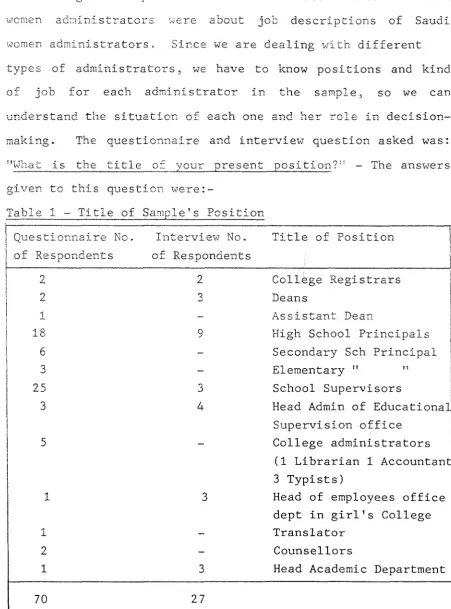
A questionnaire was sent to 70 Saudi women administra-tors in Riyadh and 27 Saud i women admi ni s tra tors in Riyadh were interviewed. The questionnaire and interview questions covered all aspects of experience and problems in decision-making and exchanging information.
CONTENTS
Introduction 8
SECTION ONE THE DEVELOPMENT OF WOMEN'S EDUCATION
Chapter 1
Chapter 2
Chapter 3
Chapter 4
Chapter 5
Chapter 6 Chapter 7
IN SAUDI ARABIA 24
Family in Saudi Arabia. Saudi Arabia as a state. Women in Islam.
Girls' Education and its structure in Saudi Arabia.
Educational Provision for Women. Women and Work.
Further change expected for women's education
25 34 46 71 91 112 119
SECTION TWO THEORIES OF EFFECTIVE MANAGEMENT
DECISION-MAKING AND COMMUNICATION 137 Chapter 8 Theories of Effective School
Chapter 9
Management Introduction
What is school administration? Styles of administration.
Behaviour of the active manager. Human Relations and their effect on educational management.
The school Principal as a manager in the education system.
The role of the Principal in School Supervision.
Traditional and Modern Supervision. Techniques of supervision and
approaches to the subject. Conclusion.
Decision-Making Introduction
Organisation and decision-making. Types of organisations.
Formal and Informal organisation. Authority and Responsibility. Definition of decision-making. Theories of decision-making.
Simon's theory of decision-making. Barnard's theory of decision-making.
138
179
What steps are needed for decision-making. Decision-making techniques.
Chapter 10
- 5
-The behavioural problcT:s thn t effect decision-making.
Motivation and its effects on decision-making.
The development of basic needs to motivate.
Raising the effectiveness of decision-making.
Types of decision-making.
Information and decision-making. The problems of information among Saudi administrators.
The involvement of the Saudi manager in decision-making.
Conclusion.
Communication
Introduction
Communication's network. Ways of communication.
Basic elements in comw~nication.
Kinds of communication.
Formal and informal communication. Difficulties in communication.
How to make communication effective. The organisations.
Meetings and committees as a way of effective communication.
231
How to improve communication among Saudi women's administration.
Summary. Conclusion.
Summary of Chapter 1-10.
SECTION THREE RESEARCH FINDINGS,
Chapter 11
QUESTIONNAIRE AND INTERVIEW WORK 270 Introduction.
Definition of elements of the sample.
Questionnaire and Interview as a method
information about communication and
decision-making.
Elements of question. Questionnaire.
How was the questionnaire made. How was the interview made. Summary.
Chapter 12
Chapter 13
Chapter 14
Chapter 15 Chapter 16 Chapter 17 Chapter 18 Chapter 19
Appendix 1
Appendix 2
Charactc~istjcs of Saudi Women's
Educational Administrators Introduction.
General questions.
Communication, ways and methods
Problems in communication among the Saudi women administrators
290
316
332
Authority and decision-Making. 368
Work Evaluation 386
Homes and Schools 394
Curriculum 402
Conclusions to the Survey findings 413 Suggested changes and recommendations. Conclusions.
Questionnaire and Interview Schedule Questionnaire Covering Letter
Questionnaire forms. Interview forms. Figures and Tables
Figure 1. Distribution of Female staff by nationality 1981-82.
424
435
Figure 1,2,3,4 and 5. Saudi Girls' Schools administrators and teachers 1981-82.
Figure 6. The structure of interior admin-istrations of Girls' Colleges 1980-81. Figure 7. The structure of Girls'
Educational system.
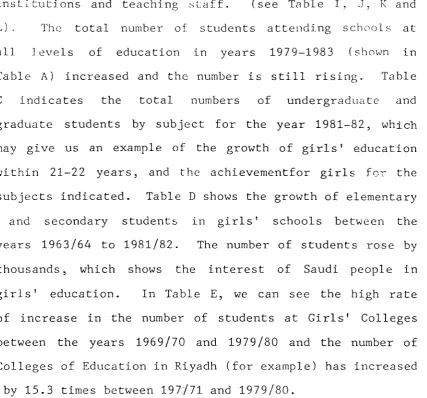
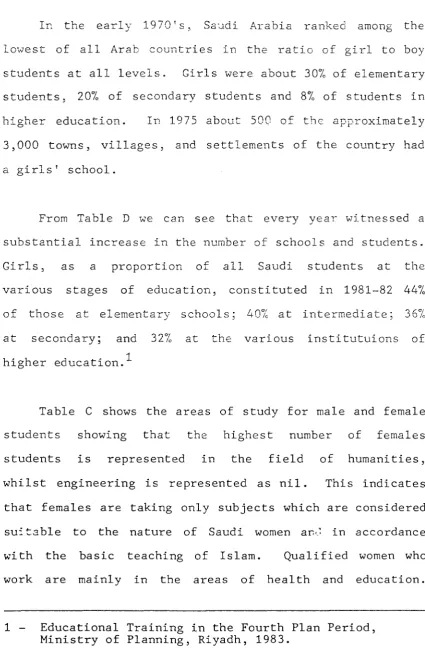
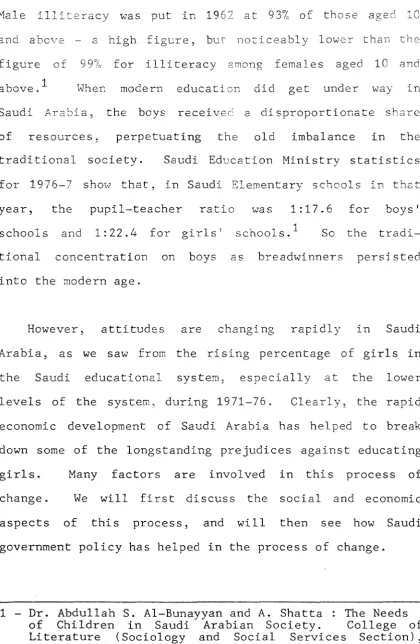
Table A. Teaching staff, Number of schools, classes and students in Saudi Arabia 1970-83. Table B. Annual Rates of Growth of Education for females 1970-71 to 1982-83.
Table C. Saudi undergr~~uates, and all graduates 1981-82.
Table D. Growth of Students (Girls) during 19 years - 1963-64 to 1981-82.
Table E. Students by Colleges 1969-70
&
1979-80.7
-Table G. Lesson plane for Elementary school ( girls ).
Table H. The needs of childhood in Saudi Arabia.
Table I,J.K,L, The progression of Girls! schools in Saudi Arabia from 1958-1982. Table M. The procedures for scientific technique of Decision - Making.
Table N. The percentage of Saudi managers who follow the scientific Techniqu of
decision - Making.
Table R. Problems of decision-making in Saudi Arabia.
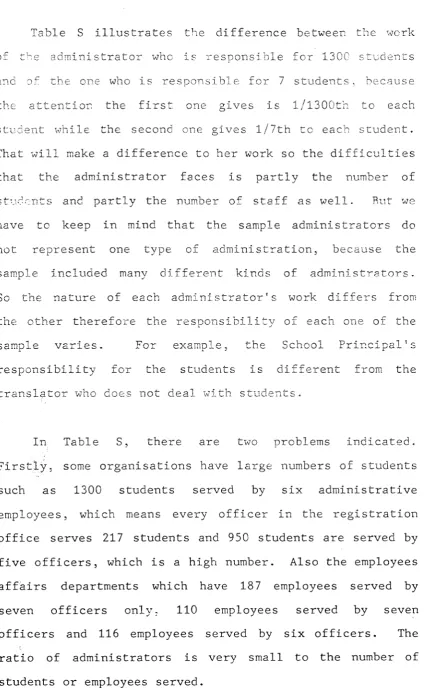
Table S. Number of students and staff of the interviewed sample.
Table T. Qualifications of the questioned sample.
Table U. Years of experience that the questioned sample have.
Table V. Comparative tables between Table 4 and table U
Table W. Level of authority in decision- making.
Table X. Decision-making & the Administrations! role.
Bibiliography. Other References
467
Introduction
196() \\'i th n few elementary schoo];-, and has expanded tn
incJud universities anci highe1- eduCltion.
Thi s thesis is [lhout educati on in Saudi Arabia ~ \-]i th
referenc(' to educ<ltion['ll problems arising
from the INay in vihj ch Islamj c cu1 ture cHvides men and
,,'omen zll1cl mi1kes effective milJl'lgC:-'nit~nt i1nd decision-making
difficult to achieve.
Th~ thesis is divided ito three sections which
are:-1.- The development of women's education in Saudi Arabia.
2.- Theories of effective management.
3.- Research findings.
SECTION ONE. WOMEN'S EDUCATION IN SAUDI ARABIA.
Saudi Arahia is an Islamic country and takes priority
over other Is lami c countd es hecause i t is the home of
the messenger of the Islamic faith, (1) and guards the
Holy Islamic areas located in Makkah and Medina, in the
west part of the country. The Kaa ba, which every Mus 1 im
s1:nuld face during his/her daily prayers, is located in
Makkah. Every Muslim man or ,,70mCJn must visit this place
at least once in his/her life if he or she has the ability
9
-j .. 0 en joys gooo hc;:]Ith nnrl can affonl the _
i0
1,; )-n "v . .' J thisJ S "ceording to the HoI\! l"'(" nil .. ( 1 ) Also the
,0
1 s the~1o!"'qu(' of the P:ophet i'-ich;imrr:erl in r-1eriinCl.
Saudi Arahia follows tl:e Islamic 13v-' and legL-::l,:1tions.
According to the respect of Islam in Saudi Arabi a, the
society is very closed and conservative. It represents
the Islamic 50C1 ':'ty, ';,]0::(-:: are sepa ra ted from men in 31}
sections, women are not allowed to appear 1n public
vJ:ithout wenring the veil they are allovJecl to 3jlpear
",7i thout i t only to thei r m·m fathers, uncles, nrothers, husbands, sons and brothers in suckling. Homen [l rc not
allowed to interfere in ments business, hut on the other
hand, women arc very respected and they are treated
kindly and with respect by the public.
Family structure in Saudi Arabia is very strong.
The relations between every member of the famiJy and the
others is very strong and polygamy st1l1 The
large size of the family encourages early marriage and
polygamous m2rriages as well. Fami 1 i es are large in
number, mother and father are heads of each family, sons
and daughters take care about their parents and support
them unti I the i r dea th . The relationships hetween each
family memher and the relative is ver.v· strong. Neighhours
a re he IpfuJ to each other, they live i n a communi ty jus t
as one family. Saudi families are large in number, which
contains the grandfather, grandmother, father, mother,
and children. Everybody feels a p~~t of everybody
else's l~fe. The f~mily forms a very Sri structure.
All schools in Siwdi Arabia in~;jst on teaching the
Q'urcln and Sunna to the young children as main suhjects,
right from the start, in orde:- to develop good cj tizens
who are good Muslims.
The population of Saudi Arahia is 7,000,358. The
sys tem 0 f gove t"Tlmcnt is Roya 1 ~lona rc hy , and the ba sic
law of Saudi Ar;:lf)ia is cierivcd from the HoI v QureJ.n anci
the Sunnas as are the legislation texts, whose provisions
apply the precepts of Islamic law.
Organisation of Petroleum Exporting Countries
(OPEC) . (1) In dealing ,-,lith the Gulf countries, Saudi
Arabia is a member of the Gulf Co-operation Council
(Gce) which was created in 1981.
The Saudi Government is doing its best to make the
country achieve the best method to reach the goal of
educating the women with the Islamic theory which
respects the women and gives her rights and duties.
The rradi tions in Saucii Arabia are based "n Islam
which is the formal religion of the country. Saudi
people are 100% Arab Muslims. There is no other religion
11
-existing beside Islam in Saudi Arabia. lsI am is the kind of religion which organises the socia} life, gives everybody the right and duty to work as an active element in the society. Islam respects women just as men, but gives the right to control women's movements and considers men to be responsible for women.
Islam has called for the education of both sexes but separately, co-education does not exist in Saudi Arabian schools except for pre-school children in private schools, (1) therefore, the field of work for women was not limited by Islam, but by the social policy which ensures that women are separated from men and to keep her in respect according to her nature of l i fe within her society, al so women are not allO'i,;Ted to drive a car for social reasons so not let the women to appear to the public, and consider driving the man's responsibility.
The separation between men and women does not affect the chance for each sex to be educated, the government encourages both men and women's education by offering free education in all schools and levels with monthly payments made availahle for each student so as to support their needs for education.
Islamic tradition demands the creation of separate educational facilities for women especially at the higher education level.
In the fifties, the Ministry of Education, an organ-isation responsil)le for the education of boys, m8de it possible for ambitious girls to earn official school ccrt-ificates: by allovJing them to take the intermediate and
( 1 )
secondary school examinations as external students. .
The first attempt towards giving Saudi Girls a kind of formal education was started by opening Dar al-Hanan's school. Dar aI-Hanan was founded in 1957, as a small residential school for poor, orphan girls by H. M Queen Iffat, widow of late King Faisal. (2)
Formal education for girls was officially recognised only in 1960, when the King announced in a Royal speech, that it had been decided upon the wish of the religious men of learning to open schools for girls under a committee responsible to the Mufti.
Girls education from Kindergarten to the higher educa-tional levels was controlled by the General Presidency of Female Educatjon, which is headed by a male religious figure and was responsible to the King. Female education in the 1970's extending to the University level (3)
,
remained completley segregated from those of males.1. Rpsearch report, Institutions of Higher Education for women in Saudi Arabia, Al-Bassam I. Int. S Education-al Development, Vol. 4 No.3, p.255-258. 1984.
2. Same reference as (1).
13
-The President of Gi rl s I EducC'ltion enjoys the same
privileges ann status as a minister. The
President is assisted bv a vice president and a deputy
President fer girls' collcg('s.
Riyadh Col1ege of Education for Girls was the first
institution of higher education for women in Saudi
Later, seven more institutions of higher
education for women were opened a l l o v e r the country.
Universities are taking into consideration the training
of teachers and teacher training institutes as well.
Education for women at all levels is free, as i t is
for men.
Saudi Arahian schools follow the three-stage sequence
of education adopted in 1958 by all memhers of the League
of Arab States. Educationa] policy in the Kingdom of
Saudi Arabia states that the aim of education is the
correct understanding of Islam and the inculcation and
dissemination of the Islamic creed, is the imhuing of
the student with Islamic values, doctrines and ideals in
the imparting of the various types of knowledge and
skills: the social, economic and cultural development of
society and the p;C'paration of the individual to he a
useful participant in the building of his society.
Since Saudi Arabia is the foremost representative of
Islamic lq:islation in its daily life, it is balancing the needs of the people and the t~a~itional way of life, so while i t called for ,Nomen! s cation in the country, at the same time it was concerned to preserve traditional Islamic culture. By limiting the field of work for women in this way, it enables her to be an active element by getting her education and maintains the
Is :tami c cvs turns and trad i tions ,,-,hi ch society imposes to avoid employment which forces women to mix with men. So the opportunities for women to be educated are limi ted within the frame of society's traditions.
The object of a woman's education in Saudi Arabia is to bring her up in a sound Islamic way, so that she can fulfil her role in society as a successful' housewife, ideal wife and a good mother, and to prepare her for other activities that suit her nature of social life inside the country such as teaching, nursing and medicine.
Therefore, women's curricula differs from men's. It is very limited within the frame of preparing educated mothers, wives teachers, nurses and doctors as well.
The Quran did not limit the field of work for women,
but •
t-]
-
did forbid her to show her attrac~iveness tostrange men.
15
-girls schools in the country is increasing. Attention has beer. paid to\cJ3yds a more organised l:'J . Polyg2mous marriage is decreasing now because of gi rIs! education v.Jhich enables women to have a better understanding of married life.
From what has been said, girls' education is expanding gradually and the faculty of Saudi women is now replac{ng employees on contract from other countries in school teaching, administration and medicine. The trend is to appoint Saudi citizens to top administrative positions.
However, lack of direct communication between men and women at work causes problems for effective management of the system of girls! education. This leads us to focus on communication and decision-making in administra-tion which will be discussed in Secadministra-tion Two.
SECTION TWO
Decision-making is defined simply as an operation of choosing a substitute among many substitutes. This choice is made after a wide study and analysis of all sides of the problem which is the subject lmder decision.(l) No decision can be made without communication, so communica-tion is cosidered as the heart of decision-making.
But we have alY-Jays -:':c;-(';w~mhey that there [ s no effective
decision to bE e 'without ac ef feC:::i \1E GC2S 0
=-communication.
Communication lS simply debned as a social
inter-action, i t is transferring and receiving the information
from one person to another and i t is the method of uniting
Our life is based on communication whether oral ~
,...,ritten or the use of gesticulation. The new born baby
is developed by using littlE words gradually until he
grows up with full unformation on how to express himself,
so he can be understood. The method of decision-making
anywhere, starting \vt th home and ending with the formal
and semi-formal offices, depends upon communication and
its effectiveness is dependant upon the effectiveness of
using the right method of communication.
The section then covers decision-making within Girls'
School administration in Saudi Arabia.
Although school administration is still a modern
science which started in the 20th century, girls' school
administra~tnn is an even more recent creatior since
girls I education in Saudi Arabia started only 26 years
ago, a very short period of time compared wi th women's
education in developed countries.
17
-SLlce Islamic relIes h;:n;e a large influence or the womer's life, the a inistration
edlJcc:tior in Saudi Arabia is controlled by men ,.\7}:c 8re
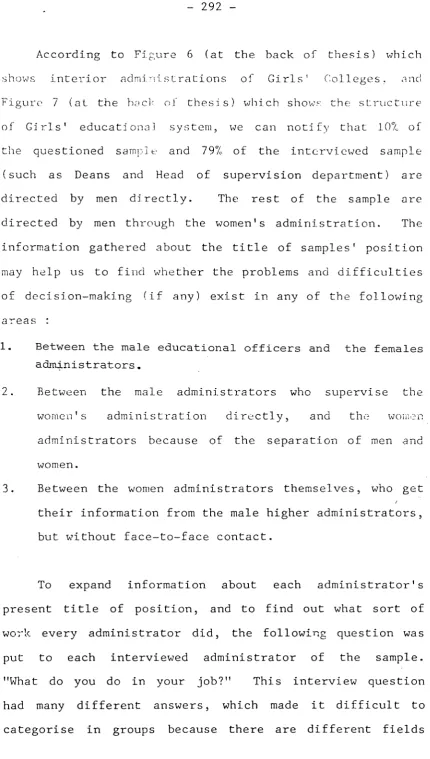
the senior administrators. The most senior women in administration are supervisors in offices, schools and girls' colleges. Girls I education is governed by the
President (male) and all higher administration is directed by men as well, 2:,G at the same time women arLO not allov,7ed to meet any str~mge men in any face to face
communication.
The system is centralised. The financing, supplement, directions, orders, etc., all corne from male heads of departments. The ",vomen however have ideas, suggestions, evaluation forms and are involved in scheduling and they must keep in contact with the male administrators. These women administrators are allowed to communicate with men only
by:-1) writing, 2) telephone, 3 ) some organi sa tions are supplied with closed circuit TV, so it is used for communication. Women therefore transfer the messages or information coming from the higher administration (men) to other women who are teachers, employees, assistants, etc.
by men and at the same time, girls' schools, institutes
3nd colleges are directed by women, who refer to the
higher administration (men) withouc any meetings.
SECTION THREE
Section three reports on research in Saudi ArahiA
since research and references about communication and
decision-making in the administration of women's education
are only available for a few limited subjects, i t was
decided to conduct a questionnaire and intervievJ survey
with a sample of Saudi women administrators to try to
find out the \-Jork situation of women administrators,
especially
fields.
in the communication and decision-making
Since decision-making and communication are affected
by each other, the questionnaire concentrated on
commun-ication and decision-making problems. It is important
to differentiate people from various administrative
levels. The questionnaire was followed by an interview
to give further and more detailed information.
Questionnaire
The questionnaire was administered to a sample of
women administrators designed to find out the difficulties
19
-overcome any weaknesses if the~~ are any. The question-naire forms were given to a sampl of 70 women administTa-tors in the city of Riyadh. A s Ie of the questionnaire form and covering letter which were given to the adminis-trators to he asked are includ a t the back of thi s thesis. Answers for the questionnaire were analysed and its tables were constructed to summarise the administrat-ors various answers. The questionnaire was groured into five sections which
were:-Group One
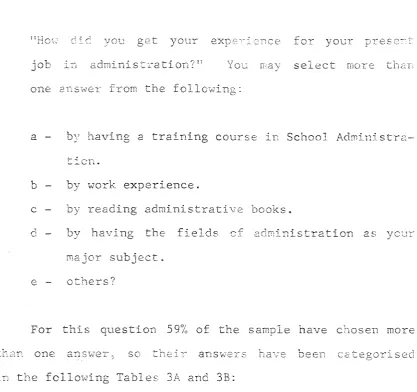
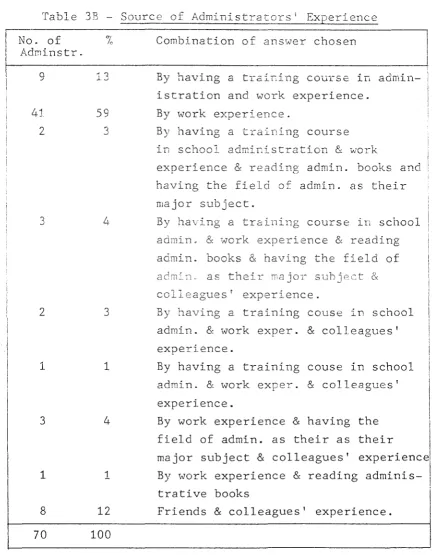
Personal questions which include academic qualifica-tions, age, title of the administrator's present position, nature of her job, and the way which she obtained her experience. These questions were used as a preliminary to further questions and to find out whether the administ-rator's qualifications and experience related to her decision-making.
Group Two
Sinc2 communication is esse~ti&lly a social affal~
~hict 2na~les the socia] unit to g~cw, i t is an integra]
part of the Drocess of management. These questions were asked t find out ho,,' the comnlu:';ication between women administn3tors and men in Genen11 PreSidency is taking place and what are the difficulties they face. The respondents were asked to give reasons for difficulties which they experien~~ and to give some Tecommendations for improvement in decision-making about women's education. It was not possible to question the men ... because the face to face interview can't he done with men to discuss and negotiate problems and difficulties, since the women are not allowed to meet strange men.
Group Three
21
-Group Four
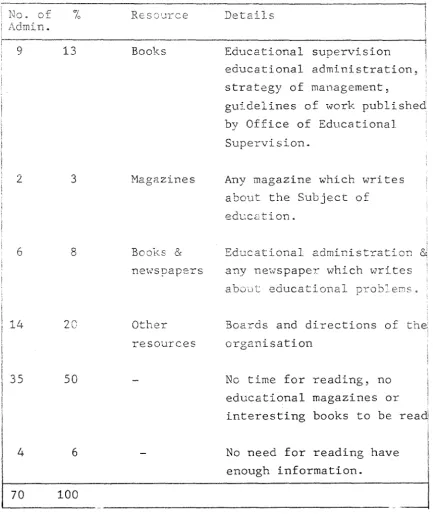
Information and aids fOT school mana~ernent.
These questions 'l-:'ere desizned to find out the general
level of educa tj on of each
leaders' education level will
as well a? her personality.
Interviews
administrator, because
reflect on her management
Following the questionnaire, a further sample of
administrators was inter,;iewed to obtain more detai led
informa tion. . Because the quest i onna i re wa s very 1 imi ted
in anS'oJers i t may not help 1.1S to find the whole picture
of the problems or sjtuation in details. Twenty-seven
women administrators in the city of Riyadh were
interview-ed and the questions 'l-:'ere grouped into five sections
which
are:-Section One
General questions about every interviewed women
administrators I posi tion how many students and employees
each interviewed adminstrator has in her school.
Section Two
Communication.
To find out if there are any communication problems
Authority and
Responsihiljty-To find out how much authority the women administrator has and her role inside her organisation.
Section Four
Curriculum.
A curriculum is an attempt to communicate the essential principles arlO features of an ec!1.J cat i Or1<i 1 programme in such a form that it is open to critical scrutiny and canable of effective translation into practice.(l) Since the curriculum is by nature based on the balancing bet,,,Jeen various kinds of knov.71edge and takes into consideration the achieving of the development of the human being at all human and emotional levels, so the curriculum should include the development of a child's ability as a whole. Because the curriculum among girls I schools is static and inflexible, but
moving very slowly according to the change and movement of the social life, this section was designed to find out what role the administrator may have in curriculum planning and design.
23
-Section Five
Work evaluation.
Any organisation benefits from co-operation and understanding bet'Neen the enlf,],oyer and employees, therefore this section was designed to know how the administrator's work is evaluated, who evaluates her ,-;ork and to find out if ShE is satisfied or not with t"c' method of evaluating her work.
Interviel']s ",1ere conducted by meetings and telephone calls, the answers were analysed and summarised i,l tables. After the questionnaire and interviews, the results and recommendations have been collected and discussed in Chapter Nineteen.
SECTION ONE
The Development of Women's Education in Saudi Arabia.
- 25
-CHAPTER ONE
Family in Saudi Arabia
The "Fami ly" is . 1
a SOCla. unit, the members of which
are united by the strong bond of marriage or bID The starting unit is marriage, and the resulting social unit, a family, consists in its simple for~ of the husband and wife and thei~ unmarried children.(ll
The Islamic family is not a private affair of no concern to the rest of society.
The Saudi family contains the mother, father and their children. But if the man has more than one wife, he supplies each wife with a house to live in with her children, and he schedules his time so as to divide it between them.
According to the sayings of the Prophet Muhammed, "He is not one of us who does not have mercy on the younger, or does not respect the older." Following from this statement, everybody in Saudi Arabia, as in any other Muslim Country, has to behave himself in the way that Muhammed has described.
strong position in each family.
The mother has a very All her children, old and young, must take care of her and must respect her words and try to satisfy her needs throughout her life. The father, on the other hand, is a very respected
person who has authority in +-~, .
• _.l !e house and has the
strcmgest ;,Jord. The Saudi fanp y is a very structured one. Everyone is close to eact other. The Kingdom of Saudi Arabia has established thousands of schools, both public anC private, to develop a 'well-educated society. Every child is sent to school at the age of five, to start at Kindergarten level. The en~rance age for elementary school is six. So people are very anxious to send their children to school early. Women are also going to school (the illiterate women). There are many adult schools to prepare women to be successful mothers and housewives. The Saudi Arabian government makes education available to everyone at every age and provides schools all round the country.
Since the society in Saudi Arabia is a Muslim society, which respects Islam and considers it as a law and an order, people follow a pattern of life which is similar between one family and another.
People aged ten and under represent the largest sector of the population, according to the survey done for the year 1962.(1) People of this age-group represent 37% of the total population. People between the ages of ten and twenty-one repr:- sent 30.8% of the total population. That shows a high percentage of younger people, and that is because of the high number of females and polygamy
- 27
-and the lack of o'-gan5 sation of birth-con;:::rol. This causes problems ir tb fields of medicine and education. In the year 1973-74, the number of students in different levels of education was 844,308.(1)
Comparing the size of the Saudi family with interna-tional averages, we find the Saudi family is a large family. This is because it is considered in SC'!~ldi ArC'!hia that a nuclear family is a family which contains the father and the married sons and their families in one house, all these people form one family. The Grandfather is the leader of the family. In the event of his death, his eldest son will take his place in leading the family. The large size of the family encourages early marriage and polygamy as well. But the size of the family in Saudi Arabia appear to have gone dmVTI in recent years. The survey of population for 19742 indicated that the total number of families in Saudi Arabia is 1,211,500 and therefore the average family's size is 5.79 people, which is a relatively low figure.
It is important to mention that the number of people per family in the towns is less than the number of people per family in the villages and among the bedouin. This is because of the level of civilisatio~ in the towns and the opportunities of jobs, as well as the
1. The Statistical Year Book. Tenth edition. 1974. p.36 Riyadh. Ministry of Planning.
COTJ~D~ ~catinn Df life and the ava~ lab:lit") of education. In 2ddition to that, the age of narriage for men is
higher in the cities and tmVIls than the ages of marri8ge
between the bedouin and the village people. Also,
polygamy is 10'\.Jer than overage clll!Ong the men of the
to,\"rns and cities. In general, early marriage for girls
is acceptable and desirable in Saudi society.
Re-marriage for widows and divorced ladies is also guiLe
~ 1
normal.
Personal Relations
Since the family in Saudi Arabia is a big family
which contains the grandfather, grandmother, father,
mother, and children, the relations between the
indivi-duals in each family is very strong. Evervbodv feels a ~, .~
part of everybody else i s l i f e . The family forms a very
strong structure. That strength includes all the
relatives as well, because of the influence of Islamic
culture. God exhorts the people to be good to their
relatives, and Muhammad the Prophet insisted on helping
relatives, "Relatives are the first outlet for your
kindness".
People are not only close to each other wi thin the
families. In addition, the neighbours are very close to
each other. Among the sayings of the Prophet is a
statement: "The person who believes in God and the
after-life should be generous to his neighbour." So Saudi
29
-people, who are very conservative abo~,t their religion, do their best to be very close to each other in each community. Ladies' neighbours, friends, and relatives help each other and take care to issue invitations and hold social parties and daily meetings. Men have the same type of social life. They meet wi th each other very often, and they meet together every day in someone's house in an area isolated from the ladies.
Children derive their habits, ideas and customs from the home and from their social environment, as well as from the school where they receive instruction together with the resulting cultural development. Since the Holy Quran is the constitution of the country ~ Saudi Arabia has derived Islamic culture from the Quran and froIT; the Sunna (sayings of the Prophe~ Muhammad.)
All schools in Saudi Arabia aim to teach the Quran and the Sunna to the young children as a main subject, right from the start, in order to develop good citizens who are good Muslims and, at the same time, good elements in society, (see Table F
&
G at the end of this thesis).In addition to the th01IScH1c1s of school s in the
cOl:ntries, so as to help meet some of the needs of the miristries and centres. The following 0
also regularly make contact \.;Ii th equivalent gro"ups
abroad, to help develop education and Islamic culture:
a) School cultural associations at the various
education-al levels.
b) Cultural groups run by government and non-governmental
bodies such as the IYoung Girls of the Peninsula! in
Riyadh, and the 'Red Sea Club' in Jeddah, Saudi Arabia
In addition, both the Ministry of Labour and Social
Affairs and the Ministry of Education have cultural
institutes and centres for young people.
One important aspect of
years
educational policy in Saudi
has been the granting of Arabia during
scholarshi ps to
recent
Saudi students to enable therr; to pursue
specialised studies abroad. But care has been taken not
to upset family life as a result of this policy, and the
wives and children of those chosen to study abroad
receive financial support to accompany their husbands/
fathers.
Inside the Kingdom of Saudi Arabia, there are many
different sources of activi ty to meet the needf: of the
young people and to encourage their creativity as well.
These sources
include:-1. The General Directorate for Youth Sponsorship. This
31
-people to be creative. It :-nc:dzes great efforts to promote the output of young people i 1: the c1i fferent
fields of cultural activity which are dle respojl~,;j1)-ility of this establishment. It was created in 1953 as part of the Ministry of the Interior. In 1975 it was linked administratively vJi th the Higher Council for Youth Sponsorship.1
2. Literary Clubs established in 1975 as part of the General Directorate for Youth Sponsorship. This organisation was announced by the Director in the course of a national poetry festival. It was created to help the communi ty to be and stay as a modern Islamic community, and to enable writers to help Arab Literature to survive and be improved.
3. The Department of Popular Arts. This was created in 1975, with the aim of helping young people to improve their talents.
4. The Arab Centre for the Revival of the artistic Heritage. This belongs to the General Directorate for Youth Sponsorship, and was created in 1975. This Centre aims to help the Kingdom of Saudi Arabia to co-operate with the Arab Organisation for Education Science and Culture.
These activities are an example of the many different establishments for young people. All the above are for
young men only.
as the Nahda Assocjc:~t::ion fOI Women, establi,; 'cd in 1960, the Wafa Association and the Fesilyya Association. These associations are led by educated women from society, who are willing to work in this field. The aims are to help women to improve their activities and talents. They have courses for typing, English teaching,
Ii terature, cree. ti VE "Jri ti ng, music, beauty lessons and
many other different social activities such as helping poor people, educating illiterates and guiding families of lower income.
These activities help to prove the ability of young men and women to help society to achieve a hetter Ii fe, by developing their hobbies and talents.
Conclusion
The family in Saudi Arabia is a part of society, which represents customs and habits and has a very strong structure. Society as a whole is improving its posi tion and trying to reach the peak in education and technology. People are very concerned about sending their children to
33
-social uni t and stress the .. +-.r ...
V1cCl i TIlportance (1
r
f ami 1 '\' , . 1..clnres. a result, education;)} progress consolidates
CHAPTER TWO Saudi Arabia as a State
The Kingdom of Saudi Arabia is bordered on the North
by Iraq, Kuwait and Jordan. On the East, it is bordered by Qatar, Bahrain, Oman and the United Arab Emirates. On the South, it is bordered by North and South Yemen and on the West by the Gul f of Aqaba and the Red Sea. All these countries have a good political relationship with Saudi Arabia.
The Territories of Saudi Arabia are divided into fourteen m(-lin administrative parts, each part is called
am "Emara". All of them belong administratively to the Ministry of the Interior in Riyadh.
states are divided into four groups:
These fourteen
1 )
-
The First Grou12: this is the largest. Each one ofits states contains more than a million people. The group contains two states (Emaras) only. The first one of these is Makkah, which has the largest population in Saudi Arabia. This high percentage of population in Makkah is because some states were included in it, such as Jeddah and Taif. The second state is Riyadh, the capital of Saudi Arabia. This contains 19% of the total number of the population. There are two Emirates included in Riyadh. One of these is Afif and the other is Khasera. Both of these are desert areas which only have a very small population.
about 350,000 sq~are kilometres.
35
-2) - The Se20nd Group: 23 ch s t 2 te here conta ins a bou
500,000
::0
1,000,000 people. 'Th i s group conta i TIS threeEmirates: the Eastern part, which is the petrol-producing area, Asseer and Medina.
3) - The Third Group: this contains Emirates of medium size. Each one has between 100,000 and 500,000 people. The group contains seven Emirates, which are Jezan. Qaseem, Hayel, Tabouk, Baha, Najran and the Northern Territories.
4) The Fourth Group: this includes the smallest Emirates in area and population. Each one has a popula-tion of less than 100,000. It contains two states only -Jouf and Gurayaat.
ThE' Organisatio-,l of the ScHJdi Government
Saudi Arabia has a Royal !,ionarchy a~; :i ts system of government. To identify the Kingdom of Saudi Arabia, there is a formal emblem, which has two crossed swords and a date-palm tree in the middle. That means that wealth and happiness cannot come without justice. The flag of the kingdom of Saudi Arabia is green. It has in the middle a svmrd which has written above it: "There is no God but Allah, Muhammad is His Prophet." That indica tes the statement of Islam, Jus ti ce and Happines s. The basic law of Saudi Arabia is derived from the Holy Quran and the Sunna, as are the legislative texts, whose provisions apply the precepts of Islamic law.
The founder of the Kingdom of Saudi Arabia was King Abdul-Aziz Ibn Saud, who united the country in 1925. From that time to the present day, the system of govern-ment has been a royal monarchy.
Social Life in the Past (before King Abdul Aziz)
Tribal life was the characteristic form of social life in the Arabian peninsula. The tribe was the basic social unit. The inhabitants were either Bedouin who moved from place to place, seeking water or grass for their cattle, or urban people who had settled in oases and villages.
environment.
37
-belonging to society, and neve~ felt any sense of citizenship, started to bel:: eve in any p()~"ey tit L
they felt was strong enough to protect the~, such a~ graves, t:::ees ~ stonces and stars. That W<1 S contrary to
Islam and its message.
All the Arabian countries were controlled by the Ottoman E~piT0 for about two hundred and fifty years before the era of Abdul Aziz. Arab countries suffered during that time from constant crises, which led the Arabs to get rid of the control of the Ottomans. Ottoman centrol extended from the year 1738. r-leanwhile, the British were trying to extend their zone of influence into the Gulf area from the beginning of the 1760 IS, when Bri ti sh power entered the
IT') the hands of the Sha1~eefs
area. Real authority was in Hijaz and Assir, the AlaweeTJ in the Yemen ~ and in the rest of the ArabLm
peninsula~ in the hands of the Princes and Shaikhs.
The most famous families among those in authority at the time were the AI-Muamer in Ayayneya, Dahharn bin Dawas in Riyadh and the AI-Saud in Duriya. By the year 1682, authority was in the hands of Mugren bin Tarkhan who selected Duriya as a capital for his government. His son Saud C2IfIl'
,I
fter ]~ jm, and then authority wasgiven to his grandson lasted from 1725 to 1765.
The inspirG~ion of Muhammad Ibn A
clear sense of the original precepts of thE Islamic religion, uncluttered by any of the superstiU ous accretions (such as the worship of graves) which had accumulated during the "dark centuYiEsi l of the Middle
Ages in the Arabian peninsula. This sense of a "call", a return to the true precepts of Islam, is still a crucial element in the political dynamics of the Kingdom of Saudi Arabia.
The relationship bet\\1een the Sa'\Jdi state and Shaikh Muhammad Ibn Abdulwahab was forged in 1744, when the Shaikh sought and received refuge wi th the Ruler of the tiny Nejdi state of Duriya, Muhammad Ibn Saud. Both sides benefitted greatly from this association. The ideas of the Shaikh: and his immense popular appeal, helped to bring the conflicting peoples of the peninsula
together. In particular, his concept of IItawhid" (believing in God only) provided an inspiration for people who had lost the sense of mission in their religion, and had been diverted towards superstitions more characteristic of paganism than of monotheistic religion.
39
-on the peninsula, and the oresence or ahsence of an externally-backed military force irl Arabia. By the time of Muhammad Ibn Sat~d f s death in 1765, most of the Najd
(the middle and East:ern part of Saudi Arabia) was under Saudi control. \-Jhen to:uhammad Ibn AbdulvJaha b di ed in 1792, that control had been extended south to the Rub-al-Khali (Empty Quarter). Al-Hasa (in the eastern part) was captured in the closing years of the eighteenth century, and shortly thereafter Saudi forces gained their richest prize control of the holy cities of Makkah (1801) and Medina (1805), and of the greater part of the Hijaz (the western part of Saudi Arabia).
The capture of the holy cities led to a response ,
from the Ottoman government, which in 1814 empowered its Viceroy in Egypt (Muhammad Ali) to free the cities from Saudi control. As a result, Muhammad Ali's son with his troops forced the Saudis -hacf-< to the Najdi heartland, and in 1818 they destroyed the Saudi capital of Duriya. The AI-Saud were driven back from Najd and took up temporary residence in Kuwait.
To reconstruct the Saudi state, a new form of military force was created, with the name of Ikhwan. This was developed by Ibn Saud 2TlO his followers. The
1906. Abdul Aziz Ibn Saud consolidated his control over centrel Nejd. In 1913, al-Hasa came under Saudi co~trol as a result of the expulsion of the Ottoman garrisons there. In 1919, after defeating the troops of the Sharif Hussain of the Hijaz at the battle of Khurma, Abdul Aziz began to exert pressure on Hijazi territories.
In 1920, territory in the vicinity of Kuwait came under Saudi control. In 1921, the independent power of the Al-Rashid in Northern Arabia was brought to an end, and their territory was incorporated in the Saudi state. In 1923, Abdul Aziz secured control of much of Asir, and by 1926 the main part of what is today the Kingdom of Saudi Arabia had been integrated into the Saudi state. The State was known as the Kingdom of Hijaz, Nejd and its Dependencies until 1932, when the modern name of the Kingdom of Saudi Arabia was adopted.
King Abdul Aziz ruled the Kingdom until his death in 1953. Then his son Saud carne as King until 1964, when his brother King Faisal bin Abdul Aziz took his place to be the new King. Faisal ruled the Kingdom until his death in 1975, when King Khaled became the Ruler of the Kingdom until his death in 1982. After his death, His Majesty King Fahd bin Abdul Aziz started his reign, and is still the King of Saudi Arabia.
41
-King Abdul Aziz 8f Shaikh Muhammac J Abdul'/Jahab,
\,;iho had the idee. 81 a cOlmt'ry ruled according to the
religious and socia] message of Wahabism.
There are two powers ruling the country: firstly the
King and his government, and secondly, the religious
people who are very respected and powerful, because the
country is an ahsolute monarchy, theoretically limited
only by the Divine Law or Shari' a. The Shari I a must be
obeyed by everybody, even the King himself. The Shari'a
is supplemented by a fairly large body of custom (such
as, for example, the rules regulating the behaviour of
women) .
King Abdul Aziz summoned a Majlis al-Shura in 1926,
which is a committee for counselling and discussing
affairs between the King and the religious people. That
is according to the Quranic injunction: IITake counsel
among yourselves." The religious people are the
instru-ments in the King's rise to power, and the King still
needs their support. Even the opening of Girls' schools
in 1960 was given to the religious people, and is still
managed by them. They take care of the behaviour of the
girls, and educate them in a way that does not conflict
Relations between Saudi Arabia and the Gulf States and Muslim Countries
Since the Kingdom of Saudi Arabia is the centre of all M1.Jslims who are requested to visit the Holy Lemd in Makkah and Medina (the Pilgrimage) from allover the world, the policy of the relationship between the Kingdom and all Arab and Muslim countries is very strong. This policy is based on co-operation and is intended to lead the Muslim world to a happy and satis-factory life.
Saudi Arabia plays a prominent role in the Arab League Organisation, whose treaty was brought into force on 22nd March 1945. Saudi Arabia was one of the estab-lished countries which co-operated and volunteered in drafting the Charter of the Arab League Organisation, which aims to unite all Arab countries and to solve the problems between them and to harmonise their points of view, so as to strengthen the neighbourly and brotherly relations with them. The countries involved are: Saudi Arabia, Jordan, Morocco, Algeria, Tunisia, Libya, Sudan, Egypt, Yemen, South Yemen, Syria, Lebanon, Kuwait, Iraq, Bahrain, Qatar, Oman and the United Arab Emirates, Mauritania, Somalia
&
Djibouti.43
-hring about peacE between nations. Because Saudi Arabia
is one of the countries \-Jhich export petroleum, i t is an
active member in the Organisation of "Petroleum Exporting
Countries (OPEC) , the organisatioD which keeps the
balance of petroleuD' price in eq\Ji 1 bri um to balance
and protect its budgetary position.
Those countri es which are m2mbo~-s of OPEC co-operate
to control the price of petrol, which is the main source
of their exports.
OPEC
manages the marketing of petroleumand ensures the rights of the producer countries. It is
important to mention the position of Saudi Arabia in keeping the Huslim vlOrld uni ted, and encouraging ~luslims
to go back to the soul of Islam as a Way of Life. King
Faisal bin Abdul Aziz Al Saud called for Islamic unity
among all Muslim countries to defend their holy lands and
beliefs. In dealing with the Gulf countries, Saudi
Arabia is a member of the Gulf Co-operation Council
(G.C.C.), which was created in 1981. The aim of this
O"rganisation is to encourage the Gulf states to work in a
\CjiJY 'V-:hich proves their unity and co-operation. The
countries involved in G.C.C. are Qatar, Saudi Arabia,
Conclusion: State and Culture
1 - Because of the simi lari tv of nature and cl im,i te in
Saudi Arabia and the Gulf states, and the nature of the
land vJhich facilitates movement from country to cour;try
(especially for the Bedouin), there has been a spread
across the borders of these states of families from the
same race.
2 The similarity of customs and traditions, religion
and language formed the people of Saudi Arabia and the
Gulf States as one complete uni t. But Saudi Arabia is
considered as the mother state. This is because of the
vastness of its area, the large population and the
location of the Holy Places in i t . All these factors
gave i t the important role of being the heart of the
Gulf countries.
3 - For the above reasons, y,70men in these various Gulf
countries follQi..J the same kind of behaviour. They act
in a very conservative manner, and follow the way of
life that society imposes on them in fields such as
marriage, work opportunities, etc. But there are some
particular constraints that limit the movement of women
in Sau:-:i. Arabia as a result of the Wahabi IT:()vement in
Saudi Arabia and the location of the Holy Places there.
4 - As a result of the creation of the Gulf Co-operation
45
-the relations betv<.7een all -the Gulf states economical
political the defence field, there will be
positive impact on the position of women in Saudi
Arabia. This wi1 result from international co-operation
in the field of education and culture, including the
exchange of educational television programmes between
the various countries.
In fact j the monarchies showed themselves generally
flexible and responsive to economic and social change.
Hembers of the Saudi Arabian royal family, for example,
have taken a keen interest in the development of
educa-tion. The present King of Saudi Arabia served for many
years as Minister of Education during the reign of his
brother King Feisal, and has continued to show keen
CHAPTER THREE
Women in Islam
Saudi Arabia is the place which is visited by all
Muslims in the world because of the location of Makkah
and Medina,
place among
two Holy Places which give Saudi Arabia first
Islamic countries and represents the real
Islamic country, therefore all Saudi people are Arab
Muslims.
So we have given a brief idea about the nature of
women in Islam to get a general picture of Saudi women.
What is Islam, and how many rights does i t give to women?
Islam is an Arabic \.;rord "submission", i.e. to the
Will of God. This is the key concept which describes the
attitude of all Mohammadans to their religion. It claims
to be a divine revelation, communicated to the world
through Muhammad, who was the last of a succession of
inspired prophets, beginning with Adam. Its doctrine and
practice are based upon:
1.- The word of God, the Quran (Holy Book).
2.- The tradition (Hadith) or rather the sayings and
manner of life (sunna) of Muhammad, as contained in
the traditions.
The Muslim creed is "There is no God but Allah;
47
-is held to imply helief in:
1. - Goel
2.- Tile angels.
3.- The inspired books.
4.- The Prophets.
5.-
The day of Judgment.6.- Godls predestination of good and evil.
The religious practices which the believer is obliged to perform are:
1.- The recital of the creed.
2.- The performance of praying five times a day.
3.- The ninth month of the Arabic Caiendar (Ramadan). 4.- Payment of the legal alms_
5.- Pilgrimage to Makkah.
These requirements are for man and women to equally, so men and women are equal in following rules of Islam. As the Holy Quran says: "Allah
do the has promised to the believing man and believing woman gardens beneath which the rivers flow to abide in them, and goodly dwellings in gardens of perpetual abode; and the best of all is Allah's goodly pleasure; that is the grand achievrnent.1f
to seek for knoh'ledge" so botb sexes are equal in searching for education.
The ~tatus of Arab women before Islam (before the~ear 580)
In the dark era (about 15 centuries ago) before Islam, women were greatly neglected in the whole of the Arabian peninsula. People in many Arab tribes regarded women as useless creatures. Women held a very low
position in Arab social inferiors,
society; but like
they were treated not only as slaves and chattels. v..Then a man who had many wives died, the latter were inherited by his sons like moveable property. It was a mark of dishonour for any son to have a daughter, and many preferred to bury alive their female children, rather than face social approbrium. It was Islam and the teachings of the Holy Prophet which dispelled the prevail-ing idea that women were inferior to man or that female children deserved any treatment different from that meted out to male issue.
women by declaring:
The Quran asserted the digni ty of
- 4<:1
-"And when the girl-child that ,,;'as buried al::,ve is asked for sin she was slain"~ and a1sc !lAnd
daughter is announc ed to one of th em, hi s face hecome s dark and he is full of wrath. He hides himself from the people, because of that which is announced to him. Shall he keep i t with disgrace or bury it (alive) in dust? Now surely evil is ,,:hat they judge.1t
As far as the Holy Quran is concerned, it promulgated the doctrine of human equality, inc]uding sey equality, in a comprehensive verse which negates all inequalities due to sex, race, colour, nationa 1 i ty , ca s te or tribe. As the Quran says: "0 people, be careful of your duty to your Lord, who created you from a single being and created its mate of the same (kind) and spread from these two many men and women."
~~hammad the Prophet has made many statements to give
women their rights. He said IIParadise lies under the feet of the mothers. II There was a man who came to him
to h:is wivestl
• He said also tlGod commands t::8 to treat
"'orne,, nobly!!. The more civi~ and kind a Muslirr i~ to his
the more perfect of fa i th he is. II It is easy to
infer tha t the Quran ano' ~ - rhD '--.~ s a y l i 6 ~ . n()"s of the Prophet are
clear 5~n stating that n,en and \,Jomen are complementary to
each other, and in their full co-operation and harmony
lies the very purpose of life.
On consonance with the spirit
Quran ("They have rights similar to
in a just manner"). The Prophet
reminded his followers that female
of equality in the
those ag<linst them,
of Islam constantly
children should be
treated exactly in the same manner as male issue.
According to a report from Anas Bin Malik, one of the
Prophet 1 s followers, the Prophet said: "Girls are models
of affection and sympathy and a blessing to the family.
If a person has one daughter, God wi 11 screen him from
the fire of Hell owing to his daughter. If he has two
daughters, God will admit him to paradise. If he has
three, God will exempt him from the obligations of
charity and jehad." The Holy Quran has in more than one
place made i t plain that, in regard to moral and spiritual
development, men and women stand on a level of perfect
equali ty. For example, the Holy Quran says: "Men shall
have the benefit of what they achieve and acquire, and
women shall have the benefit of that which they similarly
achieve and acquire". In Islam, men and women have equal
51
-VJhat are the c1jfferences between the_=~£,hts of men and women in Isl2;n~~hy?_
We can start with a state~ent in the Holy Quran which says "Men are in charge of women, hecause Allah hath made the one of them to excel the other, and because they spend of their property (for the support of women) " . And there is another statement which says: "And they (women) have the rights similar to those of men over them in kindness, and men are a degree above them.1f That is because of the same reason which is indicated above. Men spend their property for the support of women. Men are also stronger than women, so they can work to support them.
appearance of wome~ during their appearances outdoors.
Th must appear ,,;i th decency 3 dignjty. ThE' general
rules of pllflJ j c h aViOllY and morel]] ty are incumbent upon
men and women alike. Just as women are obliged to guard
modesty and chastity so men are strictly forbidden
ogle or leer at "wmen. There is no sound authority to
convince anyone that Islam prescribes the total
confine-ment complete s2gyega ti on of women. I t merely 16ys
down certaill restrictions as to dress, speech and movement.
Another statement came in the Holy Quran to clear up
the idea of keeping women on the safe side hy not
display-ing their beauty to the public. This says: "And stay in
your houses. Bedizen not yourselves with the bedizenment
of the Time of Ignorance." That is because in the time
of the Ignorance, womer: used to work side by side wi th
men, wi thout restrictions. This might cause some sexual
problems~ such as falling in love with each other, which
is forbidden in Islam, especially for married women who
are responsible for their husbands and children. The
Quran says: "And when ye ask of them (the wives of the
Prophet) anything, ask :i t of them from behind a curtain.
That is purer for your heart and for their hearts."
"As for women past cri Id-bearing, who have no hope of
marriage, i t is no sin for them to discard their (outer)
clothing in such a way as not to show adornment. But to
refrain is better for them" "0 wives of the Prophet, ye
are not as other women. If ye fear God, be not too
- 53
-heart is a eli sease of incontinence, hut speak thE speech
\oJhic); is conveni.ent."
As these verses shOl" , ,,-'omcll in pre.-Islamic Arahia diel
not ohserve any rules of decency while going out ~~nd
dressed themselves with great ostentation wi.th the
intention of looking attrclctive to the male sC'x. During
the period of earl y lsI am, every Mus I 1m man and women,
was a toiler, worker and warrior. Naturally, total
segrega tion of the sexes could not be enforced, because
women had to movp out of the:i r houses for pC(lnorni c,
religious and other re,1sons. In fact, accoreline to a
trac1i tion reported by Urmn Atiya Nasiba 1 , the Prophet
had issued definite orders that all women, including
girls, should attend 'Id al-Fitr congregations. It was
because Islam, from its very inception, realised the
impracticalityof total sex segregation, that :it laid dOlvn
rules of decency concerning the appearance, behaviour and
dress of women. But with the extension of the era of Arab
conquests ,an unbelievable amount of wealth began to flow
in. This fact, coup] ed with the division of conquered
land among the mili tary leaders, barons and rich men who
did not require the economic co-operation of their
womenfolk in earning their bread. They lived in luxury
2nd comfort without making any economic efforts. Naturally
the social habits of the newly-risen rich classes were
different from those of the old Muslim toilers and
---_._--_.-
-------
---_._---_._----1. Umm Atiya. Nasiba was one of the Prophet Mohammad's followers, she participated Uhud' s Battle which was between Muhammad and his followers
&
the people whowarriors. The, :i nlf)act of these condi ~ions on the social
ighly delct~~ious.
The <3ppearance of feudal i sm, the effect of 50ci<31 contacts
wi th people of the conquerec countries and the cOIlii ng
into being of a leisured CldS::' devoted to the purSed t of
physical pleasures contributed to the lowering of the
1 " f 1 I" h H 1 " 1
genera stanaaro o· sexua mora lty among t e ~luSLlms.
The Kings and Monarchs in the Hus1im countries, and
along with them, the countries and aristocrats, developed
the institution of Harem. There wa s no 1 imi t to the
number of concubines they could keep, and since i t was
highly probable that many of them could remain sexually
dissatisfied, extraordinary measures were taken to erect
barriers between them and the outside world. Strict
seclusion of women and total segreg<3tion of the sexes
among the rulers, the fe'udal barons and other sections of
the population depending on the monarchs or allied to the
aristocracy began as an inevitable process. Its effects
gradually percolated down to the middle classes also, who
could earn their living without any economic co-operation
from the women. That this kind of seclusion and absolute
sex-segregation had no religious sanction behind i t , is
proved by the fact that Muslim women belonging to the
lower and poorer classes sf Islam have never observed
that kind of strict purdah which characterises the life
of middle and upper-class Muslims. It is true that Islam
laid dow'!) a few rules for regulating the movement, dress