Millennial Generation And Digitization:
Implementation Of Higher Education Functions
Jamaluddin Ahmad, Muliani S, HardiantiAbstract: The function of higher education in Indonesia according to Law Number 12 of 2012 is to develop an innovative, responsive, creative, skilled, competitive and cooperative academic community. Millennial generation emerges with the concept of digitizing all daily life, including the activities of the learning process, research, and community service. The aim of this study is to understand the level of acceptance of millennial generation and the application of digitalization in encouraging the implementation of higher education functions. This type of research is qualitative with data collection techniques through documents and interviews, the data is then analyzed using qualitative descriptive analysis. The results show that the level of acceptance tends to be more innovative, more creative, more competitive, and more cooperative, but tends to lack skills by digitizing all higher education functions. The conclusion is that by digitizing all processes of higher education, millennial generation is more optimal in accepting the function of higher education.
Index Terms: digitization; education function; millennial generation.
—————————— ——————————
1.
INTRODUCTION
That to improve the competitiveness of the Indonesian people in the face of globalization in all fields, higher education is needed that can develop science and technology and produce intellectuals, scientists or professionals who are cultured and creative, tolerant, democratic, resilient in character, and brave to defend the truth for the sake of national interest. The development of application-based digital media has become one of the main foundations in the development of 21st century learning. Practically, digital media has become a necessity for our daily lives. There were 171.17 million internet users in Indonesia in 2018. When they get old, internet users are controlled by the millennium. This data was revealed by the Indonesian Internet Service Providers Association (APJII), which annually releases the latest number of internet users in Indonesia. From the age segment, it seems that from the age of 15-19 years had the highest penetration (reaching 91%). The digitalization of the function of higher education in Indonesia is a must. According to Law No. 12 of 2012 the function of higher education is to develop academics who are innovative, responsive, creative, skilled, competitive and a cooperative academic community through the application of the higher education function. At the same time Indonesia will experience a demographic bonus that is the size of the productive population between 15 - 45 years, the population is estimated at 52 percent in 2020-2030. This demographic bonus must be considered so as not to be a demographic disaster. This condition is the duty of the university to prepare it.
On the other hand, disruptions occurred in tertiary institutions, such as data in the Higher Education Database (PDDIKTI) until the end of 2019 there were 231 tertiary institutions closed and 425 experienced changes from 4,026 tertiary institutions in Indonesia consisting of academies, polytechnics, tertiary institutions, institutes, universities, and community colleges. The emergence of millennial generation that carries the concept of digitizing all everyday life, including the activities of the learning process, research, and community service. What is the level of acceptance of millennial generation and the application of digitalization in encouraging the implementation of the higher education function? Thus, problems arise about how to prepare quality human resources to handle demographic bonuses in the midst of the current 4.0 industrial revolution? This is the focus of this research.
2 LITERATURE REVIEW
2.1 Millennial concept
Millennial is a term in demographics, is a noun meaning followers or groups. Millennial means the use of the internet in everyday life. Millennial means it's still easy for more or less under 40 years. Even Millennials are considered "unique" because of colonial opponents. This millennial gave birth to a generation called millennial generation.
The term millennial generation comes from millennial, coined by two American historians and writers, William Strauss and Neil Howe in several of his books. Millennial generation or Generation Y is also known as my generation or echo boomer [1]. They had the oldest birth in 1980 and the youngest in 2002. So their age (in 2019) was 17 years to 40 years and under [2]. Millennials (also known as Generation Y) are demographic groups after Generation X. In order for the Millennial generation to be analytically meaningful, and to begin to see what might be unique about the next group, the Pew Research Center decided a year ago to use 1996 as the last birth year for Millennials for our future work. Anyone born between 1981 and 1996 (aged 23 to 38 in 2019) is considered a Millennial, and anyone born since 1997 and onward is part of a new generation [3]. When you hear the term "millennial generation", what will surely cross our minds is a group of teenagers who always hold smartphones in their hands. However, the true generation that is often referred to as Generation Y according to social researchers is grouped in generations born between 1980-2000 [1]. So, people included ————————————————
Jamaluddin Ahmad is currently a lecturer at Public Administration masters degree program in Universitas Muhammadiyah Sidenreng
Rappang. E-mail: [email protected],
Muliani S. is currently a lecturer at Public Administration masters degree program in Universitas Muhammadiyah Sidenreng Rappang. E-mail: [email protected]
Hardianti is currently a student of masters degree program in
Universitas Muhammadiyah Sidenreng Rappang. E-mail:
in this category are the younger generation who are currently aged 17-39 years. This generation is thought to be born after the Second World War and technological developments have developed. So that certainly has a difference both from the nature and attitude with the previous generation. The millennial generation is a generation of followers of the following technology and is identical with technological development [1]. Strauss & Howe (2000) is called the millennial generation because they feel the development of technology and the turn of the millennium [4]. At least according to the author, millennial generation can be understood from two dimensions, namely the dimension of the year of birth and the dimension of behavior. First, based on the group of birth years, millennial generation according to the authors are those born from 1980 to 2002. The behavioral dimension is millennial generation, also called google generation, internet generation, echo boomers, and the dumbest generation. The millennial generation is a unique generation, and different from other generations. It can be marked by the increasing use of communication tools, media and information technology used. For example; the internet, MP3 players, YouTube, Facebook, Instagram, smartphones, extended internet connections, and social networking media, and so on. Millennials are innovators, because they seek, learn, and work in an environment of innovation that relies heavily on technology to make changes in various aspects of life that greatly affect the mindset, values, and behaviors adopted [5],[4]. The millennial generation is a generation that is very proficient in technology. With their capabilities in the world of existing technology and facilities, this generation has many opportunities to be far ahead of the previous generation. But unfortunately, from some literature statistics, it is said that millennial generation tends to be less concerned with social conditions, including politics and economics. They tend to focus more on the lifestyle of freedom and hedonism. They tend to want things that are instant and don't value the process [1]. The millennial generation lives in an age where the internet and gadgets have become like lovers. Not a few people are complacent about the internet. Not infrequently also if the gadget is left at home and he is already on his way to school or office, he is willing to return home to pick it up. Virus and internet gadget seem to have supported the development of information and communication. Youth who holds the title of ‗millennial generation‘ have been familiar with gadgets and internet since studying in elementary school, and some have even been held by their own gadgets [5]. Gadgets really fit with equipment, so that the generation of gadgets is needed with the generation that in life is always in contact with the emerging equipment that requires information technology. So, as if the various equipment has become an inseparable part of their lives [5]. An important phase that occurs when a millennial generation grows is the development of technology that moves everyday life [4]. The world seems to have become a global village. Gadgets are connected to the internet, resulting in community connections with each other to cross regions, countries, and even continents. Connected in this case who can carry out conversations, search, even refute information in the form of written (chat), spoken (telephone), to video calls. Thus, the development of information technology has blurred geographical boundaries. Mc Luhan is declared a Global Village because humans can explore distant territories only sitting in limited space. In this context too, the time limit also becomes meaningless. It was also mentioned by Paul
Virilio with the Dromology theory. According to him, technology has exceeded the limits of space and time/speed [5]. The characteristics of the millennial generation are; 1. They get information online 2. They get information and content 3. They themselves manage large amounts of content 4. They themselves create, collect, and adjust information 5. They act as distributors as well as marketers of information 6. They always connected 7. They get the full information 8. They are always Active [1]. Another characteristic or characteristic of this generation is the level of education and knowledge that is better than the previous generation [4]. According to data from the Central Statistics Agency (BPS) in 2020, the percentage of millennials can reach 34% which will reach the age of 20 to 40 years. This year, the millennial generation will be the backbone of Indonesia's growth. Thus, a demographic bonus occurs [5]. Characteristics of the millennial generation The results of the study show that 34% of the population of Indonesia is the millennial generation, it is estimated that in 2025, it will fill all good governance in the government as well as those in the non-government administration which will be controlled by the millennial generation [1]. In full, there is no specific demographic in determining this group of generations. It is undeniable that the millennial generation is the generation born in 1980 to 2002 who struggled with digitalization technology. Millennials aged 17-40 years who follow the development of internet technology with the priority to develop, implement, talk, and improve digital life systems.
2.2 The Concept of Digitalization
expertise is needed in the application of higher education functions. One important feature of the new communication technology according to what was asked by Feldman, is digitalization. Digitalization allows humans to store various information in a small place. Digitalization makes it easy for humans to be able to create and change messages in a short time. Digitalization also provides people to convey information across the boundaries of existing media platforms [6]. Digitalization is a term to describe the process of transferring media from printed, audio and video forms to digital forms. This digital system was created using an Android-based Java programming language. Android is a Linux operating system, an operating system designed to develop touch screens mobile devices such as smartphones and tablet computers. This application is also based on Client-Server which is a paradigm in information technology related to two parties, namely Client and Server, and was developed using the PHP and MySQL programming languages as database design and data management. PHP is an open-source language that can be used on various machines (Linux, Unix, Windows) and can be run in runtime through the console. One of the advantages of the PHP programming language is access to a flexible database, especially the MySQL database [11]. Digitalization can determine the use of digital technology for new business models and provide new opportunities that generate value. This is a digital business and integrates digital technology into everyday life. Digitalization is an opportunity for companies and organizations to improve their business activities. In the era of digitization and automation, a lot of work can be done more efficiently and efficiently. Digitalization can be seen as an opportunity to improve customer relationships, business processes, create and adopt new business models [12]. Administrative service digitization application that provides convenience when preparing, provides a service system and provides satisfaction for students in tertiary institutions [11]. Characteristics in the era of the industrial revolution include digitization, optimization, and production of customization, automation, and adaptation, the interaction between humans and machines, value-added services and business, automatic data exchange and communication, and the use of information technology. Therefore, education and industry must develop the strategy of transforming industries by considering the human resource sector that has competence in their fields. And the industrial revolution will change all aspects of life, such as discussing the economy, work, and social order of society [1]. In the education sector, digitalization is the development of work methods, workspaces, and workspaces. Advances in information technology and computerized systems that develop into digitalization can make work more efficient and faster. The general consensus is that because of digitalization, customers will become more independent and work environments change to more digital environments, which can change the whole organization. Telecommuting and working remotely from the office will become more work methods now and in the future, digital skills are becoming more important and becoming a workforce needs [12]. Libraries in tertiary institutions are required to immediately carry out transformations in order to be able to oppose and evolve to encourage digital education and the industrial revolution 4.0. Because in this age the library can no longer be managed conventionally [1]. Worth referring to, as at the beginning of the industrial revolution 200 years ago, also the beginning of information technology about half a century ago.
The digital revolution also has implications that bring rich and deep social insights into responding. The spread of hatred tests that ride information traffic through the creation of social media is a bad effect of the digital revolution.
3 METHODOLOGY
This study uses qualitative methods, qualitative representing methods to discuss and understand the meaning proposed by each person or group of people related to social problems or assistance [13]. The research subjects were determined by using purposive sampling and snowball sampling. Snowball sampling was used to increase the number of the research subjects when more in-depth information was needed. Data collection through documents and interviews, the data is then analyzed using qualitative descriptive analysis. As a research method used is descriptive qualitative, by studying literature or literature review. The author agrees to discuss student understanding and digitization of higher education functions, by linking according to the concepts used and data or documents that have been collected according to research needs. In this study, researchers as human instruments observe the learning process carried out in class, examinations, and the process of community service conducted by respondents. To confirm the validity of the data, the validity of the research data was first checked. In the research here, to get comprehensive data, triangulation is used by combining all data from various sources in various ways and at various times. In addition, to gain confidence, the transcription of the question was cross-checked by each participant for each word that was mistyped or an idea that was not confirmed. The data obtained were analyzed and displayed descriptively.
4 RESULTS
4.1 Digital Platform
The future of public services will be shaped increasingly by the evolution of global, Internet-enabled, digital platforms, with two distinctive technical and commercial features [14]. Therefore, the preparation of more innovative learning systems in higher education such as curriculum learning, and improving students' abilities in terms of Data Information Technology (IT), Operational Technology (OT), Internet of Things (IoT), and Big Data Analytics, integrated objects physical, digital and human to produce competitive and trained tertiary institutions in the aspects of data literacy, technological literacy, and human literacy.
Android. The results of studies with students regarding the level of acceptance of digital platforms indicate they strongly agree, announced in the following table:
TABLE 1
STUDENT PERCEPTIONS ABOUT DIGITALIZATION POLICY
Year of Entry Support Opposite Abstain
2015 81% 18,5% 0,5%
2016 83% 17% -
2017 2018 2019
85% 85% 89%
14% 15% 9%
1% - 2%
Source: Data Analysis
Table 1 shows the facts that support the digitization platform every year for the past five years, with an average increase of 2-4%. This improvement is supported by students who have entered into the millennial category. An average age of 17-22 years which strongly supports digitalization policies. This is in accordance with the millennial concept [4], [5]. Even public services, education digitization must be implemented. Today, almost all developing nations‘ public administrations are going digital, leveraging disruptive technologies for better service delivery and improved efficiency [15]. That digital public services are developed to support [16]. However, abstain support is still seen to occur in 2019 at 2%. This is due to the fact that there are some who answer that the right students are still doubtful about digitizing policies regarding the use of practicum subjects. The results of the interview said:
"I am still doubtful whether digitalization can be applied to practicum courses. This policy must be taken from this university "
Understanding student opinion because it does make one of the characteristics of generations is that they themselves create, gather, and adjust information [4]. Compared to students in practicum courses they cannot be digital.
4.2 Higher Education Function
Cyber University programs, such as the distance learning lecture system, reduce the intensity of lecturer and student meetings. Cyber University is then expected to be a solution for children of the nation in remote areas to achieve high quality higher education. Muhammadiyah Online University was officially launched on 18 November 2019 to coincide with the 107th anniversary, the oldest Islamic organization in Indonesia. The university offers to learn flexibility, unlimited access, without knowing the geographical location, without knowing the time difference and is more efficient. According to Sayuti (Secretary of the Higher Education and Development Council Leadership Center of Muhammadiyah) "Specifically, there are three study programs that will be the forerunners of Informatics Engineering, Public Health, and Management." This is an effort to offer higher education closer to the hearts of the people and the anticipation of the future. Muhammadiyah considers the Muhammadiyah Online meeting as a committee effort in carrying out the mandate of the constitution that educates the nation's life as well as competing in advancing education. In line with the opinion of modern cities currently equipped with sensors that produce large amounts of data waiting to be tapped for "smart" decision making such as smart grids, smart transport, smart buildings, and smart health care [17]. Smart education is also needed in the framework of higher education functions. Preparation of human resources specifically lecturers and researchers, as well as responsive,
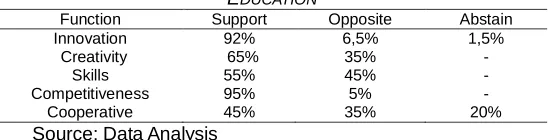
adaptive, and reliable engineers for the progress of the industrial revolution 4.0, can be prepared. In addition, the rejuvenation of infrastructure and development of education, research, and innovation infrastructure has also been carried out to sustain the quality of education, research, and innovation. Digitalization is becoming one of the leading and most effective approaches to increasing the effectiveness and performance [18]. The following in Table 2 shows the perceptions of students in the use of digitalization of the implementation of educational functions as a comparison, research, and community service.
TABLE 2
STUDENTS'PERCEPTIONS ABOUT THE FUNCTION OF HIGHER
EDUCATION
Function Support Opposite Abstain
Innovation 92% 6,5% 1,5%
Creativity 65% 35% -
Skills Competitiveness
Cooperative
55% 95% 45%
45% 5% 35%
- - 20%
Source: Data Analysis
One example of this activity is students and lecturers who conduct site-based research and community service. Students create a village website and the village is occupied to do community service in the form of an internship and a real work lecture. This website aims to provide public services, village potential, and village profiles in digital form. The public service is getting faster because it is based on population data through data collection from house to house and then within minutes has completed the process of public services needed by the community from the village or village administration. Village potential in the form of natural resources, human resources, environmental conditions, etc. Faster identified by the existence of village websites. Likewise, village profiles that are conventionally placed on office walls or created in the form of printed documents have been converted into audio-visual documents that can be accessed through the internet network. Based on table 2, mark digitalization is able to support 92% innovation. Hoping students want to work deeper as working capital for good things that need to use the internet more in work. There are 65% agree that digitalization can increase creativity at work. In line with the results of research as a new e-government model, which is an alternative to the changing paradigm of e-government, 100% digitization of government services is proposed as a vision to realize the sustainable development of society as a whole [19]. Implementation of digital technologies and platform solutions in the public service system might bring many positive outcomes and allow to establish a purpose priority before functions [18]. The Likewise in education that increases competitiveness by 95%. Students are of the view that by digitizing the educational process their competitiveness in the workforce is high. Students answer:
"I was immediately offered to work in the village office where I was apprenticed"
(cooperatively) 45% support and 35% do not support, even 20% abstain. Public service workers traditionally enjoy broad freedom to make decisions about clients [21]. Students' perceptions are less preferred because they prefer the freedom of experimentation. Skills and cooperation are still lower when compared to the support of innovation, creativity, and competitiveness. Students tend to like information technology because the lecturer does not understand information technology. Interview result:
"There are still lecturers who do not understand the use of information technology (digitalization)"
Not understanding when answering interview results is lacking in skills. Keep learning to want to keep pushing yourself. These technologies influence every aspect of how companies organize and manage their supply chains and have a strong impact on sustainability [22]. Requires skills. It shows that there has been a breakthrough in research and development that supports the Industrial Revolution 4.0 and the research and development ecosystem to improve the quality and quantity of research and development in universities, industry, and society. Breakthrough innovation and strengthening innovation systems to increase industrial productivity and improve technology-based startups.
5 CONCLUSIONS
The conclusion is that by digitizing all educational processes, the millennial generation is more optimal in accepting higher education functions. Student acceptance rates are more innovative, more creative, more competitive, and more cooperative, but more difficult than increasing the skills of all ways of education.
ACKNOWLEDGMENT
The author thanks Hardianti, Sandy Lubis and Yayuk Astuty for helping as observers in retrieving research data. Furthermore, researchers also thank RISTEKDIKTI, through a research grant program for this Thesis Master research fund.
REFERENCES
[1] C. Khadijah, ―Transformasi perpustakaan untuk generasi millenial menuju revolusi industri 4.0,‖ IQRA` J. Ilmu Perpust. dan Inf., vol. 12, no. 2, p. 59, 2019.
[2] Witel, M. Rizal, M. Mubian, and N. Munajat, ―Analisis Perencanaan Karier Individual Pada Generasi Millennials ( Studi Pada Pt .,‖ Eduma, vol. 1, no. 1, pp. 1–8, 2019. [3] M. Dimock, ―Defining generations: Where Millennials end
and Generation Z begins,‖ Pew Res. Cent., pp. 1–7, 2019.
[4] S. Sutijono and D. A. M. Farid, ―Cyber Counseling di Era Generasi Milenial,‖ Sosiohumanika, vol. 11, no. 1, pp. 19–32, 2018.
[5] I. Al Walidah, ―Tabayyun di Era Generasi Millenial,‖ J. Living Hadis, vol. 2, no. 2, p. 317, 2018.
[6] P. Maulina, P. Studi, I. Komunikasi, and U. T. Umar, ―Media dalam tantangan industri 4.0: analisis penerapan sistem digitalisasi pada perusahaan media tempo,‖ Source J. Ilmu Komun., vol. Volume 5, pp. 1–12.
[7] N. Naujok and H. Stamm, The digital transformation of steel, vol. 42, no. 6. 2018.
[8] A. Khare, H. Ishikura, and W. W. Baber, ―Transforming Japanese Business,‖ in Transforming Japanese Business Rising to the Digital Challenge, 2020.
[9] Chambre de Commerce Luxembourg, Digital transformation in business and society. 2016.
[10] D. M. S. & D. S. A. Kiray, ―Education Highlights in Science and Technology 2018,‖ in Education Research Highlights in Mathematics, Science and Technology 2019, D. M. S. & D. S. A. Kiray, Ed. ISRES Publishing All, 2019. [11] S. P. Effendi and E. Tasrif, ―PERANCANGAN
DIGITALISASI PELAYANAN ADMINISTRASI AKADEMIK JURUSAN TEKNIK ELEKTRONIKA BERBASIS ANDROID Sandy Putra Effendi 1) , Elfi Tasrif 2) 1,‖ vol. 7, no. 2, 2019.
[12] I. Nurfalah and A. S. Rusydiana, ―Digitalisasi Keuangan Syariah Menuju Keuangan Inklusif: Kerangka Maqashid Syariah,‖ Ekspansi J. Ekon. Keuangan, Perbank. dan Akunt., vol. 11, no. 1, p. 55, 2019.
[13] J. Ahmad, ―Metode Penelitian Administrasi Publik; Teori dan Aplikasi,‖ in Gava Media, Yogyakarta, 1st ed., Yogyakarta: Gava Media, 2015, pp. 1–232.
[14] J. Fishenden and M. Thompson, ―Digital government, open architecture, and innovation: Why public sector it will never be the same again,‖ J. Public Adm. Res. Theory, vol. 23, no. 4, pp. 977–1004, 2013.
[15] S. Melhem, ―Assessing Country Progress Towards Digitization,‖ World Bank Gr., no. February, pp. 2018– 2019, 2019.
[16] I. Lindgren, C. Ø. Madsen, S. Hofmann, and U. Melin, ―Close encounters of the digital kind: A research agenda for the digitalization of public services,‖ Gov. Inf. Q., vol. 36, no. 3, pp. 427–436, 2019.
[17] V. Priya, S. Subha, and B. Balamurugan, ―Analysis of performance measures to improve the quality of service in cloud based e-government web portal,‖ Electron. Gov., vol. 14, no. 1, pp. 32–50, 2018.
[18] A. Semenova, ―Digital transformation of public services: leading trends, opportunities, and threats,‖ Adv. Soc. Sci. Educ. Humanit. Res., vol. 318, no. Icseal, pp. 403–409, 2019.
[19] S. C. Shin and Z. M. Rakhmatullayev, ―Digital Transformation of the Public Service Delivery System in Uzbekistan,‖ Int. Conf. Adv. Commun. Technol. ICACT, vol. 2019-Febru, pp. 703–709, 2019.
[20] S. Hippmann, R. Klingner, and M. Leis, ―Digitization – Areas of Application and Research Objectives,‖ Digit. Transform., pp. 9–17, 2019.
[21] P. A. Busch and T. R. Eikebrokk, ―Digitizing Discretionary Practices in Public Service Provision: An Empirical Study of Public Service Workers‘ Attitudes,‖ Proc. 52nd Hawaii Int. Conf. Syst. Sci., vol. 6, pp. 3130–3139, 2019.