IJSRR, 7(4) Oct. – Dec., 2018 Page 1844
Research article Available online www.ijsrr.org
ISSN: 2279–0543
International Journal of Scientific Research and Reviews
Enhancing Reading Skills through Task-Based Approach
Shamsudeen G. Syed
Department of English The New College-600014 Email: [email protected]
ABSTRACT
Task based approach is a universally recognized approach and is widely applied for teaching the macro skills of language, However is a less explored area in the context of teaching reading. This paper aims to analyses the importance of reading skills in English and to explore how reading skills can be enhanced if task-based approaches are adopted by teachers in their reading classes. An experimental approach was adopted to find the efficacy of task based approach in the context of teaching reading using task based approach. A paired sample t-test was carried out for test reliability. Some interesting findings emerged from the study. The findings suggest that task based approach is effective than other traditional approaches for teaching reading. The findings of the study shall be of great relevance to the policy makers and teaching practitioners. Recommendations for future research are made.
*Corresponding author
Shamsudeen G. Syed
Assistant Professor
IJSRR, 7(4) Oct. – Dec., 2018 Page 1845
1.0 INTRODUCTION
The importance of English Language is greatly felt in multinational companies, corporate industries, Civil Service exams, State Service exams, information desks, embassies, courts, colleges, universities, etc. It has become an inevitable library language and language to stay connected globally through social networks like Facebook, Twitter, WhatsApp, etc. Though higher education in Tamil Nadu is primarily imparted through English medium learners generally find it difficult to upgrade their knowledge with the latest inventions, discoveries, research findings in many fields because they may have problems in reading English. The reasons may be that the learners may not have given enough attention to acquire reading skills at primary level and secondary level. At the tertiary level, they are expected to have good reading skills in order to consult the reference books, journals, thesaurus and encyclopedias. Hence a good awareness and exposure to reading skills would help the learners to overcome the inhibitions and widen their knowledge through reading.
1.1 Research Questions
The following research questions were formulated to test the effectiveness of TBA. ( Task Based Approach)
1. How can the teachers help learners develop their reading comprehension skills? 2. How can a task-based approach enhance the reading skills?
3. How can the teachers make the task-based approach effective for the learners?
1.3. Hypothesis
In alignment with the research questions hypothesis the following hypothesis was formulated. The students who were instructed using task based approach performed better than the students who were taught using traditional approach.
2.0 REVIEW OF LITERATURE
IJSRR, 7(4) Oct. – Dec., 2018 Page 1846
As reading is active process the readers are expected to have the knowledge of the writing system, understanding of the language, ability to decode, general knowledge, the purpose of reading and the appropriate style for understanding the text. A reader who has the basic ability to understand the grapheme, nuances of language, general awareness locally and globally, one who applies the correct approach to comprehend the text is considered to be an effective reader.
There are several purposes for reading in general. People read newspapers, magazines, social media messages, comments, reports, documents that are legal, stories, novels, dramas, instructions, warnings, notice boards, circulars, etc. Basically, people read mainly for two main purposes. They are reading for information and reading for pleasure.
2.1 Approaches in Reading
Several approaches are adapted by a student in order to achieve the purpose of reading. The most notable among them are skimming, scanning, intensive reading, extensive reading, loud reading and silent reading. Skimming is basically looking over a text hurriedly to get a plain idea of the content of the text.
Scanning is intended to locate a particular item from a specific section. So what is done here that some aid is required to be guided to the specific section where we could find the particular item. Looking up a dictionary for a definition of a specific word may be referred to as scanning. So scanning is looking very rapidly to search for a particular information in the text.
Reading a legal document line by line to get a complete understanding of the content is referred to as intensive reading. In intensive reading we read slowly and steadily for extracting full information from the text.
In extensive reading, we read quickly for getting an overall understanding of the longer text like a novel or a lengthy essay. It is like reading a newspaper rapidly to get a perspective about the previous day’s events and general knowledge information.
In most cases, day to day reading is usually done silently. Silent reading help to focus efficiently on the meaning of the text without any distraction, this is lost when it is done loudly because the concentration is shared between speaking and reading. Due to this reason comprehension is hampered and as a result, reading becomes much more complicated. On occasions where the others do not have access to the text, reading an information over the phone or reading a circular in the class, it can be done, otherwise, silent reading should be encouraged because it prepares the learners in real-life reading.
IJSRR, 7(4) Oct. – Dec., 2018 Page 1847
head instead of the eyes, saying words in a sentence loudly, hopping from one word to another instead of moving the eyes smoothly across the line, and moving the eyes backward time and again. These learners could be given certain training to improve their reading speed. At a lower level, the teacher could design a reading task using flashcards. A situation like stepping inside a cinema hall looking at different counters they have to raise their hand if they see ticket counter. For this purpose, the teacher could design some flash cards like refreshment corner, information desk, teasers, etc. This could improve the word comprehension speed steadily. Many such tasks can be designed to improve comprehension speed and word recognition.
Similarly, some more tasks can be designed for the learners at a higher level to improve their reading speed and comprehension. For example, the teacher can a passage on a big screen with the help of multimedia projector and speakers. It can be arranged in such a way that few sentences appear on the screen the duration for sentences to appear could be depending upon the average time taken to read the sentences. After this, the following sentences are displayed in clusters until the passage ends. Then learners could be asked to answer the comprehension questions from the passage. The learners’ level of improvement can be monitored with a help of a progress report.
Basically reading classes can be broadly divided into three stages that is the first one is Pre-reading, and the second one is while reading and the last part is Post-reading. In the first stage that is the Pre-reading stage, the teacher should arouse the learners’ interest in the subject that they are going to read. This can be achieved by making gives their opinion about the subject. This would encourage them to involve themselves in reading. By doing this teacher try to remove some of the obstruction in the path of this stage. A real-life situation relevant to the subject of reading could be introduced to generate interest among students. Further, the teacher could introduce some reading technique like guessing the meaning of the word from the context. Meanings of difficult words also could be taught to them. By doing such things the learner gradually sets his mind for reading.
In the While reading stage, the learners can be asked to read the passage quickly. For doing this teacher could give them some guiding questions which would make the learners understand the information stated in the text, reacting analytically on the subject that has been read etc. The questions could be like “What is the overall theme of the text?”, “What are facts that you have come across in the passage?
IJSRR, 7(4) Oct. – Dec., 2018 Page 1848
2.2 List of important skills required for Reading
1. Knowing the script of a language
2. Assume the meaning and use of unfamiliar words 3. Inferring plainly stated information
4. Making out the abstract meaning
5. Deducing the connection within the sentence
6. Finding out relations between parts of a text through lexical and grammatical cohesive devices
7. Perceiving a text by going outside it 8. Understanding indicators in discourse 9. Recognizing the main point in a passage
10.Differentiating the main idea from supporting details 11.Picking out the important points to summarize the passage 12.Basic reference skills
13.Skimming and scanning to find out specific information 14.Converting information into another form
(Adapted from Munby3, 1978: 126-131)
The above-mentioned reading skills are necessary to approach a text and comprehend it without any obstructions. At tertiary level learners are mainly expected to acquire these skills to be familiar with the library language and be proficient readers. Teachers are expected to help the learners acquire these skills gradually. A systematic planning, need a based choice of materials and methodology would ensure a better outcome for the learners at tertiary level. Sometimes the textbooks prescribed by the colleges may have lengthy passages on different themes. The prose and poems prescribed for the learners may not be relevant to the day-to-day lives of the learners due to this the learners may not be interested or motivated to read such literary pieces. Therefore the teacher could think of some innovative methods which generate interest and motivate the learners to study those passages. There could be two methods to provide a solution to this challenge. One could be to use supplementary materials related to the prescribed passages in reading classes to make it more interesting for the learners. The second solution could be to design tasks based on the passages to make reading interesting and enterprising.
2.3 Task-Based Approach
IJSRR, 7(4) Oct. – Dec., 2018 Page 1849
are encouraged to activate and use whatever language they already have in the process of completing a task. The use of tasks will also give a clear and purposeful context for the teaching and learning of grammar skills. … All in all, the role of task-based learning is to stimulate a natural desire in learners to improve their language competence by challenging them to complete meaningful tasks.” (CDC 1999: 41)
“Tasks are activities which have meaning as their primary focus. Success in tasks is evaluated in terms of achievement of an outcome, and tasks generally bear some resemblance to real-life language use. So task-based instruction takes a fairly strong view of communicating language teaching.” Skehan4
The key assumption of tasked instruction are summarized by Freez5 as 1.The focus on process rather than a product. Basic elements are purposeful activities that emphasize communication and meaning. 2. ·Learners learn a language by interacting communicatively and purposefully while engaged in the activities.3.·Activities and a task can be either:4.Those that learners might need to achieve in real life; 5.Those that have pedagogical purpose specific to the classroom.6. Activities of the task-based syllabus are sequenced according to difficulty.
The teacher has to keep in mind the level of difficulty while designing a task for the learners. The factors that can be considered for this are the kind of previous experience the learners are familiar with, how complex the task should be for the learners, use of language to do the task and necessary support from a teacher.
According to Nunan6 (1989,1993), six basic elements are required to design a task. The first is the input data, which is the material that learners work on, it could be an article from a magazine or a video with subtitles. The next element is a procedure that is carried out by the learners to do the activities. Other elements are goals, roles of teachers, roles of learners and an ideal setting.
According to Alderson7 and Ataei8 ,there are different kinds of textbooks materials which can be used for developing reading skills. Some of them have passages and activities supplementing them. Some other textbooks do not have enough activities based on the passages so in such cases the teacher can design some tasks for enhancing reading skills that could motivate the learners to do those tasks with much interest. The teacher can choose short pieces for the activities those activities should be complementing the passages that have been done in the classroom. These activities would captivate the interest of the learners and could support them to become familiar with basic reading comprehension skills. Given below are some reading tasks that could be used in classrooms for enhancing reading skills. These tasks can be introduced to learners at tertiary level to improve their reading skills in English. The details of the tasks are given in the annexure.
IJSRR, 7(4) Oct. – Dec., 2018 Page 1850
The sample for the study consists of 60 students. A random sampling was followed according to the guidelines stated in Best & Kahn9 and Brown10. The students were the first year undergraduate students of English literature. A pretest was conducted before the instructional phase. The pretest scores were calculated. The pretest was diagnostic by nature. Chacko11 and Cook12 emphasize about the important of pretest in the experimental research. After the pretest the teacher used a task based approach to teach reading. After his instructional phase he analysed their performance using a paired t-test. IELTS reading rubric was used to analyze their post test scores. The students received 15 hours of task based instruction which comprised of tasks pertaining to skimming, scanning, intensive reading, extensive reading and speed reading.
4.0 ASSESSMENT PROCEDURE
The following reading tasks from IELTS general were given to the students after the instructional phase.
Adapted from www.IELTS.com
IJSRR, 7(4) Oct. – Dec., 2018 Page 1851
Figure-1: Skills tested in Reading Assessment
5.0 DATA ANALYSIS
The raw data of the pretest and posttest scores of the students are presented below. Similar kind of analysis is reported before in the previous studies such as Chalak13, Ellis14. Evans15and Griva16. As indicated earlier the pretest was conducted before the instructional phase and the post test was conducted after the instructional phase. The blue lines given in figure -1 indicates the performance of pretest and the redlines represent the performance of posttest. The redlines indicate that there was a distinct improvement in the posttest score. This is similar to the findings of Prabhu17 and Richards and Rodgers18.
1 2 3 4 5 6 7 8 9 101112131415161718192021222324252627282930 PRETEST 1011 5 111514151011 5 111013 5 111514151011 3 131716231414131712 POSTTEST 1615 9 172220231715 9 171615 9 17222023171513232423231819232219
10 11
5 11
15 14 15
10 11
5
11 10 13
5 11
15 14 15
10 11
3 13
17 16 23
14 14 13 17 12 16 15 9 17 22 20 23 17 15 9
17 16 15
9 17 22 20 23 17 15 13
23 24 23 23
18 19 23 22 19 0 5 10 15 20 25 30 AXIS TITLE
Pretest and posttest scores
IJSRR, 7(4) Oct. – Dec., 2018 Page 1852
Figure-2: Raw data of pretest and posttest scores
Table-1 represents the frequency of the pretest. Among the 30 participants only one candidate has scored 3 points. Three candidates have scored five points and four candidates have scored ten points. Six candidates have scored 11 points, only one candidate has scored twelve. So there were 15 students in the below par and average category.
In terms of above average performance there are three candidates who have scored 13 points, four candidates 14 points and four candidates 15 points. Only one candidate has scored 16 points and 2 candidates have scored 17. In terms of exemplary performance there was only one candidate.
Table-1: Frequency Table of Pretest Pretest
Frequency Percent Valid Percent
Cumulative Percent
Valid 3.00 1 3.3 3.3 3.3
5.00 3 10.0 10.0 13.3
10.00 4 13.3 13.3 26.7
11.00 6 20.0 20.0 46.7
12.00 1 3.3 3.3 50.0
13.00 3 10.0 10.0 60.0
14.00 4 13.3 13.3 73.3
15.00 4 13.3 13.3 86.7
16.00 1 3.3 3.3 90.0
17.00 2 6.7 6.7 96.7
23.00 1 3.3 3.3 100.0
Total 30 100.0 100.0
When we compare the frequency table in posttest there is a sharp contrast. The frequency table-2 indicates that there is discernible improvement in the performance of the candidates in posttest.
Table-2 represents the frequency of the posttest. Among the 30 participants none of the candidates had scores between 0 to 8. Only three candidates have scored nine points. None of the candidates are found between the ranges 10 to 12. One candidate had scored 13 and four candidates have scored 15.
It is clear that there is a distinct improvement among most of the candidates as they have improved from mediocre to average in reading skills. The number of students who are above average have also drastically risen. Five students have scored 17, one student have scored 18.Similarly one candidate has scored 19 and 20 respectively. The improved cognition indicates that the students in the average category have performed very well.
IJSRR, 7(4) Oct. – Dec., 2018 Page 1853
Table-2: Frequency table of post-test
Valid Frequency Percent Valid Percent Cumulative Percent
9.00 3 10.0 10.0 10.0
13.00 1 3.3 3.3 13.3
15.00 4 13.3 13.3 26.7
16.00 2 6.7 6.7 33.3
17.00 5 16.7 16.7 50.0
18.00 1 3.3 3.3 53.3
19.00 2 6.7 6.7 60.0
20.00 2 6.7 6.7 66.7
22.00 3 10.0 10.0 76.7
23.00 6 20.0 20.0 96.7
24.00 1 3.3 3.3 100.0
Total 30 100.0 100.0
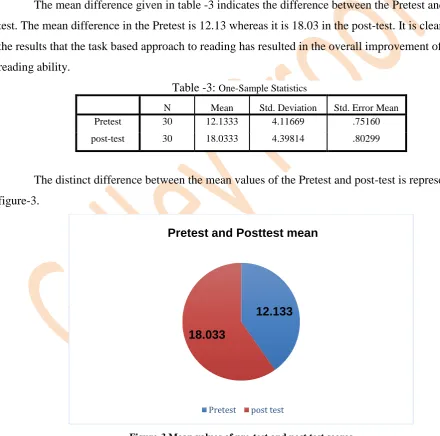
The mean difference given in table -3 indicates the difference between the Pretest and Post-test. The mean difference in the Pretest is 12.13 whereas it is 18.03 in the post-Post-test. It is clear from the results that the task based approach to reading has resulted in the overall improvement of the reading ability.
Table -3: One-Sample Statistics
N Mean Std. Deviation Std. Error Mean
Pretest 30 12.1333 4.11669 .75160
post-test 30 18.0333 4.39814 .80299
The distinct difference between the mean values of the Pretest and post-test is represented in figure-3.
Figure-3 Mean values of pre-test and post test scores
Since mean values alone cannot be used as indicators to justify the hypothesis a one sample test was carried out using SPSS. The t value in the Pretest is 16.143 whereas it is 22.45 in the post-test. The lower value of the 95% confidence interval is 10.59 in the Prepost-test. On the contrary it is
12.133
18.033
Pretest and Posttest mean
IJSRR, 7(4) Oct. – Dec., 2018 Page 1854
16.391 in the post-test. The upper value of the 95% confidence interval is 13.67 in the Pretest. On the contrary it is 19.675 in the post-test. Hence it is clear that the post test scores and statistically significant. Contrasting finding in a similar context are reported by Rivers17 and Samuels18.
Table-4: One-Sample Test Test Value = 0
t df Sig. (2-tailed)
Mean Difference
95% Confidence Interval of the Difference
Lower Upper
Pretest 16.143 29 .000 12.13333 10.5961 13.6705
posttest 22.458 29 .000 18.03333 16.3910 19.6756
6.0 DISCUSSION
The following research questions were raised in the study
R.1. How can the teachers help learners develop their reading comprehension skills?
In regard to the research question 1 it is clear from the study that the teachers can use a task based approach to teach reading
R.2 How can a task-based approach enhance the reading skills?
The results of the t-test and the correlations carried out in the study indicate that a task based approach enhances the reading skills at four levels such as lexical level, skimming for gist, scanning for details and making inferences. Lacerenza19, and Tobe20 had come out with similar findings.
R.3 How can the teachers make the task-based approach effective for the learners?
It is also clear from the study that the teachers can make task based approach more interesting by exposing the learners to a plethora of tasks that focuses on the micro skills of reading.
The hypothesis that the students who were instructed using task based approach performed better than the students who were taught using traditional approach is justified in the study.
7.0 CONCLUSION
The main aim of the study was to analyze if task based approach to reading would yield the desired results. An experimental pretest and posttest approach was used in the study. The tasks were prepared accordingly to achieve the main objectives of this paper. The paired t-tests and the correlations formed the basis on the research. The findings of the study indicated that the tasks can enhance if the teachers adopt a task-based approach in their reading classes to get the required outputs. Future studies can be carried out on a large scale among other level of learners such as primary and secondary learners. Although the study was primarily carried out among only tertiary learners the results of the study can be generalized.
REFERENCES
IJSRR, 7(4) Oct. – Dec., 2018 Page 1855
2. Grey.R "Phonologically based reading disabilities: Toward a coherent theory of one kind of learning disability." Perspectives on learning disabilities. Routledge, 2018; 106-135.
3. Munby, J. Communicative Syllabus Design. Cambridge: Cambridge University Press. 1978.
4. Skehan, P. Tasks and language performance assessment. In P. S. M. Bygate (Ed.),Researching pedagogic tasks: Second language learning, teaching and testing. Harlow: Longman 2001.
5. Freez, S. Jay. "Enhancing reading fluency in learning-disabled students." Perspectives on learning disabilities. Routledge. 2018; 176-189.
6. Nunan, D. Designing tasks for the Communicative Classroom. Cambridge. Cambridge University Press. 1989.
7. Alderson, J. C. The relationship between grammar and reading in English for the academic purposes: selected papers from the 1900 Language testing research Colloquium. In D. Douglas, & C.Chapelle (Ed.), VA: TESOL. Assessing Reading.NY: Cambridge University Press.1993; 2: 200-220.
8. Ataei, M. R. ESP revisited: a reappraisal study of discipline-based EAP programs in Iran.
Unpublished PhD dissertation, University of Isfahan, Iran. 2004; 18-28
9. Best, J. W., & Kahn, J.V. Research in Education(10th ed.). NJ: Prentice Hall 2006.
10.Brown, H. D. Language assessment principles and classroom practice. San Francisco: Pearson University. 2001.
11.Chacko, Anil, et al. "Engaging fathers in effective parenting for preschool children using shared book reading: A randomized controlled trial." Journal of Clinical Child & Adolescent Psychology 2018; 47(1): 79-93.
12.Cook, V. Second language learning and language teaching. London: Edward Arnold. (1991). 13.Chalak, A. The effects of explicit and implicit pragmatic instruction on Iranian EFL learners’
Journal of Applied Linguistics and Language Research. (2015).
14.Ellis, R.Task-based language learning and teaching. Oxford: Oxford University Press. 2003. 15.Evans, S., & Green, C. Why EAP is necessary: A survey of Hong Kong tertiary
16.Students. English for Academic Purposes, 2007; 6(1): 193-206.
17.Griva, E. Reading Strategies of Greek university students learning English in context. English for Specific Purposes world. 2003.
18.Prabhu, N. S. Second language pedagogy. A perspective. Oxford: Oxford University Press. 1987.
IJSRR, 7(4) Oct. – Dec., 2018 Page 1856
21.Lacerenza, Christina N., et al. "Team development interventions: Evidence-based approaches for improving teamwork." American Psychologist 2018; 73(4): 517.