Licensed under Creative Common Page 262
http://ijecm.co.uk/
ISSN 2348 0386
THE EFFECT OF STRATEGIC MANAGEMENT PRACTICES ON
ISLAMIC BANKS PERFORMANCE: EVIDENCE FROM QATAR
Elsayed Elsiefy
Qatar Faculty of Islamic Studies, Hamad Bin Khalifa University, Qatar Foundation, Qatar Faculty of Commerce, Alexandria University, Egypt
Adel Eljohani
Qatar Faculty of Islamic Studies, Hamad Bin Khalifa University, Qatar Foundation, Qatar [email protected]
Abstract
This work explores strategic management practices in Islamic banks and their impact on
performance within Qatar’s Islamic financial sector. Financial ratios analysis was used, as the
most common in the literature and among practitioners for measuring the performance of
Islamic banks in Qatar. The researcher addressed these questions: Do Islamic banks practice
strategic management? Do strategic management practices influence banks’ performance?
And, Is strategic management an important tool in Islamic banks? To address the first question,
the researcher looked at the strategic management process, which includes strategy analysis,
strategy formulation, strategy implementation, and strategy control and evaluation, in order to
assess how far Islamic banks adopt this process during their operations. We developed a
questionnaire which was completed by decision makers at the highest level in Islamic banks. To
answer the second and third questions, we measured the overall performance of the Islamic
banks in Qatar through calculating five sets of financial results: namely, return on equity, return
on assets, return on investment, the debt to equity ratio, and the total debt ratio. These ratios
were calculated over five years, from 2010 to 2014, chosen to avoid the financial crisis period.
The findings led to the conclusion that Islamic banks practice strategic management. Similarly,
the strategic management practice has a significant effect on the banks’ performance. In
addition, strategic Management is an important tool for Islamic banks to consider and use.
Licensed under Creative Common Page 263 INTRODUCTION
To the researcher’s best knowledge, no research has investigated the relationship between strategic management practices and their impact on the performance of Islamic banks in the GCC region. In the present research, we examine the strategic management practices of these Islamic Banks and the impact of them on the banks’ performance within the state of Qatar. Our questions include how far to what extent strategic management is applicable, what the implications of applying it are, and what the consequences of not applying it are. Our research combines a strategic management framework with the analysis of financial ratios.
The recent financial crisis has revealed the reasons underlying this critical situation and the effective role of strategies. Sahlman (2009) declared that “It is asserted that this systemic failure has been caused by the mismanagement”. Organizations need to know where they are, where they are going and how to manage the shift, with respect to strategic management (Thomson, 2005).
All enterprises, including Islamic financial institutions, no matter what their size, whether profit seeking or not-for profit, private or public, are created for one purpose: that is, to achieve long-term and short-term objectives of their stakeholders (Bradmore, 1996). Islamic banks are subject to Shar’ia objectives which consider the principles of Shar’ia, social justice and the equitable distribution of income and wealth, which is based on divine scripture. It prohibits interest, upholds moral and ethical values, humanity, sympathy, forgiveness, generosity and charity.
Licensed under Creative Common Page 264 and multidivisional. We conclude with strategy control and evaluation, through reviewing performance and comparing it with targets.
In the other hand, we will measure banks’ strategic management practices through analysis of primacy data collected. Ultimately, to judge on the extent whether management is driving the company to the safe coast or directing it towards loss or extrafailure. Finally, we will examine their overall performance through calculating financial ratios which will achieve a clearer and fairer judgmental decision with respect to Islamic banks’ performance.
Research Problem
A study by K.K.Siraj and P.Sudarsanan Pillai from 2005 to 2010 showed that Islamic banks’ net profit ratio was lower than that of conventional banks even though their marketshares and asset growth had increased in the same period. Similarly, a study conducted by ElSiefy(2013) for the period 2006–2010 illustrated that Islamic banks’ market share had increased and they had maintained stronger asset growth and credit growth than had conventional banks before and after the financial crisis. In addition, he stated that there was a slowdown in Islamic banks’ profitability after the crisis and a significant low performance over most of the period of the research compared to the performance of conventional banks. This has led to the following questions: how do Islamic banks perform compared with one another? How has this arisen? On what basis? Are Islamic banks systemically applying strategy management or not?
Research Questions
1. Do Islamic banks practice strategic management?
2. Does strategic management influence banks’ performance? 3. Is strategic management an important tool in Islamic banks?
Importance of the Research
It is a significant study for the Islamic finance industry in two dimensions. First, the Academic dimension: to our best knowledge no study has investigated the application of strategic management in Islamic banks and its impact on performance in Qatar. In addition, this is hoped to provide a benchmark for future research and its replication would considerably enhance the understanding of strategy practices in Islamic banks.
Licensed under Creative Common Page 265 METHODOLOGY
We based the work on the four areas of the strategic management process framework: strategy analysis, strategy formulation, strategy implementation and strategy evaluation & control (Thomson (2012), Wheelen & Hungers (2006), Marten, F. (2010)).
A questionnaire was used to collect some of the data. AllC-level executives (e.g.CEO, President, First Executive VicePresident, etc.) of those banks were approached as potential respondents to have an adequate response rate, given the volume of data being sought. It also increases the likelihood that managers will give information of a confidential nature if they are asked for it in a face-to-face interview, they may not be willing to give it over the telephone or in writing. Given the details of the proposed questionnaire, it is the most suitable method to elicit a complete and accurate response.
We measured the overall performance of the Islamic banks in Qatar through calculating five sets of financial results: namely, return on equity, return on assets, return on investment, the debt to equity ratio, and the total debt ratio. These ratios were calculated over five years, from 2010 to 2014, chosen to avoid the financial crisis period.
SHAR’IA COMPLIANCE
Islamic finance is based on the principles established by the Shar’ia which are derived from the Holy Qur’an and Sunna and its interpretation by jurisprudence in the form of fatwa issued by qualified Muslim scholars. The core principle in Islamic finance is based on the prohibition of interest (Riba). Allah says in the holy Qur’an“Those who consume interest cannot stand [on the Day of Resurrection] except as one stands who is being beaten by Satan into insanity. That is because they say, “Trade is [just] like interest.” But Allah has permitted trade and has forbidden interest. So whoever has received an admonition from his Lord and desists may have what is past, and his affair rests with Allah. But whoever returns to [dealing in interest or usury] – those are the companions of the Fire; they will abide eternally therein” Al-Baqara – Verse 275
Licensed under Creative Common Page 266 Any violation of these previous principles will be considered non-compliance with the orders of Allah (disobedience), while the practice of endowments is to be encouraged, to increase the satisfaction of Allah and get more reward. The second issue is that the structure of the Islamic finance system is a human construct. All the mechanisms or tools that are used in Islamic finance are subject to discussion, modification, correction, error and criticism. Failure to apply them does not mean disbelief.
Some people think that Islamic finance opposes debt finance and that finance must be based on equity and profit sharing only. This is not correct, because many Islamic financing contracts depend on debt creating modes such as Murabaha, Ijarah, Ijarah Montahia Bi Tamalok.Bai Bi Thaman Ajel, Istis’a', Salam. Only in Musharakh (Restricted & Unrestricted) and Wakalah (Restricted & Unrestricted) is there no debt. To solve such problems, Islamic economics mixes debt and equity finance by mixing Musharakhwith Wakalah and Mudarabah and benefits from multiple modes of financing, whereas commercial banks limit their finance to debt finance only. This misunderstanding comes from the Islamic writings by Asian scholars in the second part of the last century about pure Islamic models (the pure exchange model and the pure consumption model.
Islamic finance contracts can be categorized, as Monzer finds, into two categories; main hybrid contracts and nominate contracts. Hybrid contracts developed over the past half century and are practiced in contemporary Islamic finance and banking. Nominate contracts are those that can be found in the classical Fiqh. They include deferred payment sales, Salam, Istisna, Ijarah, Musharakah, Muzar’a' and its derivatives and Mudarabah. Examples of all of these contracts can be found in the classical Fiqh. Deferred payment and installment sales serve as the foundation of Mudarabah in Islamic banking today. They are basically sales at a higher price and are fair. It is a misconception to say otherwise because this concept is well known in Fiqh. A Salam sale is a sale with future delivery but without deferred payment, and gives the customer a discount. It is only permissible if it is realistic. It must be described in full, with the date/place of delivery determined, along with other conditions. Istisna is the deferment of price and delivery and usually applies to manufactured goods/construction. Ijarah financing is the sale of a usufruct for a given price.
Licensed under Creative Common Page 267 BBA, three party Salam, three party Istisna, lease purchase, buy-lease/sale back, commodity Murabaha and Tawarruq. Commodity Murabaha is haram (impermissible) because it contains the element of Tawarruq the transaction itself is not real and not an asset- based transaction which alienates it from the basic principle of Islamic finance.
The basic disadvantage of conventional finance is information asymmetry, which entails two kinds of risk. The first is that of moral hazard and the second is adverse selection. Islamic finance can avoid information asymmetry in most of its 12 permitted contracts. All trade contracts (Murabaha, Bai Bi Thaman Ajel, Istis’a', Salam, and Ijarah&Ijarah Montahia Bi Tamalok& Salam) are free of information asymmetry. But in Wakalah (Restricted&Unrestricted) and Mudarabah (Restricted &Unrestricted) information asymmetry unfortunately exists, since the owner of the money does not know much about the way in which the money may be used. Information asymmetry can be avoided by mixing Musharakh with Mudarabah several Islamic banks often share the same scholars. This phenomenon has the negative side effect of creating a conflict of interest among the Islamic banks which share Shar’ia scholars or advisors. The first measure that any bank wishing to offer Islamic products must undertake is to appoint a Shar’ia board or at the very least a Shar’ia counselor. This initial step is essential for the future operations of the bank, because it helps to minimize Shar’ia risk, the risk that the terms agreed in a contract do not effectively comply with Islamic principles and thus are not valid under Islamic law. In consequence, the contract could be declared (wholly or partially) void in a Shar’ia court (Solé, 2007, pp.4-5).
Licensed under Creative Common Page 268 ANALYSIS AND RESULTS
Financial Ratio Analysis
Financial ratios reflect how efficient a bank’s management is in allocating available resources to high yielding assets. The ratios calculate return on equity, return on assets, return on investments, debt to equity, and total debt to equity and are all used to measure and judge the performance of any entity. For the sample study we calculated the financial ratios for five years from 2010 to 2014 from the published financial statements for each bank. The purpose of the calculation was to compare the financial ratios for the four banks in question so as to learn which bank had the highest performance.
Return on Equity (ROE)
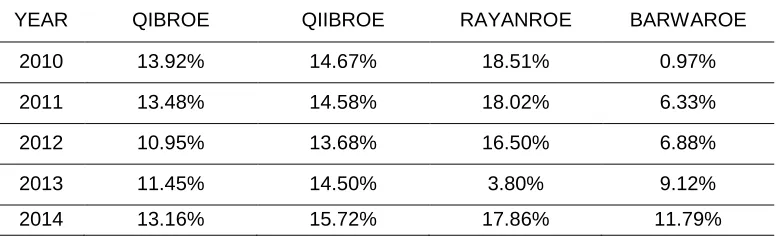
Return on equity or return on capital is the ratio of the net income of a bank during a given year to its stockholder’s' equity during the year. It measures the efficiency of a bank at generating profits from each unit of shareholder equity. ROE is a profitability ratio from the investor's point of view, not the bank’s. Investors want to see a high return on equity ratio because this indicates that the bank is using its investor’s' funds effectively. Higher ratios are almost always better than lower ratios.
This can be seen clearly in Table1,which illustrates the return on equity for the sample study. It is observable that Rayan is the highest bank in terms of return on equity with 14.94%, followed by Qatar International Islamic Bank, with a small difference 14.63%, whereas Qatar Islamic Bank comes in third place with 12.59%, and Barwa is ranked last with 7.02%.
Table 1. ROE
YEAR QIBROE QIIBROE RAYANROE BARWAROE
2010 13.92% 14.67% 18.51% 0.97%
2011 13.48% 14.58% 18.02% 6.33%
2012 10.95% 13.68% 16.50% 6.88%
2013 11.45% 14.50% 3.80% 9.12%
2014 13.16% 15.72% 17.86% 11.79%
Return on Assets (ROA)
Licensed under Creative Common Page 269 more effectively managing its assets to produce greater amounts of net income.A closer look at Table 2 indicates that Rayan was the bank ranked leader with 2.93%. Qatar International Islamic Bank and Qatar Islamic Bank achieved 2.73% and 2.15 % respectively, whilst Barwa’s return on assets is the lowest, 1.48 %.
Table 2. ROA
YEAR QIBROA QIIBROA RAYANROA BARWAROA
2010 2.77% 3.32% 4.12% 0.35%
2011 2.48% 3.06% 3.13% 1.81%
2012 1.89% 2.62% 2.57% 1.56%
2013 1.77% 2.38% 2.32% 1.69%
2014 1.85% 2.28% 2.50% 1.98%
Return on Investment (ROI)
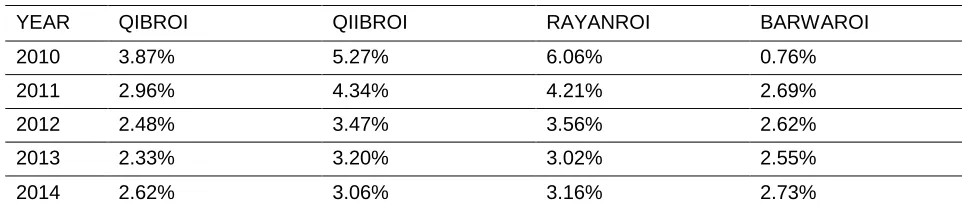
Return on investment is the benefit to the investor resulting from the investment of some resource. A high ROI means that the investment gains compare favorably to the investment cost. Generally, any positive ROI is considered a good return. This means that the total cost of the investment was recouped in addition to some extra amount. A negative return on investment means that the revenues were too low even to cover the total costs. Hence, higher return rates are always better than lower return rates. This can be noted in Table 3 which shows that Rayan is the highest bank in terms of average return on investment, whereas Barwa is the lowest, with 4.00 % and 2.27 % respectively. Qatar International Islamic Bank ranks second with 3.87 %, whilst Qatar Islamic Bank takes third place with 2.85%.
Table 3. ROI
YEAR QIBROI QIIBROI RAYANROI BARWAROI
2010 3.87% 5.27% 6.06% 0.76%
2011 2.96% 4.34% 4.21% 2.69%
2012 2.48% 3.47% 3.56% 2.62%
2013 2.33% 3.20% 3.02% 2.55%
2014 2.62% 3.06% 3.16% 2.73%
Debt to Equity Ratio (D/E)
Licensed under Creative Common Page 270 risky to creditors and investors, and this is observable in Qatar Islamic Bank, Barwa, and Qatar International Islamic Bank, where the percentages are 2.32, 1.35, and 1.26 respectively.Rayan is the bank with the lowest ratio, 0.62. Unlike in equity financing, all debt must be repaid to the lender. Since debt financing also requires debt servicing or regular interest payments, debt can be a far more expensive form of financing than equity financing and this clearly exists in Qatar Islamic Bank, Barwa, and Qatar International Islamic Bank. Rayan is in a better position than all other banks because banks which leverage large amounts of debt may not be able to make the required payments. Table below shows the average debt to equity ratio for the sample study.
Table 4. D/E ratio
YEAR QIBDER QIIBDER RAYANDER BARWADER
2010 231.45% 75.94% 28.00% 69.57%
2011 264.46% 85.98% 59.82% 143.11%
2012 229.98% 151.31% 102.94% 119.05%
2013 221.04% 187.82% 24.59% 152.81%
2014 214.28% 129.60% 95.26% 191.30%
Total Debt Ratio (TDR)
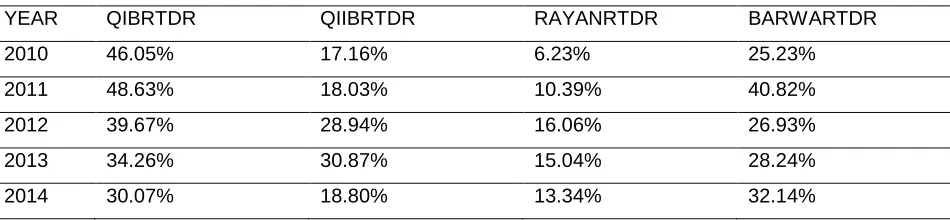
The total debt ratio is a solvency ratio that measures a bank’s total liabilities as a percentage of its total assets. In a sense, the debt ratio shows a bank's ability to pay off its liabilities with its assets. As with many solvency ratios, a lower ratio is more favorable than a higher ratio. This can be noted in the case of Rayan in Table 5; it is the bank with the lowest total debt ratio, 0.1221. A lower debt ratio usually implies a more stable business with the potential of greater longevity, because a bank with a lower ratio also has lower overall debt. Conversely, the Qatar International Islamic Bank’s total debt is twice that of Rayan, and that of Barwa and Qatar Islamic Bank is three times that of Rayan. The debt ratio is a fundamental solvency ratio, because creditors are always concerned about being repaid.
Table 5. TDR
YEAR QIBRTDR QIIBRTDR RAYANRTDR BARWARTDR
2010 46.05% 17.16% 6.23% 25.23%
2011 48.63% 18.03% 10.39% 40.82%
2012 39.67% 28.94% 16.06% 26.93%
2013 34.26% 30.87% 15.04% 28.24%
Licensed under Creative Common Page 271 Questionnaire Response Analysis
In this research we developed a questionnaire covering the strategic management process, as indicated in the literature review. The questions in the questionnaire were developed by the researcher, drawing on the following: a questionnaire developed by Elbanna (2013)to learn about the processes and impacts of strategy management; it took evidence from the public sector in the United Arab Emirates; a questionnaire about the effectiveness of performance management in the Thai banking industry developed by Pachsiry Chompukum; and his own inputs as the researcher. These questions were put to the representative bank CEOs of the sample study by email.
After receiving confirmation from the banks that the questionnaires had been answered, the researcher conducted interviews with the chief executive officers of the leading Rayan and Barwa banks, together with an interview with Qatar International Islamic Bank CEO advisor, and one with the head of the Qatar Islamic Bank’s strategy department. The questions included in the interview schedule were as follows:
1. Do you use consultants from outside your organization to contribute to the preparation of strategy plans and performance management systems?
2. What is your comment on the quality of their services?
3. Are there experts within your organization to take part in the preparation of strategy plans and performance management systems?
4. How do you assess their work?
5. Please describe the process of strategy planning in your organization.
6. What is your role in the strategy planning processes and performance management in your organization?
7. Is there a positive impact of strategic planning on your organization? 8. How is it assessed?
9. Will your organization be affected negatively, positively or will there be no effect if the organizational unit(s) responsible for strategy planning and performance management is/are canceled?
10. Does the strategy planning unit in your organization have enough expert staff?
Importance of Strategic Management
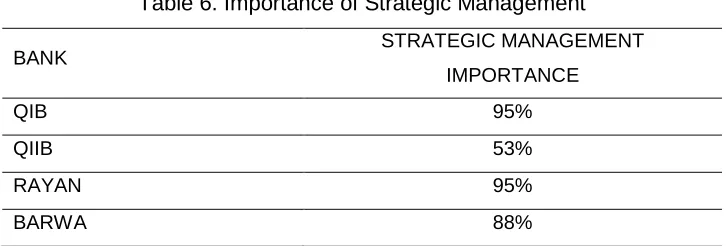
Licensed under Creative Common Page 272 International Islamic Bank was affected by this low score and it was ranked lowest with a percentage of 56%. To increase its strategy position in the future, the Qatar International Islamic Bank’s management should review its approach to the importance of strategic management and benefit from the advantages of doing so.
Table 6. Importance of Strategic Management
BANK STRATEGIC MANAGEMENT
IMPORTANCE
QIB 95%
QIIB 53%
RAYAN 95%
BARWA 88%
Strategic Management Awareness
With respect to strategic management awareness, the table below shows that Barwa, Rayan, and Qatar Islamic Bank scored 88%, 87%, and 83% respectively, whilst Qatar International Islamic Bank scored only 57%. This result indicates that strategic management awareness exists throughout the sample study to a high degree, except for Qatar International Islamic Bank which scored lowest. Qatar International Islamic Bank’s management should widely adopt strategic management awareness in order to enable its staff to provide the highest quality of service to its customers.
Table 7. Strategic Management Awareness BANK STRATEGIC MANAGEMENT AWARENESS
QIB 83%
QIIB 57%
RAYAN 87%
BARWA 88%
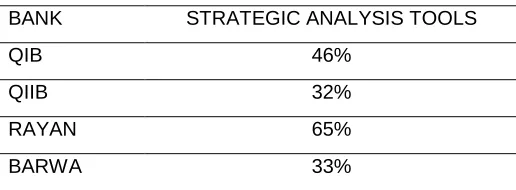
Strategic Analysis Tools
Licensed under Creative Common Page 273 stakeholder analysis, and learning curve analysis are all used by all Islamic banks. This finding may be associated with the ease of preparation and of use of these tools, since they are familiar to the personnel of the banking sector. However, value chain analysis, PEST analysis, strategy planning software, the internal factor evaluation matrix, external factor evaluation matrix, competitive profile matrix, and Boston consulting group matrix are less used in Islamic banks,even though they are very significant inputsin formulating the strategy,and this may be due to the high professional skills required to use these tools effectively. Controversially, McKinsey’s 7 S frameworks, Porter's 5-forces analysis, strategy position and action evaluation matrix (SPACE),the internal/external matrix, grand strategy matrix, and quantitative strategy planning matrix were not found to be used in the sample study. This may be due to the lack of knowledge about these tools and the increasing demand for highly talented and skilled staff.Islamic banks need to adopt more of the tools of strategic analysis in order to increase the percentage for their use, which would enable Islamic banks to analyze and explore their performance better.
Table 8. Strategic Analysis Tools BANK STRATEGIC ANALYSIS TOOLS
QIB 46%
QIIB 32%
RAYAN 65%
BARWA 33%
Strategic Analysis (Internal& External)
Licensed under Creative Common Page 274 the statement “Our services/products enjoy customers’ acceptance” implied high commitment from Qatar Islamic Bank, Rayan, and Barwa to meeting customers’ needs, but Qatar International Islamic Bank failed to show the same commitment.
Table 9. Strategic Analysis(Internal& External)
BANK STRATEGIC ANALYSIS (INTERNAL & EXTERNAL)
QIB 83%
QIIB 66%
RAYAN 94%
BARWA 80%
Strategic Plan Implementation
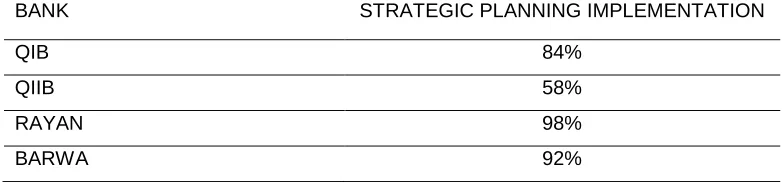
The respondents’ answers related to their implementation of the strategic plan show that Rayan and Barwa bank scored highest, with 98% and 92% respectively whereas Qatar International Islamic Bank scored lowest58% and Qatar Islamic Bank scored 84%. This is a positive indicator for the three highest-scoring banks and demonstrates that they engaged in the required activities and actions for implementing it. In addition, it illustrates that there is little for them between the processes of implementing the strategic plan and putting its activities into action
As long as developing initiatives and projects, as defined in the first question, is the core activity of any implementation plan, without such activity no bank can assume that it is systematically implementing its strategic plan.
Licensed under Creative Common Page 275 strategy objectives” was found applicable to all banks with the exception of Qatar International Islamic Bank, which should review this approach and then adopt it.
Table 10. Strategic Plan Implementation
BANK STRATEGIC PLANNING IMPLEMENTATION
QIB 84%
QIIB 58%
RAYAN 98%
BARWA 92%
Strategy Plan Evaluation
With regard to the strategy plan evaluation, Rayan bank scored highest, 93%, and Qatar International Islamic Bank scored lowest, critically, 33%. Qatar Islamic Bank and Barwa stood equal at 82%.Strategic plan evaluation refers to the activities and actions required to assess the strategic plan. Qatar Islamic Bank and Barwa agreed with the statement “An independent unit within our bank is responsible for the strategy plan assessment process” whereas Rayan and Qatar International Islamic Bank did not apply it to themselves. The latter two banks should establish an independent unit or sub-unit with the task of evaluating their strategy plans. In the bans which had such a unit, the score indicated how far the top management supported the strategy evaluation. Two statements were used to assess the content of the performance measures. The first statement was that banks use different types of performance measure such as financial, customers, internal process and learning measures. This statement was accepted by all the banks except for Qatar International Islamic Bank. The second statement, that banks benchmark their performance measures against those of other banks was again accepted by all the sample banks, again with the exception of Qatar International Islamic Bank. Qatar International Islamic Bank should review the indicators for its performance measures. For the reporting of performance measures, it may be observed that only one bank,Qatar International Islamic Bank, deviates from the measures.
Licensed under Creative Common Page 276 corrective action based the performance report. Qatar International Islamic Bank also does this, but only to a small extent.
Table 11. Strategy Plan Evaluation
BANK STRATEGIC PLANNING EVALUATION
QIB 82%
QIIB 33%
RAYAN 93%
BARWA 82%
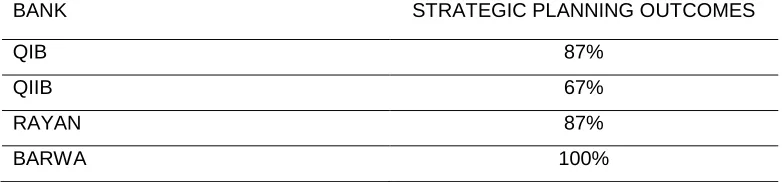
Strategy Planning Outcomes
With respect to strategic planning outcomes, Barwa bank scored highest, with 100%, and Qatar International Islamic Bank the lowest, 67%. Qatar Islamic Bank and Rayan had the same score, 87%. The strategic planning outcomes are the ultimate result of the whole strategic management process. They embody four significant factors; strategy direction, fit with environment, communication with stakeholders, and performance. The respondents’ answers support the strategy direction in questions 5, 6, 7, and 8.Qatar Islamic Bank And Qatar International Islamic Bank indicates little support from the central bank as a high authority in this sector, which can affect the operating process of Islamic banks. All the sample respondents in Islamic banks agreed with all the statements related to performance results as an outcome of the strategic planning process.
Table 13. Strategy Plan Outcomes
BANK STRATEGIC PLANNING OUTCOMES
QIB 87%
QIIB 67%
RAYAN 87%
BARWA 100%
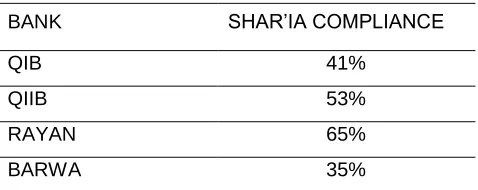
Shar’ia Compliance
Licensed under Creative Common Page 277 understanding of the customer that all Islamic banks transactions are Shar’ia compliant and any deviation from this approach may harm Islamic banks severely. Rayan and Qatar Islamic Bank considered offering non-Shar’ia compliant products to cause risks to their reputation, but they however they rejected the statement in question. It is easy to observe the contradiction in Qatar Islamic Bank’s responses to the two previous statements.
None of the sample banks accepted the statement that Islamic banks offer products that run contrary to the fatwas of the international Fiqh academy. Qatar International Islamic Bank, Rayan, and Barwa agreed with the statement that the bank receives queries from customers about the Shar’ia compliance of its products, but Qatar Islamic Bank rejected this statement. Rayan and Qatar International Islamic Bank agree with the statement that the strategic plan aims to avoid any products that become controversial from the Shar’ia point of view, whereas Qatar Islamic Bank and Barwa did not find it applicable. All Islamic banks aim to expand the number of the contracts whose terms they observe to cover all fifteen Islamic contracts. Three out of four in the sample study hired Shar’ia board members with a PhD, but they all lack degrees in economics and finance, this will lead to critical implications in the handling of Islamic contracts which need a combination of Shar’ia knowledge and financial and economic science. Qatar Islamic Bank and Barwa disagreed with the statement that the Shar’ia board provides arbitration between the bank and its customers in case of differences or conflicts. It would seem that this rule must be consistently applied in Islamic banks because it differentiates them from conventional ones. All of the sample study agreed with the statement that innovative products must be strictly Shar’ia compliant in order to protect the bank from reputation risk, which is significant and was given high priority. All the respondents’ answers supported the statement that the strategy plan gives high priority to Shar’ia compliance.
Table 13. Shar’ia Compliance
BANK SHAR’IA COMPLIANCE
QIB 41%
QIIB 53%
RAYAN 65%
BARWA 35%
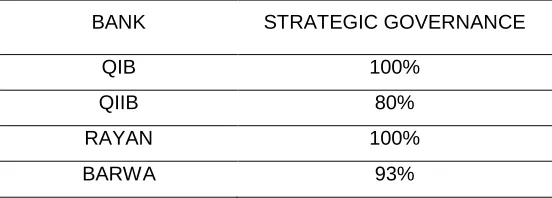
Strategic Governance
Licensed under Creative Common Page 278 governance in their internal policies, announce in their annual reports their compliance with these principles, take into account the interests of all stakeholders, and establish a supervisory committee. The supervisory committee assesses the quality of the internal control and risk management system, analyzes the efficiency of the external audit and the actions taken by senior management with regard to recommendations made by the external auditor, and ensures the submission of high quality information by dependent and associated companies.
Table 14. Strategic Governance
BANK STRATEGIC GOVERNANCE
QIB 100%
QIIB 80%
RAYAN 100%
BARWA 93%
Strategic Leadership
All of the sample study respondents evaluated their work in the preceding period, including their evaluation of the contribution and competence of individual members, and also the joint activities of their board. In addition, the report to be submitted by the supervisory or management board to the general assembly included the evaluation of the total business performance of the bank, the activities of its management, and a special comment on its cooperation with the management. All Islamic banks were found to have internal auditors and an internal audit system.
With regard to strategic leadership, Rayan bank had the highest score, 91%, and Qatar International Islamic Bank the lowest,55%, while Barwa and Qatar Islamic Bank scored 85%, and 82% respectively.All the respondents agreed with the statement that the senior level management were involved in the bank’s efforts to improve quality, which included planning, communicating, measuring, changing, and monitoring. In addition, the senior level management integrated the values of quality into everything they said and did, internally and externally.
Licensed under Creative Common Page 279 Except for Qatar International Islamic Bank, all Islamic banks in the sample believed that a focus on customers and quality was effectively communicated to all the bank’s employees. They all supplied regular training and support to the staff to reduce errors and improve quality. All managers and supervisors within Islamic banks are effective at reinforcing the focus on customers and quality. They all, except for Qatar International Islamic Bank, adopt strong integrated ethics, public responsibility, environmental protection, and safety into their business practices. With the exception of Qatar International Islamic Bank, all banks have evidence, such as a trend date, to clearly show that they are addressing social issues and are actively involved in community services, education, environmental protection, health care, and other public quality programs.
Table 15. Strategic Leadership
BANK STRATEGIC LEADERSHIP
QIB 82%
QIIB 55%
RAYAN 91%
BARWA 85%
Overall Strategic Management Practices
In relation to practices overall, Rayan bank scored highest, 87%,followed by Qatar Islamic Bank, 79%,Barwa, 77%, and Qatar International Islamic Bank, 56%. These results indicate that the Islamic banks apply strategy management to a reasonably high degree, except for Qatar International Islamic Bank. This will lead to the prosperity of Islamic banks and the fulfillment of the required managerial standards.
Table 16. Overall Strategic Management Practices
BANK OVERALL STRATEGY
MANAGEMENT PRACTICE
QIB 79%
QIIB 56%
RAYAN 87%
Licensed under Creative Common Page 280 Summary of Findings of Financial Indicators and Strategic Management
Performance Indicators and strategic management practice processes show that there is a clear positive relationship between the practice of strategic management and an entity’s performance. This relation can be observed clearly in Rayan bank, which has the highest score, 87% in terms of overall strategic management practice, and also the highest score with regard to financial indicators – return on equity, return on assets, and return on investment. In addition it has the lowest score in terms of debt to equity ratio, and of total debt ratio.
The results of Qatar International Islamic Bank do not match those of the above bank and we returned its submission as a set of answers to our questionnaire by a non-specialist; we received the answers through email and we suspected that the person who gave them seems not to have come from senior management or to have been a decision maker.
By excluding Qatar International Islamic Bank from our sample for these reasons, we can clearly infer from the results that there is also a clear positive relation between the practice of strategic management and financial performance for both Qatar Islamic Bank and Barwa. Qatar Islamic Bank bank ranked second in overall strategic management practice and also in return on equity, return on assets, and return on investments (which are the most significant indicators when measuring performance), However, Barwa took third place for the same indicators in addition to strategic management practice.
The results of this research are compatible with those in the studies of Arasa(2012), David (1997), Greenley and Hofer (1986),Henderson (1979), and Schendel (1978)and in addition, Henry Kombo’s study (2014) of commercial banks in Kenya that companies record improved performance once they effectively embrace strategic planning.
RECOMMENDATIONS
Licensed under Creative Common Page 281 REFERENCES
Alan R. Nankervis, R. L. Compton, Marion Baird, (1990) Strategy Human Resource Management, Human Resource Development Press.
Baird, (1989) Strategy Human Resource Management Sourcebook, Human Resource Development Press.
Bob Paladino, (2007)Innovative Corporate Performance Management: Five Key Principles to Accelerate Results, John Wiley and Sons Inc.
Bonn, (1996) Strategy and Organization: Realizing Strategy Management, Cambridge University Press. Bourgeois, (1996) Distinguishing the Effects of Functional and Dysfunctional Conflict on Strategy Decision Making: Resolving a Paradox for Top Management Teams, Available from: http://amj.aom.org/content/39/1/123.short
Bourgeois, (1996) Strategy Management: From Concept to Implementation,Dryden Press. Bradmore, (1996) Competitive Advantage: Concepts and Cases, Prentice-Hall, Australia.
C Appa, Parvathiswara, and Sivaramakrishna, (2008) Strategic Management Business Policy, 1st Edition, New Delhi, Anurajain.
Caescu Stefan Claudiu, Popescu Andrei, Ploesteanu Mara Gabriela(n.d.) Internal environment analysis techniques (1)
Cole Ehmke, Craig Dobbins, Allan Gray, Michael Boehlje, Alan Miller (n.d.) Farm Business Management for the 21st Century.
Dale, (1978) Strategies, Sage Publication Inc. International Educational and Professional Publisher. David, (1997) Concepts of Strategy Management, 3rd ed., Prentice Hall.
Dessler, (1976) Organization and management: a contingency approach, Prentice Hall February 1976 Dryden Press.Lawrence R. Jauch, William F. Glueck, (1984) Business policy and strategy management, 5Rev Ed., Mcgraw-Hill Education.
Elbanna Said, (2013) Processes and Impacts of Strategy Management: Evidence From the Public Sector in the United Arab Emirates, International Journal of Public Administration, April 2013.
ElsiefyElsayed, (2013) Comparative Analysis of Qatari Islamic Banks Performance Versus Conventional Banks Before, During, and After The Financial Crisis, International Journal of Business and Commerce, Vol 3, No.3: November 2013.
Eric Mayne, (2007) Chief.Supervision.Officer, ASX, 2 August 2007.
Eric Mayne, (2007), ASX Corporate Governance Council Corporate Governance principles and recommendations with 2010 amendments,2nd Edition.
FarhadAnaloui, AzharKarami (2003) Strategy Management in Small and Medium Enterprises, 1st ed., Thomson Learning.
Foursight Consulting Group (2006) Tayside Vision, Mission & Values Workshop, April 2006. Foursight Consulting Group Inc., (2006) Journal.
Frank T.Rothaermel, F. T., (2013) Strategy Management: Concepts and Cases, 2nded. Fred David, (2011), Strategy Management Concept and Cases, 13th edition.
Fred David, (2013) Strategy Management A competitive Advantage Approach, 14th Edition.
Fred R. David, (2014) Strategy Management Concepts and Cases: A Competitive Advantage Approach, 14thed.
Licensed under Creative Common Page 282 Hitt, Ireland &Hoskisson, (2012) Strategy management and strategy competitiveness,10th edition J. Smullen, (2004) Strategy Management and Performance, Public Administration Review. Jim Clayton, (n.d) Strategy as Action: Competitive Dynamics and Competitive Advantage,
John Harvey, (2003)Making It Happen: Reflections on Leadership, 1st ed., South Western Cengage Learning.
John Pearce, Richard Robinson, (2012) Strategy Management Planning for Domestic and Global Competition, 13thed.
John Ratz, (n.d.) Analyzing Internal Strategy Resources and Capabilities, chapter 3
John Thomson with Frank Martin, (2012) Strategy Management Awareness and Change, Fifth Edition. K.K. Siraj and P. SudarsananPillai, (2013) Efficiency of NPA Management in Indian SCBs A Bank-Group Wise Exploratory Study. Available from: http://www.scienpress.com/Upload/JAFB/Vol%203_2_8.pdf Kenneth R. Andrews, (1971) The Concept of Corporate Strategy, 3rd ed., Richard D Irwin
L.J. Bourcgeios, (1996) Strategy Management: From Concept to Implementation.
LinetNjagi, Henry Kombo,( 2014)Effect of Strategy Implementation on Performance of Commercial Banks in Kenya, European Journal of Business and Management, Vol 6, No. 13.
Marta White, (n,d.) Strategy Action: Strategy Formulation, Business Level Strategy, Cengage Learning (chapter4, p.27, ppt).
Michael porter, (1980) Competitive Strategy: Techniques for Analyzing Industries and Competitors, The Free press.
Nigel Evans , George Stonehouse , David Campbell , (1989) Strategy Management for Travel and Tourism, Butterworth Heinemann Publications.
Paladino, R. (2007), Strategy Control, Theme 14.
Peter Drucker, (2012) The Practice of Management, 30th ed., Elsevier Ltd.