Archives of Business Research – Vol.5, No.1 Publication Date: January. 25, 2017
DOI: 10.14738/abr.51.2438.
Evgeny, P. & Viktoriya, S. (2017). The Impact of the Resource Specificity on the Interfirm Interaction. Archives of Business Research, 5(1), 26-37.
The Impact of the Resource Specificity on the Interfirm
Interaction
Popov Evgeny
Institute of Economics, Ural Branch of Russian Academy of Sciences Ural Federal University, Post address: 620014, Russian Federation
Ekaterinburg, Moskow st., 29, Institute of Economics Ural Branch of Russian Academy of Sciences
Simonova Viktoriya
Ural Branch of Russian Academy of Sciences. Russian Federation, Ekaterinburg, Moskow st., 29
Institute of Economics, Ural Branch of Russian Academy of Sciences
Abstract
The transactional nature of hybrid organisations in the Russian industrial market is analysed with the help of conceptual tools drawn from transaction cost theory. The dependency of the impact of the specificity of resources on the transactions of hybrid organisations is empirically determined. An outline of the specific character of the organisation of inter-firm cooperation in the Russian industrial market is presented.
Keywords: inter-company transactions, hybrid organisation, transaction management mechanisms, transaction cost theory
INTRODUCTION
In modern institutional economic theory, three types of alternative mechanisms for transaction management can be distinguished (market, hierarchical and hybrid), the applicability of which is explained with the help of conceptual tools drawn from transaction cost theory (see Williamson O., 1991). Researchers in this area are paying particular attention to hybrid mechanisms of transaction management, due to their widespread and effective use by corporations in the real economy.
It has been over 20 years since the publication of one of the first studies to assess the hybrid forms of Russian organisations (see Bim, Jones and Weisskpof, 1993); however, this paper remains a relevant assessment of the real transactional interaction between participants of a hybrid agreement. A fortiori, the relevance of such research increases under the conditions of the transformation of the mechanisms of governance transactions in Russian industry.
THE TRANSACTIONAL NATURE OF HYBRID ORGANISATIONS
Hybrid organisational forms occupy an intermediate position between hierarchical and market forms (see Williamson O., 1991). Representing a discrete set of organisational forms, they are not uniform in content, combining in varying degrees the attributes of the two extreme types of institutional arrangements. In this case, they are not simply the result of a synthesis of the attributes of two opposing governance mechanisms, but possess unique characteristics that inhere in the distinctive logic of processes occurring through their coordination (see Podolny Joel M., Page Karen L., 1998). Analysis of these unique characteristics, adapted to the particular features of certain transactions, can reveal the transactional content of hybrid organisations.
In order to identify the essential characteristics of hybrid organisations, it is necessary to begin with an examination of the various definitions and approaches to the identification of sustainable forms of inter-firm interaction within the framework of scientific approaches such as transaction cost theory, the network approach, relationship marketing, strategic management and others.
The introduction by Oliver Williamson of the concepts of “hybrid organisations” into the economic cycle contributed to the qualitative analysis of different organisational means within a single theoretical framework. Williamson defined hybrid institutional arrangements as long-term contractual relationships, which preserve the autonomy of the parties, but also involve the creation of transaction-specific precautions that prevent opportunistic behaviour of participants and provide adaptation to changing circumstances in terms of non-zero contractual risks (see Williamson O., 1991). This definition points to the long-term nature of the relationship. This approach preserves the independence of the parties based on the right of ownership; the stability of the relationship is provided by inbuilt mechanisms designed to protect transactions.
Claude Menard treats “hybrid forms as special structures of transaction management, distinguished both from the market and from the hierarchy, which are relevant in two cases – depending on participants or multilaterally when this dependence is already creates a need for close coordination, but is still insufficient for full integration” (see Menard C., 1998). Here he emphasises the strategic interdependence of the participants’ intercompany relationships and focuses on the need for joint coordination of economic activities.
In accordance with the approach of Candace Jones and his colleagues “the network organisational model presupposes a selected, sustainable and structured range of autonomous businesses involved in the creation of goods and services on the basis of implied and indefinite contracts, contributing to adaption to unforeseen circumstances, the environment, and coordinating the protection of exchange transactions” (see Jones C. et al., 1997). According to this definition, inter-firm interaction presents itself as a stable, selective system. However, the basis of cooperation in such a system implies incomplete contracts and implied agreements, involving a problematic recourse to external legal mechanisms.
Jeffrey Bradach and Robert Eccles emphasise the unique coordination mechanism used in inter-firm cooperation, which is neither reducible to a hierarchical administrative authority nor to market-derived price signals. The authors interpret hybrid organisations as “transaction management mechanisms, based on trust and cooperation” (see Bradach J., Eccles R., 1989).
Primarily, to the distinctive characteristics of hybrid organisations should be added the fact that the resources of economic agents include the use of assets common to several companies rather than focusing on a single integrated structure or an exclusive contract. When pooling resources and firm-specific functionality for any joint implementation activities, business entities (firms) remain autonomous in the legal sense and only carry out economic cooperation on the basis of the contracts and agreements concluded between them. At the same time, the process of cooperation in hybrid organisations, based on recurring transactions, aims to preserve the differences between the individual partners to ensure their complementarity.
The basis for such cooperation consists in the contractual nature of the interaction. Cooperation and coordination between independent economic entities that share resources is based on contracts that are more or less formalised. At the same time, however, many authors emphasise the importance of attitudinal contracting, reflecting the “spirit of the agreement”, which is often more important for the interaction of participants than a formal agreement (see Menard C., 2004; Baker G., Gibbons R., Murphy K. 2002). The importance of a sustainable interaction is underpinned by the sharing of complementary and means-specific resources and the competencies of firms whose union is not possible based on an exclusive use of the price mechanism. Instead, it is necessary for the parties to ensure compliance with each other. The requirement for compliance on the one hand presupposes the existence of switching costs applied to the other counterparty and, on the other, indicates the emergence of multiplicative effects, providing a systematic advantage to hybrid organisations. The foregoing allows us to characterise the studied forms of organisation not as open but rather as selective systems, suggesting the presence of non-price barriers to entering into contractual relations. In summary, organisational relations are described as “hybrid” when there is a formal autonomy of interdependence between the parties, but the mechanism of their selection is an important element of the investigated forms of economic cooperation.
Another important characteristic of a hybrid inter-firm association is the strategic management of joint activities in the absence of legal controls over the relevant property. This means that, irrespective of whether hybrid organisations primarily rely on market-based mechanisms or the management of administrative processes, individual elements of the planning interactions must be implemented collaboratively. In other words, planning in the context of resource pooling is not primarily autonomous but is carried out in accordance with the formation of the private plans of companies. In general, there may be sufficient freedom of action within the framework of inter-firm interaction to support the possibilities of determination of priorities according to the character and focus of activities that take into account the responsibility for the final result.
Since the basis of cooperation consists in incomplete contracts, specific mechanisms for adapting to unexpected events are required in order to ensure the sustainable operation of this form of economic cooperation. In other words, freedom from conflicts is not guaranteed (see Popov E.V., Simonova V.L., 2006). Therefore, in order to ensure the sustained operation of the hybrid agreements, procedures for the settlement of conflicts through collaborative problem solving should be developed (see Mohr J., Spekman R., 1994). In fact, it is a mechanism for filling the gaps in the contract, which is too expensive to identify ex-ante on account of high uncertainty and bounded rationality, and in which resides the significance for the continuation of cooperation. Here there is ample scope for putting private order conflict resolution mechanisms into effect reducing the need for recourse to the legal system.
replacing the costly monitoring system obtaining in hierarchical structures. Disclosure requirements are aimed at easing the problem of information asymmetry. Given the selectivity of hybrid organisations, the communication system, within and through which information is exchanged, must have specific properties for business entities participating in this agreement.
Thus, hybrid organisations require the sustained interaction of legally independent firms involved in cooperative activities on the basis of incomplete or implied formal contracts, providing for flexibility in adapting to unforeseen circumstances and comprising protection mechanisms for implemented transactions. The type of contracting framework involves formal contracts, within which actively developing informal relationships, based on trust and social ties, are formed as a result of the experience of the ongoing interaction.
The proposed concept of hybrid organisations creates a theoretical basis for the development of working hypotheses concerning the impact of the specificity of the resources used in the transaction characteristics of inter-firm cooperation.
IMPACT OF THE RESOURCE SPECIFICITY ON THE INTERFIRM INTERACTION CHARACTERISTICS
Impact of the resource specificity
As part of the approach developed by Williamson, alternative control mechanisms, such as market, hierarchical or hybrid, are not mutually exclusive, but complementary; consequently, their application is determined by the level of transaction costs (see Williamson, 1996).
The magnitude of these costs is directly dependent on the conditions and characteristics of the ongoing transactions, amongst which are typically divided the specificity of resources, the frequency of transactions and the degree of economic uncertainty. Despite the importance of attributes such as the frequency of transactions and the level of uncertainty, Williamson rejects a key role in the exact extent of resource specificity, determining the choice of adequate forms of coordination. The specificity of resources determines the extent to which these resources are tailored to the needs of a particular user, as well as the degree to which they can be used to satisfy alternative needs.
To date, there are a number of empirical studies confirming the conclusions of the theory of transaction costs. In particular, researchers confirm the influence of the level of specificity of assets costs accompanying the transaction, and consequently the selection of the control mechanism (see Anderson E., Schmittlein D., 1984).
Thus, the specificity of the resource is a key feature of the transaction, which defines the organisational parameters of inter-firm cooperation. Accordingly, the theoretical justification of the main characteristics of the organisation of inter-firm interaction is necessarily dependent on the degree of specificity of the resource used in transactions with a view to their subsequent empirical verification.
communicational component reflects the effectiveness of the exchange of knowledge and information between the participating companies; and the resource component characterises the complementarity of participants of the inter-firm cooperation. Table 1 reveals the contents of the isolated groups.
The impact of the specificity of the resource on the characteristics of the proposed hybrid agreements is summarised below.
Institutional Characteristics
The use of specific resources is associated with problems such as the problems of “extortion” and irreversible investment. To mitigate these risks, the participants in the interaction will more thoroughly try to elaborate formal agreements, the detailing of which will reflect the specific conditions of the transaction relationship. To a certain extent, this legally protects the partners. However, complex binding contracts are usually too complex and too expensive; for this reason, the growth of the specificity of resources and associated risks require mechanisms that are complementary to formal contracts. Accordingly, it would be logical to expect that with increasing specificity of resources the nature of the contractual relationship will change, with formal contracts being supplemented by informal agreements formed on the basis of the relationship (first hypothesis – H1).
From the point of view of the importance of trust as a characteristic of hybrid agreements, an illustrative interpretation of some authors is presented in terms of the three coordination mechanisms based on price, power, and trust (see Bradach J., Eccles R., 1989).
Many authors consider trust between partners as an important mechanism for ensuring the stability and security of relations in terms of their interdependence, which is a consequence of the use of specific resources (see Hunt S., Morgan R., 1995). Consequently, we can assume that the higher the specificity of the resources used, the higher the level of trust between the partners (H2).
According to advocates of the network approach to the analysis of hybrid arrangements, social networks are the fundamental basis for sustainable inter-firm interaction (see Nieves J., Osorio J., 2013). Social ties between employees of firms included in a network of inter-firm cooperation contribute to the accumulation of specific inter-firm knowledge and continuity of relations, which can have a significant impact on the use of specific resources by legally autonomous economic agents. Consequently, the growth of asset specificity increases the importance of social networks based on interpersonal relationships (H3).
Communicational Characteristics
The interaction between economic agents within a hybrid agreement is based on an explicit or indirect exchange of information. R. Miles and C. Snow consider the exchange of information between the parties as the basis of trust and coordination (Miles R., Snow C., 1986). Disclosure requirements are aimed at easing the problem of information asymmetry, including the behavioural uncertainty of economic agents, and enhancing the effectiveness of the coordination process between the inter-firm cooperation of the parties. Therefore, with an increase in resource specificity, the intensity of information sharing also increases.
the resources used is accompanied by an increased intensity of information exchange, with this information becoming ever more strategic in nature, which, in turn, generates the need for more reliable information technology (H4).
Management Characteristics
In terms of inter-firm interaction that involves the use of specific resources, it is necessary to reconcile the objectives of the various participants in order to ensure the effectiveness of the interaction. In addition, there is a need for close cooperation with partners in addressing operational issues. Therefore, with increasing resource specificity, enhanced administrative functions need to be unified under the legal independence of participants of inter-firm cooperation (Н5).
Although, from the perspective of property rights, the main characteristic of the hybrid relations of firms consists in their autonomy, property (property relations) can be distinguished as distinctively characteristic in the Russian business environment as a mechanism for coordination between the parties’ inter-firm interactions. The property mechanism has considerable potential for effective long-term cooperation by reducing the cost of transactions by means of a simplified procedure for the harmonisation of goals, selection of strategic alternatives and coordination of ongoing activities. We can assume that under the conditions of high risks associated with specific assets, the enterprise will seek to organise inter-firm cooperation through the use of the mechanism of participation in the property of the partner (Н6).
Resource Characteristics
To ensure the sustainability of transactions that use specific resources, it is necessary to ensure the compliance of the parties to each other, which involves the implementation of mutual investments and formation of mutual relations (Wilson D., Jantrania S., 1996). Therefore, the specificity of tme resource necessitates investment in the partner in order to ensure better compliance of the parties to each other (Н7).
In addition, the degree of specificity of the resource creates a locking-in effect on the part of the partner and increases the costs of switching suppliers. In this case, inter-company relationships will be regarded as a selective system (Н8).
EMPIRICAL RESEARCH
Today there are many investigations devoted to the empirical verification of the transactional theory basis. In particularly these investigations are about the dependence between transactional characteristics and the government mechanisms. In the most of the papers researchers show the specificity of assets as the key factor in the choosing of the method for transactional organization. But here we haven’t the single view on the empirical identification of this parameter. Therefore in our research we used the expert estimation of the degree of specificity of resources due to the investigation of Masten S., Meehan J., Snyder E. (1989): Spes_Res is the expert assessment of the degree of specificity of resources used, measured on a 10-point scale (1 corresponds to the level when the resource acquired by the supplier is the standard on the market; 10 corresponds to a product specifically designed by the provider for the needs of a particular company which does not have the possibility of being used by another consumer.
parameters that may influence the choice of the characteristics of the organisation of inter-firm relationships., which also was estimated by the 10-point scale jn the basis of survey.
• Extent of formalisation of relations (Formal_Re) is estimated by a score system in which
a business relationship with a partner is governed by a formal agreement: one point corresponds to the ratio in which the contract is a mere formality, with all issues being resolved on an informal basis; 10 points designates relationships that are governed solely by the terms of the contract, which stipulate all possible conditions of the deal and take into account all the specifics of the relationship with the counterparty;
• Level of trust between the partners (Trust), measured according to a 10-point scale, calibrated according to the belief that the partner will not act in bad faith (1 corresponds to a situation where there is no assurance that the partner will not act in bad faith or take advantage of changed conditions for mercenary purposes and 10 corresponds to the full assurance that the partner will not act in bad faith but will act in the interests of the general development);
• Sophistication of intragroup social network (So_Net) represents the importance of the
inter-firm social network on a 10-point scale, estimated according to the importance of personal interaction (1 – low, due to the human factor not forming a significant part of the interaction; 10 – high, due to personal interaction playing an important role at all levels of the interaction);
• Information exchange intensity (Inf_Int) represents the intensity of the exchange of information on a 10-point scale (1 corresponds to a weak information exchange, when all the necessary information, including current information, is accessible by the employees of the company and 10 – strong, is when a significant amount of the required information is provided by the partner),
• Strategic level of information provided (Strat_Inf) represents the strategic level of information transmitted, on a 10-point scale determined by assessing the level of potential damage in the event of “leakage” of information provided by the partner outside the company (1 – low level, due to the partner only providing general information published in official sources for public use; 10 – very high, because the transmitted information is strategic in nature),
• Quality of technical communication (Tech_Com) represents an assessment of the quality
of technical communications (communications, information technology, technical maintenance and support services, etc.). With partners according to a 10-point scale (1 – unreliable, does not provide for the needs of production; 10 – reliable, consistently provides for production needs and security of information interaction),
• Presence of common strategic development goals (Co_Dev) represents potential joint
development with partners on a 10-point scale, as measured by the consistency of goals and objectives (1 – weak, due to companies having different goals and objectives; 10 – strong, due to having a significant proportion of goals and objectives in common), • Participation in the collaborative solution to the current problems of the partner
(Coord) represents the need for joint coordination on a 10-point scale, estimated according to the importance of the participation of a partner in solving the current problems of the enterprise (1 – not important, because all problems are decided separately; 10 – very important because many decisions are taken through interaction),
• Participants’ compliance requirement in terms of business processes (Spec_inv)
represents the need for specific investments in the partner evaluated on a 10-point scale (1 – no need for specific investments; 10 – the need for specific investments is very high, since it is necessary to ensure that the technological, intellectual, etc. levels of business processes of the partner enterprise),
• Blocking effect action (Lock_Eff) represents the degree of locked-in-ness of the partner
products for many businesses; 10 – high, i.e. the entity is the only consumer of the partner’s products).
In order to test the effect of asset specificity on the characteristics of hybrid agreements, an empirical study was conducted by the Institute of Economics of the Ural Branch of the Russian Academy of Sciences in 2013-2014. In this study, the object of the analysis consisted in the relations between producers and their major suppliers. Interviews were conducted with senior managers from more than 100 industrial corporations in the Ural region for which transactions with suppliers are characterised by stable relationships maintained over a long period of time.
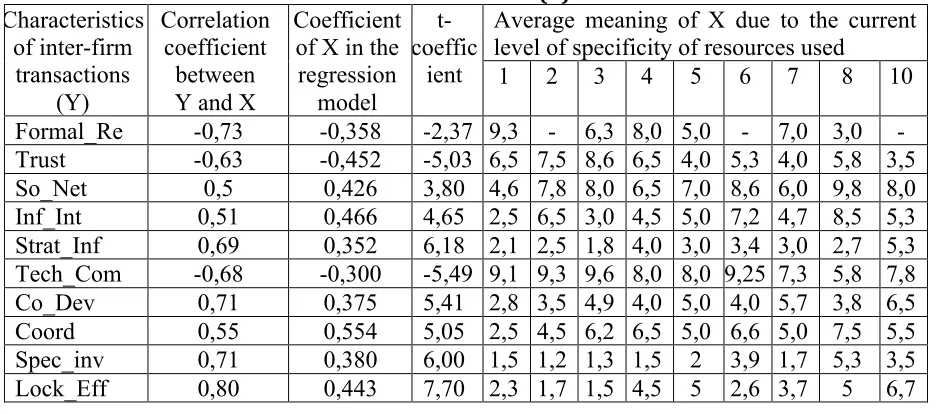
The analysis of dependence between inter-firm transactional characteristics and the specificity of resources used was carried out on the basis of correlation and regression analysis. The results was shown in the Table 2.
The obtained results are shown lower due to the investigated hypotheses.
Н1: increasing specificity of resources the nature of the contractual relationship will change,
with formal contracts being supplemented by informal agreements formed on the basis of the relationship
As shown by the empirical results, the relationship with a partner is predominantly governed by formal contract in the course of implementation of industrial enterprise transactions. Thus, 77% of transactions are realised on the basis of complete formalisation and regulated solely by the terms of the contract (10 points on 10-point scale); 12% of the transactions are characterised by a high degree of formality (7-9 points); 7% of transactions are subject to moderate formality (4-6 points); and 4% of transactions are characterised by a low degree of formalisation (less than 3 points when all issues are resolved on an informal basis).
Under the conditions of the predominance of complete formalisation of inter-firm relations, an analysis of the entire dataset does not permit a determination of the level of formalisation of relations depending on the degree of asset specificity. However, this dependence can be seen if we analyse the weakly formalised 23% of transactions.
In this case, the results of the study demonstrate an inverse relationship between the degree of specificity and the formalisation of the relations. It can be assumed that an increase in the specificity of resources used suggests a certain flexibility in relations oriented towards long-term cooperation. In addition, the obtained results update the research on mechanisms in use by Russian enterprises to influence the partner and control the implementation of the contract, secured by the legal system of alternative mechanisms.
Н2: the higher the specificity of the resources used, the higher the level of trust between the
partners
This fact can be explained by the specific character of the Russian business environment, in which personal relationships and past experiences of mutual obligations are not able to mitigate the risks associated with specific assets occurring under weak enforcement of contracts and the general economic instability of the Russian economy.
The findings underscore the importance of analysis of credible commitments and other precautionary measures taken by domestic industrial actors in the implementation of specific investment decisions.
Н3: the growth of asset specificity increases the importance of social networks based on interpersonal relationships.
The results demonstrate a positive relationship between the degree of asset specificity and the relevance of the human factor in the communications between enterprises. This fact confirms the conclusions about the need for multilateral, stable relations, which can only arise in the course of interpersonal communication in the organisation of inter-company transactions, based on the use of specific resources.
Н4: a growth in the specificity of the resources used is accompanied by an increased intensity of information exchange, with this information becoming ever more strategic in nature, which, in turn, generates the need for more reliable information technology
The results of empirical studies show that the growth of asset specificity increases with the intensity of the exchange of information between enterprises. The relationship between the degree of specificity and intensity of asset information exchange is represented in. In addition, a growth in asset specificity increases the strategic level of the transmitted information.
Since the exchange of information involves certain risks, especially in an environment where the information is strategic in nature, there is an increased demand for quality technical communications (networks, information technology, technical maintenance and support services, etc.) with partners. The results confirm the conclusions: the growth of asset specificity and, consequently, the strategic level of the transmitted information, leads to growing dissatisfaction with the quality of traditional technical communications, hence the need to increase spending on information security.
Н5: with increasing resource specificity, enhanced administrative functions need to be unified under the legal independence of participants of inter-firm cooperation
Hybrid forms of inter-firm cooperation presuppose the existence of coordination mechanisms to manage the implementation of the contract. The results of the study confirm the conclusions regarding the impact of the degree of asset specificity on the development of mechanisms used to coordinate inter-firm cooperation. Thus, with increasing specificity of resources used in transactions, the potential of joint development is enhanced by means of objectives and tasks In addition, in terms of resource specificity, many issues are resolved only through partner interaction.
The results obtained from the research into mechanisms of organisation of transactions of industrial firms in the Urals refute the findings of previous studies regarding the dominance of proprietary mechanisms in the inter-firm cooperation of Russian enterprises. Thus, the vast majority (86%) of the analysed transactions between industrial firms and their major suppliers are implemented on the principles of legal independence.
This result makes it possible to draw conclusions about changes in the terms and principles of the organisation of economic practice in the Russian economy over the last decade, when the consolidation of management functions began to implement administrative functions predominantly without combining the assets of the various participants. The reasons for these transformations should be sought in the changes to the institutional structure of the Russian economy.
Н7: the specificity of the resource necessitates investment in the partner in order to ensure better compliance of the parties to each other
Statistical indicators of the relationship between the studied parameters lead to the conclusion that the need to ensure the compliance of the parties to each other is an essential condition for the functioning of hybrid agreements that involve the use of specific resources.
Н8: the degree of specificity of the resource creates a locking-in effect on the part of the partner and increases the costs of switching suppliers
The effect of locking in the supplier can be estimated in terms of the isolation of the partner relative to the consumer enterprise. The results show a positive relationship between the degree of specificity of the resource and the effect of locking in the supplier. A graphical illustration of the dependency is represented in Fig. 10.
CONCLUSION
The conducted analysis of transactions of hybrid organisations in Russian corporations leads to the following conclusions.
The model verification of hybrid mechanisms of inter-firm interaction confirms the applicability of some of the conclusions of the theory of transaction costs to the economic conditions obtaining in Russia. With the growth of asset specificity, acting as an indicator of transaction costs, the significance increases of such characteristics of hybrid organisations as relational contracting, intensity of the exchange of information with the increasing demands on the level of technical communications, co-development capacity building, consolidation of administrative functions, resource interdependence and the need to ensure the compliance of the parties to each other.
At the same time, the following Russian-specific factor applying to the organisation of inter-firm cooperation is revealed.
Second, the weak legal institutions underpinning the Russian economy were found to exert a strong influence on the parameters of informal ties of inter-firm cooperation.
Third, when organising inter-firm cooperation, greater significance is accorded to the mechanisms impacting on the partner and the control of the implementation of the contract, forming an alternative to trust.
Fourth, over the past decade, the consolidation of management functions began to implement control functions without, as a general rule, also unifying the assets of various actors, i.e. on the basis of legal independence.
Thus, the theoretical and practical analysis of transactions of hybrid organisations demonstrates the possibility of a theoretical description of contemporary inter-firm interactions and a determination of the specific manifestations of transactional relations under the contemporary conditions of Russian industrial corporations.
References
1. Anderson E., Schmittlein D. 1984, Integration of the Sales Force: an Empirical Examination // the Rand
Journal of Economics. Vol. 15. N 3. pp. 385–395
2. Baker G., Gibbons R., Murphy K. 2002, Relational Contracts and the Theory of the Firm // Quarterly
Journal of Economics. Vol. 117. pp. 39-84.
3. Bim A.S., Jones D.Ch. and Weisskopf T.E. 1993, Hybrid Forms of Enterprise Organization in the Former
USSR and the Russian Federation // Comparative Economic Studies. Vol. 35. N 1. pp. 1-37.
4. Bradach J., Eccles R. 1989, Price, Authority and Trust - from Ideal Types to Plural Forms // Annual Review
of Sociology. Vol. 15. pp. 97 – 118.
5. Crocker K., Reynolds K. 1993, the Efficiency of Incomplete Contracts: An Empirical Analysis of Air Force
Engine Procurement // the Rand Journal of Economics. Vol. 24, N 1. pp. 126–146
6. Hunt Sh., Morgan R. 1995, the Comparative Advantage Theory of Competition // Journal of Marketing.
Vol. 59. N 2. p. 1-15
7. Podolny J.M., Karen L. P. 1998, Network Forms of Organization // Annual Review of Sociology. Vol.24. pp.
57-76
8. Jones C., Hesterly W., Вorgatti S. 1997, A General Theory of Network Governance: Exchange Conditions
and Social Mechanisms // Academy of Management Journal. Vol. 22. N 4. pp. 911-945
9. Joscow P. 1987, Contract Duration and Relationship-Specific Investments: Empirical Evidence from Coal
Markets // American Economic Review. Vol. 77. N 1. pp. 168–185
10. Masten S., Meehan J., Snyder E. 1989, Vertical Integration in the U.S. Auto Industry: a Note on the
Influence of Transaction Specific Assets // Journal of Economic Behavior and Organization.. Vol. 12. pp. 265–273
11. Menard С. 1998, Maladaptation of Regulation to Hybrid Organizational Forms // International Review of
Law and Economics. Vol. 18. N 4. pp. 403-417
12. Menard С. 2004, the Economics of Hybrid Organizations // Journal of Institutional and Theoretical
Economics. Vol. 160. P.345-376
13. Miles R., Snow C. 1986, Network organizations: New Concepts for New Forms // California Management
Review. Vol. 28. N 3. pp. 62–73.
14. Mohr J., Spekman R. 1994, Characteristics of Partnership Success: Partnership Attributes, Communication
Behavior, and Conflict Resolution Techniques // Strategic Management Journal. Vol. 15. N 2. pp. 135–152
15. Monteverde K., Teece D. 1982, Supplier Switching Costs and Vertical Integration in the Automobile
16. Popov E. 2014, Transaction Estimation of Institutions //Advances in Economics and Business. Vol. 2. N 1. pp. 58-64.
17. Popov E., Simonova V. 2006, Forms of Opportunism between Principals and Agents // International
Advances in Economic Research. Vol. 12. N 1. pp. 115-123.
18. Williamson O. 1991, Comparative Economic Organization: the Analysis of Discreet Structural Alternatives.
// Administrative Science Quarterly. Vol. 36. N 2. pp. 269-296.
19. Williamson O. 1996, the Mechanisms of Governance. NY: Oxford University Press
20. Wilson D., Jantrania S. 1996, Understanding the Value of a Relationship // Asia-Australian Marketing
Journal. Vol. 2. N 1. pp. 55–66.
Table 1. Interfirm interaction characteristics
Group
characteristics Content characteristics
Institutional
Extent of formalisation of relations Level of trust between the partners
Sophistication of intragroup social network
Communication
Information exchange intensity
Presence of networked databases and quality of technical communication
Strategic level of information provided
Management
Presence of common strategic development goals
Participation in the collaborative solution to the current problems of the partner
Form of organisational interaction
Resource
Participants’ compliance requirement in terms of business processes
Blocking effect action
Table 2. Dependence between the inter-firm transactional characteristics (Y) and the specificity of resources used (X).
Characteristics of inter-firm
transactions (Y)
Correlation coefficient
between Y and X
Coefficient of X in the regression
model
t-coeffic
ient
Average meaning of X due to the current level of specificity of resources used
1 2 3 4 5 6 7 8 10
Formal_Re -0,73 -0,358 -2,37 9,3 - 6,3 8,0 5,0 - 7,0 3,0 -
Trust -0,63 -0,452 -5,03 6,5 7,5 8,6 6,5 4,0 5,3 4,0 5,8 3,5
So_Net 0,5 0,426 3,80 4,6 7,8 8,0 6,5 7,0 8,6 6,0 9,8 8,0
Inf_Int 0,51 0,466 4,65 2,5 6,5 3,0 4,5 5,0 7,2 4,7 8,5 5,3
Strat_Inf 0,69 0,352 6,18 2,1 2,5 1,8 4,0 3,0 3,4 3,0 2,7 5,3
Tech_Com -0,68 -0,300 -5,49 9,1 9,3 9,6 8,0 8,0 9,25 7,3 5,8 7,8
Co_Dev 0,71 0,375 5,41 2,8 3,5 4,9 4,0 5,0 4,0 5,7 3,8 6,5
Coord 0,55 0,554 5,05 2,5 4,5 6,2 6,5 5,0 6,6 5,0 7,5 5,5
Spec_inv 0,71 0,380 6,00 1,5 1,2 1,3 1,5 2 3,9 1,7 5,3 3,5