The Study
of Realistic
Job Previews
for the Position
of Recruiter
in Poland:
Qualitative
Research Results
The Study of Realistic Job Previews
for the Position of Recruiter in Poland:
Qualitative Research Results
Tomasz Ingram, Ph.D.
University of Economics in Katowice,
The Department of Entrepreneurship and Innovation Management
[email protected]
Alicja Siga, B.Sc
[email protected]
Abstract:
Purpose – The main aim of the paper is to test to what degree information supplied to the job candidate by means of internet advertisement are realistic in Polish reality.
Methodology – To achieve this aim, a study on 117 job advertisements for the position of recruiter, located on eleven job recruitment portals, was performed. 43 characteristic keywords were identiied within each job ad. The next step involved comparing those results with the analysis of qualitative data gathered from three persons hired for the position of a recruiter at least two years ago. The data received from three recruiters were analyzed following Eisenhardt's (1989) suggestions and grounded theory approach.
Findings – Research results reveal that majority of tasks performed in the position of recruiter were placed within recruitment advertisement. The tasks that were not enclosed in recruitment ads and indicated by recruiters as important are as follows: HR processes modeling, taking care of company blog and holding employee meetings. Research results suggest that, despite the notion of realistic job previews (RJPs), in Polish conditions they do not necessarily lead to dissatisfaction from the job in the three analyzed cases.
Limitations – The main limitation of the paper is the restriction of realistic job previews to information regarding job duties and tasks of only one position – recruiter. The study signals RJP’s importance in Poland and we believe further research on the issue is necessary.
Keywords – realistic job previews, recruitment, qualitative research results
Paper classiication – Research paper.
1. Introduction
As Earnest, Allen, and Landis (2011) claim, organizations are continuously struggling to attract, select and retain well-itted employees while it is essential for organizational performance. However, these goals are not easily accomplished and recruitment and selection processes remain one of the key tasks of human resources management since they supply organizations with necessary resources – employees’
International Journal of Synergy and Research
Vol. 4, No. 1, 2015 p. 53–61
IJSR
4,1
competences (Ordanini and Silvestri, 2008; Parry and Wilson, 2009; Patterson et al., 2008). However, attracting and selecting appropriate employees comprises just of a irst step enabling effective use of their competences. It is the retention process that helps to fully capitalize on acquired competencies. Therefore, indicators of employee absenteeism and turnover (which result from, for example, the lack of satisfaction from the job) as well as spillover during the attraction process are among the main measures of organizational capability in managing human capital (Bret Becton et al., 2009; Wheeler et al., 2010). As Rynes and Barber (1990) state, there are numerous factors inluencing recruitment process, including the message sent to attract applicants. The confrontation of the message sent to applicant with the ‘reality’ of the job allows to state if the message – preview information – was realistic or not. If it was, the job candidate and further, employee, will probably remain satisied with the job, since it is what he or she expected. If not, the employee may become dissatisied and this is relected in absenteeism, and further, turnover intentions. Therefore, the RJP, the realism of the information sent to job candidate, remains one of important predictors of employee intentions to leave and it became a signiicant topic in management research (Suszko and Breaugh, 1986).
The issue of realistic job previews, grounded strongly in recruitment literature, has received signiicant attention over the years (Breaugh, 1983; Dugoni and Ilgen, 1981; Earnest et al., 2011). However, research results, as it is in other ields of management, are not conclusive (Breaugh and Starke, 2000; Langhammer et al., 2012). While research on the topic is not convincing, the main aim of the paper is to test to what degree information supplied to the candidate, with the use of internet advertisement, is realistic in Polish conditions. Therefore, it is a pilot, initial, exploratory (rather than explanatory) study that focuses on the level of issue that is poorly recognized in Polish conditions.
2. Realistic job previews: The premise of satisied,
well-performing employee
Realistic job previews, grounded strongly in recruitment literature, has received signiicant attention over the years (Billings, 1986; Bretz and Judge, 1998; Richardson et al., 2008). However, research results, as it is in other ields, are not deinite. The idea of a realistic job preview lays in supplying job candidate with appropriate, adequate information about the job itself, including requirements, offer, the future supervisor, team composition, work style, and organization itself (Breaugh, 1983). The information supplied to job candidate prevents the dissatisfaction resulted from discrepancies between the perception of a job, supervisor, and organization and the reality, which he or she meets after getting the job. In short, it helps to increase the it between the new employee and conditions met in the workplace (Cable and Judge, 1997). Because of the crucial issue of it between the candidate and the job in both recruitment and selection, as well as the rest of human resource management practices, realistic job previews consist of a critical issue to address (Kristof-Brown et al., 2005).
The Study
of Realistic
Job Previews
for the Position
of Recruiter
in Poland:
Qualitative
Research Results
Previous research has extensively undertaken the issue of realistic job previews andthe complete review of existing literature is beyond the scope of the paper. Therefore, chosen research results are briely described to show the essence and the very nature of realistic information supplied to a job candidate. Barksdale Jr. and colleagues (2003), on the basis of research carried out in 54 companies concluded that realistic job previews are an important source of job satisfaction (resulting in lower turnover rates) and they are also helping to improve salesperson performance by improving the role clarity. As such, RJPs are also strongly related to the perception of training. Similar results were also found by Costigan (1996), on the basis of research carried out on the sample of university students. The scholar found out that the time of message delivery is important for the comprehension of the job and that social cues play an important role in the impression of the job.
Bretz and Judge (1998) focused on two aspects of RJP, namely the weight that job candidates place on negative information and differences in which the best applicants react to negative information. They conclude, on the basis of research carried out in a sample of voluntary 83 graduate students, that job applicants pay signiicant attention to the negative job information and best candidates are less willing to pursue job opportunities if presented with an undesirable preview. In the same vein, Buda and Charnov (2003), on the basis of information from 200 respondents, analyzed the effectiveness of the message framing in the context of measures of job attractiveness perceptions, willingness to accept a job offer, and expectations. They conclude that the effect of message framing becomes more salient under low need for cognition of a candidate, and such candidates are more prone to the inluence of negatively framed messages. On the other hand, respondents with a high need for cognition were much less affected by the negative aspects of job information. Haden's research (2012) revealed that individuals reporting higher duty self-eficacy expectancies set higher speed and more precise aims for the job task ascribed to them. He identiied relationships between job previews and expectations, personal goals, and inally, individual performance.
Job previews were also studied as a dependent variable, speciically by Meglino et al. (1993), in a longitudinal ield experiment where participants divided into two groups were exposed to realistic and unrealistic job previews. The study found that the preview resulted in a lower ratio of job acceptance among candidates with no earlier job experience. Their results suggest that previous experience modiies the approach to the job preview interpretation. Phillips (1998), performing a meta-analysis on 40 empirical studies on RJPs assessed both the job recruitment attrition on the basis of the level and accuracy of initial job expectations, as well as affective reactions, job performance and turnover. He found out that RJPs were related to higher performance and lower attrition from the recruitment process as well as lower voluntary and overall turnover rates. He concludes that timing and medium of information play an important role in effectiveness of preview, and that well-crafted methods have further organizational outcomes.
In contrast to other studies, Reilly and others (1981) found out, on the basis of analysis carried out in a sample of 842 job candidates, that RJPs did not inluence the job acceptance, job commitment or turnover and expectations. However, they conclude
IJSR
4,1
that RJPs tend to be more effective with more complex jobs, but in other cases they do not help to explain differences in organizational outcomes.
To summarize the brief literature review, RJPs are believed to help job candidates make better choices and reduce dissatisfaction and turnover. These results are obtained by adjusting initial job expectations inluencing job recruitment and attrition processes. RJPs are also supposedly explaining differences in individual performance, however, despite abundant studies, up-to-date research results are not conclusive. While the issue in Poland is barely studied and poorly emphasized in the literature, we suppose that organizations will relatively unlikely present realistic job preview to job candidates. In order to study to what extent the job preview is realistic in Polish conditions, we carried out a two-step research process, which we describe further in the text.
3. Methodology
The irst step of the study encompassed analysis of 117 job advertisements for the position of recruiter, located on eleven job recruitment portals1, performed in August 2014. The majority of job ads were placed on the portals by recruitment agencies willing to offer a recruiter job. We concentrated only on one aspect of realistic job previews – the duties and tasks enlisted in the job ad. The basic question was if the information regarding duties and tasks in the job ads is consistent with what a recruiter actually does in his or her job. In order to identify duties and tasks that are supposed to be performed by a recruiter, suitable job ads were analyzed. At this stage, a list of keywords was created. Duties and tasks were grouped according to semantic similarity to form similar duties or tasks to shorten the list.
In the next step, to gather information of typical recruiter duties and tasks we conducted an analysis of qualitative data gathered from three persons hired for the position of recruiter at least two years before the date of the interviews. Respondents were working in recruitment agencies. The data from three recruiters was analyzed (Eisenhardt, 1989). Suggestions, case study methodology and coding characteristic for grounded theory approach were used. In the inal stage of the research, results of job ads with the data from three interviews was compared. Results are presented in the following part.
4. Research results
Most typical duties that were identiied within 117 studied recruitment ads for the position of recruiter are presented in Figure 1 (only 10 most common duties are presented).
As it can be noted from Figure 1, in most cases employees working as recruiters, are responsible for carrying out recruitment projects and active seeking of new job
1 Recruitment portal name and the number of job ads found and included to the analysis between
August 1 and 31: pracuj.pl – 39; praca.pl – 32; infopraca.pl – 20; gowork.pl – 10; monsterpolska.pl – 6; gazetapraca.pl – 4; praca.gratka.pl – 2; jobexpress.pl – 1; katowiczak.pl – 1; liderpracy.pl -1; praca.ccc. eu – 1.
The Study
of Realistic
Job Previews
for the Position
of Recruiter
in Poland:
Qualitative
Research Results
candidates as well as selecting applications. About one third of applicants are managing databases and creating reports. Only one fourth of future employees are building and maintaining long-lasting relationships with candidates and carrying out job interviews. About one ifth of job candidates are building relationships with clients, creating recruitment ads and preparing other recruitment documentation.
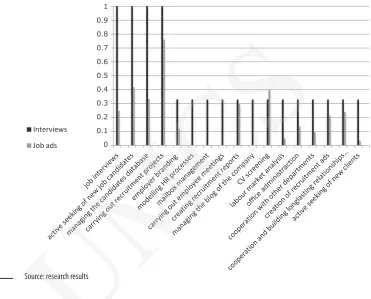
In the next step, we carried out interviews with three active recruiters and created a list of typical tasks performed by them at work. For illustrative purposes, in Figure 2, we present the comparison of main duties listed by interviewees and the content of analyzed recruitment ads.
While interviews’ results should not be analyzed quantitatively, we presented Figure 2 only for illustrative purposes. Three things can be noticed from the graph analysis. First, there are common duties for three interviewees, and to some – usually signiicant – extent, they are also enclosed in analyzed job advertisements. Secondly, there are duties performed by one of three interviewees (modeling HR processes, mailbox management, carrying out employee meetings or managing the blog of a company) that consume signiicant amount of time or are requiring different knowledge and are not mentioned in the analyzed job ads. Thirdly, while the attention paid to diverse aspects of recruitment ads may be different and job candidates may actually need to perform divergent duties within organizations, results of this study should not be generalized.
Source: research results
0% 10% 20% 30% 40% 50% 60% 70% 80%
Source: research results
Figure 1:
Percentage of recruitment ads containing listed duties
IJSR
4,1
5. Discussion and conclusions
Research results reveal that majority of tasks performed in the post of a recruiter were placed within recruitment advertisement. The tasks that were not mentioned by recruiters included HR processes modeling, taking care of company blog as well as holding employee meetings. There were also interesting observation resulting from the qualitative data analysis – every single one of three respondents regularly performs tasks, of which he or she was not informed during the recruitment process, but none of them indicated dissatisfaction with that fact. This contradicts the basic assumption underlying realistic job previews stating that the lack of information about important tasks performed in the job leads to lack of it between a person and a position and, subsequently, to dissatisfaction (Edwards, 2008).
There are at least two basic limitations of the study. Firstly, it would be more appropriate to analyze a certain amount of job ads and later, ‘following’ persons who actually received and accepted a job offer for that position to ask them what they knew before getting the job and what they actually do at work. However, such research design is hard to handle adequately, since it would require at least half a year contact with companies issuing recruitment ads with their and respective job candidates/employees permissions to carry it out. Secondly, the actual recruitment job in 117 recruitment ads may be diverse, so duties and tasks may, to some extent, vary. Therefore, a larger sample would allow for more accurate process of list creation.
Source: research results
Figure 2:
Comparison of main duties listed by interviewees and the content of analyzed recruitment ads
recruitment ads
Source: research results
0 0,1 0,2 0,3 0,4 0,5 0,6 0,7 0,8 0,9 1
Interviews Job ads
ofice adm
inistr action
1 0.9 0.8 0.7 0.6 0.5 0.4 0.3 0.2 0.1 0
The Study
of Realistic
Job Previews
for the Position
of Recruiter
in Poland:
Qualitative
Research Results
Presented research was designed as initial, exploratory study of the issue scarcelytreated in management literature in Poland. We believe that further studies on the issue are necessary for both theory and practice, especially in post-transition Polish job conditions. Future studies could undertake the problem from diverse perspective analyzing RJPs as a dependent and independent variable, with diverse possible, individual, team, and organizational outcomes (Popovich and Wanous, 1982). To our knowledge, such studies have not been carried out in Polish conditions so far. For practitioners, this article draws attention to the problem of job candidates’ perceptions and expectations. The implication of the study is that the information supplied to the candidate does not have to be exact all the time. However, one should bear in mind that the failure to inform job candidates for key positions about job, organization, supervisor or a team in which he or she will be performing duties may result in dissatisfaction, absenteeism and, inally, turnover (Vandenberg and Scarpello, 1990).
Reference:
Barksdale Jr., H.C., Bellenger, D.N., Boles, J.S. and Brashear, T.G. (2003), “The impact of realistic job previews and perceptions of training on sales force performance and continuance commitment: A longitudinal test”, Journal of Personal Selling & Sales Management, Vol. 23, No. 2, pp. 125–138.
Breaugh, J.A. and Billings, R.S. (1986), “The realistic job preview: Five key elements and their importance for research and practice”, Best Papers Proceedings... Annual Meeting of the Academy of Management, p. 240. DOI: http://dx.doi.org/10.5465/ambpp.1986.4980684 Breaugh, J.A. (1983), “Realistic job previews: A critical appraisal and future research directions”,
Academy of Management Review, Vol. 8, No. 4, pp. 612–619. DOI: http://dx.doi. org/10.2307/258262, http://dx.doi.org/10.5465/AMR.1983.4284662
Breaugh, J.A. and Starke, M. (2000), “Research on employee recruitment: So many studies, so many remaining questions”, Journal of management, Vol. 26, No. 3, pp. 405–434. DOI: http://dx.doi.org/10.1177/014920630002600303
Bret Becton, J., Matthews, M.C., Hartley, D.L. and Whitaker, D.H. (2009), “Using biodata to predict turnover, organizational commitment, and job performance in healthcare”, International Journal of Selection and Assessment, Vol. 17, No. 2, pp. 189–202. DOI: http:// dx.doi.org/10.1111/j.1468-2389.2009.00462.x
Bretz, J., Robert D. and Judge, T.A. (1998), “Realistic job previews: A test of the adverse self-selection hypothesis”, Journal of Applied Psychology, Vol. 83, No. 2, pp. 330–337. DOI: http://dx.doi.org/10.1037/0021-9010.83.2.330
Buda, R. and Charnov, B.H. (2003), “Message processing in realistic recruitment practices”, Journal of Managerial Issues, Vol. 15, No. 3, pp. 302–316.
Cable, D.M. and Judge, T.A. (1997), “Interviewers’ perceptions of person–organization it and organizational selection decisions”, Journal of Applied psychology, Vol. 82, No. 4, p. 546. DOI: http://dx.doi.org/10.1037/0021-9010.82.4.546
Costigan, R.D. (1996), “Effects of information processing on post realistic job preview perceptions”, Journal of Social Behavior & Personality, Vol. 11, No. 1, pp. 51–61.
Dugoni, B.L. and Ilgen, D.R. (1981), “Realistic job previews and the adjustment of new employees”, Academy of Management Journal, Vol. 24, No. 3, pp. 579–591. DOI: http:// dx.doi.org/10.2307/255576
IJSR
4,1
Earnest, D.R., Allen, D.G. and Landis, R.S. (2011), “Mechanisms linking realistic job previews with turnover: A meta-analytic path analysis”, Personnel Psychology, Vol. 64, No. 4, pp. 865–897. DOI: http://dx.doi.org/10.1111/j.1744-6570.2011.01230.x
Edwards, J.R. (2008), “Person–environment it in organizations: An assessment of theoretical progress”, The Academy of Management Annals, Vol. 2, No. 1, pp. 167–230. DOI: http:// dx.doi.org/10.1080/19416520802211503
Eisenhardt, K.M. (1989), “Building theories from case study research”, The Academy of Management Review, Vol. 14, No. 4, p. 532. DOI: http://dx.doi.org/10.5465/AMR.1989.4308385, http:// dx.doi.org/10.2307/258557
Haden, S.S.P. (2012), “Realistic job previews and performance: The mediating inluence of personal goals”, Journal of Management Research, Vol. 12, No. 3, pp. 163–178.
Kristof-Brown, A.L., Zimmerman, R.D. and Johnson, E.C. (2005), “Consequences of individuals' it at work: A meta-analysis of job, organization, group, and person-supervisor it”, Personnel psychology, Vol. 58, No. 2, pp. 281–342. DOI: http://dx.doi. org/10.1111/j.1744-6570.2005.00672.x
Langhammer, K., Bernhard-Oettel, C. and Hellgren, J. (2012), “Individual determinants of behavioral intentions: What tells us that practitioners really want to change hiring strategies?”, International Journal of Selection and Assessment, Vol. 20, No. 4, pp. 453–463. DOI: http:// dx.doi.org/10.1111/ijsa.12008
Meglino, B.M., Denisi, A.S. and Ravlin, E.C. (1993), “Effects of previous job exposure and subsequent job status on the functioning of a realistic job preview”, Personnel Psychology, Vol. 46, No. 4, p. 803. DOI: http://dx.doi.org/10.1111/j.1744-6570.1993.tb01570.x
Ordanini, A. and Silvestri, G. (2008), “Recruitment and selection services: Eficiency and competitive reasons in the outsourcing of HR practices”, The International Journal of Human Resource Management, Vol. 19, No. 2, pp. 372–391. DOI: http://dx.doi. org/10.1080/09585190701799960
Parry, E. and Wilson, H. (2009), “Factors inluencing the adoption of online recruitment”, Personnel Review, Vol. 38, No. 6, pp. 655–673. DOI: http://dx.doi.org/10.1108/00483480910992265 Patterson, F., Ferguson, E. and Thomas, S. (2008), “Using job analysis to identify core and speciic
competences: implications for selection and recruitment”, Medical Education, Vol. 42, No. 12, pp. 1195–1204. DOI: http://dx.doi.org/10.1111/j.1365-2923.2008.03174.x
Phillips, J.M. (1998), “Effects of realistic job previews on multiple organizational outcomes: A meta-analysis”, Academy of Management Journal, Vol. 41, No. 6, pp. 673–690. DOI: http://dx.doi.org/10.2307/256964
Popovich, P. and Wanous, J.P. (1982), “The realistic job preview as a persuasive communication”, Academy of Management Review, Vol. 7, No. 4, pp. 570–578. DOI: http://dx.doi. org/10.2307/257223, http://dx.doi.org/10.5465/AMR.1982.4285243
Reilly, R.R., Brown, B., Blood, M.R. and Malatesta, C.Z. (1981), “The effects of realistic previews: A study and discussion of the literature”, Personnel Psychology, Vol. 34, No. 4, pp. 823–834. DOI: http://dx.doi.org/10.1111/j.1744-6570.1981.tb01433.x
Richardson, J., McBey, K. and McKenna, S. (2008), “Integrating realistic job previews and realistic living conditions previews: Realistic recruitment for internationally mobile knowledge workers”, Personnel Review, Vol. 37, No. 5, pp. 490–508. DOI: http://dx.doi. org/10.1108/00483480810891646
Rynes, S.L. and Barber, A.E. (1990), “Applicant attraction strategies: An organizational perspective”, Academy of Management Review, Vol. 15, No. 2, pp. 286–310. DOI: http:// dx.doi.org/10.2307/258158, http://dx.doi.org/10.5465/AMR.1990.4308158
Suszko, M.K. and Breaugh, J.A. (1986), “The effects of realistic job previews on applicant self-selection and employee turnover, satisfaction, and coping ability”, Journal of Management, Vol. 12, No. 4, p. 513. DOI: http://dx.doi.org/10.1177/014920638601200406
The Study
of Realistic
Job Previews
for the Position
of Recruiter
in Poland:
Qualitative
Research Results
Vandenberg, R.J. and Scarpello, V. (1990), “The matching model: An examination of the processesunderlying realistic job previews”, Journal of Applied Psychology, Vol. 75, No. 1, p. 60. DOI: http://dx.doi.org/10.1037/0021-9010.75.1.60
Wheeler, A.R., Harris, K.J. and Harvey, P. (2010), “Moderating and mediating the HRM effectiveness–intent to turnover relationship: The roles of supervisors and job embeddedness”, Journal of Managerial Issues, Vol. 22, No. 2.
Biographic Notes
Tomasz Ingram is a researcher and lecturer at the Department of Entrepreneurship and Innovation Management, University of Economics in Katowice, Poland. He obtained his Ph.D. (recruitment and selection policies and organizational effectiveness) in management science in 2009. His research interests are related to talent management, recruitment and selection, human resource management, and innovation management.
Alicja Siga is a gradute of the University of Economics in Katowice, Poland. She defended her bachelor thesis (realistic job previews) in 2014 in the Faculty of Economics, and currently she works for one of the leading consulting companies in Poland.
The research project was inanced from the sources of Polish National Science Center (NCN) on the basis of decision number DEC-2012/05/D/HS4/01521.