1. Introduction
Today, the digital game industry has become one of the most profitable industries, along with other main industries. Also, this fore-mentioned industry has led to economic growth and increase of employment in many countries in the world. According to the statistics from internet resources in the United States, "the turnover of this industry was about twenty-five billion dollars in 2010". Around forty percent of China annual revenue is allocated to the sale of digital games. This volume of sales has contributed many gaming companies to gamble on mobile games, along with computer game products [1].
In spite of the high sale and income of existing companies in the game industry and along with the best-selling games, there are always unsuccessful game products and failed companies. This indicates the emergence of a performance evaluation system in the game industry [2]. To this end, in this paper, we introduced a new performance evaluation model based on BSC-AHP for the digital game industry.
Corresponding author
E-mail address: [email protected] DOI: 10.22105/jarie.2018.130777.1037
A Model for Performance Evaluation of Digital Game Industry
Using Integrated AHP and BSC
Nima Moradi1, Hossien Malekmohammad2, Saeed Jamalzadeh1 1Department of Industrial Engineering, Sharif University of Technology, Tehran, Iran. 2Department of Railway Engineering, Iran University of Science and Technology, Tehran, Iran.
A B S T R A C T P A P E R I N F O
Nowadays, due to continuous changes in the environment of organizations, the performance evaluation of productive or non-productive companies is not as simple as the past. In spite of the high sale and income of existing companies in the game industry, there are always unsuccessful game products and failed companies. So the digital game industry needs an appropriate performance evaluation system. In this paper, a model for performance assessment of companies in the digital game industry is proposed using integrated Analytic Hierarchy Process (AHP) and Balanced Scorecard (BSC) approach. In order to design the evaluation system, the strategies and visions of the game companies are extracted as the initial step. The next step is to extract corresponding attributes and measures based on the four dimensions of the Balanced Scorecard. In the following, the weights of each measure, attributes and dimensions are obtained based on the expert’s opinion. Finally, the results of the implementation of the proposed model of the digital game company are calculated and the efficiency of the model for performance evaluation of the digital game industry is shown.
Chronicle:
Received: 14 March 2018 Accepted: 28 August 2018
Keywords:
Digital Game Industry. Performance Evaluation. Balanced Scorecard Method. AHP.
Journal of Applied Research on Industrial
Engineering
2. Literature Review
One of the known methods for evaluating the performance of organizations is the Balanced Scorecard that is used in this paper. By using BSC, we will be able to let the most part of any organizations and plans achieve the strategic goals. There are various articles on economics, sales, and marketing of digital products in literature. Marcoux and Selouani [3] predicted sales for video games using data mining techniques. First, by preparing and processing the initial data using the technique of Principal Component Analysis (PCA), they go to the main data mining stage. Then, using the Neural Networks Trained (NNT) and Hybrid Forecasting System (HFS), the results and outputs for the two real case studies are obtained. Chang [4] predicted the stock price of the video game industry by comparing both the Artificial Neural Network (ANN) and the Decision Tree (DT). The results show that the prediction accuracy of the model is the most consistent with the actual stock price by Artificial Neural Network; in addition ANN method is more stable than the other methods in the case of price fluctuations. Cox [5] investigated the attributes influencing the commercial success of a digital game industry based on the statistics of the American game. Features of a digital game, which transforms it into a successful project, has been analyzed and predicted by an econometric model. The results indicate that gaming by a popular publisher alongside the popular console can ensure the success of that game. Also, quality is considered one of the most important variables in this prediction model. Marchand and Hennig-Thurau [1] showed how to create value in the video game market; also, they examined the subjects of the industrial economy, customer profit and market opportunities in the game industry. In order to create value, a conceptual model is presented as follows (Fig. 1).
Fig. 1. A conceptual model to create value in the game industry [1].
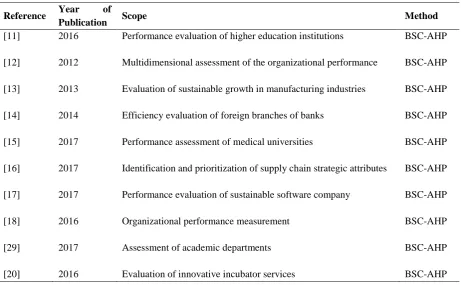
probability of terrorist attacks with the help of BSC technique. It is concluded that by understanding the structure of terrorist organizations and their organizational value, it is possible to predict the behavior and choices of these types of organizations. In some papers, the Balanced Scorecard approach has been used by combination with other decision-making methods such as Fuzzy AHP, AHP and Fuzzy ANP in the issues of Enterprise Resource Planning [9] and manufacturing companies [10]. In addition to benefit from the advantages of BSC, these papers used other decision-making techniques to enhance the performance evaluation. The efficiency of the hybrid model had been obtained in various articles for a variety of topics, which are shown in Table 1 for recent papers.
Table 1. Recent papers of integrated BSC and AHP.
According to the Table 1, it is clear that there is no article with the topic of the performance evaluation of the game industry based on BSC-AHP. So in this paper, the performance evaluation of the digital game industry has been examined by integrating the AHP and the BSC in order to fulfill this gap in the literature. Also, based on the mentioned articles, the efficiency of the BSC-AHP method has been proved for performance evaluation. So the contributions of this paper can be listed as follows:
Propose a new performance evaluation model for the digital game industry. Examine the use of BSC and AHP as a hybrid method in the digital game industry.
Introduce new attributes and measures of the performance evaluation of the game industry. Calculate the weights of the measures based on the game industry expert’s opinions.
In the following, in the 3rd Section, the concepts and definitions described in AHP and BSC are explained. In the 4th Section, a model for evaluating the game industry based on the integration of AHP and BSC is proposed. In the 5th Section, the outputs of the model implementation are shown for an example of the game company. Finally, in the last Section, conclusions and suggestions for future studies are presented.
Reference Year of
Publication Scope Method
[11] 2016 Performance evaluation of higher education institutions BSC-AHP
[12] 2012 Multidimensional assessment of the organizational performance BSC-AHP
[13] 2013 Evaluation of sustainable growth in manufacturing industries BSC-AHP
[14] 2014 Efficiency evaluation of foreign branches of banks BSC-AHP
[15] 2017 Performance assessment of medical universities BSC-AHP
[16] 2017 Identification and prioritization of supply chain strategic attributes BSC-AHP
[17] 2017 Performance evaluation of sustainable software company BSC-AHP
[18] 2016 Organizational performance measurement BSC-AHP
[29] 2017 Assessment of academic departments BSC-AHP
3. Basic Definitions
3.1. Balanced Scorecard Approach
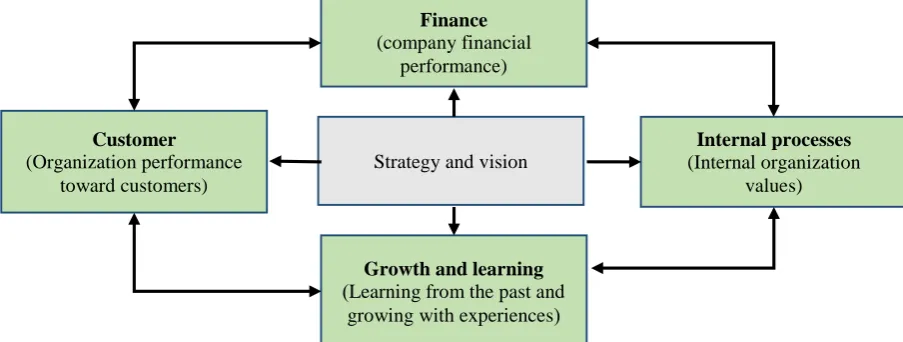
One of the management tools that help decision-makers to achieve future successes of the organization is the Balanced Scorecard method. Before introducing this method by Kaplan and Norton, the evaluation of performance was more focused on the financial and economic aspects of organizations. Then, by introducing this method, organizational performance evaluation tools evolved significantly. The main objective of BSC is to reach the ability to measure the objectives and perspectives of the organization so that the organization is able to control and evaluate its strategies. In the process of evaluating the performance using BSC, four organization dimensions are considered. These four dimensions are growth and learning, internal processes, customers, and finance. These dimensions are exhausted from the strategies and perspectives of the organization which is shown in Fig. 2 [21].
The financial dimension of BSC approach reflects the organization's performance in terms of economic and financial aspects, and how the organization has functioned over time in terms of cost control, budgeting, and other financial affairs. In the customer dimension, the market shares and customers of the company are determined. Based on this, the organization's performance is judged to fulfill the customer satisfaction and increase the market share. In internal processes, the company's goal is to meet customer and shareholder expectations regarding the financial outcomes. The sum of these points determines the value of the organization relative to competitors in the market. On the dimension of growth and learning, the target is to provide conditions for long-term growth and development of the organization, thus, the measures for each dimension are extracted to evaluate the performance of the organization [22, 23].
3.2. Analytic Hierarchy Process (AHP)
One of the most popular techniques among multi-criteria decision-making methods is the Analytic Hierarchy Process (AHP), introduced first in the 1970s by Saaty [25]. This technique is based on four principles and is capable to deal with qualitative and quantitative criteria. The beginning of the problem-solving process of this method is performed using a paired comparisons matrix so that the problem criteria are all compared just in pairs. One of the benefits of this approach is to determine the consistency
Finance (company financial
performance)
Strategy and vision
Internal processes (Internal organization
values) Customer
(Organization performance toward customers)
Growth and learning )Learning from the past and
growing with experiences(
or inconsistency of the decisions. In order to implement the AHP method on the issues involved, the following steps should be taken in order [24, 25]:
Creating a graphical representation of the problem at the highest level, and then break it all into sub-criteria.
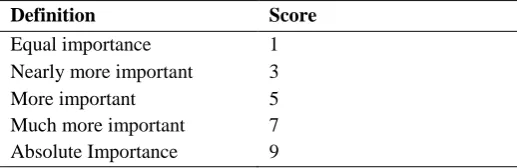
Formation of paired comparison matrix for elements of each level relative to its higher level using the preferences scores based on Table 2.
Table 2. Scores of preferences in paired comparison matrix.
Calculate the relative weight of each element based on the paired comparisons matrix:
In this step, according to the grades given on each pair comparison matrix, the relative weights of each criterion and sub-criteria are measured relative to the higher levels and the significance and superiority of each criterion are measured relative to each other. In the weighing process, there are two possibilities for the preferences in the paired comparisons matrix. In one case, the matrix is consistent with one and in the other case, the matrix is inconsistent. Inconsistent matrix mode, the relative weight is calculated simply by dividing each element of the matrix over the sum of the corresponding column elements. In inconsistency mode, approximate methods, least squares and eigenvector method are presented in the literature for calculating relative weights, which are not mentioned here to avoid prolongation of the content.
Calculate the final weight of the alternatives by relative weights:
By counting multiplication of weights, the final weights of the alternatives are obtained, which indicates the priority of the alternatives relative to each other.
Prioritization of alternatives based on the final weights achieved:
The alternatives are sorted according to the weights obtained and desired alternatives are identified.
4. Performance Evaluation Model of the Digital Game Industry Based on AHP-BSC
4.1. Performance Evaluation of the Game Industry Using BSC
In this section, a model for evaluating the performance of digital game companies based on BSC is presented. First, based on the four dimensions mentioned for the BSC, the desired attributes for managers are extracted for each dimension. Then, based on the attributes allocated to each dimension, performance evaluation measures are presented, in other words, quantitative criteria and measures are presented to evaluate each of the attributes.
Definition Score
Equal importance 1
Nearly more important 3
More important 5
Much more important 7
4.1.1. Growth and learning
In this dimension, the learning attributes of the organization related to the game production industry and the ways of gaining experience and education improvement are discussed. The attributes and measures related to each factor are shown in Table 3.
Table 3. Attributes and measures of growth and learning dimension.
4.1.2. Internal process
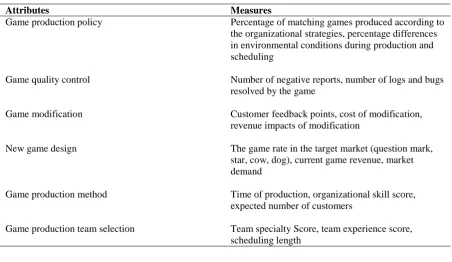
In this dimension, the value and credit of the game production company are determined based on its internal processes. In Table 4, the attributes and measures for each factor are shown for this dimension.
Table 4. Attributes and measures of internal process dimension.
4.1.3. Customer
In this dimension of the BSC, the customer and stakeholder satisfaction of the performance of the digital gaming company are analyzed, and the relevant attributes and measures are shown in Table 5.
Attributes Measures
Training and holding seminars
Degree score and skill level of staffs, Per capita employee training per year, Per capita employee Survey
The game advertising ways
Game visiting, The number of installation, the number of active accounts
Knowledge creation and organizational learning
Percentage of knowledge extraction from events, Per capita presentation of articles
Innovation and creativity in the game Per capita proposals, Per capita suggestion implementation
Attributes Measures
Game production policy Percentage of matching games produced according to
the organizational strategies, percentage differences in environmental conditions during production and scheduling
Game quality control Number of negative reports, number of logs and bugs
resolved by the game
Game modification Customer feedback points, cost of modification,
revenue impacts of modification
New game design The game rate in the target market (question mark,
star, cow, dog), current game revenue, market demand
Game production method Time of production, organizational skill score,
expected number of customers
Game production team selection Team specialty Score, team experience score,
Table 5. Attributes and measures of customer dimension.
4.1.4. Financial
In this dimension, the financial performance of the digital game company is measured during its organizational activity. The attributes and measures related to this dimension are shown in Table 6.
Table 6. Attributes and measures of financial dimension.
Finally, by calculating the company's data for each of the measures mentioned in each dimension, the score of each measure is obtained. Then these scores will be scaled from zero to one, for all of the measures. Thus, regarding the weights of each measure, the final score of the game production company is calculated in total so that the score of the company in each dimension of BSC with the total score of the company is calculated and defects and the strength of the organization are known and evaluated quantitatively.
4.2. Weights Calculation of Measures Using AHP
Implementing the AHP technique, the weight of each attribute in the evaluation of the game industry in the four dimensions is calculated. Initially, four dimensions related to the BSC are selected as weighting criteria. The attributes in the tables of the previous section are considered as sub-criteria. In addition, measures in quadruple dimensions are considered as alternatives. The objective of the problem is to find the weights of sub-criteria and calculate the score of each measure based on its corresponding attribute. First, the grade of the preferences of each measure and dimensions relative to each other is determined based on expert opinions. In other words, the five paired comparisons matrix are written in which the computational results are obtained in order to find the weights of each criterion and the sub-criteria with the inconsistency rate of each one. Because the inconsistency rates are less than 0.1, they are all accepted. The calculations are done using the Expert Choice software. To summarize, the proposed AHP approach will use the dimensions and attributes as alternatives and criteria as shown in Fig. 3.
Attributes Measures
Customer satisfaction of game quality Number of installation, removal rate after installation, user rates
Customer Satisfaction of the game price The price relative to competitor prices, per capita income from the game
Customer interest Number of introducing to others, per capita account
activity
Attributes Measures
Game sales National sales, international Sales, number of
unauthorized downloads
Game finances Company market share, corporate profitability
Organization turnover Operating Cash Flow, the Current ratio (current debt
Fig. 3. Adaptation between AHP (left side) and four dimensions of BSC with measures (right side).
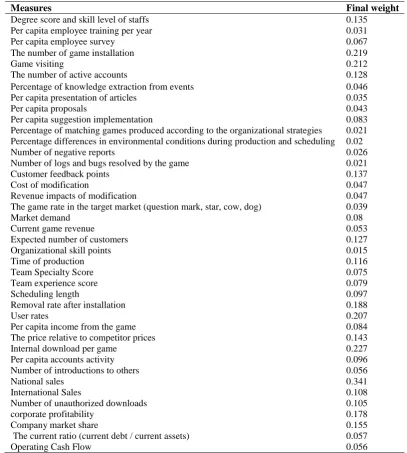
By the results of the weights obtained from the paired comparison matrix, in the calculation of the total number of obtained weights, the final weights of each measure are calculated, which is shown in Table 7.
Table 7. Final weights of total measures calculated by AHP.
Measures Final weight
Degree score and skill level of staffs 0.135
Per capita employee training per year 0.031
Per capita employee survey 0.067
The number of game installation 0.219
Game visiting 0.212
The number of active accounts 0.128
Percentage of knowledge extraction from events 0.046
Per capita presentation of articles 0.035
Per capita proposals 0.043
Per capita suggestion implementation 0.083
Percentage of matching games produced according to the organizational strategies 0.021 Percentage differences in environmental conditions during production and scheduling 0.02
Number of negative reports 0.026
Number of logs and bugs resolved by the game 0.021
Customer feedback points 0.137
Cost of modification 0.047
Revenue impacts of modification 0.047
The game rate in the target market (question mark, star, cow, dog) 0.039
Market demand 0.08
Current game revenue 0.053
Expected number of customers 0.127
Organizational skill points 0.015
Time of production 0.116
Team Specialty Score 0.075
Team experience score 0.079
Scheduling length 0.097
Removal rate after installation 0.188
User rates 0.207
Per capita income from the game 0.084
The price relative to competitor prices 0.143
Internal download per game 0.227
Per capita accounts activity 0.096
Number of introductions to others 0.056
National sales 0.341
International Sales 0.108
Number of unauthorized downloads 0.105
corporate profitability 0.178
Company market share 0.155
The current ratio (current debt / current assets) 0.057
Finally, using the AHP technique, the weights of the attributes derived from the BSC are calculated, and with these weights of measures, the performance of a gaming company could be assessed by taking the relevant measures into account. In the next section, using an example of a gaming company, the performance of the company is scored by the proposed model and according to the results, the analysis is carried out.
5. Results and Discussion
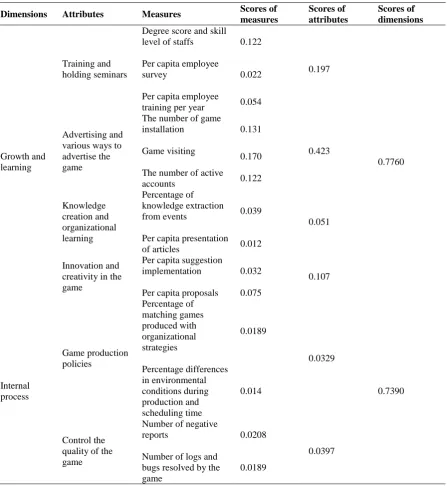
In this section, in order to analyze the performance of the proposed model, the outputs from the implementation of the proposed method are shown in an example of a digital game production company. Thus, by initial scoring, the output and the scores for each dimension and the total score of the company are calculated as Table 8.
Table 8. Scores of company's dimensions and attributes calculated by the proposed model.
Dimensions Attributes Measures Scores of
measures Scores of attributes Scores of dimensions Growth and learning Training and holding seminars
Degree score and skill
level of staffs 0.122
0.197
0.7760 Per capita employee
survey 0.022
Per capita employee
training per year 0.054
Advertising and various ways to advertise the game
The number of game
installation 0.131
0.423 Game visiting
0.170
The number of active
accounts 0.122
Knowledge creation and organizational learning Percentage of knowledge extraction
from events 0.039
0.051
Per capita presentation
of articles 0.012
Innovation and creativity in the game
Per capita suggestion
implementation 0.032
0.107
Per capita proposals 0.075
Internal process Game production policies Percentage of matching games produced with organizational strategies 0.0189 0.0329 0.7390 Percentage differences in environmental conditions during production and scheduling time 0.014 Control the quality of the game
Number of negative
reports 0.0208
0.0397 Number of logs and
bugs resolved by the game
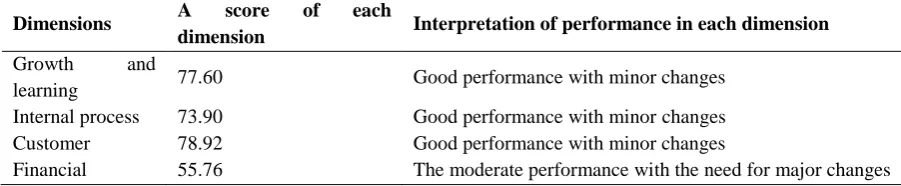
Taking into account the results of Table 8, with the consideration of expert's opinions, the interpretation of scores of each dimension can be explained according to Table 9. Thus, according to the values obtained of the example, the results of the performance appraisal of the game industry company in each dimension and how its management performance is interpreted is shown in table 10 based on the proposed model.
Modified game produced
Customer feedback
points 0.1096
0.1425 Cost of modification 0.0235
Revenue impacts of
modification 0.0094
New game design
The game rate in the target market (question mark, star, cow, dog)
0.0331
0.15155
Current game revenue
0.0760
Market demand 0.0424
Game production methods
Time of production 0.1079
0.20415 Organizational skill
points 0.0150
Number of expected
customers 0.0812
Select a team to build the game
Team Specialty Score
0.0562
0.1685 Team Experience
Score 0.0395
Scheduling length 0.0727
Customer Customer satisfaction of game quality 0.3709 0.7892 Number of installation
0.1449
Removal rate after
installation 0.0756
Satisfaction of customers from the price of the game
The price relative to
competitor prices 0.1287
0.3103 Per capita income
from the game 0.1816
Customer interest
Number of
introductions to others 0.0912
0.108 Per capita of accounts
activity 0.0168
Financial
Game sales statistics
Internal sales 0.1705
0.2782 0.5576 International sales 0.0972 Number of unauthorized downloads 0.0150 Financing the entire game Company market
share 0.1424 0.1889
Corporate profitability 0.0465
Organization turnover
Operating cash flow
0.0513
0.0905 Current ratio
Table 9. Interpretation of the obtained scores.
Table 10. Performance evaluation of company's dimensions by the proposed model.
According to the results presented in Table 10, it is shown that the performance of the digital game company in the dimensions of growth and learning, internal processes and customer is good and it is just recommended that the company can apply minor changes and keeps going toward the current path as much as possible. Furthermore, the evaluation of the proposed model in the financial dimension is different from other dimensions. So, considering the high weight of the financial dimension by the AHP, the performance of the company in this dimension is moderate and requires practical solutions. In this section, the performance evaluation of a company was carried out by the proposed model based on the integration of AHP and BSC, and the scores and interpretation of its performance were demonstrated.
6. Conclusion
In this paper, a model for performance evaluation of the digital game industry based on integrating AHP and BSC is proposed. Then, by the implementation of the proposed model of the sample example of a digital game company, the efficiency of the proposed model was shown. The results of the game production company show that the organization has a good performance in terms of growth and learning, internal process and customer, but has a modest performance in terms of financial performance, and in the recent context requires helpful and major solutions. As a result, the proposed AHP-BSC based model is able to evaluate the performance of the digital game industry considering the attributes and measures that define the strategies of a game production company.
For future studies, the subject of digital game performance evaluation using BSC and other weighting techniques in the multi-criteria decision-making framework can be considered with each other. Besides the BSC approach, other performance evaluation methods in the digital game industry can be used and comparisons can be made between the applied methods. Also, in order to evaluate the efficiency of the method proposed in this paper, a method can be implemented to evaluate another type of organizations, and then the outcomes can be analyzed from the standpoint of performance.
Related
interval Interpretation of each interval
80%-high Good performance by keeping current conditions 65%-80% Good performance with minor changes
50%-65% The moderate performance with the need for major changes
40%-50% The moderate performance with the need for significant changes and solutions
30%-40% Weak Performance and near critical level with the need for fundamental changes in the relevant dimension and the application of the majority of strategies.
Low-30% The performance is extremely weak and critical with the need for fundamental changes and even re-engineering the relevant processes
Dimensions A score of each
dimension Interpretation of performance in each dimension
Growth and
learning 77.60 Good performance with minor changes
Internal process 73.90 Good performance with minor changes
Customer 78.92 Good performance with minor changes
Acknowledgments
The authors of this article would like to acknowledge Mr. Younes Ansari, Mrs. Maryam Rezaei, and Mrs. Zahra Kakavand associates related to the field of the game industry and other respectable colleagues from the Simorgh Research Center, the Advanced Technologies of Meghdad, and the Innovative Company of Amn Andish Sharif, which presented their opinions in our discretion.
References
[1] Marchand, A., & Hennig-Thurau, T. (2013). Value creation in the video game industry: Industry economics, consumer benefits, and research opportunities. Journal of interactive marketing, 27(3), 141-157.
[2] Granic, I., Lobel, A., & Engels, R. C. (2014). The benefits of playing video games. American psychologist, 69(1), 66.
[3] Marcoux, J., & Selouani, S. A. (2009, March). A hybrid subspace-connectionist data mining approach for sales forecasting in the video game industry. Proceedings of2009 WRI world congress on computer science and information engineering (pp. 666-670). Los Angeles, CA, USA
:
IEEE.[4] Chang, T. S. (2011). A comparative study of artificial neural networks, and decision trees for digital game content stocks price prediction. Expert systems with applications, 38(12), 14846-14851.
[5] Cox, J. (2014). What makes a blockbuster video game? An empirical analysis of US sales data. Managerial and decision economics, 35(3), 189-198.
[6] Chand, D., Hachey, G., Hunton, J., Owhoso, V., & Vasudevan, S. (2005). A balanced scorecard based framework for assessing the strategic impacts of ERP systems. Computers in industry, 56(6), 558-572.
[7] Martinsons, M., Davison, R., & Tse, D. (1999). The balanced scorecard: a foundation for the strategic management of information systems. Decision support systems, 25(1), 71-88.
[8] Beitel, G. A., Gertman, D. I., & Plum, M. M. (2004). Balanced scorecard method for predicting the probability of a terrorist attack. WIT transactions on ecology and the environment, 77.
[9] Cebeci, U. (2009). Fuzzy AHP-based decision support system for selecting ERP systems in textile industry by using balanced scorecard. Expert systems with applications, 36(5), 8900-8909.
[10] Yüksel, İ., & Dağdeviren, M. (2010). Using the fuzzy analytic network process (ANP) for Balanced Scorecard (BSC): A case study for a manufacturing firm. Expert systems with applications, 37(2), 1270-1278.
[11] Ramasamy, N., Rajesh, R., Pugazhendhi, S., & Ganesh, K. (2016). Development of a hybrid BSC-AHP model for institutions in higher education. International journal of enterprise network management, 7(1), 13-26.
[12] Bentes, A. V., Carneiro, J., da Silva, J. F., & Kimura, H. (2012). Multidimensional assessment of organizational performance: Integrating BSC and AHP. Journal of business research, 65(12), 1790-1799.
[13] Sundharam, V. N., Sharma, V., & Stephan Thangaiah, I. S. (2013). An integration of BSC and AHP for sustainable growth of manufacturing industries. International journal of business excellence, 6(1), 77-92.
[14] Mohaghar, A., Hakkak, M., & Yaghoubi, H. (2014). Efficiency evaluation of foreign currrency branches of bank keshavarzi of Iran Using integated BSC, DEA and AHP approaches. International Journal of industiral engineering & producion management, 25(2), 237-247.
[15] Mehrolhassani, M. H., Emami, M., Haghdoost, A. A., Dehnavieh, R., Amanpour, S., Sabbah, F., & Bazrafshan, M. (2017). Performance assessment of medical universities using balanced scorecard and analytical hierarchy process. Iranian journal of epidemiology, 12(5), 55-64.
[16] Zare, S. (2017). Identifying and prioritizing supply chain management strategic factors based on integrated BSC-AHP approach (Master's thesis). Available from diva-portal.org
[17] Pérez, C. Á., Montequín, V. R., Fernández, F. O., & Balsera, J. V. (2017). Integration of balanced scorecard (BSC), strategy map, and fuzzy analytic hierarchy process (FAHP) for a sustainability business framework: a case study of a Spanish software factory in the financial sector. Sustainability, 9(4), 527.
[18] Yaghoobi, T., & Haddadi, F. (2016). Organizational performance measurement by a framework integrating BSC and AHP. International journal of productivity and performance management, 65(7), 959-976.
[20] Shuxin, W., & Yu, B. (2016). Research on evaluation of innovative business incubator service ability based on BSC and AHP. Proceedings of the 13th international conference on innovation and management.Kuala Lumpur, Malaysia: Wuhan University of Technology Press.
[21] Kaplan, R. S., & Norton, D. P. (2007). Balanced scorecard. Das summa summarum des management (pp. 137-148). Gabler.
[22] Van Grembergen, W. (2000, May). The balanced scorecard and IT governance. Proceedings of the 2000 information resources management association international conference on challenges of information technology management in the 21st century (pp. 1123-1124). IGI Global.
[23] Isoraite, M. (2008). The balanced scorecard method: From theory to practice. Intelektine ekonomika, (1).
[24] Saaty, T. L. (1994). How to make a decision: the analytic hierarchy process. Interfaces, 24(6), 19-43.
![Fig. 1. A conceptual model to create value in the game industry [1].](https://thumb-us.123doks.com/thumbv2/123dok_us/8578922.1718460/2.595.139.475.392.586/fig-conceptual-model-create-value-game-industry.webp)