INTERNATIONAL JOURNAL OF PHARMACEUTICAL, CHEMICAL AND BIOLOGICAL SCIENCES
Available online at
www.ijpcbs.com
ISOLATION AND CHARACTERIZATION OF ANTIBIOTIC PRODUCING
BACTERIA FROM SOIL SAMPLES OF DIBRUGARH DISTRICT, ASSAM
Aradhana Priyambada Bhuyan
1*and RNS. Yadav
2and R. Samanta
21
Centre for Biotechnology and Bioinformatics, Dibrugarh University,
Dibrugarh-7860 04, Assam, Dispur, India.
2
Department of Life Sciences, Dibrugarh University,
Dibrugarh-786 004, Assam, Dispur, India.
INRTRODUTION
Antibiotics are chemical compounds that have been used since being discovered and used as remedy for infections, inflammations and diseases. This antibiotic is prevelant in almost everywhere. Soil is biodiversified with various types of microorganisms which include mainly bacteria, cyanobacteria, microfungi, microalgae and protozoans. Among all the products produced by soil microbes antibiotics are the most important secondary metabolites produced by them. Today almost all the known disease producing bacteria have developed resistance to the existing drugs because of their extensive use . So need of new antimicrobial agents is greater than ever because of emergence of multidrug rasistance in common
pathogens, rapid emergence of new infections and use of multidrug resistant pathogens in bioterrorism (Spellberg et al.2004).When resources such as nutrients are limited, a bacterium can produce an antibiotic to destroy or inhibit neighbouring bacteria, thereby limiting competition for the scarce resources.( Mindy G. Brown et al. 2009). To combat the situation there is a great demand that new antibiotics is to be developed. In case of Soil microbes they have great potential to produce effective anti-microbial product. Taking up of natural material like soil can be justified by the fact that samples from widely diverse locations are more likely to yield novel microorganisms and therefore hopefully novel metabolites as a result of the geographical variation. (Sen et
Research Article
ABSTRACT
Antibiotics are the important secondary metabolites of almost all types of microbes. Soil microbes also produce antibiotics. The process of antibiotic production by microbes is known as antibiosis where the metabolic products of one organism directly inhibit or kill other pathogenic organisms. Northeastern region of India is well known for its biodiversity hotspot with so many unexplored economically important microorganisms. The aim of the current study is to detect the antimicrobial activity of soil isolates from Dibrugarh District, Assam, India. A total of 50 soil samples were collected from the selected areas of Dibrugarh district. 115 bacterial isolates showed potential antimicrobial activities, out of which 64 showed good antimicrobial activity, 31 showed low antibacterial activity and 21 showed antifungal activities against B. subtilis (MTCC 121), Pseudomonas arginosa (MTCC 4673), S. cerevisiae (MTCC 3090) and Candida albicans
(MTCC 227), E.Coli (MTCC 40), Clostridium acetobutylicum (MTCC 11274), Enterococcus
mutans (MTCC 3031), Streptococcus mutans (MTCC 497) .The most potent bacterial isolates
with antimicrobial effects against the above mentioned standard strains were identified as
Klebsiella pneumonia sp on the basis of biochemical tests as prescribed by Bergey’s manual of
systematic bacteriology. These results indicate that the areas of Dibrugarh District soil microorganisms could be an interesting source of antibacterial and antifungal bioactive substances.
al.1993) .Moreover bacterial strains from soil and sewage are a potential reservoir for antimicrobial resistance genes( Sengupta et al,2011).Besides the important approaches helpful in discovering new microbial species which are isolated and characterized from the most extreme habitat (Lee and Hwang,2002) and relatively unknown or untouched areas (Moncheva et al.2002).In this regard Dibrugarh district region is of significant areas as it is situated in the indo-Burma biodiversity hotspot range(D.Thakur et al,2007).
Due to various temperature and climatic conditions this region is likely to harbor unusual types of microorganisms while poorly studied and explored habitation increases chance of finding novel microorganisms. Keeping this points in view ,the present study was undertaken to isolate and characterise antimicrobes from soil samples of this area.
MATERIALS AND METHODS Collection of soil samples
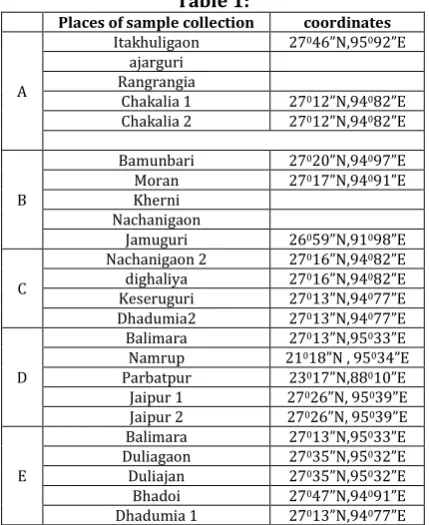
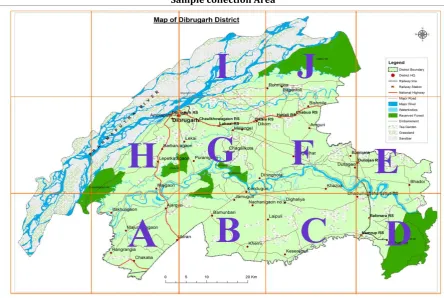
Soil samples were collected from different sites of Dibrugarh district. For collection of samples, the whole Dibrugarh district was divided into 10 equal zones given the codes from A to J. GPS Position and location of the sites are shown in Fig 1 and Table 1. Five samples from each zone on random basis were collected from 5-8 cm depth and kept in sterile polythene bags and were preserved -20oC until use.
Isolation and screening of antibiotic producing bacteria
One gram of each soil samples from the 5 sites belonged to the same zone (as mentioned earlier) were mixed and ground properly using mortar and pestle. One gram of these mixtures were serially diluted up to 10-7 fold and inoculated on nutrient agar plates followed by incubation at 36oC for 24 hr. All the isolates obtained after incubation were subcultured and stored until further use.
Preliminary screening of the potential antibiotic producing isolate
Preliminary screening for antibiotic production was done by screening antimicrobial activity against standard microbial cultures viz., E. coli MTCC-40, B. subtilis MTCC-121, Pseudomonas arginosa MTCC-4673 , S. cerevisiae MTCC-3090,
Clostridium acetobutylicum MTCC-11274,
Enterococcus mutans MTCC 3031 Streptococcus mutans MTCC 497 , Acetobacter aceti MTCC -3246, Serratia sicaria MTCC 8930 , Enterobacter aerogens MTCC 111 by well diffusion method. Further, the screening was extended with pathogenic strains viz., Clostridium
acetobutylicum MTCC-11274, Enterococcus
mutans MTCC 3031, Streptococcus mutans MTCC 497, Acetobacter aceti MTCC -3246, Serratia
sicaria MTCC 8930 , Enterobacter aerogens
MTCC 111. Standard bacterial broths were spread plated on MHA plates and 100 µL of the broth of each isolates were loaded in respective agar wells. The screening of the most potential isolates were done on the basis of the zone of inhibition given by each isolates against the test organisms after incubation. II) and (Fig-III).
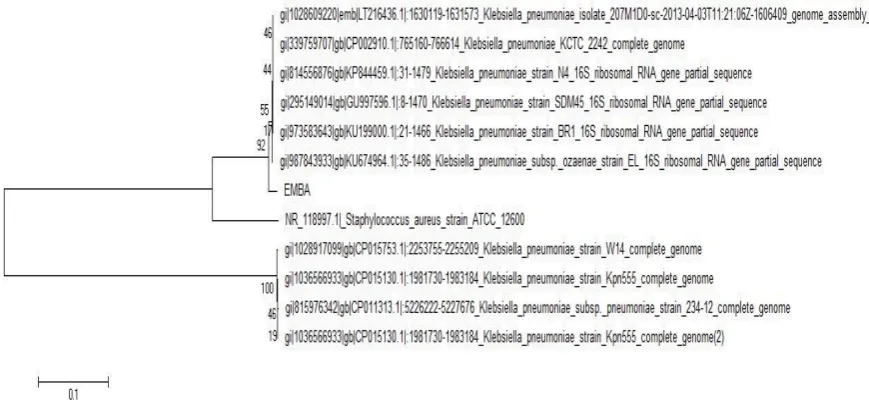
Identification of most potential isolate The potent strains hence isolated were finally identified on the basis of 16s rRNA sequencing analysis. Genomic DNA from each of the potential isolates were extracted and purified. 16s rRNA gene was amplified by using 27F (5´-AGAGTTTGATCMTGGCTCAG-3´) forward and 1492R (5´-TACGCYTACCTTGTTACGACTT-3´) reverse primer. The purity of the amplicons was checked by agarose gel electrophoresis analysis. The sequencing of the amplicons were carried out using ABS. Phylogenetic analysis was conducted using MEGA-6 software taking 1000 bootstrap value (Tamura et.al., 2011). The 16s rRNA gene sequence of strain EMBA was aligned using the CLUSTSAL W programme(Thompson et al.1994)against corresponding nucleotide sequence retrieved from GenBank. Phylogenetic tree (NAA, fig vi) was inferred by the maximum –likelihood method (Felsenstein 1981) with Kimura 2-parameter (Kimura 1980) model (EMBA fig vii). Tree topologies were evaluated by bootstrap analysis (Felsenstein 1985). Blast results are shown and phylogenetic analysis is shown in table.
RESULTS
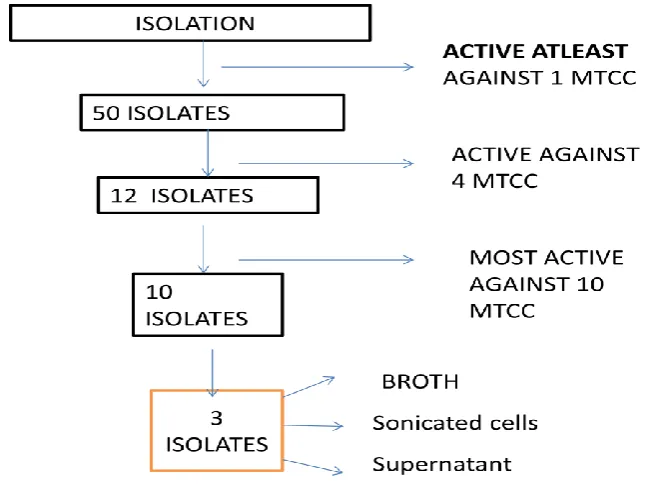
Current study was carried out for the isolation and screening of antibiotic producing novel bacteria collected from different localities of Dibrugarh district of Assam. A total of 115 active isolates were screened on the basis of their anti microbial activities against at least one of the test microbes considered in this study viz.o E.
coli MTCC-40, B. subtilis MTCC-121,
Pseudomonas arginosa MTCC-4673 , S. cerevisiae MTCC-3090, out of a sample size (n=) 50. Out of these, 64 showed good antimicrobial activity (ZOI ≥ 10 mm). These were further tested against microbes responsible for plant diseases
viz. Clostridium acetobutylicum MTCC-11274,
extends activity against at least one of them. 12 of these showed activity against all the 10 microbes under consideration .
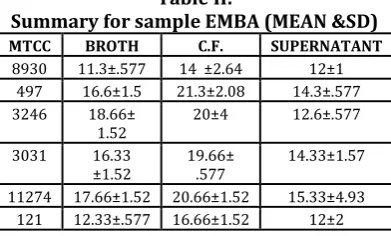
The isolate designated as NAA showed highest activity amongst all the three strains followed by the isolate EMBA . A comparison of antimicrobial activities by the respective bacterial culture (broth), cell free extract and sonicated cell extract is shown in table II. Biochemical characterization is done and presented in table III. The strain is gram negative and non sporulated. Under light microscope it is observed as rod shaped. Finally the isolates were identified as
Enterobacter cloaca and klebsiella pneumonia
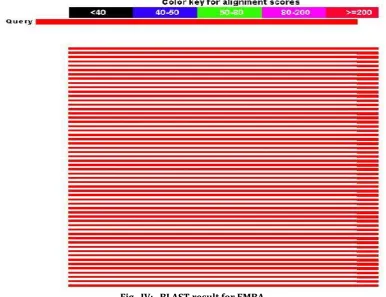
on the basis of 16s rRNA study. The strain NAA was found to be Enterobacter cloaca with 95% similarity score with Enterobacter cloaca_ strain_ ATCC_ 13047 and EMBA was found to be Klebsiella pneumonia with 92% similarity score with Klebsiella pneumonia_strain _BR1_16s_ribosomal_RNA_gene_partial
_sequence . GenBank accession number for strain NAA is KX859176 and for strain EMBA is KY111029.
DISCUSSION
Among various environmental compartments, soil is considered to be one of the primary reservoir of released antibiotics (kemper,2008;seveno et al.,2002).Antibiotics released to the soil whatever means it be (animal sewage,wastewater irrigation) may cause extensive antibiotic resistance build up in soil (Agerso et al.,2006;Heuer and Smalla,
2007;Kummerer,2004;Marti et al.,2013).Numerous antibiotic resistant bacteria (ARB) have been detected and isolated from soil samples (Brandt et al.,2009;DCosta et al.,2006,Schmitt et al.,2006).Antibiotic resistant genes (ARGs) have also been widely detected in soil in past few decades. Our interest focused on microorganisms belonging to soil microflora . Present finding highlights the importance of further investigation towards the goal of obtaining novel antimicrobial agent from extreme part Northeast India’s untapped habitat. These areas represent diverse and largely unscreened ecosystem and the least investigated ecosystem for the isolation of potent antibiotic producing microorganisms. In our study two strains namely Enterobacter cloaca and Klebsiella pneumonia were isolated from tea garden and industrial area of Dibrugarh district ,Assam exhibited promising antibacterial and antifungal activity against a varied range of organisms. Diversified environmental condition and high level of nutrient content in this region could trigger or favor unusual metabolite production by these isolates and thus stressing their potential as a source of novel antibiotic, which encouraged further studies to isolate and identify these novel compounds.
ACKNOWLEDGEMENT
Author is grateful to Centre for Biotechnology and Bioinformatics , Dibrugarh University for providing laboratory facilities required to carry out this work.
Table 1:
Places of sample collection coordinates
A
Itakhuligaon 27046”N,95092”E
ajarguri Rangrangia
Chakalia 1 27012”N,94082”E
Chakalia 2 27012”N,94082”E
B
Bamunbari 27020”N,94097”E
Moran 27017”N,94091”E
Kherni Nachanigaon
Jamuguri 26059”N,91098”E
C
Nachanigaon 2 27016”N,94082”E
dighaliya 27016”N,94082”E
Keseruguri 27013”N,94077”E
Dhadumia2 27013”N,94077”E
D
Balimara 27013”N,95033”E
Namrup 21018”N , 95034”E
Parbatpur 23017”N,88010”E
Jaipur 1 27026”N, 95039”E
Jaipur 2 27026”N, 95039”E
E
Balimara 27013”N,95033”E
Duliagaon 27035”N,95032”E
Duliajan 27035”N,95032”E
Bhadoi 27047”N,94091”E
F
Bishmile 27048”N, 95017”E
Chabua 27048”N, 95017”E
amguri 26081”N, 94052”E
Khajua 26081”N, 94052”E
Tengakgat 27038” N,95017”E
G
Chaolkhowa 27038” N,95017”E
Puranigaon 27045”N, 95008”E
Dikom 27045”N, 95008”E
Mohanbari 27048”N, 95002”E
Lahoal 27045”N, 95000”E
H
Amolapotty 27047”N, 94089”E
Dibrugarh university 27047”N, 94091”E
Borboruagaon 27047”N, 94091”E
Jamirahgaon 27041”N, 94085”E
Majgaon 26096 N, 94089”E
I
Rohmoria 1 27051”N,95010 E
Bogoritoli Charukolia sapori J
Rohmoria 2 27051”N,95010 E
paltanbazar 27048”N,94094”E
panitola 27049”N,95024”E
Maijanbeel area 27032”N,94058”E
Sample collection Area
Fig. I:
Flow chart for isolation of active isolates
Fig. II:
Samples showing activity against MTCC
Table II:
Summary for sample EMBA (MEAN &SD) MTCC BROTH C.F. SUPERNATANT
8930 11.3±.577 14 ±2.64 12±1 497 16.6±1.5 21.3±2.08 14.3±.577 3246 18.66±
1.52 20±4 12.6±.577 3031 16.33
±1.52 19.66± .577 14.33±1.57 11274 17.66±1.52 20.66±1.52 15.33±4.93
121 12.33±.577 16.66±1.52 12±2
Summary for sample NAA (MEAN &SD)
MTCC BROTH C.F. SUPERNATANT 3031 14±1 10±1 16±1 8930 19±1 14.66±.577 20±1 11274 17±1 14.6±.577 18±1 497 15.33±.577 14.33±.577 18±1 3246 15±1 -- 17.33±.577
111 14±1 -- 18.6±.577 121 21.66±1.520 15±1 16±1
40 19±2.64 18±2.64 16±1 3090 18±1 22.6±.577 14.33±2.08
Table III: Biochemical study of both the strains Name of tests STRAIN NAA STRAIN EMBA
Gram Staining negative negative Spore Non spore Non spore Catalase positive positive Oxidase negative negative Gas production positive positive Citrate utilisation positive positive Acid production positive positive Gelatine liquefaction test Positive positive Lipase test Negative negative ONPG Positive Positive Sucrose Positive positive Mannitol Positive positive Sucrose fermentation Positive positive Lactose Positive positive Inulin Positive positive Glycerol Positive Positive Sorbitol positive Negative Cellobiose Positive: negative Positive:negative Esculin hydrolysis Positive Positive
Melonate Positive Positive Nitrate Negative Positive H2S production Negative Negative
Fig. IV: BLAST result for EMBA
Fig. VI: Phylogenetic relationships of the new potent isolate (NAA) Enterobacter sp. with ten other most closely related Enterobacter species based on 16S rDNA sequencing. The data set resembled 1000 times using the bootstrap option, and percentage values are given at the nodes
Fig. VII: Phylogenetic relationships of the new potent isolate (EMBA) Klebsiella sp. with ten other most closely related Klebsiella species based on 16S rDNA sequencing. The data set resembled
1000 times using the bootstrap option, and percentage values are given at the nodes
REFERENCES
1. Boubetra O. Taxonomy and chemical characterization of new antibiotics produced by Saccharothrix SA 198 isolated from a Saharan soil, Microbiological Research. 2013;168:223-230.
2. Kirk Jennifer L. Methods of studying soil microbial diversity,Journal of Microbiological Methods. 2004;58:169-188.
3. Thakur Youg Raj and Bijender K. Bajaj, Antibiotic resistance and molecular characterization of poultry isolates of Salmonella by RAPD-PCR. World journal
of Microbiol Biotechnol 2006;22:1177-1183.
4. Yim Grace, Helena Huimi Wang and Julian Davies. The truth about antibiotics, International Journal of Medical Microbiology. 2006;296:163-170.
5. Chen Chaoqi. Occurance of antibiotics and antibiotic resistances in soil from wastewater irrigation areas in Beijing and Tianjin China. Environmental Pollution. 2014;193:94-101.
kalapatthar;Mount Everst Region, Nepal journal of Science and Technology 10. 2009;173-182.
7. Brown G Mindy., Antibiotic resistance in bacteria isolated from the deep terrestrial surface, MicroEcol. 2009;57:484-493.
8. Todovora sevdalina and Lubka Kozhuharova. Characteristics and antimicrobial activity of Bacillus subtilis strains isolated from soil, World journal of Microbial Biotechnol. 2010;26:1207-1216.
9. Sengupta Nabonita. Diversity and antibiotic susceptibility pattern of
cultivable anaerobic bacteria from soil and sewage samples of India, Infection ,Genetics and Evolution. 2011;11:64-77. 10. Manzetti Sergio and Rossella Ghisi. The environmental release and fate of antibiotics, Marine Pollution Bulletin. 2014;79:7-15.
11. Duraipandiyan V. Antimicrobial properties of actinomycetes from the soil of Himalaya , Journal of Mycologien Medicale. 2010;20:15-20.