2015 | VOLUME 11 |259
© ARCHIVES OF BUDO | HEALTH PROMOTION AND PREVENTION
This is an open-access article distributed under the terms of the Creative Commons Attribution-NonCommercial 4.0 International (http://creativecommons.org/licenses/by-nc/4.0), which permits use, distribution, and reproduction in any medium, provided the original work is properly cited, the use is non-commercial and is otherwise in compliance with the license.
Effect of type of static exercise and whole body
vibration frequency on oxygen consumption and
respiratory activity in young and middle-aged women
Wiktor Niewiadomski
1AD, Anna Strasz
1B, Anna Mróz
2B, Dorota Laskowska
1B, Józef
Langfort
3D, Anna Gąsiorowska
14ACDE1
Department of Applied Physiology, Mossakowski Medical Research Centre, Polish Academy of Sciences, Warsaw, Poland
2Department of Physiology, Józef Piłsudski University of Physical Education, Warsaw, Poland
3
Department of Experimental Pharmacology, Mossakowski Medical Research Centre, Polish Academy of Sciences, Warsaw,
Poland
4
Laboratory of Preclinical Studies in Neurodegenerative Diseases, Nencki Institute of Experimental Biology, Polish Academy
of Sciences, Warsaw, Poland
Source of support:
The research was supported by Ministry of Science and Higher Education in Poland, grant no. N N404
517138.
Received:
09 February 2015;
Accepted:
31 July 2015;
Published online:
19 August 2015
ICID:
1167892
Abstract
Background & Study Aim:
A significant increase in oxygen consumption noted during whole body vibration (WBV) training gave riseto the notion that the latter may be a form of endurance training. However, this applies to exercise exceed-ing 300 s. Since consumption ramped up durexceed-ing the exercise, we wanted to know whether short, 30 s exercise also causes a significant increase in, and whether vibration frequency, type of exercise, and age influence, oxy-gen consumption.
Material & Methods:
Seven young and five middle-aged women each performed five different static exercises at vibrationfrequen-cies of 0, 20, 30, and 40 Hz. Each 30 s exercise was followed by at least 1 min of rest. Oxygen consumption and respiratory function were measured breath by breath.
Results:
Specific oxygen consumption and minute ventilation increased slightly but significantly with vibrationfquency, and were influenced by the type of exercise. The effect of age was evident only in the respiratory re-sponse. The increase in vibration frequency was accompanied by an increase in tidal volume in young women, and by an increase in respiratory frequency in middle-aged women.
Conclusions:
As the oxygen consumption increase caused by vibration exercises was small, regarding WBV as an enduranceexercise does not seem justified. We hypothesize that the small increase in oxygen consumption observed for a typical WBV protocol was due to the brevity of the single exercise, and possibly depends on the duration of pauses between exercises; manipulation of the exercise protocol allows one to influence oxygen consumption.
Keywords:
endurance training · exercise physiology · training design · vibration trainingCorresponding author:
Anna Gąsiorowska
, Department of Applied Physiology, Mossakowski Medical Research Centre, PolishAcademy of Sciences, 5 Pawińskiego, 02-106 Warsaw, Poland; e-mail: [email protected] Authors’ Contribution:
I
ntroductIonWhole body vibration (WBV) has become a pop-ular training method. It requires the application of vibratory stimulus to the body. Mechanical stimuli are generated by vibratory platforms, which are cur-rently widely available and used. It has been dem-onstrated that applying vibration to the whole body produces effects similar to those of strength train-ing [1,2]. WBV may prevent age-dependent loss of muscle strength [3]. A significant increase in mus-cle strength in older women [4] and men [5, 6] has been observed after WBV training. It has been shown that, in postmenopausal women, the growth in muscle strength after 6 months of WBV training can be com-parable to that achieved through resistance training [7]. Similarly, Tapp and Signorile [8] demonstrated that, for postmenopausal women, 8 weeks of WBV training can increase lower body strength to a level similar to that produced by resistance training. This suggests that WBV training can be an effective alter-native to conventional strength training.
Rittweger et al. [9] addressed the question of oxygen consumption during vibration exercise. They compared the oxygen uptake during a single session of dynamic vibration exercises with additional load, performed until exhaustion, with a classic ergometer test per-formed with increasing steps of 50 W over 3 min until exhaustion. They found that, at the end of vibration exercises lasting 325 s on average, oxygen consump-tion was 50% of the value of VO2max obtained in the ergometer test. In the next study [10], in order to elu-cidate the effect of vibration on oxygen consumption, three different exercises each lasting 3 min, performed with and without vibration, were compared. They found that the vibration caused on average, additional oxy-gen uptake of 4.5 ml·kg–1·min–1 (measured in the 3rd min of each exercise). Thus, there arises the question of whether WBV, besides being a form of strength train-ing [11], may also be regarded as endurance traintrain-ing.
Iorio et al. [12] showed that during static and dynamic exercises performed on vibration platform there was gradual increase in oxygen consumption which reached plateau after the 3rd min of exercise. The greatest oxygen consumption was lower than that noted by Rittweger et al. [9], but the addition of vibrations similarly increased this consumption by 4-5 ml·kg–1·min–1.
The shortest duration of a vibration training ses-sion which effectively increased muscle strength was 30 s [4,5]. Since the oxygen consumption increased throughout the exercise, we wanted to know whether
exercise lasting 30 s would also cause its significant increase, and whether vibration frequency, type of exercise, and age would influence that increase.
M
aterIalandM
ethodParticipants
Twelve women participated in this study after the ces-sation of 12 weeks of vibration training. Training fre-quency was thrice weekly, with at least 1 day of rest between sessions. Prior to the training, all volunteers underwent a medical interview. The exclusion criteria were as follows: taking medication influencing bone or muscle metabolism, neuromuscular or neurodegen-erative diseases, diabetes, stroke, heavy cardiovascu-lar disorders, implants, or bypasses. The subjects were assigned, according to age, to a younger or a middle-aged group. Subjects’ details are shown in Table 1. All participants gave written, informed consent, and the study was approved by the Ethical Committee of Warsaw Medical University in Warsaw.
Table 1. Physical characteristics of the subjects
Variable (indicator) Young (n=7) Middle-aged (n=5)
Age (years) 30 ± 5 52 ± 5
Height (cm) 166 ± 6 167 ± 5
Weight (kg) 68 ± 11 66 ± 12
BMI (kg·m–2) 25 ± 4 24 ± 3 Values are presented as mean ± standard deviation
Procedures and measures
For each subject, the whole experiment was performed over one day. The subjects were exposed to whole body vibration using a vibration platform (Vibmax, Grizzly Ltd., Poland). Four different vibration fre-quencies were applied in the following order: 0, 20, 30, and 40 Hz. Participants performed five different static exercises for each frequency: squat (knee angle of ~120º), deep squat (knee angle of ~90º), calves (stand-ing with heels slightly raised, knees slightly bent), left leg squat (standing on the left leg with the right knee raised), right leg squat (standing on the right leg with the left knee raised). The subjects were already famil-iar with the exercises. Each exercise lasted 30 s, with at least one minute of rest between exercises.
During the whole procedure, respiratory gas exchange was measured with a portable respiratory analy-ser (Cosmed® K4 B2, Italy). Prior to the
experi-ments, a K4 B2 turbine flow meter was calibrated with a 3-L calibration syringe using a standard, certi-fied gas preparation (16% O2, 5% CO2, 79% N2). Data
WBV (whole body vibration) is the method of vibration application. WBV is usually applied to the subject who stands on the vibrating platform which oscillates in a vertical direction with subject performing various exercises [15].
Vibration – is a mechanical oscillation which usually is sinusoidal though others form of oscillations may be applied. In case of sinusoidal oscillations it is defined by frequency measured in the unit of hertz (Hz) and by amplitude. The number of Hz denotes number of cycles per seconds. Amplitude is a half difference between the maximum and the minimum of the oscillation [15].
Static exercise – a kind of exercise when muscles develop tension and do not change the length. Static exercise may effectively enhance muscle mass and strength.
© ARCHIVES OF BUDO | HEALTH PROMOTION AND PREVENTION 2015 | VOLUME 11 |261
were measured breath-by-breath for oxygen uptake (VO2, mL/min). Carbon dioxide production (VCO2, mL/min), respiratory frequency (Rf, b/min), tidal vol-ume (Vt, L), and ventilation (VE, L/min) were calcu-lated. The data were stored on a memory card and then downloaded to a computer.
Data analysis
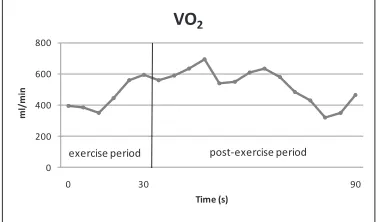
The data were divided into sections. Each exercise period lasting 30 s and the subsequent 1min rest break were regarded as one section. This division was based on the breath-by-breath results. Oxygen uptake increased gradually during the 30 s of exercise and gradually declined during the rest period, attaining its baseline level within 90 s from the section’s beginning. A sample record of oxygen consumption during one section is shown in Figure 1. The breath-by-breath data of each section were averaged and analysed.
Figure 1. Sample oxygen consumption (in ml/min)
record during the exercise and post-exercise periods. Breath-by-breath results of oxygen uptake obtained in one subject during deep squat without vibration, followed by the post-exercise period. The average from the combination of the 30-s exercise period and 60-s post exercise period was used for estimation of exercise-induced oxygen consumption.
S
tatIStIcalanalySISA three-way analysis of variance (ANOVA) for repeated measures was performed to evaluate the effect of frequency (four levels: 0, 20, 30, and 40 Hz), the effect of exercise (five levels: squat, deep squat, calves, left leg squat, right leg squat), and the effect of age (two levels: young and middle-aged). A value of p<0.05 was accepted as the threshold of statisti-cal significance. A Newman-Keuls post hoc analysis was performed when significant factor effects or their interactions were detected.
r
eSultSOxygen consumption and carbon dioxide production
Specific oxygen consumption (VO2/kg) increased slightly but significantly with vibration frequency, and
was influenced by the type of exercise. The three-way ANOVA revealed the main effect of exercise (p<0.001), frequency (p<0.001), and the interaction between those two factors (p<0.005). Age had no effect, so the results from both age groups were combined. The highest val-ues of VO2/kg were obtained when the deep squat was performed (Figure 2). The next highest level of oxy-gen consumption was observed in the calves position. Greater oxygen consumption was noted at the higher frequencies, 30 and 40 Hz. A significant effect of fre-quency on oxygen consumption was found only for the calves and right leg squat positions. Similar results were obtained when oxygen consumption was expressed in ml·min–1 (VO
2).
Figure 2. Specific oxygen consumption for different
exercises and vibration frequencies. Mean values of
VO2/kg were calculated for the two age groups pooled.
Carbon dioxide production was influenced by the type of exercise and vibration frequency in a way very sim-ilar to oxygen consumption. The three-way ANOVA revealed main effects of frequency (p<0.05) and exer-cise (p<0.001), but in contrast to VO2/kg, no interac-tion between those two factors was shown.
Ventilation, respiratory frequency, and tidal volume
The effect of the type of exercise and vibration fre-quency on ventilation (VE) resembled the effect on oxygen consumption. Three-way ANOVA revealed the main effects of exercise (p<0.001) and frequency (p<0.001). The highest values of VE were observed during deep squat; significantly lower ventilation was measured during calves. However, VE during these kinds of exercise was higher than during the remain-ing types of exercise. The frequencies of 30 and 40 Hz caused a significant increase in VE in all types of exer-cises (Figure 3).
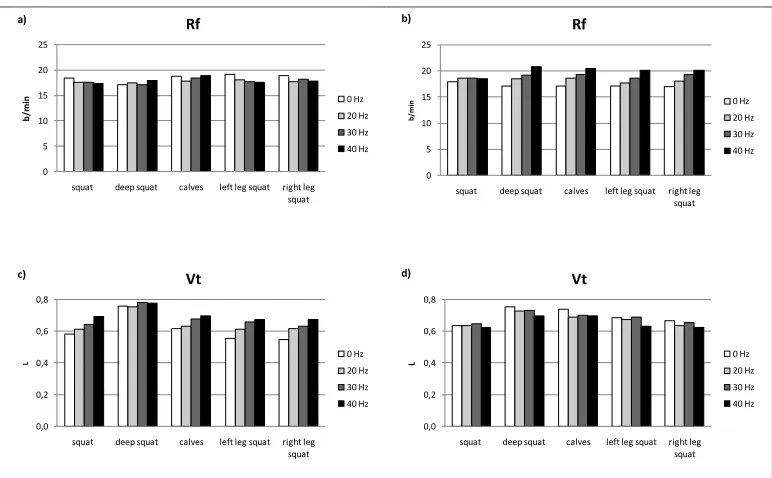
The influence of vibration frequency on respiratory frequency (Rf) was different in the two age groups. Three-way ANOVA revealed significant interaction between frequency and age (p<0.01), so the results from both age groups are shown separately (Figure 4).
5
Figure 1. Sample oxygen consumption record during the exercise and post-exercise periods. Breath-by-breath results of oxygen uptake obtained in one subject during deep squat without vibration, followed by the post-exercise period. The average from the combination of the 30 s exercise period and 60 s post exercise period was used for estimation of exercise-induced oxygen consumption.
Statistical analysis
A three-way analysis of variance (ANOVA) for repeated measures was performed to evaluate the effect of frequency (four levels: 0, 20, 30, and 40 Hz), the effect of exercise (five levels: squat, deep squat, calves, left leg squat, right leg squat), and the effect of age (two levels: young and middle-aged). A value of p<0.05 was accepted as the threshold of statistical significance. A Newman-Keuls post hoc analysis was performed when significant factor effects or their interactions were detected.
Results
Oxygen consumption and carbon dioxide production
Specific oxygen consumption (VO2/kg) increased slightly but significantly with vibration
frequency, and was influenced by the type of exercise. The three-way ANOVA revealed the main effect of exercise (p<0.001), frequency (p<0.001), and the interaction between those two factors (p<0.005). Age had no effect, so the results from both age groups were combined. The highest values of VO2/kg were obtained when the deep squat was performed (Figure 2). The
next highest level of oxygen consumption was observed in the calves position. Greater oxygen consumption was noted at the higher frequencies, 30 and 40 Hz. A significant effect of frequency on oxygen consumption was found only for the calves and right leg squat positions. Similar results were obtained when oxygen consumption was expressed in ml·min–1(VO2).
0 200 400 600 800
0 30 90
ml
/
min
Time (s)
VO2
exercise period post-exercise period
6
Figure 2. Specific oxygen consumption for different exercises and vibration frequencies.
Mean values of VO2/kg were calculated for the two age groups pooled.
Carbon dioxide production was influenced by the type of exercise and vibration frequency in a way very similar to oxygen consumption. The three-way ANOVA revealed main effects of
frequency (p<0.05) and exercise (p<0.001), but in contrast to VO2/kg, no interaction between those two factors was shown.
Ventilation, respiratory frequency, and tidal volume
The effect of the type of exercise and vibration frequency on ventilation (VE) resembled the effect on oxygen consumption. Three-way ANOVA revealed the main effects of exercise
(p<0.001) and frequency (p<0.001). The highest values of VE were observed during deep squat; significantly lower ventilation was measured during calves. However, VE during these kinds of exercise was higher than during the remaining types of exercise. The frequencies of 30 and 40 Hz caused a significant increase in VE in all types of exercises (Figure 3).
The influence of vibration frequency on respiratory frequency (Rf) was different in the two age groups. Three-way ANOVA revealed significant interaction between frequency and age
(p<0.01), so the results from both age groups are shown separately (Figure 4). 0
1 2 3 4 5 6 7 8
squat deep squat calves left leg squat right leg squat
m
l·kg
-1·m
in
-1
VO2/kg
262| VOLUME 11 | 2015 www.archbudo.com Figure 3. Ventilation for different kinds of exercise and
vibration frequencies. Mean values of VE were calculated for the two age groups pooled.
In the middle–aged group, the higher respiratory fre-quency was observed at higher vibration frequencies, a significant difference was seen only between 0 and 40 Hz (p<0.01). In the younger group, no clear effect of vibration frequency on Rf was observed.
Three-way ANOVA also revealed significant inter-action between frequency and exercise (p<0.05). Post hoc analysis suggests that the interaction was caused by the fact that an increase in vibration frequency resulted in an increase in Rf only for the deep squat and calve positions (with a significant difference in Rf values only between 0 and 40 Hz).
The other factor of VE, tidal volume (Vt), besides being influenced by the type of exercise and the
vibration frequency, was also affected by subjects’ ages. Three-way ANOVA revealed the main effect of exercise (p<0.001); the highest values of Vt were obtained when the deep squat position was used. A post hoc Newman-Keuls test showed significant (p<0.001) differences between this position and all others. The three-way ANOVA also revealed the interaction between frequency and age (p<0.01). In the young women, the greater tidal volume was observed at higher vibration frequencies. A post hoc test confirmed a statistically significant difference in Vt between 0 and 40 Hz (p<0.05) only in this group. In conclusion, the effect of vibration frequency on Vt was seen in young women, whereas the frequency’s effect on Rf was seen in middle-aged group.
d
IScuSSIonThe average specific oxygen consumption increased sig-nificantly during vibration exercises. This consumption attained the level of 6-7 mL·kg–1·min–1 for the deep squat. For other kinds of exercises, this level was lower. These levels of consumption are all distinctly lower than that seen after long-lasting vibration sessions, in which oxygen consumption values attained 14.4 mL·kg–1·min–1 at the end of static exercise lasting 3 minutes [12].
We found a slight increase in oxygen consumption with increasing vibration frequency, significant for the 7
Figure 3. Ventilation for different kinds of exercise and vibration frequencies. Mean values of VE were calculated for the two age groups pooled.
Figure 4. Respiratory frequency (Rf) and tidal volume (Vt) for different exercises and vibration frequencies in two age groups. Mean values were calculated separately for the young (a, c) and middle-aged (b, d) groups.
0 2 4 6 8 10 12 14 16
squat deep squat calves left leg squat right leg squat
L/ m in VE 0 Hz 20 Hz 30 Hz 40 Hz 0 5 10 15 20 25
squat deep squat calves left leg squat right leg
squat b/ m in Rf 0 Hz 20 Hz 30 Hz 40 Hz a) 0 5 10 15 20 25
squat deep squat calves left leg squat right leg
squat b/ m in Rf 0 Hz 20 Hz 30 Hz 40 Hz b) 0,0 0,2 0,4 0,6 0,8
squat deep squat calves left leg squat right leg
squat L Vt 0 Hz 20 Hz 30 Hz 40 Hz c) 0,0 0,2 0,4 0,6 0,8
squat deep squat calves left leg squat right leg
squat L Vt 0 Hz 20 Hz 30 Hz 40 Hz d)
Figure 3. Ventilation for different kinds of exercise and vibration frequencies. Mean values of VE were calculated for the two age groups pooled.
Figure 4. Respiratory frequency (Rf) and tidal volume (Vt) for different exercises and vibration frequencies in two age groups. Mean values were calculated separately for the young (a, c) and middle-aged (b, d) groups.
0 2 4 6 8 10 12 14 16
squat deep squat calves left leg squat right leg squat
L/ m in
VE
0 Hz 20 Hz 30 Hz 40 Hz 0 5 10 15 20 25squat deep squat calves left leg squat right leg squat b/ m in Rf 0 Hz 20 Hz 30 Hz 40 Hz a) 0 5 10 15 20 25
squat deep squat calves left leg squat right leg squat b/ m in Rf 0 Hz 20 Hz 30 Hz 40 Hz b) 0,0 0,2 0,4 0,6 0,8
squat deep squat calves left leg squat right leg squat L Vt 0 Hz 20 Hz 30 Hz 40 Hz c) 0,0 0,2 0,4 0,6 0,8
squat deep squat calves left leg squat right leg squat L Vt 0 Hz 20 Hz 30 Hz 40 Hz d)
Figure 4. Respiratory frequency (Rf) and tidal volume (Vt) for different exercises and vibration frequencies in two age
© ARCHIVES OF BUDO | HEALTH PROMOTION AND PREVENTION 2015 | VOLUME 11 |263
highest frequencies applied (30 and 40 Hz) in com-parison to the lowest (0 Hz). This observation con-firms those of Rittweger et al. [13], who also found that changing from a lower frequency (18 Hz) to a higher one (34 Hz) increased oxygen consumption. Our results demonstrate that the effect of vibration frequency on oxygen consumption is already present when the exercise duration is 1/10 of that used by Rittweger et al. [13] and Iorio et al. [12]. Similarly, the effect of type of exercise can be discerned when exercise duration is of a length typically used dur-ing WBV sessions. It should be pointed out that the distinct effect of kind of exercise presented by other authors [10,12,14], applies to major differences such as static vs. dynamic or exercise with no additional load vs. exercise with heavy additional load. However, in this study, the differences in oxygen consumption during various exercises were more likely due to posi-tions assumed by the subjects.
Iorio et al. [12] demonstrated that specific oxygen consumption had increased to about 5 mL·kg–1·min–1 only 30 s after the exercise’s beginning – a ~100% increase with respect to the baseline. We observed a much smaller increase in oxygen consumption. In this context, it must be mentioned that we are presenting data which are averaged from 90 s encompassing the 30 s of vibration exercise and the subsequent 60 s of post-exercise rest. Thus, the peak oxygen consumption may be close to the value observed by Iorio et al. [12].
We chose this way of estimating oxygen consumption because its dynamics revealed two important features when performing 30 s static vibration exercises. First, there is a several-second delay between the beginning of an exercise and the beginning of the rise in oxy-gen consumption. Second, the decline of oxyoxy-gen con-sumption after cessation of exercise is also gradual, slower than the rise. Thus, to account for the whole increase in oxygen consumption evoked by such exer-cise, we decided to include, beside the exercise period, the fairly long period of post-exercise rest. Moreover, these two observations point towards the possibility of manipulating the level of oxygen consumption by changing the duration of exercise and/or the dura-tion of the pause between exercises. The prolongadura-tion
of the former and the shortening of the latter could increase oxygen consumption. This possibility may be of value for designing vibration training in persons with low physical capacity due to age or health status.
Regarding the effect of age on oxygen consump-tion, in contrast to Cochrane et al. [14], who found a greater increase in oxygen uptake in younger par-ticipants, we did not find any age related differences. However, it must be pointed out that the exercise pro-tocol used by the authors differed significantly form that used by us. We were unable to find any other paper dealing with the effect of age.
However, age affected the respiratory response to changes in vibration frequency. In young women, increasing vibration frequency consistently caused slight but significant increases in tidal volume, but did not affect respiratory frequency. Conversely, respi-ratory frequency in middle-aged women increased along with vibration frequency, but tidal volume remained unaffected. In the end, however, VE, which is a product of respiratory frequency and tidal volume, was affected by vibration frequency in similar ways in both groups, i.e. ventilation increased with increasing vibration frequency.
c
oncluSIonSThe observed increase in oxygen consumption caused by vibration exercises was small. This small increase was probably due to the short duration of a single exercise. Thus, it seems unjustified to consider WBV an endurance exercise. Furthermore, our observations raised the question of whether it would be possible to manipulate oxygen consumption during WBV by changing the durations of the exercise and inter-exer-cise rest. This might allow for the design of WBV training according to specific goals, like minimizing or maximizing oxygen consumption, or with respect to cardiac safety.
c
oMpetIngIntereStr
eferenceS1. Bosco C, Colli R, Introini E et al. Adaptive responses of human skeletal muscle to vibration exposure. Clin Physiol. 1999; 19: 183–187
2. Cardinale M, Bosco C. The use of vibration as an exercise intervention. Exerc Sport Sci Rev 2003; 31: 3–7
3. Machado A, García-López D, González-Gallego J et al. Whole-body vibration training increases mus-cle strength and mass in older women: a random-ized-controlled trial. Scand J Med Sci Sports 2010; 20: 200–207
4. Roelants M, Delecluse C, Verschueren SM. Whole-body-vibration training increases knee-extension strength and speed of movement in older women. J Am Geriatr Soc 2004; 52: 901–908
5. Bogaerts A, Delecluse C, Claessens AL et al. Impact of whole-body vibration training versus fitness train-ing on muscle strength and muscle mass in older men: a 1-year randomized controlled trial. J Gerontol A Biol Sci Med Sci 2007; 62: 630–635
6. Kennis E, Verschueren SM, Bogaerts A et al. Effects of fitness and vibration training on muscle quality: a 1-year postintervention follow-up in older men. Arch Phys Med Rehabil 2013; 94: 910–918 7. Verschueren SMP, Roelants M, Delecluse C et al.
Effect of 6-month whole body vibration training on hip density, muscle strength, and postural control in postmenopausal women: a randomized controlled pilot study. J Bone Miner Res 2004; 19: 352–359 8. Tapp LR, Signorile JF. Efficacy of WBV as a
modal-ity for inducing changes in body composition, aero-bic fitness, and muscular strength: a pilot study. Clin Interv Aging 2014; 9: 63–72
9. Rittweger J, Beller G, Felsenberg D. Acute physi-ological effects of exhaustive whole-body vibration exercise in man. Clin Physiol 2000; 20: 134–142 10. Rittweger J, Schiessl H, Felsenberg D. Oxygen
uptake during whole-body vibration exercise: com-parison with squatting as a slow voluntary move-ment.Eur J Appl Physiol 2001; 86: 169–173
11. Niewiadomski W, Cardinale M, Gąsiorowska A et al. Could vibration training be an alternative to resis-tance training in reversing sarcopenia? J Hum Kinet 2005; 14: 3-20
12. Iorio FDi, Cesarelli M, Bifulco P et al. The effects of whole body vibration on oxygen uptake and elec-tromyographic signal of the rectus femoris muscle during static and dynamic squat. J Excerc Physiol Online 2012; 15: 18–31
13. Rittweger J, Ehrig J, Just K et al. Oxygen uptake in whole-body vibration exercise: influence of vibration frequency, amplitude, and external load. Int J Sports Med 2002; 23: 428–432
14. Cochrane DJ, Sartor F, Winwood K et al. A compar-ison of the physiologic effects of acute whole-body vibration exercise in young and older people. Archs Phys Med Rehabil 2008; 89: 815–821
15. Luo J, McNamara B, Moran K. The use of vibra-tion training to enhance muscle strength and power. Sports Med 2005; 35: 23-41