Study on Target Program of G+15
Hospitality Building Cluster
D Pruthvi Charan Reddy1 and Sohail Amer2
1
Student, MTech (Construction Management), Department of Civil Engineering, Lords Institute of Engineering &Technology, Himayat Sagar, Hyderabad, Telangana, India
2
Assistant Professor, Department of Civil Engineering, Lords Institute of Engineering &Technology, Himayat Sagar, Hyderabad, Telangana, India
Abstract – Delay in construction projects is a common issue. Considerable percentages of projects fall behind schedule causing damages to almost all involved parties. Owners may experience losses due to postponed completion dates and Contractors may face liquidated damages. Even Architects and Engineers may face additional challenges resulted by delays. This paper is a study on a target program developed and scheduled for a cluster of five G+15 hospitality buildings. An analysis has been conducted on the Target program, Timeframe, Milestones and Work Breakdown Structure of the project. After analyzing the available project data, target program has been prepared and it is set as a base for the project to be executed. The inference of the study also tries to show the achieved progress of the planned target program. Data of project progress reports at various time intervals has been used to understand and analyze them for the purpose of the study. Key Performance Indicators (KPI) like S- curves is used for the study. The study also underlines the importance of the KPI and their significance in making timely changes in the project schedule to achieve desired project outcomes in defined time frame. Graphical and Tabular representation of the S-curves, Progress curves will give the reader a clear understanding of the objective of the paper.
Keywords — Target Program, G+15hospitality building
1.INTRODUCTION
This chapter intends to give brief introduction of the Jewel of the Creek Project and give an overview of the project which includes the Project description, Timeframe, Permits and Milestones.
In the further chapters, Method statement, Target Programme details which includes Mobilization, Engineering, Procurement, Construction as well as Testing and Commissioning, Authority approval and Handing over will be detailed. It also explains the project Critical Path in brief.
The project includes 5 high rise structures which includes 4 service apartments and one 5 star hotel. The Construction site is along the creek area and footbridges connect the structure on the creek side
with that of the main land. There are various marine works involved in the overall project construction. Project Description: Jewel of the Creek Project - Five Hospitality Buildings
Time Frames:
Commencement Date: 1st of June 2014 Project Duration / Construction Period: 36
Calendar Months
Completion Date: 31st of May 2017
Permits and NOC’s:
Municipality Building Permit will be required to commence concrete pours for all permanent structures.
Design NOC’s for Power, Water and RMU to be obtained and provided to company by the Engineer as required.
Fire Fighting, Fire Alarm, Car park Ventilation, Telecommunication and Drainage NOC to be obtained and provided to company by the Engineer as required. Upon receiving the same as above, it must
be provided to MEP Subcontractor to follow-up and complete works in all aspect to finally achieve Authority approvals.
Interim - Contractual and Control Milestones: Date receive Clearance form
Employer/Engineer to Start Marine works: 16th Aug. 2015
Commence Landscape Works: 1st June 2015
Air Conditioning System "Partially Operational" : 8th May 2016
RTA Clearance to complete Marine Works : 1st Sept 2016
2.MAIN ELEMENTS OF SCOPE OF WORKS
Scope of works comprises of Civil, Finishes and Fit-Out Works all as per “Contract Drawings” and “Specifications” including but not limited to the following:
All concrete work including but not limited to columns, slabs, walls, screed and other related concrete works.
MEP works:
The Scope of MEP Works includes the Supply, Installation, Testing & Commissioning, Handover and Defects Liability Period of following Systems:
MECHANICAL SYSTEMS a) Chilled Water System
b) Space Cooling and Ventilation Systems c) Water Supply
d) Sewage System e) Storm Water Drainage f) Fire Fighting
g) LPG System
h) Building Management System i) Compressed Air System j) Steam System
ELECTRICAL SERVICES a) Power Supply and Distribution b) Lighting system
c) Wiring devices & miscellaneous equipment d) Safety systems
e) Central Battery Emergency Lighting system f) Lighting Control System for the BOH areas g) Information and communication (ICT) systems
All metal works including metal fabrications, handrails, railings, access ladders, etc. and metal doors.
All carpentry works and furnishing including but not limited to shelving, door architrave and sills, sub-frames, pantry cabinets, wood veneer panelling wood column cover and countertops.
Thermal & moisture protection.
Waterproofing, fire stopping system, sealants and sound insulation on slabs and vibration control.
All Glazing and Aluminium works, all fixed and operable units for openings i.e. steel doors, revolving doors, etc. supply and installation of finish hardware as per drawing & schedules. All finish work as per schedule of finishes
including but not limited to plastering, suspended ceilings, vinyl, wall and floor finishes. Skirting, carpet, paint and metal cladding.
All Signage, toilet partitions, access flooring, parking accessories, lockers toilet and bath accessories as indicated in drawings and specifications.
Specialist Work by subcontractor includes, but not limited to the following: Window cleaning equipment, Façade lighting.
Special construction includes saunas and steam rooms as specified in specifications.
External and Marina Works:
Inner creek (canal) waterproofing & protection work.
Ground floor slab and podium waterproofing and protection.
Vehicle Bridge crossing the canal
Design &Construction of Foot Bridges crossing the Canal.
Build up the RMU room in area C1.0. Supply & install the LPG system and gas
tanks including civil works. Internal and external signage.
Security systems, CCTV and access controls.
Cafes and Restaurants including kitchens, pantries, stores.
Waste management systems. Hard and Soft Landscaping:
Hard and Soft Landscaping for the entire plot
Other Miscellaneous Obligations:
Account for the removal of all embedded cranes sections and inserts in the raft, and for closing, with reinforced concrete slabs, all the openings left in the slabs above and prepare the soffits and floors surface to receive the specified finishes.
All openings above the embedded sections shall be closed by reinforced concrete and shall receive the specified finishes for all the used areas.
“Saw Cutting” down to the level of the Inner Creek Slab and carting away the debris of diaphragm wall adjacent to the Floating Bridge. Removal of the existing temporary reinforced
concrete wall adjacent to the Floating Bridge. Breaking and removal of mass concrete wall
adjacent to the Floating Bridge
Making openings in the constructed Periphery Retaining wall as well as the Diaphragm Wall behind them at all locations shown in the Tender drawings where the entrances/exits of the tunnels.
Any temporary dewatering needed for any activity mentioned above.
Responsible for Maintenance of submersible pumps to keep the Inner Creek Canal free of water during the whole construction period. Cost price of water proofing and protection
works of the Inner Creek Canal forming part of the Contract Works.
Providing and maintaining valid all insurances in the contract including that for the executed works.
Coordination with other Contractors on site for the removal of cofferdam and/or any other Contractor appointed by the Employer.
works outside the Plot boundary which may encroach onto the site boundary.
3. CONSTRUCTION METHOD STATEMENT Your Construction Method Statement is an essential an essential document to use as a reference for the preparation of the Target Program. It outlines the sequence of activities and works that are needed to be worked out in order to meet the project outcomes in stipulated time. The Target statement can only be prepared after careful review of the method statement has been conducted.
Initial mobilization will commence after 7 days of receiving notice to commence (NTP).
Company will obtain or renew necessary Permits and NOC’s for all the Temporary Facilities (if required) and liaise with relevant Authorities for obtaining Permits and Approvals as required to start-up construction activities on site.
The site facilities will be constructed during Mobilization period which will include the establishment of site offices, project signboards, shaded car parking (temporary) and storage yards etc.
The various preliminary works which will be started upon commencement includes but not limited to the following:
Obtaining Approvals and NOC from various authorities to proceed with construction.
Appointment of key subcontractor’s / suppliers for both Domestic as well as Nominated Subcontractor’s / Suppliers Coordination and scope interface study of
different works.
The detail engineering works includes the production of shop drawings and materials submittals and approvals.
Company will ensure that sufficient time period is allowed for procurement and delivery of materials to site including long lead items prior to execution works or installation of Equipment’s on site.
Construction of Superstructure works will start simultaneously in all the five Buildings namely A1, A2, A3 A4 and A5 with commencement of site preparation works which includes cleaning by sand blasting & straightening of reinforcement bars /dowels above Ground Floor Slab.
Provision for allocation of six teams which as assigned for Superstructure Concrete works are as mentioned below:
Building A1 – Two teams working simultaneously i.e. in parallel to each other in Zone A and Zone B
Building A2, A3 &A4 – One team each will work simultaneously starting same time.
Building A5 - One team will work independently in each building.
Ballroom F3 – (G+2) floors building only which is mainly steel structure and concrete works
commence after 9 months of A1 concrete works in progress to facilitate logistics and crew movement.
Since Construction of F3-Ballroom will commence in month number 12 following completion of around 15 to 16 Floors of A1 Concrete structure.
After finish of Structural Concrete works in F3 Building, installation of Structural steel works will commence in month # 16 and finish in month # 21.
Proprietary formwork systems will be used to construct the vertical elements and the floor slabs, inner creek walls will use “single-side” forms with “push-pull” props. Walls, shaft walls, columns and slabs will follow in the sequence indicated in the program of works.
Structure works for each buildings will be followed by other trades, MEP 1st fix, 2nd fix and final fix while both internal and external finishes works are in progress.
Once the buildings envelope is completed and with permanent power on, AC will be partially operational with the wild air on in each building which will then facilitate to commence the installation of sensitive finishes on each floor of the buildings A1 to A5, F3 and Basements such as installation of wooden doors, painting and decoration works as well as ID works by specialized subcontractors.
Basement finishing works for the existing 4 level will commence in month # 4 with activities of Block work, Plaster etc. which include MEP works, Equipment installation, sensitive finishes and ID works for specific areas.
Externals works of RMU and Cooling tower to commence in month # 5, Marina works construction to start in month # 10 prior to it in month# 5 clearance to proceed with the works is obtained from Client/ Engineer so as to facilitate related Engineering activities including coordination with Authorities.
Inner Canal works will commence in month # 20, Foot bridges and Vehicle bridge construction in month # 27
Hard and soft landscape works for the external areas and around towers to commence in month # 13 and finish in month # 35.
Other miscellaneous works such as removal of existing temporary reinforced concrete wall currently closing the canal near floating bridge, saw cutting of diaphragm wall to facilitate RTA works in future, breaking and removal of mass concrete wall adjacent to floating bridge and other contract obligations are carried out as and when required to facilitate smooth execution of works leading to on time completion of project.
Once all the finish are complete, civil and MEP snagging and cleaning is carried out floor by floor in each building to be ready for project handover.
4.MANPOWERPLANNINGFORTARGET PROGRAM
Manpower Planning for preparation of target program includes Human Resource Planning consists of putting right number of people, right kind of people at the right place, right time, doing the right things for which they are suited for the achievement of project outcomes. Man power Planning has got an important place in the arena of Target program preparation. Manpower Planning has to be a systems approach and is carried out in a set procedure. The procedure is as follows:
1. Analyzing the current manpower inventory 2. Making future manpower forecasts
Analyzing the current manpower inventory Before a Construction Project Planner makes forecast of future manpower, the current manpower status has to be analyzed. For this the following things have to be noted-
Type of Construction Project
Efficiency of Manpower based on their skill Manpower Quantity on Man Days basis
Making future manpower forecasts
Once the factors affecting the future manpower forecasts are known, planning can be done for the future manpower requirements in several work units. The Manpower forecasting techniques commonly employed by the construction organizations are as follows:
Expert Forecasts: This includes informal decisions, formal expert surveys and Delphi technique.
Trend Analysis: Manpower needs can be projected through extrapolation (projecting past trends), indexation (using base year as basis), and statistical analysis (central tendency measure).
Work Load Analysis: It is dependent upon the nature of work load in a department, in a branch or in a division.
Work Force Analysis: Whenever production and time period has to be analyzed, due allowances have to be made for getting net manpower requirements.
Other methods: Several Mathematical models, with the aid of computers are used to forecast manpower needs, like budget and planning analysis, regression, and new venture analysis.
Manpower efficiency data
Efficiency of manpower is a very important element and the basis on which the whole target program depends. Production rate is to be calculated
based on the amount of work a man can do in a particular day. The total project work is then assessed based on how much work 1 man is able to do and how long he will take to finish a particular work
5.MATERIALPLANNINGFORTARGET PROGRAM
Material quantities are essential data to be analyzed and used to prepare Target program. Concrete, Formwork and Steel Rebar quantities are analyzed and the amount of planned quantity utilization helps us to create the program. The planned and actual data that will be obtained in the later part when we start the execution of the project will be reflecting the work left and work completed based the quantities of material used and the remaining quantities that are to be used. So, the three materials data is analyzed in this chapter and proper histograms are drawn against the data.
6. TARGET PROGRAM TRACKING USING S- CURVES
An S-curve is defined as: "A display of cumulative costs, labor hours or other quantities plotted against time. The name derives from the S-like shape of the curve, flatter at the beginning and end and steeper in the middle, which is typical of most projects. The beginning represents a slow, deliberate but accelerating start, while the end represents a deceleration as the work runs out."
Types of S-curves
There are a variety of S-curves that are applicable to project management applications, including:
Man Hours versus Time S-curve Costs versus Time S-curve Baseline S-curve
Actual S-curve Target S-curve
Value and Percentage S-curves
Baseline S-curve
Prior to project commencement, a schedule is prepared outlining the proposed allocation of resources and the timing of tasks necessary to complete the project within a set time frame and budget. This schedule is referred to as the Baseline Schedule. From this schedule, a Baseline S-curve is generated. This S-curve reflects the planned progress of the project. If the project requirements change prior to commencement (e.g. change of scope, delayed start), the Baseline Schedule may require revision to reflect the changed requirements.
Target S-curve
Baseline Schedule). The production schedule reflects the actual progress of the project to date, and any revisions made to tasks yet to commence or not yet completed. From this schedule, a Target S-curve may be generated. This S-curve reflects the ideal progress of the project if all tasks are completed as currently scheduled. In an ideal world, the Target S-curve will meet the Baseline S-S-curve at the end of the project (On Time, On Budget) or finish below and to the left of the Baseline S-curve (Early, Under Budget). In reality, it is not uncommon for the Target S-curve to finish above and to the right of the Baseline S-curve (Late, Over Budget).
Actual S-curve
The production schedule is updated on a regular basis throughout the duration of the project. These updates include the revision of percentage complete for each task to date. Using this information, an Actual S-curve may be generated. This S-curve reflects the actual progress of the project to date, and may be compared with the Baseline and Target S-curves to determine how the project is progressing. During the project, the Actual S-curve will terminate at the Cutoff Date. This is the date the Production Schedule was last updated. At the completion of the project, the Actual curve will meet the Target S-curve
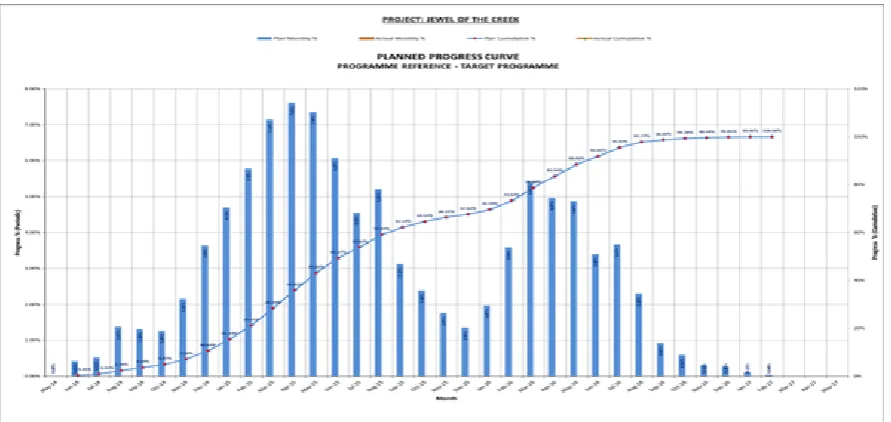
Fig 1: Planned Progress Curve
S-curve Analysis
Initial examination of the S-curves generated above reveal the following about the status of the project.
The project has grown in scope. (The Target S-curve finishes above the Baseline S-curve)
The project has slipped. (The Target curve finishes to the right of the Baseline S-curve)
The project is behind schedule. (The Actual S-curve sits below the Target S-curve at the Cut Off Date)
Project Growth
Analysis of the Baseline and Target S-curve data reveals the project has grown in scope by 12 man-hours, or 14.29%.
Growth = Target MHs - Baseline MHs = 96 - 84 = 12
Growth % = (Target MHs / Baseline MHs - 1) x 100% = (96 / 84 - 1) x 100% = 14.29%
Project Slippage
Analysis of the Baseline and Target S-curve data reveals the project has slipped by 1 day, or 20.00%.
Slippage = Target Duration - Baseline Duration = 6 - 5 = 1
Slippage % = (Target Duration / Baseline Duration - 1) x 100% = (6 / 5 - 1) x 100% = 20.00%
8.CONCLUSIONS
Every project must like a target program. In the construction industry the projects are very volatile and are exposed to many risks. So, to overcome all the risks that may arise at the time of execution stage of the construction management we all must be prepared to counter them with a proper strategy. In this case it is target program that can be a helpful tool which can be used as a reference to compare the progress with that of the actual planned value. We need various inputs to prepare this target program.
quantity and manpower efficiency are crucial factors and the data obtained along with the construction method statement will be comprehensive in our aim to develop a proper program. Inputs from various sources are collected and analyzed to bring it out. Work Breakdown Structure (WBS), Program of Works and Critical Path is the outputs of the Target Program.
The S-curve is an important but often overlooked and misunderstood project management tool. A variety of S-curves exist, the most common being Man Hours versus Time, and Costs versus Time. By creating a Baseline Schedule, a Baseline S-curve can be generated. Baseline S-curves provide a basis on which to compare a project's actual status to its planned status. They may also assist in the planning of manpower and financial resources required to complete the project.
Construction projects use many modern day planning tools and Primavera is one such tool which can be utilized to analyze the raw data and to be converted into a resourceful target program. As a conclusive statement, it will be essential to take proper precaution rather than to worry at the final stage of project collapse. So, there is a need of a target program to be planned in order to have a proper desired project output.
Acknowledgment
I am thankful to Mr. Mohammed Shafiuddin, Professor and Head of the Department of Civil Engineering, Lords Institute of Engineering & Technology, Hyderabad for his support during my work.
REFERENCES
[1] Arshi Shakeel Faridi and Sameh Monir El-Sayegh b.
"Significant factors causing delay in the UAE construction industry." Construction Management and Economics, Volume 24, Issue 11 (November 2006): pages 1167 - 1176.
[2] Adhikari I., Soo-Yong Kim and Young-Dai Lee. "Selection
of Appropriate Schedule Delay Analysis Method:
Analytical Hierarchy Process (AHP." Technology
Management for the Global Future, (2006): Page(s):483 - 488.
[3] Jha, K. C. Iyer and K. N. Critical Factors Affecting
Schedule Performance: Evidence from Indian Construction Projects. August 2006. 28 April 2009
[4] Madhav Prasad Nepal, 1 Moonseo Park,2 and Bosik Son3.
"Effects of Schedule Pressure on Construction
Performance." J. Constr. Engrg. and Mgmt. Volume 132, Issue 2, (February 2006): pp. 182-188.
[5] 6) Nasa. Learning Curve calculator. 25 May 2007. 28 April
2009
[6] S. Nicoletti and F. Nicol`o. "“A concurrent engineering decision model Management of the project activities information flow,”." (n.d.).