O R I G I N A L A R T I C L E
Open Access
miR2118
-triggered phased siRNAs are
differentially expressed during the panicle
development of wild and domesticated
African rice species
K. N. Ta
1,2†, F. Sabot
1†, H. Adam
1, Y. Vigouroux
1, S. De Mita
1,4, A. Ghesquière
1, N. V. Do
2, P. Gantet
2,3and S. Jouannic
1,2*Abstract
Background:Rice exhibits a wide range of panicle structures. To explain these variations, much emphasis has been placed on changes in transcriptional regulation, but no large-scale study has yet reported on changes in small RNA regulation in the various rice species. To evaluate this aspect, we performed deep sequencing and expression profiling of small RNAs from two closely related species with contrasting panicle development: the cultivated African riceOryza glaberrimaand its wild relativeOryza barthii.
Results:Our RNA-seq analysis revealed a dramatic difference between the two species in the 21 nucleotide small RNA population, corresponding mainly tomiR2118-triggered phased siRNAs. A detailed expression profiling during the panicle development ofO. glaberrimaandO. barthiiusing qRT-PCRs andin situhybridization, confirmed a delayed expression of the phased siRNAs as well as their lncRNA precursors and regulators (miR2118andMEL1 gene) inO. glaberrimacompared toO. barthii. We provide evidence that the 21-nt phasiRNA pathway in rice is associated with male-gametogenesis but is initiated in spikelet meristems.
Conclusion:Differential expression of themiR2118-triggered 21-nt phasiRNA pathway between the two African rice species reflects differential rates of determinate fate acquisition of panicle meristems between the two species.
Keywords:Panicle, Meristem, Small RNAs, phasiRNAs,miR2118, Domestication,Oryza barthii,Oryza glaberrima
Background
A prevailing view in evolutionary developmental biology (Evo-Devo) is that morphological traits evolved mostly by changes in expression patterns of functionally con-served genes rather than through the emergence of new genes (Doebley and Lukens 1998; Carroll 2008). Although much emphasis was placed on changes in transcriptional regulation, gene expression is regulated at many levels. In this context, the regulation of genome expression by small RNAs appears to be an important
mechanism in the control of plant development
(morphogenesis and phase transition), through post-transcriptional regulation of mRNA abundance (by
miR-NAs and secondary siRNAs) and silencing of gene
expression (by siRNAs) via site-specific DNA methyla-tion (Jones-Rhoades et al. 2006; Arikit et al. 2013). Secondary, phased small interfering RNAs (phasiRNAs) are emerging regulators of gene expression in plants (Zheng et al. 2015; Xia et al. 2013). Analyses in large panel of plant species covering plant kingdom revealed that a huge diversity of phasiRNA-generating loci types in plants (Zheng et al. 2015; Xia et al. 2013). An unsus-pected diversity of phasiRNAs originating from protein-coding genes was observed. However, most of these loci were clade- or species-specific with distinct expression * Correspondence:[email protected]
†Equal contributors
1
IRD, UMR DIADE, 911, avenue Agropolis, BP64501, F-34394 Montpellier, Cedex 5, France
2LMI RICE, National Key Laboratory for Plant Cell Biotechnology, Agronomical
Genetics Institute, Pham Van Dong road, Hanoi, Vietnam Full list of author information is available at the end of the article
patterns, suggesting recent and independent evolution-ary origins (Xia et al. 2013).
Several types of phasiRNA-generating loci were re-ported from Asian riceOryza sativaand its wild relative Oryza rufipogonfrom various tissues or organs (Arikit et al. 2013; Zheng et al. 2015; Liu et al. 2013). InO. sativa, phasiRNAs triggered by specific miRNAs and originating from non-coding loci, were shown to be involved in pan-icle development and more specifically in male gameto-genesis (Arikit et al. 2013; Johnson et al. 2009; Komiya et al. 2014; Song et al. 2012a, b). The TAS3-associated trans-acting siRNAs (or ta-siRNAs), triggered by the
microRNA miR390, are known to target mRNAs of
Auxin Response Factor(ARFs) involved in various devel-opmental processes including floret and stamen develop-ment (Allen et al. 2005; Liu et al. 2007; Nogueira et al. 2007; Song et al. 2012b). Other detected phasiRNAs are panicle-specific 21- or 24-nucleotide (nt) small RNAs. They are produced from numerous polyA-tailed long non-coding RNA (lncRNA) generating loci through an RDR6-dependent pathway triggered by the microRNAs miR2118 and miR2275 respectively (Komiya et al. 2014; Song et al. 2012a, b). The 21-nt phasiRNAs may act in a complex with the gamete-specific Argonaute (AGO)
protein MEIOSIS ARRESTED AT LEPTOTENE1
(MEL1) (Komiya et al. 2014). In maize, each phasiRNA type exhibits independent spatiotemporal regulation, with 21-nt premeiotic phasiRNAs dependent on stamen epidermal differentiation and 24-nt meiotic phasiRNAs dependent on tapetal cell differentiation (Zhai et al. 2015). However, their function during male gametogen-esis remains unclear.
African riceOryza glaberrimawas domesticated about 2000 to 3000 years ago from Oryza barthii, whereas O. sativawas domesticated in Asia almost 10,000 years ago
from Oryza rufipogon (Second 1982; Linares 2002;
Caicedo et al. 2007; Vaughan et al. 2008; Huang et al. 2012; Orjuela et al. 2014; Wang et al. 2014; Zhang et al. 2014a. African rice domestication has a single origin in West Africa (Linares, 2002; Wang et al. 2014) and is associated with a severe genetic bottleneck (Li et al. 2011a, b; Nabholz et al. 2014; Orjuela et al. 2014). It is also associated with major morphological and physio-logical changes. For example, O. barthii and O. glaber-rima exhibit strikingly different panicle architectures, from a low branching complexity and small grain num-ber in O. barthii to a more complex panicle and higher grain number inO. glaberrima(Linares 2002). A similar divergence of domestication-related traits was also ob-served between the Asian wild rice and its cultivated counterpart (Vaughan et al. 2008). It has been suggested that several small RNA loci, such as miRNA-triggered
phasiRNAs loci including ta-siRNA locus TAS3a2, as
well as the microRNA loci MIR164e, MIR390 and
MIR395a/b, have experienced direct selection during Asian rice domestication (Liu et al. 2013; Wang et al. 2010; Wang et al. 2012). However, a large-scale study of small RNA expression in relation to the early stages of panicle development in African rice is still lacking. To investigate whether the latter varies between the two African species in relation to changes in small RNA ex-pression, we conducted a comparative analysis of small RNA populations accumulating during early panicle
development in the two African species. We found
conservation of the male gametogenesis-associated
miR2118-triggered phasiRNA pathway in these African rice species. Our data revealed significant changes in expression of these gamete-specific 21-nt phasiRNAs be-tween O. barthiiandO. glaberrima, associated with dif-ferential expression of their regulators, namely miR2118 and MEL1. This is suggestive of a differential rate of de-terminate meristem fate acquisition during the initial panicle development stages between the two species.
Results
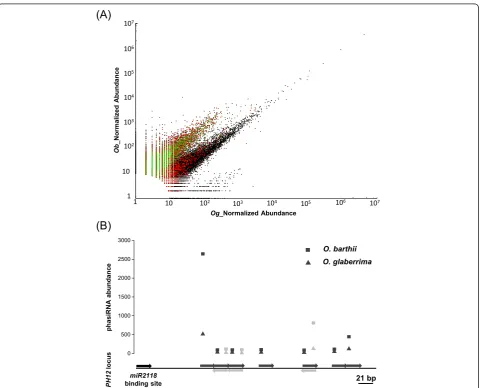
surprisingly large fraction of small RNAs with a higher expression in O. barthiithan in O. glaberrima (Fig. 1a). This subpopulation corresponds to 29 % of the 21-nt small RNAs mapped, when considering small RNAs
that were at least 5-fold more accumulated in O.
barthii. Other size classes (from 18- to 28-nt, except 21-nt) were not distinguished by such a pattern of distribution between the two species (Additional file 5). The overall 21-nt small RNAs were categorized into five distinct classes corresponding to the different functional compartments of the rice genome: miRNAs (11.3 %), ncRNAs (13.1 %), repeats (12.4 %), genes (CDS, intron, UTR: 25.5 %) and unannotated regions
(37.7 %) of O. sativa reference genome. However, the distribution of the over-expressed fraction in the wild species showed a strong bias towards unannotated
regions (81.4 %; p-value = 0.0) with the remaining
classes all severely under-represented: miRNAs (2.5 %; p-value = 8.0 × 10−139), ncRNAs (0.6 %; p-value = 3.5 × 10−301), repeats (0.8 %; p-value = 2.3 × 10−261) and
genes (14.8 %; p-value = 1.2 × 10−83) (Fig. 1a;
Additional file 5). This indicated that the
over-expressed 21-nt small RNAs detected in O. barthii
panicles were mainly derived from unannotated
re-gions of the O. sativa reference genome (Fig. 1a;
Additional file 5).
Fig. 1Relative abundance of panicle-derived 21-nt small RNAs fromO. barthiiandO. glaberrima.aRelative abundance of 21-nt small RNAs betweenO. barthii(Ob) andO. glaberrima(Og). Normalized abundance of distinct small RNA sequences. Black dots represent global 21-nt small RNAs, red dots unannotated 21-nt small RNAs, and green dots 21-nt small RNAs associated with detected phased loci.bRelative abundance of detected phasiRNAs generated from a single locus (PH-12) betweenO. barthiiandO. glaberrima.The lower panel illustrates the position of the
miR2118binding site and the detected phasiRNAs from thePH12locus in the two species (above or below the line if originating from plus or minus strand respectively). The upper panel illustrates the abundance of the corresponding phasiRNAs inO. glaberrima(triangles) andO. barthii
21-nt phasiRNAs are over-represented in African wild rice transcriptomes
Previous studies ofO. sativa showed that the miR2118-triggered 21-nt phasiRNAs specifically expressed in the rice panicle originate from unannotated regions of the genome (Johnson et al. 2009; Song et al. 2012a; Komiya et al. 2014). To determine whether the over-represented 21-nt small RNA fraction inO. barthiialso corresponds to this class of 21-nt phasiRNAs, we used a dedicated program (see Material and methods), and detected 4 100 distinct phasiRNAs from O. barthii and O. glaberrima, distributed across 892 loci (denoted“phased loci”), using the O. sativagenome as reference (Additional file 6). In addition, 952 distinct 21-nt small RNAs mapped to these 892 loci, but were not detected as phased siRNAs by our procedure. In total, 5 052 distinct 21-nt small RNA se-quences associated with these 892 phased loci were found, corresponding to 21.2 % of the panicle-derived 21-nt small RNA population from the two species. Out of these 5 052 small RNAs, 3 694 were detected in both species, 1 352 were detected only in O. barthiiand six only in O. glaberrima (Additional file 6). As previously reported, the detected phased loci were present on all 12 chromosomes but not at the same density, and were or-ganized in clusters or super-clusters, such as on chromo-some 12 (Additional file 7). As expected, 86.5 % of these 21-nt phasiRNAs mapped to unannotated regions of the O. sativagenome. This fraction of 21-nt phasiRNAs rep-resents 49 % of the unannotated 21-nt small RNA popu-lation (4 418 over 8 977 sequences). The 892 phased loci were scanned for the presence of the 22-nt miRNA miR2118recognition site in their vicinity (Johnson et al. 2009; Song et al. 2012a; Komiya et al. 2014). 529 phased loci (59.3 %) shared the conserved motif close to one end (from two to 452 bp from the end). Between two and 91 distinct sequences were detected per phased locus, with an average of 6.0 (±4.8, SD) distinct se-quences, the majority being 3 or 5 sequences per phased locus (Additional file 5). As expected for double strand RNA processed small RNAs, most of the detected phased loci generated small RNAs from both strands (92.5 %) (Additional file 6).
For 96 % of the phased loci, there was a significant dif-ference in read counts between the two species, and about 71 % of them displayed an abundance ratio higher than 5 (Additional file 6). These 21-nt siRNAs were mainly over-accumulated in O. barthii and contributed to 52 % of the O. barthiifive fold over-accumulated 21-nt small RNAs (Fig. 1a). The abundance of differe21-nt pha-siRNAs from a given locus was variable, with the predominance of one or two phasiRNAs (Fig. 1b; Additional file 8). For the differentially expressed loci, this unequal distribution over the locus was conserved between the two species, with over-accumulation of all
the detected phasiRNAs from a single locus (Fig. 1b). Interestingly, the proportion of phased loci sharing the miR2118 recognition site was significantly higher (p-value = 1.5 × 10−08) in the differentially expressed group (i.e. higher expression inO. barthii) (61 %,n= 854) than in the group of non-differentially expressed phased loci (16 %, n= 38) (Additional file 6). Therefore, phased loci over-expression in O. barthiiversus O. glaberrima may result from differences in miR2118 regulation between the two species.
Panicle-associated microRNAs in African rice species Comprehensive analysis of conserved miRNAs led to the identification of 146 annotated miRNA families expressed in African rice panicles, including 62 canonical families, 20 variant ones and 64 siRNA-like ones, according to the classification of Jeong et al. (2011) (Additional files 6 and 9). Some of the siRNA-like families were previously re-ported to be associated with transposable elements (TEs) inO. sativa, namelyTE-MIRs (Li et al. 2011b; Yan et al. 2011). In the same way, other annotatedMIRloci were ev-idenced in our analysis of 21-nt phased loci as overlapping loci, suggesting that these loci are phasiRNA-generating loci rather than MIR ones: osa-MIR5486, osa-MIR5488, osa-MIR5506, osa-MIR5514, osa-miR5516, osa-miR5519, osa-MIR5517, osa-MIR5527, osa-MIR5530,osa-MIR5791, osa-MIR5796,osa-MIR5800andosa-MIR5822(Additional file 6). Thus, the annotations of these two classes ofMIR loci (i.e. variant and siRNA-like) should be reconsidered. Similarly to what was reported for O. sativa(Jeong et al. 2011), the canonical and variant miRNA families expressed in African rice panicles can be classified accord-ing to the length of the highest accumulated small RNA: length ranging from 19- to 25-nt, with 3 main types corre-sponding to 21-nt (48 %), 24-nt (31 %) and 22-nt (9 %) long mature miRNAs (Additional files 6 and 9).
Most miRNA families were expressed at similar levels in O. barthii and O. glaberrima. Interestingly, the miR159/
319 families contributed to 64 % of mature miRNA
expressed in young panicles of both African species (Additional file 6), in contrast to previous studies of panicle-derived miRNAs in O. sativa (Jeong et al. 2011; Peng et al. 2011). This may be related to the specific devel-opmental stages used in our study or may reflect differ-ences between Asian and African rice species. Differential expression affected only a few miRNA families with a trend towards higher expression in O. barthii (Fig. 2). These families included the canonical 22-ntmiR2118 and
five other ones, namely miR2275, miR5495, miR5497,
despite over-expression of miR2275 in O. barthii, no major over-expression of a large subset of the 24-nt small RNAs was detected (Additional file 5). The canonical
miRNAsmiR5495andmiR5497were previously shown in
O. sativa to be miRNAs specifically expressed in pollen (Wei et al. 2011).
Variations in the expression ofmiR2118, 21-nt phasiRNAs and associated precursors during African rice panicle development
The differential accumulation of specific microRNAs
and 21-nt phasiRNAs observed between O. barthii and
O. glaberrima may result from differences in their ex-pression levels, but may also reflect a shift in the timing of their expression during panicle development. To test these hypotheses, expression analysis of miR2118, 21-nt phasiRNAs and their RNA precursors was performed on 4 distinct morphological stages of panicles collected fromO. barthii (accession B88) andO. glaberrima (var-iety CG14) (Fig. 3; see Additional file 10 for histological description). Four different phased loci from distinct clusters and chromosomes were considered for the RNA precursors as well as the phasiRNA with the highest level of accumulation for each locus (Fig. 3; Additional files 8, 11 and 12).
The differential accumulation of miR2118, selected phasiRNAs and their corresponding precursors between the two species were validated through Northern-blotting and/or RT-PCRs on RNA bulks similar to the ones used for small RNA deep sequencing (Additional
file 8). While neither mature miR2118 nor 21-nt
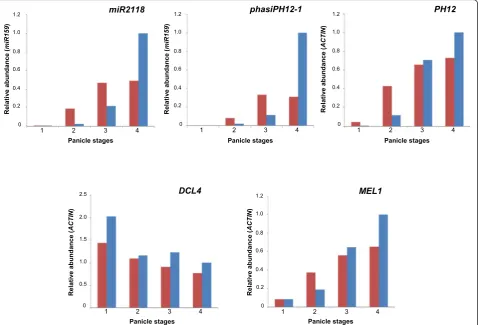
phasiRNAphasiPH12-1 were detected at the early mor-phological stage of panicle development (inflorescence meristem after reproductive transition, stage 1), their ex-pression was initiated earlier inO. barthii(early branch-ing stage, stage 2) than inO. glaberrima (late branching stage, stage 3). The expression level reached a peak at stage 3 in O. barthii and remained at the same level at stage 4 (young flowers with differentiated organs). In O. glaberrimathe miRNA and phasiRNA were more abun-dant at stage 4 and displayed a higher expression level than in O. barthii at this stage (Fig. 3). Similar patterns of expression were observed during panicle development for 21-nt phasiRNAs from the four phased loci tested (Additional file 12). These findings indicate that the later accumulation of 21-nt phasiRNAs during the panicle de-velopmental time-course in O. glaberrima is associated with a later accumulation of miR2118. These findings are in agreement with the small RNA-seq data, as the RNA bulks used for sequencing originate from panicles at morphological stages 1 to 3, in which miR2118 and 21-nt phasiRNAs are accumulated at higher levels in O. barthiithan inO. glaberrima.
Similarly to Komiya et al. (2014), we showed that the 21-nt phasiRNAs from the African species were generated from polyA-tailed long non-coding RNAs (lncRNAs) (Additional file 11). The accumulation patterns of these polyA-tailed lncRNAs were similar to those of the phasiR-NAs with a later initiation of expression inO. glaberrima than in O. barthii, regarding the morphological stages (Fig. 3; Additional file 12). Furthermore, we investigated the accumulation levels of mRNAs corresponding to gene Fig. 2Relative abundance of miRNA families betweenO. barthii(Ob) andO. glaberrima (Og). Normalized abundance of miRNA reads. Black diamonds represent the differentially expressed miRNA families, and grey points to non-differentially expressed miRNA families betweenO. barthii
orthologs encoding other factors involved in the biogen-esis of themiR2118-triggered 21-nt phased RNAs, such as the OsDCL4 DICER-like protein, and the gamete-specific Argonauteprotein MEL1 (Song et al. 2012a, b; Komiya et al. 2014). The accumulation level of African riceOsDCL4 ortholog mRNAs decreases slightly over the 4 stages,
while African rice MEL1 ortholog mRNA accumulation
increases from stage 1 to stage 4 in a similar pattern to the small RNAs and lncRNAs (Fig. 3; Additional file 12). Taken together, these data suggest that the accumulation
levels of phasiRNAs may depend on miR2118, phased
loci-associated lncRNAs and African rice MEL1ortholog transcript accumulation levels rather than to those of the OsDCL4ortholog.
To determine the spatial expression patterns of
miR2118, phasiPH12-1 and PH12 lncRNAs during
panicle development, in situ hybridization analysis
was performed at different developmental stages of young panicles from the two species (Fig. 4). Similar
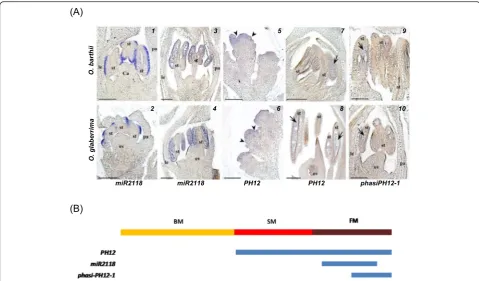
patterns were observed for the two species with varia-tions in spatial patterning of these factors. This ana-lysis revealed that the onset of the miR2118-triggered 21-nt phasiRNA pathway is sequential in terms of ini-tiation of expression. PH12 lncRNAs are detected first in spikelet meristems and are maintained in develop-ing florets, but only in stamens and more specifically in the pollen sac. Subsequently, miR2118 specifically accumulates in the hypodermis of developing stamens (prior to pollen sac differentiation) at the early floret differentiation stage, then in the epidermis and the pollen sac in differentiated stamens at later stages.
Finally, the phasiPH12-1 phasiRNAs are specifically
located in pollen sac of differentiated stamens subse-quent to miR2118 detection (Fig. 4). Eventually, all three signals were observed at the same location at later stages (i.e. pollen sac).
Our spatial expression analysis of miR2118,
pha-siPH12-1 and PH12 lncRNA and their differential
Fig. 3Time course expression analysis of small RNAs and related-regulators during panicle development. qRT-PCR analysis ofmiR2118,PH12
accumulation patterns with respect to the morphological stages of panicle development between the two species indicates that at the branching stage, the gamete-associated small RNAs are initiated later and expressed at lower levels inO. glaberrima than inO. barthii. This suggests that for the same morphological stage of pan-icle development, stamen differentiation, and therefore floret differentiation, might be delayed inO. glaberrima with respect to its wild relative,O. barthii.
Variations in expression of a spikelet-related gene during panicle development
To investigate this hypothesis further, we analysed the
expression pattern of orthologs of the O. sativa
E-function MADS-box LEAFY HULL STERILE1 (LHS1)/
OsMADS1 gene that promotes the determination of
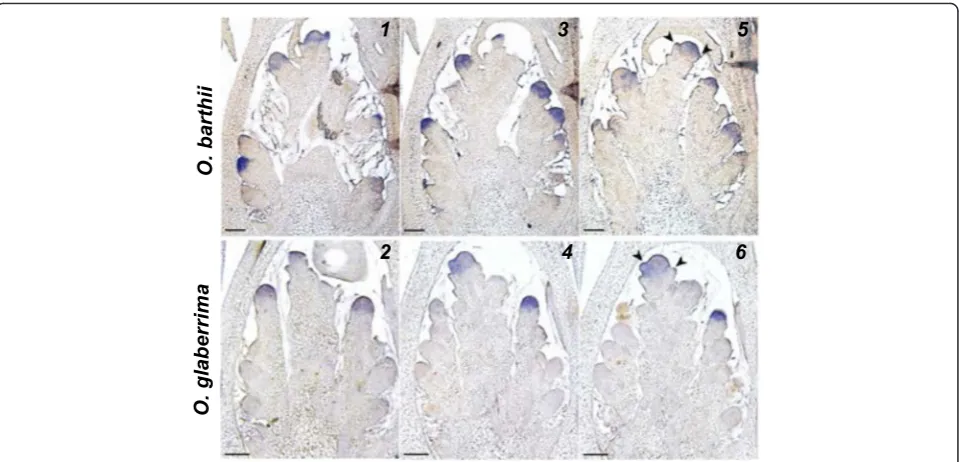
meristems (i.e. spikelet and floret meristems) (Jeon et al. 2000; Cui et al. 2010; Khanday et al. 2013). Using in situ hybridization, we investigated the expression pattern of theLHS1ortholog inO. barthiiand O. glaberrima pani-cles at the early branching stage. In the two species,
LHS1 mRNA was detected specifically in SMs (Fig. 5).
However, while theLHS1mRNA signal was observed in
some lateral meristems inO. glaberrima, it was detected in all lateral meristems in O. barthii (Fig. 5). This sup-ports the hypothesis that for the same morphological stage, all terminal and lateral meristems had acquired the spikelet fate inO. barthii, whereas inO. glaberrima few had done so. These observations are also in agree-ment with the gamete-associated small RNA profiling data obtained.
Discussion
Conservation ofmiR2118-triggered 21-nt phasiRNAs in Oryza species
Using panicle-derived small RNA transcriptome sequen-cing inO. glaberrimaand its wild ancestor,O. barthii,we showed that 29 % of the 21-nt small RNA population is drastically repressed (or non activated) in cultivated geno-types during the branching stage of panicle development. This large difference in expression pattern suggests a change in regulation of key regulatory molecules(s). The Fig. 4In plantaexpression analysis of small RNAs and related-regulators during panicle development.aIn situhybridization of maturemiR2118
(1–4),PH12mRNA precursor (5–8) andphasiPH12-1(9–10) in spikelet meristem (SMs), floret meristem (FMs) and differentiated floret inO. barthii
(B88) andO. glaberrima(CG14). MaturemiR2118transcripts were detected in the outer cell layer of stamens (i.e.hypodermis) (1–2) and later in pollen sac (3–4). PrecursorPH12mRNAs were detected in the spikelet meristem (5–6) and in pollen sac of the anthers (arrow) (7–8). ThephasiPH12-1small RNAs were detected in the pollen sac of the anthers in florets (9–10). This panel of photos illustrates stages for which the transcripts were detected. le, lemma; pa, palea; st, stamen; ca, carpel; ov, ovule. Arrowheads, lemma and palea primordium formation in SMs; arrow, anthers. Scale bars: 100μm.
altered fraction of small RNAs corresponds mainly to 21-nt phasiRNAs generated from nearly a thousand non-coding RNA loci, associated with altered expression of the 22-nt microRNAmiR2118. This is in agreement with ob-servations inO. sativa that panicle-specific 21-nt phasiR-NAs are produced from multiple non-coding RNA loci through an RDR6/DCL4-dependent pathway triggered by the microRNAmiR2118(Johnson et al. 2009; Song et al. 2012a, b). The synthesis of secondary siRNAs (or phasiR-NAs) in reproductive organs from non-coding loci has only been reported in rice, maize andBrachypodium, sug-gesting a recent origin of these secondary siRNAs from a common ancestor of grasses (Zheng et al. 2015; Johnson et al. 2009; Song et al. 2012a, b; Zhai et al. 2015, Vogel et al. 2010). However, the low conservation of these loci across the group suggests that they may have species-specific functions (Zheng et al. 2015;, Komiya et al. 2014). Interestingly,miR2118-triggered secondary siRNA synthe-sis is also conserved across distantly related species, such asMedicago truncatula, tobacco and tomato. However, in these eudicot species, the miR2118 family members (in-cludingmiR482family members) were recruited to initiate secondary siRNAs on mRNAs encoding NBS-LRR pro-teins involved in disease resistance (Zhai et al. 2011; Li et al. 2012; Shivaprasadet al.2012).
Our study revealed conserved features of panicle-associated 21-nt phasiRNAs and panicle-associated loci between Oryza species. However, this analysis was limited to the fraction of small RNAs corresponding to O. barthiiand O. glaberrima phasiRNAs conserved in O. sativa (i.e.
mapped to theO. sativa genome), and does not provide a complete overview of the complexity of phased loci in African rice species and their evolution during the African domestication process. The genome sequence of O. glaberrima accession CG14 was recently published (Wang et al. 2014), however, we obtained better map-ping results from our small RNA sequence data using the reference genomeO. sativasspjaponicacv
Nippon-bare MSU v7.0 than the O. glaberrima CG14 released
sequence: 72.1 % of small RNA reads from both African species using Nipponbare MSU v7.0 sequence in con-trast to 61.6 % and 56.2 % fromO. barthiiandO.
glaber-rima respectively using the O. glaberrima reference
because they were identified in a different way, i.e. based on different stages of panicle development. It should also be noted that more small RNA sequences were charac-terized in our study. Even if sequences are conserved
between Oryza species, it cannot be ruled out that
species-specific expression patterns of these lncRNA loci may occur. Moreover, 40 % of the detected loci associ-ated with differentially expressed 21-nt phasiRNAs between the two African species had nomiR2118 recog-nition site motif, suggesting a potentially distinct mech-anism of production. Another possible explanation would be that miR2118 recognition sites are present in the African rice genome at these loci but not in the O. sativa genome. In addition, in our comparative analysis,
48 % of the over-expressed 21-nt small RNAs in O.
barthiimapping to theO. sativagenome were not asso-ciated with the detected phased loci, and also originated mainly from unannotated regions of the genome. It is possible that these remaining over-expressed 21-nt small RNAs belong to phased loci specific to African rice ge-nomes that were not detectable in our analysis because of sequence divergence from the O. sativareference, or that they are associated with non-coding loci unrelated to phased small RNA generating loci. Recently, Zhang et al. (2014b) showed that a large set of long non-coding RNAs was expressed in anthers and pistils of O. sativa rice. Interestingly, only 122 of the 1624 reported lncRNA loci were associated with small RNAs (Zhang et al. 2014b). In agreement with this, only a few of the reported lncRNA loci overlapped with the miR2118-associated phasiRNA-generating loci inO. sativa and African rice species (data not shown). This suggests that these lncRNAs are mostly not associated with the production of phasiRNAs or other small RNAs and may act through other mechanisms during plant development.
ThemiR2118-triggered 21-nt phasiRNAs are markers of male-gametogenesis in African rice
The function of the 21-nt phasiRNAs during panicle de-velopment is still unclear. MicroRNAmiR2118has been reported to be preferentially expressed in rice and maize stamens, suggesting a role in male gametogenesis (Song et al. 2012a). Recently, it was shown that the function of this class of phased small RNA was dependent on the germ line-specific Argonaute (AGO) protein MEL1 through a direct interaction between MEL1 and phasiR-NAs (Komiya et al. 2014). Moreover, as maturemiR2118 was detected in the MEL1-binding small RNA fraction, it was argued that MEL1 might play a role in the first steps of the 21-nt phasiRNA biogenesis pathway as the AGO protein in the miR2118-driven RISC triggering to the first cleavage of lncRNA precursors (Komiya et al. 2014). This is in agreement with the expression pattern
observed for MEL1 and miR2118. MEL1 mRNAs were
observed to be first detectable byin situhybridization in the hypodermis of developing stamen primordia in a spotty pattern, similarly to that which we observed for miR2118microRNA, later becoming restricted to micro-sporangia and pollen sac (Nonomura et al. 2007). In our study, while PH12precursor lncRNAs were detected in the spikelet meristem differentiation stage, phasiPH12-1 was only detected in the stamens of differentiating flo-rets and co-localized withPH12precursor lncRNAs, but only aftermiR2118was observed to accumulate. The lat-ter was first limited to the hypodermis of differentiating stamens and extended to the pollen sac in later stages. Together, these data suggest that the 21-nt phasiRNA regulatory network is initiated early during panicle de-velopment from the stage of spikelet meristem
establish-ment, before miR2118 and MEL1 expression, through
the induction of lncRNA precursor expression. The
co-expression of miR2118 and MEL1 in the hypodermis of
the differentiating stamen would result in the initiation of the 21-nt phasiRNA biogenesis pathway, leading to the accumulation of the phasiRNAs. However, the trans-acting factors involved in the regulation of the lncRNA precursors are still unknown. Zhai et al. (2015) have recently shown that maizemiR2118-triggered 21-nt pha-siRNAs correspond to premeiotic pha-siRNAs in anthers, with a similar spatial patterning observed in rice, indicat-ing a conservation of the spatial regulation of this path-way in grasses.
Although direct evidence is still lacking for the
in-volvement in male gametogenesis of miR2118 and the
associated phasiRNAs and lncRNA precursors, their in-volvement is supported by the phenotypes of rdr6 and dcl4mutants affected in flower and stamen development (Liu et al. 2007; Song et al. 2012b). Moreover the mel1 mutant phenotype indicates that the MEL1 AGO protein mediates the regulation of germ-line mother cell devel-opment and meiosis in both male and female organs, suggesting that the MEL1-phasiRNA complexes may be involved in these processes (Nonomura et al. 2007; Komiya et al. 2014). The remaining question is whether
these phasiRNAs can be considered as ta-siRNA
(secondary siRNAs targeting other mRNAs). The predominant accumulation of MEL1 protein in the
cytoplasm would favour a trans-acting function of
MEL1-phasiRNA complex on mRNAs but without cleavage activity of the putative targets (Komiya et al. 2014; Zhai et al. 2015).
Differential rate of determinate fate acquisition in the panicle meristems of African rice
complexity during the early branching stage, all meri-stems are converted into spikelets inO. barthiiwhereas only those of the apical part of the panicle branches are converted inO. glaberrima, as suggested by the expres-sion pattern of the spikelet-associated MADS-box gene LHS1/OsMADS1. This difference was paralleled by the later initiation of expression and lower accumulation during the branching stage of the 21-nt phasiRNA
path-way members (miR2118, MEL1, lncRNAs and
phasiR-NAs) inO. glaberrima, as well as the lncRNA precursors expressed in spikelet meristems. The differential rate of spikelet transition observed between the two species may be explained by a shorter duration of development in O. barthiithan in O. glaberrima but also possibly by the synchronous transition of the apical and lateral meri-stems from the indeterminate to the determinate state in O. barthii.
Theoretical modelling of inflorescence architecture suggests that inflorescence branching complexity and its evolution depends on differences in the timing of floral (i.e. determinate) fate acquisition in apical and/or lateral meristems (Prusinkiewicz et al. 2007). This biological basis is supported by the analysis of various mutants af-fected in floral meristem identity in different species, notably inArabidopsis thaliana, Antirrhinum majus, pe-tunia and tomato (Koes 2008; Moyroud et al. 2010; Park et al. 2014). A comparative study of the diversity of in-florescence architecture in tomato based on meristem-specific transcriptome analysis provided support for this model (Park et al. 2012). In the case of the grass inflor-escence and more specifically the rice panicle, it was also reported that variations in panicle architecture depended on the activity or expression levels of both meristem fate controlling genes and branch-promoting genes (Kyozuka et al. 2014; Zhang and Yuan 2014). In the context of our comparative analysis of African rice species, a differential rate of determinate fate acquisition in panicle meristems would result in a longer or higher rate of branching activ-ity inO. glaberrimacompared toO. barthii, leading to a higher branch complexity in the domesticated species. However, further functional studies are required to define the link between the major regulatory changes of spikelet-related gene expression and the panicle phenotypic varia-tions associated with domestication.
Conclusions
We provide evidence that the male-gametogenesis-specific 21-nt phasiRNA pathway triggered bymiR2118 is conserved in both wild relative and domesticated African rice species. Our study shows that the onset of
the miR2118-triggered 21-nt phasiRNA pathway is
sequential in terms of initiation of expression with variations in spatial patterning of these factors. This pathway is initiated when spikelet meristems are
established, through the activation of lncRNA precursor expression. Our study provides evidence that the differ-ential expression of the miR2118-triggered 21-nt pha-siRNA pathway inO. barthiiandO. glaberrimamay be associated with different rates of determinate meristem fate acquisition during branching stage of panicle devel-opment. It will be of great interest to determine whether a similar scenario has occurred in the Asian rice species (O. sativavs. O. rufipogon), so as to deter-mine whether or not the phenotypic convergence of panicle development observed between the two domes-tication processes is paralleled by similar changes in the expression of molecular regulatory components associ-ated with spikelet differentiation and panicle architec-ture complexity.
Methods
Plant materials and panicle sampling
For Illumina sequencing, 10 accessions ofO. glaberrima and 10 accessions of O. barthii (see Additional file 1: Table S1) were grown in the greenhouse at IRD, Mont-pellier. Around 15 panicles from each accession were collected from 4 to 15 days after induction, to obtain homogeneous representation of early developmental stages corresponding to early rachis elongation to early floret differentiation.
For histological analysis and expression analysis, CG14 and B88 plants were grown in growth chamber at IRD, Montpellier (France) with a 14-10 h day/night cycle at 32 °C/28 °C and humidity at 60 %. Flowering was induced by short day conditions (10-14 h day/night cycle). Panicles were collected at 4 different morphological stages: stage 1, inflorescence meristem stage, after initiation of primary branch (i.e. rachis and primary branch meristems); stage 2, early branching stage (i.e. panicle with elongated pri-mary and higher order branch development); stage 3, late branching stage (i.e. panicle with elongated primary and secondary branches); stage 4, young flowers with differen-tiated organs (Additional file 10).
Illumina sequencing and data processing
Total RNAs (including small RNAs) were extracted using an RNeasy Plant Mini Kit with RLT and RWT buffers (Qiagen, France). DNase treatments were per-formed using the RNAeasy-free DNase set (Qiagen, France). Two bulks of total RNAs corresponding to a mix of total RNAs from the 10 accessions of the two species were used for sequencing. Purified small RNA sequencing was performed by Eurofins/MWG Operon
(Germany) on an Illumina Hi-seq 2000 using the
using CutAdapt (Martin 2011). All the trimmed reads ranging from 18 to 28 nucleotides were clustered and
mapped to O. sativa ssp japonica cv Nipponbare
gen-ome (MSU release version 7; http://rice.plantbiology.m-su.edu/) using BLAST(Altschul et al. 1990) (Additional file 4) in order to evaluate library quality. The 18–28 nu-cleotide reads were them annotated through a filtering process using successive hierarchical BLAST(Additional file 4) versus (in order) miRBase v17.0 (Kozomara and Griffiths-Jones 2011), Rfam v7, a home-made repeat database (successive curated concatenation ofRetrOryza, RepBase, TREP and TIGRRepeats), CDS then gene fea-tures (i.e. introns and UTRs) from Oryza sativa ssp ja-ponica varNipponbare MSU v7.0 annotation, and finally the MSU v7.0 rice genome for the sequences not similar to miRNAs, non coding RNAs, Repeat-associated se-quences and genes. BLAST filtering was done using Oryza genus data form the different databases (i.e. mainly O. sativa). Mapping of the sequences to the O. sativaMSU v7.0 reference genome was done for the last three steps of our annotation pipeline. This genome was used as a reference because (i) of its equal divergence to the two species we analyzed (avoiding favoring one spe-cies in mapping analyses rather than the other one), and (ii) because of the larger resources in terms of annota-tion, expression data and genomic information available for this species. The BLASTand post-filter parameters used were probability of 85 %, e-value of 10−3, on a size of 85 % of the reads (minimum size of 16). The same BLAST parameters were used throughout the analysis.
Mapping from O. glaberrima and O. barthiismall RNA
sequences was then compared and filtered using a series of homemade Perl scripts (available on demand). Com-prehensive analysis of the miRNA-associated small RNAs from African rice species was limited to the fam-ilies present inO. sativa, and did not include diverse iso-forms. For the same reason, potential African rice specific miRNAs were not investigated. The 21-mers were used in phasing analysis with the ta-si Prediction tool from the UEA sRNA workbench facilities (http:// srna-workbench.cmp.uea.ac.uk/; Stocks et al. 2012). A post-analysis manual filtering was performed for se-quences mapping to more than 10 loci in genome, as well as telomere-associated loci, leading to the deletion of 123 loci from the 1015 initial loci reported in ta-si Prediction tool outputs. Once the loci were identified, we used theEMBOSS software suite v6.5.7.0 (Rice et al. 2000) to extract −500/+500 bases around each locus, and treated them using MEMEv4.8.1 (Bailey and Elkan 1994). Then, the loci sequences were used as a BLAST database to add other 21-nt sequences that were not identified originally as phased (in order to by-pass the genome divergence), in two pass: first we select only new sequences with 100 % of identity on 85 % of their
length (minimum HSP length of 16), then we change the threshold to 85 % of identity on 85 % of their length (min HSP length of 16). Finally, statistical tests of all the processed data were performed using g-test and a fixed p-value of 10−3. Depending on the experiment, the de-gree of freedom was adjusted but was generally 1. All
the calculations were performed using homemade Perl
scripts and CPAN statistical modules.
Quantitative RT-PCR analysis
Total RNAs (including small RNAs) were extracted as described before, from the 4 individual morphological stages of young panicles ofO. glaberrima(CG14) andO. barthii (B88). First-stand cDNA was synthesised using SuperScript III cDNA First-strand synthesis system (Invitrogen). Quantitative stem-loop RT-PCR analyses on small RNAs were performed using 100 ng of total RNA according to Varkonyi-Gasic et al. (2007) with re-verse transcription at 42 °C in conjunction with small RNA-specific stem-loop primers. Quantitative RT-PCR analyses on mRNAs were performed using 1μg of total RNA in conjunction with polydT or random hexamer primers according to the manufacturer’s instructions. qRT-PCRs were performed using LightCycler 480 ther-mocycler (Roche, France) in conjunction with SYBR
Green I master mix (Roche, France) in 8 μL reaction
mix containing 2 μL of diluted RTs and 0.8 μL of for-ward and reverse primers at 10μM. The qPCR amplifi-cation conditions include 3 stages: pre-incubation (95 °C in 10 min); amplification with 45 cycles (95 °C 15 s and 60 °C 30s); melting curve (95 °C 5 s and 70 °C 1 min). In stem-loop qRT-PCR, the levels of miRNA were normal-ized by mature miR159expression level. In classic
qRT-PCR, mRNAs were normalized to the rice Actin gene
(LOC_Os03g50885.1). Each set of experiments was re-peated three times, and the relative quantification method with efficiency corrected calculation model (Souaze et al. 1996) was used to evaluate quantitative variations. The primers used are listed in Additional file 1: Table S5.
In situhybridizations
(2011). Detection was performed using the Vector Blue Alkaline Phosphatase Substrate Kit III (Vector Laborator-ies). Slides were observed and photographed by Evolution MP5.0 colour Media Cybernetics camera in conjunction with a Leica DMRB microscope and images were processed using Photoshop CS6.
Additional files
Additional file 1: Table S1.List of genotypes used in this study.Table S2.Summary statistics of small RNA libraries.Table S3.Summary of sequence number (clusters and reads) mapped toO. sativaNipponbare reference genome (MSU7.0) andO. glaberrimaCG14 reference genome forO. barthiiandO. glaberrimasmall RNA sequences.Table S4.Summary of sequence number (clusters and reads) in each annotation class (i.e. sequence databases) forO. barthiiandO. glaberrimasmall RNA sequences based on BLAST-filtering.Table S5.List of primers used in this study. The bases in brackets represent the ones that were modified LNAs. The sequences in italic correspond to stem-loop region for stem-loop RT-PCRs. The underline sequences correspond to T7 RNA polymerase binding site used for RNA probe synthesis. (PDF 191 kb)
Additional file 2:Size distribution, mapping and annotation ofO. barthiiandO. glaberrimapanicle-derived small RNAs onO. sativa Nipponbaregenome. (a) Small RNA size distribution of clusters (distinct) and reads (abundance). The size of small RNAs was plottedversus
frequency (percentage relative to total abundance). (b) Mapping rate (percentage relative to total number) of clusters (i.e. distinct sequences) and total reads onO. sativa nipponbareMSU7.0. The percentage values are indicated in the bars. (c) Small RNA annotation frequency (percentage relative to total abundance) of clusters (distinct) and individual reads (abundance). The percentage values are indicated in the bars. (d) Size distribution of the annotated small RNA clusters (i.e. distinct sequences) according the annotation classes. (e) Size distribution of the annotated small RNA sequences (i.e. abundance/reads) according the annotation classes. (PDF 333 kb)
Additional file 3:Genomic distribution and abundance ofO. barthiiand
O. glaberrimapanicle-derived small RNAs onO. sativa nipponbare
genome. (a) Distribution and abundance ofO. barthiireads vs. O. sativa nipponbaregenome MSU7.0. (b) Distribution and abundance ofO. glaberrimareads vs.O. sativa nipponbaregenome MSU7.0. (PDF 1091 kb) Additional file 4:Bio-informatic workflow for small RNA analysis. (PDF 158 kb)
Additional file 5:Relative abundance of small RNAs betweenO. barthii
andO. glaberrima. (a) Relative abundance of small RNAs betweenO. barthii(Ob) andO. glaberrima(Og) according to their size (from 18- to 28-nt small RNAs). LogPlots of normalized abundance of distinct small RNA sequences. (b) Relative abundance of the annotation classes of 21-nt small RNAs betweenO. barthii(Ob) andO. glaberrima(Og). LogPlot of normalized abundance of distinct small RNA sequences. Black dots represent global 21-nt small RNAs, and red dots the class of annotated 21-nt small RNAs. (c) Relative abundance of the annotation classes of 24-nt small RNAs betweenO. barthii(Ob) andO. glaberrima(Og). LogPlot of normalized abundance of distinct small RNA sequences. Black dots represent whole 24-nt small RNAs, red dots represent the class of annotated 24-nt small RNAs. (PDF 1571 kb)
Additional file 6:21-nt small RNAs associated to phased loci and mature miRNA families detected in young panicles ofO. glaberrimaand
O. barthii. (a)O. sativaNipponbare loci associated with 21-nt phased and unphased siRNAs fromO. barthiiandO. glaberrimadetected using sRNA-workbench facilities. (b) Normalized count of reads (relative abundance for 2 millions of total reads) associated with mature miRNA families in relation to small RNA size. (PDF 383 kb)
Additional file 7:Genomic distribution, abundance and complexity of
O. barthiiandO. glaberrima21-nt phased small RNAs onO. sativa nipponbaregenome (MSU 7.0). (a) Genomic distribution and abundance ofO. barthiiandO. glaberrima21-nt phasiRNAs onO. sativa nipponbare
genome (MSU 7.0). (b) Distribution of number of detected 21-nt phasiRNAs from African species per phased locus onO. sativa nipponbaregenome (MSU 7.0). (PDF 547 kb)
Additional file 8:Sequences and phasiRNA abundances of the 4 phased loci used for validation. The 4 phased loci reported here were used for stem-loop RT-PCR (phasiRNAs) and classical RT-PCR (lncRNAs) validation. The positions of the phased loci on MSU7.0 chromosomes are indicated. The alignment betweenmiR2118fand the phased locus is indicated. ThemiR2118recognition site is in blue. The phasiRNAs detected in the plus strand are highlighted alternately in green and in red. The phasiRNAs detected in the minus strand are underlined alternately in green and in red. The phasiRNA boxed in yellow is the most abundant one and the one used for stem-loop RT-PCR validation and qRT-PCR analysis. Histograms illustrate the relative abundance of the detected phasiRNAs per locus in the two species (PDF 159 kb) Additional file 9:Features ofO. barthiiandO. glaberrimapanicle-derived microRNAs and abundance of sequences related to microRNA precursor sequences. (a) Size distribution of clusters (distinct) and reads (abundance) related toO. sativamicroRNAs inO. barthiiandO. glaberrima. (b) Relative abundance ofO. barthiiandO. glaberrimareads related toO. sativa
microRNA precursors. The precursors are classified according to the abundance distribution pattern as defined by Jeong et al. (2011) (i.e. canonical, variant, siRNA-like). (PDF 200 kb)
Additional file 10:Histological description of selected developmental stages of African rice panicles.O. barthii: 1,3,5,7,9,11;O. glaberrima: 2,4,6,8,10,12; stage 1: unbranched stage with elongation of rachis meristem (arrowheads) and formation of primary branch meristems (*) (1,2); stage 2: early branching stage with rachis meristem (arrowheads) and elongating primary branches (3,4). At the end of this stage, secondary branches (white *) are initiated from PBs (*) (5,6); stage 3: late branching stage with elongated secondary branch and spikelet meristem (SM) and floret meristem (FM) differentiation (7,8); stage 4: floret organ differentiation/ development (9,10); mature stage: 11 and 12. White arrowhead: vestige of aborted rachis meristem. Scale bar: 100μm. (PDF 1544 kb)
Additional file 11:RNA-seq data validation by northern-blotting and semi-quantitative RT-PCR for miRNAs, phasiRNAs and ncRNAs associated with phased loci in panicle-derived small RNA bulks fromO. barthii(Ob) andO. glaberrima(Og). (a) Northern blot hybridization usingmiR2118as probe. U6 probe was used as control. (b) Stem-loop RT- PCR analysis of various miRNAs and phasiRNAs.miR159aprobe was used as a loading control. (c) Classic RT-PCR analysis of ncRNAs associated with 21-nt phased small RNA loci using from polydT primer (dT) or random hexamer primers (RH) for the RTs. TheACTINgene (Os03g50885) was used as a loading control. (d) Test of specificity of stem-loop RT-PCRs against phasiR-NAs onPH12andPH779loci, in conjunction with phasiRNA specific forward primer (PH12-F and PH779-F primers; phasiRNA label) and long ncRNA forward primer (PH12-F2 and PH779-F2 primers; long ncRNA label). Controls: 1. RT reaction usingO. glaberrimaRNA bulk without stem-loop RT primer; 2. RT reaction usingO. barthiiRNA bulk without stem-loop RT primer; 3. RT-PCR without stem-loop RT matrix; Ø: RT-RT-PCR without RT. See Additional file 1: Table S5 for primer and probe sequences. (PDF 1888 kb)
Additional file 12:Expression patterns of phasiRNAs and lncRNA precursors associated with 21-nucleotide phased loci inO. glaberrimaand
O. barthii. qRT-PCR analysis of 21-nucletiode phasiRNAs expression levels (a) and lncRNAs (b) from 3 distinct phased loci (PH557, PH612andPH779) during panicle development inO. barthii(red) andO. glaberrima(blue). Expression values are relative toO. glaberrimastage 4 and theACTIN
gene ormiR159miRNA used as reference is indicated. Panicle stages: Stage 1, Inflorescence meristem stage, after initiation of primary branch (i.e. rachis and primary branch meristems); stage 2, early branching stage (panicle with elongated primary and higher order branch development); stage 3, late branching stage (i.e. panicle with elongated primary and secondary branches with spikelets and beginning of floret differentiation); stage 4, young flowers with differentiated organs. See Additional file 1: Table S5 for primer sequence. (PDF 56 kb)
Competing interests
Authors’contributions
SF established and conducted the bio-informatic pipeline analysis of the small RNA dataset; JS, VY and SF carried out the analysis of bio-informatic out-puts; TKN performed molecular analysis (PCR, RT-PCR,in situ
hybridization); MS conducted the initial bio-informatic analysis of data set; AH performed the sampling and RNA preparation; JS and VY initiated and organized the project; GP, DNV and GA managed the project. JS, SF, TKN, VY, AH and GP wrote manuscript together. All authors approved the final manuscript.
Acknowledgments
We thank members of the lab for their help with plant care and RNA extractions. We thank members of IRD-Montpellier bioinformatics platform for their technical support. We also thank colleagues from IRD-Montpellier for critical reading of the manuscript. This project was jointly supported by Agropolis Fondation (through the « Investissements d’avenir » programme (ANR-10-LABX-0001-01)) and Fondazione Cariplo under the reference ID EVOREPRICE 1201–004. This work was also supported by the Institut de Recherche pour le Développement (IRD) institutional funding, Agropolis foundation (ARCAD project for post-doctoral fellowship of SDM), Vietnamese government (program 322 to TKN) and the Global Rice Science Partnership (GRiSP) scholarship program (TKN).
Author details
1IRD, UMR DIADE, 911, avenue Agropolis, BP64501, F-34394 Montpellier,
Cedex 5, France.2LMI RICE, National Key Laboratory for Plant Cell
Biotechnology, Agronomical Genetics Institute, Pham Van Dong road, Hanoi, Vietnam.3Université de Montpellier, UMR DIADE, Place Eugène Bataillon, F-34095 Montpellier, Cedex 5, France.4Present address: INRA, Université de Lorraine, UMR 1136 Interactions Arbres/Microorganismes, F-54280 Champenoux, France.
Received: 19 December 2015 Accepted: 6 March 2016
References
Adam H, Marguerettaz M, Qadri R, Adroher B, Richaud F, Collin M, Thuillet AC, Vigouroux Y, Laufs P, Tregear JW, Jouannic S (2011) Divergent expression patterns ofmiR164andCUP-SHAPED COTYLEDONgenes in palms and other monocots: implication for the evolution of meristem function in angiosperms. Mol Biol Evol 28:1439–1454
Allen E, Xie Z, Gustafson AM, Carrington JC (2005) MicroRNA-directed phasing during trans-acting siRNA biogenesis in plants. Cell 121:207–221 Altschul SF, Gish W, Miller W, Myers EW, Lipman DJ (1990) Basic local alignment
search tool. J Mol Biol 215:403–410
Arikit S, Zhai J, Meyers BC (2013) Biogenesis and function of rice small RNAs from non-coding RNA precursors. Curr Opin Plant Biol 16:170–179
Bailey TL, Elkan C (1994) Fitting a mixture model by expectation maximization to discover motifs in biopolymers. In: Altman R, Brutlag D, Karp P, Lathrop R, Searls D (eds) Proceedings of the Second International Conference on Intelligent Systems for Molecular Biology. AAAI Press, Menlo Park Caicedo AL, Williamson SH, Hernandez RD, Boyko A, Fledel-Alon A, York TL,
Polato NR, Olsen KM, Nielsen R, McCouch SR, Bustamante CD, Purugganan MD (2007) Genome-wide patterns of nucleotide polymorphism in domesticated rice. PLoS Genet 3:1745–1756
Carroll S (2008) Evo-Devo and an expanding evolutionary synthesis: a genetic theory of morphological evolution. Cell 134:25–36
Cui R, Han J, Zhao S, Su K, Wu F, Du X, Xu Q, Chong K, Theissen G, Meng Z (2010) Functional conservation and diversification of class E floral homeotic genes in rice (Oryza sativa). Plant J 61:767–781
Doebley J, Lukens L (1998) Transcriptional regulators and the evolution of plant form. Plant Cell 10:1075–1082
Huang X, Kurata N, Wei X, Wang Z-X, Wang A, Zhao Q, Zhao Y, Liu K, Lu H, Li W et al (2012) A map of rice genome variation reveals the origin of cultivated rice. Nature 490:497–501
Jeon JS, Jang S, Lee S, Nam J, Kim C, Lee SH, Chung YY, Kim SR, Lee YH, Cho YG et al (2000)leafy hull sterile1is a homeotic mutation in a rice MADS box gene affecting rice flower development. Plant cell 12:871–884
Jeong D-H, Park S, Zhai J, Gurazada SGR, De Paoli E, Meyers BC, Green PJ (2011) Massive analysis of rice small RNAs: mechanistic implications of regulated
microRNAs and variants for differential target RNA cleavage. Plant cell 23: 4185–4207
Johnson C, Kasprzewska A, Tennessen K, Fernandes J, Nan G-L, Walbot V, Sundaresan V, Vance V, Bowman LH (2009) Clusters and superclusters of phased small RNAs in the developing inflorescence of rice. Genome res 19: 1429–1440
Jones-Rhoades MW, Bartel DP, Bartel B (2006) MicroRNAS and their regulatory roles in plants. Ann Rev Plant Biol 57:19–53
Khanday I, Yadav SR, Vijayraghavan U (2013) RiceLHS1/OsMADS1controls floret meristem specification by coordinated regulation of transcription factors and hormone signaling pathways. Plant Physiol 161:1970–1983
Koes R (2008) Evolution and development of virtual inflorescences. Trends Plant Sci 13:1–3
Komiya R, Ohyanagi H, Niihama M, Watanabe T, Nakano M, Kurata N, Nonomura K-I (2014) Rice germline-specific Argonaute MEL1 protein binds to phasiRNAs generated from more than 700 lincRNAs. Plant J 78:385–397
Kozomara A, Griffiths-Jones S (2011) miRBase: integrating microRNA annotation and deep-sequencing data. Nucl Acids Res 39:D152–D157
Kyozuka J, Tokunaga H, Yoshida A (2014) Control of grass inflorescence form by the fine-tuning of meristem phase change. Curr Opin Plant Biol 17: 110–115
Li Y, Li C, Xia J, Jin Y (2011a) Domestication of transposable elements into MicroRNA genes in plants. PLoS ONE 6:e19212
Li Z-M, Zheng X-M, Ge S (2011b) Genetic diversity and domestication history of African rice (Oryza glaberrima) as inferred from multiple gene sequences. Theor Appl Genet 123:21–31
Li F, Pignatta D, Bendix C, Brunkard JO, Cohn MM, Tung J, Sun H, Kumar P, Baker B (2012) MicroRNA regulation of plant innate immune receptors. Proc Natl Acad Sci USA 109:1790–1795
Linares OF (2002) African rice (Oryza glaberrima): history and future potential. Proc Natl Acad Sci USA 99:16360–16365
Liu B, Chen Z, Song X, Liu C, Cui X, Zhao X, Fang J, Xu W, Zhang H, Wang X et al (2007) Oryza sativadicer-like4reveals a key role for small interfering RNA silencing in plant development. Plant Cell 19:2705–2718
Liu Y, Wang Y, Zhu QH, Fan L (2013) Identification of phasiRNAs in wild rice (Oryza rufipogon). Plant Signal Behav 8:e25079
Martin M (2011)Cutadaptremoves adapter sequences from high-throughput sequencing reads. EMBnetwork J 18:10–12
Moyroud E, Kusters E, Monniaux M, Koes R, Parcy F (2010) LEAFY blossoms. Trends Plant Sci 15:346–352
Nabholz B, Sarah G, Sabot F, Ruiz M, Adam H, Nidelet S, Ghesquière A, Santoni S, David J, Glémin S (2014) Transcriptome population genomics reveals severe bottleneck and domestication cost in the African rice (Oryza glaberrima). Mol Ecol 23:2210–2227
Nogueira FTS, Madi S, Chitwood DH, Juarez MT, Timmermans MCP (2007) Two small regulatory RNAs establish opposing fates of a developmental axis. Genes Dev 21:750–755
Nonomura K-I, Morohoshi A, Nakano M, Eiguchi M, Miyao A, Hirochika H, Kurata N (2007) A germ cell specific gene of theARGONAUTEfamily is essential for the progression of premeiotic mitosis and meiosis during sporogenesis in rice. Plant Cell 19:2583–2594
Orjuela J, Sabot F, Chéron S, Vigouroux Y, Adam H, Chrestin H, Sanni K, Lorieux M, Ghesquière A (2014) An extensive analysis of the African rice genetic diversity through a global genotyping. Theor Appl Genet 127:2211–2223 Park SJ, Jiang K, Schatz MC, Lippman ZB (2012) Rate of meristem maturation
determines inflorescence architecture in tomato. Proc Natl Acad Sci USA 109: 639–644
Park SJ, Eshed Y, Lippman ZB (2014) Meristem maturation and inflorescence architecture - lessons from the Solanaceae. Curr Opin Plant Biol 17:70–77 Peng T, Lv Q, Zhang J, Li J, Du Y, Zhao Q (2011) Differential expression of the microRNAs in superior and inferior spikelets in rice (Oryza sativa). J Exp Bot 62:4943–4954
Prusinkiewicz P, Erasmus Y, Lane B, Harder LD, Coen E (2007) Evolution and development of inflorescence architectures. Science 316:1452–1456 Rice P, Longden I, Bleasby A (2000) EMBOSS: The European Molecular Biology
Open Software Suite. Trends Genet 16:276–277
Second G (1982) Origin of the genic diversity of cultivated rice (Oryzaspp.): study of the polymorphism scored at 40 isozyme loci. Jap J Genet 57:25–57 Shivaprasad PV, Chen H-M, Patel K, Bond DM, Santos BACM, Baulcombe DC
Song X, Li P, Zhai J, Zhou M, Ma L, Liu B, Jeong D-H, Nakano M, Cao S, Liu C et al (2012a) Roles of DCL4 and DCL3b in rice phased small RNA biogenesis. Plant J 69:462–474
Song X, Wang D, Ma L, Chen Z, Li P, Cui X, Liu C, Cao S, Chu C, Tao Y et al (2012). Rice RNA-dependent RNA polymerase 6 acts in small RNA biogenesis and spikelet development. Plant J 71:378–389
Souaze F, Ntodou-Thome A, Tran CY, Rostene W, Forgez P (1996) Quantitative RT-PCR: limits and accuracy. Biotechniques 21:280–285
Stocks MB, Moxon S, Mapleson D, Woolfenden HC, Mohorianu I, Folkes L, Schwach F, Dalmay T, Moulton V (2012) The UEA sRNA workbench: a suite of tools for analyzing and visualizing next generation sequencing microRNA and small RNA datasets. Bioinformatics 28:2059–2061
Varkonyi-Gasic E, Wu R, Wood M, Walton EF, Hellens RP (2007) Protocol: a highly sensitive RT-PCR method for detection and quantification of microRNAs. Plant Meth 3:12
Vaughan DA, Lu BR, Tomooka N (2008) The evolving story of rice evolution. Plant Sci 174:394–408
Vogel JP, Garvin DF, Mockler TC, Schmutz J, Rokhsar D, Bevan MW, Barry K, Lucas S, Harmon-Smith M, Lail K et al (2010) Genome sequencing and analysis of the model grass Brachypodium distachyon. Nature 463:763–768
Wang Y, Shen D, Bo S, Chen H, Zheng J, Zhu Q-H, Cai D, Helliwell C, Fan L (2010) Sequence variation and selection of small RNAs in domesticated rice. BMC Evol Biol 10:119
Wang Y, Bai X, Yan C, Gui Y, Wei X, Zhu Q-H, Guo L, Fan L (2012) Genomic dissection of small RNAs in wild rice (Oryza rufipogon): lessons for rice domestication. New Phytol 196:914–925
Wang M, Yu Y, Haberer G, Marri PR, Fan C, Goicoechea JL, Zuccolo A, Song X, Kudrna D, Ammiraju JSS et al (2014) The genome sequence of African rice (Oryza glaberrima) and evidence for independent domestication. Nature Genet 46:982–988
Wei L, Yan L, Wang T (2011) Deep sequencing on genome-wide scale reveals the unique composition and expression patterns of microRNAs in developing pollen ofOryza sativa. Genome Biol 12:R53
Xia R, Meyers BC, Liu Z, Beers EP, Ye S, Liu Z (2013) MicroRNA superfamilies descended frommiR390and their roles in secondary small interfering RNA biogenesis in Eudicots. Plant Cell 25:1555–1572
Yan Y, Zhang Y, Yang K, Sun Z, Fu Y, Chen X et al (2011) Small RNAs from MITE-derived stem-loop precursors regulate abscisic acid signaling and abiotic stress responses in rice. Plant J 65:820–828
Zhai J, Jeong D-H, De Paoli E, Park S, Rosen BD, Li Y, González AJ, Yan Z, Kitto SL, Grusak MA et al (2011) MicroRNAs as master regulators of the plant NB-LRR defense gene family via the production of phased, trans-acting siRNAs. Genes Dev 25:2540–2553
Zhai J, Zhang H, Arikit S, Huang K, Nan G-L, Walbot V, Meyers BC (2015) Spatiotemporally dynamic, cell-type-dependent premeiotic and meiotic phasiRNAs in maize anthers. Proc Natl Acad Sci USA 112:3146–3151 Zhang D, Yuan Z (2014) Molecular control of grass inflorescence development.
Ann Rev Plant Biol 65:553–578
Zhang Q-J, Zhu T, Xia E-H, Shi C, Liu Y-L, Zhang Y, Liu Y, Jiang W-K, Zhao Y-J, Mao S-Y et al (2014a) Rapid diversification of five Oryza AA genomes associated with rice adaptation. Proc Natl Acad Sci USA 111:E4954–E4962 Zhang Y-C, Liao J-Y, Li Z-Y, Yu Y, Zhang J-P, Li Q-F, Qu L-H, Shu W-S, Chen Y-Q
(2014b) Genome-wide screening and functional analysis identify a large number of long noncoding RNAs involved in the sexual reproduction of rice. Genome Biol 15:512
Zheng Y, Wang Y, Wu J, Ding B, Fei Z (2015) A dynamic evolutionary and functional landscape of plant phased small interfering RNAs. BMC Biol 13:32
Submit your manuscript to a
journal and benefi t from:
7Convenient online submission
7Rigorous peer review
7Immediate publication on acceptance
7Open access: articles freely available online
7High visibility within the fi eld
7Retaining the copyright to your article