O R I G I N A L A R T I C L E
Functional evaluation of horse chestnut seed and its application
in the production of compounded paper for effective utilization
of an untapped resource
Tetsuya Takahashi1•Yoko Tsurunaga2•Werner F. Schmidt3•Katsumi Yoshino4
Received: 15 March 2017 / Accepted: 18 June 2017 / Published online: 27 July 2017
ÓThe Japan Wood Research Society 2017
Abstract Many streets in Europe and the US are lined with horse chestnut trees. However, its fruit is inedible and poorly utilized. Therefore, its effective utilization has been a big issue. For recycling of horse chestnut seed, it was separated into ‘‘sarcocarp and endodermis’’ and ‘‘outer theca’’; each part was finely ground for analysis of its functions. Ground horse chestnut seed showed excellent antibacterial activity toward Staphylococcus aureus,
Escherichia coli, and Streptococcus mutans. Antibacterial activity was particularly strong againstE. coli, which is a Gram-negative bacterium. The ‘‘outer theca’’ part showed a higher antibacterial activity than did the ‘‘sarcocarp and endodermis’’ part. It was found that the polyphenol content of the ‘‘outer theca’’ of the horse chestnut fruit was approximately three times that of the ‘‘sarcocarp and endodermis’’; these polyphenols are believed to play a role in the seed’s antioxidation capacity. The ground outer theca of horse chestnut seed showed oxygen radical absorbance capacity (ORAC) of 531 mmol Trolox equiv-alent (TE)/g. Antioxidant activity was assumed to con-tribute to the antibacterial activity. In other words, antioxidant activity was assumed to damage the peptido-glycan layer of the bacterial cell wall. For possible
recycling of horse chestnut seed, compounded paper con-taining the ground outer theca blended with pulp fibers was prepared. In this study, compounded paper containing ground ‘‘outer theca’’ was prepared using a traditional Washi paper-making method. The compounded paper was found to retain high deodorizing activity of the ground theca. Furthermore, although mechanical properties dete-riorated as the proportion of the ground outer theca increased, these parameters remained adequate for practi-cal applications. The compounded paper may be expected to have a wide range of applications as a highly functional paper with high gas permeability, deodorant activity, and antibacterial activity.
Keywords Horse chestnut seedAntibacterial activity
Deodorant abilityOxygen radical absorbance capacity
Compounded papers
Introduction
Horse chestnut (marronnier) is a tall deciduous tree that belongs to genus Aesculus of family Hippocastanaceae
[1,2]. It is a magnificent tree with loosely expanding big branches. Space created by horse chestnut trees lining a street has beneficial effects such as charm and the feeling of peace. This is why streets are lined with many horse chestnut trees in Europe. The US horse chestnut trees bear seed from September to November, and the fallen seed abundantly covers roadsides. The fallen seed is taken away by rodents for caching [3]. Nonetheless, the fallen seeds, which are quite large, remain concentrated under canopies of mother trees and need to be removed. The horse chestnut seed is covered with a hard theca. When the theca is cracked, a seed appears that closely resembles a chestnut & Tetsuya Takahashi
1 Faculty of Human Sciences, Shimane University, 1060
Nishikawatsu-cho, Matsue, Shimane 690-8504, Japan
2 Faculty of Education, Shimane University, 1060
Nishikawatsu-cho, Matsue, Shimane 690-8504, Japan
3 Formerly Hahn-Meitner Institute, Dahler Weg 172,
14167 Berlin, Germany
4 Shimane Institute for Industrial Technology, 1, Hokuryo-cho,
seed. Horse chestnut seed contains a high concentration of saponin as well as aesclin and coumarin glycoside, which exert antithrombotic action and can be used as pharma-ceutical drugs [4]. On the other hand, because horse chestnut seed is not edible, it is not much utilized and is treated as waste. Its effective utilization is a big issue at present. To effectively utilize horse chestnut seed, it is necessary to examine the properties of ground seed.
In this study, horse chestnut seed was separated into two parts: one consisting of the sarcocarp and endodermis and the other consisting of the outer theca. Various character-istics of each part were analyzed for the purpose of effective utilization. The above-mentioned experiment revealed high antibacterial activities of horse chestnut seed toward all the tested bacterial species. This activity was found to be particularly strong in the outer theca. In addition, an attempt was made to prepare compounded paper to take advantage of this product. The compounded paper was tested for its performance, which is described in this report.
Materials and methods
Samples
Horse chestnut seed
These seeds were sampled from horse chestnut trees (Sci-entific name:Aesculus hippocastanum L.) lining Dahlemer Strasse, in the Zehlendorf area of Berlin in Germany, in October 2013. A piece of seed was 3–4 cm in diameter (Fig.1). Horse chestnut seed dried at room temperature was notched in the pericarp to separate the seed from pericarp (Fig.1). The seed and pericarp were separately ground in an Oster blender (SUN BEAM OSTER) at 15,000 rpm for approximately 2 min, and then sifted through a 1-mm-mesh sieve to obtain particles approxi-mately 1 mm in diameter. Because the sarcocarp and the endodermis firmly adhered to each other such that they could not be separated, the outer theca alone was peeled off to separate the ‘‘sarcocarp and endodermis’’ from the ‘‘outer theca’’ (Fig.1).
Testing for effects on bacteria
Staphylococcus aureus (NBRC 12732), Escherichia coli
(NBRC 3301), andStreptococcus mutans (NBRC 13955) were obtained from the National Institute of Technology and Evaluation, Independent Administrative Institute, and used to evaluate the sarcocarp and endodermis and the outer theca for antibacterial activities toward various bac-teria. S. aureus is a Gram-positive coccus, E. coli is a
Gram-negative rod, and S. mutans is a Gram-positive, anaerobic streptococcus also known to cause dental caries.
Preparation of compounded papers
Compounded paper was prepared by the method reported previously [5–7]. Briefly, outer theca of horse chestnut seed was ground under wet conditions with a mass colloider (stone mill type crusher) with a clearance of 40lm, before blending with desired amounts of pulp and latex binder. The pulp used was prepared by refining Canadian-bleached conifer kraft pulp to a standard freeness of 550 mL with a refiner. Aica Aibon RAX117 (Aica Kogyo, Kiyosu, Aichi, Japan), a latex binder (emulsion) made of styrene-butadi-ene rubber (SBR), was used to improve the adhesion between pulp and the ground outer theca of horse chestnut seed. Then, the ground outer theca of horse chestnut seed was blended with a prescribed amount of the bleached conifer kraft pulp and the latex binder. Compounded papers containing the ground outer theca of horse chestnut seed were prepared as described previously. The ground horse chestnut seed content was adjusted to 20, 40, 60 wt% in the formulation; the latex binder content was 0.3 wt% of the combined amount of the ground outer theca of horse chestnut seed and the pulp in all the formulations. Distilled water was added to the mixtures of the foregoing ratios, which were then stirred with a mixer for 10 s to obtain slurries of even dispersion. An angular-sheeting machine (PU-401; Tester Sangyo, Saitama, Japan) was used to adjust the slurries to a paper weight of 100 g/m2. The sheets were pressed at 410 kPa at room temperature and dried at 120°C with a rotating drier to prepare com-pounded papers containing the ground outer theca of horse chestnut seed.
Measurement method
Soluble polyphenol concentration
Oxygen radical absorbance capacity (ORAC)
A test liquid was prepared by extracting 25 mg of a ground part of horse chestnut seed with 1 mL of distilled water in a 1.5-mL microtube (Violamo, AS ONE Corporation, Osaka, Japan) at 100°C for 10 min. A fluorescence plate reader (SH-9000Lab, CORONA ELECTRIC Co., Ltd., Ibaragi, Japan) kept at 37°C was used to measure fluorescence intensity of fluorescein after we placed 35 lL of a test liquid or a Trolox solution and then 115lL of a fluorescein solution (94.4 nM/75 mM-phosphate buffer solution, pH 7.4) in a well of a 96-well microplate (#3072, Becton–Dickinson). Then, 8 min after addition of 50lL of an 2,20-azobis-2-methyl-propanimidamide, dihydrochloride (AAPH) solution (31.7 mM/75 mM-phosphate buffer solution, pH 7.4) and shaking, the microplate reader was used to take measurements at intervals of 2 min for 90 min
to register the time course of fluorescence intensity. An excitation wavelength of 485 nm and a detection wave-length of 520 nm were used for measurement on the microplate reader. Hydroxyl Radical Antioxidant Capacity (H-ORAC) values were expressed in Trolox equivalents (mmol TE/g).
Antibacterial properties
With JIS-L-1902 as a Ref. [9], antibacterial activity assays were performed on the ground parts of horse chestnut seed and compounded paper. A sample weighing 0.04 g was placed in a 15-mL tube (FalconTM 15 mL Conical Cen-trifuge Tubes), which was then autoclaved at 121°C for 15 min. For S. aureus, a liquid culture medium was pre-pared with peptone [1.0 wt%, Becton, Dickinson and Company (BD)], yeast extract (0.5 wt%, BD), and sodium
chloride (0.5 wt%). For E. coli, peptone (1.0 wt%) from BD, yeast extract (0.5 wt%), and sodium chloride (0.5 wt%) were used to prepare a liquid culture medium. ForS.
mutans, the liquid culture medium was prepared from
TrypticaseTMSoy Broth (Soybean-Casein Digest Medium) (3.0 wt%, BD) and yeast extract (0.3 wt%). These liquid culture media were used to adjust bacterial concentration to 1.0±0.3 9 105 colony-forming units (CFU)/mL for S.
aureus and E. coli, 1.67 9 108 CFU/mL for S. mutans,
respectively. A sample was inoculated with 0.10 mL of a bacterial suspension and tightly sealed. Culturing condi-tions were 37°C for 18 h for S. aureus and E. coli and 37°C for 48 h for S. mutans.
Sodium chloride (0.85 wt%) and Tween 80 (0.20 wt%) from Santa Cruz Biotechnology, Inc., were added into and incubated in the culture tube (FalconTM 15 mL Conical Centrifuge Tubes) for adjustment to a desired bacterial concentration, followed by the addition of 10 mL of physiological saline for washing and shaking to disperse the bacteria. Physiological saline prepared from sodium chloride (0.85 wt%) was added to each stock bacterial suspension for up to 107-fold dilution of a given concentration.
Mannitol salt agar (Code 05236, Nissui Pharmaceutical Co., Ltd., Tokyo, Japan) plates adjusted to 11.1 wt% were prepared for S. aureus; MacConkey agar (Code 05036, Nissui Pharmaceutical Co., Ltd., Tokyo, Japan) plates adjusted to 5.0 wt% were prepared for E. coli; and agar plates with TrypticaseTM Soy Broth adjusted to 3.0 wt%, yeast extract adjusted to 0.3 wt%, and agar powder (Code 018-08721, Wako Pure Chemical Industries, Ltd., Osaka, Japan) for bacterial media adjusted to 1.5 wt% were pre-pared forS. mutans. A plate was inoculated with a bacterial suspension diluted to desired concentrations. Inoculation involved dropping 5lL of a diluted bacterial suspension at five spots in each of the four quadrants of a plate [5–7,10]. The plates were inverted and incubated at 37°C for 20 h forS. aureusandE. coli(personal Incubator PIC-100, AS ONE, Osaka, Japan) and at 37°C for 44 h for S. mutans. Colonies were counted after the incubation, and each number was multiplied by a respective dilution factor to obtain a viable cell count. An Anello Pack Gas Detection System by Mitsubishi Gas Chemical, Inc., was employed for the incubation of S. mutans, which is an anaerobic bacterium.
Evaluation of deodorant ability
A quantity of 400 mL each of acetic acid, ammonia, trimethylamine, and acetaldehyde was placed in a separate 500-mL glass bottle (AS ONE, Osaka, Japan) at room temperature. A 2.0-mL syringe (All glass Type, AS ONE, Osaka, Japan) was used to take an appropriate amount of
saturating vapor from the bottle via suction. Each of the highly concentrated odorous gases mentioned above was injected via a syringe into a separate Tedlar bag (AS ONE, Osaka, Japan) containing 20 L of pure air. Additional pure air was added to the Tedlar bags to adjust the concentra-tions of the gases to the following values: acetic acid, 25±0.5 ppm; ammonia, 60±2 ppm; trimethylamine, 60±2 ppm; and acetaldehyde, 20±2 ppm.
An 1±0.0001 g sample of paper was placed in a 5-L Tedlar bag, to which 3.0 L of an odorous gas was trans-ferred at a flow rate of 500 mL/min with a measuring pump (DP0105, Nitto Kohki Co., Ltd., Tokyo, Japan). The gas concentration in the bag was measured using a Gas Sam-pling Pump (GV-100 Type, Gastec Corporation, Kana-gawa, Japan) at 10 min, 30 min, 1, 3, 6, and 24 h from the time of the gas injection into the Tedlar bag. The initial concentration of the gas was converted to 100% and a plot of the odor residual rate was mapped against time. The odor residual rate of the sample was calculated by the Eq. (1) given below [7,10,11].
Odorresidual rateð%Þ ¼Themeasuredgas concentration
Initial concentration 100:
ð1Þ
Observation under a scanning electron microscope
A carbon tape for vapor deposition was pasted on a stage for electron microscopy, and a sample was fixed onto the tape. After the fixed sample was dried at room temperature for 24 h, gold was vapor-deposited on the sample using an ion sputterer (E-1010, Hitachi High-Technologies Corp., Tokyo, Japan). An S-3000 N scanning electron microscope (Hitachi Science Systems Co., Ltd., Tokyo, Japan) was then used to observe the surface of the crushed horse chestnut’s shell and papers. The SEM was operated at an accelerating voltage of 20 kV.
Mechanical properties of paper
The Clark stiffness of the paper was measured in compliance with JIS-P8143 [14]. A test piece with a width of 30 mm and length of 80 mm was sandwiched between two rollers that can be rotated in the clockwise and counterclockwise directions. The critical length of the test piece was measured; the critical length is the length of the test piece when it bends at an angle (critical turning angle) of 90°, caused by its empty weight, with the rotation of the rollers. The Clark stiffness is calculated by raising the critical length to the third power and dividing by 100; this value represents the bending resistance of a test piece owing to its empty weight—that is, the hardness of paper.
Using the following formula (2), the Clark stiffness was calculated:
Clark stiffnessS ¼ L
3
100: ð2Þ
Here, S is the Clark stiffness; L is the critical length (cm).
Gurley-type air resistance
The air resistance of the paper was measured using a Gurley testing machine in compliance with JIS-P8117 [13,15]. First, 300 mL of air that was compressed by the weight of an inner cylinder was passed through a 50 mm950 mm test piece fixed to a tightening plate with a circular hole having a diameter of 28.6±0.1 mm (air permeation area: 642 mm2). The time period required for 300 ml of the compressed air to pass through the hole was represented by t (s). A shortert meant higher air perme-ability for the paper.
Results and discussion
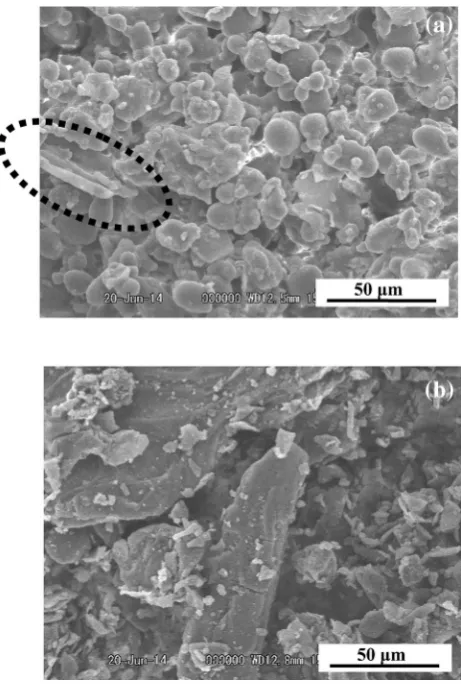
Shapes of particles of ground horse chestnut seed Electron microscopic analysis at 7009magnification was carried out for the ground outer theca as well as ground sarcocarp and endodermis of horse chestnut seed, which were described in section ‘‘Samples’’ (Fig.2). Many pieces of the ground sarcocarp of horse chestnut seed were found to have a round shape 10–20lm in diameter (Fig.2a). Furthermore, there were long ground pieces of the endo-dermis indicated by a circle of a dotted line (Fig.2a).
On the other hand, pieces of the ground outer theca were found to be relatively large: approximately 30lm in width and approximately 100lm in length (Fig.2b). Unlike the ground sarcocarp, ground pieces of the outer theca were not round. As described above, the outer theca was so hard to grind that its ground pieces remained relatively large,
whereas the sarcocarp of horse chestnut seed was ground to relatively small pieces.
Antibacterial activities of ground horse chestnut seed
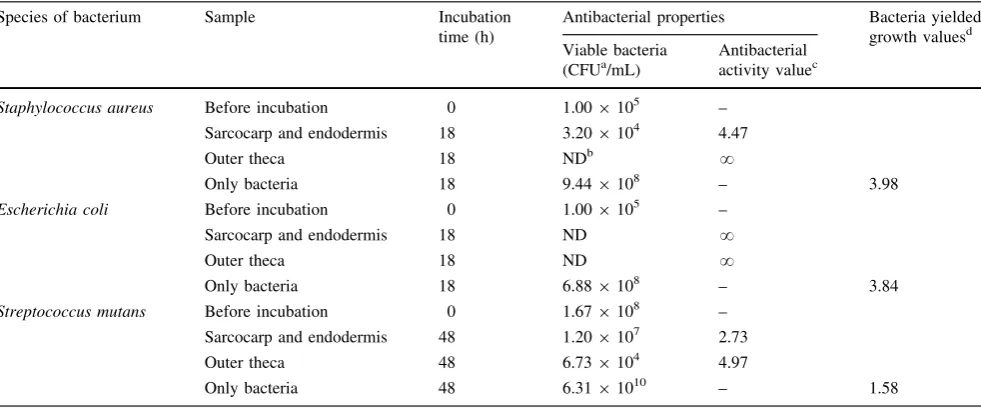
Gram-positive S. aureus, Gram-negative E. coli, and anaerobic S. mutans were used to conduct assays of antibacterial activities of the ground seed. Table1 shows the results. The results revealed that all three bacteria species yielded growth values of 0.5 or higher, which is the JIS standard for the assay [9]. In other words, all three species grew without any problem in the antibacterial assays.
S. aureusgrew from a viable count of 1.009105CFU/ mL before incubation to that of 9.449108CFU/mL after 18 h of incubation in the culture medium alone. In short, this bacterium was found to proliferate roughly 104-fold. In contrast, when inoculated on to the endodermis and seed of the horse chestnut seed, incubation decreased the viable
Fig. 2 Scanning electron micrographs of ground horse chestnut seed (9700). Acceleration Voltage: 20 kV. asarcocarp and endodermis,
b outer theca. The circle of a broken curve shows parts of the
count to 3.209104CFU/mL, or approximately 1/10 of the viable count before the incubation. Considering the viable count of 9.44 9 108CFU/mL when the bacterium alone was incubated, the effect was found to correspond to approximately 1000-fold decrease in the cell count. The outer theca of the horse chestnut seed did not show any viable cells of the bacterium at all. In short, the bacterium was effectively killed. These data indicated that horse chestnut seed, especially the outer theca, has antibacterial properties.
Neither the sarcocarp nor endodermis of horse chestnut seed showed any viable cells ofE. coli, a Gram-negative bacterium, after 18 h of incubation. These data showed that every part of the horse chestnut seed has a strong antibacterial activity towardE. coli.
The viable cell count of S. mutans, a Gram-positive anaerobic bacterium, was 1.67 9 108 CFU/mL before incubation and 6.319 1010 CFU/mL after 48 h of incu-bation in the culture medium alone. In brief, when the bacterium alone was incubated, the viable count increased 100-fold. In contrast, when the bacterium was inoculated onto the endodermis and sarcocarp of the horse chestnut seed, the viable cell count decreased to 1.29107CFU/mL or 1/10-fold. Furthermore, after inoculation onto the outer theca of horse chestnut seed, the viable cell count
decreased to 6.73 9 104 CFU/mL. Compared with the incubation of the bacterium alone, the viable count was found to decrease by as much as 1/10,000-fold. In con-clusion, the outer theca of the horse chestnut seed clearly possesses excellent antibacterial activity towardS. mutans. Such a difference in antibacterial activity between assays of S. aureusand of E. coli was assumed to result from the difference in bacterial cell wall. That is,S. aureus
and S. mutans, both of which are Gram-positive, have a
thick layer of the cell wall mostly consisting of peptido-glycan, whereas Gram-negative E. coli has a cell wall containing a small amount of peptidoglycan. In general, Gram-positive bacteria have a peptidoglycan layer as thick as 20–80 nm, whereas Gram-negative bacteria have a layer 7–8 nm thick, i.e., Gram-positive bacteria have a far thicker cell wall. The dry weight of the bacterial cell wall is only 10% in Gram-negative bacteria. In contrast, it is as high as 90% in Gram-positive bacteria. As a consequence, the antibacterial activity of horse chestnut seed more easily damaged the cell wall of Gram-negative bacteria and more easily acted onE. coli in particular.
JIS stipulates that a value of 2.0 or higher in an assay of antibacterial activity (a kill ratio of 99% or higher) means an antibacterial effect [9]. Horse chestnut seed yielded high values of antibacterial activity, higher than 2.0, toward all
Table 1 Antibacterial properties of the ground horse chestnut seed against different species of bacterium
Species of bacterium Sample Incubation
time (h)
Antibacterial properties Bacteria yielded
growth valuesd Viable bacteria
(CFUa/mL)
Antibacterial activity valuec
Staphylococcus aureus Before incubation 0 1.009105 –
Sarcocarp and endodermis 18 3.209104 4.47
Outer theca 18 NDb ?
Only bacteria 18 9.449108 – 3.98
Escherichia coli Before incubation 0 1.009105 –
Sarcocarp and endodermis 18 ND ?
Outer theca 18 ND ?
Only bacteria 18 6.889108 – 3.84
Streptococcus mutans Before incubation 0 1.679108 –
Sarcocarp and endodermis 48 1.209107 2.73
Outer theca 48 6.739104 4.97
Only bacteria 48 6.3191010 – 1.58
a Colony-forming units
b Not Detected
c Antibacterial activity value=(logC
t– logC0)-(logTt– logT0); wherelog Ctlog(average (viable cell count after incubation of bacteria alone for a given period));log C0log(average (viable cell count before incubation));log Ttlog(average (viable cell count after incubation of the inoculated samples for a given period));log T0log(average (viable cell count of the samples immediately after inoculation))
d Bacteria yielded growth values = logC
the bacteria tested. The horse chestnut seed was found to have high antibacterial effects also on the basis of the JIS standard.
The difference in antibacterial activity between the ‘‘sarcocarp and endodermis’’ of horse chestnut and its ‘‘outer theca’’ is believed to be due to their different components. Generally, polyphenols are thought to be closely involved in antibacterial activity. Thus, we exam-ined the soluble polyphenol concentration in the ‘‘sarco-carp and endodermis’’ and ‘‘outer theca’’, and the results are presented in Table2. The results showed that the sol-uble polyphenol concentration was 3476 mg catechin eq./ 100 gDW in the ‘‘outer theca’’ and 1184 mg catechin eq./ 100 gDW in the ‘‘sarcocarp and endodermis’’. Thus, the polyphenol content of the ‘‘outer theca’’ was approximately three times higher than that of the ‘‘sarcocarp and endo-dermis’’. Table2 also shows the soluble polyphenol con-centration in compounded paper, which is discussed later. To study the mechanism behind the antibacterial activity of horse chestnut seed, it was decided to measure ORAC values as an indicator of antioxidant activity. The concept of ORAC was developed by the researchers at the USDA and National Institute on Aging. ORAC is a numerical value showing oxygen radical absorbance capacity (antioxidant capacity). Two measurements must be made: one with a substance in a ground state and the other with an extract (Fig.3). The results revealed that both the ground outer theca of the horse chestnut seed and its extract yielded approximately 4.2-fold greater ORAC values than the sarcocarp and endodermis did. The higher antibacterial activity in the ‘‘outer theca’’ than in the
‘‘sarcocarp and endodermis’’ was believed to be due to the difference in the soluble polyphenol concentration. The polyphenols contained in them potentially acted as antioxi-dants [16, 17]. In brief, antioxidant activity damaged the peptidoglycan layer [18] of the bacterial cell wall and thus suppressed bacterial growth. Nevertheless, it cannot neces-sarily be stated that antioxidant function alone is responsible for the antibacterial activity. Some receptors on the surface of bacterial cells may conceivably be also involved [19]. Moreover, ORAC was approximately 40-fold higher in the ground state than in the extract. This finding revealed that the extraction removed approximately 2.5% of antibacterial activity from the ground sample.
Deodorizing activity of the outer theca of horse chestnut seed
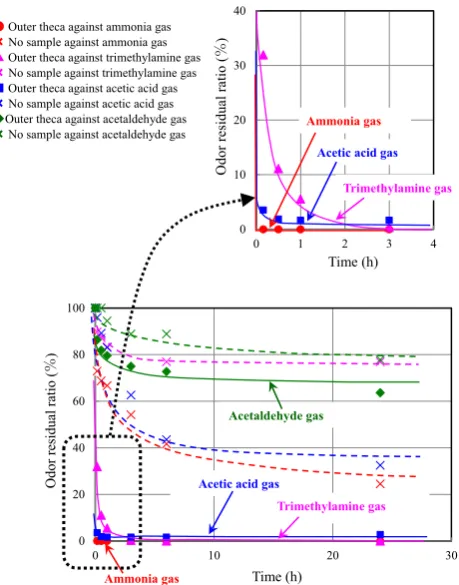
It was decided to focus on the outer theca, which showed high antioxidant and antibacterial activities. We also wanted to examine the deodorizing activity of the outer theca against various kinds of odor. Odorous gases used in the deodorization assays were ammonia and trimethy-lamine as basic odors, acetic acid as an acidic odor, and acetaldehyde as a neutral odor.
Figure4shows how the odor residual rate depended on time. The results revealed that the outer theca of horse chestnut seed effectively deodorized such a basic odor as ammonia and trimethylamine as well as acetic acid, which is an acidic odor. The odor residual rate of ammonia gas in particular decreased down to 0% in only 10 min. This amazing effect should be marked for further analysis.
Concerning the mechanism of deodorization of ammo-nia gas by the ground outer theca of horse chestnut seed, it was assumed that hydroxyl groups of polyphenol in the outer theca formed hydrogen bonds with ammonia mole-cules to form a salt, which was then released into moisture in the air. To sum up, we assumed that some OH groups of polyphenol in the ground outer theca were chemically transformed to O-NH4?to incorporate ammonia gas into
its molecular structure [7].
In addition, the odor residual rate for acetic acid gas was found to substantially decrease to 1.9% in only 30 min. In short, the ground outer theca was also found to possess good deodorization capacity against acidic odor.
0 2 4 6 8 10 12 14 16
0 100 200 300 400 500 600 700 800
sarcocarp and endodermis outer theca
ORAC value
mmol TE/g
ORAC value
mmol TE/g
Ground horse chestnut seed Its extract yielded
Fig. 3 ORAC values per gram for ground parts of the horse chestnut seed and extracts
Table 2 Soluble polyphenol
concentration mg catechin eq./100 gDW Standard error (n=6)
Sarcocarp and endodermis 1184 25
Outer theca 3476 55
Paper containing 20wt% of theca 36.0 0.5
Paper containing 40wt% of theca 96.8 2.8
According to the Weber–Fechner law, sensory intensity of an odor is proportional to the logarithm of the concen-tration of the odorant. That is, a 10-fold increase in odorant concentration is perceived as approximately two-fold increase in the intensity of the odor. Conversely, one tenth of the concentration is perceived half as intense in terms of odor. In conclusion, ground horse chestnut seed was found to halve the sensory intensity of a basic odor and an acidic odor. In stark contrast, the ground theca of horse chestnut was found to have a negligible deodorizing activity toward acetaldehyde, a neutral odor.
Performance of compounded paper containing the theca of horse chestnut seed
As described above, good antibacterial and deodorizing activities were found in the ground outer theca of horse chestnut seed. A product with a large specific surface area may be considered suitable for effective practical use of these properties. An attempt was made to prepare com-pounded paper as a way to effectively utilize the outer theca of horse chestnut seed. The ground outer theca was blended with pulp in ratios of 20, 40, or 60 wt% to prepare compounded paper by the traditional Washi paper-making method. Stable production of compounded paper with uniform weight distribution was achieved.
Electron microscopy was used to examine the structure of compounded paper containing the ground outer theca of horse chestnut seed. Figure 5a, b show the surface and cross-section of compounded paper containing the ground theca at a 60 wt% proportion. The ground outer theca was found to be present as lumps in some parts of the pulp fiber network. That is, the ground outer theca was not found to be completely uniformly distributed among pulp fibers. Nonetheless, the ground theca did not come off when the compounded paper was touched with a hand.
Subsequently, the compounded paper prepared as described above was examined for antibacterial activity.
E. coli, toward which the ground theca showed the highest antibacterial activity, was used in the assays of antibacte-rial activity. Each sample was inoculated with a bacteantibacte-rial suspension at a concentration adjusted to 105CFU/mL and incubated for 20 h before viable cell counts were determined.
Figure6 presents photographs of the culture medium incubated for 20 h. Many colonies were observed in cases 0
10 20 30 40
0 1 2 3 4
Odor residual ratio (
㸣
)
Time (h)
Outer theca against ammonia gas No sample against ammonia gas Outer theca against trimethylamine gas No sample against trimethylamine gas Outer theca against acetic acid gas No sample against acetic acid gas Outer theca against acetaldehyde gas
No sample against acetaldehyde gas
Ammonia gas
0 20 40 60 80 100
0 10 20 30
Odor residual ratio (
㸣
)
Time (h)
Acetic acid gas
Ammonia gas
Trimethylamine gas Trimethylamine gas
Acetic acid gas
Acetaldehyde gas
Fig. 4 Time course analyses of various odorous gases showing odor residual ratios for the ground outer theca of the horse chestnut seed
of compounded paper containing 100 wt% pulp or only 20 wt% of the ground theca. Especially in the quadrants of 102- or 103-fold dilutions colonies were so numerous that they were found to overlap and form aggregates. In the case of compounded paper containing 40 wt% of ground theca, the number of colonies was somewhat smaller than that in cases of 0 or 20 wt% of the ground theca. The number of colonies was found to further decrease in the case of compounded paper containing 60 wt% of the ground theca. In particular, a comparison of 103-fold dilution quadrants clearly showed that the number of colonies in the case of 60 wt% of the ground theca was smaller than in cases of other compounded paper samples containing a smaller proportion of the ground theca. In contrast, no colonies were detected in the culture medium containing the ground theca alone. That is, the ground theca itself was found to possess very high antibacterial activity.
Viable cell counts obtained in the antibacterial activity assays were analyzed next (Table3). The data revealed that the viable count was 1.109107CFU/mL in the case of compounded paper containing 20 wt% of the ground theca in contrast to 1.58 9 107 CFU/mL in the case of compounded paper of 100 wt% pulp, revealing little or no difference. When the proportion of the ground theca increased to 40 wt%, viable counts decreased a little, down to 9.209106CFU/mL. When the proportion of the ground theca further increased to 60 wt%, the viable cell count was found to decrease to 3.969105CFU/mL. To sum up, the antibacterial activity increased with the increasing pro-portion of ground theca in compounded paper to suppress
bacterial growth 1/100-fold. Nevertheless, a comparison with the case of the ground theca alone indicated that the viable cell count was very high in case of compounded paper.
The traditional Washi paper-making method adopted for the preparation of compounded paper was assumed to be responsible for the observed lack of the effect. In other words, effective antibacterial components may be elimi-nated or destroyed in that paper-making process. There-fore, the soluble polyphenol concentrations of those compounded papers were examined (Table 2). The results showed that compounded papers with higher antibacterial activities had a higher soluble polyphenol concentration. However, the compounded papers were found to have much lower soluble polyphenol concentration than the ground seed of horse chestnut. To use compounded paper containing horse chestnut seed in applications that require high antibacterial activity, it may be helpful to do further adjustments and optimizations, such as adopting a manu-facturing process other than the traditional Washi paper-making method.
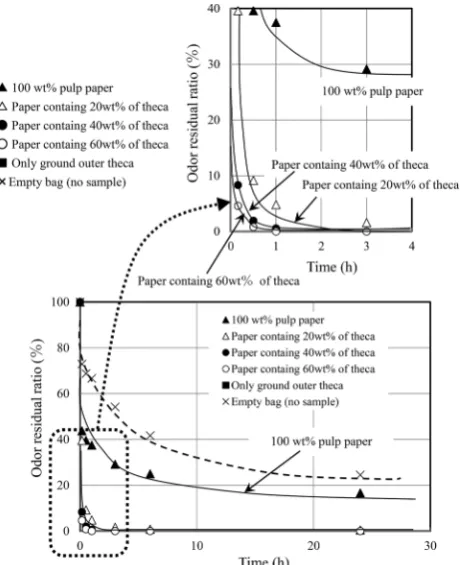
After that, compounded paper containing the ground outer theca of horse chestnut seed was examined for deodorizing activity. In the testing, we used ammonia gas, toward which the ground outer theca had shown high deodorizing activity. Figure7 presents the results. Com-pounded paper containing 60 wt% of the ground outer theca of horse chestnut seed showed a strong deodorizing activity: the odor residual rate was only 0.8% within only 30 min. Furthermore, the odor residual rate was found to be low, at 9.2%, after 30 min even in the case of 60wt% 100wt% (Only ground theca)
20wt% 40wt%
fold dilution fold dilution 0wt% (Only pulp)
compounded paper with ground-theca content of 20 wt%. Ammonia gas is said to be faintly odorous and detectable even at 1 ppm (detectable threshold concentra-tion). As for the method for evaluation of deodorizing textiles, Japan Textile Evaluation Technology Council states that a deodorizing textile needs to decrease odor
concentration of[40 ppm (which is said to be intensely odorous) to under a detectable threshold concentration within 24 h [20]. In addition, by this criterion, compounded paper containing the outer theca of horse chestnut seed can be said to possess an excellent deodorizing activity against ammonia gas.
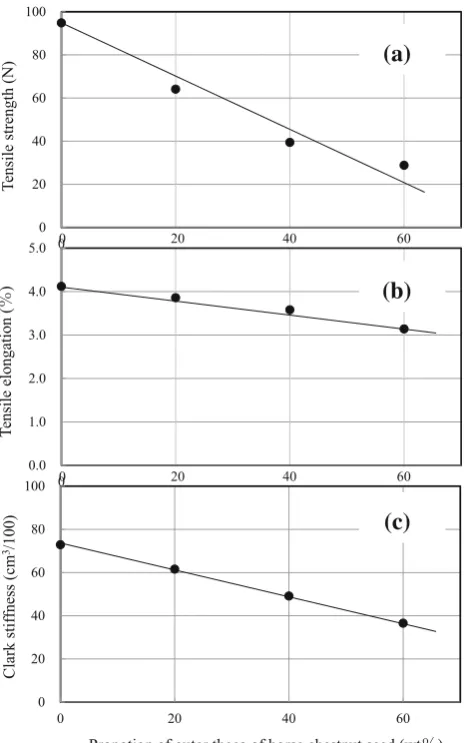
Mechanical properties of compounded paper containing the outer theca of horse chestnut seed Various applications may be considered for com-pounded paper with such excellent antibacterial and deodorizing activities. Nonetheless, practical applica-tions of compounded paper often require certain mechanical properties and gas permeability. First, compounded paper samples with different proportions of the ground theca were examined for such mechanical properties as tensile strength, tensile elongation, and Clark stiffness. Figure8 shows the results. All the properties were found to deteriorate with the increasing proportion of outer theca of horse chestnut seed. Mechanical properties for compounded paper were also found to worsen with the decreasing proportion of pulp fiber. That is, the ground outer theca was found to worsen mechanical properties.
Hence, to examine the fracture mechanism of compounded paper, a double logarithmic graph was prepared to identify a relation between fracture strength and Clark stiffness (Fig.9). The results showed a single straight line without dependence on ground outer theca content. The slope was approximately 1/2. According to Griffith’s theory, Eq. (2) shown below describes fracture stressaband elastic modulusE in brittle
fracture [20]. Crack length is represented byc, and surface
Fig. 7 Time course of ammonia gas showing an odor residual ratio for compounded paper containing the ground outer theca of the horse chestnut seed
Table 3 Antibacterial properties of compounded papers containing the ground theca againstEscherichia coli
Sample Incubation
time (h)
Antibacterial properties Bacteria yielded
growth valuesd Viable bacteria
(CFUa/ml)
Antibacterial activity valuec
Before incubation 0 1.009105 –
100 wt% pulp paper 18 1.589107 -0.05
Paper containing 20wt% of theca 18 1.109107 0.11
Paper containing 40wt% of theca 18 9.209106 0.19
Paper containing 60wt% of theca 18 3.969105 1.55
Only ground outer theca 18 NDb ?
Only bacteria 18 1.429107 – 2.15
a Colony-forming units
b Not detected
c Antibacterial activity value=(logC
t– logC0)-(logTt– logT0); wherelog Ctlog(average (viable cell count after incubation with 100 wt% pulp paper for a given period));log C0log(average (viable cell count before incubation));log Ttlog(average (viable cell count after incubation of the inoculated samples for a given period));log T0log(average (viable cell count of the samples immediately after inoculation))
d Bacteria yielded growth values = logC
energy per unit area for a new plane is denoted bycin the Eq. (3).
ab¼
ffiffiffiffiffiffiffiffiffiffiffiffiffi
2cE=c p
: ð3Þ
In this experiment, tensile strength of compounded paper corresponded to stress at fracture, and Clark stiffness of compound paper corresponded to elastic modulus, which is resistance to transformation. The results depicted in Fig.9 indicated that breaking strength of compounded paper containing the ground outer theca can be expressed by Griffith’s fracture mechanism [21]. That is, Fig.9 shows that fracture of compounded paper containing the ground outer theca originated in a crack caused by the ground theca inside compounded paper and extended along the development from the original crack. This finding is in agreement with the nonuniform distribution of the ground
theca among pulp fibers, as determined by electron microscopy of compounded paper shown in Fig.5.
Although mechanical properties of compounded paper deteriorated when the ground theca of horse chestnut seed was incorporated, they were also found to be maintained with pulp to some extent. Even at a 60 wt% proportion of the ground theca, tensile strength was 28.9 N and tensile elon-gation was 3.1% (Fig.8). These values were found to be adequate for practical use. Furthermore, compounded paper with 20 wt% ground theca content had better mechanical properties, and adequate antibacterial and deodorizing activities. This finding revealed that compounded paper may be used in a wide range of applications.
Gas permeability was examined next. Figure10presents Gurley-type air resistance versus ground theca content. Air resistance, which corresponds to gas permeability of com-pounded paper, was found to decrease as the proportion of the ground theca of horse chestnut seed increased. In other
0 20 40 60 80 100
0
T
ensile strength
(N)
nm
0.0 1.0 2.0 3.0 4.0 5.0
0
T
ensile elongation
(
)
nm
0 20 40 60 80 100
0 20 40 60
Clark stif
fness
(cm
3/100)
0 20 40 60
0 20 40 60
(a)
(b)
(c)
Propotion of outer theca of horse chestnut seed (wt )
Fig. 8 Mechanical properties of compounded paper containing the
outer theca of horse chestnut seed (temperature: 23°C, relative
humidity: 50%).atensile strength,btensile elongation andcClark stiffness
10.0 100.0
0 . 0 0 1 0
. 0 1
T
ensile strength
(N)
Clark stiffness (cm3/100)
The inclination of a straight line is 1/2
20.0 30.0 40.0 60.0 80.0 60.0
80.0
20.0 30.0 40.0
Fig. 9 Relationship between Clark stiffness and tensile strength of compounded paper containing the outer theca of horse chestnut seed
0 10 20 30 40 50
0 20 40 60
Air resistance
(s/300 m
L
/1
sheet
Propotion of outer theca of horse chestnut seed (wt )
words, the greater the ground theca content is, the higher the gas permeability of compounded paper is. These data suggest that ground outer theca created small gaps among pulp fibers in compounded paper to increase gas permeability. This finding offers some directions for the development of prac-tical applications of compounded paper containing the ground theca of horse chestnut seed. For example, high gas permeability may be useful in seed wrapping paper with excellent antibacterial activity. Furthermore, various appli-cations may be feasible for multifunctional paper that has such properties as deodorizing and antibacterial activities.
Conclusions
For recycling of horse chestnut seed, it was separated into ‘‘sarcocarp and endodermis’’ and ‘‘outer theca’’; each part was finely ground for analysis of its functions. Com-pounded paper containing outer theca was prepared and its properties were examined.
1. Ground horse chestnut seed showed excellent antibac-terial activity towardS. aureus,E. coli, andS. mutans. Antibacterial activity is particularly strong against
E. coli, which is a Gram-negative bacterium. The
‘‘outer theca’’ part showed a higher antibacterial activity than did the ‘‘sarcocarp and endodermis’’ part. 2. The ground theca of horse chestnut seed was found to have ORAC of 531 mmol TE/g and to possess high antioxidant capacity. The reason why ground horse chestnut seed showed a high antibacterial activity may be its antioxidant properties. In other words, antioxi-dant activity was assumed to damage the peptidogly-can layer of the bacterial cell wall.
3. The outer theca of horse chestnut seed was found to have a high deodorizing activity against basic or acidic odors. For example, it was found to decrease ammonia gas to 0% (odor residual rate) only in 10 min. 4. Compounded paper was prepared that contained the
ground outer theca of horse chestnut seed blended with pulp fibers. The compounded paper was found to possess high deodorizing activity. Furthermore, although mechanical properties deteriorated as the proportion of the ground outer theca increased, these parameters remained adequate for practical applications.
References
1. Brockman CF, Merrilees R (1986) Trees of North America. Golden Press, New York
2. Mabberley DJ (1997) The plant book, 2nd edn. Cambridge University Press, Cambridge
3. Vander Wall SB (1990) Food hoarding in animals. University of Chicago Press, Chicago
4. Harborne JB, Baxter H (1993) Phytochemical dictionary. Taylor and Francis, London
5. Takahashi T, Aso Y, Kasai W, Kondo T (2010) Effect of light irradiation on the antibacterial activity of compounded papers containing wasted tea leaves. J Wood Sci 56(4):299–306 6. Takahashi T, Aso Y, Kasai W, Kondo T (2010) Improving the
antibacterial activity in Staphylococcus aureus of composite
sheets containing wasted tea leaves by roasting. J Wood Sci 56(5):403–410
7. Takahashi T, Aso Y, Kasai W, Kondo T (2011) Synergetic deodorant effect and antibacterial activity of composite paper containing waste tea leaves. J Wood Sci 57(4):308–316
8. Swain T, Hillis WE (1959) The phenolic constituents ofPrunus
domestica. I. The quantitative analysis of phenolic constituents. J Sci Food Agric 10:63–68
9. JIS-L1902 (2015) Determination of antibacterial activity and efficacy of textile products (in Japanese). Japanese Standard Association, Tokyo
10. Takahashi T, Aso Y, Yoshino K (2013) Incorporation of photo-catalytic function into nonwoven polyester fabrics via
impreg-nation with peroxo titanic acid solution. J Mater Sci
48(23):8199–8208
11. Takahashi T, Oowaki M, Onohara Y, Yanagi Y (2013) Deodorant performance of titanium dioxide-added acrylic/cellulose diacetate blended-fibers. Text Res J 83(8):800–812
12. JIS-P8113 (2006) Paper and board—determination of tensile properties—(in Japanese). Japanese Standard Association, Tokyo 13. Takahashi T, Kunitake T, Yokota H, Abe S, Yoshino K (2014) The effects of the traditional hand-crumpling on the performance of Manila hemp paper. Text Res J 84(6):614–625
14. JIS-P8143 (2009) Paper—Determination of stiffness—Clark stiffness tester method (in Japanese). Japanese Standard Associ-ation, Tokyo
15. JIS-P8117 (2009) Paper and board—determination of air per-meance and air resistance—Gurley method- (in Japanese). Japa-nese Standard Association, Tokyo
16. Kunikata T, Kohno K, Ushio S, Kimura H, Ogawa S, Fukuda S (2011) Inhibitory effects of polyphenolic compounds from seed
shells of the Japanese horse chestnut (Aesculus turbinate
BLUME) on adherence of Helicobacter pylori to a stomach
cancer cell line MKN 45. Shoyakugaku Zasshi 65(1):43–49 17. Ogawa S, Kimura H, Niimi A, Jisaka M, Katsube T, Yokota K
(2009) Inhibitory effects of polyphenolic compounds from seed shells of Japanese horse chestnut (Blume) on carbohydrate-di-gesting enzymes. Nippon Shokuhin Kagaku Kogaku Kaishi 56(2):95–102
18. Shiratsuchi A (2012) Induction and regulation of innate immune
responses by cell-wall components of Staphylococcus aureus.
Biochemical 84(9):737–752
19. Toda M, Okubo S, Ikigai H, Shimamura T (1990) Antibacterial and anti-hemolysin activities of tea catechins and their structural relatives. J Jpn Soc Bacteriol 45(2):561–566
20. Yasuda H, Arakawa T (1995) Deodorizing mechanism of (-
)-epigallocatechin gallate against methyl mercaptan. Biosci Bio-tech Bioch 59(7):1232–1236