O R I G I N A L A R T I C L E
Open Access
Analysing the rice young panicle
transcriptome reveals the gene regulatory
network controlled by
TRIANGULAR HULL1
Jun Wang
1,2†, Qiang Zhang
1,2†, Yi Wang
1,3†, Jing Huang
1,2, Nengjie Luo
1,2, Shengbo Wei
1,2and Jian Jin
1,2*Abstract
Background:TRIANGULAR HULL1(TH1), a member of the rice ALOG gene family, has been characterized as a rice lemma/palea-related gene. To understand the gene regulatory network that controlled byTH1, we analyzed the transcriptome from aTH1knock out (KO) line, which was generated by CRISPR/Cas9. Our study may shed some light on the molecular mechanism of lemma/palea development.
Results:We obtained 20 T0th1-C transgenic plants by CRISPR/Cas9. Among the 20 plants, there were eight bi-allelic mutations, five homozygous mutations, three heterozygous mutations, and four Non-KO plants. By comparing with the wild type and the heterozygous knock out (KO) line, the homozygous KO lines showed defects in lemma/palea development as well as in grain filling. Further more, we studied the gene regulatory network that controlled by TH1by comparing the transcriptome of a homozygousTH1KO line with its Non-KO line as a control. A total of 622 genes were identified as differentially expressed genes (DEGs), of which 297 genes were significantly up-regulated while 325 genes were down-regulated. One hundred thirty eight of the DEGs were assigned to the 59 KEGG (Kyoto Encyclopedia of Genes and Genomes) pathways. Among these annotated DEGs, 15 genes were related to plant hormone signal transduction, eight genes were related to starch and sucrose metabolism. These were the two largest groups of DEGs according to the KEGG pathway analysis.
Conclusions:Our results indicated that hormone related genes and starch/sucrose metabolism related genes might act as downstream targets ofTH1; they might be responsible for lemma/palea development and grain filling respectively.
Keywords:Rice,TH1, RNA-seq, Lemma/Palea development, Grain filling
Background
Rice (Oryza sativa L.) is one of the most important crops, feeding more than one third of the whole popula-tion of the world. The spikelet is a critical unit for rice yield. In rice, one spikelet contains a fertile floret, which consists by one lemma, one palea, two lodicules, six sta-mens and one pistil. The shape of the grain is largely de-termined by the development of the lemma and palea.
In recent years, a number of genes involved in lemma and palea development have been identified.
DROOPING LEAF (DL), a member of the YABBY gene family, is specifically expressed in the lemma, but not in the palea, it involves in leaf midrib formation and carpel specifica-tion. Although its expression is restricted to the lemma, its function on lemma development remains unknown (Yamagu-chi et al.2004; Ishikawa et al.2009);MOSAIC FLORAL OR-GANS1 (MFO1)/MADS6 is a member of MADS-box gene family that specifies palea identity. In themfo1 mutants, the margin of the palea shows an abnormal outgrowth accompan-ied by an ectopic expression ofDL(Ohmori et al.2009; Li et al. 2010); RETARDED PALEA1(REP1), a TCP-domain pro-tein, is expressed specifically at an early stage in the palea primordial, and later disperses to the lemma, palea and sta-men. Transgenic plants overexpressingREP1 show a similar * Correspondence:[email protected]
†Jun Wang, Qiang Zhang and Yi Wang contributed equally to this work.
1State Key Laboratory for Conservation and Utilization of Subtropical
Agro-bioresources, Guangxi University, Nanning 530004, People’s Republic of China
2College of Life Science and Technology, Guangxi University, Nanning
530004, People’s Republic of China
Full list of author information is available at the end of the article
phenotype to that ofmfo1(Luo et al.2005; Yuan et al.2009); OsMADS1/LHS1 and OsMADS15 play a critical role in lemma and palea development, loss of function in these two genes causes defects in both lemma and palea development (Jeon et al.2000; Wang et al.2010).PEN BEAK(OPB)/ STA-MENLESS1(SL1)/JAG/ andDEGENERATED HULL1(DH1) are also required for normal lemma/palea development (Hori-gome et al.2009; Xiao et al.2009; Duan et al.2010; Li et al.
2008). Recently research showed that genes involved in the
small RNA pathway including SHOOT ORGANIZATION1
(SHO1),SHOOTLESS2(SHL2),SHO2/SHOOTLESS4(SHL4) andWAVY LEAF1(WAF1) participate in determining the po-larity of the lemma and palea (Itoh et al.2000; Nagasaki et al.
2007; Abe et al.2010) .
TRIANGULAR HULL1 (TH1), also known as BEAK
LIKE SPIKELET1 (BLS1)/BEAK-SHAPED GRAIN1
(BSG1)/BEAK-SHAPED HULL1 (BH1)/ABNORMAL
FLOWER AND DWARF1 (AFD1), is a member of the
rice ALOG gene family, it encodes a DUF640 domain transcription factor that associated with grain shape (Iyer and Aravind 2011), and it is expressed mainly in the young panicle and elongating stem. In comparison with the wild type plant,th1mutant shows an abnormal beak-shaped grain whose lemma and palea develop in-completely, resulting in the reduction for grain width, and therefore for the yield (Li et al.2012; Ma et al.2013; Yan et al. 2013; Wei et al. 2013; Ren et al. 2016). Al-thoughTH1 has been proven to play an important role in lemma/palea development, the regulatory network of TH1 still remains largely unknown. In the previous re-search, the mutant lines using for TH1 characterization were with amino acid change (bsg1–2) (Yan et al.2013), a frame shift that distant from the translation initiation site (th1–1, bsg1–1 and afd1) (Li et al. 2012; Yan et al.
2013; Ren et al.2016) or large fragment deletion (~ 50 kb deletion forbls1and ~ 55 kb deletion forbh1) (Ma et al.2013; Wei et al.2013). In this study, we developed a
TH1 KO line by CRISPR/Cas9 and explored the
tran-scriptional regulatory network controlled byTH1.
Result
TH1KO line was generated using CRISPR/Cas9
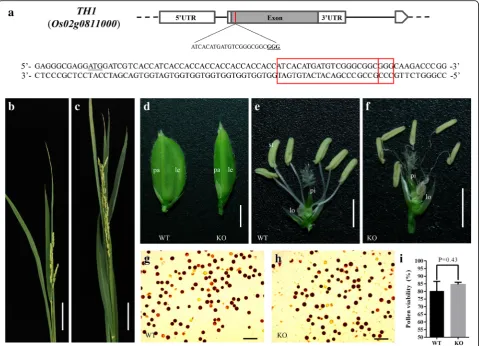
To investigate the biological function ofTH1, we gener-ated aTH1KO lineth1-C by CRISPR/Cas9, with the tar-get site located within the gene at approximately 55 bp downstream of the translation initiation site (Fig. 1a). We obtained 20 T0th1-C transgenic plants and analyzed
the target site in all the plants (Additional file 1: Table S1). Direct Sanger-sequencing of the target-containing amplicons followed by decoding via DsDecodeM (Liu et al. 2015) showed that among the 20 plants, there were eight bi-allelic mutations, five homozygous mutations, three heterozygous mutations, and four Non-KO plants. Based on allelic mutation types, 15.0% (6/40) of the
mutations were nucleotide deletions, while 57.5% (23/ 40) of the mutations were nucleotide insertions, all of which were 1 bp single insertion (Table1).
HomozygousTH1KO lines showed defects in lemma/ Palea development
During the vegetative growth stage, no phenotypic change could be observed in the T0 plants of th1-C.
Whereas during the reproductive growth stage, by com-paring with the wild type and the heterozygous KO line, the homozygous KO lines showed a slender lemma/ palea, which displayed a beak-like structure. In addition, unlike those of the wild type plants, the filaments of the KO plants were curled (Fig.1b-f ). In the maturing stage, the homozygous KO lines had a defect in grain filling and were completely infertile. By iodine potassium iod-ide staining, the pollen activity between homozygous KO line and wild type plant showed no significant difference (Fig. 1g-i). This result indicated that the sterility of the homozygous KO plant might not relate to pollen activ-ity. We also generated aTH1overexpression transgenic line, however, no phenotypic change could be observed during the whole developmental stages when compared with the wild type (data not show).
T1homozygous KO plants were identified for the
subsequent RNA-seq
In order to study the gene regulatory network that con-trolled byTH1, we analyzed the transcriptome data gener-ated from the young panicle (~ 2 cm) of homozygousth1-C and Non-KO control plants. Since the T0 generation of
homozygous KO plants were infertile, T1homozygous KO
plants (with 1 bp deletion) and Non-KO plants that derived from a T0heterozygous KO plant (th1-C-15) were used for
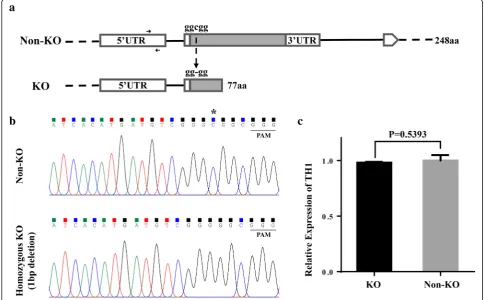
the RNA-seq experiment. By comparing with the Non-KO plant, the homozygous KO plant with 1 bp deletion in the target site leads to a frame shift with premature transcrip-tion terminatranscrip-tion for TH1(Fig. 2a-b). By qRT-PCR, we de-tected no significant difference for TH1 expression level between KO and Non-KO plants (Fig.2c).
Transcriptome analysis
We carried out the RNA-seq with three biological replicates for KO and Non-KO samples respectively. After filtering, the total number of clean reads per library was 41.16, 46.05 and 44.08 million for KO while 50.45, 43.21 and 45.24 mil-lion for Non-KO. For each library, at least 91.82% of the clean reads had a quality score of Q30. The GC content was 51.75%, 51.82% and 52.15% for KO while 51.35%, 51.22% and 51.66% for Non-KO. More than 83.53% of the clean reads were successfully and uniquely mapped to the rice genome using the TopHat2 software (Table2) (Kim et al. 2013). Additionally, Spearman correlation coefficients
between any two replicates were calculated using
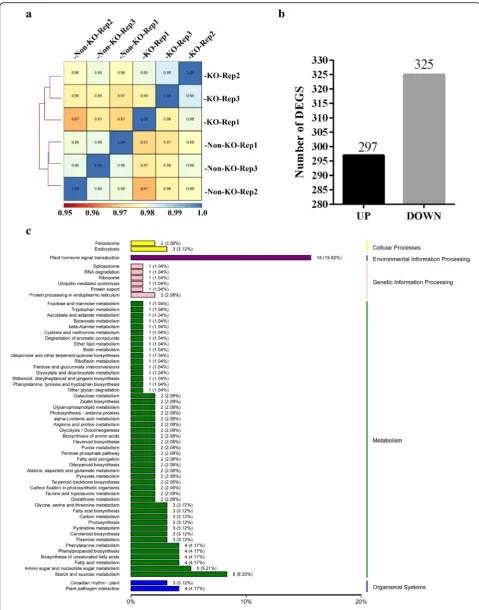
deepTool2 (Ramírez et al. 2016). The correlation was higher within groups than that between KO and Non-KO samples (Fig. 3a). Taken together, these results indicated the good quality of the sequencing data, suggesting the reli-ability for subsequent transcriptome analysis results.
Twenty-two thousand seven hundred ninety-seven genes expression level could be detected by RNA-seq at least in one group of the samples (Additional file 2: Table S2). Among these genes, a total of 622 genes were identified as differentially expressed genes (DEGs) with the cut-off for FDR (False Discovery Rate) < 0.05 and FC (Fold Change)≥
2. Of these DEGs, 297 genes were significantly up-regulated while 325 genes were down-regulated (Fig.3b; Additional file3: Table S3). One hundred fifty DEGs were annotated by KEGG (Kyoto Encyclopedia of Genes and
Ge-nomes) (Additional file 4: Table S4). One hundred
thirty-eight of 150 DEGs were assigned to the 59 KEGG pathways (Additional file5: Table S5). Among these KEGG pathway annotated DEGs, 15 genes were related to plant hormone signal transduction, and eight genes were related to starch and sucrose metabolism. These were the two lar-gest groups of DEGs according to the KEGG pathway
Table 1Ratios of mutant genotype and mutation type at the target site in T0transgenic plants
Mutant genotype ratios (%)a Mutation type ratios (%)b
Non-KO Bi-allele Homozygote Heterozygote Non-KO Insertion Deletion
20.0(4/20) 40.0 (8/20) 25.0 (5/20) 15.0 (3/20) 27.5 (11/40) 57.5 (23/40) 15.0 (6/40)
a
Based on the number of each mutant genotype out of the total number of all mutant genotypes at the target site b
Based on the number of each allele mutation type out of the total number of all allele mutation types at the target site
Fig. 1The CRISPR/Cas9 target site ofTH1and phenotype of the KO plants.aSchematic ofTH1gene structure and the CRISPR/Cas9 target site.
analysis (Fig.3c). To further validate the expression profiles of genes in our RNA-seq analyses, 15 genes were selected for expression quantification using qRT-PCR, including five that had been previously characterized as lemma/palea-re-lated genes but did not show differential expression in our experiment (WAF1, OsMADS15, SHO1, MFO1 and LHS) and 10 DEGs that were mainly related to plant hormone signal transduction (RERJ1, Os06g0142400, OsJAZ12, OsJAZ11, OsJAZ10, OsJAZ8, OsJAZ7, OsEIL2, OsSAUR23 and OsSAUR20). The results revealed that the expression pattern of the selected genes as determined by qRT-PCR were largely identical to those determined by RNA-seq (Additional file6: Figure S1).
Discussion
TH1is critical for the rice fertility
TH1has been cloned by five individual research groups using different mutants within different genetic back-grounds respectively. All these previous studies have shown that,TH1played an important role in lemma and palea development as well as rice fertility. Although both the amino acid change (bsg1–2) (Yan et al. 2013) and frame shift (th1–1,bsg1–1and afd1) (Li et al.2012; Yan et al.2013; Ren et al. 2016) mutants showed a reduction of seed setting rate, they were still partially fertile. In our study, we generated aTH1KO line using CRISPR/Cas9, with the target site relatively close to the translation
Fig. 2Comparation ofTH1locus between KO and Non-KO lines.aGenomic structures at theTH1locus in KO and Non-KO line. Arrows indicate the qRT-PCR primers forTH1.bThe original sequencing chromatograms of the target site forTH1in Non-KO and homozygous KO line, which were derived from a T0heterozygous KO plant. The protospacer adjacent motif (PAM) site is underlined, the“C”marked with an asterisk was the deleted in the KO plant.cExpression level ofTH1in KO and Non-KO line. Values are shown as means ± s.d. (n= 3). P values were calculated by the Student’s t-test
Table 2Statistical analysis of transcriptome sequencing data
Sample Total Reads Mapped Reads Mapped ratio Uniq Mapped Reads Uniq Mapped ratio GC Content %≥Q30
KO_REP1 44,162,756 37,777,354 85.54% 36,887,025 83.53% 51.57% 91.82%
KO_REP2 46,049,062 40,954,889 88.94% 39,907,326 86.66% 51.82% 91.90%
KO_REP3 44,084,330 39,067,649 88.62% 38,138,669 86.51% 52.15% 91.86%
Non-KO_REP1 50,452,122 45,162,267 89.52% 44,143,020 87.49% 51.35% 92.15%
Non-KO_REP2 43,214,520 37,838,695 87.56% 36,569,622 84.62% 51.22% 91.92%
Non-KO_REP3 45,241,590 40,278,131 89.03% 39,296,538 86.86% 51.66% 92.10%
initiation site. This difference may be responsible for the infertility of th1-C while all the other mutations were partially fertile with the mutant site relatively far away from the translation initiation site. Our result was also consistent with the fact that the transgenic plants of pTH1-RNAi had no filled seed (Li et al. 2012). In our RNA-seq experiment, eight genes related to starch and sucrose metabolism were differentially expressed be-tween KO and Non-KO plants (Fig. 4), the altered ex-pression levels of these genes might result in the defection for grain filling in the homozygous KO line.
Plant hormone-related genes might act as downstream targets ofTH1and involve in lemma/Palea development
It has been proved that DL, MFO1/MADS6, REP1,
OsMADS1/LHS, OsMADS15, OPB/SL1/JAG/DH1,
SHO1, SHL2, SHO2/SHL4 and WAF1 are involved in
lemma/palea development (Yamaguchi et al. 2004;
Ishikawa et al. 2009; Ohmori et al. 2009; Li et al.2010; Ohmori et al.2009; Li et al.2010; Luo et al.2005; Yuan et al.2009; Horigome et al.2009; Xiao et al.2009; Duan et al. 2010; Li et al. 2008; Itoh et al.; Nagasaki et al.
2007; Abe et al.2010), however, the expression levels of these genes did not show significant difference between KO and Non-KO lines in our experiment (Additional file
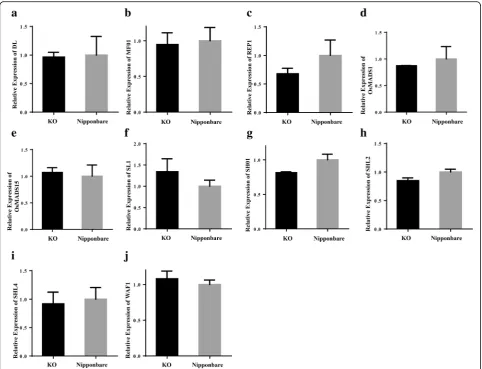
7: Figure S2). We further compared the expression levels of these 10 genes between KO lines and Non-CRISPR treated Nipponbare plants, the qRT-PCR results were in accordance with the RNA-seq data (FC < 2) (Fig.5a-j).
Some of these genes’expression pattern withinTH1 mu-tant background had been studied in the previous research: In lemma and palea ofafd1,MFO1/OsMADS6seemed to be close to that of wild type. In lodicules,OsMADS1/LHS, andOsMADS15transcripts were expressed in the mutants but not in wild type (Lou et al. 2016); In thebh1 mutant,
OsMADS1/LHS, OsMADS15, REP1 and DL showed a
Fig. 4Heat map of starch/sucrose metabolism related genes and plant hormone signal transduction related genes. The red color in this figure denotes a high level of expression while blue indicates low expression. Non-KO_REP1, Non-KO_REP2, and Non-KO_REP3 denote the three control biological replicates, while KO_REP1, KO_REP2, and KO_REP3 denote the three biological replicates for theTH1KO line. The expression levels for each gene are shown in the heat maps using FPKM (Fragments Per Kilobase of transcript per Million fragments mapped) with a log2 scale
down-regulation in the mutant around anthesis, however, they did not specify the developmental stage for the sam-ples (Wei et al.2013); The expression levels ofOsMADS1/
LHS and MFO1/OsMADS6 were only down-regulated in
0.5-cm young panicles, but not in 8-cm young panicles for the bsg1–1 mutant when comparing with the wild type (Yan et al.2013); For the 1-cm young panicle,OsMADS1/ LHS,MFO1/OsMADS6,OsMADS15,REP1andDLshowed no significant difference betweenbls1and wild type (Ma et al. 2013), this is consistent with our finding from the RNA-seq data. Taken these together, it indicated that ex-pression profile of these genes might be largely different in different genetic backgrounds, different tissues or different developmental stages.
We identified 622 DEGs related to TH1, and among these DEGs, a subset of genes (15 in total) related to plant hormone signal transduction was enriched (Fig.4). Previous research has revealed that the plant hormone
jasmonic acid (JA) plays an important role in
determining rice spikelet morphogenesis. By repressing OsMYC2, a JA-inducible transcription factor would acti-vateOsMADS1, an E-class gene crucial to spikelet devel-opment (Cai et al. 2014). In our experiment, OsMYC2 showed a significant expression change. In addition, a group of jasmonate ZIM-domain protein genes showed a differential expression between the homozygous KO
plants and the Non-KO plants, including OsJAZ6,
OsJAZ7, OsJAZ8, OsJAZ10, OsJAZ11 and OsJAZ12 (Ye et al.2009). In addition to this, five auxin-related genes
(OsIAA2, OsSAUR12, OsSAUR20, OsSAUR23,
OsSAUR25) (Song et al. 2009; Jain et al. 2006), two ethylene-related genes (OsEIL2, Os03g0324200) (Yang et al. 2015) and one ABA (abscisic acid) receptor gene (OsPLY4) (He et al. 2014) expressed differentially be-tween KO and Non-KO lines. This result implied that these genes might act as downstream targets of the rice transcription factorTH1and be involved in rice lemma/ palea development.
Fig. 5Expression levels of known lemma/palea related genes. 10 previous known lemma/palea related genes expression profiles in KO and Non-CRISPR treated Nipponbare.aDL,bMFO1/MADS6,cREP1,dOsMADS1/LHS,eOsMADS15,fOPB/SL1/JAG/DH1,gSHO1,hSHL2,iSHO2/SHL4and (j)
Conclusions
TH1was characterized as a transcription factor belong-ing to the ALOG gene family. Loss of function in TH1 led to defects for rice lemma and palea development as well as defects for grain filling. Our transcriptome study provided a survey for the regulatory network that con-trolled by TH1. The results indicated that hormone re-lated genes and starch/sucrose metabolism rere-lated genes might act as downstream targets of TH1; they might be responsible for lemma/palea development and grain fill-ing respectively. Most of these genes are uncharacterized or known to have other functions. Although RNA-seq provided the possibility of discovering new lemma/palea related or grain filling related genes, further research such as KO or overexpress of these genes will be needed to confirm our hypothesis.
Methods
Plant materials and growth conditions
Rice (Oryza sativa L.) plants were grown in the green-house at 30 °C for days and 25 °C for night. The genetic background of the all the transgenic plants was Nippon-bare. For the RNA-seq experiment, the homozygous TH1 knock out line and its control Non-KO line were derived from a T0 heterozygous TH1 knock out plant: th1-C-15. For each progeny of th1-C-15, we sequenced the target site. The plants harboring two alleles of muta-tion were referred as homozygous KO line while plants carrying homozygous intact-TH1gene were used as con-trol and referred as Non-KO line.
Vector construction
To knock outTH1: Target site was designed online (http:// cbi.hzau.edu.cn/crispr/), the optimal target site with low off-target score and high sgRNA score was selected. To prepare CRISPR/Cas9 binary constructs, the OsU3 sgRNA vector was used as template to generate a target-sgRNA ex-pression cassette(s) using an overlapping PCR method, then
the target-sgRNA was constructed to pYLCRISPR/
Cas9-MH using a Golden Gate ligation methods. All the primers were showed in Additional file8: Table S6.
To overexpressTH1: The open reading frame of TH1 (without stop codon) was amplified from cDNA using primers Oeth1F and Oeth1R. The fragment was digested by BamHI and SmaI, and then cloned into pCAM-BIA1300/35S:GFP. The primers were showed in Add-itional file8: Table S6.
Sample collection and RNA extraction
Young panicle (panicle length: ~ 2 cm) from a single plant was collected, total RNA was extracted using a Plant RNA Purification Kit: RNeasy Plant Mini Kit (74,904, QIAGEN, Germany) following the manufacturer’s instructions. RNA
degradation and contamination were monitored on 1% agar-ose gels.
Library construction and Illumina sequencing
Library construction and RNA-seq were performed at Beijing BioMarker Technologies (Beijing, China) in ac-cordance with the institute’s protocols and briefly de-scribed here. RNA concentration was measured using NanoDrop 2000 (Thermo). RNA integrity was assessed using the RNA Nano 6000 Assay Kit of the Agilent Bioa-nalyzer 2100 system (Agilent Technologies, CA, USA). A total amount of 1μg RNA per sample was used as in-put material for the RNA sample preparations. Sequen-cing libraries were generated using NEBNext UltraTM RNA Library Prep Kit for Illumina (NEB, USA) following manufacturer’s recommendations and index codes were added to attribute sequences to each sample. Briefly, mRNA was purified from total RNA using poly-T oligo-attached magnetic beads. Fragmentation was
car-ried out using divalent cations under elevated
temperature in NEBNext First Strand Synthesis Reaction Buffer (5X). First strand cDNA was synthesized using random hexamer primer and M-MuLV Reverse Tran-scriptase. Second strand cDNA synthesis was subse-quently performed using DNA Polymerase I and RNaseH. Remaining overhangs were converted into blunt ends via exonuclease/polymerase activities. After
adenylation of 3′ ends of DNA fragments, NEBNext
Adaptor with hairpin loop structure were ligated to pre-pare for hybridization. In order to select cDNA frag-ments of preferentially 240 bp in length, the library fragments were purified with AMPure XP system
(Beck-man Coulter, Beverly, USA). Then 3μl USER Enzyme
(NEB, USA) was used with size-selected, adaptor-ligated cDNA at 37 °C for 15 min followed by 5 min at 95 °C be-fore PCR. Then PCR was performed with Phusion High-Fidelity DNA polymerase, Universal PCR primers and Index (X) Primer. At last, PCR products were puri-fied (AMPure XP system) and library quality was assessed on the Agilent Bioanalyzer 2100 system. The clustering of the index-coded samples was performed on a cBot Cluster Generation System using TruSeq PE Cluster Kit v4-cBot-HS (Illumina) according to the man-ufacturer’s instructions. After cluster generation, the li-brary preparations were sequenced on Illumina Hiseq
Xten PE150 platform (paired end 150 bp) and
paired-end reads were generated. All the raw data have been submitted to the NCBI SRA database under acces-sion number of PRJNA470824.
RNA-seq data analysis
Raw data (raw reads) of fastq format were firstly proc-essed through in-house perl scripts. In this step, clean data (clean reads) were obtained by removing reads
containing adapter, reads containing ploy-N and low-quality reads from raw data. At the same time, Q20, Q30, GC-content and sequence duplication level of the clean data were calculated. These clean reads were then mapped to the reference genome sequence (Os-Nippon-bare-Reference-IRGSP-1.0: http://rapdb.dna.affrc.go.jp/ download/irgsp1.html). Only reads with a perfect match or one mismatch were further analyzed and annotated based on the reference genome. Tophat2 tools soft were used to map with reference genome (Kim et al. 2013). Gene function was annotated based on the following da-tabases: Nr (NCBI non-redundant protein sequences); Nt (NCBI non-redundant nucleotide sequences); Pfam (Protein family); KOG/COG (Clusters of Orthologous Groups of proteins); Swiss-Prot (A manually annotated and reviewed protein sequence database); KO (KEGG Ortholog database); GO (Gene Ontology). Differential expression analysis of two groups (KO samples and Non-KO samples) was performed using the edgeR pack-age. edgeR is designed for the analysis of replicated count-based expression data. In principle, edgeR will combine three KO lines and compared to the combin-ation of three Non-KO lines. Genes with FDR (false dis-covery rate) < 0.05 & FC (Fold Change) were assigned as differentially expressed.
Gene expression, KEGG pathway enrichment analysis
KEGG pathway enrichment analysis ( http://www.geno-me.jp/kegg/) was performed to identify differentially expressed genes (DEGs). KOBAS (Mao et al.2005) soft-ware was used to test the statistical enrichment of differ-ential expression genes in KEGG pathways (E≤1e-5). Gene expression levels were estimated by FPKM values (Fragments Per Kilobase of transcript per Million frag-ments mapped).
qRT-PCR
First-strand cDNA was synthesized from 1μg total RNA
using the PrimeScript™ RT reagent Kit (with gDNA
Eraser) (RR047A, Takara, Japan) according to the manu-facturer’s instructions. qRT-PCR were carried out using
the ChamQTM SYBR® qPCR Master Mix (Q311–01,
Vazyme, China) on the LightCycler® 480II (Roche) ac-cording to the manufacturer’s instructions. Rice Ubiqui-tin (Os03g0234200) was used as internal reference and gene expression level was normalized to the Ubiquitin expression level. The primers were showed in Additional file9: Table S7.
Pollen viability test
Pollen viability was estimated by IKI (iodine potassium iodide) straining. The mature pollen grains were col-lected from at least three unopened flowers randomly
for WT and TH1 homozygous knock out plants,
respectively. Then put them on a microscope slide im-mediately, dripped a drop of the IKI solution on the pollen and covered with a coverslip. Pollen viability counts were made 5 min after pollen was placed on an IKI solution. Pollen grains stained dark (dark red or brown color) were counted as alive.
Additional files
Additional file 1:Table S1.The target site sequence of the 20 T0 transgenic plants. (DOCX 20 kb)
Additional file 2:Table S2.All genes expression profile. (XLSX 3158 kb)
Additional file 3:Table S3.Differentially expressed genes. (XLSX 111 kb)
Additional file 4:Table S4.Genes assigned to KEGG. (XLS 50 kb)
Additional file 5:Table S5.Genes assigned to KEGG pathway. (XLSX 15 kb)
Additional file 6:Figure S1.Validation of RNA-seq by qPCR. (TIF 685 kb)
Additional file 7:Figure S2.Heat map of previously known as lemma/ palea-related genes. (JPG 866 kb)
Additional file 8:Table S6.Primers used for constructing the transgenic line. (DOCX 16 kb)
Additional file 9:Table S7.Primers used for qPCR for this study. (DOCX 18 kb)
Abbreviations
ABA:Abscisic Acid; DEGs: Differentially Expressed Genes; FC: Fold Change; FDR: False Discovery Rate; FPKM: Fragments Per Kilobase of transcript per Million fragments mapped; GFP: Green Fluorescent Protein; JA: Jasmonic Acid; KO: Knock Out; qRT-PCR: Quantitative Reverse Transcription Polymerase Chain Reaction; WT: Wild Type
Acknowledgements
Not applicable.
Funding
This research was supported by Guangxi Natural Science Foundation (2015GXNSFCB1390008) and the Project of High Level Innovation Team and Outstanding Scholar in Guangxi Colleges and Universities (Third batch, 2016).
Availability of data and materials
All data generated or analyzed during this study are included in this published article and its additional files.
Authors’contributions
JJ planned and designed the research. WJ, QZ, YW, JH, NL, SW, performed experiments. JJ wrote the manuscript. All authors read and approved the final manuscript.
Ethics approval and consent to participate
Not applicable.
Consent for publication
Not applicable.
Competing interests
The authors declare that they have no competing interests.
Publisher’s Note
Springer Nature remains neutral with regard to jurisdictional claims in published maps and institutional affiliations.
Author details
1State Key Laboratory for Conservation and Utilization of Subtropical
530004, People’s Republic of China.3College of Forestry, Guangxi University,
Nanning 530004, People’s Republic of China.
Received: 13 May 2018 Accepted: 30 January 2019
References
Abe M, Yoshikawa T, Nosaka M, Sakakibara H, Sato Y, Nagato Y, Itoh J-I (2010) WAVY LEAF1, an ortholog of Arabidopsis HEN1, regulates shoot development by maintaining MicroRNA and trans-acting small interfering RNA accumulation in rice. Plant Physiol 154:1335–1346
Cai Q, Yuan Z, Chen M, Yin C, Luo Z, Zhao X, Liang W, Hu J, Zhang D (2014) Jasmonic acid regulates spikelet development in rice. Nat Commun 5:1–13 Duan Y, Diao Z, Liu H, Cai M, Wang F, Lan T, Wu W (2010) Molecular cloning and
functional characterization of OsJAG gene based on a complete-deletion mutant in rice (Oryza sativa L.). Plant Mol Biol 74:605–615
He Y, Hao Q, Li W, Yan C, Yan N, Yin P (2014) Identification and characterization of ABA receptors in Oryza sativa. PLoS One 9:e95246
Horigome A, Nagasawa N, Ikeda K, Ito M, Itoh J-I, Nagato Y (2009) Rice open beak is a negative regulator of class 1 Knox genes and a positive regulator of class B floral homeotic gene. Plant J 58:724–736
Ishikawa M, Ohmori Y, Tanaka W, Hirabayashi C, Murai K, Ogihara Y, Yamaguchi T, Hirano H-Y (2009) The spatial expression patterns of DROOPING LEAF orthologs suggest a conserved function in grasses. Genes Genet Syst 84:137–146
Itoh J-I, Kitano H, Matsuoka M, Nagato Y (2000) SHOOT ORGANIZATION Genes Regulate Shoot Apical Meristem Organization and the Pattern of Leaf Primordium Initiation in Rice. Plant Cell 12:2161–2174
Iyer LM, Aravind L (2011) ALOG domains: provenance of plant homeotic and developmental regulators from the DNA-binding domain of a novel class of DIRS1-type retroposons. Biol Direct 7:39–39
Jain M, Tyagi AK, Khurana JP (2006) Genome-wide analysis, evolutionary expansion, and expression of early auxin-responsive SAUR gene family in rice (Oryza sativa). Genomics 88:360–371
Jeon JS, Jang S, Lee S, Nam J, Kim C, Lee SH, Chung YY, Kim SR, Lee YH, Cho YG et al (2000) Leafy hull sterile1 is a homeotic mutation in a rice MADS box gene affecting rice flower development. Plant Cell 12:871–884 Kim D, Pertea G, Trapnell C, Pimentel H, Kelley R, Salzberg SL (2013) TopHat2:
accurate alignment of transcriptomes in the presence of insertions, deletions and gene fusions. Genome Biol 14:R36
Li A, Zhang Y, Wu X, Tang W, Wu R, Dai Z, Liu G, Zhang H, Wu C, Chen G et al (2008) DH1, a LOB domain-like protein required for glume formation in rice. Plant Mol Biol 66:491–502
Li H, Liang W, Jia R, Yin C, Zong J, Kong H, Zhang D (2010) The AGL6-like gene OsMADS6 regulates floral organ and meristem identities in rice. Cell Res 20: 299–313
Li X, Sun L, Tan L, Liu F, Zhu Z, Fu Y, Sun X, Sun X, Xie D, Sun C (2012) TH1, a DUF640 domain-like gene controls lemma and Palea development in rice. Plant Mol Biol 78:351–359
Liu W, Xie X, Ma X, Li J, Chen J, Liu Y-G (2015) DSDecode: a web-based tool for decoding of sequencing chromatograms for genotyping of targeted mutations. Mol Plant 8:1431–1433
Lou S, Chen S, Zhao X, Chen L, Zhang J, Fu H, Liu Y-G, Chen Y (2016) The far-upstream regulatory region of RFL is required for its precise spatial-temporal expression for floral development in rice. Plant Mol Biol. 93:185–195 (Lou, S., Chen, S., Zhao, X. et al. Plant Mol Biol (2017) 93:185.https://doi.org/10.1007/ s11103-016-0556-6)
Luo Q, Zhou K, Zhao X, Zeng Q, Xia H, Zhai W, Xu J, Wu X, Yang H, Zhu L (2005) Identification and fine mapping of a mutant gene for palealess spikelet in rice. Planta 221:222–230
Ma X, Cheng Z, Wu F, Jin M, Zhang L, Zhou F (2013) BEAK LIKE SPIKELET1 is required for lateral development of lemma and Palea in rice. Plant Mol Biol. 31:98–108 (Ma, X., Cheng, Z., Wu, F. et al. Plant Mol Biol Rep (2013) 31:98. https://doi.org/10.1007/s11105-012-0480-0)
Mao X, Cai T, Olyarchuk JG, Wei L (2005) Automated genome annotation and pathway identification using the KEGG Orthology (KO) as a controlled vocabulary. Bioinformatics 21:3787–3793
Nagasaki H, Itoh J-I, Hayashi K, Hibara K-I, Satoh-Nagasawa N, Nosaka M, Mukouhata M, Ashikari M, Kitano H, Matsuoka M et al (2007) The small interfering RNA production pathway is required for shoot meristem initiation in rice. Proc Natl Acad Sci U S A 104:14867–14871
Ohmori S, Kimizu M, Sugita M, Miyao A, Hirochika H, Uchida E, Nagato Y, Yoshida H (2009) MOSAIC FLORAL ORGANS1, an AGL6-like MADS box gene, regulates floral organ identity and meristem fate in Rice. Plant Cell 21:3008–3025 Ramírez F, Ryan DP, Grüning B, Bhardwaj V, Kilpert F, Richter AS, Heyne S, Dündar
F, Manke T (2016) deepTools2: a next generation web server for deep-sequencing data analysis. Nucl Acids Res 44:W160–W165
Ren D, Rao Y, Wu L, Xu Q, Li Z, Yu H, Zhang Y, Leng Y, Hu J, Zhu L et al (2016) The pleiotropic ABNORMAL FLOWER AND DWARF1affects plant height, floral development and grain yield in rice. J Integr Plant Biol 58:529–539 Song Y, Wang L, Xiong L (2009) Comprehensive expression profiling analysis of
OsIAA gene family in developmental processes and in response to phytohormone and stress treatments. Planta 229:577–591
Wang K, Tang D, Hong L, Xu W, Huang J, Li M, Gu M, Xue Y, CHENG Z (2010) DEP and AFO regulate reproductive habit in rice. PLoS Genet 6:e1000818 Wei X, Zhang X, Shao G, He J, Jiao G, Xie L, Sheng Z, Tang S, Hu P (2013) Fine
mapping of BH1, a gene controlling lemma and Palea development in rice. Plant Cell Rep 32:1455–1463
Xiao H, Tang J, Li Y, Wang W, Li X, Jin L, Xie R, Luo H, Zhao X, Meng Z et al (2009) STAMENLESS 1, encoding a single C2H2 zinc finger protein, regulates floral organ identity in rice. Plant J 59:789–801
Yamaguchi T, Nagasawa N, Kawasaki S, Matsuoka M, Nagato Y, Hirano H-Y (2004) The YABBY gene DROOPING LEAF regulates carpel specification and midrib development in Oryza sativa. Plant Cell 16:500–509
Yan D, Zhou Y, Ye S, Zeng L, Zhang X, He Z (2013) BEAK-SHAPED GRAIN 1/ TRIANGULAR HULL 1, a DUF640 gene, is associated with grain shape, size and weight in rice. Sci China Life Sci 56:275–283
Yang C, Ma B, He S-J, Xiong Q, Duan K-X, Yin C-C, Chen H, Lu X, Chen S-Y, Zhang J-S (2015) MAOHUZI6/ETHYLENE INSENSITIVE3-LIKE1 and ETHYLENE INSENSITIVE3-LIKE2 regulate ethylene response of roots and coleoptiles and negatively affect salt tolerance in Rice. Plant Physiol 169:148–165 Ye H, Du H, Tang N, Li X, Xiong L (2009) Identification and expression profiling
analysis of TIFY family genes involved in stress and phytohormone responses in rice. Plant Mol Biol 71:291–305
Yuan Z, Gao S, Xue D-W, Luo D, Li L-T, Ding S-Y, Yao X, Wilson ZA, Qian Q, Zhang D-B (2009) RETARDED PALEA1 controls Palea development and floral Zygomorphy in Rice. Plant Physiol 149:235–244