O R I G I N A L A R T I C L E
Open Access
Recrystallization-based formation of
uniform fine-grained austenite structure
before polymorphic transition in
high-strength steels for Arctic applications
Pavel Layus
1*, Paul Kah
1, Alexander Zisman
2, Markku Pirinen
1and Sergey Golosienko
2Abstract
Background:Growing demand for materials suitable for Arctic marine constructions necessitates the development of lowcost steels with excellent low-temperature properties. One way of addressing this issue is to obtain a finegrained structure by careful control of the recrystallization process.
Methods:The research methods used in this paper includes conducting experiments and making observations. The study investigates mechanisms of grain structure formation in low-carbon cold-resistant F620 steels additionally alloyed with Nb or V during hot plastic deformation.
Results:The obtained results evidence that static recrystallization is the most effective means to refine the austenite structure under conditions of industrial rolling. On this basis, a temperature-strain scheme of fractional hot rolling is proposed that provides the most refined uniform structures of bainite and/or martensite after quenching. Additionally, the results show that substitution of the alloying element V by Nb makes the structure of the hot-rolled austenite more finely dispersed.
Conclusions:New cold-resistant F620 steels for Arctic applications alloyed with Nb of 50-mm thickness were produced utilizing the research results. These grades of steels have reduced alloying content and exhibit improved properties, in particular, cold resistance down to−60 °Сand high fracture toughness at−50 °С.
Keywords:Arctic conditions, Recrystallization, Static recrystallization, Dynamic recrystallization, Cold-resistance steel, High-strength steel
Background
Simultaneously high levels of strength and cold resistance are commonly obtained in shipbuilding steels by alloying with elements such as Ni, Mo, Cr, Cu, Nb, Ti, and V which add considerably to the cost of the steel (Khlusova et al. 2007). Consequently, the growing demand for Arctic steels is promoting research in and development of suitable low-cost steels and their respective technologies. At the same time, however, quality requirements are becoming still more severe. For example, the Russian Maritime Register of Shipping has imposed more stringent
requirements on ductility, cold resistance, and fracture toughness of “Arc-steels” while maintaining previous high-strength requirements (Russian Maritime Register of Shipping. Rules for the Classification & Construction and Equipment of Mobile Offshore Platforms 2012). Such a complex combination of qualities is feasible in thick rolled products only when fine-grained structures are present (Calcagnotto et al. 2009; Leinonen 2004; Salvatori 2006). Refining of austenite grains is possible by utilizing recrystallization (dynamic—DRx, metadynamic—MDRx, and static—SRx) (Gorelik et al. 2005) and fragmentation (Kodzhaspirov et al. 2006) processes under specific thermo-mechanical conditions (Fernández et al. 2003). In addition, the structure formation over the whole cycle of hot rolling is sensitive to small additions (~0.01 %) of Nb, Ti, or V, * Correspondence:[email protected]
1Welding Technology Laboratory, Lappeenranta University of Technology, PL
20, 53851 Lappeenranta, Finland
Full list of author information is available at the end of the article
which hinder boundary migration and, hence, grain growth (Sha & Sun 2009; Sha et al. 2011; Jung et al. 2011). The present paper investigates the effects of temperature and strain degree on DRx and SRx kinetics in austenite of cold-resistant high-strength steel F620 presented with two micro-alloying options—with V or Nb. The chemical composition of steel F620 according to various certification societies and the one used in this study is provided in Table 1.
Methods
Dynamic recrystallization experiments
The threshold strain (εр) related to DRx start was determined with stress-strain diagrams (σ-ε) based on characteristic stress maxima. Stress-strain diagrams for the steels in this study are shown in Fig. 1. At the highest temperature, 1150 °С, both steels display maximum stress values (σ≈90 MPa) at lower values of strain (εp≈0.3 %), as shown in Fig. 1 a by the red dotted line. Here, Nb augments εp by about 0.005 %, slightly hindering DRx though not stopping the process. When the temperature decreases down to 1050 °С, the Nb effect becomes most pronounced, since, unlike steel F620 alloyed with V (εp≈ 0.45 %), there are no signs of austenite DRx in F620 alloyed with Nb up to true strain of 0.9 %. At the lowest temperature, 950 °С, the DRx process ceases in both steels. The diagrams in Fig. 1 also show that the general hardening effect due to Nb becomes stronger when the deformation temperature is reduced.
In order to form a sufficiently uniform refined struc-ture, the small austenite grains inherent in DRx should cover a high enough volume fraction. However, even at
T> 1050 °C, this is possible only if single strains exceed 0.9 %, which is unrealistic in industrial rolling. There-fore, austenite formation during DRx remains incom-plete, and hence, an unwanted non-uniform structure forms (coexistence of fine and coarse grains) that re-duces the ductility of the steel. As evident in Fig. 1, this characteristic previously known with the traditional steel F620 alloyed with V (Zisman et al. 2012) remains valid for its modification alloyed with Nb. Therefore, the growth of thresholdεp due to Nb proves to have an add-itional positive effect because it more reliably excludes in-complete DRx and related grain size variation. The grain size was measured according to ISO 643: 2003 standard.
Static recrystallization experiments
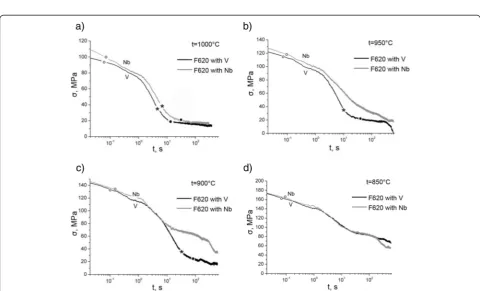
To investigate SRx of austenite, the stress relaxation method (Zisman et al. 2012; Perttula & Karjalainen 1998) was implemented on a Gleeble 3800 simulator. The selected degrees of 0.25 and 0.10 of single strains correspond, respectively, to the maximum thickness reduction during rough rolling and the average reduc-tion in finish rolling of the investigated steels. Distinct
changes in the softening rate dσ/dtallow determination of the incubation period of SRx and the time span of its primary stage (Zisman et al. 2012; Perttula & Karjalainen 1998). Stress relaxation curves for austenite of F620 alloyed with V and Nb, correspondingly, are indicated in Figs. 2 and 3 by labels “V” and “Nb.” When the incuba-tion period and duraincuba-tion of primary SRx could be derived from the diagrams, these time parameters are indicated by light and dark circles, respectively; stars indicate the time when the SRx degree reached 80 %. Following, the SRx degree is evaluated as (Zisman et al. 2012)
P tð Þ ¼ðσmax−σtÞ=ðσmax−σminÞ; ð1Þ
whereσmax andσmin are the maximum and minimum stress magnitudes during the SRx, respectively, andσt is the stress magnitude at a current timet.
Stress relaxation diagrams after ε= 0.25 % (Fig. 2) show that during technological pauses (several seconds or tens of seconds) austenite SRx in both steels becomes complete only atТ≥1000 °С. AtT= 950 °С, this process remains uncompleted in the steel micro-alloyed by Nb and at lower temperatures in both steels. After ε= 0.10 % (Fig. 3), SRx becomes much slower and becomes complete in the abovementioned pauses only at relatively high tem-peratures ofТ≥1100 °С. Earlier termination of SRx due to Nb addition accelerates the growth of the dislocation dens-ity and hence extends the range of austenite fragmentation (subgrain structure evolution) to higher temperatures (Kodzhaspirov et al. 2006; Rybin 1986). Nevertheless, pre-vious SRx still remains significant, since the fragmentation rate increases with the grains’refinement (Rybin 1986).
Results and discussion
Samples of both F620 steels alloyed with V or Nb were subjected to two treatments on the Gleeble 3800 simula-tor. The treatments included five sequential strains, sep-arated by pauses, in a temperature range of 950 to 1150 °С. In the first treatment, the pauses were not reg-ulated; in the second treatment, the pause durations, in-creasing with the temperature reduction, were selected to provide complete primary SRx in each case. The true strains, strain rate, and following cooling rate were 0.15 %, 1 s−1and 30 °С/s, respectively.
As can be seen from Figs. 4a–c and 5а–c, the most dispersed structure and therefore the highest hardness (Figs. 4d and 5d) are provided by the treatment with reg-ulated pauses selected based on the austenite SRx kinet-ics of F620 steels alloyed with V or Nb.
Rolled products of up to 50-mm thickness were fab-ricated from a new lower-alloyed cold-resistant steel, F620 (alloyed with Nb), with a rolling scheme based on the above findings. The average tensile strength was 760МPа(700–890МPаrequired by specification)
Table 1Chemical composition of F620, wt. %
Steel grade C Mn Si P S Cu Ni Mo Cr Al Nb V Ti V + Nb + Ti N B
F620 (BVa) 0.18 1.6 0.55 0.025 0.02 1.5 2 1 2 0.015 0.06 0.1 0.2 – 0.02 0.06
F620W (DNVb) 0.18 1.6 0.1–0.55 0.025 0.025 0.35 0.8 0.08 0.2 0.02 0.02–0.05 0.05–0.1 0.007–0.02 0.12 0.02 –
F620W (Lloydc) 0.18 1.6 0.55 0.025 0.025 – – – – 0–0.015 0.02–0.05 0.03–0.1 0.02 0.12 0.02 –
F620W (RMRSd) 0.18 1.6 0.55 0.025 0.025 – – – – – – – – – 0.02 –
F620W
with V (TUe) 0.08–0.10 0.3–0.6 0.17–0.37 – – + Ni:2.2Cu –2.9 Mo+ Cr:0.55–1.05 – – 0.01–0.03 – – – –
F620W with Nb (TUe)
0.08–0.10 0.3–0.6 0.17–0.37 – – Cu + Ni:2.2–2.9 Mo + Cr:0.55–1.05 – 0.01–0.03 – – – – –
If the range is not specified, the maximum allowable value is given
a
Bureau Veritas
b
Det Norske Veritas
c
Lloyd’s Register
d
Russian Maritime Register of Shipping
e
TU 5.961-11571-95 (chemical composition used in this study)
l
Journal
of
Mechanica
l
and
Materials
Engineering
(2016) 11:2
Page
3
of
Fig. 2Stress relaxation of F620 steel alloyed with V and Nb after true strain of 0.25 % at temperatures ofа1000 °С,b950 °С,c900 °С, andd850 °С
Fig. 1Loading stress-strain diagrams of F620 with V and Nb steels atаТ= 1150 °С,bТ= 1050 °С, andcТ= 950 °С
Fig. 3Stress relaxation of F620 steel alloyed with V and Nb after true strain of 0.10 % at temperatures ofа1100 and 1150 °С,b1000 °С,
c950 °С, andd900 °С
Fig. 4Microstructure F620 steel alloyed with V:аtransformed from austenite exposed for 60 s atТ= 1200 °С,Dγ= 120μm;baustenite deformed
and the yield stress 700МPа (≥620МPа required by specification). The alloying level, as reflected by the toughness parameterРcm, was 0.22 %. Apart from the required strength, the rolled products of Arc-steel showed high ductility (δ5≥20 %), good toughness, and
cold resistance down to −60 °С (Figs. 5 and 6). All tests were performed on whole thickness samples. The requirements for steels are provided according to Russian Maritime Register of Shipping (RMRS) rules. The quality characteristics of the lower-alloyed cold-resistant steel are the result of the finely dispersed structures of bainite-martensite mixture obtained by γ-α transition from the fine-grained austenite. The testing results of F620 steels alloyed with V or Nb demonstrate the effectiveness of the new procedure.
Conclusions
The outcomes and conclusions of the conducted research are:
1. During rough rolling (Т> 1050 °Сfor F620 steel alloyed with V andТ> 1100 °Сfor Nb-alloyed steel), incomplete DRx can occur, resulting in non-uniformity (grain size) of the austenite structure. To prevent this unwanted effect, it is necessary to regulate successive deformations.
2. A uniform fine-grained austenite structure may be obtained during rough rolling if primary SRx is completed within each pause; to this end, it is necessary to gradually increase the durations of the pause between successive deformations in the range 1150–950 °Сfor
Fig. 5Microstructure of F620 steel alloyed with Nb:аtransformed from austenite exposed for 60 s atТ= 1200 °С,Dγ= 100μm;baustenite
deformed with pauses regulated,Dγ= 15μm;cnot regulated,Dγ= 50μm; anddmicrohardness
Fig. 6Properties of F620 steel.аParameters of cold resistance (characteristic temperaturesТкбand NDT);bfracture toughness (CTOD at−40 °С)
F620 V-alloyed steel and 1150–1050 °Сfor F620 Nb-alloyed steel.
3. Substitution of V by Nb in Cr-Ni-Mo steels makes the structure of the hot-rolled austenite more finely dispersed as a result of a number of effects: (а) limitation on grain growth during the metal heating before rolling; (b) prevention of DRx, which may be only partial (incomplete) for technological reasons and can result in structural non-uniformity; (c) prevention of growth of new grains formed by primary SRx; and (d) extension to higher temperatures of the range of austenite fragmentation, forming new interfaces within grains.
4. Rolled products of 50-mm thickness fabricated from a new cold-resistant Nb-alloyed F620 steel with reduced alloying and made following the discussed procedure display improved product characteristics, in particular, cold-resistance down to−60 °Сand high fracture toughness at−50 °С. The steel is recommended for Arctic applications.
Competing interests
The authors declare that they have no competing interests.
Authors’contributions
PL has drafted the paper, prepared data and provided explanations for the experimental results. PK shared expert advice and helped to complete the paper with European perspective on the study. AZ conducted the experiments and shared expert advice on the paper and proposed conclusions of the paper. MP managed the research project and took part in the discussions and conclusion formulating. SG participated in the experiments and supported the paper development. All authors read and approved the final manuscript.
Acknowledgements
This research was supported by an ENPI project Arctic Materials Technology Development.
Author details
1Welding Technology Laboratory, Lappeenranta University of Technology, PL
20, 53851 Lappeenranta, Finland.2Central Research Institute of Structural
Materials Prometey, Saint-Petersburg, Russia.
Received: 17 December 2015 Accepted: 7 March 2016
References
Khlusova, EI, Kruglova, AA, & Orlov, VV (2007). The effect of chemical composition, heat and strain treatment on the size of austenite grains in low-carbon steels (in Russian).Metall heat Treat Met., 12, 3–8.
Russian Maritime Register of Shipping (2012). Rules for the classification, construction and equipment of mobile offshore platforms.2, 445. Calcagnotto M, Ponge D, Adachi Y, Raabe D (2009) Effect of grain refinement on
strength and ductility in dual-phase steels [Internet]. In:Proceedings of the 2nd International Symposium on Steel Science (ISSS 2009). Kyoto: Iron and Steel Institute of Japan (ISIJ); pp. 195–198. Available from: http://edoc.mpg.de/439324. Leinonen, JI (2004). Superior properties of ultra-fine-grained steels.Acta Polytechnica,
44(3), 37–40.
Salvatori, I (2006). Ultrafine grained steels by advanced thermomechanical processes and severe plastic deformations.La Metall Ital., 5, 41–47. Gorelik, SS, Dobatkin, SV, & Kaputkina, LM (2005).Recrystallization of metals and
alloys. Moscow: MISIS.
Kodzhaspirov, GE, Rudskoy, AI, & Rybin, VV (2006).Physical bases and sustainable manufacturing techniques for plastic deformation (in Russian). Saint Petersburg, Russia: Nauka.
Fernández, AI, Uranga, P, & López, B (2003). Dynamic recrystallization behavior covering a wide austenite grain size range in Nb and Nb–Ti microalloyed steels.Materials Science and Engineering A, 361, 367–376.
Sha, Q, & Sun, Z (2009). Grain growth behavior of coarse-grained austenite in a Nb–V–Ti microalloyed steel.Materials Science and Engineering A, 523, 77–84. Sha, Q, Huang, G, Guan, J, Ma, X, & Li, D (2011). A new route for identification of precipitates on austenite grain boundary in an Nb-V-Ti microalloyed steel.
Journal of Iron and Steel Research, International [Internet], 18(8), 53–57. Available from: http://dx.doi.org/10.1016/S1006-706X(11)60104-0. Jung, J, Park, J, Kim, J, & Lee, Y (2011). Carbide precipitation kinetics in austenite of a
Nb–Ti–V microalloyed steel.Materials Science and Engineering: A [Internet], 528(16-17), 5529–5535. Available from: http://dx.doi.org/10.1016/j.msea.2011.03.086.
Zisman, AA, Soshina, TV, & Khlusova, EI (2012). Studies of austenite recrystallization in hot rolled steel 09HN2MD by stress relaxation (in Russian).Progress in Materials Science, 2, 16–24.
Perttula, JS, & Karjalainen, LP (1998). Recrystallisation rates in austenite measured by double compression and stress relaxation methods.Materials Science and Technology, 14(7), 626–630.
Rybin, VV (1986).Large plastic deformation and fracture. Moscow: Metallurgia.
Submit your manuscript to a
journal and benefi t from:
7 Convenient online submission
7Rigorous peer review
7 Immediate publication on acceptance
7Open access: articles freely available online
7 High visibility within the fi eld
7Retaining the copyright to your article