R E S E A R C H
Open Access
An enhanced audio ownership protection
scheme based on visual cryptography
Rimba Whidiana Ciptasari
1,2*, Kyung-Hyune Rhee
3and Kouichi Sakurai
2Abstract
Recently, several ownership protection schemes which combine encryption and secret sharing technology have been proposed. To reveal the original message, however, they exploited XOR operation which is similar to a one-time pad. It is fairly losing the reconstruction simplicity due to the human visual system (HVS). It should be noted that it is completely different from the original concept of visual cryptography proposed by Naor and Shamir. To decrypt the secret message, Naor and Shamir’s concept stackedktransparencies together. The operation solely does a visual OR of the shares rather than XOR, the way HVS does. In this paper, we, consequently, adopt Naor and Shamir’s concept to apply correct theory of visual cryptography. Furthermore, audio copyright protection schemes which exploit chaotic modulation or watermark integration into frequency components have been widely proposed. Nevertheless, security issue against intentional distortions has not been addressed yet. In this paper, we aim to construct a resilient audio ownership protection scheme to enhance the security by integrating the discrete wavelet transform and discrete cosine transform, visual cryptography, and digital timestamps. In the proposed scheme, the watermark does not require to be embedded within the original audio but is used to generate a secret image and a public image. The watermark is then acquired by performing OR between the secret and public image. We can alleviate the trade-off expenses between the capacity of data payload and two other important properties such as imperceptibility and robustness without modifying the original audio signals. The experiments against a variety of audio signals processing provided by StirMark confirm superior robustness of the proposed scheme. We also demonstrate the intentional distortion by modifying the original content via experiments, it reveals comparable reliability. The proposed scheme can be widely applied to the area of audio ownership protection.
Keywords: Digital watermarking; Audio ownership protection; Visual cryptography; Transform domain; Timestamp
1 Introduction
1.1 Background
Protection of an intellectual property has become a major problem in the digital age. It is possible to duplicate digital information a million-fold and distribute it over the entire world in seconds through the Internet. There are various techniques for preventing and/or minimizing the risk of copying, making copying easier to detect, and assisting in proving infringement. One of the technical measures is to embed a ‘digital watermark’ in the host data. The water-mark is regarded as a code, which is impossible or very difficult to detect and/or remove, and it can be used to
*Correspondence: [email protected]
1Department of Informatics, Telkom University, Bandung 40257, Indonesia 2Graduate School of Information Science and Electrical Engineering, Kyushu University, 744 Motooka, Nishi-ku, Fukuoka 819-0395, Japan
Full list of author information is available at the end of the article
identify the source of the copied data [1]. This aids users in proving copyright infringement.
Among the development of digital watermarkings in a various multimedia, digital audio watermarking pro-vides a special challenge because the human auditory system (HAS) is extremely more sensitive than a human visual system (HVS) [2]. Most audio watermark algo-rithms insert the information as a plain-bit or adjusted digital signal using a key-based embedding algorithm. The embedded information is hidden and linked inseparably with the source data structure. For the optimal water-marking application trade-offs among competing criteria such as robustness, perceptibility, capacity, non-detectability, and security have to be considered. However, there is always trade-off between capacity and other two important properties, non-perceptibility and robustness. A higher capacity is always obtained at the expense of
either robustness or non-perceptibility (or both) [3]. Fur-ther, some audio quality degradations inevitably occur due to the embedding process.
1.2 Related work
In order to eliminate the trade-offs among competing criteria aforementioned, several audio ownership protec-tion schemes [4-6], which are different from the tradi-tional watermarking, have been proposed. These schemes are referred to as zero-watermarking. In the paper [4], three-level discrete wavelet decomposition (DWT) is applied to get the low-frequency subband of the host audio, which is the perceptually significant region of it. To make the scheme resist lossy compression oper-ation such as MP3 compression, discrete cosine trans-form (DCT) is pertrans-formed on the obtained low-frequency wavelet coefficients. And by considering the Gaussian sig-nal suppression property of higher-order cumulant, the fourth-order cumulants of the obtained DWT-DCT coef-ficients are calculated to ensure the robustness of the scheme against various noise addition operations. Finally, the essential features extracted based on DWT, DCT, and higher-order cumulant are used for generating binary pat-tern. In addition, the scheme introduced the presence of the authentication center to keep the copyright infor-mation such as the secret keys, original host audio, and the corresponding digital timestamp used in copyright demonstration.
Wang and Hu [5] proposed the scheme created by selecting some maximum absolute value of low frequency wavelet coefficients of original audio. The construction of the watermark is random by chaotic sequence. After gen-erating the watermark, chaotic inverse search is adopted to get the initial value of another watermark sequence that is identical to the original one. In verification phase, instead of using an original audio, they exploited chaotic modulation to generate the original watermark sequence. In order to reduce the processing time, they cut the water-mark into fifty sections. According to our experiment, despite long hours of executing the initial value searching process, we could not achieve the convergence condition. The initialization of its initial value is a somewhat trial-and-error process. The time complexity of each section is O(NM) whereNindicates the watermark’s size, andM refers to the number of iterations. In this case, we can-not predict the Mvalue. We, therefore, argue that their algorithm is not efficient. Moreover, their scheme indeed requires the length of its original watermark sequence to generate original watermarkW in extraction stage. This value was not kept either in secret keyKor initial vector H. In other words, their scheme cannot be regarded as a blind watermarking.
The authors also proposed a modification of Chen and Zhu’s scheme for generating secret keys in their earlier
work [6]. Compared to that of Chen and Zhu’s, the key’s size is relatively the same as its watermark. The scheme, however, is claimed to have good degree of robustness, imperceptibility, and payload capacity.
Furthermore, some ownership protection schemes which combine encryption and secret sharing technology [7-12] have also been proposed, and they achieved good results. Several works in visual cryptography [7,9,11] were performed in a distinctive way. In order to retrieve the secret image, they exploit XOR operation among shares instead of stacking them. This mechanism is considered as an appropriate way to be employed in ownership pro-tection area. Lou et al. [11] proposed the scheme that extracts the feature from the protected image by uti-lizing the secret key and the relation between the low and middle sub-band wavelet coefficients. Then, the fea-ture and watermark are used to generate a secret image by the codebook of visual cryptography technique. To provide further protection, the secret image, with the exception of the secret key and codebook, is registered to certification authority (CA). In the verification proce-dure, public image is first generated from the suspected image. The extracted watermark is obtained by perform-ing XOR operation between secret and public image. However, such an impressive combination has not yet been proposed for audio.
Lee and Chen [10] introduced cryptographic tools into the watermarking process to provide security against malicious attacks. As a first step, a gray-level origi-nal image was decomposed by exploiting wavelet trans-form. Vector quantization was then exploited to generate indices set I that would be signed by the owner with digital signature technique. Lastly, the owner sent signed indices set S to a trusted CA. CA digitally added time and date when it received them. This scheme can protect the indices set from alteration, and everyone can use it to verify the copyright logo corresponding to the test image. Chen and Horng [12] improved their earlier work [10]. In order to resist against geometric distortions, the water-mark was first permutated based on two-dimension pseu-dorandom permutation generated by seed s. Then, the polarity table T was constructed to be used in comput-ing the verification keyK. They included digital signature and timestamp to avoid either counterfeit or copy attacks and to make public verification possible. The advantage of their scheme was that it is resistant to blind pattern matching attack.
1.3 Challenge issues
Based on related work, we summarize the following chal-lenge issues:
audioA and watermark w as input and generates three secret keys. These keys imply the information of selected frames, extracted feature points, and its watermark, where respectively this information is denoted byK1,K2, andK3. Consider the case when
an adversary intends to produce a watermarked file using the same procedure in the paper [4]. The adversary simply extracts the information of selected frames and then applies exclusive-or operation for adversary’s watermark like binary image to obtain the K3. In an extreme case, it is sufficient for the
adversary to modifyK3. Thus,K3contains the
information of watermark. As a result, an adversary can easily produce the informationK1,K2, andK3
from an audio file and can claim that the file contains his/her watermark. This situation shows that Chen and Zhu’s scheme suffers from security weakness. Referring to the concept which is described in [3,13], the security of watermark algorithms depends on the secret keys used for embedding and recovery process. In contrast to this concept, Chen and Zhu’s secret keys are somewhat public knowledge rather than confidential information. The first challenge issue is on how to improve the scheme in order to fulfill an appropriate watermarking concept.
2. As previously mentioned, some image ownership protection schemes [7-12], which combine encryption and secret sharing technology have also been proposed. Regarding original visual
cryptography (VC) proposed by Naor and Shamir [14], the ciphertext is supposed to be revealed directly by a HVS. In that case, HVS does a visual OR rather than XOR operation. Unfortunately, most aforementioned existing schemes exploited XOR operation. Hence, the second challenge issue is on how to employ VC correctly in a digital
watermarking area.
3. In terms of audio intellectual property protection, both Chen and Zhu [4] and Wang and Hu [5] do not provide any experimental results dealing with security aspects of their scheme against intentional distortions. Although Chen and Zhu [4] registers their secret keys, host original image, and timestamp to CA for copyright demonstration, it reflects that the timestamp is not digitally added by CA. They do not provide a detailed explanation on this issue as well. We argue whether this situation leads to owner’s deception. Furthermore, most watermarking algorithms cannot resist against malicious
manipulations of the content. Such manipulations may distort audio data as well as readily destroy or even remove the watermark. The last challenge issue is on how to enhance security against intentional distortions.
1.4 Contribution
This paper proposes a novel audio watermarking based on visual cryptography that can be exploited in owner-ship protection area. Akin to our previous work [6], we extract the feature by performingH-level wavelet decom-position to obtain low-frequency subband of segmented host audio. To make the proposed scheme resistant to lossy compression operation, discrete cosine transform is performed to the obtained low-frequency wavelet coefficients. We use the whole DWT-DCT coefficients rather than a certain part of coefficients to adjust matrix dimension.
In the proposed scheme, the watermark does not require to be embedded into the original audio but is used to generate secret and public share images by using the visual cryptography technique. In a nutshell, fea-ture extraction is first accomplished to obtain digital audio’s features by frequency-domain functions. The shar-ing matrices referred to ascodebookare then generated in such ways that have two properties: contrast and secrecy. Instead of data embedding, audio’s features and binary-valued watermark are integrated to construct secret shares based on generated codebook. In other words, the image shares contain watermark information. In contrast to existing schemes [7-12] that exploit XOR operation, we employ a visual OR of the shares to reveal the original watermark as its original concept stated in [14].
Further, product registration to a trusted authority is a well-established way of protecting intellectual property rights as well as offering indisputable proof of original ownership and legal rights [15]. In order to prevent any intentional distortion, digital timestamping is incorpo-rated in a proposed scheme. Referring to timestamping’s mechanism [16], we simplify the protocol by using CA as a trusted party which is responsible for the issuing and verification of timestamps as well as issuing a digital cer-tificate that contains a name of the holder, a serial number, expiration date, and a holder’s public key. Therefore, the steps of generating a timestamp are as follows. At first, the owner signs his protected data using his private key and generates a fingerprint by using a digital signature function. Then, the fingerprint is sent to CA. The CA gen-erates a timestamp based on the owner’s fingerprint and the date and time obtained from an accurate time source. The timestamp is sent back to the owner. The CA keeps a record of the timestamp for future verification.
The rest of the paper is organized as follows. Section 2 describes the development of an ownership protection scheme. In Section 3, the proposed scheme is investigated against incidental and intentional distortions. Finally, the conclusion is provided in Section 4.
2 Proposed scheme
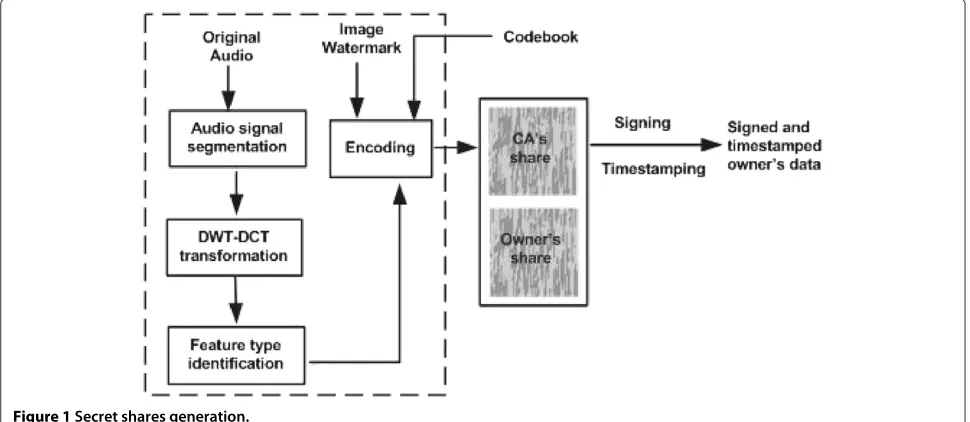
audio is first segmented into several frames, and each frame containsNsamples. Next, the sample features are extracted by performing wavelet decomposition to obtain the low-frequency coefficients. Then, DCT is exploited only to the obtained low-frequency wavelet coefficients. Afterward, features of DCT coefficients are calculated. Finally, encoding utilizes these features and binary-valued watermark to generate secret share images according to the concept of Naor and Shamir’s scheme [14]. One of the secret share image is then registered to CA for further protection and will be used for watermark verification purpose.
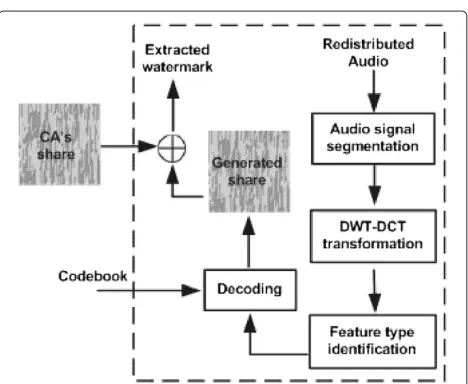
To retrieve the watermark, the received audio is seg-mented into several frames that containN samples each. Then, the samples’ features are extracted by perform-ing wavelet decomposition to obtain the low-frequency coefficients. Next, DCT is exploited to the obtained low-frequency wavelet coefficients, and the DCT coefficients are calculated. The decoding exploits these features and registered share image to generate a public share image. The watermark is recovered by performing OR operation between secret and public share images and then used to verify the ownership. The following subsections provide more detailed description on each stage.
2.1 Main process in the proposed scheme 2.1.1 Feature extraction
To accomplish feature extraction, the host audio is first segmented into several frames in which each frame con-tainsNsamples andT-level wavelet decomposition is per-formed on each frame. Then, approximated coefficients in theLLTsubband are transformed to DCT coefficients. Let ATC = DCT(AT) = {aTC(n)|n = 1,. . .,2NT} be
the obtained DCT coefficients. The output array of DCT coefficients contains real numbers, and they have a range from -1 to 1. The feature typetis then obtained by the following conditions:
t=
1 -1≤aHC(n)≤0
2 0 <aHC(n)≤1. (1)
2.1.2 Encoding and decoding
In principle, encoding is the process of generating secret shares by integrating binary value of the watermark and digital audio’s features, while decoding refers to process of revealing the original watermark message by stacking those secret shares.
Formally, the basic model of visual secret sharing is denoted askout ofnproblem. Given a secret message, we would like to generatentransparencies so that the origi-nal message is visible if anykof them are stacked together; otherwise, the message is totally invisible. We exploit orig-inal encryption problem proposed by Naor and Shamir
[14], that is a 2 out of 2 or (2,2)-secret sharing prob-lem. The watermark is visible if two shares are stacked together; otherwise, it does not provide any information.
In this paper, the watermark consists of a collection of black and white pixels. Each original pixel appears in n shares, one for each transparency. Each share consists of mblack and white sub-pixels. The resulting sharing matri-ces can be represented as two collections ofn×mBoolean matricesS={S0,S1}. To share either a white or black pixel, one randomly chooses one of the matrices in either S0 or S1, respectively. When transparenciesi1,i2,. . .,ik are stacked together, the black subpixels appearing on a com-bined share are represented by OR operation of rows i1,i2,. . .,ik in sharing matrices S. The gray level of this combined share is proportional to the Hamming weight H(V) where V is them-vector of the resulting OR opera-tion [14].
The sharing matrices should satisfy two properties, namelycontrastandsecrecy.
1. In case of contrast, the gray levelG is deemed valid if the following condition is satisfied.
G=
black ifH(V)≥d
white otherwise (2)
for a threshold1≤d≤m. In order to comply with a condition (2), the codebook shown in (3) and (4) is arranged in such a way that H(V) is 2 or 3 inS0, while
it is 4 inS1.
2. In terms of secrecy, the number of 1’s inS should have same probability distribution, i.e., codebook shown in (3) and (4) has probability Prob(Si=1/0)=Prob(Si=1/1)=0.5. Let S=[sij]be a Boolean matrix with a row for each share and a column for each subpixels. For each pixel, the share matrix must be chosen at random and must be known only by the sender (owner) and receiver (CA), while the codebook is publicly known.
The examples of share matrix representations used in our proposed scheme are described as follows.
S0=
1 0 0 1 1 0 0 1
1 1 0 0 0 1 1 0
0 1 0 1 0 0 1 1
0 1 1 0 0 1 0 1
(3)
S1=
0 1 1 0 1 0 0 1
1 0 0 1 0 1 1 0
1 1 0 0 0 0 1 1
1 0 1 0 0 1 0 1
(4)
2.1.3 Watermark reduction
to compute bit error rate (BER), it is required to have extracted watermark in the same size as its original. Let W(M×N) be the original watermark image. Note that the extracted watermarkW will be equal to M× 4N. In order to yield the same watermark size as its original one, it is necessary to accomplish the reduction process of extracted watermark. Assume that black pixel is assigned as 1 and white pixel value is 0, the reduction process is performed based on the following conditions:
Reduction result=
1 if the number of black pixel >3
0 otherwise.
(5)
2.2 Share image generation and verification procedure 2.2.1 Share image generation procedure
Figure 1 illustrates the secret share image generation, and the procedure is described as follows.
Input:host original audioA = {a(i)|i =1,. . .,Lsample}, binary image watermarkW(N×N) ={w(i,j)|w(i,j){0,1}}, and codebookC.
Output:secret share imagesSA(N×mN)andSB(N× mN)wheremis the number of subpixels per pixel.
Step 1.Firstly,Ais segmented into F frames, denoted as Fr = {fri|i = 1,. . .,F}, and each frame contains N samples. Next,T-level wavelet decomposition is per-formed on each framefrito yield its coarse signalAT and detail signalDT,DT−1,. . .,D1. Then, to take advantage of low-frequency coefficient, which is robust against signal processing manipulations, DCT is only performed onAT
and obtained DCT coefficients are denoted as
ATCk =DCT(ATk)=
aHCk (n)|n=1,· · ·, N 2T
. (6)
Step 2.Construct a new sequenceBTCn = {bTCn (n)|n = 1,. . .,N/2T}by taking the firstnframes of ATCk .
Step 3.Letxbe 1.
a.Obtain the feature typet from BTC
n based on Equation (1).
b.Construct a secret share blockS (x) by utilizing a codebookC as described in (3) and (4), feature type t, and a corresponding watermark pixel valuew(i,j ). c.Addx to one. If x≤N×N then go toa.
Step 4.The secret share imagesSA(N×mN)andSB(N× mN)are generated. Note that the security of our scheme is based on theSA(N×mN).
Step 5.The next step is timestamping for the protected data. The owner signs the security parameter by using digital signature scheme:
f =DSOPK(SA,C) (7)
where DSOPK() is a digital signature function by using the owner’s private keyOPK, andf stands for owner’s fin-gerprint. Afterward, owner sendsf,S, andC to the CA. CA creates a timestampTSwith the owner’s fingerprintf, and the timetand datedobtained from an accurate time source as
TS=TSCAPK(f,t,d) (8)
where TSCAPK() is a timestamp function by using CA’s private keyCAPK. After creating the timestampTS, it is
sent back to the owner and kept as an archive by CA as well. Subsequently, f, TS, SA, and C are used by CA in verification purpose when the dispute arises. Note that timestamping mechanism is completed by CA so that detail discussion of digital signature is beyond the scope of this paper.
2.2.2 Watermark verification and extraction procedure The presence of original audio is not required in verifica-tion and extracverifica-tion phase. In order to verify the copyright of an audio, anyone can use CA’s public key to validate the timestampTSand owner’s public key to validate the signa-turef. When a dispute arises or multiple claims occur, the earlier registered data will be regarded as the original one. In the meantime,SA andCare used to verify copyright watermark’s logo corresponding to the received audio.
As depicted in Figure 2, the extraction procedure is sim-ilar to share image generation procedure and is illustrated as follows:
Input: a received audio{A = a(s)|s = 1,. . .,Lsample}, a secret share imageS(N×N), and a codebookC.
Output:an extracted watermark logoEW(N×N) Step 1.Ais segmented intoFframes, denoted asFr =
{fri|i = 1,. . .,F}, and each frame contains N samples. Next, T-level wavelet decomposition is performed on each framefrito yield its coarse signalAT and detail sig-nalDT,DT−1,. . .,D1. Then, DCT is onATand obtained DCT coefficients are denoted as ATCk = DCT(ATk) =
{aHCk (n)|n=1,· · ·,N/2T}.
Step 2.Construct a new sequenceBTCn = {bTCn (n)|n = 1,. . .,N/2T}by taking the firstnframes of ATCk .
Step 3.Letxbe 1.
Figure 2Watermark extraction procedure performed by CA.
a.Obtain the feature typet from BTCn based on Equation (1).
b.Construct a public share blockSBxby utilizing a codebookC as described in (3) and (4) and feature typet.
c.Addx to one. If x≤N×Nthen go toa.
Step 4. A public share imageSBN×mNis yielded. An extracted watermarkW(N×mN)is obtained by
W=SAORSB. (9)
Step 5. Afterward, watermark reduction process is per-formed according to Equation 5 to obtain the recovered watermarkEW(N×N).
3 Experimental results
To demonstrate the feasibility of the proposed scheme in terms of ownership protection requirements, some experiments are conducted. Bit error rate is emplo-yed to measure robustness of the zero-watermarking system,
BER= B
MN100% (10)
where B is the number of erroneously extracted bits. Signal-to-noise ratio (SNR) is the ratio of quality sound to noise. The higher the decibel (dB) value, the better is the quality of the sound. For instance, a signal-to-noise ratio of 90 or 100 decibels is considered high fidelity. In this paper, SNR
SNR=10log10
N−1 i=0 f2(n)
N−1
i=0 (g(n)−f(n))2
(11)
is applied to evaluate the quality comparison between the attacked audio and original audio. Wheref(n)is an orig-inal audio sample, andg(n)is an attacked audio sample. SNR value is getting larger, thus leading to better audio quality.
Pearson’s correlation, denoted asρ(x,y),
ρ(x,y)= K
K
i=1XiYi−(Ki=1Xi)(Ki=1Yi)
[KKi=1X2i −(
K
i=1Xi)2] [KKi=1Yi2−(
K i=1Yi)2]
(12)
is employed to represent correlation between two images where ρ(x,y) is a correlation coefficient (CC) between x andy,Xis an image 1,Yis an image 2, andKis the number of image bits.
Figure 3Watermark extraction result without being attacked.(a)Original audio signal,(b)original watermark,(c)secret share,(d)public share, (e)extracted watermark, and(f)reduced watermark.
visually recognizable binary image of size 64×64. Three-level wavelet decomposition is performed, and the frame length is 512 samples.
3.1 Watermark extraction
We first investigate our proposed scheme in recover-ing the watermark without berecover-ing attacked. Accordrecover-ing to the experimental results described in Figure 3, BER and
correlation coefficient values of all types of audio files are respectively 0% and 1. It demonstrates that each bit of watermark data is completely extracted and identical to the original one.
On the other hand, an erroneous condition is dis-covered in embedding phase of Chen and Zhu’s scheme [4]. Consider the binary image watermark W = {wi,j|wi,j{0, 1},i= 0,. . .,M−1;j =0,. . .,N−1}.
Table 1 BER and correlation coefficient of extracted watermark attacked by StirMark
Attacks Instrumental Jazz Classical CC in
BER CC BER CC BER CC [4]
a. AddBrumm 1.90% 0.92 0.85% 0.96 2.24% 0.91 0.98
b. AddDynNoise 5.57% 0.80 2.25% 0.91 3.17% 0.87
-c. AddNoise 5.25% 0.81 1.81% 0.92 3.66% 0.86 0.99
d.AddSinus 0.098% 0.99 0.44% 0.98 1.17% 0.95 0.92
e. Amplify 0% 1 0% 1 0% 1 1
f. BassBoost 2.39% 0.90 7.67% 0.75 2.05% 0.91
-g. BitChanger 0% 1 0% 1 0% 1
-h.Compressor 0% 1 0.68% 0.97 0% 1 0.99
i. Echo 26.44% 0.47 18.70% 0.55 23.34% 0.50 1
j. ExtraStereo 5.91% 0.80 1.54% 0.93 4.27% 0.84
-k. FlippSample (2000) 33.86% 0.4 17.11% 0.57 27.61% 0.45
-FlippSample (100) 10.84% 0.68 3.34% 0.87 8.54% 0.72
-l. LSBZero 0% 1 0% 1 0% 1
-m. NoiseMax 4.79% 0.82 1.61% 0.93 3.91% 0.85
-n. RCHighPass 3.49% 0.86 8.94% 0.72 3.10% 0.87
-o. RCLowPass 1.22% 0.95 0.51% 0.98 1.001% 0.96 1
p. ReplaceSamples 13.14% 0.64 5.03% 0.81 15.73% 0.59
-q.Smooth 4.37% 0.83 0.81% 0.96 2.37% 0.90 0.99
r. Smooth2 3.10% 0.87 0.71% 0.97 2.51% 0.90
-s. Stat1 4.76% 0.82 2.29% 0.90 4.42% 0.83 0.94
t. Stat2 1.68% 0.93 0.29% 0.99 1.05% 0.95 1
u. ZeroCross 3.78% 0.85 1.34% 0.94 3.83% 0.86 0.97
a
b
c
d
e
f
g
h
i
j
k
l
m
n
o
q
r
s
t
u
v
p
Figure 4Examples of extracted watermark from attacked audio by StirMark.The music type of Instrumental is taken as an example.(a to v) The extracted watermark from StirMark attacks.
To generate watermark key, they first constructed binary pattern matrixB = {bt,p|bt,p{0, 1},t= 0,. . .,T−1;p= 0,. . .,P−1} where T is the number of selected frame and P is the number of selected coefficient cumulants on all selected frame. Then, the watermark keyK3 was
Table 2 Performance over various durations
Attacks 00:01:38 00:02:20 00:04:08
BER CC BER CC BER CC
a. AddBrumm 2.44% 0.90 0.90% 0.96 3.88% 0.85
b. AddDynNoise 3.15% 0.87 3.22% 0.87 4.49% 0.83
c. AddNoise 6.61% 0.77 2.73% 0.89 7.91% 0.74
d. AddSinus 0.46% 0.98 0.31% 0.99 1.83% 0.92
e. Amplify 0% 1 0% 1 0.02% 0.99
f. BassBoost 5.81% 0.79 10.08% 0.69 13.75% 0.63
g. BitChanger 0% 1 0% 1 0% 1
h. Compressor 0% 1 0.6836% 0.9687 0% 1
i. Echo 18.43% 0.56 21.48% 0.52 24.80% 0.48
j. ExtraStereo 15.67% 0.60 17.26% 0.57 10.52% 0.68
k. FlippSample (2000) 21.34% 0.52 11.35% 0.67 30.44% 0.43
FlippSample (100) 5.98% 0.79 3.10% 0.87 8.30% 0.73
l. LSBZero 0% 1 0.02% 0.99 0.02% 0.99
m. NoiseMax 6.60% 0.77 1.78% 0.92 6.23% 0.78
n. RCHighPass 9.59% 0.70 17.79% 0.57 19.09% 0.55
o. RCLowPass 0.42% 0.98 0.27% 0.99 0.66% 0.97
p. ReplaceSamples 16.77% 0.58 6.13% 0.78 0% 1
q.Smooth 0.49% 0.98 0.32% 0.99 0.68% 0.97
r. Smooth2 0.85% 0.96 0.44% 0.98 1.05% 0.95
s. Stat1 1.83% 0.92 1.10% 0.95 2.10% 0.91
t. Stat2 0.37% 0.98 0.12% 0.99 0.29% 0.99
u. ZeroCross 8.74% 0.72 1.78% 0.92 8.50% 0.73
generated by performing XOR operation between binary pattern matrix B and image watermark W. Notice that matrix dimension of K3 will be equal to B. It is reflected by the provided formula in [4] on how to find each pixel position in W that corresponds to B. In the extraction phase, the extracted watermark W is revealed by conducting XOR operation betweenK3and B. The dimension betweenW andW is different, thus causing the extracted watermark to be unrecognizable and unusable for verification purpose. To improve the problem, we simply utilize the entire of the obtained DWT-DCT coefficients rather than employ certai coefficients.
3.2 Robustness against incidental distortions
The next attack conducted is downsampling gener-ated by Cool Edit Pro 2.1. The sample of audio rate is adjusted from 44,100 to 22,050 Hz, and then, its sample rate is readjusted to 44,100 Hz. This process might cause an alteration in some parts of audio data. Consequently, the watermark data cannot be completely extracted. However, the BER and correlation coefficient value as shown in Table 1, which are 0% and 1, respec-tively, indicate that the proposed scheme resists to such attack.
To evaluate the robustness of proposed scheme, we draw a comparison to earlier method [4] subjected to StirMark attacks as well as short duration. In more detail, all the audio signals used in [4] were audio with 16 bits/sample, 44.1 KHz sample rate, and 28.73 s long. The music styles used throughout their experiment were not explicitly reported. In order to properly compare the schemes, we deliberately exploit various music styles. We expect the music styles used in [4] to be any of ours. BER and cor-relation coefficient values are reported in Table 1, and the extracted watermark against those attacks is illus-trated in Figure 4. The results indicate that our proposed scheme outperforms Chen’s scheme [4] on AddSinus and Compressor attacks. In case of other attacks, we still achieve considerable results compared to Chen’s scheme.
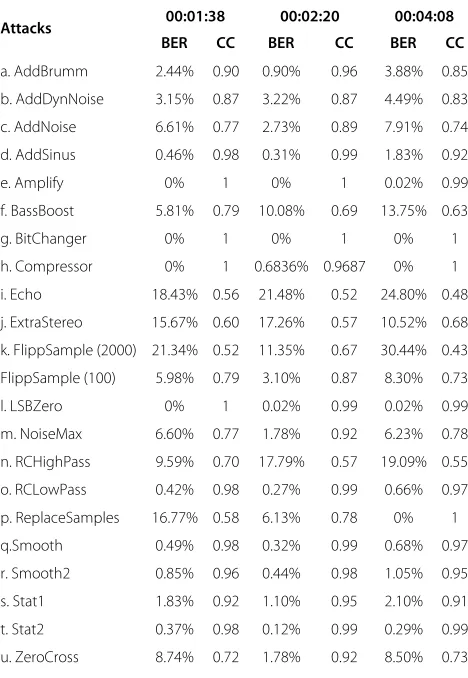
Furthermore, to verify the efficacy of the proposed scheme, evaluation over various durations is conducted as well. The duration is ranging from 1 to 4 min. However, we did not perform comparative experiments because the duration either in [4] or [5] is approximately below 60 s. The experimental results against SMFA are reported in Table 2. In general, the findings show that longer duration provides fairly the same performance as short duration. For example, BitChanger attack indicates exactly the same results, while amplify and LSBZero attacks demonstrate
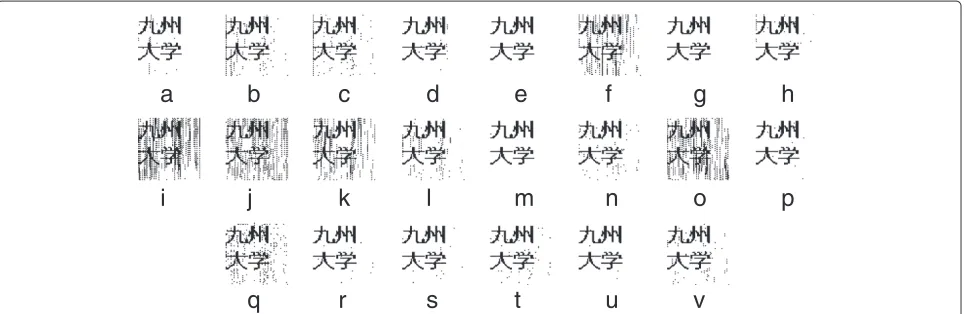
that the number of error bit is only one. To confirm the findings, the resulting extracted watermarks are provided in Figure 5.
3.3 Robustness against intentional distortions
Intentional distortion refers to distortions conducted by deliberately modifying the host content [17]. It can be performed by overwriting or removing the watermark. In the following subsection, we address two types of intentional distortions:counterfeit attackandmultiple claims situation.
3.3.1 Counterfeit attack
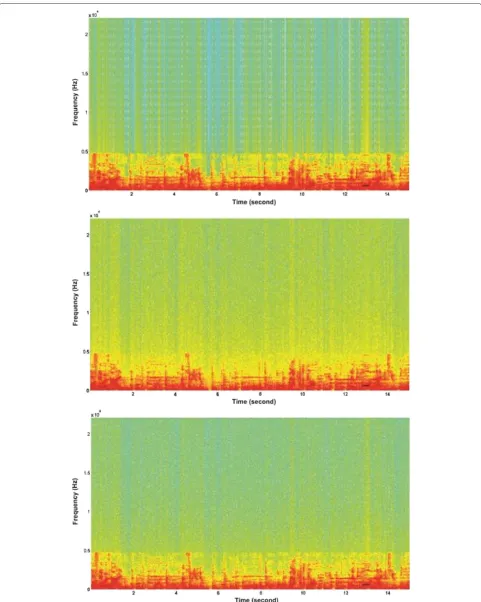
In some cases, the adversary tries to confuse ownership by creating a faked original or faked watermarked audio. In this case, an adversary performs a distortion by modi-fication of a set of features of received audioAso-called faked original audioAf. By doing so, it is expected that the original watermark will be destroyed. One simple way to alter the features is to modify the sample data in such a way that the SNR is still acceptable. Figure 6 demon-strates spectrogram of original audio signal and its faked version due to sample data alteration. The vertical axis represents frequencies up to 20,000 Hz, the horizontal axis shows positive time toward the right, and the colors represent the most important acoustic peaks for a given time frame, with red representing the highest energies, then in decreasing order of importance, orange, yellow, green, cyan, blue, and magenta.
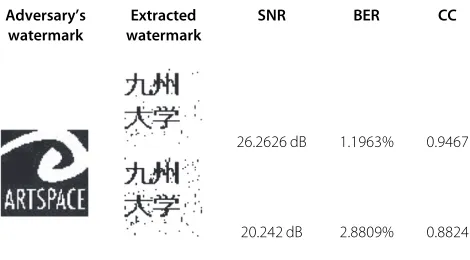
Once the faked signal is constructed, the adversary may embed his watermark onto it and produce another watermarked audio. In the verification phase, the adver-sary’s audio signal is verified by using registered secret share image. As shown in Table 3, the number of error bits is approximately in ranges 49 to 118 bits from 4,096 bits, and the owner’s watermark is completely extracted. It indicates that the proposed scheme performs well in
a
b
c
d
e
f
g
h
i
j
k
l
m
n
o
q
r
s
t
u
v
p
Table 3 Watermark extraction performance against intentional distortion
Adversary’s Extracted SNR BER CC
watermark watermark
26.2626 dB 1.1963% 0.9467
20.242 dB 2.8809% 0.8824
watermark verification phase and possesses an unambiguous property.
3.3.2 Multiple claims
In this situation, the adversary attempts to provoke a dis-pute by embedding his/her own message. The following is the model of the proposed scheme. In such a scheme, let x= (x(1) . . .x(Nf))T be a feature vector extracted from the audio content with length-Nf. The message to be hid-den is a binary matrix W of size N × N. The scheme exploits (2,2)-secret sharing. The codebookC comprises two 2×nboolean matrices(Ci0,Ci1)with:
-i=(1. . .f),f is the number of feature type. -Ci0andC1i are the base matrices for black and white pixel, respectively.
The scheme is defined as the four-tuple(W,E,D,C), where:
-E:x×W×C→Sis the encoder mapping a sequencex, a hidden messageWusing codebookC to a secret share imageS.
-D:x×C→Pis the decoder mapping a sequencex using codebookC to a public share imageP.
According to our scheme, S is kept by CA while P as well as codebook are publicly known. Suppose the adversary intends to rewrite the content with his hidden message. We would like to show that all his efforts are fairly unworthy.
Supposex*,C*, andW* are the feature vector extracted from the retrieved audio content, adversary’s codebook, and adversary’s hidden message, respectively. Based on aforementioned statement, we might convey thatC*≡C such that
-E:x*×W∗×C∗→ {S∗,P∗}whereS* is the adversary’s secret share. Note thatS* is not required since the originalShave been registered by the owner in advance.
Figure 7The example of extracted watermark of multiple claims condition.
-D:x*×C∗→P* whereP* is the adversary’s public share. Due to the property of our scheme, it is obvious thatx*≡xwhich implies thatP∗≡P. Thus the adversary’s hidden message will never be extracted.
To evoke multiple claims situation, the adversary embeds his watermark, which is depicted in Table 3, onto thex*. Figure 7 shows that original’s watermark remains extracted.
4 Conclusions
This paper investigates the problem of constructing an audio ownership protection scheme in order to resist against both intentional and incidental distortions. To achieve these goals, we have integrated wavelet trans-form, visual cryptography, and digital timestamp into an ownership protection scheme. The trade-off between data payload and two other properties, imperceptibility and/or robustness, can be reduced, while preserving its audio signal quality. According to experimental results, the pro-posed scheme fulfills several properties of ownership protection including perceptual transparency, blindness, robustness, security, and unambiguousness. In terms of security, it is achieved by means of visual cryptography method. Without possessing both shares, it is infeasible for anyone to retrieve the secret image from each share. The integrity of codebook and its secret share image is guaranteed by certification authority through timestamp mechanism. It indicates that audio ownership protec-tion can take advantage from the combinaprotec-tion of visual cryptography and watermarking and proposed scheme can be widely applied to the area of audio ownership protection.
Competing interests
The authors declare that they have no competing interests.
Acknowledgements
The authors wish to thank the anonymous reviewers for their very constructive and helpful comments. Research support for the first author was provided by the Directorate General of Higher Education, Ministry of National Education, Indonesia. The second author acknowledges support provided by Grant NRF-2011-013-D00121 from the National Research Foundation of Korea. This is an expanded version of a paper [6] presented at the Seventh International Conference on Intelligent Information Hiding and Multimedia Signal Processing (IIHMSP 2011) with further analysis and some new simulation experiments.
Author details
1Department of Informatics, Telkom University, Bandung 40257, Indonesia. 2Graduate School of Information Science and Electrical Engineering, Kyushu
Convergence and Application Engineering, Pukyong National University, 599-1, Daeyeon 3-Dong, Nam-Gu, Busan 608-737, Korea.
Received: 6 August 2012 Accepted: 18 December 2013 Published: 4 January 2014
References
1. S Stokes,Digital Copyright: Law and Practice, 2nd edn. (Hart Publishing, New York, 2005), p. 120
2. X-Y Wang, Y-R Cui, H-Y Yang, H Zhao, A new content-based digital audio watermarking algorithm for copyright protection, inProceedings of the 3rd International Conference on Information Security (SEC), vol. 85 (ACM, New York, 2004), pp. 62–68
3. M Barni, F Bartolini,Watermarking systems engineering: enabling digital assets security and other applications,(Marcel Decker, New York, USA, 2004), pp. 6–11
4. N Chen, J Zhu, A robust zero-watermarking algorithm for audio. EURASIP J. Adv. Signal Process.2008, 453580 (2008)
5. R Wang, W Hu, Robust audio zero-watermark based on LWT and chaotic modulation, inProceeding International Workshop Digital Watermarking (IWDW),(Springer, Heidelberg, 2007), pp. 373–381
6. RW Ciptasari, A Fajar, FA Yulianto, K Sakurai, An efficient key generation method in zero-watermarking for audio, inProceeding of 7th IEEE International Conference on Intelligent Information Hiding and Multimedia Signal Processing (IIHMSP),(IEEE, Washington DC, 2011), pp. 336–339 7. Z Wang, CC Chang, HN Tu, MC Li, Sharing a secret image in binary images
with verifcation. J. Inform. Hiding Multimedia Signal Process.2(1) (2011) 8. CC Chang, JC Chuang, An image intellectual property protection scheme
for gray-level images using visual secret sharing strategy. Pattern Recognit. Lett.23, 931–941 (2001)
9. SL Hsieh, LY Hsu, IJ Tsai, A copyright protection scheme for color images using secret sharing and wavelet transform, inProceedings of World Academy of Science, Engineering And Technology,(World Academy of Science, Engineering and Technology, Egypt, 2005), pp. 17–23 10. WB Lee, TH Chen, A public verifiable copy protection technique for still
images. J Syst. Software, 195–204 (2002)
11. DC Lou, HK Tso, JL Liu, A copyright protection scheme for digital images using visual cryptography technique. J. Comput. Stand. Interfaces
29, 125–131 (2006)
12. TH Chen, GB Horng, WB Lee, A publicly verifiable copyright-proving scheme resistant to malicious attacks. IEEE Trans. Ind. Electron.
52(1), (2005)
13. IJ Cox, ML Miller, JA Bloom,Digital Watermarking(Morgan Kauffman Publisher, San Francisco, 2002), pp. 45–47
14. N Naor, A Shamir, Visual cryptography. Advances in Cryptology: Eurocrypt.94, 1–12 (1995)
15. G Voyatzis, I Pitas, Protecting digital image copyrights: a framework. IEEE Comput. Graph. Appl.19(1), 18–24 (1999)
16. Electronic Time-stamping. https://www.digistamp.com/technical/how-a-digital-time-stamp-works/. Accessed 25 Oct 2011.
17. D He, Q Sun, Multimedia authentication, inMultimedia Security Technologies for Digital Rights Management, ed. by W Zeng, H Yu, and CY Lin (Academic Press, London, 2006), pp. 111-138
18. A Lang, StirMark benchmark for audio, http://sourceforge.net/projects/ stirmark/files/. Accessed 17 November 2011
doi:10.1186/1687-417X-2014-2
Cite this article as:Ciptasariet al.:An enhanced audio ownership protection scheme based on visual cryptography. EURASIP Journal on Information
Security20142014:2.
Submit your manuscript to a
journal and benefi t from:
7Convenient online submission 7Rigorous peer review
7Immediate publication on acceptance 7Open access: articles freely available online 7High visibility within the fi eld
7Retaining the copyright to your article