M I N I R E V I E W
Open Access
Expression and function of histamine and
its receptors in atopic dermatitis
M. Albrecht and A. M. Dittrich
*Abstract
Background:
Atopic dermatitis constitutes a most burdensome chronic inflammatory skin disease. Standard
treatment is cumbersome and often targets its main symptom, pruritus, only insufficiently.
Findings:
Recent advances in our understanding of the role of histamine and its four receptors suggest new
approaches which target the histamine receptors alone or as combination therapies to more efficiently combat
pruritus and inflammation in atopic dermatitis.
Conclusions:
With this review, we provide an overview on histamine and the expression of its four receptors on
skin resident and nonresident cells. Furthermore, we summarize recent studies which suggest anti-histamine
therapy to efficiently combat pruritus and inflammation in atopic dermatitis and discuss possible approaches to
incorporate these findings into more effective treatment strategies for atopic dermatitis in childhood.
Keywords:
Atopic dermatitis, Histamine, Histamine receptors, Immunology, Treatment
Introduction
Atopic dermatitis (AD) is one of the most prevalent
chronic diseases in early childhood. AD affects about
20 % of all children [1] and can prevail into adulthood. Its
severe
pruritus,
stigmatizing
local
appearance,
and
relapsing course turn it into a chronic disease with a heavy
psychological burden on the affected families. Treatment is
cumbersome and time-consuming, and pruritus can only
be addressed insufficiently, mainly by improvements in
overall disease control which cannot always be achieved.
Immunologically, AD is driven by TSLP-secretion by
ker-atinocytes and epithelial cells which modulate dendritic cell
(DC) and basophil function to preferentially induce a Th2
immune response. The Th2 associated cyto- and
chemo-kines IL-4, IL-5, IL-13, TARC/CCL17, and MDC/CCL22,
in turn, lead to recruitment of mast cells and eosinophils
whose mediator release includes histamine [2, 3].
Plasma histamine levels are higher in AD patients than
in healthy controls [4], and histamine is detected readily
in AD skin lesions [5]. Histamine’s pleiotropic actions
were acknowledged since its discovery and since the
1960s attributed to the secretion by different cell types
(Table 1) and the differential tissue expression of several
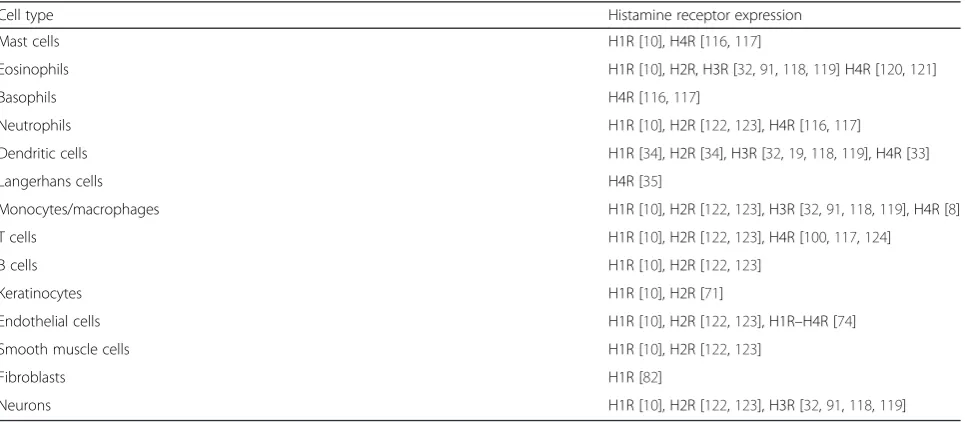
receptors (Table 2, [6, 7]). Four histamine receptors
(HRs) have been described; thus far, the
“youngest”
of
these receptors, the H4-receptor was discovered in 2000
only [8, 9]. The first clinically used anti-histamine was
synthesized in 1942, and ever since, anti-histamines have
been a mainstay of anti-allergic, particularly anti-pruritic
therapy mainly by targeting the H1R.
Targeting histamine as a therapeutic approach for AD
For a long time, histamine
’
s effects in allergic skin
dis-ease were thought to be mediated solely by its action on
H1Rs. In the skin, H1Rs are expressed on vascular
smooth muscle cells, endothelial cells, neurons, and
dif-ferent immune cells such as monocytes, neutrophils,
DCs, and T and B cells where their activation drives the
typical symptoms of immediate hypersensitivity
re-sponses, comprising edema and pruritus [10]. Anti-H1R
antagonism has been a mainstay of anti-allergic
treat-ment regimens since the advent of the first anti-H1R
antagonists by chemical synthesis. Their efficiency as
anti-pruritic agents in urticaria and inclusion in the
ther-apy of anaphylaxis are undisputed. The effects of H1R
blockade in anaphylaxis critically depend on its
vasocon-strictive properties. The anti-pruritic effects are
medi-ated by a reduction of histamine-dependent release of
pruritogenic
pro-inflammatory
mediators
such
as
* Correspondence:[email protected]Department for Pediatric Pneumology, Allergology and Neonatology, Hannover School of Medicine, Carl-Neuberg-Str. 1, 30625 Hannover, Germany
bradykinins, serotonin, prostaglandins, and substance P
by mast cells which all can confer an itching sensation.
Moreover, histamine regulates the release of nerve
growth factor [11] and semaphorin 3A from
keratino-cytes which also act as pruritic factors, and H1R
target-ing reduces IL-31, a pro-pruritic cytokine which
additionally plays an important role in skin barrier
integ-rity [12–14].
In addition to its pro-pruritic effect, several studies
acknowledge a role for the H1R on immune cells in
me-diating inflammatory effects of allergic skin diseases with
antagonism of the H1R by several drugs demonstrating
anti-inflammatory properties in different experimental
models of AD [15–19]. Thus, antagonism of histamine
has the potential to affect pruritus as well as
inflamma-tion in AD. However, numerous clinical studies have
shown that AD is only insufficiently addressed by
anti-H1Rs [20, 21] since no significant reduction in pruritus
or disease severity over control was observed with topical
or systemic treatment [22, 23]. National guidelines thus
do not recommend treatment with anti-H1R antagonists
for the therapy of childhood AD anymore, neither
system-ically nor topsystem-ically (AWMF S3 Leitlinie der deutschen
dermatologischen Gesellschaft; [24]). However, as we will
discuss below, new findings concerning the effect of
hista-mine and HR expression in AD and AD models
necessi-tate a re-thinking of the approaches used to target the
histamine pathway in atopic skin disease and suggest new
possibilities for anti-histamine therapy in AD.
Histamine and histamine receptor expression in
skin-resident and nonresident cells
In this review, we provide the readers with a
compre-hensive summary of histamine and histamine receptor
expression. In this context, we would like to caution
that, as usual, antibody-dependent methods to determine
expression levels depend on the antibody-specificity of
the antibodies used and thus need to be received with
the necessary prudence. As outlined above, a variety of
cell types within the skin are capable of histamine
secre-tion (Table 1). In turn, histamine can act on a variety of
cell types in the skin due to the widespread expression
of its four receptors on a large variety of cell types in the
skin (Table 2).
Mast cells, eosinophils, and basophils
Quantitatively, mast cells and eosinophils are mainly
responsible for histamine secretion in the skin. They can
respond to histamine secretion due to the expression of
different HRs (Tables 1 and 2). For eosinophils, differential
migratory and anti-migratory effects of histamine have
been described depending on its dose which differentially
acts on H1Rs and H2Rs [25, 26]. Additionally, both
eosinophil and mast cell migration into the skin are driven
Table 1
Resident and nonresident cells of the skin capable of
histamine secretion
Cell type
Neurons [110]
Basophils [111]
Mast cells [112]
Platelets [113]
DCs [114]
T cells [115]
Macrophages [51]
Table 2
Expression of HRs in resident and nonresident cells of the skin
Cell type Histamine receptor expression
Mast cells H1R [10], H4R [116,117]
Eosinophils H1R [10], H2R, H3R [32,91,118,119] H4R [120,121]
Basophils H4R [116,117]
Neutrophils H1R [10], H2R [122,123], H4R [116,117]
Dendritic cells H1R [34], H2R [34], H3R [32,19,118,119], H4R [33]
Langerhans cells H4R [35]
Monocytes/macrophages H1R [10], H2R [122,123], H3R [32,91,118,119], H4R [8]
T cells H1R [10], H2R [122,123], H4R [100,117,124]
B cells H1R [10], H2R [122,123]
Keratinocytes H1R [10], H2R [71]
Endothelial cells H1R [10], H2R [122,123], H1R–H4R [74]
Smooth muscle cells H1R [10], H2R [122,123]
Fibroblasts H1R [82]
by H4Rs [26–28]. Basophils, similar to eosinophils and
mast cells, show H4R-dependent chemotaxis [29]. Indeed,
findings on the effects of histamine via H4Rs on mast
cells and eosinophil migratory behavior were instrumental
in suggesting that combination therapies with H1Rs
and H4Rs could provide synergistic efficacy in atopic
skin diseases.
Neutrophils
In the context of allergic late-phase reactions,
neutro-phils also infiltrate the skin lesions in AD and are sought
to contribute to disease flares [30]. While expression of
H1R, H2R, and H4R has been described on neutrophils
(Table 2), for many functional studies on the effect of
histamine on neutrophils, it remains unclear whether
these effects can be attributed to a direct effect of
mine on neutrophils or is mediated by effects of
hista-mine on other cells types, for instance mast cells, which
in turn affect neutrophil functions. Furthermore,
hista-mine’s effects on neutrophils often show disparate
re-sults [31], suggesting that more research is needed to
increase our understanding of histamine’s effects on
neutrophils and potential beneficial aspects in the
con-text of AD.
Dendritic cells and langerhans cells and macrophages
In immune responses, histamine’s action on dendritic
cells and, in the skin, Langerhans cells (LC)s), which
express all four histamine receptors (DCs [32–34]) or
the H4R (LCs [35]), warrants special attention. DCs can
often be found in close proximity of degranulated mast
cells and histamine secretion by mast cells controls DC
migration to the lymph nodes [36]. Contact
hypersensi-tivity (CHS) reactions depend on the interaction of mast
cells and DCs [37], and the mast cell-DC interaction is
also critical in mediating tolerance to autologous
anti-gens in the skin [38]. Vanbervliet et al. showed earlier on
that H1R signaling is an important mediator for the
induction of allergen-dependent AD-like lesions in
murine skin [39]. Several studies have shown that HR
signaling critically shapes the T cell repertoire by
modu-lation of DC effects on T helper (Th) cell polarization.
For example, signaling via H1R on DCs promotes T
helper type 1 (Th1) polarization whereas H2R signaling
favors Th2 polarization and IL-10 secretion by DCs
[40–44]. Furthermore, the same group showed that
H1R signaling on DCs plays a critical role in the
balance of IFN-
γ
and IL-17 secretion, driving an AD
phenotype in mice [45]. Gschwandtner et al. showed that
IFN-
γ
upregulates H4R expression on inflammatory DCs
of AD patients and H4R stimulation of these cells leads to
reductions in TNF-
α
and IL-12 secretion [46]. In a CHS
model which displays some features of AD, blocking
of the H4R led to decreased DC migration to the LNs,
resulting in decreased Th2 and Th17 cytokine secretion
[47, 48]. In summary, these findings point towards a
decisive role for histamine in modulating DC/LC function
to distinctively shape the T cell response in AD.
In contrast to the development of DCs, during
macro-phage differentiation from monocytes H1R is up- and
H2R downregulated [49, 50]. Besides, macrophages are
capable to produce and secrete histamine themselves
[51]. Stimulation of lung macrophages by H1R leads to
release of pro-inflammatory mediators like IL-6 [52],
thereby amplifying an ongoing inflammatory response, a
process which might also take place in the skin.
More-over, stimulation of the IgE specific receptor (Fc
ε
RI) on
human monocytes promotes differentiation into
H1R-expressing macrophages, which are pro-inflammatory
and exhibit increased histamine secretion [53]. The same
authors could prove that H1R-positive macrophages are
present in AD lesions of the skin. Additionally,
stimula-tion of the H4R increases chemotaxis and phagocytosis
in murine bone marrow derived macrophages and a
macrophage-like cell line [54] furthermore aggravating
inflammation in AD. Antagonism of H1R and H4R
might thus be a strategy to inhibit self-amplifying
pro-inflammatory circles in skin macrophage function.
T cells
Polarized T cells display differential HR expression,
which contribute to the polarization and activation
sta-tus by histamine; Th1 cells express higher levels of H1R,
while T helper type II (Th2) cells express higher levels of
H2R. H1R stimulation is necessary for optimal IFN-
γ
secretion [55, 56], increases Th1 proliferation, and has
chemotactic effects on airway Th1 cells [57]. H1R
knockout mice show enhanced secretion of Th2
cyto-kines and reduced severity of Th1-dependent
auto-immune disease [58], pointing towards preferential Th1
activation by H1R. Moreover, triggering of H1R in allergic
rhinitis patients increases Th2 cytokine secretion [59]. By
resorting to differential H4R knockout mice, Hartwig et al.
could elegantly show that via H4R signaling on DCs,
the H4R is involved in T cell polarization towards a Th2
phenotype [60].
H2R-dependent suppression of IL-4 secretion by T cells in
favor of increases in IL-10 secretion [64]. Resistance
to H2R’s immunosuppressant properties and concomitant
H1R-dependent Th2 activation as observed in patients
with allergic rhinitis might underlie atopic disease
mani-festations and warrants further research [59].
Different studies also assign a role for histamine
sig-naling on tolerance induction or reduction by direct HR
activity on regulatory T cells (Tregs). In that line,
trigger-ing of the H1R on Tregs decreases their suppressive
function which was associated with decreases in CD25
and FoxP3 expression [65] while H4R triggering
stimu-lates Treg frequency [66] and migration and inhibits
IL-12 and CCL2 secretion [67]. To complicate the picture
even further, substantially, less is known on the
expres-sion of HRs on newer T helper cell subsets such as Th9,
Th17, or Th22 cells, as well as possible functional
conse-quences of such expression. H4R expression on Th17
has been described, and histamine stimulation of these
cells increased IL-17 secretion and overall activation
[68], suggesting that these cells might also be efficiently
targeted by H4R antagonists.
B cells
Histamine’s effects on B cells have not received much
attention thus far and the few studies that address this
question do not well discern direct or indirect effects of
histamine on B cells as they did not resort to B
cell-specific knockouts and could thus be mediated by
hista-mine’s effects on T cells or DCs. In HR knockout
models, histamine’s effects on B cells seem to largely
de-pend on the requirement for T cell help. For T
cell-independent B cell proliferation and immunoglobulin
se-cretion, histamine, via H1R, appears to have a positive
regulatory role while the production of T cell-dependent
antigens is suppressed via the H1R. Abolishment of H2R
signaling, however, decreases the production of T
cell-dependent immunoglobulin secretion by B cells [69].
Keratinocytes
Th polarization and differential activation of Th cells in
the skin is also driven by HR expression on
keratino-cytes. Histamine increases the production of MCP-1,
RANTES, and GM-CSF in keratinocytes [70],
chemo-kines with known pro-inflammatory and Th2-promoting
effects. Furthermore, H1R expression on keratinocytes has
been shown to differentially regulate the production of
Th1 vs. Th2 chemokines, providing a negative-feedback
signal for an existing Th2-dominant inflammation by
enhancing Th1 supporting chemokines and suppressing
Th2 favoring chemokine secretion [71]. Histamine also
has effects on other important keratinocyte functions
which go awry in AD: it decreases the formation of tight
junctions and the expression of filaggrin, processes
essential for the maintenance of skin barrier function,
and increases keratinocyte proliferation, leading to
hyper-keratosis [72, 73].
Endothelial cells
One main action of histamine on endothelial cells is its
role in increasing vascular permeability by inducing
endothelial barrier dysfunction contributing to
patho-logical processes like anaphylactic reactions. All four
identified receptors (H1R–H4R) can be found on
endo-thelial cells of dermal origin showing different subcellular
distribution amongst the receptors [74]. The disruption of
endothelial barrier function by histamine, however, seems
to be mediated primarily through H1R via the small
GTPase RhoA and its associated kinase ROCK, as
treat-ment with a ROCK inhibitor protects from anaphylactic
shock in experimental models [75]. Another function of
histamine is upregulation of P-selectin on endothelial cell
of dermal origin, enabling recruitment of leukocytes
and thus enhancing inflammation [76]. Endothelial
cells can amplify the immune response by secretion of
IL-6 and IL-8 [77, 78] and upregulation of TLR2 and
TLR4 after activation with histamine [79]. Although
the impact of histamine actions on endothelial cells in
AD pathology has been described as minor, data
de-scribing a longer lasting change in epithelial barrier
function due to histamine treatment in endothelial
cells of dermal origin compared to endothelial cells
from the umbilical vein or cardiac origin [74] might
indicate a more important role. Moreover, histamine
seems to have a pro-angiogenetic effect, since H1R
sig-naling on umbilical cord endothelial cells promotes
bFGF (basic fibroblast growth factor)-induced VEGF
(vascular endothelial growth factor) secretion and in
turn proliferation and tube formation [80].
Smooth muscle cells/fibroblasts
described [84], rendering it possible that antagonism
of H1R might influence histamine-induced tissue
re-modeling in AD.
Neurons
Specific neurons in the skin mediate histamine-induced
itching sensations, mediated by specific conducting
pathways [85, 86]. Those skin innervating sensory
neu-rons express the H1R [87], H3R, and H4R, and
activa-tion of H1R and H4R promotes pruritus further
enhanced by H3R antagonism [88]. Histamine-induced
pruritic signals are mediated via protein kinase C
δ
[89]
and activation of TRPV1 (a nonselective catione
chan-nel) via activation of phospholipase A [90]. Also, in vivo
and in vitro studies suggest that the H3R is involved in
mediating neuro-inflammatory effects by neuro-immune
interactions of nerves and T cells or mast cells [91, 92].
New histamine-directed approaches
The expression and effects of histamine-mediated
signal-ing on skin-resident and nonresident cells, as discussed
above, beg to re-evaluate the efficacy of histamine
target-ing in AD. Particularly, new studies which closer
delin-eate the main cellular players in AD, their
histamine-responsiveness, and findings on the most recently
discovered HR, the H4R, suggest that novel targeting
strategies incorporating the H4R could be effective in
targeting not only pruritus but also inflammation in this
abundant pediatric skin disease.
In that line, targeting the H4R has particular appeal
due to its pro-Th2 effects. H4R antagonism, via
modu-lation of DC activation, reduces Th2-driven airway
in-flammation [47, 48, 93]. Similarly, the H4R mediates
Th2-dependent skin inflammation [47, 48] with H4R
antagonists reducing TARC secretion by mast cells,
thereby reducing Th2 activation and polarization [19].
Signaling via H4R is also critically implied in a
hapten-induced AD model [94]. These studies translate
into other findings, showing that H4R antagonists are
more efficient than other HR antagonists in
suppress-ing allergen-induced pruritus [95] and H4R targetsuppress-ing
has been shown to efficiently target inflammation and
pruritus in different model systems [96–99], with the
H4Rs anti-pruritic effect possibly relying on reduction
of IL-31 secretion [100]. Furthermore, the H4R has
been shown to mediate Th17-dependent inflammation
in arthritis [101], suggesting that Th17-driven
inflam-mation which has been associated with AD [102–105],
particularly in acute skin lesions [106], can also be
effi-ciently countered by H4R antagonists. The first clinical
studies with JNJ39758979, a selective H4R antagonist,
showed good clinical efficacy in reducing
histamine-induced pruritus in healthy subjects [107] as well as in
reducing itch severity and duration in patients with AD
[108]. Unfortunately, severe side effects occurred in two
patients with this compound in the phase II trial, leading
to termination of the study.
Combination therapy with H1R and H4R antagonists
might be an even more powerful approach. In a T cell
transfer model, the use of specific H1- and H4-receptor
antagonists revealed a crucial role for H1- and
H4-receptors for Th2 migration and cytokine secretion in a
Th2-driven model of skin inflammation. While H1- and
H4-receptor antagonists both reduced Th2 recruitment
to the site of challenge, local cytokine responses in
skin-draining lymph nodes were only reduced by the
com-bined application of H1- and H4-receptor antagonists
[109]. These results might explain why antagonism of
H1R alone had no significant effects on the dermatitis in
an AD model [97], but co-administration did affect
in-flammation as well as pruritus [19]. Dunford et al.
dem-onstrated superiority of targeting the H4R for pruritus
compared to blockade of H1R. However, in H4R
knock-out mice, they showed an additive effect of H1R
antag-onism on pruritus, results which also argue for a
combination approach to achieve the most potent
sup-pression of histamine’s effects [95].
Conclusions
Taken together, a large number of in vitro and animal
studies suggest combined H1R/H4R targeting to
suc-cessfully address pruritus and inflammation, two closely
inter-related symptoms of AD. Initial clinical trials with
an H4R antagonist did show good efficacy with regard to
pruritus, yet the sieffects encountered prevent its
de-velopment as a marketable drug. Further improvements
in chemical compounds targeting the H4R are thus
needed to assess the effect of H4R treatment alone or in
conjunction with H1R antagonists on allergic skin
in-flammation and, provided efficacy, ultimately take them
into clinical trials to assess their clinical potential in a
disease which would clearly benefit from new
thera-peutic approaches.
Abbreviations
AD:atopic dermatitis; CHS: contact hypersensitivity; HR: histamine receptor; Th: T helper cell; Th1: T helper type I cell; Treg: regulatory T cell.
Competing interests
The authors declare that they have no competing interest.
Authors’contributions
The authors co-wrote the manuscript. Both authors read and approved the final manuscript.
Received: 20 June 2015 Accepted: 10 December 2015
References
1. Arkwright PD, Stafford JC, Sharma V (2014) Atopic dermatitis in children. J Allergy Clin Immunol Pract 2:388–95
3. Saeki H, Tamaki K (2006) Thymus and activation regulated chemokine (TARC)/CCL17 and skin diseases. J Dermatol Sci 43:75–84
4. Imaizumi A, Kawakami T, Murakami F, Soma Y, Mizoguchi M (2003) Effective treatment of pruritus in atopic dermatitis using H1 antihistamines (second-generation antihistamines): changes in blood histamine and tryptase levels. J Dermatol Sci 33:23–9
5. Greaves MW (2005) Antihistamines in dermatology. Skin Pharmacol Physiol 18:220–9
6. Ash AS, Schild HO (1966) Receptors mediating some actions of histamine. Br J Pharmacol Chemother 27:427–39
7. Lovenberg TW, Roland BL, Wilson SJ, Jiang X, Pyati J, Huvar A, Jackson MR, Erlander MG (1999) Cloning and functional expression of the human histamine H3 receptor. Mol Pharmacol 55:1101–7
8. Morse KL, Behan J, Laz TM, West RE Jr, Greenfeder SA, Anthes JC, Umland S, Wan Y, Hipkin RW, Gonsiorek W, Shin N, Gustafson EL, Qiao X, Wang S, Hedrick JA, Greene J, Bayne M, Monsma FJ Jr (2001) Cloning and characterization of a novel human histamine receptor. J Pharmacol Exp Ther 296:1058–66 9. Oda T, Morikawa N, Saito Y, Masuho Y, Matsumoto S (2000) Molecular
cloning and characterization of a novel type of histamine receptor preferentially expressed in leukocytes. J Biol Chem 275:36781–6
10. Togias A (2003) H1-receptors: localization and role in airway physiology and in immune functions. J Allergy Clin Immunol 112:S60–8
11. Kanda N, Watanabe S (2003) Histamine enhances the production of nerve growth factor in human keratinocytes. J Invest Dermatol 121:570–7 12. Dillon SR, Sprecher C, Hammond A, Bilsborough J, Rosenfeld-Franklin M,
Presnell SR, Haugen HS, Maurer M, Harder B, Johnston J, Bort S, Mudri S, Kuijper JL, Bukowski T, Shea P, Dong DL, Dasovich M, Grant FJ, Lockwood L, Levin SD, LeCiel C, Waggie K, Day H, Topouzis S, Kramer J, Kuestner R, Chen Z, Foster D, Parrish-Novak J, Gross JA (2004) Interleukin 31, a cytokine produced by activated T cells, induces dermatitis in mice. Nat Immunol 5:752–60 13. Raap U, Wichmann K, Bruder M, Stander S, Wedi B, Kapp A, Werfel T (2008)
Correlation of IL-31 serum levels with severity of atopic dermatitis. J Allergy Clin Immunol 122:421–3
14. Sonkoly E, Muller A, Lauerma AI, Pivarcsi A, Soto H, Kemeny L, Alenius H, Dieu-Nosjean MC, Meller S, Rieker J, Steinhoff M, Hoffmann TK, Ruzicka T, Zlotnik A, Homey B (2006) IL-31: a new link between T cells and pruritus in atopic skin inflammation. J Allergy Clin Immunol 117:411–7
15. Akamatsu H, Makiura M, Yamamoto N, Yagami A, Shimizu Y, Matsunaga K (2006) The effect of fexofenadine on pruritus in a mouse model (HR-ADf) of atopic dermatitis. J Int Med Res 34:495–504
16. Higashi M, Ohsawa I, Oda F, Yamada Y, Kawana S, Iida K, Mitsuishi T (2013) Histamine H1-receptor antagonistic drug olopatadine suppresses TSLP in atopic dermatitis model mice. Allergol Int 62:137–8
17. Murota H, El-latif MA, Tamura T, Amano T, Katayama I (2010) Olopatadine hydrochloride improves dermatitis score and inhibits scratch behavior in NC/Nga mice. Int Arch Allergy Immunol 153:121–32
18. Murota H, El-latif MA, Tamura T, Katayama I (2014) Olopatadine hydrochloride decreases tissue interleukin-31 levels in an atopic dermatitis mouse model. Acta Derm Venereol 94:78–9
19. Ohsawa Y, Hirasawa N (2012) The antagonism of histamine H1 and H4 receptors ameliorates chronic allergic dermatitis via anti-pruritic and anti-inflammatory effects in NC/Nga mice. Allergy 67:1014–22
20. Sher LG, Chang J, Patel IB, Balkrishnan R, Fleischer AB Jr (2012) Relieving the pruritus of atopic dermatitis: a meta-analysis. Acta Derm Venereol 92:455–61 21. Wahlgren CF, Hagermark O, Bergstrom R (1990) The antipruritic effect of a
sedative and a non-sedative antihistamine in atopic dermatitis. Br J Dermatol 122:545–51
22. Berberian BJ, Breneman DL, Drake LA, Gratton D, Raimir SS, Phillips S, Sulica VI, Bernstein JE (1999) The addition of topical doxepin to corticosteroid therapy: an improved treatment regimen for atopic dermatitis. Int J Dermatol 38:145–8
23. Drake LA, Fallon JD, Sober A (1994) Relief of pruritus in patients with atopic dermatitis after treatment with topical doxepin cream. The Doxepin Study Group. J Am Acad Dermatol 31:613–6
24. Eichenfield LF, Tom WL, Berger TG, Krol A, Paller AS, Schwarzenberger K, Bergman JN, Chamlin SL, Cohen DE, Cooper KD, Cordoro KM, Davis DM, Feldman SR, Hanifin JM, Margolis DJ, Silverman RA, Simpson EL, Williams HC, Elmets CA, Block J, Harrod CG, Smith Begolka W, Sidbury R (2014) Guidelines of care for the management of atopic dermatitis: section 2. Management and treatment of atopic dermatitis with topical therapies. J Am Acad Dermatol 71:116–32
25. Clark RA, Sandler JA, Gallin JI, Kaplan AP (1977) Histamine modulation of eosinophil migration. J Immunol 118:137–45
26. Ling P, Ngo K, Nguyen S, Thurmond RL, Edwards JP, Karlsson L, Fung-Leung WP (2004) Histamine H4 receptor mediates eosinophil chemotaxis with cell shape change and adhesion molecule upregulation. Br J Pharmacol 142:161–71 27. Hofstra CL, Desai PJ, Thurmond RL, Fung-Leung WP (2003) Histamine H4
receptor mediates chemotaxis and calcium mobilization of mast cells. J Pharmacol Exp Ther 305:1212–21
28. Reher TM, Neumann D, Buschauer A, Seifert R (2012) Incomplete activation of human eosinophils via the histamine H4-receptor: evidence for ligand-specific receptor conformations. Biochem Pharmacol 84:192–203
29. Shiraishi Y, Jia Y, Domenico J, Joetham A, Karasuyama H, Takeda K, Gelfand EW (2013) Sequential engagement of FcepsilonRI on mast cells and basophil histamine H(4) receptor and FcepsilonRI in allergic rhinitis. J Immunol 190:539–48 30. Langeveld-Wildschut EG, Thepen T, Bihari IC, ven Reijsen FC, de Vries IJ,
Bruijnzeel PL, Bruijnzeel-Koomen CA (1996) Evaluation of the atopy patch test and the cutaneous late-phase reaction as relevant models for the study of allergic inflammation in patients with atopic eczema. J Allergy Clin Immunol 98:1019–27
31. Ciz M, Lojek A (2013) Modulation of neutrophil oxidative burst via histamine receptors. Br J Pharmacol 170:17–22
32. Arrang JM, Drutel G, Garbarg M, Ruat M, Traiffort E, Schwartz JC (1995) Molecular and functional diversity of histamine receptor subtypes. Ann N Y Acad Sci 757:314–23
33. Dijkstra D, Stark H, Chazot PL, Shenton FC, Leurs R, Werfel T, Gutzmer R (2008) Human inflammatory dendritic epidermal cells express a functional histamine H4 receptor. J Invest Dermatol 128:1696–703
34. Ohtani T, Aiba S, Mizuashi M, Mollah ZU, Nakagawa S, Tagami H (2003) H1 and H2 histamine receptors are absent on Langerhans cells and present on dermal dendritic cells. J Invest Dermatol 121:1073–9
35. Gschwandtner M, Rossbach K, Dijkstra D, Baumer W, Kietzmann M, Stark H, Werfel T, Gutzmer R (2010) Murine and human Langerhans cells express a functional histamine H4 receptor: modulation of cell migration and function. Allergy 65:840–9
36. Dawicki W, Jawdat DW, Xu N, Marshall JS (2010) Mast cells, histamine, and IL-6 regulate the selective influx of dendritic cell subsets into an inflamed lymph node. J Immunol 184:2116–23
37. Otsuka A, Kubo M, Honda T, Egawa G, Nakajima S, Tanizaki H, Kim B, Matsuoka S, Watanabe T, Nakae S, Miyachi Y, Kabashima K (2011) Requirement of interaction between mast cells and skin dendritic cells to establish contact hypersensitivity. PLoS One 6:e25538
38. de Vries VC, Pino-Lagos K, Nowak EC, Bennett KA, Oliva C, Noelle RJ (2011) Mast cells condition dendritic cells to mediate allograft tolerance. Immunity 35:550–61 39. Vanbervliet B, Bendriss-Vermare N, Massacrier C, Homey B, de Bouteiller O,
Briere F, Trinchieri G, Caux C (2003) The inducible CXCR3 ligands control plasmacytoid dendritic cell responsiveness to the constitutive chemokine stromal cell-derived factor 1 (SDF-1)/CXCL12. J Exp Med 198:823–30 40. Caron G, Delneste Y, Roelandts E, Duez C, Bonnefoy JY, Pestel J, Jeannin P
(2001) Histamine polarizes human dendritic cells into Th2 cell-promoting effector dendritic cells. J Immunol 167:3682–6
41. Kitawaki T, Kadowaki N, Sugimoto N, Kambe N, Hori T, Miyachi Y, Nakahata T, Uchiyama T (2006) IgE-activated mast cells in combination with pro-inflammatory factors induce Th2-promoting dendritic cells. Int Immunol 18:1789–99 42. Mazzoni A, Young HA, Spitzer JH, Visintin A, Segal DM (2001) Histamine
regulates cytokine production in maturing dendritic cells, resulting in altered T cell polarization. J Clin Invest 108:1865–73
43. McIlroy A, Caron G, Blanchard S, Fremaux I, Duluc D, Delneste Y, Chevailler A, Jeannin P (2006) Histamine and prostaglandin E up-regulate the production of Th2-attracting chemokines (CCL17 and CCL22) and down-regulate IFN-gamma-induced CXCL10 production by immature human dendritic cells. Immunology 117:507–16
44. van der Pouw Kraan TC, Snijders A, Boeije LC, de Groot ER, Alewijnse AE, Leurs R, Aarden LA (1998) Histamine inhibits the production of interleukin-12 through interaction with H2 receptors. J Clin Invest 102:1866–73
45. Vanbervliet B, Akdis M, Vocanson M, Rozieres A, Benetiere J, Rouzaire P, Akdis CA, Nicolas JF, Hennino A (2011) Histamine receptor H1 signaling on dendritic cells plays a key role in the IFN-gamma/IL-17 balance in T cell-mediated skin inflammation. J Allergy Clin Immunol 127(943–53):e1–10 46. Gschwandtner M, Schakel K, Werfel T, Gutzmer R (2011) Histamine H(4)
47. Cowden JM, Riley JP, Ma JY, Thurmond RL, Dunford PJ (2010) Histamine H4 receptor antagonism diminishes existing airway inflammation and dysfunction via modulation of Th2 cytokines. Respir Res 11:86
48. Cowden JM, Zhang M, Dunford PJ, Thurmond RL (2010) The histamine H4 receptor mediates inflammation and pruritus in Th2-dependent dermal inflammation. J Invest Dermatol 130:1023–33
49. Triggiani M, Petraroli A, Loffredo S, Frattini A, Granata F, Morabito P, Staiano RI, Secondo A, Annunziato L, Marone G (2007) Differentiation of monocytes into macrophages induces the upregulation of histamine H1 receptor. J Allergy Clin Immunol 119:472–81
50. Wang KY, Arima N, Higuchi S, Shimajiri S, Tanimoto A, Murata Y, Hamada T, Sasaguri Y (2000) Switch of histamine receptor expression from H2 to H1 during differentiation of monocytes into macrophages. FEBS Lett 473:345–8 51. Takamatsu S, Nakashima I, Nakano K (1996) Modulation of endotoxin-induced
histamine synthesis by cytokines in mouse bone marrow-derived macrophages. J Immunol 156:778–85
52. Triggiani M, Gentile M, Secondo A, Granata F, Oriente A, Taglialatela M, Annunziato L, Marone G (2001) Histamine induces exocytosis and IL-6 production from human lung macrophages through interaction with H1 receptors. J Immunol 166:4083–91
53. Novak N, Peng WM, Bieber T, Akdis C (2013) FcepsilonRI stimulation promotes the differentiation of histamine receptor 1-expressing inflammatory macrophages. Allergy 68:454–61
54. Czerner CP, Klos A, Seifert R, Neumann D (2014) Histamine induces chemotaxis and phagocytosis in murine bone marrow-derived macrophages and RAW 264.7 macrophage-like cells via histamine H4-receptor. Inflamm Res 63:239–47
55. Jutel M, Klunker S, Akdis M, Malolepszy J, Thomet OA, Zak-Nejmark T, Blaser K, Akdis CA (2001) Histamine upregulates Th1 and downregulates Th2 responses due to different patterns of surface histamine 1 and 2 receptor expression. Int Arch Allergy Immunol 124:190–2
56. Noubade R, Milligan G, Zachary JF, Blankenhorn EP, del Rio R, Rincon M, Teuscher C (2007) Histamine receptor H1 is required for TCR-mediated p38 MAPK activation and optimal IFN-gamma production in mice. J Clin Invest 117:3507–18 57. Bryce PJ, Mathias CB, Harrison KL, Watanabe T, Geha RS, Oettgen HC (2006) The H1 histamine receptor regulates allergic lung responses. J Clin Invest 116:1624–32
58. Ma RZ, Gao J, Meeker ND, Fillmore PD, Tung KS, Watanabe T, Zachary JF, Offner H, Blankenhorn EP, Teuscher C (2002) Identification of Bphs, an autoimmune disease locus, as histamine receptor H1. Science 297:620–3 59. Botturi K, Lacoeuille Y, Vervloet D, Magnan A (2010) Histamine induces Th2
activation through the histamine receptor 1 in house dust mite rhinitic but not asthmatic patients. Clin Exp Allergy 40:755–62
60. Hartwig C, Munder A, Glage S, Wedekind D, Schenk H, Seifert R, Neumann D (2015) The histamine H4 -receptor (H4 R) regulates eosinophilic inflammation in ovalbumin-induced experimental allergic asthma in mice. Eur J Immunol 45:1129–40
61. Kunzmann S, Mantel PY, Wohlfahrt JG, Akdis M, Blaser K, Schmidt-Weber CB (2003) Histamine enhances TGF-beta1-mediated suppression of Th2 responses. FASEB J 17:1089–95
62. Elenkov IJ, Webster E, Papanicolaou DA, Fleisher TA, Chrousos GP, Wilder RL (1998) Histamine potently suppresses human IL-12 and stimulates IL-10 production via H2 receptors. J Immunol 161:2586–93
63. Osna N, Elliott K, Khan MM (2001) Regulation of interleukin-10 secretion by histamine in TH2 cells and splenocytes. Int Immunopharmacol 1:85–96 64. Meiler F, Zumkehr J, Klunker S, Ruckert B, Akdis CA, Akdis M (2008) In vivo
switch to IL-10-secreting T regulatory cells in high dose allergen exposure. J Exp Med 205:2887–98
65. Forward NA, Furlong SJ, Yang Y, Lin TJ, Hoskin DW (2009) Mast cells down-regulate CD4+ CD25+ T regulatory cell suppressor function via histamine H1 receptor interaction. J Immunol 183:3014–22
66. del Rio R, Noubade R, Saligrama N, Wall EH, Krementsov DN, Poynter ME, Zachary JF, Thurmond RL, Teuscher C (2012) Histamine H4 receptor optimizes T regulatory cell frequency and facilitates anti-inflammatory responses within the central nervous system. J Immunol 188:541–7 67. Morgan RK, McAllister B, Cross L, Green DS, Kornfeld H, Center DM, Cruikshank
WW (2007) Histamine 4 receptor activation induces recruitment of FoxP3+ T cells and inhibits allergic asthma in a murine model. J Immunol 178:8081–9 68. Mommert S, Gschwandtner M, Koether B, Gutzmer R, Werfel T (2012)
Human memory Th17 cells express a functional histamine H4 receptor. Am J Pathol 180:177–85
69. Yanai K, Son LZ, Endou M, Sakurai E, Watanabe T (1998) Targeting disruption of histamine H1 receptors in mice: behavioral and neurochemical characterization. Life Sci 62:1607–10
70. Giustizieri ML, Albanesi C, Fluhr J, Gisondi P, Norgauer J, Girolomoni G (2004) H1 histamine receptor mediates inflammatory responses in human keratinocytes. J Allergy Clin Immunol 114:1176–82
71. Fujimoto S, Komine M, Karakawa M, Uratsuji H, Kagami S, Tada Y, Saeki H, Ohtsuki M, Tamaki K (2011) Histamine differentially regulates the production of Th1 and Th2 chemokines by keratinocytes through histamine H1 receptor. Cytokine 54:191–9
72. Glatzer F, Gschwandtner M, Ehling S, Rossbach K, Janik K, Klos A, Baumer W, Kietzmann M, Werfel T, Gutzmer R (2013) Histamine induces proliferation in keratinocytes from patients with atopic dermatitis through the histamine 4 receptor. J Allergy Clin Immunol 132:1358–67
73. Gschwandtner M, Mildner M, Mlitz V, Gruber F, Eckhart L, Werfel T, Gutzmer R, Elias PM, Tschachler E (2013) Histamine suppresses epidermal keratinocyte differentiation and impairs skin barrier function in a human skin model. Allergy 68:37–47
74. Adderley SP, Zhang XE, Breslin JW (2015) Involvement of the H1 histamine receptor, p38 MAP kinase, myosin light chains kinase, and Rho/ROCK in histamine-induced endothelial barrier dysfunction. Microcirculation 22:237–48 75. Mikelis CM, Simaan M, Ando K, Fukuhara S, Sakurai A, Amornphimoltham P,
Masedunskas A, Weigert R, Chavakis T, Adams RH, Offermanns S, Mochizuki N, Zheng Y, Gutkind JS (2015) RhoA and ROCK mediate histamine-induced vascular leakage and anaphylactic shock. Nat Commun 6:6725
76. Miyazaki Y, Satoh T, Nishioka K, Yokozeki H (2006) STAT-6-mediated control of P-selectin by substance P and interleukin-4 in human dermal endothelial cells. Am J Pathol 169:697–707
77. Delneste Y, Lassalle P, Jeannin P, Joseph M, Tonnel AB, Gosset P (1994) Histamine induces IL-6 production by human endothelial cells. Clin Exp Immunol 98:344–9
78. Jeannin P, Delneste Y, Gosset P, Molet S, Lassalle P, Hamid Q, Tsicopoulos A, Tonnel AB (1994) Histamine induces interleukin-8 secretion by endothelial cells. Blood 84:2229–33
79. Talreja J, Kabir MH, B. Filla M, Stechschulte DJ, Dileepan KN (2004) Histamine induces Toll-like receptor 2 and 4 expression in endothelial cells and enhances sensitivity to Gram-positive and Gram-negative bacterial cell wall components. Immunology 113:224–33
80. Lu Q, Wang C, Pan R, Gao X, Wei Z, Xia Y, Dai Y (2013) Histamine synergistically promotes bFGF-induced angiogenesis by enhancing VEGF production via H1 receptor. J Cell Biochem 114:1009–19
81. White MV (1990) The role of histamine in allergic diseases. J Allergy Clin Immunol 86:599–605
82. Lin L, Yamagata K, Nakayamada S, Sawamukai N, Yamaoka K, Sakata K, Nakano K, Tanaka Y (2015) Histamine inhibits differentiation of skin fibroblasts into myofibroblasts. Biochem Biophys Res Commun 463:434–9 83. Yang L, Murota H, Serada S, Fujimoto M, Kudo A, Naka T, Katayama I (2014)
Histamine contributes to tissue remodeling via periostin expression. J Invest Dermatol 134:2105–13
84. Hoffjan S, Epplen JT (2005) The genetics of atopic dermatitis: recent findings and future options. J Mol Med (Berl) 83:682–92
85. Andrew D, Craig AD (2001) Spinothalamic lamina I neurons selectively sensitive to histamine: a central neural pathway for itch. Nat Neurosci 4:72–7 86. Schmelz M, Schmidt R, Bickel A, Handwerker HO, Torebjork HE (1997)
Specific C-receptors for itch in human skin. J Neurosci 17:8003–8 87. Han L, Ma C, Liu Q, Weng HJ, Cui Y, Tang Z, Kim Y, Nie H, Qu L, Patel KN, Li Z,
McNeil B, He S, Guan Y, Xiao B, Lamotte RH, Dong X (2013) A subpopulation of nociceptors specifically linked to itch. Nat Neurosci 16:174–82
88. Rossbach K, Nassenstein C, Gschwandtner M, Schnell D, Sander K, Seifert R, Stark H, Kietzmann M, Baumer W (2011) Histamine H1, H3 and H4 receptors are involved in pruritus. Neuroscience 190:89–102
89. Valtcheva MV, Davidson S, Zhao C, Leitges M, Gereau RW 4th (2015) Protein kinase Cdelta mediates histamine-evoked itch and responses in
pruriceptors. Mol Pain 11:1
90. Shim WS, Tak MH, Lee MH, Kim M, Kim M, Koo JY, Lee CH, Kim M, Oh U (2007) TRPV1 mediates histamine-induced itching via the activation of phospholipase A2 and 12-lipoxygenase. J Neurosci 27:2331–7 91. Dimitriadou V, Rouleau A, Dam Trung Tuong M, Newlands GJ, Miller HR,
92. Teuscher C, Subramanian M, Noubade R, Gao JF, Offner H, Zachary JF, Blankenhorn EP (2007) Central histamine H3 receptor signaling negatively regulates susceptibility to autoimmune inflammatory disease of the CNS. Proc Natl Acad Sci U S A 104:10146–51
93. Dunford PJ, O'Donnell N, Riley JP, Williams KN, Karlsson L, Thurmond RL (2006) The histamine H4 receptor mediates allergic airway inflammation by regulating the activation of CD4+ T cells. J Immunol 176:7062–70 94. Hirasawa N, Ohsawa Y, Katoh G, Shibata K, Ishihara K, Seyama T, Tamura S,
Hong J, Ohuchi K (2009) Modification of the picryl chloride-induced allergic dermatitis model in mouse ear lobes by 12-O-tetradecanoylphorbol 13-acetate, and analysis of the role of histamine in the modified model. Int Arch Allergy Immunol 148:279–88
95. Dunford PJ, Williams KN, Desai PJ, Karlsson L, McQueen D, Thurmond RL (2007) Histamine H4 receptor antagonists are superior to traditional antihistamines in the attenuation of experimental pruritus. J Allergy Clin Immunol 119:176–83
96. Matsushita A, Seike M, Okawa H, Kadawaki Y, Ohtsu H (2012) Advantages of histamine H4 receptor antagonist usage with H1 receptor antagonist for the treatment of murine allergic contact dermatitis. Exp Dermatol 21:714–5 97. Rossbach K, Wendorff S, Sander K, Stark H, Gutzmer R, Werfel T, Kietzmann M, Baumer W (2009) Histamine H4 receptor antagonism reduces hapten-induced scratching behaviour but not inflammation. Exp Dermatol 18:57–63 98. Seike M, Furuya K, Omura M, Hamada-Watanabe K, Matsushita A, Ohtsu H
(2010) Histamine H(4) receptor antagonist ameliorates chronic allergic contact dermatitis induced by repeated challenge. Allergy 65:319–26 99. Suwa E, Yamaura K, Oda M, Namiki T, Ueno K (2011) Histamine H(4) receptor
antagonist reduces dermal inflammation and pruritus in a hapten-induced experimental model. Eur J Pharmacol 667:383–8
100. Gutzmer R, Mommert S, Gschwandtner M, Zwingmann K, Stark H, Werfel T (2009) The histamine H4 receptor is functionally expressed on T(H)2 cells. J Allergy Clin Immunol 123:619–25
101. Cowden JM, Yu F, Banie H, Farahani M, Ling P, Nguyen S, Riley JP, Zhang M, Zhu J, Dunford PJ, Thurmond RL (2014) The histamine H4 receptor mediates inflammation and Th17 responses in preclinical models of arthritis. Ann Rheum Dis 73:600–8
102. Batista DI, Perez L, Orfali RL, Zaniboni MC, Samorano LP, Pereira NV, Sotto MN, Ishizaki AS, Oliveira LM, Sato MN, Aoki V (2015) Profile of skin barrier proteins (filaggrin, claudins 1 and 4) and Th1/Th2/Th17 cytokines in adults with atopic dermatitis. J Eur Acad Dermatol Venereol 29:1091–5 103. Dhingra N, Guttman-Yassky E (2014) A possible role for IL-17A in
establishing Th2 inflammation in murine models of atopic dermatitis. J Invest Dermatol 134:2071–4
104. Narbutt J, Wojtczak M, Zalinska A, Salinski A, Przybylowska-Sygut K, Kuna P, Majak P, Sysa-Jedrzejowska A, Lesiak A (2015) The A/A genotype of an interleukin-17A polymorphism predisposes to increased severity of atopic dermatitis and coexistence with asthma. Clin Exp Dermatol 40:11–6 105. Roesner LM, Heratizadeh A, Begemann G, Kienlin P, Hradetzky S, Niebuhr M,
Eiz-Vesper B, Hennig C, Hansen G, Baron-Bodo V, Moingeon P, Werfel T (2015) Der p1 and Der p2-specific T cells display a Th2, Th17, and Th2/Th17 phenotype in atopic dermatitis. J Invest Dermatol 135(9):2324–7 106. Koga C, Kabashima K, Shiraishi N, Kobayashi M, Tokura Y (2008) Possible
pathogenic role of Th17 cells for atopic dermatitis. J Invest Dermatol 128:2625–30
107. Kollmeier A, Francke K, Chen B, Dunford PJ, Greenspan AJ, Xia Y, Xu XL, Zhou B, Thurmond RL (2014) The histamine H(4) receptor antagonist, JNJ 39758979, is effective in reducing histamine-induced pruritus in a randomized clinical study in healthy subjects. J Pharmacol Exp Ther 350:181–7
108. Ohsawa Y, Hirasawa N (2014) The role of histamine H1 and H4 receptors in atopic dermatitis: from basic research to clinical study. Allergol Int 63:533–42 109. Mahapatra S, Albrecht M, Behrens B, Jirmo A, Behrens G, Hartwig C,
Neumann D, Raap U, Bahre H, Herrick C, Dittrich AM (2014) Delineating the role of histamine-1- and−4-receptors in a mouse model of Th2-dependent antigen-specific skin inflammation. PLoS One 9:e87296
110. Glick G, Wechsler AS, Epstein SE (1968) Mechanisms of reflex vasodilation: assessment of the role of neural reuptake of norepinephrine and release of histamine. J Clin Invest 47:511–20
111. Shelley WB, Juhlin L (1962) In vitro effect of licithinase A on the cytology of the human basophil. J Lab Clin Med 60:589–97
112. Fawcett DW (1954) Cytological and pharmacological observations on the release of histamine by mast cells. J Exp Med 100:217–24
113. Saxena SP, Brandes LJ, Becker AB, Simons KJ, LaBella FS, Gerrard JM (1989) Histamine is an intracellular messenger mediating platelet aggregation. Science 243:1596–9
114. Jutel M, Akdis M, Akdis CA (2009) Histamine, histamine receptors and their role in immune pathology. Clin Exp Allergy 39:1786–800
115. Kubo Y, Nakano K (1999) Regulation of histamine synthesis in mouse CD4+ and CD8+ T lymphocytes. Inflamm Res 48:149–53
116. Nakamura M, Zhao ZQ, Clark KL, Velez DV, Guyton RA, Vinten-Johansen J (2000) A novel adenosine analog, AMP579, inhibits neutrophil activation, adherence and neutrophil-mediated injury to coronary vascular endothelium. Eur J Pharmacol 397:197–205
117. Zhu YK, Liu XD, Skold CM, Umino T, Wang HJ, Spurzem JR, Kohyama T, Ertl RF, Rennard SI (2001) Synergistic neutrophil elastase-cytokine interaction degrades collagen in three-dimensional culture. Am J Physiol Lung Cell Mol Physiol 281:L868–78
118. Arrang JM, Garbarg M, Schwartz JC (1983) Auto-inhibition of brain histamine release mediated by a novel class (H3) of histamine receptor. Nature 302:832–7
119. Gbahou F, Rouleau A, Morisset S, Parmentier R, Crochet S, Lin JS, Ligneau X, Tardivel-Lacombe J, Stark H, Schunack W, Ganellin CR, Schwartz JC, Arrang JM (2003) Protean agonism at histamine H3 receptors in vitro and in vivo. Proc Natl Acad Sci U S A 100:11086–91
120. Nakamura T, Itadani H, Hidaka Y, Ohta M, Tanaka K (2000) Molecular cloning and characterization of a new human histamine receptor, HH4R. Biochem Biophys Res Commun 279:615–20
121. Zhu Y, Michalovich D, Wu H, Tan KB, Dytko GM, Mannan IJ, Boyce R, Alston J, Tierney LA, Li X, Herrity NC, Vawter L, Sarau HM, Ames RS, Davenport CM, Hieble JP, Wilson S, Bergsma DJ, Fitzgerald LR (2001) Cloning, expression, and pharmacological characterization of a novel human histamine receptor. Mol Pharmacol 59:434–41
122. Kobayashi T, Inoue I, Jenkins NA, Gilbert DJ, Copeland NG, Watanabe T (1996) Cloning, RNA expression, and chromosomal location of a mouse histamine H2 receptor gene. Genomics 37:390–4
123. Traiffort E, Vizuete ML, Tardivel-Lacombe J, Souil E, Schwartz JC, Ruat M (1995) The guinea pig histamine H2 receptor: gene cloning, tissue expression and chromosomal localization of its human counterpart. Biochem Biophys Res Commun 211:570–7
124. Sugata Y, Okano M, Fujiwara T, Matsumoto R, Hattori H, Yamamoto M, Nishibori M, Nishizaki K (2007) Histamine H4 receptor agonists have more activities than H4 agonism in antigen-specific human T-cell responses. Immunology 121:266–75
Submit your manuscript to a
journal and benefi t from:
7Convenient online submission 7Rigorous peer review
7Immediate publication on acceptance 7Open access: articles freely available online 7High visibility within the fi eld
7Retaining the copyright to your article