A N A C T I O N R E S E A R C H S T U D Y O F E F F E C T I V E A N D E F F I C I E N T
R E H E A R S A L S I N A G R A D E 8 B A N D S E T T I N G
Maureen Ferley
River East Transcona School Division, Manitoba
Abstract
Involving 28 grade eight students, this action research study examined strategies that lead to effective and efficient band rehearsals at the junior high level. Data was gathered concerning the proportion of instructional time spent on teaching concepts and skills, on active music making, and on classroom management. From this, and a review of the literature on best practice, new ways were designed to improved rehearsal practice. Data was then gathered to track their effectiveness and students’ perceptions regarding the changes.
Introduction
The purpose of this action research study was to examine strategies that lead to effective and efficient band rehearsals at the junior high level. “To watch an effective music teacher at work (rather than a “trainer” or “instructor”) is to observe this strong sense of musical intention linked to educational purposes: skills are used for musical ends, factual knowledge informs musical understanding” (Swanwick, 1999, p.45). I did some critical self-evaluation to determine my effectiveness as a musical educator and to see if my perception might be askew in some band rehearsals.
Participants in the study were 28 grade 8 band students, 11 males and 17 females, as well as one music teacher researcher. Of 35 grade 8 band students, 28 or 80% chose to participate in the study. The school is located in a relatively high social-economic suburban junior high school.
The research questions addressed were:
1. What proportion of instructional time do I spend on: teaching musical concepts and skills; conducting active music making; classroom management; waiting or wasting time?
2. How can I change my rehearsal practice to spend more time engaging students in active musical learning, and less time on non-musical tasks, thus improving the effectiveness and efficiency of my middle-years band rehearsals?
3. How do students perceive and respond to their band rehearsals?
To answer these questions I first gathered quantitative data concerning the amount of class time spent: instructing, actively making music, managing the class, and waiting or wasting time. I thought that, depending on the musical concept being learned or explored, the “active” music making time would vary. I wondered what previous research said concerning the optimum percentage of time spent in active music making. I reviewed the literature, related research, and designed new ways to improve my rehearsal practice. I implemented these new practices and tracked the effectiveness of them. Finally, I gathered data from students to discover what their perceptions were regarding active music making time during class.
musicianship; and (c) ones where related research studies were discussed and examined for relevancy in effective and efficient rehearsals. Although there are many articles on rehearsal strategies and techniques, I found that the adolescent learner is often treated in a manner comparative to other age groups. I believe that adolescent learners offer unique challenges that need to be addressed. For instance, Worthy (2003) examined the differences with the same expert conductor rehearsing a high school honour band and a college band. He noted there was a difference with the pacing of the rehearsal and the amount of directions given to the musicians at one time.
Method -During a 10-week block, from January to March, 2006, specific teaching innovations (drawn from the research and pedagogical literature review) were implemented with an aim to improve the effectiveness and efficiency of the band class. These innovations focused on the use of non-verbal methods to help foster deeper levels of student musicianship. Byo’s (1990) article discussed six specific musical elements that help foster a musician’s independence. These six elements are: rhythm, style, quality of sound, blend and balance, phrasing, and intonation. Shayne Cofer’s (1998) study concerned teaching students to recognize conducting gestures and how increased student knowledge is directly linked to their ability to be effective musicians. I incorporated seven specific conducting gestures during this study to see if specific instructions concerning conducting gestures do, in fact, lead to more effective and efficient rehearsals. Menghini (2003) advocated students be conditioned to respond to a “set position”. Conductors develop a stance that signals to the band that the time for active music making is at hand. Conductors cannot talk while their arms are in the set “ready” position since this unconditions the students and they will stop responding effectively to the “set position”. I created specific objectives for each class which helped to focus rehearsals towards a defined purpose. These objectives incorporated one of Byo’s listening elements and the related conductor gesture or gestures suggested by Shayne Cofer. Abeles, Hoffer and Klotman (1994) believe that through specifically stated objectives teachers clarify, in their own minds, what they want to accomplish and have a better chance of engaging learners in all three domains of learning: cognitive, affective and psychomotor.
Data Collection - Daily exit slips were completed by students to help instil self-reflection as a “habit of mind”. Farrell (1996) stated that students needed to develop their ability to understand their work in relation to the work of others. Hewitt (2001; 2002) advocates the use of self-evaluation but warns that junior high students’ self-reflections don’t always match actual musical results. Use of the daily exit slips helped focus the student’s perception of the class’ effectiveness and efficiency. Tips on how to reflect accurately on daily activities were discussed, and time was taken to share the data gathered with students every two cycles.
Teacher delivery style has been noted in many studies (Allsup, 2003; Anderson, 1999; Bauer, 2001; Bringham, Renfro, & Brigham, 1994; Brunner, 1996; Franciso, 1994; Lacombe, 2003; Madsen, 2003; Townsend, 2003; Van Weelden, 2002; Walker, 1989; Williamson, 1998; Wis, 1998; West, & Rostvall, 2003; Worthy, 2003) as having a direct effect on rehearsal effectiveness and tone. I strive to keep my delivery style effective and engaging. This incorporates facial expression, eye contact, varying tone of delivery, and the use of good posture during rehearsals.
…data analysis is a way of ‘seeing and then seeing again.’ It is the process of bringing order, structure, and meaning to the data, to discover what is underneath the surface of the classroom (p.65).
With this in mind, videotape analysis consisted of two steps. First, videotapes were reviewed and organized into rehearsal frames (Cavitt, 2003; Duke, 1999/2000; Worthy 2003). “The organizing principle for each rehearsal frame is the target-the proximal goal toward which the instructional efforts are directed” (Duke, 1999/2000, p, 22). Rehearsal frames were coded according to five different areas:
1. instruction (modelling, feedback, error correction)
2. active music making (playing or else on task behaviour related to musical subject – ex. composition)
3. classroom management (discipline, etc.)
4. waiting (for either teacher or student(s) to be ready, set-up of instruments and music, sectionals)
5. announcements (housekeeping for school and band activities – ex. fundraising).
The total number of instructional minutes spent in each area were recorded and charted.
The second way that the videotape data were assessed was through teacher reflection questions:
1. Were the instructions clear and understandable to the students?
2. Were instructions repeated? Or were they stated clearly and succinctly one time only?
3. How long do I spend giving cues? Preparing in silence for a cue? 4. If a cue was given, was it clear?
5. Were several cues/ideas described at the same time so that students found it hard to follow or to know on what to focus?
The teacher journal reflections and answers to the video questions were coded to find common themes and categories from which to discover and report findings. Students’ short answers on the exit slips were coded in a similar manner with special attention being given to any epiphanies or significant experiences being described by the students. Concept mapping was utilized to find themes for students’ and teacher’s perceptions. General exit slip themes were shared and discussed with the students following the completion of every second cycle.
For each item of the attitudinal survey, mean scores were calculated to determine students’ responses to their band rehearsals. To assess if there was a change in how students perceive and respond to their band rehearsals during the eight weeks of research their surveys and exit slips were statistically analysed. The differences between participants’ pre- and post-survey mean ratings were compared with T-tests for paired samples. A significance level of p≥.01 was set because multiple comparisons were made.
Jan. 10 Jan. 13 Jan. 16 Jan. 18 Jan. 23 Jan. 24 Jan. 31 Feb. 1 Feb. 8 Feb. 9 Feb. 12 Feb. 16 Feb. 27 Mar. 1
Date
0
10
20
30
40
50
60
70
80
90
100
110
P
ro
p
o
rt
io
n
o
f
T
im
e
(
%
)
Class Management
Announcements
Forms
Instruction
Waiting
Playing
Jan. 10 Jan. 13 Jan. 16 Jan. 18 Jan. 23 Jan. 24 Jan. 31 Feb. 1 Feb. 8 Feb. 9 Feb. 12 Feb. 16 Feb. 27 Mar. 1Date
0
10
20
30
40
50
60
70
80
90
100
110
P
ro
p
o
rt
io
n
o
f
T
im
e
(
%
)
Class Management
Announcements
Forms
Instruction
Waiting
Playing
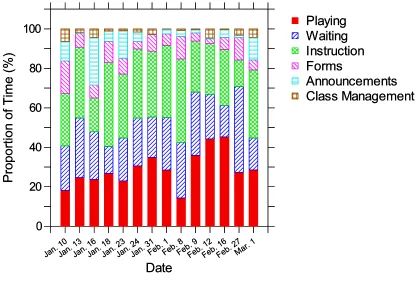
Figure 1.Bar graph showing percentage of instructional time spent on: playing, waiting, instruction, forms, announcements, and classroom management.
Video Data: When looking at the video data graph (Figure 1) there is a steady increase in playing time until the final two classes, which were after festival performance, and at a time when review of the band’s performance occurred. Overall the proportion of class time spent in instruction and with class management stayed relatively even. Time spent making announcements and completing research forms varied throughout the study. The most interesting finding relates to the waiting category. “Waiting” time seems to amount to between 15% to over 40% of class time, however this is misleading. Confusion resulted due to assigning too many activities to the “waiting” category. Time spent in: individual warm-up, individual or sectional rehearsal, or individual or sectional instruction were all classified as “waiting” by the researcher. Non-musical waiting, such as waiting for silence from class or waiting for the instructor to be ready, was also included in this category. Next time I would use Cavitt’s (2003) behaviour categories: teacher talk, teacher modeling, full ensemble plays, section plays, individual plays, performance approximation, student talk, and marking music to help clarify the differences between active music making, instruction, and waiting time. I would also be interested in knowing how other researchers, such as Worthy (2003) or Duke (1999), define playing time and whether or not individual warm-up and sectional playing is included in their definitions.
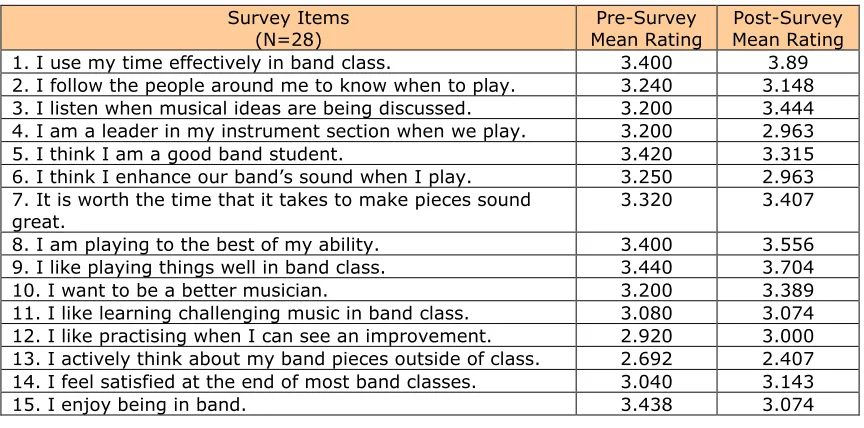
Survey Response: A statistical analysis of the survey results gleaned from students’ responses to 15 fixed items, shown in Table 1, yielded no significant differences between the pre- and post-survey procedures. T-tests assume equal variability in the two tests being compared; therefore F-tests were performed to check for significant differences in variability between the pre- and survey data. No detectable differences between pre- and post-survey results were found for any questions (p≥.01).
Survey Items (N=28)
Pre-Survey Mean Rating
Post-Survey Mean Rating 1. I use my time effectively in band class. 3.400 3.89 2. I follow the people around me to know when to play. 3.240 3.148 3. I listen when musical ideas are being discussed. 3.200 3.444 4. I am a leader in my instrument section when we play. 3.200 2.963
5. I think I am a good band student. 3.420 3.315
6. I think I enhance our band’s sound when I play. 3.250 2.963 7. It is worth the time that it takes to make pieces sound
great.
3.320 3.407
8. I am playing to the best of my ability. 3.400 3.556 9. I like playing things well in band class. 3.440 3.704
10. I want to be a better musician. 3.200 3.389
11. I like learning challenging music in band class. 3.080 3.074 12. I like practising when I can see an improvement. 2.920 3.000 13. I actively think about my band pieces outside of class. 2.692 2.407 14. I feel satisfied at the end of most band classes. 3.040 3.143
15. I enjoy being in band. 3.438 3.074
Table 1.
Pre-and Post-Survey Mean Results
Open Ended Response Items. The open-ended items asked students what they enjoyed about band class and what they would change. Two clear thematic categories emerged from the pre-survey data related to students’ “enjoyment”: (a) Playing and (b) Class Environment. Since students’ suggested changes to our band class at the beginning of the study were not implemented during the study, the new themes emerging from the post-survey were assumed to be a result of the study. The themes emerging from the post-survey item related to “enjoyment” were similar to the pre-survey results. “Playing” was again the most dominant sub-theme which included: (a) playing music; (b) playing fun songs; (c) playing my instrument; (d) playing well (new answer); and (e) learning more music. “Class environment” was the second most prominent response with all the pre-survey responses recurring, in addition to “band trips” and “everything” being included as aspects of the band program that students enjoyed. There were 4 students who chose not to respond to this question on the post-survey.
pre-survey responses. It might be inferred that students were more aware of specific tasks being accomplished during each class.
Conclusions
Question 1 - What proportion of instructional time do I spend on: teaching musical concepts and skills; conducting active music making; classroom management; waiting or wasting time?
Looking at the video data gathered, active music making (i.e. playing) accounts for 15% to 45% of my class time. If the “waiting” category is included, then “playing” increases from 40% to 70% of class time. I believe the reality is in the middle with approximately 30% to 50% of music class spent in active music making. The data collected shows that approximately 15% to 45% of classes are spent on instruction depending on the material being presented. The class time spent completing forms is atypical since this activity only occurred during this action research project. Making announcements took up from 0% to 25% of class time with the majority of classes involving less than 5% of time on announcements. Surprisingly, less than 5% of class time was used for classroom management, with the majority of classes devoting less than 1% of class time to classroom management issues. The literature provides support which indicates that these percentages characterize efficient band rehearsals.
Question 2 - How can I change my rehearsal practice to spend more time engaging students in active musical learning, and less time on non-musical tasks, thus improving the effectiveness and efficiency of my middle years band rehearsals?
New innovations using the ideas of Byo (1990) and Shayne Cofer (1998) fostered student musical independence by introducing non-verbal music skills. These skills focussed on: rhythm, style, quality of sound, blend and balance, phrasing, intonation, and conducting gestures. Also, regular use of a “set position” (Menghini; 2003) was incorporated into each music class which I believe was the most effective innovation introduced. This technique helped to create a “habit of mind” and a period of silent preparation for everyone in the room. As this habit formed, the length of time needed to prepare decreased, which contributed to the efficiency of the class. To be efficient classes need to be well planned with post-evaluations occurring after each rehearsal. I will continue to incorporate Bauer’s (2001) idea of writing the rehearsal order on the board and Munsons’s (1998) post-rehearsal evaluations which evaluate both teacher and student activity.
Question 3 - How do students perceive and respond to their band rehearsals?
While reviewing the related literature and conducting this action research study, many different ideas for future research come to mind. Future research that grows directly from my action research project would be to examine the following questions. Is there a link between the length of silent cue preparation time and effective rehearsals? Is there a notable difference when a conductor uses silent cues as opposed to count-off cues? What really is the correct pacing to use when preparing for an upcoming concert or festival performance? Is there a direct time link between the length of piece, difficulty of piece, age of participants, and so on, or do conductors just gradually develop a “feel” for correct pacing as they mature into their art form? Finally, is there a direct link between students perceived music responsibilities (e.g. expected practice time) and an ensemble’s musical expressiveness?
Final Thoughts
This action research project provided professional growth for the teacher/researcher and the students/performers. By systematically studying my practice, I have improved. The data derived from exit slips and video recordings does reflect this improvement, and I feel I have increased my understanding of pacing and my students’ overall perception of the band program. Allsup (2003), Broomhead (2001), Lisk (1991) and West and Rostvall (2003) discuss different musical experiences that help tap into a student’s inherent creativity or expressiveness. I will continue to use engaging, but challenging, listening warm-ups, improv, and composition assignments to try and access each student’s inner creativity. I will use teaching ideas from the literature and new practical knowledge I have gained from this action research project to challenge and access my own musical creativity, and to help keep me energized in my chosen vocation.
In “An Interview with Don Buell”, Simon (2006) states: “What causes a teacher to be efficient on the podium is when he or she recognizes whether a performance issue exists because the players don’t understand something or if they lack the skills to do it. ‘Understanding’ is addressed most effectively through demonstration or modeling, while skill-related instruction is best delivered verbally” (p.60). I want to be effective and efficient in my music classes and I believe that this action research project has helped, and will continue to help me achieve this goal.
References
Abeles, H. F., Hoffer, C. F., & Klotman, R. H. (1994). Foundations of music education (2nd ed.). New York, NY: Schirmer Books.
Allsup, R. E. (2003). Mutual learning and democratic action in instrumental music education. Journal of Research in Music Education, 51(1), 24-38.
Anderson, B. L. (1999). The habits of highly effective music educators. Teaching Music, 7(2), 48-51.
Bauer, W. (2001). Classroom management for ensembles. Music Educators Journal, 87(6), 27-32.
Brigham, F. J., Renfro, A. K., & Brigham M. M. (1994). Instruction and classroom management: A combination that is music to your ears. Valparaiso, IN. (ERIC Document Reproduction Service No. ED374109)
Broomhead, P. (2001). Individual expressive performance: Its relationship to ensemble achievement, technical achievement, and musical background. Journal of Research in Music Education, 49(1), 71-85.
Byo, J. (1990). Teach your instrumental students to listen. Music Educators Journal, 77(4), 43-46.
Cavitt, M. E. (2003). A descriptive analysis of error correction in instrumental music rehearsals. Journal of Research in Music Education, 51(3), 218-230.
Duke, R. A. (1999/2000). Measures of instructional effectiveness in music research. Bulletin of the Council for Research in Music Education, 143, 1-48.
Duke, R. A., & Henninger, J. C. (2002). Teachers’ verbal corrections and observers’ perceptions of teaching and learning. Journal of Research in Music Education, 50(1), 75-87.
Farrell, S. R. (1996). Tools for powerful student evaluation: A practical source of authentic assessment strategies for music teachers. Fort Lauderdale, FL: Meredith Music Publications.
Francisco, J.M. (1994). Conductor communication in the ensemble rehearsal: The relative effects of verbal communication, visual communication, and modeling on performance improvement of high school bands (Doctoral dissertation, Indiana University, 1994). Dissertation Abstracts International, 56(08), (University microfilms order no. 9542638).
Fonder, M. (1998). Defining and realizing your band’s ideal tone. Music Educators Journal, 85(3), 22-25.
Hewitt, M. P. (2001). The effects of modeling, self-evaluation, and self-listening on junior high instrumentalists’ music performance and practice attitude. Journal of Research in Music Education, 49(4), 307-324.
Hewitt, M. P. (2002). Self-evaluation tendencies of junior high instrumentalists. Journal of research in music education, 50(3), 215-227.
LaCombe, J. S. (2003). Managing the music classroom you can! Music Educators Journal, 89(4), 21-24.
Lisk, E. (1991). The creative director: Alternative rehearsal techniques [Videotape]. (Available from Meredith Music Publication, 170 N. E. 33rd St., Fort Lauderdale, FL 33334)
Madsen, K. (2003). The effect of accuracy of instruction, teacher delivery, and student attentiveness on musicians’ evaluation of teacher effectiveness. Journal of Research in Music Education, 51(1), 38-51.
Menghini, C. T. (2003). The efficient school band rehearsal. Retrieved March 23, 2005, from
http://www.vandercook.edu/free/EfficSchoolBandReh.pdf.
Munson, M. (1998). Ready for rehearsal? Teaching Music, 6(1), 32-34.
Townsend, A.S. (2003). Stop! Look! Listen! For effective band rehearsals. Teaching Music, 10(4), 22-25.
Van Weelden, K. (2002). Relationships between perceptions of conducting effectiveness and ensemble performance. Journal of Research in Music Education, 50(2), 165-176.
Walker, D. E. (1989). Teaching music: Managing the successful music program. New York, NY: Schirmer Books.
West, T., & Rostvall, A. (2003). A study of interaction and learning in instrumental teaching. International Journal of Music Education, 40, 16-29.
Williamson, J. E. (1998). Rehearsing the band (2ed.). Cloudcroft, NM: Neidig Services.
Wis, R. M. (1998). Invite, instruct, inspire. Teaching Music, 5(6), 38-40.
Worthy, M. D. (2003). Rehearsal frame analysis of an expert wind conductor in high school vs. college band rehearsals. Bulletin of the Council for Research in Music Education,156, 11-19.