ORIGINAL PAPER
Road safety audit on a major freeway: implementing
safety improvements
Sophia Vardaki&Fanis Papadimitriou&Pantelis Kopelias
Received: 25 July 2013 / Accepted: 16 May 2014 / Published online: 4 June 2014 #The Author(s) 2014. This article is published with open access at SpringerLink.com
Abstract
PurposeThe paper presents (i) the method followed in a road
safety audit of Attica Freeway (“Attiki Odos”), (ii) the find-ings and recommendations which arose from the RSA, (iii) the improvements made by the freeway operator to improve safe-ty, and (iv) the pilot safety treatments which were proposed with a view to broader implementation in order to mitigate similar problems at other locations.
MethodThe Road Safety Audit team conducted the RSA with
the goal of identifying potentially dangerous roadway or traffic features of the freeway operating environment, as well as potentially misleading or missing information by the ap-plying the safety principles of positive guidance and self-explaining roads.
ResultsThe RSA findings were recorded in the RSA report
together with recommendations for implementation. On the basis of the RSA findings, the freeway operator decided on the prompt implementation of several countermeasures, and in cooperation with the RSA team submitted to the Ministry of Infrastructure a proposal for pilot implementation of safety improvements included in the RSA report.
Conclusions An important factor determining the
effective-ness of the RSA was that the RSA recommendations were
implemented shortly after the RSA was completed. Prelimi-nary results from a before-and-after analysis of data regarding skid resistance characteristics, speeds and crashes at locations where RSA recommendations had been implemented showed improvements in skid resistance characteristics and a reduc-tion in the number of crashes and incidents. The RSA of Attica Freeway promoted the implementation of innovative road safety measures such as shot blasting and motorcyclist-friendly restraint systems.
Keywords Road safety audit . Road safety improvements . Freeway safety inspection . Vulnerable road users . Human factors
1 Introduction
Road Safety Audit is a formal, systematic, independent as-sessment of the potential road safety problems associated with a new road scheme or road improvement scheme. The assess-ment should involve the placing of equal emphasis on all road users. An RSA is not a check on compliance with standards [1]. Austroads includes the examination of existing roads in RSA, also noting that it is not the scale of the project that is important but the scale of any potential hazard the design may unwittingly hide [2].
The focus of RSA, which is proactive and qualitative, is on road safety. RSAs are carried out by a multidisciplinary auditing team comprising two or more experienced and qual-ified road safety engineers who are not part of the design team [1], [3].
RSA meets the “Safe System” requirements which are: designing, constructing and maintaining a road system so that forces on the human body generated in crashes are generally less than those resulting in fatal or debilitating injury; improv-ing roads and roadsides to reduce the risks of crashes and S. Vardaki (*)
Department of Transportation Planning and Engineering, School of Civil Engineering, National Technical University of Athens, 5, Iroon Polytechniou St., 15773 Zografou Campus, Greece
e-mail: [email protected]
F. Papadimitriou
:
P. KopeliasAttica Tollway Operations Authority–Attikes Diadromes S.A., 41, 9 km Attiki Odos Motorway, 19002 Paiania Athens, Greece
F. Papadimitriou
e-mail: [email protected]
P. Kopelias
minimise harm; measures for higher speed roads including dividing traffic, designing forgiving roadsides and providing clear driver guidance; managing speeds [2].
RSA has been broadly recognized as a successful preven-tive tool for minimizing future collision occurrence and forms an integral part of the safe system approach. There are three main, current, RSA guidelines internationally: those published by Austroads in 2009 [2], those published by the British Institution of Highways and Transportation (IHT) in 2008 and those published in the USA in 2006, by the Federal Highway Administration (FHWA). These documents as well as several studies (e.g., [4–6]) clearly indicate the benefits of RSA.
It is widely recognized that RSA findings should provide feedback to teams designing similar projects. The results of the RSA study might provide infrastructure operators and designers with feedback that assists them in identifying potential safety issues at an early stage – since the same tools/design guidelines are used for the design of freeway infrastructure [7]. A process for effective dissemination of RSA results should be introduced, while RSA might con-tribute to a“safety by design”culture within organizations [1], [8].
European Directive 2008/96/EC of the European Parlia-ment and of the Council on Road Infrastructure Safety Man-agement (Official Journal of the European Union 29.11.2008, L319/59-L319-67) which makes RSAs mandatory for the Trans European Road Network was recently incorporated into Greek law [9]. Although the necessary procedures for RSA implementation were recently regulated [10], critical parame-ters of implementation such as Road Safety Auditor training and accreditation urgently need to be addressed.
Attica Freeway (also known as“Attiki Odos”) is a newly designed and constructed urban freeway. In 2009, in order to address the need to improve safety levels, the Attica Freeway Operations Authority (Attikes Diadromes S.A., the agency responsible for operating and maintaining the freeway), de-cided that an RSA should be carried out by a team of experi-enced road safety engineers. At the time the Attica Freeway RSA was implemented (2009), RSAs had not been adopted formally. Particular safety concerns included crash history, especially the high percentage of motorcycle crashes, the increase in traffic volumes as well as high operating speeds, especially at some locations with challenging alignment. The operator has developed a procedure of effective maintenance programs and implements regular inspections to improve the operating conditions of the freeway.
This paper presents the method followed in a road safety audit of Attica Freeway, the findings and recommendations which arose from the RSA, the improvements made by the freeway operator to improve safety and the pilot safety treat-ments which were proposed with a view to broader imple-mentation in order to mitigate similar problems at other
locations. Finally the key elements of the RSA of Attica Freeway are discussed and the conclusions are presented.
2 Method
In general, conducting a RSA requires a formalized process which should be adapted to the nature and scale of the partic-ular project [2]. In conformity to this systematic process, RSA for Attica Freeway involved the following steps: i. The agency/operator (Attica Freeway Operations Authority) se-lected the RSA team which consisted of experienced road safety engineers being in addition independent from the pro-ject; ii. project designers provided the necessary project infor-mation to the audit team enabling auditors to assess the project; iii. the operator convened a commencement (pre-audit) meeting with the designers and the RSA team; iv. RSA team assessed the data and the documents; v. RSA team inspected the site and discussed the findings with the operator and the designers; vi RSA wrote a report with their findings and relevant recommendations for improvements; vii. The operator responded to RSA report.
2.1 Project background
Attica Freeway (“Attiki Odos”) is a 70 km freeway centreline length in each direction and is used as a Ring Road for Athens, the capital of Greece. There are 39 Entrances to the Freeway through toll plazas with 195 toll lanes. Mainly it is a 3 lane freeway with a small section (less than 20 km) with 2 lanes.
Attica Freeway was delivered in segments starting March of 2001 and was completed in June 2004, prior to the 2004 summer Olympics. It consists of two major freeway sections, a) The“Elefsina - Stavros - Spata (ESSM), b) The”Imittos Western Peripheral Motorway” (IWPM) or Imittos Ring Road.
The overall safety level of Attica Freeway is depicted in Table 1. Fatal crashes per million of vehicle kilome-ters for 2011 is 0.6. This result is attributed to the quality of design, construction and equipment as well as the effectiveness of programs for monitoring, inter-vention and maintenance.
The study area is the entire length of the freeway, i.e. 70 km including the mainline and the Imittos Ring Road, twenty
Table 1 Indicators of fatal accidents and deaths per 100 million
vehicle-kilometers (2009–2011)
2009 2010 2011
eight interchanges, four toll plazas (in the mainline) and access roads to the (two) rest areas.
2.2 RSA team
The RSA was carried out by an independent team of road safety engineers with appropriate experience and qualifica-tions for the particular project. They had considerable exper-tise in road design and construction, traffic management and human factors.
2.3 Pre-audit meeting
Before the field inspection, a commencement meeting was held in which the RSA team, the operator staff and a police officer participated. The meeting was necessary for the oper-ator to become familiar with the audit process and for the audit team to obtain the necessary background for the project and receive information regarding road safety concerns and prob-lems, issues and constraints requiring specific consideration.
2.4 Data collected
The data which were provided to the audit team included:
& The design standards that were used. & Traffic volumes.
& Horizontal and vertical alignment plans (1:5000 scale). & Ortho photomaps (1:2000).
& Previous road safety audit reports from the pre-opening stage.
& Sign plans (1:5000). & Freeway plans“as built”. & Crash data.
& Route mapper software. .
2.5 Field Inspection and checklists
When inspecting a design or a newly constructed project, road safety auditors must first consider who might be hurt in a collision on a particular part of the highway and how that might occur. The auditors must then consider how the poten-tial for such a collision can be reduced or how its conse-quences might be limited [1], [2], [3].
The Road Safety Audit team conducted the RSA with the goal to identify potentially dangerous roadway or traffic fea-tures of the freeway operating environment, as well as poten-tially misleading or missing information by the application of safety principles of positive guidance and self-explaining roads while recognizing the potential influence of human factors such as road users’ limitations in capabilities or unfamiliarity.
The RSA audit lasted approximately one month. The RSA team developed checklists for the specific project, as was requested by the operator. They were based on a review of the relevant material and were tailored to the specific freeway. The freeway was inspected in daylight and at night-time in wet and dry conditions and included all movements at each interchange. The inspection was undertaken from the point of view of all road users. Motorcyclists accounted for a consid-erable share of crashes, as was evident from the data provided to the RSA team, while older drivers displayed difficulties at certain locations.
During the road inspection emphasis was placed on how drivers might perceive or adjust their behavior to the features of the roadway, allowing the identification of any aspects of the roadway where drivers’ expecta-tions about the road and traffic might be violated or where the layout fails to give the right message [2], [11]. The RSA team checked issues regarding recogniz-ability, early warning and guidance, particularly at loca-tions where drivers make complex decisions and/or per-form complex maneuvers [12], [13], [14]. The road was reviewed on the basis of the adequacy of time available to drivers in order to decide and perform maneuvers, the conformity of road layout to driver expectancies (any changes/critical transition points in road and traffic characteristics being indicated clearly and in good time), checking potential violations of expectancies related to roadway design. Inspections were scheduled during typ-ical or representative traffic conditions, allowing the RSA team to understand how usual traffic conditions and road user behavior may affect safety during the daytime and at night [15].
RSA was partly based on a research study on perfor-mance assessment and self-assessment in which active older drivers participated in an on-road trial on the freeway in question [16], [17]. A method of perfor-mance assessment was developed which was based on observations of driving behavior and task analysis. Task analysis is a process tool, useful in revealing the inter-action between task demands and users’ capabilities [18], [19], [16]. The route appeared to have complexi-ties at certain locations where drivers had to choose directions and/or maneuver in short sequence or inside tunnels, following rather complicated signs at relatively high speeds and in considerable traffic [16], [17].
The RSA findings were recorded in the RSA report togeth-er with recommendations for implementation.
3 RSA findings and recommendations
presented in the following sections along with the correspond-ing recommendations. They are summarized in Table2
3.1 Markings
The road marking was faded at certain locations, while old markings controlling temporary traffic had not been removed effectively (Fig.1). Improvement of road markings was rec-ommended since ineffective markings could cause course
deviation and driver behavior problems especially in a high speed environment as a result of inadequate warning and guidance. The use of a high-quality retroreflective material effective in rain and darkness with adequate skid resistance characteristics was recommended. Priority of implementation was recommended for horizontal curves and transition points.
3.2 Roadside hazards
The RSA team identified locations where the roadside barrier was interrupted for a short distance. This would cause an errant vehicle entering the unprotected zone to be“trapped”, with no possibility to retain control and crash into roadside obstacles behind the barriers. In addition, there were some-times no safety barriers in front of roadside obstacles such as lighting columns, pipes in tunnels and electrical and mechan-ical installations. Such features cannot be removed, while at these locations maintenance activities by technical personnel take place regularly. The team recommended the installation of restraint systems to fill the short gap between consecutive barriers–ensuring safety-barrier continuity–and in front of road equipment (Fig.2).
During the RSA, the team identified some locations where bridge abutments are almost in contact with the restraint system. Similarly, there was almost no space between the safety barrier and the bridge column
Table 2 Selected safety issues
Topic areas Safety issues Recommendations
Signage Faded road markings Improved road markings Old road markings Removal of old road markings Roadside hazards Unprotected road equipment (lighting columns, pipes in
tunnels, electrical and mechanical installations)
Installation of roadside barriers
Short gaps between road side barriers Extension of barriers
Bridge abutments and columns Installation of safety barrier special treatment Cross-sections Variability of emergency lane width/excessive width Constant width of emergency lane
Stopping sight distance (ssd)
Limited ssd on horizontal curves (vegetation, guard rails, tunnel concrete wall)
Elimination of plantation (New Jersey) Improvement of road surface skid resistance Warning sign (danger)/VMS Lower speed limit Automatic speed cameras enforcement
Decision sight distance
Restricted sight distance due to upstream horizontal/ vertical curvature
Improvement of road surface skid resistance Advance warning signs Improvement of road delineation/markings Crash cushion at noses (ends of barriers) Speed limit sign Automatic speed cameras enforcement
Driver behavior Operating speeds exceeding speed limit in tunnels and direction choice points
Improvement of road surface skid resistance Improvement of road delineation/markings Speed limit signs in tunnels (Rumble strips before decision points)
Encroachment on delineated areas Use of rumble strips Advance warning signs (gantries) Special considerations
for vulnerable road users
Protection of motorcyclists Addition of a skirting to road restraint systems, especially on tight curves
Older drivers’hesitation upstream of exit locations (lack of familiarity with the freeway and traffic safety rules/ practices)
Guidance of drivers by advance signing and speed limit enforcement
(Fig. 3). In the case of a vehicle collision with the restraint systems there would be not adequate space allowing effective absorption of the kinetic energy.
The installation of a concrete barrier of appropriate height and length and special treatment of transition areas between the different types of restraint systems was recommended.
3.3 Cross section
The emergency lane had variable width and at some locations drivers might use it as an ordinary lane. The application of constant width along the emergency lane was recommended along with appropriate transition between variable widths.
3.4 Limited stopping sight distance
During the inspection, the RSA team identified horizontal curves with limited sight distance. A comparison between the available sight distances and the required stopping sight distances [12] (calculations based on the speed limit) on
curves identifies where there were visibility restrictions in the left lane due to the height of vegetation (i.e. the case of the median concrete barrier on left horizontal curves) or the height of the guardrail as well as in the right lane mainly due to the tunnel wall. Suggestions of the RSA team included de-creasing the speed limit, placement of appropriate warning signs, elimination of plantation on horizontal curves, improve-ment of road surface skid resistance and speed limit enforce-ment. In order to increase speed limit compliance, the RSA team proposed the use of automatic speed cameras. It is worth noting however that speeding should be treated with a com-bination of measures including roadway treatments and be-havioral countermeasures [20]. The RSA team proposed for pilot awareness campaigns to promote the acceptance by the public of the use of automatic speed cameras (section 4.2).
3.5 Decision sight distance
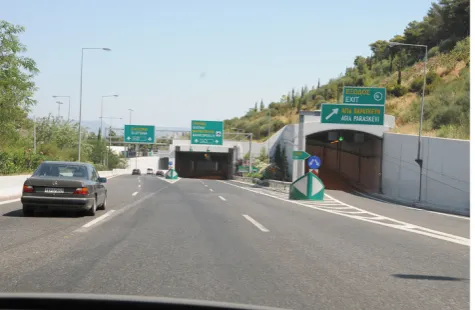
The RSA team identified restricted visibility in locations where complex maneuvers are carried out, during which drivers have to choose directions and/or maneuver in short sequence or inside tunnels, following rather complicated signs at relatively high speed and in considerable traffic. The par-ticular layouts were considered uncommon, potentially vio-lating drivers’expectancies [11].
3.5.1 Freeway split with an optional lane
A freeway split is located downstream from an entrance and a sight-restricting horizontal curve (Fig.4).
3.5.2 Lane drop
Drivers on a two-lane ramp connecting road have to follow directions to the mainline. As they approach they are warned about the exit (combined with a lane drop) which is located downstream from a sight-restricting vertical curvature. In addition, they usually have to change lane to follow the
Fig. 2 Short break in guard rails
mainline direction, merging into the left fast lane (direction to mainline).
3.5.3 Consecutive maneuvers
Approaching consecutive exits, located downstream from a sight-restricting vertical curvature, drivers have to make di-rectional choices and maneuvers in short sequence following directional signs inside a tunnel. Due to high operating speeds, the available visibility distances to these locations were less than the sight distance needed to decide and complete the maneuver they were almost sufficient at driving speeds within the speed limit [12].
RSA recommendations included improvement of road sur-face skid resistance and installation of advance warning signs within tunnels. In addition, since additional safety issues were identified at these locations, the team suggested appropriate measures such as improved road delineation and elimination of old markings, installation of a crash cushion at gores or split points, installation of speed limit signs and speed limit enforcement.
3.6 Driver behavior
3.6.1 Operating speeds exceeding speed limit
The RSA team observed driving behaviors related to driving speeds exceeding the speed limit along sections where limited sight distances were identified, specifical-ly on horizontal curves with limited stopping sight distance due to the presence of plantation or a guardrail on the restraint system and the concrete wall inside tunnels. Relatively high driving speeds were also ob-served in proximity of freeway exits or split points where complex maneuvers are carried out.
The team recommended improvement of road surface skid resistance and improvement of road delineation and markings, as well as speed management measures such as installation of speed limit signs in tunnels, as well as rumble strips before decision points and enforcement of speed limits. Among the measures suggested was the monitoring of speeds and skid resistance in these areas in order to identify, as early as possible, the need for relevant interventions.
3.6.2 Encroachment on delineated areas
Observations of drivers’ behavior revealed that at cer-tain locations (either on a ramp connecting road or on the mainline along a transition section between variable widths) drivers encroached on delineated areas. In order t o d i s c o u r a g e t h i s u n i n t e n d e d u s e , t h e t e a m
recommended the use of rumble strips in these areas and installation of advance warning signs on gantries.
3.7 Motorcyclists
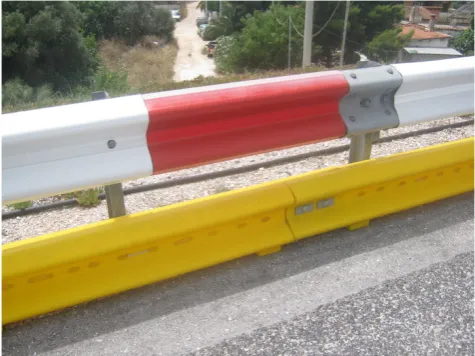
Accident data revealed a significant proportion of accidents involving motorcyclists. In particular, motorcycles represent 3 % of traffic while their share in road deaths is 60 %. The RSA team recommended addition of a “skirting” to road restraint systems (Fig.5), especially on tight curves, for guid-ance and protection especially for motorcyclists.
4 RSA follow-up and implemented improvements
The findings of the RSA and the proposed improvements were included in the final RSA Report and were presented during a meeting with the freeway operator. It is worth men-tioning that some of the recommendations of the RSA team were already part of the operator’s regular maintenance program.
In response to the RSA, shortly after its completion, the operator submitted to the Ministry of Infrastructure a proposal for pilot implementation of selected road safety improvements included in the RSA recommendations. After the completion of the RSA the freeway operator implemented the following improvements:
& Shot blasting technique was used for old markings elim-ination and road skid resistance improvement
& Speed limits were displayed on VMSs at tunnel entrances as well as in tunnels.
& Speed limit signs were installed in tunnels and at tunnel entrances (gantries), with special consideration to tunnels with visibility restrictions due to operating speeds exceed-ing the speed limit.
& Automatic speed cameras were installed for speed limit enforcement in 14 sites of the freeway
& A“skirting”was added to road restraint systems, especial-ly on tight curves, for guidance and protection of motorcyclists.
4.1 Preliminary results
The results of the before-and-after analysis of data following the shot blasting [21] and the speed reduction measures showed an improvement in skid resistance characteristics and a reduction in the number of crashes.
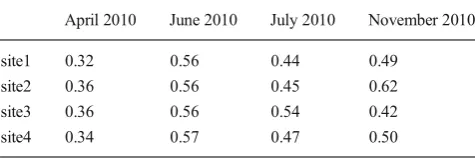
Table3presents the Grip Number (GN) values before and after applying the method of shot blasting at four sites of Imittos Ring Road. The GN indicator quantifies the value derived from the measurement system of resistance to slip, Grip Tester. The results show a significant improvement of GN immediately after the implementation of the procedure at all sites (June 2010 onwards).
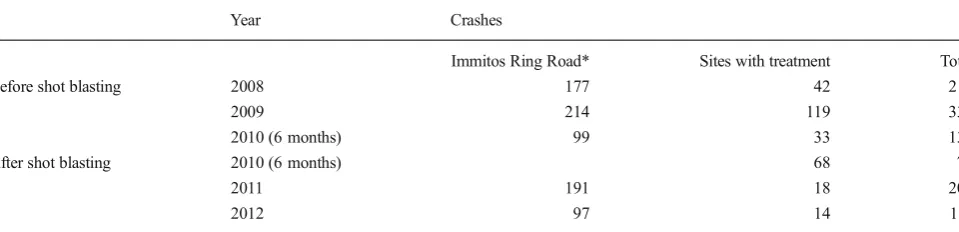
Crashes at sites with treatment (shot blasting) are compared to the number of crashes of the total length of Imittos Ring Road (control data). Table4shows the number of accidents in both groups for a period of 2,5 years before and after the treatment. A chi-square test was performed to examine this difference between the accidents reduction. The results show a significant difference at the sites with shot blasting (χ2=42, df=1, p<0.01).
These improvements might be related to the shot blasting as well as to the reduction in average speeds at locations where speed radars were installed. It is worth noting that a reduction in average speeds was identified at locations without speed radars as well, which might be related to a general perception of speed enforcement along the freeway. By the summer of 2010, the installation of automatic speed cameras was completed at 14 sites. About half of them were installed along the Imittos Ring Road. The first results show a reduction in the average speed of 4 %. Given the potential temporary character of these changes, continuous monitoring of operating speeds is consid-ered necessary, particularly at locations with visibility
restrictions, to ensure that the issues will be addressed promptly.
4.2 Proposals for pilot implementation of selected road safety improvements
Following a request from the operator, the RSA team developed a proposal regarding the pilot implementation of road safety improvements to address the safety issues raised during the RSA. The specific road safety im-provements were selected on the basis of the potential of their effective implementation within a relatively short time and without greatly affecting the operation of the freeway. These safety treatments were proposed as pilots for broader implementation to mitigate similar problems at other locations. On the basis of their per-formance as pilot interventions, these could be imple-mented later on a larger scale to address similar safety issues. Among the main pilot interventions to address specific safety issues are:
& Improvement of visibility on left horizontal curves with median concrete safety barriers. Proposal: Elimination of plantation; installation of speed radar for speed limit en-forcement; shot blasting to improve skid resistance. & Lowering operating speeds and improvement (if
neces-sary) of skid resistance on horizontal curves with guard-rails and parapets on median safety barriers and in tunnels. The RSA suggested the possible lowering of the speed limit in combination with an awareness campaign and speed limit enforcement, as well as installation of a sign displaying the measured vehicle speeds. The proposed measures were implemented by the operator in mid-2010 and the results were presented in the previous sections. & Improved guidance and warning of upstream freeway split
with an optional lane where there is the potential of drivers’expectancy violation. Proposals include measure-ment of skid resistance (and improvemeasure-ment if necessary); elimination of old markings; installation of advance warn-ing signs within the tunnels; installation of rumble strips before and after a sight-restricting horizontal curve; instal-lation of speed limit signs and speed radar for speed limit enforcement; installation of a crash cushion at the split point in front of tunnel walls.
& Deterrence of drivers encroaching on delineated areas. The proposal included the use of rumble strips in these areas, while at locations where there is a reduction in the number of lanes, the installation of advance warning signs on gantries was suggested. The implementation of rumble strips is planned for summer 2012 at locations selected by the RSA team in collaboration with the Attica Freeway Operator.
Table 3 GN number before and after the application of shot blasting
April 2010 June 2010 July 2010 November 2010
site1 0.32 0.56 0.44 0.49
site2 0.36 0.56 0.45 0.62
site3 0.36 0.56 0.54 0.42
& Continuity of roadside safety barriers at locations where there are short gaps between consecutive barriers and installation of road safety barriers in front of road equip-ment inspected regularly by roadway personnel.
& Special treatment of concrete safety barriers in close prox-imity to bridge abutments, columns or walls, accompanied by appropriate transition between the various types of restraint systems and linear delineation before and after bridge structures.
& Installation of a“skirting”to road restraint systems, espe-cially on tight curves, for guidance and protection of motorcyclists. The red and white protective system has gradually been implemented over the last three years in combination with speed limit signing.
5 Discussion and conclusions
An RSA of the Attica Freeway was conducted in mid-2009 aiming at identifying features of the roadway operating envi-ronment which might be potentially dangerous. Emphasis was placed on the principles of positive guidance and self-explanatory design consistent with road users’expectations while recognizing their information needs, limitations and capabilities. Observed and assessed behavior of a group of active older drivers on the freeway was exploited in the Road Safety Audit.
The road safety issues raised, as well as the recommenda-tions for improvement which were considered for pilot imple-mentation, were selected on the basis of their potential effec-tiveness on a wider scale without major implications for freeway operation. They cover horizontal curves with visibil-ity restriction; freeway split locations; delineated areas where traffic is prohibited; road safety barriers installation; the spe-cial configuration of the restraint system in close proximity to bridge abutments and columns; and the installation of a skirt-ing to restraint systems for the guidance, warnskirt-ing and protec-tion of motorcyclists.
RSA findings and recommendations have been well re-ceived by the operator of the Attica Freeway. On the basis of the RSA findings, the freeway operator decided on the prompt implementation of several countermeasures, and in coopera-tion with the RSA team submitted to the Ministry of Infra-structure a proposal for pilot implementation of selected safety improvements already included in the RSA report. Apart from the broad perspective of safety issues identified by the RSA audit team, the experience of conducting an RSA on an operating freeway revealed characteristics of the RSA that have promoted the acceptance of RSA recom-mendations and their implementation, thus making the RSA useful.
Based on the experience gained from the implemen-tation of RSA in the operating stage it should be stressed that the participation in the RSA team of mem-bers with knowledge of human factors is considered advisable for an effective result. A local enforcement officer (enforcement practices and condition) and a team from the operator staff with experience in maintenance practices and conditions participated in the meetings providing firsthand knowledge for the project. Specifi-cally, with the help of operator staff, the pre-audit meeting was useful for the RSA team to obtain a picture of the project background and the challenges of the Attica Freeway in operation. In addition, the RSA team discussed the preliminary RSA results (find-ings and recommendations) in a preliminary find(find-ings meeting before the conclusion of the RSA report. Topics of discussion were practical issues regarding the imple-mentation of RSA recommendations and a realistic time frame for implementation. This resulted in suggested safety treatments which were practical and reasonable.
An important factor determining the effectiveness of the RSA was that the RSA recommendations were im-plemented shortly after the RSA was completed. Prelim-inary results from a before-and-after analysis of data regarding skid resistance characteristics, speeds and crashes at locations where RSA recommendations had
Table 4 Number of crashes before and after shot blasting
Year Crashes
Immitos Ring Road* Sites with treatment Total
Before shot blasting 2008 177 42 219
2009 214 119 333
2010 (6 months) 99 33 132
After shot blasting 2010 (6 months) 68 74
2011 191 18 209
2012 97 14 111
been implemented showed improvements in skid resis-tance characteristics and a reduction in the number of crashes and incidents. It is worth noting that the RSA of Attica Freeway (“Attiki Odos”) promoted the implementation of innovative road safety measures such as shot blasting and motorcyclist-friendly restraint systems.
Open AccessThis article is distributed under the terms of the Creative
Commons Attribution License which permits any use, distribution, and reproduction in any medium, provided the original author(s) and source are credited.
References
1. The Institution of Highways & Transportation (IHT) 2008. Road Safety Audit. London. ISBN 978-0-902933-40-8.
2. Austroads 2009. Guide to Road Safety. Part 6. Road Safety Audit. Publication No. AGRS06-09.Sydney
3. Federal Highway Administration (FHWA) 2006.Road Safety Audit Guidelines. Publication No. FHWA-TO-86-1. FHWA, U.S.
Department of Transportation
4. Heaslip K., Jones, J., Harpst, T., Bolling, D. 2010. Implementation of Road Safety Audit Recommendations: Case Study in Salt Lake City, Utah.Transportation Research Record,No. 2182, ISBN 978-0-309-16053-7, pp. 105–112
5. Kanellaidis G (1999) Aspects of road safety audits. ASCE J Transp Eng 125(6):481–486. doi:10.1061/(ASCE)0733-947X(1999) 125:6(481)
6. Mahgoub H., Skorseth, K., Marshall, R., Selim A. 2010. Local Rural Road Safety Audit Guidelines and Case Studies.Transportation Research Record,No. 2182, ISBN 978-0-309-16053-7, pp 97–104. 7. Kanellaidis, G., Vardaki, S. 2011. Highway geometric design from
the perspective of recent safety developments.ASCE Journal of Transportation Engineering, Forum piece, Vol. 137, Is. 12, December 2011, pp. 841–844. DOI: 10.1061/(ASCE)TE.1943-5436.0000322
8. Transportation Research Board (TRB) 2010a. White Papers for the web Stakeholder Workshop for Toward Zero Deaths: A National Strategy on Highway Safety, August 25–26, Washington, D.C. [Ward, N.J., Linkenbach, J., Keller, S.N., Otto, J. White paper on
Traffic Safety Culture (No.2)]. Available from Internet:http://safety. transportation.org/doc/web2 Safety Culture White Paper.pdf
9. Journal of the Government of the Hellenic Republic (JGHR). Issue 237/A /07.11.2011.http://www.ermis.gov.gr
10. Journal of the Government of the Hellenic Republic (JGHR). Issue 3134/B/27.11.2012.http://www.ermis.gov.gr
11. Alexander, G., Lunenfeld, H. 1986.Driver expectancy in Highway Design and Traffic Operations. Technical Report FHWA-TO-86-1. FHWA, U.S. Department of Transportation
12. American Association of State Highway and Transportation Officials (AASHTO) 2004.A Policy on Geometric Design of Highways and Streets. Washington D.C.. ISBN 1-56051-263-6
13. AIPCR/PIARC. Human factors guideline for safer road infrastructure, Route2 market, France, 2008.ISBN2-84060-215-6 14. Transportation Research Board (TRB) (2012) “Human Factors
Guidelines for Road Systems”NCHRP Report 600 (Second Edition). Washington D.C.
15. Federal Highway Administration (FHWA) 2006a. Road Safety Audits: Case Studies. Publication No. FHWA-TO-86-1. FHWA, U.S. Department of Transportation, 2006a
16. Vardaki, S 2008. An investigation of older driver actual and per-ceived behavior on freeway. InTransportation Research Record, Journal of the Transportation Research Board, No. 2078, Transportation Research Board of the National Academies Washington, D.C., 2008, 41–47. DOI:10.3141/2078-06
17. Vardaki, S., Karlaftis, M., G. 2011. An investigation of older driver road safety perceptions and driving performance on freeways. Advances in Transportation Studies, Special Issue 2011, pp.7-18 18. Knoblauch, R., Nitzburg, M, Seifert, R. 1997.An Investigation
of Older Driver Freeway Needs and Capabilities. Publication No. FHWA-RD-95-194, Federal Highway Administration, McLean VA.
19. Fuller, R, Santos J.A. 2002.Human Factors for Highway Engineers, Chapt.17, Road users who are elderly: drivers and pedestrians, 1st Ed., Pergamon, Oxford. ISBN 0-080-43412-6. http://www. westerntransportationinstitute.org/documents/reports/4W3048_ Final_Report.pdf
20. Transportation Research Board (TRB) 2010b. White Papers for the web Stakeholder Workshop for Toward Zero Deaths: A National Strategy on Highway Safety, August 25–26, Washington, D.C. [White paper on Safer Infrastructure (White paper No.6)]. Available from Internet: http://safety.transportation.org/doc/web6 Safer Infrastructure White Paper.pdf