Psychology, available online: https://doi.org/10.
Manuscript Details
Manuscript number: COPSYC_2018_21_R1 Title:Attachment and Prejudice
Short title:Attachment and Prejudice Article type: Review article
Abstract
There is a paucity of research that examines prejudice from an attachment theory
perspective. Herein we make theoretical links between attachment patterns and levels of prejudice. Perceptions of outgroup threat, which activate the attachment system, are thought to lead to fear and prejudice for those high in attachment anxiety, and to distancing and prejudice for those high in attachment avoidance. We review the literature that examines the associations between attachment patterns and prejudice; evidence from attachment priming studies suggest a causal role of attachment security in reducing prejudice. We identify several mediators of these links: empathy, negative emotions, trust, social dominance orientation, romanticism, and contact quality. Future research should manipulate potential mediators and use psychophysiological assessments of threat.
Corresponding Author's Institution: University of Southampton Order of Authors
Katherine Carnelley, Elle Boag
Submission Files Included Ref: COPSYC_2018_21Title: Attachment and Prejudice Journal: Current Opinion in Psychology
• Declarations of interest.docx [Conflict of Interest]
Highlights
Insecurity links to prejudice via different mechanisms, but most involve
threat.Research using priming methods suggest attachment insecurity may cause prejudice.Future research should include the experimental manipulation of
Attachment and Prejudice
Katherine B. Carnelley
11
Department of Psychology University of Southampton Highfield Campus Southampton, SO17 1BJ United KingdomElle M. Boag
22
Birmingham City University School of Social Sciences Department of Psychology Room C333Curzon Building Cardigan StreetBirminghamB4 7BDUnited Kingdom
Abstract
There is a paucity of research that examines prejudice from an attachment theory
Attachment and Prejudice
Introduction
Prejudice and discrimination are important social problems worldwide [1]. Our aim is to review the small body of research that applies attachment theory to understand individual differences in prejudice. Because this area is understudied, we chose a more comprehensive approach that covered papers published from 2001 to most recently, 2016, that focused on ethnicity, immigrants, religion, gender, lesbian/gay/bisexual and elderly outgroups. (We
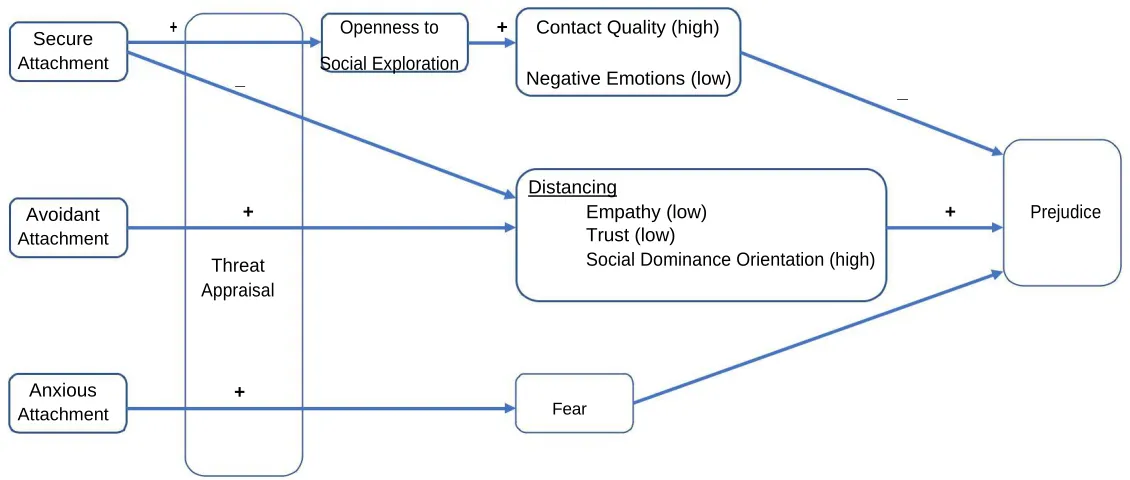
excluded two papers on disabled, mentally ill and physically ill because these targets potentially represent a large number of varied categories that were not comprehensively examined). In general, attachment anxiety and avoidance are positively associated with prejudice via different mechanisms, however most presumably involve threat that activates the attachment system. Perceptions of outgroup threat are thought to lead to fear and prejudice for those high in attachment anxiety, and to distancing and prejudice for those high in attachment avoidance (see Figure).
Attachment and Theoretical Links to Prejudice
Attachment theory explains how childhood relationship experiences influence
expectations and behaviours within relationships throughout life [2,3]. Individual experiential differences in consistency of sensitivity and responsiveness to needs in early childhood lay the foundations for individual attachment-related behavioural repertoires (patterns). Attachment patterns vary on two dimensions: attachment-related anxiety (related to fear of
abandonment) and attachment-related avoidance (related to discomfort with dependency); high levels of either dimension indicate an insecure attachment pattern, and low levels of both indicate a secure attachment pattern. Attachment anxiety is a result of inconsistent and
Why or how would attachment patterns relate to prejudice? Attachment patterns are associated with how individuals regulate affect and deal with threat. “Prejudice is an individual-level attitude (whether subjectively positive or negative) toward groups and their members that creates or maintains hierarchical status relations between groups.” [5]. Stephan, Ybarra, and Morrison [6] suggest that people may be predisposed to view outgroup members as
threatening.
Generally speaking, threats are posed in times of danger, stress or illness: The attachment behavioural system is activated in order to obtain felt-security. Those high in attachment security can effectively regulate negative affect by self-soothing or seeking support from others. Their high social competence and humanity-esteem [7,8] reflect their positive models of self and others [9]. Furthermore, they are open to experiences [10] suggesting more engagement with and acceptance of outgroup members. In contrast, insecure individuals theoretically would respond to outgroup-related threats with greater prejudice. Those high in attachment anxiety have hyperactivated attachment systems that lead them to focus on threat in their environments. They have low unstable self-esteem [11], hold partner views that
fluctuate in valence over time and are ambivalent [12,13], have more aversive relationship and social goals [14,15], use more stereotyped judgments [16], and are low in humanity-esteem [7]. Prejudice may be a way to protect the self from threat for these people. Those high in
avoidance have chronically deactivated attachment systems; they turn away from relationships and rely compulsively on the self in times of threat. Similar to anxious individuals, they make more stereotyped judgments and are low in humanity-esteem [7,16]; however, avoidant individuals hold negative models of others [9], are low in agreeableness [17], have low approach motivation [18] and low appetitive relationship goals [14]. Prejudice and
Attachment and Prejudice: Evidence about ethnic and gender outgroups
The most consistently examined targets of prejudice in this area are immigrants and people of different ethnicities or religions, with a few studies of other outgroups (e.g., aged adults [19], LGB individuals with mixed results, [20,21,22,23], and gender). For example, Di Pentima and Toni [24] examined the links between attachment orientation and subtle and blatant prejudice against immigrants. They discovered that secure Italian adolescents (age 13-19)were lower in blatant and subtle prejudice compared to adolescents with insecure styles. Consistent with this, research in the Netherlands has shown that secure adults had more positive attitudes toward immigrants’ integration into the host society, whilst insecure adults had more negative attitudes; specifically dismissing-avoidant individuals thought that
immigrants should maintain separation from the host society and attachment-anxious
individuals thought immigrants should be marginalized [25,26]. This is consistent with avoidant individuals’ negative models of others and desire to maintain distance and anxious individuals’ ambivalent view of others and desire to protect the self.
Past research suggests that high quality contact with outgroup members decreases prejudice [27]. Boccato, Capozza, Trifiletti, and Di Bernardo [28] address the interesting question of how attachment patterns influence the extent to which people interact with
outgroup members (immigrants). They find that secure attachment is positively associated with amount of contact with immigrants and contact quality. Furthermore, contact quality mediates the link between security and positive evaluations of outgroup members. Their findings show that openness to exploration (particularly social exploration) mediates the link between security and contact quantity and quality. Avoidant attachment is negatively associated with outgroup evaluations. These researchers also go beyond explicit evaluations and use the IAT to assess implicit approach versus avoidance motives toward immigrants, finding attachment security is associated with a lower tendency to associate immigrants with avoidance-related words and a higher tendency with approach-related words. This suggests that secure
allows them to be open to new experiences and implicitly move toward them.
Attachment patterns also predict prejudiced attitudes regarding gender. Hart and
colleagues [29,30] examined how models of romantic others that underlie attachment patterns predicted benevolent and hostile sexism among male and female samples. Attachment anxiety was associated with more benevolent and hostile sexist attitudes (i.e., ambivalent sexism), whereas avoidance was associated with only more hostile sexist attitudes toward the opposite sex. Furthermore, attachment anxiety predicted high romanticism, which in turn, predicted high benevolent sexism, whereas avoidance predicted low romanticism, which in turn, predicted low benevolent sexism. Some results differed across men and women. For men, avoidance was associated with low benevolent sexism toward women, and the link between avoidance and hostile sexism was mediated by social dominance orientation (i.e., preference for maintaining status hierarchies). For women, the link between avoidance and hostile sexism was mediated by (low) trust. These results suggest that men and women of each attachment style have different motives/reasons (romanticism, trust, social dominance) that drive their sexism. Interventions to reduce sexism might focus on the particular drivers for a given individual based on their attachment patterns and gender.Primed Attachment and
Prejudice Studies
The above studies are correlational and cannot address causal processes. In an attempt to examine causation, researchers have manipulated attachment security temporarily by priming it subliminally or supraliminally to examine how it affects prejudice and discrimination. Research shows that participants primed with an attachment pattern think, act and feel in ways consistent with those who have that attachment orientation, due to the activation of working models of attachment [31]. For example, primed security leads to higher empathy and compassion [32,33] and more positive self- and other-views [34,35]. These features suggest reductions in or resilience to threat which, in turn, should be associated with less prejudice.
individuals. In general, they found that security-primed participants (compared to neutral- and positive-affect control-primed) failed to rate ingroups more favourably than outgroups or indicate they were more willing to interact with ingroup than outgroup members. Attachment orientation did not moderate these effects and positive mood did not explain them. Evidence demonstrated that these effects were due to lowered realistic and symbolic threat appraisals from security primes, and security-prime effects occured even when a threat to self-esteem or worldview was induced. This supports the idea that the attachment system regulates
responses to threat which influence prejudice.
In a series of studies, Boag and Carnelley [37,38] extended this research and examined the effects of security-priming on prejudiced attitudes and discriminatory behaviour toward Muslims and immigrants. Their results demonstrated that security- (versus neutral-) primed participants report higher empathy and lower prejudice; furthermore, empathy mediated the link between prime and prejudice. In addition, primed attachment avoidance (compared to security) led to low empathic concern, which in turn led to high prejudice. Finally, those primed with security (versus a neutral-prime) sat closer to where a Muslim participant they expected to interact with was purported to be sitting, suggesting primes can influence attitudes and behavior.
Saleem and colleagues [39] built on these findings by investigating the role of emotions. Security-priming (versus neutral) led to reduced negative emotions (e.g., anger, disgust, fear) about outgroup members (Arabs and Muslims), and security-priming (versus neutral- and positive-affect primes) led to lower negative emotions and stereotypes of ISIS members, less support of aggressive actions against ISIS, and less likelihood to sign a petition for anti-ISIS policies (the latter two DVs indicated outgroup harm). Finally, the effect of security-priming on outgroup harm was mediated by negative emotions but not negative stereotypes.
security-primes led to lowered prejudice (see Figure). This is consistent with viewing attachment patterns as affect-regulation strategies [40] and the privileging of fear discussed by Crittenden [41] and paranoia discussed by Fonagy and Higgit [42] in response to neglect or rejection.
The above research examines how security-priming can reduce prejudiced views and discriminatory behavior. In a different focus, Davis, Soref, Villalobos, and Mikulincer [43] examined whether people primed with security (versus control-prime) could be made to admit to holding prejudiced attitudes, assumptions and behaviors in the past. They argued that felt-security resulting from the prime would lead to lowered defences and therefore increased disclosure of past prejudice. Consistent with their expectations, security-priming (compared to insecurity- and neutral-priming) led Israeli Jews to admit to having more negative attitudes and behaviors toward Israeli Arabs. Taken together these research findings suggest that security priming leads to less negative attitudes and discrimination toward outgroup members. However, if people have engaged in stereotyping, prejudice and discrimination in the past, security priming makes them more likely to confess this, presumably due to lowered psychological defences. This begs the question: Is it necessary to recognize one’s own prejudiced views as an initial step to tackling them and moving toward acceptance and tolerance? Research suggests that being aware of one’s prejudice may be a necessary but not sufficient step to challenging prejudice views [44,45]. Attachment security may help in at least two ways to reach that goal (recognizing past biases and lowering defences). Future research should directly test the role of lowered psychological defences in this process.
Discussion and Conclusions
Research involves participants from several countries (UK, US, Italy, Israel, Netherlands) using different prejudice targets, suggesting some robustness in effects. Exceptions are
hormone assessments (cortisol) which are not subject to self-report biases. Interventions designed to decrease prejudice and discrimination should target the
specific drivers of these for each attachment pattern; for example, empathy for avoidant individuals, and romanticism for anxious individuals. In general, reducing perceptions that outgroup members are threatening should reduce fear and paranoia and thus, reduce prejudice.
In conclusion, prejudice is linked to attachment insecurity via different specific mechanisms, but most involve threat which activates the attachment system. Research using priming methods suggests attachment insecurity may cause prejudice. Available evidence is sparse; future research should investigate causal mechanisms.
Acknowledgments: We thank Janet Ruscher for helpful comments on an earlier version of this manuscript.
References
[1]United Nations (2016). The report on the world social situation 2016: Leaving no one behind: The importance of inclusive development. United Nations Publication.
[2]Bowlby, J. (1969). Attachment and loss (Vol. 1): Attachment. London, UK: Pimlico.
[3]Mikulincer, M., & Shaver, P. R. (2016). Attachment in adulthood: Structure, dynamics, and
change, 2
nd
Edition. New York: Guilford Press.[4]Ainsworth, M. D. S., Blehar, M. C., Waters, E., & Wall, S. (1978). Patterns of attachment: Assessed in the strange situation and at home. Hillsdale, NJ: Erlbaum.
[5]Dovidio, J. F., Hewstone, M., Glick, P., & Esses, V. M. (2013). Prejudice, stereotyping and discrimination: Theoretical and empirical overview. In J. F. Dovidio, M. Hewstone, P. Glick, and V. M. Esses (Eds)., The SAGE handbook of prejudice, stereotyping and discrimination (pp. 3-26). London: Sage Publications Limited.
[6]Stephan, W. G., Ybarra, O., & Morrison, K. R. (2009). Intergroup threat theory. In T. D. Nelson’s Handbook of Prejudice, Stereotyping, and Discrimination (pp.43-59). London: Routledge.
[7]Luke, M. A., Maio, G. R., & Carnelley, K. B. (2004). Attachment models of the self and others: Relations with self-esteem, humanity-esteem, and parental treatment. Personal Relationships, 11, 281–303. doi: 10.1111/j.1475-6811.2004.00083.x
[8]Zimmerman, P. (2004). Attachment representations and characteristics of friendship relations during adolescence. Journal of Experimental Child Psychology, 88(1), 83– 101. doi:10.1016/j.jecp.2004.02.002
[9]Bartholomew, K., & Horowitz, L. M. (1991). Attachment styles among young adults: A test of a four-category model. Journal of Personality and Social Psychology, 61, 226- 244. doi: 10.1037/0022-3514.61.2.226
[11]Foster, J. D., Kernis, M. H., & Goldman, B. M. (2007). Linking adult attachment to self-esteem stability. Self and Identity, 6, 64-73.
[12]Alfasi, Y., Gramzow, R. H., & Carnelley, K. B. (2010). Adult attachment patterns and stability in esteem for romantic partners. Personality and Individual Differences, 48, 607-611.
[13]Mikulincer, M., Shaver, P. R., Bar-On, N., & Ein-Dor, T. (2010). The pushes and pulls of close relationships: Attachment insecurities and relational ambivalence. Journal of Personality andSocial Psychology, 98, 450-468.
[14]Carnelley, K. B., & Story, A. L. (2008, February). Adult attachment and appetitive and aversive goals. Poster presented at the 9th Annual Meeting of the Society for Personality and Social Psychology, Albuquerque, NM.
[15]Gable, S. L. (2006). Approach and avoidance social motives and goals. Journal of Personality, 74, 175–222. doi:10.111/j.1467-6494.2005.00373.x
[16]Mikulincer, M. (1997). Adult attachment style and information processing: Individual differences in curiosity and cognitive closure. Journal of Personality and Social Psychology, 72, 1217–1230. doi:10.1037/0022-3514.72.5.1217
[17]Mikulincer, M., & Shaver, P. R. (2007). Boosting attachment security to promote mental health, prosocial values, and inter-group tolerance. Psychological Inquiry: An International Journal for the Advancement of Psychological Theory, 18(3), 139–156. doi: 10.1080/ 10478400701512646
[18]Meyer, B., Olivier, L., & Roth, D. A. (2005). Please don’t leave me! BIS/BAS, attachment styles, and responses to a relationship threat. Personality and Individual Differences, 38, 151– 162. doi:10.1016/j.paid.2004.03.016
[19]Bodner, E., & Cohen-Fridel, S. (2014). The paths leading from attachment to ageism: A structural equation model approach. Death Studies, 38, 423-429. doi:
10:1080/07481187.2013.766654
[20]Ciocca, G., Tuziak, B., Limoncin, E., Mollaioi, D., Capuano, N., Martini, A., et al. (2015).
with a higher homophobic attitude. Journal of Sexual Medicine, 12, 1953- 1960. doi: 10.1111/jsm.12975
[21]Gormley, B., & Lopez, F. (2010). Authoritarian and homophobic attitudes: Gender and adult attachment style differences. Journal of Homosexuality, 57, 525-538. doi:
10.1080/00918361003608715
[22]Marsh, T. & Brown, J. (2011). Homonegativity and its relationship to religiosity, nationalism and attachment style. Journal of Religious Health, 50, 575-591. https://doi.org/10.1007/s10943-009-9286-2
[23]Schwartz, J., & Lindley, L. (2005). Religious Fundamentalism and attachment: Prediction of homophobia. The International Journal for Psychology of Religion, 15(2), 145-157.
http://dx.doi.org/10.1207/s15327582ijpr1502_3
[24]Di Pentima, L., & Toni, A. (2009). Subtle, blatant prejudice and attachment: A study in adolescent age. Giornale de Psicologia, 3, 153-163.
http://giornaledispsicologia.it/gdp/gdp.2009.2/GiornaleDiPsicologia.2009.2.pdf
[25]Hofstra, J., Van Oudenhoven, J. P., & Buunk, B. P. (2005). Attachment styles and majority members’ attitudes towards adaptation strategies of immigrants. International Journal of Intercultural Relations, 29, 601–619. doi:10.1016/j.ijintrel.2005.05.009
[26]van Oudenhoven, J., & Hofstra, J. (2006). Personal reactions to ‘strange’
situations: Attachment styles and acculturation attitudes of immigrants and majority members. International Journal of Intercultural Relations, 30, 783-798.
http://dx.doi.org/10.1016/j.ijintrel.2006.05.005
[27]Pettigrew, T. F., & Tropp, L. R. (2006). A meta-analytic test of intergroup contact theory. Journal of Personality and Social Psychology, 90, 751-783.
[28]Boccato, G., Capozza, D., Trefiletti, E., & Di Bernardo, G. A. (2015). Attachment security and intergroup contact. Journal of Applied Social Psychology, 45, 629-647. doi: 10.1111/jasp.12325 [29]Hart, J., Glick, P., & Dinero, R. E. (2013). She loves him, she loves him not: Attachment style as
507-518. doi: 10.1177/0361684313497471
[30]Hart, J., Hung, J. A., Glick, P., & Dinero, R. E. (2012). He loves her, he loves her not: Attachment style as a personality antecedent to men’s ambivalent sexism. Personality andSocial Psychology Bulletin, 38, 1495-1505. doi: 10.1177/0146167212454177
[31]Baldwin, M. W., Keelan, J. P. R., Fehr, B., Enns, V., & Koh-Rangarajoo, E. (1996). Social cognitive conceptualization of attachment working models: Availability and accessibility effects. Journal of Personality and Social Psychology, 71, 94-104. doi: 10.1037/0022-3514.71.1.94 [32]Mikulincer, M., Gillath, O., Halevy, V., Avihou, N., Avidan, S., & Eshkoli, N. (2001). Attachment theory and reactions to others’ needs: Evidence that activation of the sense of attachment security promotes empathetic response. Journal of Personality and Social Psychology, 81, 1205–1224. doi: 10.1037/0022-3514.81.6.1205
[33]Mikulincer, M., Shaver, P. R., Gillath, O., & Nitzberg, R. (2005). Attachment, caregiving, and altruism: Boosting attachment security increases compassion and helping. Journal of
Personality and Social Psychology, 89, 817-839. http://dx.doi.org/10.1037/0022-3514.89.5.817 [34]Carnelley, K. B., & Rowe, A. C. (2007). Repeated priming of attachment security influences immediate and later views of self and relationships. Personal Relationships, 14, 307–320. doi: 10.1111/j.1475-6811.2007.00156.x
[35]Rowe, A. C., & Carnelley, K. B. (2003). Attachment style differences in the processing of attachment relevant information: Primed-style effects on recall, interpersonal expectations, and affect. Personal Relationships, 10, 59–75. doi:10.1111/1475- 6811.00036
[36]Mikulincer, M., & Shaver, P. R., (2001). Attachment theory and intergroup bias: Evidence that priming the secure base schema attenuates negative reactions to outgroups. Journal of Personality and Social Psychology, 81, 97-115/ doi: 10.1037//0022-3514.81.1.97
**This was the first paper to examine the effects of security priming on prejudice. Across a variety of target groups, security-primed participants demonstrated less prejudice.
doi: 10.1111/j.2044-8309.2011.02065.x
[38]Boag, E. M., & Carnelley, K. B. (2016). Attachment and prejudice: The mediating role of empathy. British Journal of Social Psychology, 55, 337–356. doi:10.1111/bjso.12132
* One of the most recent papers on attachment and prejudice; it shows security leads to high empathy which in turn leads to lower prejudice.
[39]Saleem, M., Prot, S., Cikara, M., Lam, B. C. P., Anderson, C. A., & Jelic, M. (2015). Cutting Gordian knots: Reducing prejudice through attachment security. Personality and Social Psychology Bulletin, 41, 1560-1574. doi: 10.1177/0146167215601829
[40]Kobak, R., & Sceery, A. (1988). Attachment in late adolescence: Working models, affect regulation, and representations of self and others. Child Development, 59(1), 135- 146. doi:10.2307/1130395
[41]Crittenden, P. M. (1997). Toward an integrative theory of trauma: A dynamic-maturational approach. In D. Cicchetti and S. Toth (Eds.), The Rochester Symposium on Developmental Psychopathology, Vol. 10. Risk, Trauma, and Mental Processes (pp. 34-84). Rochester, NY: University of Rochester Press.
[42]Fonagy, P., & Higgitt, A. (2007). The development of prejudice: An attachment theory hypothesis explaining its ubiquity. In H. Parens, A. Mahfouz, S. W. Tremlow & D. E. Scharff (Eds.), The future of prejudice: Psychoanalysis and the prevention of prejudice. Maryland, US: Rowman & Littlefield Publishing Group.
[43]Davis, D., Soref, A., Villaobos, J. G., & Mikulincer, M. (2016). Priming states of mind can affect disclosure of threatening self-information: Effects of self-affirmation, mortality salience and attachment orientations. Law and Human Behaviour, 40, 351- 361. doi: 10.1037/lhb0000184
[44]Devine, P. G. (1989). Stereotypes and prejudice: Their automatic and controlled components. Journal of Personality and Social Psychology, 56, 5-18.
Secure
Attachment
Avoidant
Attachment
Anxious
Attachment
+ Openness to + Contact Quality (high)
å
_ Social Exploration Negative Emotions (low)
_
+
Distancing
+
Empathy (low) Prejudice
Trust (low)
Threat Social Dominance Orientation (high)
Appraisal
+
Fear
Figure 1. Conceptual Relations between Attachment and Prejudice
Note: No Evidence