Age Adaptive Social Distancing: a nonlinear engineering strategy to
contrast COVID-19 via precision and personalized mitigation
Carlo Vittorio Cannistraci1,2,*
1Biomedical Cybernetics Group, Biotechnology Center (BIOTEC), Center for Molecular and Cellular Bioengineering (CMCB), Center for Systems Biology Dresden (CSBD), Department of Physics, Technische Universität Dresden, Tatzberg 47/49, 01307 Dresden, Germany
2Complex Network Intelligence Center (CNI), Tsinghua Laboratory of Brain and Intelligence (THBI), Tsinghua
University, Beijing, China
*Corresponding author: Carlo Vittorio Cannistraci ([email protected])
Abstract
COVID-19 severity is heterogeneously distributed over age strata, but current mitigation strategies are homogeneously applied to all population. Social-distancing and stay-home are effective conservative approaches but lack economic sustainability on long term. Conversely, herd-immunity is a nonrestrictive strategy which can cost remarkable number of human lives and can melt the healthcare system down. Here I propose an Age Adaptive Social Distancing (AASD) engineering strategy to mitigate COVID-19 outbreak. AASD is based on the scientific evidence that the fatality rate grows nonlinearly with age, hence also the containing strategy should adapt nonlinearly. Essentially, AASD suggests that ‘silent spreaders’ (age 0-39) should avoid/minimize direct and indirect contacts with individuals in ‘dangerous zone’ (age 40+). The rationale is: 0-19 should follow parents strategy, healthy 20-39 (low fatality rate) might conduct screened life under active surveillance, to sustain economy and acquire rational immunity; 40-59 should respect social distancing (waiting a therapy); 60+ should stay at home (waiting a vaccine). This might save human lives, reduce healthcare demand and improve economic sustainability. The final take-home message is that future studies should design precision and personalized strategies for specific contagious diseases that integrate different social constrains, active surveillance and contact tracing.
Introduction
The world, the entire humanity is currently abused by a horrible pandemic which is causing pain, panic, psychological and economic misery. Although different articles warned about coronavirus risk1–3, the international community did not take this too seriously. Western governments currently struggle to find new solutions to contrast the COVID-19 outbreak. We do not have neither cure nor vaccine. Only the implementation of strategies to keep social distance can help to mitigate the epidemic4. Chinese government successfully implemented a restrictive stay-home measure (an isolation measure according to which people lock themselves at home to avoid contagion) that in few months controlled COVID-19 outbreak in its own territory5,6. Now the challenge for China is to avoid the return of the epidemic. European states are unable to respond in a coordinated and effective fashion. Most European countries initially delayed any containing action because of the heavy economic impact of the stay-home strategy. COVID-19 contagion in Italy is around 10 days ahead of other Western countries and was at the beginning unsuccessfully approached with a non-restrictive strategy that lead to an irrepressible exponential contagion growth, which is currently causing thousands of deaths and is melting the Italian healthcare system down7,8. Then Italian government, on March 7, followed the example of China and turned to the
stay-home strategy to induce an inversion of the exponential growth and to control the contagion speed (flatten the epidemic curve). But this is weakening Italian economy and causing large psychological distress, opening the way to a dangerous economic recession and crisis, which is for the moment contained by the European Central Bank (ECB) mainly via quantitative easing strategy. Other European countries are experiencing the same Italian horrifying path and are moving all towards restrictive strategies such as social-distancing (people avoid contacts by keeping a fair distance that minimizes contagion) or stay-home. How long will ECB be able to sustain economy also in case of lockdown of all main European countries? If COVID-19 pandemic leads to a global economy collapse many lives will be lost, probably not less than COVID-19 could ever take away alone, indeed there is a strong correlation between income per capita and indicators of population health9.
UK was the only country in the world that at first considered to approach the problem from a different and controversial standpoint. UK government initially sustained that the epidemic should not be opposed but rather left to act (or even voluntarily accelerated if possible) in order to induce herd-immunity, which (trivially simplified) emerges when at least 60% to 70% of the population is immune. Their hope, according to the UK government office for science, was to buffer the growth and flatten the epidemic curve without need to introduce social restrictions that could evidently depress economy. Herd-immunity is a spontaneous mechanism that happens in nature and suppresses epidemics in animal species. In humans, herd-immunity is a strategy generally realized by vaccination and its induction by social-exposure to contagion was considered controversial because: i) there are not previous evidences of success for COVID-19 and the cost of human lives in UK could be estimated as hundreds of thousands deaths; ii) the direct impact on economy might be contained (in respect to the other available strategies) but the traumatic loss of lives and the ‘tsunami’ impact on the healthcare system might cause a systemic shock in UK. Nothing is really in the middle of these opposite strategies at the moment. We urge to design new strategies that allow to save human lives while containing the economic impact.
Results
At the beginning of the outbreak in China, specific knowledge about COVID-19 was not available, therefore stay-home strategy was the only reasonable solution. Now we lack good data10–12 on many aspects, but an incontrovertible and unique feature of COVID-19 epidemic is emerging by analyzing the naïve case fatality rate (NCFR, the ratio between deaths and cases) for China and Italy in fig. 1. I acknowledge that the NCFR is just a naïve approximation of the real case fatality rate (CFR). For instance, many studies stress that the NCFR does not account for two factors13,14: i) underreporting cases (e.g. asymptomatic) that causes overestimation; ii) the time delay to death (some confirmed cases of today might die after several days) that causes underestimation. I would add a new third factor, which I did not find in previous literature: healthcare capacity saturation can led to CFR overestimation. Indeed, the number of freely available acute-care/ICU beds is an important factor to decide who should be hospitalized, and therefore impacts the estimation of CFR in situations such as Italian COVID-19 outbreak7. Unfortunately, the adjustment of CFR on healthcare saturation would require a separated study and does not significantly influence the conclusions of this essay. Nevertheless, a recent study on the accurate estimation of the age-specific case fatality ratio (CFR) - accounting for both underreporting of cases and time delay to death - concluded that overall CFR among all infections in Hubei, China, was 1.6% (1.4-1.8%) and increased considerably for the elderly13. Hence, regardless of the precision of the CFR estimation, a milestone
conceptual bases of AASD are robust and are respected regardless of the population in analysis. Lastly, a further evidence at support of AASD is that in Italy, on March 26, we count 6801 confirmed deaths on all population, but 0 deaths in the age range 0-29, which also reports only 5% of confirmed COVID-19 cases on the total 73780 ones.
The main goal of this study is to suggest engineering principles that can be used to design the first adaptive mitigation strategy specific for COVID-19 outbreak. This strategy which is named AASD is based on two important scientific evidences that emerge from fig. 1. i) NCFR is growing nonlinearly with the age therefore also the strategy should adapt nonlinearly to increase efficiency; ii) we can simplify (but not oversimplify) by drawing two important age-zones of the disease: one at low CFR which is the silent-spreader zone (39- age); the other at relatively high and high CFR which is the dangerous zone (40+). The definition of a silent-spreader zone is supported by evidences provided in two studies of data from China. One concludes that symptomatic infection rises steadily as age increases14, the other concludes that 86% of infections went undocumented and that, per person, these undocumented infections were 55% as contagious as documented infections12. By inference, if we put the two findings together, we can conclude that the 39- might be a ‘silent-spreader’ zone (fig. 1) with low fatality and low symptomatic events. Hence, a key understanding of this study is that it does not make sense to depress economy potentially by homogenous social distancing and certainly by stay-home strategy. This is also confirmed by another recent study15 that using network epidemics computational modelling concludes: i) passive social distance strategies are not enough to contain the epidemic; ii) a full confinement (stay-home) is not feasible and will not solve the problem, without active measures in place after the confinement, since there would be a new outbreak15. Hence, here I propose that the constraint of the mitigation strategy should adapt to the disease characteristic and in this case we can clearly design a soft and variable containing constraint tailored for COVID-19.
As a consequence of the previous data analysis, the first engineering principle I propose is to design an adaptive COVIDE-19 mitigation strategy to minimize the impact of the silent-spreader zone on the dangerous zone, for instance by means of rigid separation. Indeed, the high number of deaths in Italy in comparison to other countries might be also associated to the high intergenerational tie in Italian families16 and not only to healthcare saturation7. Most dramatically, in the light of current policy measures – in particular, school closures and stay-home – taken around the world, social structures might quickly reshuffle if grandparents move in with or visit their grandchildren to accommodate families’ need for childcare16. Understanding better how such intergenerational interaction relates to CFRs is therefore a key and pressing concern for policymaking16.
subsequent day for 40+, in a continuous rotational cycle. 0-19 should follow the strategy of their parents. Strict separation of 20-39 and 40+ should be enforced also in the work space and any shared environment. The goal of screened life is to offer the opportunity to 20-39 to develop a rational immunity (at low CFR risk), which is the type of immunity that aims to reduce their silent spreader status and therefore their impact on the dangerous zone contagion. 20-39, in relation with economic possibility of healthcare system, could be also weekly monitored by tests for positive or recovered conditions, this will progress with future availability of low cost tests for detection of ongoing infection (generally based RNA in salivary swab) or recovered state (generally based on antibodies in blood serum). In few words, screened life aims to produce a rational immunity in 20-39 that reduces the silent intergenerational contagion which can put at risk the 40+, meanwhile 20-39 could normally work to participate to economic sustainability. Of course, individuals at risk for pre-existing diseases or that live at home with parents 40+ should be excluded. My proposal is an extreme solution, it remains with a ‘question mark’ in fig.1, and depending on the cases can be replaced also with active social distancing. Indeed, there might be issues associated with short-lived immunization and virus mutation. Although previous literature suggests this is a minor worry17,18, we urge longitudinal serological studies to determine the duration of immunity to COVID-1919, because this is a fundamental information to design mitigation strategies. Finally, most likely a natural process of acquired immunity is already in action in the range 20-39 (see our previous considerations that a large asymptomatic and undocumented infection number seems concentrated in 39-), hence a screened life strategy would not really significantly change the numbers from what they are now in this age range. Confirmed cases between 40 and 59 years old present NCFR certainly higher and not comparable with seasonal flu (fig.1). Although current data lack quality10–12, and true CFR might be also lower for this specific age strata, we must design a mitigation strategy that protects them. Hence, individuals in this age range should follow social distancing strategy (waiting for a possible therapy that reduces their risk) and support economy working from home or from any protected environment where they do not interact with silent spreaders such as 20-39. The range 60+ should follow a rigid separation from all the other age strata, and should follow stay-home strategy (waiting for a vaccine or very effective therapies), since they are the ones with a significantly increased NCFR in comparison to seasonal flu, that can be considered a baseline. According to AASD schools and universities can remain open, but their access is discouraged to individuals 40-59 (in social distancing) and prohibited to 60+ (in stay-home) that should do remote teaching or job when possible. If their work environment is not properly isolated, all the school/university personnel 40+ that cannot perform remote job, should be substituted by 39- personnel. Students 20+ that live with parents 40+ should also follow remote teaching regime. In general, 0-19 should follow the same strategy of their parents if they live with them and minimize their interaction by social distancing of other 0-19 individuals, in order to avoid silent spreading to the 40+ dangerous zone. Finally, the age ranges that I propose are indicative and can be modified by governments in relation with the specific characteristics of the outbreak on their territory. For instance the current range 20-39 can be reasonable adjusted to 18-39 to match the fact that legal age in many countries is 18 years old.
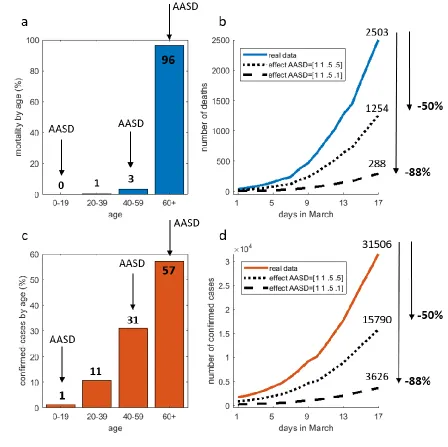
individuals. Fig. 2c reports the percentage of confirmed infected cases by age strata (number of cases with a certain age divided by the total number of cases), which is another important variable because it is associated with the maximum possible load of the healthcare system. This is also another key factor that we want to minimize by the proposed AASD strategy. Fig. 2c shows that AASD does not put a constraint only on the 11% of the population that is confirmed, hence this unconstrained part of the population minimally contributes to overload the healthcare system. Indeed, now I provide some quantitative estimations of the mitigation impact of AASD on number of deaths and confirmed cases, by evaluating the reduction due to AASD of these important variables. I consider two worst-case scenarios using a linear mitigation-effect impact analysis (see Methods) imposed on March 17 Italian data. This is a naïve modelling because it is neglecting many other factors associated with the internal mechanisms and dynamics of the epidemics, but it is adequate to estimate worst-case scenarios. Indeed, the aim of this study is not to provide advanced modelling, but to present an innovative idea of adaptive mitigation strategy that could be further explored in future studies, when the available data will be more accurate and reliable19,20. Data reliability/standardization is unfortunately one of the main bottleneck we currently face, as many experts commented10–12. To implement the linear mitigation-effect impact analysis, I define a mitigation-effect factor mef that for each age strata can take a value between 0 (total suppression) and 1 (no mitigation effect). The first worst-case scenario assumes that AASD does not have effect on 0-19 (mef1=1) and 20-39 (mef2=1), while AASD has moderate social-distancing effect on 40-59 (mef3=0.5) and ineffective isolation effect on 60+ (mef4=0.5, we assume that a good isolation should reach mef4=0.1 which is close to total suppression), this can be summarized in the mitigation-effect vector: [1 1 .5 .5]. The second worst-case scenario is more effective than the first on the 60+ (mef4=0.1, which is close to total suppression), this can be summarized in the mitigation-effect vector: [1 1 .5 .1]. The result of the linear mitigation-effect impact analysis (fig. 2b,d) shows that, also in case of worst-case scenario estimation, the gain on current real deaths and confirmed-case numbers might be promising. Most importantly, AASD can contrast the COVID outbreak by means of a soft nonlinear and adaptive constraint that, while preserving unconstrained the 20-39 part of the population, simultaneously aims both to contain the deaths and reduce healthcare demand.
the same of before. The number of hospitalized and ICU cases are significantly reduced and this represents a promising result at support of the interest that AASD should trigger in the scientific community.
Discussion
AASD, with the proper adjustments that are necessary for its application to real scenario, can be of inspiration to develop very efficient precision or personalized strategies to mitigate COVID-19 outbreak. If AASD is applied at the early stage of the outbreak can reduce the impact on healthcare systems, while sustaining the continuation of many economic activities. However, the current situation in Italy is already advanced and, in a second phase after the contagion peak is surpassed, AASD could be a good candidate as lockdown-exit strategy, which is a strategy to transit from a homogenous stay-home regime towards a less restrictive regime that still protects fragile categories.
Finally, to attain the best result from the AASD mitigation strategy, it should be paired together with adequate COVID-19 healthcare strategies. Current western healthcare systems have been built around the concept of patient-centered care, but an epidemic such as COVID-19 requires a change of perspective toward a concept of community-centered care8. Generic hospitals are not the proper place to cure COVID-19 patients, because they facilitate transmission to uninfected patients8. The healthcare strategy for COVID-19 should move towards: i) active surveillance of the territory and contact tracing in order to detect contagion chains at their beginning and isolate them; ii) home care and mobile clinics8,15. Future studies might consider to develop directly precision and personalized strategies, which adapt directly on the single patient characteristic an integrated mitigation/healthcare strategy. AASD focuses only on the age adaptiveness, but there are many other parameters that should be considered, and smart AI-based technology can help to exploit online algorithms that combine smart-phone network contacts information15 with GPS localization over time, but this might require also adequate discussion of privacy policy that goes beyond this current study. A first important point to design and to apply flexible and efficient mitigation strategies is to track the phase of the epidemic spread. We are missing this. We have immediate need for large-scale serological surveys to assess the stage of the COVID-19 epidemic19,21. We have to identify other biological factors that separate asymptomatic from mild/severe symptomatic cases regardless of age. Furthermore, in this study I propose a preliminary evaluation of AASD by mitigation-effect impact analysis of worst-case scenarios. However in future studies, when the available data will be sufficiently accurate and reliable19,20, especially on age strata specific information, the comparison of AASD versus standard mitigation strategies by means of advanced modelling such as generalized SEIR22 will be crucial. This will help to understand better the effect of AASD on the internal mechanisms and dynamics of the COVID-19 epidemics.
The take home message of this study is that we have to move from generic mitigation strategies towards precision and personalized mitigation strategies, which adapt to the features and phases of an outbreak, as well as to its infected population. Future precision strategies should act coordinately at different scale of the society, by integrating different large-scale social constrains, with medium-scale active surveillance and small-scale contact tracing19.
Methods
Data
http://weekly.chinacdc.cn/en/article/id/e53946e2-c6c4-41e9-9a9b-fea8db1a8f51
- The Italian data considered in fig. 1,2,3 of this study are referring to the data available on March 17, 2020. Data were recovered by the table 1 of the Bulletin of the Italian Superior Institute of Health at the link below:
https://www.epicentro.iss.it/coronavirus/sars-cov-2-sorveglianza-dati
Data were recovered (for cross-check and comparison) also by the official bulletin of the Italian Minister of heath available at the link below:
http://www.salute.gov.it/portale/nuovocoronavirus/dettaglioContenutiNuovoCoronavirus.jsp?lingua=it aliano&id=5351&area=nuovoCoronavirus&menu=vuoto
Linear mitigation-effect impact analysis
This section provides the linear model used for the quantitative estimation of the mitigation-effect impact of AASD proposed in fig. 2b,d (respectively number of deaths and confirmed cases) and fig. 3b,d (respectively number of hospitalization and ICU cases). The general formula of the model is:
𝑥𝑚 = 𝑓𝑐0−19∗ 𝑚𝑒𝑓0−19∗ 𝑥 + 𝑓𝑐20−39∗ 𝑚𝑒𝑓20−39∗ 𝑥 + 𝑓𝑐40−59∗ 𝑚𝑒𝑓40−59∗ 𝑥 + 𝑓𝑐60+∗ 𝑚𝑒𝑓60+∗ 𝑥
This is a naïve modelling because it is neglecting many other factors associated with the internal mechanisms and dynamics of the epidemics, but it is adequate to estimate the mitigation-effect in worst-case scenarios, which fits with the aim of this study. 𝑥 is a variable before mitigation and 𝑥𝑚 is the same variable after mitigation. In order to implement the linear modelling, I define 𝑓𝑐𝑥−𝑦 as the fraction of cases in the x-y age range, and the mitigation-effect factor 𝑚𝑒𝑓𝑥−𝑦 that for each age range x-y can take a value between 0 (total suppression) and 1 (no mitigation effect). The first worst-case scenario assumes that AASD does not have effect on 0-19 (𝑚𝑒𝑓0−19=1) and 20-39 (𝑚𝑒𝑓20−39=1), while AASD has moderate social-distancing effect on 40-59 (𝑚𝑒𝑓40−59=0.5) and ineffective isolation effect on 60+ (𝑚𝑒𝑓60+=0.5, we assume that a good isolation should reach 𝑚𝑒𝑓60+=0.1 which is close to total suppression), this can be summarized in the mitigation-effect vector: [1 1 .5 .5]. The second worst-case scenario is more effective than the first on the 60+ (𝑚𝑒𝑓60+=0.1, which is close to total suppression), this can be summarized in the mitigation-effect vector: [1 1 .5 .1]. The values of 𝑓𝑐𝑥−𝑦 are obtained by the respective values in the bar plots reported in fig. 2a,c and fig. 3a,c.
Acknowledgments
I thank: Alessandro Muscoloni for proof-reading the article; Alessandro Muscoloni, Eunhye Baek, Arianna Bottinelli, Matteo Zignani, Massimo Alessio and Jackie Han for reviewing the AASD idea; Gaetano Pisciotta, Michael Schroeder and Gianaurelio Cuniberti for the constant spur to conduct the study; Maryam Zamani and Katrin Witte for supporting the project. @NAChristakis, @VirusesImmunity, @BallouxFrancois, @AdamJKucharski for their enlightening tweets.
References
1. Cheng, V. C. C., Lau, S. K. P., Woo, P. C. Y. & Kwok, Y. Y. Severe acute respiratory syndrome coronavirus as an agent of emerging and reemerging infection. Clinical Microbiology Reviews (2007).
doi:10.1128/CMR.00023-07
2. Menachery, V. D. et al. A SARS-like cluster of circulating bat coronaviruses shows potential for human emergence. Nat. Med. (2015). doi:10.1038/nm.3985
2019‐nCoV. J. Evid. Based. Med. 13, 3–7 (2020).
4. Ferguson, N. M. et al. Strategies for mitigating an influenza pandemic. Nature 442, 448–452 (2006). 5. Chen, D. & Zhou, T. Control Efficacy on COVID-19. https://arxiv.org/abs/2003.00305 (2020).
6. Kraemer, M. U. G. et al. The effect of human mobility and control measures on the COVID-19 epidemic in China. Science (80-. ). eabb4218 (2020). doi:10.1126/science.abb4218
7. Remuzzi, A. & Remuzzi, G. COVID-19 and Italy: what next? Lancet 0, (2020).
8. Nacoti, M. et al. At the Epicenter of the Covid-19 Pandemic and Humanitarian Crises in Italy: Changing Perspectives on Preparation and Mitigation. NEJM Catal. Innov. Care Deliv. (2020).
doi:10.1056/CAT.20.0080
9. Sharma, R. Health and economic growth: Evidence from dynamic panel data of 143 years. PLoS One (2018). doi:10.1371/journal.pone.0204940
10. Ioannidis, J. P. A. In the coronavirus pandemic, we’re making decisions without reliable data.
https://www.statnews.com/2020/03/17/a-fiasco-in-the-making-as-the-coronavirus-pandemic-takes-hold-we-are-making-decisions-without-reliable-data/ (2020).
11. Lipsitch, M. We know enough now to act decisively against Covid-19.
https://www.statnews.com/2020/03/18/we-know-enough-now-to-act-decisively-against-covid-19/ (2020). 12. Li, R. et al. Substantial undocumented infection facilitates the rapid dissemination of novel coronavirus
(SARS-CoV2). Science (2020). doi:10.1126/science.abb3221
13. Riou, J., Hauser, A., Counotte, M. J. & Althaus, C. L. Adjusted age-specific case fatality ratio during the COVID-19 epidemic in Hubei, China, January and February 2020. medRxiv (2020).
doi:10.1101/2020.03.04.20031104
14. Wu, J. T. et al. Estimating clinical severity of COVID-19 from the transmission dynamics in Wuhan, China. Nat. Med. 1–5 (2020). doi:10.1038/s41591-020-0822-7
15. Martín-Calvo, D., Aleta, A., Pentland, A., Moreno, Y. & Moro, E. Effectiveness of social distancing strategies for protecting a community from a pandemic with a data-driven contact network based on census and real-world mobility data. https://covid-19-sds.github.io/ (2020).
16. Bayer, C. & Kuhn, M. Intergenerational ties and case fatality rates. VOX, CEPR Policy Portal (2020). 17. Callow, K. A., Parry, H. F., Sergeant, M. & Tyrrell, D. A. J. The time course of the immune response to
experimental coronavirus infection of man. Epidemiol. Infect. 105, 435–446 (1990).
18. Grubaugh, N. D., Petrone, M. E. & Holmes, E. C. We shouldn’t worry when a virus mutates during disease outbreaks. Nature Microbiology 5, 529–530 (2020).
19. Kissler, S. M., Tedijanto, C., Goldstein, E. M., Grad, Y. H. & Lipsitch, M. Projecting the transmission dynamics of SARS-CoV-2 through the post-pandemic period. doi:10.1101/2020.03.04.20031112
20. Peak, C. M. et al. Modeling the Comparative Impact of Individual Quarantine vs. Active Monitoring of Contacts for the Mitigation of COVID-19. medRxiv 2020.03.05.20031088 (2020).
doi:10.1101/2020.03.05.20031088
21. Lourenço, J. et al. Fundamental principles of epidemic spread highlight the immediate need for large-scale serological surveys to assess the stage of the SARS-CoV-2 epidemic.
https://www.dropbox.com/s/oxmu2rwsnhi9j9c/Draft-COVID-19-Model %2813%29.pdf?dl=0 (2020). 22. Peng, L., Yang, W., Zhang, D., Zhuge, C. & Hong, L. Epidemic analysis of COVID-19 in China by dynamical