R E S E A R C H
Open Access
A convex nonlocal total variation
regularization algorithm for multiplicative
noise removal
Mingju Chen
1,2, Hua Zhang
1*, Qiang Han
1,2and Chen Cheng Huang
1Abstract
This study proposes a nonlocal total variation restoration method to address multiplicative noise removal problems. The strictly convex, objective, nonlocal, total variation effectively utilizes prior information about the multiplicative noise and uses the maximum a posteriori estimator (MAP). An efficient iterative multivariable minimization algorithm is then designed to optimize our proposed model. Finally, we provide a rigorous convergence analysis of the alternating multivariable minimization iteration. The experimental results demonstrate that our proposed model outperforms other currently related models both in terms of evaluation indices and image visual quality.
Keywords:Multiplicative noise, Nonlocal total variation, Alternating minimization problem, Maximum a posteriori estimation
1 Introduction
Image deblurring is an important task with numerous applications in both mathematics and image processing. Image deblurring is an inverse problem that determines
the unknown original image u from the noisy image f.
Total variation (TV) regularization methods are efficient for smoothing a noisy image while effectively preserving the image textures and edges [1, 2]. In recent years, a large number of TV methods have been extensively studied for additive noise removal [3, 4], most of which are convex variation models. The convex models can be optimized using simple and reliable numerical methods, such as the gradient descent [5], primal-dual formulation [6], alternating direction method of multipliers [7], and Bregmanized operator splitting [8].
Multiplicative noise often exists in many coherent im-aging systems, such as ultrasonic imim-aging, optical coher-ence tomography (OCT), synthetic aperture radar (SAR), and so on [9–11]. Speckle is the most essential characteristic of noisy images that are corrupted by multiplicative noise. For example, a radar sends coherent
waves, and then the reflected scattered waves are cap-tured by the radar sensor. The scattered waves are cor-relative and interfere with one another, resulting in the obtained image, which is degraded by speckle noise. Owing to the coherent characteristics of multiplicative noise, despeckle is more difficult than additive noise re-moval. If the statistical properties of multiplicative noise are known, multiplicative noise can be removed effect-ively. According to forming mechanism of multiplicative noise, many statistical distribution patterns of noise are found, such as Rayleigh noise model [12], Poisson noise
model [13], Gaussian noise model [14], and Gamma
noise model [15].
Over the last decade, some famous local TV ap-proaches have been successfully used to remove multi-plicative noise because of the edge-preserving property of the local TV regularizer. Rudin, Lions, and Osher
(RLO) [14] proposed the first local total variational
method for multiplicative Gaussian noise removal.
Aubert and Aujol (AA) [15] composed a novel local TV
model based on multiplicative noise and use the max-imum a posteriori (MAP) to remove multiplicative
Gamma noise. Shi and Osher (SO) [16] discussed the
statistical characteristics of multiplicative noise and pro-posed a general local TV model for different multiplica-tive noise reduction, but the fidelity term in the model is * Correspondence:[email protected]
1School of Information Engineering and Robot Technology Used for Special
Environment Key Laboratory of Sichuan Province, Southwest University of Science and Technology, Mianyang 621010, China
Full list of author information is available at the end of the article
not strictly convex. In order to overcome this particular
drawback, Huang, Ng, and Wen (HNW) [17] utilized a
log transformation and constructed a strictly convex local TV model that can be easily solved by the global optimal solution. Furthermore, reference [18] integrated a quadratic penalty function into local TV model and proposed a new convex variational model for low multi-plicative noise removal. Reference [19] designed a con-vex model that is quite suitable for high multiplicative noise removal by combining a data fitting term, a quad-ratic penalty term, and a TV regularizer.
Unfortunately, owing to the local total variation regularization framework, smeared textures and numer-ous staircase effects frequently occur in the denoised image [20,21]. Exploiting nonlocal correlation informa-tion of the image can improve performance of total vari-ation and achieve better image denoising results [22,23]. One of the well-known nonlocal-based methods is the nonlocal means filter (NLM), which restores the image by using the nonlocal similarity patches. Nonlocal con-vex functions that were recently utilized as the regularization terms have been successfully used for multiplicative noise reduction [24, 25]. Reference [26] applied the nonlocal total variation (NLTV) norm to the AA model and proposed a new NLTV-based method for multiplicative noise reduction. Unfortunately, this model was nonconvex. Therefore, it is usually difficult to obtain a global solution. Dong et al. proposed a convex nonlo-cal TV model for multiplicative noise and introduced minimization iterative algorithms corresponding to the
model [27]. Since the NLTV makes full use of
self-similarity and redundancy within images, it has good image despeckling and denoising performance. However, the NLTV for multiplicative noise reduction is still an open area of research.
In this study, we concentrate on the Gamma-distrib-uted noise and propose a new NLTV-based model for multiplicative noise removal to overcome the drawbacks in current NLTV-based models. First, we utilize prior in-formation regarding multiplicative noise and use the MAP estimation to formulate a novel, strictly convex NLTV model. To efficiently optimize our proposed model, we use split Bregman iteration method to design an alternating multivariable minimization iteration to optimize the convex model. We also provide a rigorous convergence analysis of the alternating iteration method. The experimental results demonstrate that the proposed NLTV model has better performance than some other NLTV-based models for multiplicative noise deblurring.
The following sections are organized as follows. The related NLTV methods are reviewed in Section 2. In Section 3, we propose a new NLTV-based model for multiplicative noise deblurring and design an alternating algorithm for optimizing our proposed model. In Section
4, we applied the proposed model to image deblurring to present its good performance. Finally, conclusions are provided in Section 5.
2 Overview of NLTV algorithms for multiplicative noise reduction
A blurred image contaminated by noise has higher total variation than the clean original image. Minimizing the total variation of noisy image can deblur the image and reduce the noise. The total variation function can be de-fined as
JTVð Þ ¼u j∇uj1: ð1Þ
where ∇u is the gradient of u. The first NLTV, regularization-based image denoising was presented by Gilboa and Osher [28] for additive noise removal, which is described as follows:
u¼arg min
u ðj∇N Luj þ
λ
2∥f−u∥
2
2Þ: ð2Þ
Image denoising obtains the denoised image u∗ by
minimizing the above bounded energy function (2), which is composed of total variation term and fidelity term. Reducing the total variation term smooths the noisy image and minimizing the fidelity term makes
denoised image similar to the original image. λ is the
regularization parameter that adjusts the balance be-tween the two terms above. To date, NLTV methods for additive noise reduction have been extensively studied. However, multiplicative noise reduction by NLTV methods is still an open area of research. In this study, we provide the definitions of NLTV and review NLTV models for multiplicative noise reduction.
2.1 Nonlocal total variation
LetΩ∈R2be a bounded domain andu:Ω→Rdenote a
real function. If (x,y)∈Ω×Ω is a pair of points, then the nonlocal gradient∇uNL(x,⋅) atxcan be defined by
∇uNLðx;yÞ ¼ðu xð Þ−u yð ÞÞpffiffiffiffiffiffiffiffiffiffiffiffiffiffiw xð ;yÞ ð3Þ
where w(x,y) is a symmetric weight function that indi-cates the amount of similarity between the square patches centered at the pointsxandy. It can be defined by the following function
wxy¼exp (
Ga ð∥uðxþ Þ−uðyþ Þ∥2Þ 2h2
)
ð4Þ
whereGais a Gaussian of standard deviationa, andhis
Therefore, the norm of the nonlocal gradient, nonlocal divergence, and graph Laplacian operators can be re-spectively defined as follows:
j∇uN Lj ¼
ffiffiffiffiffiffiffiffiffiffiffiffiffiffiffiffiffiffiffiffiffiffiffiffiffiffiffiffiffiffiffiffiffiffiffiffiffiffiffiffiffiffiffiffiffiffiffiffi Z
ΩðuðxÞ−uðyÞÞ
2w
xyÞdy s
: ð5Þ
divN L!ðu xÞ:¼ Z
Ωðuðx;yÞ−uðy;xÞÞ
ffiffiffiffiffiffiffiffiffi wxyÞ q
dy: ð6Þ
ΔuN L :¼1
2divN Lð∇uNLÞ ¼ Z
Ωðuðx;yÞ−uðy;xÞÞwxyÞdy: ð7Þ
2.2 NLTV method for multiplicative noise reduction Multiplicative noise removal aims to find the original imageufrom the observed noisy imagef. The image deg-radation model can be mathematically described as
f ¼un ð8Þ
where n denotes multiplicative noise. We assume that f≥0 and u≥0. The multiplicative noise follows a Gamma law with mean 1. Therefore, we obtain the density function of the noisen
g nð Þ ¼ L L
Γð ÞL n
L−1 expð−LnÞ ð9Þ
whereΓis a Gamma-function andLis a positive integer. The previous TV model for multiplicative noise removal presented by Aubert and Aujol was the AA model [15], which is the following minimization problem derived from MAP estimation:
u¼ arg min
u j∇uj þλ loguþ
f u
: ð10Þ
The AA model is efficient for multiplicative noise re-moval. However, it has some problems since the local total variation regularization framework is exploited, such as smeared textures and the occurrence of staircase effects.
Motivated by the AA model, Li replaced the TV with the NLTV norm in the AA model and proposed the nonlocal-AA model [26]:
u¼ arg min
u j∇NLuj þλ loguþ
f u
: ð11Þ
Like the AA model, the nonlocal-AA model also per-formed well for image denoising. However, it is convex only foru∈(0, 2f). As a result of the nonconvexity of the nonlocal-AA model, it is usually difficult to obtain a
glo-bal optimal solution. Inspired by the SO model [16],
Dong et al. suggested the use of the log transformation
(z= logu) to resolve the nonconvexity. The transformed variational model then becomes
min
z ∥∇N Lz∥1þλ Z
Ω
ðz−f e−zÞ !
: ð12Þ
We note that the above TV function is strictly convex. It is easy to obtain a global optimal solution and find the
unique minimizerz for the minimization problem. This
TV model is referred to as the exponential nonlocal-SO model [27].
3 The proposed method—multiplicative denoising nonlocal total variation model
In our study, we obtain a strictly convex NLTV model for multiplicative noise removal and employ Bregman it-eration to optimize it.
3.1 The proposed model
Assume the prior information about the mean and vari-ance of the multiplicative noise are known in advvari-ance, that is,
1 N
Z
η¼1; ð13Þ
1 N
Z
η−1
ð Þ2¼σ2 ð14Þ
whereN=∫1. The mean of the noise is 1 and the vari-ance equals σ2. In the aforementioned approaches, such as (10, 11, 12), only the density function of the noisy image is exploited for the MAP estimation to derive the minimization problem. The two previous constraints (mean and variance) are introduced into the nonlocal-AA model, and we can improve the NLTV model and obtain the following constrained optimization problem:
u¼ arg min
u j∇uNLj þλ loguþ f u
s:t
1 N
Z f
u¼1 and 1 N
Z f u−1
2
¼σ2
!
:
ð15Þ
Our goal is to solve the above equality constrained
minimization problem (15). The constrained
optimization problem is converted into an uncon-strained formula:
u¼ arg min
u j∇uNLj þ λ1
Z loguþf
uþλ2
Z
f uþλ3
Z
f u−1
2!
( )
:
ð16Þ
u¼ arg min
u j∇NLuj þλ Z af uþ b 2 f u 2
þclogu !
( )
ð17Þ
where a, b, and c are constrained parameters that are greater than 0. HðuÞ ¼λðaufþb
2ð
f uÞ
2
þcloguÞ is the fi-delity term, which is continuous. We obtain
∂H uð Þ ∂u ¼a
f u2þb
f2 u3−c
1
u: ð18Þ
The initial data satisfy u(0) =f, and H(u) has a mini-mum atu=u(0). We can obtainc=a+b.
Unfortunately, this model is nonconvex. Similarly, we use the variablez= logu and, by replacing the regulari-zer |∇NLu| with |∇NLz|, we further convert (17) into the following minimization problem:
u¼ arg min
z E1ð Þ ¼z arg minz j∇NLzj
þλX afe−zþb 2f
2e−2zþðaþbÞz
:
ð19Þ
3.2 Bregman iteration for the proposed model
The above constraint (19) can be optimized by the iteration-based multivariable minimization algorithm. Note that the fidelity term in (19) contains exponential forms. Thus, we introduce an auxiliary variable p(p=z) to split the problem into subproblems that are easier to solve. Equation (19) is then rewritten as the following constrained problem:
u¼ arg min
z;p E2¼ arg minz;p j∇NLpj
þλX afe−zþb 2f
2
e−2zþðaþbÞz
; s:t: p¼z:
ð20Þ
The minimization problem (20) is shown to be equiva-lent to (19). The constrained minimization function (20) can be transformed to the following unconstrained, multi-variable optimization function:
u¼ arg min
z;p E2μ¼ arg minz;p j∇NLpj þ
μ
2kp−zk
2 2
þλX afe−zþb 2f
2
e−2zþðaþbÞz
ð21Þ
There are two variables in the regularization function (21). Inspired by the core ideas of the split Bregman al-gorithm, we use the alternating minimization scheme and obtain the following two subproblems:
( min
pE2pðpÞ ¼∥∇N Lp∥1þ
μ 2∥p−z∥
2 2
minzE2zðpÞ ¼μ 2∥p−z∥
2 2þλ
X
ðða f e−zþb 2f
2
e−2zþ ðaþbÞzÞÞ
:
ð22Þ
To solve the p subproblem, ∇NLp is replaced with d
and the constraint is forced using the Bregman iteration process as follows:
pkþ1;dkþ1
¼ arg min p;d k k þd1
γ
2 d−∇NLp−b k
2
2þ
μ 2kp−zk
2 2
;
ð23Þ
bkþ1¼bkþ∇NLpkþ1−dkþ1 ð24Þ where b is an auxiliary variable. The solution of (23) is obtained by performing the following alternative minimization subproblems:
pkþ1¼ arg min p
γ
2 d
k−∇NLp−bk
2
2
þμ 2 p−z
k 2
2; ð25Þ
dkþ1¼ arg min d k k þd1
γ
2 d−∇NLp kþ1−bk
2
2: ð26Þ
To minimize function (25) by gradient descent, we de-rive the following optimality equation forpk+ 1
−γ divNL dk−∇NLp−bk
−μp−zk¼0: ð27Þ
Using a Gauss-Seidel iterative scheme, pk+ 1 is repre-sented as
pkþ1
i ¼
1 μþγPwij
rXwijpkjþμzki−φX ffiffiffiffiffiffiwij
p
dkij−bkij−dk jiþbkji
:
ð28Þ
To solve dk+ 1, we use the soft-shrinkage formula [29] as follows
dkþ1¼ ∇NLp kþ1þbk ∇NLpkþ1þbk
max ∇NLpkþ1þbk−1
γ;0
:
ð29Þ
Optimizing zk+ 1is equivalent to solving the following Euler-Lagrange equation:
μz−pkþ1þλðaþbÞ−afe−z−bf2e−2z¼0: ð30Þ
The Newton method is used to yield a fast solution:
zkþ1¼zk−μ z−p kþ1
þλðaþbÞ−afe−z−bf2e−2z uþλafe−zþ2bf2e−2z :
ð31Þ
3.3 Bregman iteration for NLTV minimization
Initialization:u0= logf,p0=z0,b0=d0= 0,k= 0 andλ,μ,
γ,tol
While‖zk+ 1−zk‖2/‖zk‖2>tol
pkiþ1¼ 1 μþγPwij r
X
wijpkjþμzki−φ
X ffiffiffiffiffiffi
wij
p
dkij−bkij−dkjiþbkji
;
dkþ1¼ ∇NLp kþ1þbk ∇NLpkþ1þbk
max ∇NLpkþ1þbk−1
γ;0
;
bkþ1¼bkþ∇NLpkþ1−dkþ1; zkþ1¼zk−μ z−pk
þ1
þλðaþbÞ−afe−z−bf2e−2z
μþλafe−zþ2bf2e−2z ;
End
3.3.1 Convergence analysis
We first analyze the convexity of the objective function to simplify our proof for the convergence of the minimization iteration schemes of our proposed model. We then prove that the sequence generated by the alter-native iteration scheme converges to the minimum point of (21).
For the transformation z= logu, it is obvious that the
second derivative of the fidelity term in (21) is af
exp(−z) +bf2exp(−2z), which is always greater than zero.
Therefore, this term is strictly convex in z.Next, we
prove that the first term |∇NLz| is also convex. Assuming∀k1,k2> 0,k1+k2= 1,∀z1,z2, we obtain
∇NLðk1z1þk2z2Þ
j j ¼ X
j
k1z1jþk2z2j−k1z1i−k2z2i
2
wij !1
2
≤k1
X
j
z1j−z1i 2
wij !1
2 þk2
X
j
z2j−z2i 2
wij !1
2
:
¼k1j∇NLz1jiþk2j∇NLz2ji
¼k1j∇NLðk1z1Þj þk2j∇NLðk2z2Þj
ð32Þ
Since the first term is also convex, (21) is strictly con-vex for allz. We obtain the denoised imagez∗by minim-izing the function and obtaining the global minimum point. We prove that the above alternative optimization subproblem algorithms converge to the global minimum point. Some fundamental criteria and properties of the alternative iteration minimum that are used to provide the convergence are displayed in [30,31]. The alternative optimization subproblems are defined as
pkþ1¼S zk ¼S R p k ; ð33Þ
E2μ(z,p) is convex and separately differentiable with
respect to z and p. Suppose the unique minimizer of
E2μ(z,p) isð~z;p~Þ. We note that
∂E2μð~z;~pÞ
∂z ¼0 ∂E2μð~z;~pÞ
∂p ¼0 8 > > < > >
: ð35Þ
This implies that ð~z;~pÞ is the minimizers ofE2μ. This
signifies that ~z¼Rð~pÞ ¼RðSð~zÞÞ and ~p¼Sð~zÞ ¼SðRð~pÞ
Þ. Therefore,~zand~pare the fixed points.
Since R(S(·)) is an alternative to the minimizer of
E2μ(z,p) and R(S(·)) is convex and nonexpansive, we
obtain
zkþ1−~z
¼ R S z k −R Sð ð Þ~z Þ
¼ R S z k −~z ≤ zk−~z : ð36Þ
This implies that kzk−~zk is monotonically decreasing (note that zk is a bounded sequence). Therefore, we de-duce thatzkconverges to a limit point^z, such that
lim k→∞z
k¼^z: ð37Þ
Similarly, we obtain pk, which converges to a limit
point
lim k→∞p
k¼^p: ð38Þ
The denoised image z∗ is the unique minimizer of the
constraint problemE1(z). Let p∗=z∗, p∗ and z∗ represent the minimizers of the constraint problem E2(z,p). Sup-pose subsequencefzkjg⊆fzkg∞
k¼1and fpkjg⊆fpkg
∞
k¼1are convergent, which is a solution to minimize the energy ofE2μ(z,p). The following inequality is combined as
E2μ zkj;pkj
¼E2 zkj
þμ 2 p
kj−zkj 2
2≤E2μ z
;p
ð Þ ¼E2ðz;pÞ:
ð39Þ
Whenkj→∞,
^ p−^z
k k2 2≤
2
μðE2ð^z;^pÞ−E2ðz;pÞÞ: ð40Þ
Sinceμ> 0, then
E2ð^z;^pÞ≤E2ðz;pÞ: ð41Þ
Since z∗,p∗ is the unique solution to the minimization functionE2(z,p), we can deduce
E2ð^z;^pÞ ¼E2ðz;pÞ: ð42Þ
lim k→∞k^p−^zk
2
2¼0: ð43Þ
This implies
^
p¼^z: ð44Þ
Combining equations (37, 42, 44), we conclude that
lim k→∞z
k¼^z¼z: ð45Þ
In Eq. (45), we conclude zk converges to z∗, which is the unique minimizer ofE1(z).
4 Experiment results and discussions
4.1 Experimental setting
In this subsection, we present some experimental results to demonstrate the effectiveness of our proposed model. We experiment on classical grayscale images and coher-ent imaging images contaminated by artificial multiplica-tive Gamma noise. Our proposed model is compared with several recent NLTV-based models, namely the nonlocal-AA and nonlocal-SO model. All simulations are performed in MATLAB9.0 on an Intel I7 PC with 4 GB of memory.
To reduce to the computation complexity, we only compute the ten best neighbors in the 21 × 21 nonlocal searching window and four nearest neighbors in the 5 × 5 patch. We set the stopping criteriontol= 0.001 to ter-minate iteration. The regularization parameters are fixed: μ= 0.1,λ= 10, andγ= 20. To objectively estimate
the quality of the denoised image, the peak
signal-to-noise ratio (PSNR) and structural similarity index (SSIM) are used, which are defined as
PSNRð Þ ¼dB 10 log10255
2MN
u−_u 2
2
;
SSIM¼ 2μ_uμu 2σu_uþc2
μ2
u
_þμ2uþc1
σ2
uþσ2_uþc2
whereM×Nis the size of the image, whileuand_u are, respectively, the original image and the recovered image.
μ_u andμuare the mean values of them; σ u
_ and σu
de-note their standard deviations; σ u _
u is the covariance of u
_
andu; andc1,c2are predefined constants.
4.2 Results on classical grayscale images with artificial noise We use classical grayscale images with artificial multi-plicative Gamma noise for the first test. Figure 1 shows four test images with resolutions of 256 × 256 × 8, which are used in our experiments. The original noise-free
im-ages in Fig. 1 are contaminated by multiplicative noise
followed by the Gamma distribution of mean 1 and
vari-ance σ. In our proposed model, we set a=b= 0.5 to
effectively utilize the prior information about mean and variance of the noise.
Table 1 lists the PSNR and SSIM values to measure
the denoising performance of different NLTV-based models on the test images blurred by different levels of Gamma noise. The highest PSNR and SSIM values are highlighted in italic font. From Table 1, it is apparent that our proposed NLTV model almost always attains the highest PSNR and SSIM values among all the NLTV-based multiplicative noise removal models. The nonlocal-AA fails to be competitive with the other two methods for most cases. This is attributable to the fact that the nonlocal-AA is nonconvex and it is difficult to compute the minimal point. The nonlocal-SO almost has lower PSNR and SSIM than our method because nonlocal-SO is not effective to consider the noise prior
information about the mean and variance. Table 1
fur-ther shows that our proposed NLTV method effectively utilizes prior information about the multiplicative noise, and gains higher objective criteria values than the other methods.
To evaluate visual quality of the different models above, we present the denoised images that were re-stored by the different models on the noisy Lena image, which was blurred by adding multiplicative noise with a variance of 0.05. The restored images are inspected in Fig. 2. We find that the image (Fig. 2b) restored by the
nonlocal-AA method produces undesired white
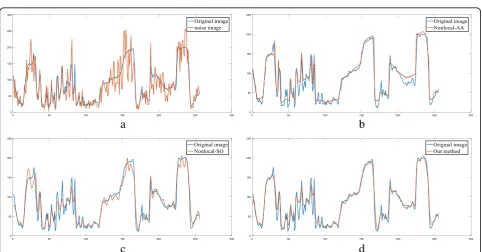
point-like artifacts and suffers a loss of details and edges, the textures in the hat, and the facial region are seriously destroyed. The nonlocal-SO method can reserve image structures and edges. However, it over-smooths image textures and eliminates details (see the wrinkles on hat in Fig. 2c). From the restored image (Fig. 2d) using our method, we note that our method reduces more multi-plicative noise and better preserves textures and details than other methods-the curly hair and the wrinkles on hat can be well distinguished. In Fig. 3, the 200th lines of the clean, noisy, and deblurred images that occur in
Fig. 2 are presented. We observe that the line
con-structed by our method (Fig.3d) is closer to the original line than those restored by the other methods.
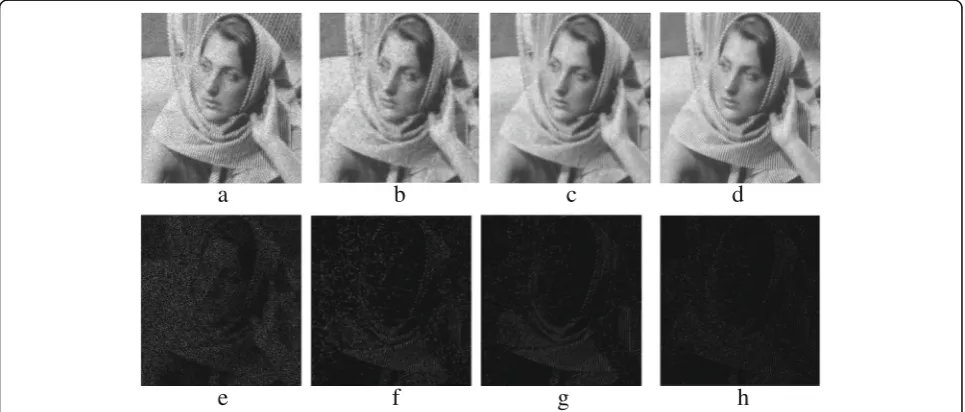
To highlight the competitive visual performance of our proposed model for multiplicative noise removal, parts of the denoised images Cameraman and Woman are presented to measure the texture-preserving prop-erty of different models in Figs.4and 5, respectively. To further evaluate the performance of noise reducing and texture preserving, we also present the method noise im-ages that are the difference between original image and
denoised images in Figs. 4 and 5. The nonlocal-AA
nonlocal-AA method (Figs. 4h and 5h) reveal that the nonlocal-AA method provided limited noise suppression
and detail damage. The nonlocal-SO method (Figs. 4c
and 5c) reduces the staircase effect and effectively
removes noise (see smooth region Figs.4c and5c), but it
blurs image edges and textures (camera’s edges in Fig.4c and the hood’s texture in Fig.5c are barely visible). Our proposed method exhibits the best visual appearance
among all the NLTV-based methods so that the camera’s
edges in Fig. 4d and the hood’s texture in Fig. 5d are clearly visible. Additionally, comparing the method noise
images in Figs. 4 and 5, we can observe that our
pro-posed method produces less residual noise and preserves more textures than other methods. The results shown in
Figs. 4 to 5 let us conclude that our proposed model
removes multiplicative noise while simultaneously
reconstructing more image textures and details than the other model.
4.3 Results on images acquired by coherent imaging system
Since multiplicative Gamma noise often occurs in the coherent imaging systems, we compare the performance of our proposed model with other models on more com-plicated images acquired by coherent imaging technique where it is not easy to discern the foreground from the background. In this section, we use ultrasonic image, OCT image, and SAR image to verify the effectiveness of our proposed method.
a
b
c
d
Fig. 1Original images for experiments.aLena image.bWomen image.cBaboon image.dCameraman image
Table 1Comparisons of the results using different models based on different images
Image σ Nonlocal-AA Nonlocal-SO Our method
PSNR SSIM PSNR SSIM PSNR SSIM
Lena 0.02 28.9757 0.7974 29.6365 0.8355 29.6522 0.8377
0.05 26.3467 0.7530 27.3785 0.7750 27.4042 0.7768
0.1 24.6380 0.6816 25.8112 0.7279 25.8365 0.7310
Woman 0.02 27.9584 0.7741 28.5441 0.8044 28.5547 0.8132
0.05 25.5996 0.7014 26.6301 0.7477 26.6229 0.7436
0.1 24.8337 0.6884 25.0348 0.7002 25.1303 0.7059
Cameraman 0.02 28.4807 0.8027 28.4787 0.7969 28.7461 0.8172
0.05 26.1229 0.7584 26.0631 0.7380 26.3612 0.7693
0.1 24.0989 0.6549 24.3225 0.6911 24.6099 0.7308
Baboon 0.02 25.1895 0.6904 26.2700 0.7380 26.3582 0.7442
0.05 23.9535 0.5718 24.3048 0.6257 24.2040 0.6154
a
b
c
d
Fig. 2Results of different models on the Lena image degraded by a Gamma noise of level withσ= 0.05.aNoisy image,bnonlocal-AA,cnonloca-SO, anddproposed method
a
b
c
d
Figure6shows visual comparisons of denoised images processed by different NLTV-based methods. The ori-ginal ultrasonic image (resolution is 256 × 256 × 8) is added multiplicative Gamma noise with variance 0.1.
Figure 4c–g respectively shows the denoised images
using nonlocal-AA method, nonlocal-SO method, and our method. A texture region marked by red-lined box is selected for visual comparison. Observing the edges and details in the red-lined box, similar effects appeared
in the above examples are regarded here. The
nonlocal-AA method cannot adequately remove the multiplicative Gamma noise. Some residual noise exists
in the denoised image and the artifacts obscure the edges. The nonlocal-SO method shows better perform-ance than the nonlocal-AA method, but some edges in the red-lined box are seriously obscured or invisible. Our proposed method attains almost the highest PSNR and SSIM values and exhibits the best visual quality among all the methods, allowing the edges in the red-lined box to clearly recovered and the residual noise is difficult to find.
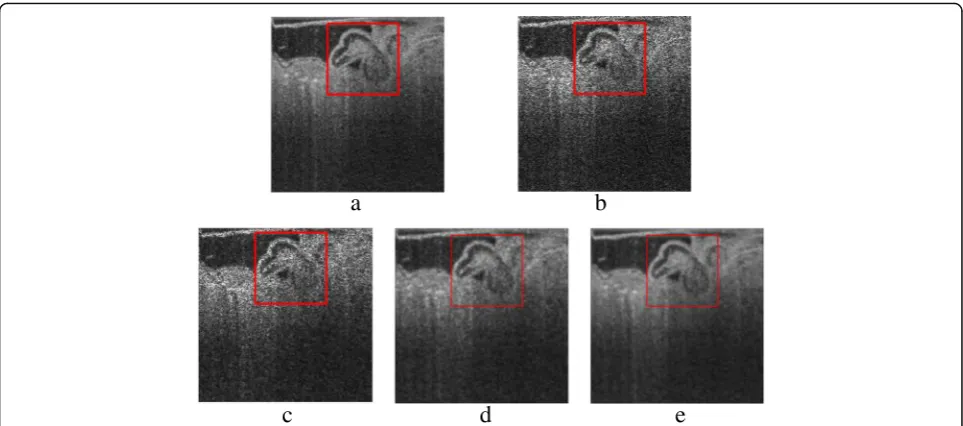
Moreover, we use OCT (resolution is 128 × 128 × 8) and SAR (resolution is 128 × 128 × 8) images, which are contaminated by multiplicative Gamma noise
a
b
c
d
e
f
g
h
Fig. 4Zoomed version of the denoised image Cameraman of different methods degraded by a Gamma noise with variance 0.1.aNoisy image,
bnonlocal-AA method,cnonlocal-SO method,dproposed method,enoise image,fmethod noise image of nonlocal-AA method,gmethod noise image of nonlocal-SO method, andhmethod noise image of proposed method
a
b
c
d
e
f
g
h
Fig. 5Zoomed version of the denoised image Woman of different methods degraded by a Gamma noise with variance 0.02.aNoisy image,b
with, respectively, variance 0.1 and 0.08, to further verify the effectiveness of our proposed method. To distinguish the differences in edge preservation and texture contrast enhancement between the different methods, a square region that contains salient edge and complicated texture is selected for enlarging views. The original and denoised images and the zoomed versions of the selected region marked with a
red box are presented in Figs. 7 and 8. The noisy
im-ages (Figs. 7b and 8b) show that speckle noise
re-duces the image visual quality, resulting in
barely-visible textures and blurred edges. The results
of the nonlocal-AA method (Figs. 7c and 8c) cannot
effectively reduce noise or obscure edges. The results
of the nonlocal-SO method (Figs. 7d and 8d)
elimin-ate the artificial effect and improve the properties of nonlocal-AA method, but blurs still exist in the denoised image, especially in the edges (see the
zoomed version of (Figs. 7d and 8d). Since our
method makes full use of prior information for noise and is an extension of the nonlocal-SO method, it is more effective in removing the noise and preserving image details than the nonlocal-SO method. The
tex-tures deblurred by our method (Figs. 7e and 8e) are
clearer and more distinct than the textures deblurred by the nonlocal-SO method. Additionally, our pro-posed method obtains larger PSNR and smaller MSE values the other methods, again indicating that the
d
a
b
c
e
Fig. 6Recovered ultrasonic images via different methods.aOriginal image,bnoisy image (PSNR = 29.2360, SSIM = 0.8174),cnonlocal-AA method (PSNR = 31.2127,SSIM = 0.8488),dnonlocal-SO method (PSNR = 32.3298, SSIM = 0. 8878), andeproposed method
(PSNR = 32.6496, SSIM = 0.8994)
a
b
c
d
e
superiority of our proposed method in removing multiplicative Gamma noise is very appropriate for complicated images.
5 Conclusion
This study utilizes prior information and proposes a strictly convex NLTV-based multiplicative noise removal model based on the maximum prior estimate frame-work. Based on the split Bregman iteration algorithm, we design an efficient alternating minimization iteration to optimize our proposed NLTV model. We also prove that the alternative minimization iteration converges to a fixed point, which is the unique solution of the original minimization problem. Finally, results compared with related NLTV-based multiplicative noise removal models indicate that our proposed NLTV method effectively removes multiplicative noise and outperforms other re-lated NLTV models.
The proposed method is suitable for multiplicative noise removal and successfully implements the coherent imaging system. However, a large number of predefined constants and parameters involved in the alternative it-eration algorithm, values of these constants, as well as their parameters are important factors influencing the denoising result of the proposed method. In our experi-ment, these values are manually set. In later works, adaptively adjusting these parameters to obtain better denoising results will be a future research direction.
It is worth mentioning that the proposed method can-not be directly applied to other types of noise removal problems, such as mixed noise. For example, in the elec-tronic microscopy imaging system, the captured images are usually contaminated by Gaussian and Poisson noises, which are combined as a superposition. Future research is required to make use of NLTV for different
types noise removing, especially for mixed noise. On the other hand, the proposed method can be successfully implemented on video sequences, which is not present in this paper due to space limitations. However, we have simply focused on utilizing the correlation information in a single image for noise removal and have not consid-ered similar content and correlation information in dif-ferent images. There is a great correlation and a large number of redundant information existing between the adjacent frames in the video sequences. Accordingly, utilizing similar and redundant information in the video sequences to improve our proposed method is another direction for future research.
Abbreviations
AA:Aubert and Aujol; HNW: Huang, Ng, and Wen; MAP: Maximum a posteriori estimator; NLM: Nonlocal means filter; NLTV: Nonlocal total variation; OCT: Optical coherence tomography; PSNR: Peak signal-to-noise ra-tio; SAR: Synthetic aperture radar; SO: Shi and Osher; SSIM: Structural similarity index; TV: Total variation
Acknowledgements
The authors thank the editor and anonymous reviewers for their helpful comments and valuable suggestions.
Funding
This research was supported by the Open Fund Project of the Artificial Intelligence Key Laboratory of Sichuan Province (Grant no. 2016RYY02), and the Scientific Research Project of Sichuan University of Science and Engineering (Grant no. 2018RCL17 and no. 2015RC16).
Availability of data and materials
Request for authors.
Authors’contributions
All authors take part in the discussion of the work described in this paper. The author MC conceived the idea, optimized the model, and did the experiments of the paper. HZ, QH, and CH were involved in the extensive discussions and evaluations, and all authors read and approved the final manuscript.
b
a
c
d
e
Authors’information
Mingju Chen (1982-) received the M.S. degree in College of Communication Engineering from Chongqing University of Posts and Telecommunications in 2007. He is currently pursuing the Ph.D. degree in Southwest University of Science and Technology. His research interests include machine vision inspection systems and image processing.
Hua Zhang (1969-) received his PhD degree in College of Communication Engineering from Chongqing University in 2006. He is currently a professor in School of Information Engineering of Southwest University of Science and Technology. His research interests include nuclear detection technology, robot technology, and machine vision inspection systems.
Qiang Han(1987-) received the B.S degree from Ocean university of China in 2010, and M.S. degree from Sichuan University of Science and Engineering in 2013. Now, he is currently pursuing his PhD degree in Southwest University of Science and Technology. His current research interests include consensus and coordination in multi-agent systems, networked control system theory, and its application.
Chencheng Huang(1984-) received BS degree in applied mathematics from Shijiazhuang Tiedao University in 2007, Master degree in applied mathematics from Chongqing University in 2011, and a PhD degree from Chongqing University in 2015. He is currently a lecturer with School of Automation and Information Engineering of Sichuan University of Science and Engineering. His research interests are image processing.
Competing interests
The authors declare that they have no competing interests.
Publisher’s Note
Springer Nature remains neutral with regard to jurisdictional claims in published maps and institutional affiliations.
Author details
1School of Information Engineering and Robot Technology Used for Special
Environment Key Laboratory of Sichuan Province, Southwest University of Science and Technology, Mianyang 621010, China.2School of Automation & Information Engineering, Sichuan University of Science & Engineering, Zigong 643000, China.
Received: 16 September 2018 Accepted: 5 January 2019
References
1. A.N. Tikhonov, V.Y. Arsenin, Solution of ill-posed problems[J]. Math. Comput. 32(144), 491–491 (1977).
2. R. Acar, C.R. Vogel, Analysis of bounded variation penalty methods for ill-posed problems[J]. Inverse Problems10(6), 1217–1229 (1997).
3. L.I. Rudin, S. Osher, E. Fatemi, Nonlinear total variation based noise removal algorithms[J]. Physica D Nonlinear Phenomena60(1–4), 259–268 (1992). 4. T. Chan, A. Marquina, P. Mulet, High-order total variation-based image
restoration[J]. SIAM J. Sci. Comput.22(2), 503–516 (2000).
5. A. Beck, M. Teboulle, Fast gradient-based algorithms for constrained total variation image denoising and deblurring problems.[J]. IEEE Transactions on Image Processing A Publication of the IEEE Signal Processing Society18(11), 2419–2434 (2009).
6. A. Chambolle, An Algorithm for Total Variation Minimization and Applications. J. Math. Imaging. Vision.20(12), 89-97 (2004). 7. N.B. Bras, J. Bioucasdias, R.C. Martins, et al., An alternating direction
algorithm for total variation reconstruction of distributed parameters[J]. IEEE Trans. Image Process.21(6), 3004–3016 (2012).
8. G. Li, X. Huang, S.G. Li, Adaptive Bregmanized total variation model for mixed noise removal[J]. AEU - International Journal of Electronics and Communications80, 29–35 (2017).
9. L. Zhu, W. Wang, J. Qin, et al., Fast feature-preserving speckle reduction for ultrasound images via phase congruency[J]. Signal Process.134, 275–284 (2017).
10. S. Adabi, S. Conforto, A. Clayton, et al., An intelligent speckle reduction algorithm for optical coherence tomography images[C]// international conference on photonics, optics and laser technology. IEEE4, 38–43 (2017). 11. N. Tabassum, A. Vaccari, S. Acton, Speckle removal and change preservation by distance-driven anisotropic diffusion of synthetic aperture radar temporal stacks [J]. Digital Signal Processing74, 43–55 (2018).
12. L. Denis, F. Tupin, J. Darbon, et al., SAR image regularization with fast approximate discrete minimization.[J]. IEEE Transactions on Image Processing A Publication of the IEEE Signal Processing Society18(7), 1588 (2009).
13. S. Setzer, G. Steidl, T. Teuber, Deblurring Poissonian images by split Bregman techniques[J]. Journal of Visual Communication & Image Representation21(3), 193–199 (2010).
14. L. Rudin, P.L. Lions, S. Osher,Multiplicative denoising and deblurring: theory and algorithms[M]// geometric level set methods in imaging, vision, and graphics(Springer, New York, 2003), pp. 103–119.
15. G. Aubert, J.F. Aujol, A variational approach to removing multiplicative noise[J]. SIAM J. Appl. Math.68(4), 925–946 (2008).
16. J. Shi, S. Osher, A nonlinear inverse scale space method for a convex multiplicative noise model[J]. Siam Journal on Imaging Sciences1(3), 294– 321 (2008).
17. Y.M. Huang, M.K. Ng, Y.W. Wen, A new Total variation method for multiplicative noise removal[J]. Siam Journal on Imagingences2(1), 20–40 (2009).
18. Y. Dong, T. Zeng, A convex variational model for restoring blurred images with multiplicative noise[J]. Siam Journal on Imaging Sciences6(3), 1598– 1625 (2013).
19. J. Lu, L. Shen, C. Xu, et al., Multiplicative noise removal in imaging: an exp-model and its fixed-point proximity algorithm[J]. Applied & Computational Harmonic Analysis41(2), 518–539 (2016).
20. S. Fu, C. Zhang, Adaptive non-convex total variation regularization for image restoration[J]. Elect. Lett.46(13), 907–908 (2010).
21. L.A. Vese, S.J. Osher, Modeling textures with total variation minimization and oscillating patterns in image processing[J]. J. Sci. Comput.19(1–3), 553–572 (2003).
22. A. Buades, B. Coll, J.M. Morel, A review of image denoising algorithms, with a new one[J]. Siam Journal on Multiscale Modeling & Simulation4(2), 490– 530 (2005).
23. M. Chen, H. Zhang, G. Lin, et al., A new local and nonlocal total variation regularization model for image denoising[J]. Clust. Comput.6, 1–17 (2018). 24. X. Nie, X. Huang, W. Feng, A new nonlocal TV-based variational model for
SAR image despeckling based on the G0, distribution[J]. Digital Signal Processing68, 44–56 (2017).
25. J. Li, Q. Yuan, H. Shen, et al., Hyperspectral image recovery employing a multidimensional nonlocal total variation model[J]. Signal Process.111(C), 230–248 (2015).
26. L. Shuai, X. Zhao, G. Wang, Nonlocal TV model for multiplicative noise with Rayleigh distribution removal[J]. Chinese Journal of Scientific Instrument 36(7), 1570–1576 (2015).
27. F. Dong, H. Zhang, D.X. Kong, Nonlocal total variation models for multiplicative noise removal using split Bregman iteration[J]. Mathematical & Computer Modelling55(3), 939–954 (2012).
28. G. Gilboa, S. Osher, Nonlocal operators with applications to image processing[J]. Siam Journal on Multiscale Modeling & Simulation7(3), 1005– 1028 (2008).
29. W. Li, Q. Li, W. Gong, et al., Total variation blind deconvolution employing split Bregman iteration[J]. Journal of Visual Communication & Image Representation23(3), 409–417 (2012).
30. R.Q. Jia, H. Zhao, W. Zhao, Convergence analysis of the Bregman method for the variational model of image denoising[J]. Applied & Computational Harmonic Analysis27(3), 367–379 (2009).