Date of publication xxxx 00, 0000, date of current version xxxx 00, 0000.
Digital Object Identifier 10.1109/ACCESS.2017.Doi Number
Urban Computing and Smart Cities: Towards
Changing City Processes by Applying
Enterprise Systems Integration Practices
Vahid Javidroozi1, Hanifa Shah1, and Gerald Feldman1
1Faculty of Computing, Engineering, and Built Environment (CEBE), Birmingham City University, Birmingham B4 7XG, UK
Corresponding author: Vahid Javidroozi (e-mail: [email protected]).
ABSTRACT For developing smart cities, it is necessary to integrate all components of a city as a system of systems. This is facilitated by urban computing as a technology to address the complexity of providing adequate services to citizens through various city sectors/systems. Since business processes across city sectors/systems should be aligned with the objectives of urban computing, Business Process Change (BPC) is also a significant prerequisite of city systems integration for Smart City Development (SCD). However, there is limited research on understanding of BPC and its challenges in SCD, while in the private sector, the BPC best practices for Enterprise Systems Integration (ESI) have already been recognised and implemented. By considering city as an enterprise, this research aims at providing an understanding of similarities and differences between BPC challenges in the two contexts: SCD and ESI. This study collects data through literature analyses, interviews, and document analyses and suggests that many BPC challenges in SCD have an equivalent from the ESI context. In addition, the findings provide new insights through some challenges that are only relevant to the SCD context, so-called unsolved challenges. Consequently, the study developed a comparison framework, which indicates that the learnings from ESI could be utilised for the SCD context, in order to address BPC challenges. This will assist city authorities in designing their SCD roadmap, prioritising BPC challenges based on the efforts employed for ESI, and thinking about addressing unsolved challenges; as well as smart city solution providers to develop solutions for changing city processes.
INDEX TERMS Business process change, smart cities, smart city development, systems integration, Urban Computing.
I. INTRODUCTION
Smart City Development (SCD) is a response to the current issues of rapid urbanisation [1]–[3] that offers a large number of benefits for citizens to enhance their quality of life, as well as for the city authorities to improve the quality of city services [4]. This can be achieved by integration of city systems and connecting every component of a city including people, businesses, technology, processes, data, infrastructures, consumption, spaces, energy, strategies, management, in order to support each other and using each other’s resources, with no waste [5][6]. This is what has been undertaken by private enterprises, to meet their customers’ fluctuating demands by integrating their
systems, so that they can survive in today’s unpredictable and competitive business environment.
while Business Process Change (BPC1) is central for systems integration [7]–[9], to date, very little attention has been given to the role of ‘BPC in SCD’2. The little research regarding BPC in public sector that has been conducted, mainly discusses BPC for e-Government [10]–[12], while BPC is a fundamental feature of SCD, in order to align cross-sectoral city processes with the integration objective of urban computing [13], [14]. This alignment requires changing existing business processes across city systems. For instance, according to the ‘service providing layer’ of urban computing general framework [15], innovative processes are required to provide efficient and real-time communication between various agents to deliver information and take an appropriate action regarding anomalies of people’s mobility in a city [16]. These integrated processes can also be connected to the navigation systems of emergency vehicles, so that they can automatically redirected.
Moreover, BPC encompasses several challenges, whereas academic research that particularly and comprehensively describes these challenges in the SCD context is scarce. Conversely, in the ESI context the BPC challenges have been recognised and addressed by applying some success factors, approaches, and techniques that might be useful for the SCD context. However, up to now, far too little attention has been paid to the association between the BPC challenges in (smart) city and (integrated) enterprise.
Recently, researchers have shown an increased interest in considering the city as a system of systems, so that the collaboration between these systems (city sectors) provides efficient, effective, and real-time services for citizens [17]– [19]. This consideration is supported by a systems thinking perspective, which provides a better understanding of the inter-communications among the components of a city system. Based on a systems thinking approach, everything is related to everything else, so that everything should be connected to everything else, to get the benefits of a change in the whole system, so that improvement in one part affects the other parts [20], [21]. The city as a ‘system of systems’ should also adhere this rule, so as to provide smartness for everything within the city, especially city sectors and systems [22][23]. In addition, by looking into the supply chain of the city’s services, similar to an enterprise, a city encompasses components such as customers, suppliers, managers, deliverable services, data, and systems/system of systems.
1 BPC is defined as analyse, redesign, and improve the existing
business processes to achieve a competitive advantage in performance [69].
2 In this study, ‘BPC in SCD’ refers at ‘changing cross-sectoral city
processes, which are performed by city sectors to communicate with and enquire from each other’. Accordingly, ‘BPC challenges in SCD’ correspond to the challenges that can be faced during changing cross-sectoral city processes for the purpose of SCD.
As a result, since city is a system of systems, by considering city as an enterprise, this study aims to recognise the association between the BPC challenges during SCD and ESI by investigating the BPC challenges in the ESI and SCD contexts and developing a comparison framework for outlining the BPC challenges during systems integration in both contexts of ESI and SCD. The framework helps to understand the possibility of utilising the lessons learned from ESI for conducting BPC in the SCD context. As a result, the research focuses on understanding the similarities and differences between the BPC challenges in the two abovementioned contexts, to support the following SCD requirements:
Develop the association between smart city and integrated enterprise from a BPC viewpoint through developing a comparison framework; Identify and prioritise the BPC challenges, based
on the status of the SCD project in any city worldwide;
Design a SCD roadmap for a city to be smart from a process-centric point of view;
Develop technical solutions for changing city processes by solution providers (e.g. CISCO, IBM, SAP).
Accordingly, the following objectives are addressed by this research:
To summarise the BPC challenges in ESI through a literature analysis
To identify the BPC challenges in SCD through a qualitative research, including semi-structured interviews and document analysis
To compare the identified BPC challenges in SCD with those in ESI context
The next section will provide a literature review related to the abovementioned arguments. Then, a methodology for conducting the research will be set. Next, the findings regarding BPC challenges in the contexts of ESI and SCD will be provided and explained. Afterwards, the findings in the two contexts will be compared and a comparison framework will be developed. Finally, the conclusions will be offered.
II. RESEARCH CONTEXT
authorities have to change how their cities operate, and it can be achieved by developing smart cities through a seamless communication amongst city components, sectors, and systems and availability of real-time information by them [17], [25].
A. UNDERPINNING CONCEPTS
The smart city concept has been discussed by a large number of researchers and experts (such as [2], [4], [5], [26]–[30]) in various aspects of the city such as people-centricity, well-being, smart services, smart economy, smart environment, smart mobility, smart technology, and so on that are all about enhancing liveability of the cities. It has also been highlighted that the city should be seen as a system of systems, which interact, communicate, and share information with each other [17], [31]. Viewing a city as a system of systems leads to cross-sectoral thinking about everything within a city. For example, cross-sectoral business processes, which are a part of the city system and create the city services should be flexible, dynamic, agile, and connected to the relevant systems of a city [25].
Based on the key principle that BPC is central component of SCD, and our inference from [18], [19], and [25], this research defines smart city as “a system of systems in which cross-sectoral city systems integration has been accomplished, enabling access to real-time information and knowledge by all the city sectors, providing integrated services, and enhancing liveability, workability, and sustainability for the citizens”. According to this definition, the city systems should seamlessly be connected to each other, and using each other’s resources efficiently and effectively. Hence, the city systems would access to each other’s information and knowledge and this can be achieved by integrating the city systems. Therefore, for developing a smart city a close and seamless connection among city sectors (city systems integration) is necessary, in order to improve sustainability and quality of life, and to provide efficiency in a city’s resource administration, offering public services, enhance inter-communication and inter-collaboration among a city systems/sectors [2], [32].
For such cross-sectoral collaboration, urban computing technologies ameliorate the change from traditional services to smart city services [4], [17], [31], [33]. Nevertheless, integration of city systems encompasses other requirements and challenges, which are still poorly understood (explained in section I). However, integration of enterprise systems, so-called ESI, its requirements and challenges have already been recognised and addressed to provide real-time information, enabling timely decisions, and delivering cheaper, quicker, and high-quality services [34]. Hence, to meet the requirements of systems integration for SCD, a city is considered as a large-scale enterprise, in which service providers are considered as suppliers, citizens as customers, and local
government/authorities as the managers and leaders of the enterprise. These are the main constituents of the supply chain for city services. Moreover, any enterprise consists of systems such as sales, marketing, finance, and human resource. Likewise, a city comprises a number of sectors/systems such as transport, healthcare, energy, and education. However, city sectors are mostly public, while enterprise departments are private. In other words, both enterprise and city embrace similar components, deliverable services, data, and systems, which are internally different. As a result, the lessons learned from enterprises can be useful to meet the requirements and address the challenges of systems integration in the SCD context [11][35][36], necessitating the consideration of the similarities and differences of those requirements and challenges between the two contexts.
B. BUSINESS PROCESS CHANGE
For a successful systems integration in enterprises, changing key elements, including business processes, people, and technology, as well as the flow of information amongst them, is required. BPC is the most important and challenging task for successful systems integration [7]–[9]. Consequently, BPC becomes a significant endeavour in SCD, which requires the city systems integration as a necessity [13], [37]–[39]. In other words, in the smart city in which citizens, businesses, and the government use urban computing technologies as enablers or catalysts, (not necessarily a fundamental element) for well-being [40], [41], all of these dimensions need to be aligned with systems integration principles, implying that the business processes should be changed and lined up with the integration process.
A few researchers have also briefly discussed BPC as a challenging area in SCD. For instance, [23] pointed out four significant challenges for SCD. ‘Collaboration between private and public partners’ and ‘commitment of the stakeholders’, are two of them, which are related to people viewpoint. Two other challenges, which are related to process and technology emphasise the significance of BPC in SCD, these include:
Establishing intelligent procurement processes by changing existing procurement rules and legislation, in order to facilitate collaboration between the city and private companies, especially Small and Medium-sized Enterprises (SMEs), enabling both parties to engage in the actual procurement process; and
service transformation and the solutions to address them.
Moreover, as argued by [42], BPC is a complex task and includes many challenges such as interdependencies between processes, departments, stakeholders, their attributes, and applications. In addition, as the redesigned business processes should be flexible enough to be able to deal with continuous process change, BPC would be more complex. Therefore, flexibility and complexity are also two imperative examples of the issues in BPC. Many success factors have also been suggested by earlier studies and have been utilised by enterprises, to the extent that they have been recognised as best practices. For instance, Business Process Management (BPM) as a systematic approach can address inter-relationship issues, as well as flexibility and complexity in BPC [43]. Furthermore, peer-to-peer communication between business processes and departments addresses the issues of interoperability in BPC [44]. These are some exemplars of success factors, which are being utilised to address BPC challenges in ESI and will be comprehensively discussed in the next chapter. The success factors may also be useful for the challenges in SCD context.
As a result, for rewarding and effective systems integration in any context, BPC needs to be managed and planned carefully, meaning that the BPC challenges must be identified and addressed [45].
III. METHODOLOGY
Through explorative and descriptive research, this study explores the BPC challenges in ESI and SCD contexts, then it provides more details about already explored concepts [46]. This enables comparison of the BPC challenges in ESI and SCD. Moreover, the ultimate purpose of this research is to understand the similarities and differences of BPC challenges between ESI and SCD contexts for utilizing ESI best practices for the SCD context. Hence, this study employs a qualitative survey approach to interrogate multiple sources of data, for attaining realistic and rich descriptive insights into the research subject under investigation.
A. DATA GENERATION
To address the research objectives the following two datasets identified:
BPC challenges in ESI BPC challenges in SCD
The first dataset was mainly gathered through a literature analysis.
The second dataset was identified using two techniques to generate empirical data, directly (by interviewing people, who are within the group of experts in the field of study) and indirectly (by analyzing written records and documents) [47], [48]. The study population categories for both the interviews and document analysis, included (i)
smart city developers, such as city authorities, advisors, and consultants; and (ii) solution providers for SCD, such as CISCO, IBM, and SAP. The unit of analysis in the first category was ‘city’ and in the second category was ‘organisation’. The generalisability of the study was also considered during selection of the interviewees and documents, so that they were selected from different cities of the various countries instead of gathering data within a limited region. Thus, global non-probability sampling was carried out allowing collection of information and opinions from diverse sources around the world.
This research employed non-probability purposive sampling to select interviewees based on their job affiliation, their ability to provide relevant information, and roles.
The inclusion criteria to select interviewees are as follows:
Directly involved with the development of a smart city, especially in city process change projects More than two years of experience in SCD Fit in management or implementation role
categories
Furthermore, the cities and companies were selected based on critical case sampling according to their positions regarding SCD projects in the world. As the diversity of responses was significant in this research, at least one or two members from each city that demonstrates significant progress in SCD, and at least one member from each solution provider were targeted for the interview.
Regarding the solution providers, people who had been involved with smart city projects and changing business processes were selected for this research.
The snowballing technique was also used to access more participants after each interview.
1) LITERATURE ANALYSIS
As the main movements related to BPC and its challenges started in the 1990s, to explore BPC challenges in ESI, the literature, published between 1990 and 2018, was analyzed. Peer reviewed journal and conference articles, along with most cited books related to BPC challenges in ESI and smart cities, were qualitatively studied.
2) INTERVIEWS
After exploring BPC challenges in ESI, the research employed semi-structured interviews to collect data regarding BPC challenges in SCD. Using open-ended questions as precursors that encourage probing for details about the topic under discussion, offered flexibility to pose new questions to clarify some of the answers provided to the initial questions. In addition, the researcher allowed the interviewees to freely share their BPC related experience in developing a smart city in their cities or developing solutions for smart cities. This strategy provided non-bias, objectivity, and reliability for the data [49].
direction. In addition, the ambiguity and impreciseness of the responses were abridged. Nevertheless, it was sometimes difficult, especially for interviewees in different geographical locations. However, initially, the researcher travelled to various locations for face-to-face interviews (e.g. Barcelona, Rome, London, Paris, Tehran, Berlin). Next, the issue was resolved by meeting the candidates in smart city events, such as conferences, forums, and congresses. During the events, the interviewees were asked to participate in the research by booking a time after the sessions or in the next few days. Moreover, in a few cases, business cards were exchanged to follow up the interview in the future. Thus, telephone and web-based (mainly Skype) interviews were occasionally conducted. This strategy was merely conducted to meet potential interviewees and discuss the research with them, in order to attract their interest to participate, not necessarily to conduct the interviews during the events. However, two interviews were conducted during smart cities events.
Every interview was conducted for 45 minutes. The interviews were audio recorded and notes were taken to be used for analysis. Before the interview meetings, some information regarding the research and interviews along with invitation letter were sent to the interviewees. In addition, permission to record the interview was obtained in advance.
The validity of the collected data were also qualitatively addressed during and after interviews. During the interviews, the researcher repeated some of the core BPC challenges that were pointed out by the interviewee to ensure these were not misunderstood and nothing is fundamental was missed (respondent validation). After interviews the quality and rigor of the collected data were also assessed through approaches, such as comparison of the notes and audio transcriptions, triangulation, and intercoader reliability (explained in the next sections). In total, 16 interviewees shared their experiences from 20 cities and six organisations. it was considered to be sufficient coverage, because the saturation point, where no new BPC challenge was identified was met after 12 interviews. However, four more interviews were conducted to verify the saturation point.
All these participants were directly involved with the development of a smart city, especially in city process change projects, have more than two years of experience in SCD and fit in management or implementation role categories. Although most of them worked in one particular city or organisation, some had the opportunity to work in multiple cities and some worked in both population categories. Therefore, they offered a vast experience spanning multiple cities when responding to the interview questions. Accordingly, various data sets from every interviewee with multiple cities experience were organised. Thus, it can be concluded that by conducting 16 interviews, BPC challenges in SCD were identified from
20 cities of 17 countries and six organisations. Table-1 highlights the city/country and organisation of all the interviewees that were part of the smart city developers’ category.
TABLE-1:THE INTERVIEWEE EXPERIENCES BY CITY
(COUNTRY)/ORGANIZATION Interviewees Smart city experiences
Total number of cities/ organizations
per interviewee
Interviewee-1 Birmingham (England) 1
Interviewee-2 Santiago (Chile), Buenos Aires
(Argentina), Sao Paolo (Brazil) 3
Interviewee-3 SAP 1
Interviewee-4 Service Birmingham 1
Interviewee-5 Belfast (North Ireland),
Birmingham (England) 2
Interviewee-6 Tehran (Iran) 1
Interviewee-7 Amsterdam (Netherland), Atos 2
Interviewee-8
Copenhagen (Denmark), Trondheim (Norway), Smart City
Catalyst
3
Interviewee-9 London (England), Birmingham
(England), Siemens 3
Interviewee-10 Vienna (Austria) 1
Interviewee-11 IBM 1
Interviewee-12 SAP 1
Interviewee-13
Paris (France), Barcelona (Spain), Singapore (Singapore), Tokyo (Japan), San Francisco (USA)
5
Interviewee-14 Rio De Janeiro (Brazil), Sao Paolo (Brazil), Madrid (Spain) 3
Interviewee-15
Madrid (Spain), Barcelona (Spain), Napoli (Italy), Berlin
(Germany)
4
Interviewee-16 Barcelona (Spain) 1
3) DOCUMENT ANALYSIS
TABLE-2:BREAKDOWN OF DOCUMENTS BY CATEGORIES AND PROVIDERS
Document provider
Number of analyzed documents
Smart city developers category
Vienna, Austria 2 Toronto, Canada 1 Paris, France 2 New York, USA 1 London, UK 1 Tokyo, Japan 1 Berlin, Germany 2 Copenhagen, Denmark 2 Hong Kong 1 Barcelona, Spain 1 Birmingham, UK 3 Glasgow, UK 1 Cape town, South Africa 1
Solution providers category
SAP 3 IBM 1 CISCO 1 Schneider Electric 1 Fireball 1 Weber Shandwick (WS) 1 Atos 1 ESRI 1 Ovum 1 Blue Cities 1 Idox 1
Standards and guidance providers
ISO 1 British Standards Institute (BSI) 4 Smart City Council 1 European Commission 1 European Parliament 1
B. DATA ANALYSIS
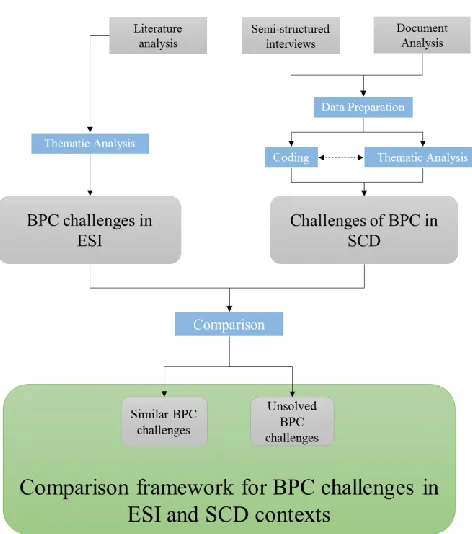
This research applied qualitative data analysis to make sense of the data gathered and provide a summary of the results, as well as organise, interpret, evaluate, and transform them to sensible information [51]. The Literature analysis results were thematically analysed to explore the first dataset (the outcome of the analysis is shown in Table-3). The interview records were transcribed and each transcript was assigned a code instead of interviewees’ names and organising the notes [51]. Then, the relevant documents were identified and prepared. Once the data were prepared and organised, initial thematic analysis, thematic coding, and final analysis were performed. Fig. 1 illustrates a holistic view of qualitative data analysis in this research. The initial codes was assigned based on the first de-contextualization of the data from literature (BPC challenges in ESI context). Then, thematic coding was carried out, to code various topics, which were related to BPC challenges, based on their meanings, similarities, and relations. Then, the BPC challenges, which were related to each code were organised and compared with the previously identified BPC challenges. Afterwards, the similar challenges were grouped into themes as shown in Table-4.
Fig. 1: The study’s qualitative data analysis
In all data coding phases, a sample of transcripts and documents were given to another researcher for analysis so that the codes compared to ensure reliability and credibility of the data coding and avoid personal bias [52], [53].
Once the BPC challenges in SCD were extracted from the interviews and document analysis, they were compared to the BPC challenges in ESI context. Thus, similar BPC challenges were identified, along with some BPC challenges in SCD that do not correspond to any challenges in ESI (referred to as ‘unsolved challenges’ in this study). Finally, a comparison framework for BPC challenges in ESI and SCD contexts was developed.
IV. RESEARCH FINDINGS
The findings of literature analysis, interviews, and document analysis to identify two main data sets of this research are represented in this section.
A. BUSINESS PROCESS CHANGE CHALLNGES IN ESI
Since the 1940s, the challenges of BPC in ESI have been identified by researchers and industry. However, to date an aggregated list of BPC challenges in ESI that can be utilised to understand their associations with BPC challenges in SCD context has not yet been offered. Therefore, this section provides the result of a literature analysis regarding the BPC challenges in ESI.
decade, these people related challenges have been increased. In the 1990s, the ‘politics’ and ‘cost’ have been the most challenging areas of BPC. A few researchers have also discussed other challenges such as ‘risk’ and ‘data sharing’ in this decade. Between 2000 and 2009, several new BPC challenges especially in the managerial, inter-organisational, and functional settings, such as BPC monitoring, standardisation, monitoring, interoperability, inter-dependencies, efficiency, quality assurance, agility and flexibility, have been identified by earlier researchers. It means, the research has been redirected from preparation of BPC to management and implementation of BPC,
during this decade. In contrast, since 2011, the BPC challenges have mainly been addressed by adopting the suggested success factors, techniques, and approaches (some examples are mentioned in Table-3). Thus, no new BPC challenge has been discussed by the researchers in the last few years.
Table-3 summarizes the main BPC challenges in ESI along with some technique/approach exemplars that have been commonly discussed by the academia and industry and this study has collected them through a literature analysis.
TABLE-3:BPC CHALLENGES IN ESI AND THEIR PRACTICES (IDENTIFIED THROUGH LITERATURE ANALYSIS)
BPC challenges Practices Suggested techniques/ approach exemplars Reference examples
Clarification and understanding
Clarification and understanding of business processes and BPC by assessing and analyzing them for internal departments and external partners
-BPM
-Business Process Modelling (BPMo) techniques (UMM, RosettaNet, BPMN, ebXML)
-Visualisation
[11], [54]–[58]
BPC Monitoring High control, tracking, monitoring & measuring of
BPC
-BPMo as a framework for controlling and measuring of processes
-Testing
[54], [55], [57]–[60]
Risk Analysis and management of the risk during BPC -BPM
-Training for risk management
[57], [61], [62]
Governance Management of the process of BPC (Main challenge
in BPC)
-Clarification of overall strategy for stakeholders
-Risk management
[63]–[65]
Standardization Standardization of business processes, compliance of
BPC with business standards, policies and regulations
-BPMo techniques such as WSBPEL and BPMN
-WfM
[7]–[9], [66]–[68]
Efficiency Improving efficiency and reducing redundancies and
time lags in business processes
-Reducing the wasteful activities -Visualization
[68]–[71]
Quality assurance
Preventing any error and enhancing quality of BPC and redesigned business processes
-Training -User involvement -Monitoring -BPM including TQM
[54], [60], [68], [72], [73]
Complexity Reducing complexity of business processes especially
when performed by various partners
-Shaw et al.'s architecture for BPMS -Addressing interdependencies
[11], [58], [74], [75]
Agility & Flexibility
Providing agility and flexibility for business processes to quickly response to continuous change
-BPM
-Shaw et al.'s BPMS architecture model -Combination of EAI, SOA, and BPM
[57], [68], [74], [76]
Interoperability
Enhancing interoperability and inter-coordination between business processes across different departments and organizations
-BPM -BPMo tools -EAI -Web services -Semantic Web -SBPM
[8], [12], [43], [57]– [59], [68], [75]
Data and business process sharing
Convincing parties to share necessary data and share the activities of business processes with each other, in both intra- and inter-organizational BPC
-Proper assignment of business process ownership
-Culture changing
-Partners’ relationship management
[59], [70], [77], [78]
Inter-dependencies
Inter-dependencies between processes, departments, and stakeholders
-BPMo technique
-WfM approaches (P2P, PVM, peer-to-Peer CPM)
[42], [59], [70], [79], [80]
Autonomy and Confidentiality
Autonomy and confidentiality of external partners for inter-organizational business processes
-B2B frameworks
-Establishing trust between external partners
[59], [70], [73], [78], [81]
Economic conditions and cost of change
Economic condition of the organization, considering the cost of change and try to reduce it in the process of BPC
-Standardization -ABC framework
[78], [82]–[84]
Politics
Organizational power, formal and informal relations, and communication between staff, management, and BPC project leaders
-Recognizing reservations borne by stakeholders and decision makers -Top-Down initiation of BPC
[82], [83], [85]
People related challenges
Minimizing human issues such as acceptance, commitment, culture, and knowledge of the users and stakeholders
-Top-Down management -Human-centricity -Advertising project progress
B. BUSINESS PROCESS CHANGE CHALLNGES IN SCD
As established in section I, BPC is the main component of city systems integration and it is a necessity for SCD. Not surprisingly, one of the interviewees commented:
‘The majority of the conversation is about if I had all this data, I could report on it. But you have got to do something that’s when the process kicks in, that’s when you can make a real-time decision and do something....’
Another interviewee emphasized the role of business processes in city systems integration and said:
‘In Buenos Aires’ smart city projects, the point is they get data from weather systems; they get data from the drains, they get data from people phoning, saying it’s flooding. They get data from everywhere and having it on a dashboard is fantastic, but what’s even better if you can say right now to a field engineer, you need to go out and fix that drain… It is what you are going to do with changing processes… For example, in enterprises like SAP,
researchers have spent a lot of time to standardize the business processes, for instance they have said this is the best purchase to pay business process. Now for smart cities there are a lot of business processes that should be defined in an integrative manner….’
However, as discussed in section I, recent smart city-related studies focus on the concept and initiatives [88][24][89], technological aspects [30][90][39], or a particular BPC approach or technique [91][92][93], and there is very little to none attention given on BPC challenges in SCD. More importantly, the BPC challenges in this context are mostly unknown.
Therefore, this study explored SCD beyond the data and technological realm to reduce process integration challenges. Accordingly, this section represents the identified BPC challenges in SCD, along with a brief smart city-centric description, extracted from semi-structured interviews and document analysis (Table-4).
TABLE-4:BPC CHALLENGES IN SCD(IDENTIFIED THROUGH INTERVIEWS AND DOCUMENT ANALYSIS)
Challenges
No. of interviewees and documents that shared the challenge
Descriptions
Understanding the city processes
5 interviewees 6 documents
Understanding, transparency, and clarification of existing city processes and their activities, which create communication between the sectors, and understanding their deficiencies that make issues
Monitoring BPC 2 interviewees
7 documents
Controlling the changing process, its stages, and activities
Governance and leadership
3 interviewees 1 document
Lack of overall governance in a city to align all the sectors, as well as leadership to provide guidance on what needs to be done
Standardization 5 interviewees 7 documents Providing a common understanding, standards, and language for BPC and business processes by all the city sectors Agility and
flexibility
4 interviewees 5 documents
Providing agile and flexible business processes is a goal for BPC, as it is necessary for smart cities, which are dynamic and changing. The BPC process itself should also be agile and flexible.
Efficiency 2 interviewees
6 documents
Providing efficiency and reducing redundancy for new business processes is an important objective of BPC
Inter-operability 4 interviewees
4 documents
This challenge includes three main issues:
- Insular city sectors
- Low-level experience in interaction with each other
- Lack of collaboration across city sectors and inability to learn from each other
Complexity 6 interviewees
3 documents
The city systems and processes are complicated; thus BPC is a complex job, as it has to do the change within a complex environment, which is the public sector.
Sharing data and business processes
10 interviewees 5 documents
For processes that are carried out by different organizations, departments, and people, ‘sharing’ should occur at two levels of BPC:
- At data level: willingness to release data and give up their power over the data
- At transitional level: business processes and their activities should be shared amongst various parties. Thus, the ownership of processes is a challenge
Privacy concerns 7 interviewees
4 documents
Sectors are not keen on being clear. They also do not enjoy other sectors knowing how they are undertaking their activities and services. In addition, the issues related to personal data, protection of organizational data, security of people’s data, and data protection policies such as ‘Freedom of Information ACT’ (in the UK) works as a barrier to communication between sectors and using public data for integration and BPC
Inter-dependencies 2 interviewees
1 document
The business processes, carried out by various sectors are dependent on each other, so that deficiency in one sector can cause delay and deficiency in providing services for citizens
Politics 3 interviewees
1 document
Political influence that acts as a strategic driver of BPC, which promotes or discourages the BPC to be carried out. e.g. political guidelines, governmental legislations, bureaucratic principles
Managers’ hastiness
4 interviewees 0 document
The sectors are not keen on long-term plans. They want to show some tangible achievements in their 3,4 years management period (the government change = changing the plan and actions)
Economic conditions and cost
10 interviewees 3 documents
Vertical policies 3 interviewees
1 document
This challenge is about dictating what and how to do the tasks by the government to the cities’ authorities. Although cities have a common goal in SCD, every city is different so that local authorities should have their own power for making their cities smart
Contracting 1 interviewees
1 document
Contracts are barriers to change; for instance, long term contracts with private companies, which are resistant to change
Foundations 6 interviewees
3 documents
Providing efficient infrastructure and preparing all requirements before commencing the BPC. For example, the realization of priorities in each city, which is going to become smart, is a necessity.
People related challenges
11 interviewees 4 documents
The challenges which are related to the people aspect of BPC:
- Resistance to change by both government agencies and citizens
- Training
- Doing day-jobs while changing their business processes
- Culture changing: for example, convincing the government agencies to agree to work together and change their business plan and processes
- Ability to give up their power
- Slow decision making
- Willingness: they are not willing to change because they have other priorities, which may be more interesting for them (e.g. green energy). They are also mostly focused on the priority of cost cutting.
- Stakeholder management: coordination and participation of stakeholders can guarantee the succeed in SCD
- People think they can do BPC themselves and they do not need experts
V. DISCUSSION OF BPC CHALLENGES: ESI VS. SCD The BPC challenges in SCD, listed in Table-4, was compared with BPC challenges in the ESI context (Table-3), to detect the differences and similarities between them. It was carried out by mapping the interviewees’ answers with the list of BPC challenges in ESI. The result of this comparison is shown in Table-5.
TABLE-5:A COMPARISON BETWEEN BPC CHALLENGES IN SCD AND ESI
SCD ESI
Understanding city processes Clarification and understanding Monitoring BPC Monitoring
Governance and leadership Governance Standardization Standardization Agility and flexibility Agility and flexibility Efficiency Efficiency
Sharing data and business processes
Business process ownership and data sharing
Interoperability Interoperability Complexity Complexity
Privacy concerns Autonomy and confidentiality Inter-dependencies Inter-dependencies
Politics Politics Managers’ hastiness -
Economic conditions and cost Economic conditions and cost Vertical policies -
Contracting - Foundations -
People related challenges People related challenges - Quality assurance - Risk
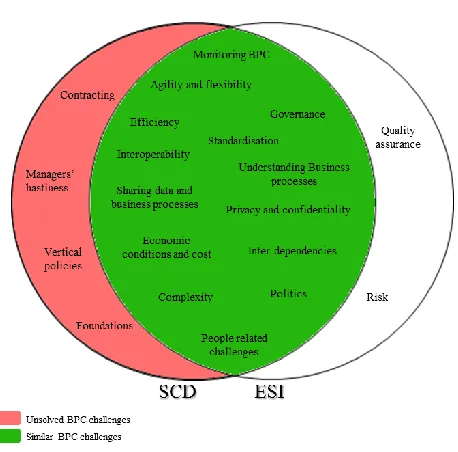
Based on the findings, presented in Table-5, a comparison framework for outlining the BPC challenges during systems integration in both contexts of ESI and SCD is developed (shown in Fig. 2).
Fig. 2: A comparison framework for BPC challenges in ESI and SCD contexts
This framework identifies and presents the BPC challenges in ESI and SCD. It groups the BPC challenges in SCD into two groups of ‘similar challenges’ for those, which have an equivalent in ESI context, and ‘unsolved challenges’ for those, which are not similar to any BPC challenges in the ESI context. Hence, it recognizes the association between the BPC challenges in (smart) city and (integrated) enterprise.
As shown in Fig. 2, the majority of BPC challenges in SCD have an equivalent in ESI. However, four challenges, ‘managers’ hastiness’, ‘foundations’, ‘vertical policies’, and ‘contracting’ in SCD, do not exist in ESI.
‘The city sectors do not like the long-term plan because they want to show some tangible achievements in their three or four year’s management period.’
Thus, this challenge is closely associated with the people related challenges, so that the learnings would be useful for managers’ hastiness challenge.
Vertical policies: as stated by almost all interviewees, every city is different. Thus, dictating rigid and vertical policies from the national government would not be useful for all cities and may hinder BPC. Smart city processes should be aligned with each city’s characteristics, citizens, environment, geographical location, and so on. As a result, more power should be given to local authorities and they should have the freedom and power to implement these processes. Contracting: a few documents mentioned
contracts as barriers to BPC. Similarly, an interviewee said:
‘Long term contracts with private companies, which resist to change, do not let us change the business processes and connect the sectors in both levels of data and process.’
Another interviewee suggested that:
‘Long-term contracts should be avoided. In addition, the contracts should be somehow written that support SCD and future city’s objectives, not creates issues (sic).’
Foundations: before BPC in the cities, some foundations and preparations, especially regarding infrastructures, intra-sectoral alignments, and priorities, should be established. In fact, ‘foundations’ is not a BPC specific challenge in SCD, as all preparations and foundations should have been considered and completed before commencing the BPC. However, the analysis of the data collected in this research revealed setting the foundations to be a significant challenge, which has not been addressed by BPC success factors in ESI.
Also, systems within a city must be prepared well for BPC. For example, intra-sectoral business processes and infrastructures should be integrated. This argument is also supported by an interviewee, who said:
‘Business processes within sectors should be automated and integrated before inter-sectoral integration, which is required by SCD’.
In addition, the framework in Fig. 2 shows that two of the BPC challenges in ESI, ‘quality’ and ‘risk’, have not been pointed out as BPC challenges in SCD. Possibly, the interviewees and the documents’ authors considered these challenges less important or as a default in any BPC
project. Thus, it is difficult to completely ignore these challenges in SCD. Perhaps future studies can explore the implications of these two challenges.
Furthermore, the framework helps to design a plan for addressing BPC challenges in SCD by prioritizing the most important ones in a particular city, especially for unsolved challenges. In addition, the framework clearly shows that as most of the BPC challenges in the both contexts are similar, the best practices and learnings from ESI context are useful for changing business processes for SCD successfully. This is helpful for smart city developers to set their priorities and design their SCD roadmap. It means the city authorities may give more priority to the unsolved challenges, in order to define research projects, identify success factors, and execute test practices for addressing unsolved challenges. Then, they would adapt the best practices from the ESI context for addressing similar challenges.
The framework can also be extended and aligned for any individual city, in which business processes are being changed, to accommodate more challenges, faced by smart city developers or solution providers in the future. Therefore, different outcomes can be obtained for different circumstance/cases, which according to [94]–[96] accredits the generalisation of this study.
VI. CONCLUSIONS
In this research, it was explained that while systems integration is a common term in the private sector (ESI), the scientific understanding of this matter in SCD context is still lacking. Consequently, the requirements of city systems integration including BPC in SCD have not also been understood properly. Accordingly, the research intended to expedite utilising the learnings of changing business process from the ESI context for changing cross-sectoral city processes for SCD, by developing a comparison framework that can be used as a guide for smart city developers, decision-makers, and solution providers for smart cities, especially for those who are willing to adapt BPC best practices from ESI in SCD context. In other words, since the city is a system of systems, in order to build BPC related foundation of SCD on a similar ideology to BPC in ESI, a city should be considered as an enterprise and the BPC challenges in these two contexts should be compared.
All findings through the literature analysis and primary data generation techniques were presented in sections III and IV. Hence, the BPC challenges in both contexts of ESI and SCD were identified. Next, the BPC challenges in SCD were analyzed and compared with those challenges in ESI context (comparison mechanism). Thus, the BPC challenges in SCD that had an equivalent in the ESI context were identified (similar BPC challenges). Moreover, the findings for unsolved challenges that were obtained by a return to interviews, documents, and literature were offered.
This novel comparison framework, developed in this research clearly shows that as most of the BPC challenges in the both contexts of ESI and SCD are similar. Therefore, this study is significant for the following reasons:
- From a theoretical viewpoint, the study posits that the learnings from ESI are useful to address BPC challenges in the SCD context. In addition, the comparison framework provides an opportunity to consider and address unsolved challenges, which do not have equivalent in ESI context. Addressing BPC challenges in SCD eases city systems integration to offer efficient and agile processes for addressing citizens’ needs;
- From a practical standpoint, the findings of the research offers guidelines for:
o City authorities to identify and prioritise the BPC challenges, based on the status of their SCD project. This is an initial requirement for designing their SCD roadmap from a process-centric point of view;
o Smart city solution providers to develop solutions for changing city processes. Like any qualitative research, the small number of participants could be considered a limitation. However, it should be noted that BPC in SCD is still in its infancy and there are not many experts available. Nevertheless, in this research, a global geographical range of experts were interviewed to occupy the opinions from most of the becoming smart cities, especially top 10 ones, so that the generalizability of the study was also met. In addition, most of the interviewees utilized their experiences from various cities and organizations, when answering to the questions. Moreover, the interviews were continued to reach the saturation point, where no new BPC challenge was identified. Thus, the number of interviewees is considered to be sufficient in this study. In addition, the study benefited from document analysis as complementary to the semi-structured interviews.
This study identified the BPC challenges in ESI and SCD and through a comparison framework it developed an association between the BPC challenges in these two contexts. Thus, future directions of research would be to utilize the learnings from ESI context and attempt to
identify and adapt the success factors, techniques, and approaches from ESI for addressing BPC challenges in the SCD context. Moreover, this study elucidated the systems integration domain of SCD, focusing on its BPC aspect. Thus, future directions of research would be concentrated on technical and social aspects of urban computing and city systems integration. In addition, further studies focusing on other requirements of SCD, such as policy making, national-local communications, public-private relationships, legal and political features are also recommended.
REFERENCES
[1] IBM, “IBM TheSmarterCity - United States.” IBM, New York, New York, USA, 04-May-2012.
[2] F. Mosannenzadeh and D. Vettorato, “Defining Smart City. A Conceptual Framework Based on Keyword Analysis,” TeMA J. L. Use, Mobil. Environ., no. Special, p. 998, 2014. [3] BSI, “PAS 180 – Smart Cities Terminology | BSI Group,”
2014.
[4] A. Visvizi, M. D. Lytras, E. Damiani, and H. Mathkour, “Policy making for smart cities: innovation and social inclusive economic growth for sustainability,” J. Sci. Technol. Policy Manag., vol. 9, no. 2, pp. 126–133, Jul. 2018. [5] A. M. Townsend, Smart Cities: Big Data, Civic Hackers, and
the Quest for a New Utopia. New York: W. W. Norton & Company, 2013.
[6] A. Medina-Borja, “Editorial Column—Smart Things as Service Providers: A Call for Convergence of Disciplines to Build a Research Agenda for the Service Systems of the Future,” Serv. Sci., vol. 7, no. 1, 2015.
[7] I. C. Ehie and M. Madsen, “Identifying critical issues in enterprise resource planning (ERP) implementation,” Comput. Ind., vol. 56, no. 6, pp. 545–557, 2005.
[8] O. Volkoff, D. M. Strong, and M. B. Elmes, “Understanding enterprise systems-enabled integration,” Eur. J. Inf. Syst., vol. 14, no. 2, pp. 110–120, Jun. 2005.
[9] P. Trkman, “The critical success factors of business process management,” Int. J. Inf. Manage., vol. 30, no. 2, pp. 125– 134, Apr. 2010.
[10] H. J. Scholl, “E-government: a special case of ICT-enabled business process change,” in 36th Annual Hawaii International Conference on System Sciences, 2003. Proceedings of the, 2003, p. 12 pp.
[11] H. J. (Jochen) Scholl, “Current practices in e-government-induced business process change (BPC),” p. 18, May 2004. [12] A. Pateli and S. Philippidou, “Applying Business Process
Change (BPC) to Implement Multi-agency Collaboration: The Case of the Greek Public Administration,” J. Theor. Appl. Electron. Commer. Res., vol. 6, no. 1, pp. 127–142, Apr. 2011.
[13] City of Edinburgh Council, “Delivering the Smart City: A 21st Century Government Action Plan,” Edinburgh, 2001. [14] T. Nam and T. A. Pardo, “Smart city as urban innovation:
focusing on management, policy, and context,” in
Proceedings of the 5th International Conference on Theory and Practice of Electronic Governance - ICEGOV ’11, 2011, p. 185.
[15] Y. U. Zheng, M. Research, Y. Zheng, L. Capra, O. Wolfson, and H. Yang, “Urban computing: Concepts, methodologies, and applications,” ACM Trans. Intell. Syst. Technol, vol. 5, no. 38, 2014.
[16] M. J. Torres-Ruiz and M. D. Lytras, “Urban Computing and Smart Cities Applications for the Knowledge Society,” Int. J. Knowl. Soc. Res., vol. 7, no. 1, pp. 113–119, Jan. 2016. [17] P. Liu and Z. Peng, “Smart Cities in China,” Computer (Long.
Beach. Calif)., vol. PP, no. 99, pp. 1–1, 2013.
to Conceptualize the Building of Smart City Innovation Ecosystems,” J. Knowl. Econ., vol. 4, no. 2, pp. 217–231, 2013.
[19] A. Solanas et al., “Smart health: A context-aware health
paradigm within smart cities,” IEEE Commun. Mag., vol. 52, no. 8, pp. 74–81, 2014.
[20] P. Checkland, “Systems Thinking, Systems Practice,” 1981. [21] P. Checkland, “Systems Thinking,” in Rethinking
Management Information Systems : An Interdisciplinary Perspective: An Interdisciplinary Perspective, OUP Oxford, 1999, p. 528.
[22] P. Harmon and B. P. Trends, Business Process Change: A Guide for Business Managers and BPM and Six Sigma Professionals. Morgan Kaufmann, 2010.
[23] J. Mortensen, F. J. Rohde, K. R. Kristiansen, M. Kanstrup-Clausen, and M. Lubanski, “Danish smart Cities: sustainable living in an urban world,” Copenhagen, 2012.
[24] H. Chourabi et al., “Understanding Smart Cities: An
Integrative Framework,” in 2012 45th Hawaii International Conference on System Sciences, 2012, pp. 2289–2297. [25] A. Vojdani, “Smart Integration,” IEEE Power Energy Mag.,
vol. 6, no. 6, pp. 71–79, 2008.
[26] A. Visvizi and M. D. Lytras, “Rescaling and refocusing smart cities research: from mega cities to smart villages,” J. Sci. Technol. Policy Manag., vol. 9, no. 2, pp. 134–145, Jul. 2018. [27] R. Giffinger and G. Haindlmaier, “Smart cities ranking: an
effective instrument for the positioning of the cities?,” ACE Archit. City Environ., vol. 4, no. 12, pp. 7–26, Feb. 2010. [28] T. Nam et al., “Smart cities and service integration,” in
Proceedings of the 12th Annual International Digital Government Research Conference on Digital Government Innovation in Challenging Times - dg.o ’11, 2011, p. 333. [29] S. Govada, W. Spruijt, and T. Rodgers, “Smart City Concept
and Framework,” in Smart Economy in Smart Cities, Springer Singapore, 2017, pp. 187–198.
[30] H. Schaffers, N. Komninos, and M. Pallot, “Smart Cities as Innovation Ecosystems Sustained by the Future Internet,” 2012.
[31] C. Harrison and I. A. Donnelly, “A Theory of Smart Cities,” in Proceedings of the 55th Annual Meeting of the ISSS - 2011, Hull, UK, 2011, vol. 55, no. 1.
[32] M. Arnold, K. van Leeuwen, P. Easton, R. Elelman, F. Clarens, and B. Ulanicki, “Regulatory and integrative aspects in smart cities,” 2015.
[33] K. Marciniak and M. L. Owoc, “Usability of Knowledge Grid in Smart City Concepts,” in 15th International Conference on Enterprise Information Systems, 2013, pp. 341–346. [34] M. Hobday, “Systems integration: a core capability of the
modern corporation,” Ind. Corp. Chang., vol. 14, no. 6, pp. 1109–1143, Aug. 2005.
[35] A. Halachmi and T. Bovaird, “Process reengineering in the public sector: Learning some private sector lessons,”
Technovation, vol. 17, no. 5, pp. 227–235, 1997. [36] R. McAdam and J. Donaghy, “A study of staff perceptions
and critical Business process re-engineering in the public sector,” Management, vol. 5, no. 1, pp. 33–49, 1999. [37] BSI, “PD 8101: 2014 Smart cities – Guide to the role of the
planning and development process,” 2014.
[38] V. Javidroozi, H. Shah, A. Cole, and A. Amini, “Towards a City’s Systems Integration Model for Smart City
Development: A Conceptualization,” 2015 Int. Conf. Comput. Sci. Comput. Intell., pp. 312–317, 2015.
[39] J. Van Den Bergh and S. Viaene, “Key challenges for the smart city: Turning ambition into reality,” in Proceedings of the Annual Hawaii International Conference on System Sciences, 2015, vol. 2015-March, pp. 2385–2394.
[40] J. M. Eger, “Smart Growth, Smart Cities, and the Crisis at the Pump A Worldwide Phenomenon,” I-WAYS - J.
E-Government Policy Regul., vol. 32, no. 1, pp. 47–53, Jan. 2009.
[41] M. Lytras, A. Visvizi, M. D. Lytras, and A. Visvizi, “Who Uses Smart City Services and What to Make of It: Toward
Interdisciplinary Smart Cities Research,” Sustainability, vol. 10, no. 6, p. 1998, Jun. 2018.
[42] A. Lodhi, V. Köppen, and G. Saake, “Business Process Improvement Framework and Representational Support,” in
Proceedings of the Third International Conference on Intelligent Human Computer Interaction, 2013, vol. 179, pp. 155–167.
[43] M. Segatto, “Business process management: a systemic approach?,” Bus. Process Manag. J., vol. 19, no. 4, pp. 698– 714, Jul. 2013.
[44] Q. Chen and M. Hsu, “Inter-enterprise collaborative business process management,” in Proceedings 17th International Conference on Data Engineering, 2001, pp. 253–260. [45] M. C. Jurisch, W. Palka, P. Wolf, and H. Krcmar, “Which
capabilities matter for successful business process change?,”
Bus. Process Manag. J., vol. 20, no. 1, pp. 47–67, Jan. 2014. [46] G. Wisker, The Postgraduate Research Handbook: Succeed
with your MA, MPhil, EdD and PhD. Hampshire, New York, 2008.
[47] M. Myers, “Qualitative Research in Information Systems,”
MIS Q., vol. 21, no. 2, pp. 241–242, 1997.
[48] A. Fink, The Survey Handbook. SAGE Publications, 2003. [49] S. Kvale, Interviews : an introduction to qualitative research
interviewing. Thousand Oaks Calif.: Sage Publications, 1996. [50] J. A. Maxwell, “Designing a qualitative study,” in The SAGE
Handbook of Applied Social Research Methods, Los Angeles, London, New Delhi, Singapore, Washington DC: SAGE Publications, 2008, pp. 214–253.
[51] J. W. Creswell, Research Design: Qualitative, Quantitative, and Mixed Methods Approaches. Los Angeles, London, New Delhi, Singapore: SAGE Publications, 2009.
[52] Y. I. Cho, “Intercoder reliability,” Encycl. Surv. Res. methods, vol. 2, pp. 344–345, 2008.
[53] N. Mouter and D. M. Vonk Noordegraaf, “Intercoder reliability for qualitative research: You win some, but do you lose some as well?,” in Proceedings of the 12th TRAIL congress, 30-31 oktober 2012, Rotterdam, Nederland, 2012. [54] F. F.-H. Nah, J. L.-S. Lau, and J. Kuang, “Critical factors for
successful implementation of enterprise systems,” Bus. Process Manag. J., vol. 7, no. 3, pp. 285–296, Jan. 2001. [55] T. Dufresne and J. Martin, “Process modeling for e-business,”
În Inf. Syst. Dep. Georg. Mason Univ. L. Kerschb., 2003. [56] N. P. Dalal, M. Kamath, W. J. Kolarik, and E. Sivaraman,
“Toward an integrated framework for modeling enterprise processes,” Commun. ACM, vol. 47, no. 3, pp. 83–87, Mar. 2004.
[57] C. Liu, Q. Li, and X. Zhao, “Challenges and opportunities in collaborative business process management: Overview of recent advances and introduction to the special issue,” Inf. Syst. Front., vol. 11, no. 3, pp. 201–209, May 2008. [58] A. Momoh, R. Roy, and E. Shehab, “Challenges in enterprise
resource planning implementation: state-of-the-art,” Bus. Process Manag. J., vol. 16, no. 4, pp. 537–565, Jul. 2010. [59] M. H. Larsen and R. Klischewski, “Process ownership
challenges in IT-enabled transformation of interorganizational business processes,” in 37th Annual Hawaii International Conference on System Sciences, 2004. Proceedings of the, 2004, p. 11 pp.
[60] T. H. Davenport, J. G. Harris, and S. Cantrell, “Enterprise systems and ongoing process change,” Bus. Process Manag. J., vol. 10, no. 1, pp. 16–26, Jan. 2004.
[61] J. Ritchie and J. Lewis, “Qualitative Research Practice: A guide for Social Science Students and Researchers,” 2003. [62] P. Na Ranong and W. Phuenngam, “Critical Success Factors
for effective risk management procedures in financial industries : A study from the perspectives of the financial institutions in Thailand.” 2009.
[63] A. Braganza and R. Lambert, “Strategic integration: developing a Process-Governance Framework,” Knowl. Process Manag., vol. 7, no. 3, pp. 177–186, Jul. 2000. [64] W. Bandara, M. Indulska, S. Chong, and S. Sadiq, “Major
Perspective,” in ECIS 2007 - The 15th European Conference on Information Systems, 2007, pp. 1240–1251.
[65] M. L. Markus and D. D. Jacobson, “Business Process Governance,” in Handbook on Business Process Management 2, J. vom Brocke and M. Rosemann, Eds. Berlin, Heidelberg: Springer Berlin Heidelberg, 2010, pp. 201–222.
[66] M. Al-Mashari, A. Al-Mudimigh, and M. Zairi, “Enterprise resource planning: A taxonomy of critical factors,” Eur. J. Oper. Res., vol. 146, no. 2, pp. 352–364, Apr. 2003. [67] N. A. Morton and Q. Hu, “Implications of the fit between
organizational structure and ERP: A structural contingency theory perspective,” Int. J. Inf. Manage., vol. 28, no. 5, pp. 391–402, Oct. 2008.
[68] L. Da Xu, “Enterprise Systems: State-of-the-Art and Future Trends,” IEEE Trans. Ind. Informatics, vol. 7, no. 4, pp. 630– 640, Nov. 2011.
[69] P. Harmon, Business Process Change: A Manager’s Guide to Improving, Redesigning and Automating Processes. San Francisco: Morgan Kaufmann Publishers, 2003. [70] C. Legner and K. Wende, “‘The Challenges of
Inter-organizational Business Process Design – a Res’ by Christine Legner, et al.,” in European Conference on Information Systems (ECIS 2007), 2007, pp. 1643–1654.
[71] N. Slack, S. Chambers, and R. Johnston, Operations and Process Management: Principles and Practice for Strategic Impact. Prentice Hall/Financial Times, 2009.
[72] S. Finney and M. Corbett, “ERP implementation: a compilation and analysis of critical success factors,” Bus. Process Manag. J., vol. 13, no. 3, pp. 329–347, Dec. 2007. [73] X. Guo, S. X. Sun, and D. Vogel, “A Dataflow Perspective for
Business Process Integration,” ACM Trans. Manag. Inf. Syst., vol. 5, no. 4, pp. 1–33, Oct. 2014.
[74] D. R. Shaw, C. P. Holland, P. Kawalek, B. Snowdon, and B. Warboys, “Elements of a business process management system: theory and practice,” Bus. Process Manag. J., vol. 13, no. 1, pp. 91–107, Feb. 2007.
[75] U. Kannengiesser, “Integrating Cross-Organisational Business Processes Based on a Combined S-BPM/DSM Approach,” in
Proceedings of the Workshop on Crossorganizational and Cross-company BPM (XOC-BPM), 2015.
[76] J. Lee, K. Siau, and S. Hong, “Enterprise integration with ERP and EAI,” Commun. ACM, vol. 46, no. 2, pp. 54–60, Feb. 2003.
[77] J. A. Champy, X-Engineering the Corporation Reinventing Your Business in the Digital Age. New York: Warner, 2002. [78] H.-H. Hvolby and J. H. Trienekens, “Challenges in business systems integration,” Comput. Ind., vol. 61, no. 9, pp. 808– 812, Dec. 2010.
[79] D. Chen, G. Doumeingts, and F. Vernadat, “Architectures for enterprise integration and interoperability: Past, present and future,” Comput. Ind., vol. 59, no. 7, pp. 647–659, 2008. [80] H. A. . Awad and M. O. Nassar, “Supply Chain Integration:
Definition and Challenges,” in Proceedings of the International MultiConference of Engineers and Computer Scientists, 2010.
[81] H. Smith and P. Fingar, Business Process Management: The Third Wave. Meghan Kiffer Pr, 2006.
[82] W. J. Kettinger and V. Grover, “Toward a theory of business process change management - ProQuest,” J. Manag. Inf. Syst., vol. 12, no. 1, p. 9, 1995.
[83] M. C. Jurisch, C. Ikas, W. Palka, P. Wolf, and H. Krcmar, “A Review of Success Factors and Challenges of Public Sector BPR Implementations,” 2012.
[84] S. K. Herath and A. Gupta, “Towards Increasing the Management Accountants’ Contribution to the Changing Organizational Needs: A Framework for Analysing Cost Structures in Business Process Reengineering (BPR),”
Proceedings of International Conference on Business Management, vol. 2. 02-Dec-2013.
[85] V. Grover and W. J. Kettinger, Business Process Change: Concepts, Methods, and Technologies. Idea Group Inc (IGI), 1995.
[86] G. Puth and L. van der Walt, “Culture change or reengineering: A case study of employee perceptions preceding a major imminent change.,” African J. Bus. Manag., vol. 6, no. 47, pp. 11626–11634, 2012.
[87] M. Kamal, V. Weerakkody, and Z. Irani, “Attitudinal and Behavioural Determinants Influencing Decision Makers When Adopting Integration Technologies in Local Government,” in
2010 43rd Hawaii International Conference on System Sciences, 2010, pp. 1–12.
[88] T. Nam and T. A. Pardo, “Conceptualizing smart city with dimensions of technology, people, and institutions,” in
Proceedings of the 12th Annual International Digital Government Research Conference on Digital Government Innovation in Challenging Times - dg.o ’11, 2011, p. 282. [89] L. Aelenei et al., “Smart City: A Systematic Approach
towards a Sustainable Urban Transformation,” Energy Procedia, vol. 91, pp. 970–979, 2016.
[90] J. R. Gil-Garcia, T. A. Pardo, and A. Aldama-Nalda, “Smart cities and smart governments,” in Proceedings of the 14th Annual International Conference on Digital Government Research - dg.o ’13, 2013, p. 296.
[91] D. Brandt, “Lean Six Sigma and the city,” Ind. Eng., vol. 43, no. 7, pp. 50–52, 2011.
[92] G. Mathew, M. M. Sulphey, and S. Rajasekar, “Scope of Business Process Reengineering in Public Sector
Undertakings,” Asian Soc. Sci., vol. 11, no. 26, p. 129, Sep. 2015.
[93] P. Budhiputra and K. Putra, “Smart city framework based on business process re-engineering approach,” ICT Smart Soc. (ICISS), 2016, 2016.
[94] H. S. Becker, “Generalizing from case studies,” in Qualitative Inquiry in Education: The Continuing Debate, E. W. Eisner and A. Peshkin, Eds. New York: Teachers College, Columbia University, 1990, pp. 233–242.
[95] D. Wynn and C. K. Williams, “Principles for conducting critical realist case study research in information systems,”
MIS Q., vol. 36, no. 3, pp. 787–810, Sep. 2012.
Vahid Javidroozi is currently a ‘Research Fellow in Smart City Systems Engineering’ at Birmingham City University (BCU), working on several research projects mainly in the domain of smart cities, systems engineering, enterprise systems integration, and process change. Vahid awarded his PhD in smart city systems engineering from Birmingham City University in June 2018. He also acquired his MSc Enterprise Systems Management with distinction in May 2012 and BSc Computer Science in 2009. Vahid has also granted SAP ERP associate consultant certificate and currently working as a SAP ERP trainer in BCU. In addition, he occasionally works as a guest lecturer. He is also a committee member of Journal and international conference on smart systems, devices, and technologies.
Hanifa Shah is Executive Dean and Professor of Information Systems in the Faculty of Computing, Engineering and the Built Environment at Birmingham City University. She has been successful in securing significant amounts of funding for projects from industry and research councils. Her research interests and PhD supervisions include information systems and their development, knowledge management, enterprise architectures & enterprise systems, business process change and smart cities, IT professional development & research methods and qualifications through work-based learning.