Using the notion of ‘gift exchange’ to explore effective mentoring
relationships in the placement setting.
Dr Kerry Dobbins
a1and Dr Patricia Lynne Fell
b*a. Faculty of Health, Education and Life Sciences, Birmingham City University,
Birmingham, UK.
b. School of Health Sciences, Faculty of Health, Education and Life Sciences,
Birmingham City University, 133 Seacole Building, City South Campus,
Westbourne Road, Birmingham, B15 3TN. Tel: 0121 331 6134. E-mail address:
Funding details: This work was funded through Birmingham City University internal funding
This is an Accepted Manuscript of an article published by Taylor & Francis in Teaching in Higher Education on 31st January 2019, available online:
https://doi.org/10.1080/13562517.2019.1573218
Using the notion of ‘gift exchange’ to explore effective mentoring
relationships in the placement setting.
Abstract
Placement or work-based learning is an integral component of many HE programmes
and mentors can play a pivotal role in a student’s learning experience. Studies have
explored the characteristics of ‘good’ mentors or mentees, but there is limited research
that fully considers the interpersonal dynamics within such relationships. The notion of
‘gift exchange’ and ‘gift giving’ was applied to the analysis of students’ views
concerning placement learning in a healthcare setting, exploring particularly issues of
power, identity, duty and reciprocity. Findings suggest that both mentor and mentee
play an important role in the gift exchange but these roles may be more fluid than
previously considered. Students may need to tread a fine line in maintaining a good
relationship with their mentor and invest considerable ‘emotional work’. HEIs and
placement providers should devote time to allow students to explore the interpersonal
dynamics of mentoring relationships to prepare them for such work.
Keywords: mentors; mentees, mentorship, interpersonal relationships; placement
learning, work based learning.
Introduction
Government Policy continues to place emphasis on the role of universities in preparing
students for the world of work (DfE 2017a). The Teaching Excellence Framework
(TEF) sets a high value on graduate employment and embedding employability into the
core of curriculum design remains a key priority of Higher Education Institutions
Placement or work based learning offers students the opportunity to apply theory to
practice and develop skills and knowledge in a chosen area of practice, clearly aiming to
improve student employability. Such placements are an integral component of many HE
programmes, particularly in vocational fields, for example in teacher education and in
health and social care where placements can be a mandatory requirement for
Professional, Statutory and Regulatory Body (PSRB) accreditation, and as such can
contribute to a substantial proportion of a programme’s curriculum.
A dedicated mentor may often play a pivotal role in a student’s placement experience
(Myall, Levett-Jones and Lathlean 2008, Ambrosetti and Dekkers 2010; Thomson,
Docherty and Duffy 2017). The term ‘mentor’ however can adopt different meanings in
different contexts and is not clearly defined. Homer’s The Odyssey is cited as the
original source for the concept of mentoring where the character Mentor (and with
reference also to the actions of Athena whilst posing as Mentor), was portrayed as a
knowledgeable, powerful figure that helped guide and support (Murrell 2007). The term
today can refer to many roles, often suggesting a hierarchical relationship, including:
someone who imparts wisdom to and shares knowledge with a less experienced
colleague, coach, advisor, confidante, champion, facilitator, role model and can also
incorporate the role of assessor (Ali and Panther 2008; Ambrosetti and Dekkers 2010;
Keifer 2010; Jokelainen et al. 2011 ). What is clear, however, is that mentoring involves
a relationship and at the heart of a successful mentorship experience is the quality of the
relationship between mentee and mentor.
The importance of effective mentor/mentee (henceforth abbreviated to mentor/ee)
relationships in placement learning has been well documented, particularly in the field
of healthcare (e.g. Eller, Lev and Feurer et al. 2014; Foster et al. 2015; Papastavrou et
success of mentorship schemes is a continued area of concern (Dickson, Morris and
Cable 2015; Fell, Dobbins and Dee 2016; Thomson, Docherty and Duffy 2017). Whilst
there are many studies that explore what characterises a good mentor or mentee (e.g.
Chow and Suen 2001; Jokelainen et al. 2011; Eller, Lev and Feurer et al. 2014; Rylance
et al. 2017) there is limited research that fully explores the interpersonal dynamics of
such relationships. To enhance the success of mentorship schemes and thus the quality
of placement education, it is important to delve deeper into understanding more about
the dynamics that occur during mentorship relationships and how such interactions can
contribute to or impede successful placement experiences.
The notion of the ‘gift’ in mentoring
The National College for Teaching and Leadership (2013, 1) begins its guide for
mentoring with a Swahili proverb:
The greatest gift we can give to others is not just to share our riches with them, but to
reveal their riches to themselves.
The notion of the ‘gift’ of knowledge, experience and wisdom seems inherent in the
idea of mentorship. As such, the concept of gift giving and gift exchange is a useful
lens to apply to gain original and insightful analyses of mentor/ee relationships. Others
have already begun to do this, drawing on the work of scholars such as Mauss to
illuminate the dyadic, rather than one-sided, nature of the mentor/ee relationship
(Kamvounias, McGrath-Champ and Yip 2008; Clouder and Adefila 2014). As with any
field, the theory and philosophy of the ‘gift’ are debated from different perspectives.
From a philosophical stance, Derrida’s work focuses on defining the ‘gift’ and the
conditions for its (non-)existence. At the heart of this work is the philosophical paradox
that a true gift is impossible because, once recognised as a gift, it is never free from the
the receiver (Horner 2001, Johnstone 2004). A true gift ‘would presuppose the total
absence of return’ and would also not be perceived as a gift by either the donor or the
recipient (Champetier 2001, 5).
Contrastingly, reciprocation is central to Mauss’ work on gift giving and gift exchange
from an anthropological and sociological perspective (Sabourin 2013). Rather than
trying to define the ‘gift’, Mauss studied a range of what he termed ‘primitive’ and
‘archaic’ societies to understand more about how the phenomena of gift giving
functions to develop bonds (spiritual and economic) between individuals and groups
(Mauss 1954, 1). Mauss stated that by exploring the ‘forms of contract and exchange’
in various societies, he was seeking ‘conclusions on the nature of human transactions’
in societies that are not based on currency-driven markets (Mauss 1954, 2). It is this
focus on the interactional element of the gift exchange process that the connection to
mentor/ee relationships can be made. Whilst mentoring is recognised as passing on the
gift of knowledge, wisdom and experience to mentees, there are also often informal and
unwritten expectations of the ‘transactions’ that will take place between both parties.
Kamvounias, McGrath-Champ and Yip (2008) and Clouder and Adefila (2014)
specifically used Mauss’ work on gift exchange because it provides a framework
through which to conceptualise the ‘dynamic underpinning the student/educator
relationship’ (Clouder and Adefila 2014, 56) and ‘reveal human relations, power
relations and motives’ (Kamvounias, McGrath-Champ and Yip 2008, 19).
Additionally, Kamvounias, McGrath-Champ and Yip (2008, 18) contended that
mentoring relationships are often framed ‘from the perspective of the mentor giving to
the mentee’. The emphasis on gift exchange enables consideration of the gift that
In Mauss’ study (1954, 22), the gift (whatever form it may take) appears to be a thing in
constant motion: there is the expectation that the gift will be returned (in the same or
different form) and/or ‘used on behalf of, or transmitted to, a third person…’ As Mauss
(1954, 1) identified, in theory the phenomena of gift giving in the societies studied is
‘voluntary, disinterested and spontaneous’ but gifts are in fact ‘given and repaid under
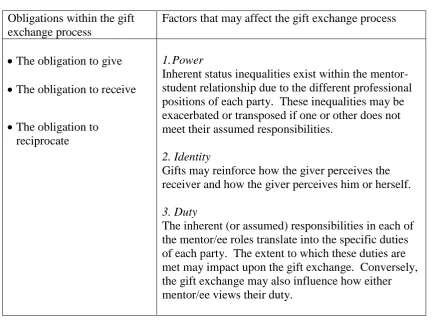
obligation’. The process of gift exchange is then underpinned by three obligations: the
obligation to give, the obligation to receive and the obligation to reciprocate. In their
study of educators who mentor, Clouder and Adefila (2014) identified that this process
of gift exchange, and the obligations implied within it, may be affected by three specific
factors: power, identity and duty (Table 1).
[Table 1 here]
These three factors provide a framework through which to explore the notion of gift
exchange from the mentee’s perspective. The research reported below uses this
framework to explore students’ views of placement learning in a healthcare placement
setting through the lens of the gift exchange process. In doing so, it extends ideas
presented in Kamvounias, McGrath-Champ and Yip (2008) and Clouder and Adefila
(2014) and the factors that may influence mentor/ee dynamics.
The research project
Placement learning experiences are a key feature of nursing and allied health professions
undergraduate degrees with students spending a significant proportion of curriculum time
in placement. The specific role of a mentor may vary to some extent between the different
nursing and allied health professions, however, the literature generally reinforces the
Department of Health (2001) guidance that mentors will facilitate learning opportunities
supervision, and carry out student assessment (e.g. Pulsford, Boit and Owen 2002; Myall,
Levett-Jones and Lathlean 2008; Webb and Shakespeare 2008). These responsibilities
reinforce the pivotal role that mentors play in placement learning experiences where
students are exposed to the practical aspects of their future roles and required to apply to
their practice the knowledge that they have gained in the classroom setting. Ultimately,
mentors help to ensure that students are ‘prepared to practise safely and effectively’
(NMC 2004, 15) and work efficiently with other professional colleagues.
The findings presented in this paper were collected as part of a larger study investigating
the experiences of students in five nursing and allied health professions programmes
concerning their placement learning of biosciences. The aims of this study were to
explore (1) how relevant students perceive biosciences to their professional role; (2) what
opportunities students have to apply biosciences knowledge to practice; (3) what students
perceive about the support they receive from their mentors regarding their biosciences
learning. It was during investigations related to the final aim that data was gathered
concerning experiences of mentorship in general and some of the underpinning
relationship dynamics.
The data reported below was collected in the 2013/14 academic year during the
second phase of the study in which focus groups were conducted. The first phase
involved a survey of 237 final year healthcare students’ perceptions of their overall
experiences regarding placement learning of biosciences. The data gained from this
survey helped to inform questions that were asked within the focus groups. These
questions focused on the importance placed on bioscience whilst on placement and the
support received from mentors to enhance learning in this area. Six focus groups were
held involving 34 final year students in total (see Table 2).
Participants were recruited from the survey employed in the first phase of the
study. Respondents were asked to consider participating in follow-up focus groups and,
if willing, to provide their contact details. The potential participants were then contacted
via email and focus groups arranged. All focus group protocols were approved by the
Faculty of Health Research Committee.
Findings
The gift exchange concept was applied as an overall analytical frame to the focus group
data. The findings below are discussed in relation to the three factors identified by
Clouder and Adefila (2014) as impacting on the obligations to give, receive and
reciprocate (see Table 1). Implications for the reciprocal element of the gift exchange are
also discussed.
Power
In a traditional view of mentoring, the mentor is characterised as the giver bestowing the
gift of knowledge, wisdom and experience downwards to the mentee (Kamvounias,
McGrath-Champ and Yip 2008). Consequently, the mentor is presumed to have higher
status within the relationship, which is further reinforced by factors such as his or her
position as an experienced professional and role as the gatekeeper for and assessor of
students’ learning (Clouder and Adefila 2014). From this perspective, it ‘is really no
wonder that students stand in awe of most clinicians with whom they work’ (Clouder and
Adefila 2014, 56). Expressions of awe were certainly evident in various focus group
comments:
I’ve had an awesome mentor who had been a senior nurse in India before he came over
[Some mentors] are absolutely fantastic at problem-solving; [others] are fantastic with
their underpinning knowledge (PA5).
It was also clear, however, that power in mentoring relationships is a far more complex
and fluid notion than the traditional view would suggest. Clouder and Adefila (2014, 61)
highlighted that power dynamics can be reversed when a mentor ‘feels like they are
working equally as hard, if not harder, than their student’ to maintain his or her identity
as a ‘hard working, kind and nurturing educator’. Our data suggests that, from the student
perspective, power dynamics can be altered when mentors do not appear to have an
adequate gift to bestow:
There are occasions when you go in and you meet the mentor and you as a…student know
dramatically more than your mentor does (NMH6).
Mentors are expected to pass on the gift of knowledge to their mentees; however, various
students across the different professions in our study reported experiences when they had
felt the most knowledgeable party in the relationship. These comments arose particularly
when students were asked about the extent of their mentors’ knowledge concerning
biosciences. Most referred to ‘gaps in [mentors’] knowledge’ (PA4) or a lack of ‘up to
date’ (MW2) knowledge which became apparent to students through what they perceived
as unsatisfactory answers to particular questions that they had asked. There is an implicit
sense of role reversal here: the knowledge of the mentor is being tested and found wanting
by the student. Though of course not officially testing the mentors’ knowledge, it is a
facet of the relationship that students will look to their mentors, as experienced
professionals, to increase and supplement both the practical and theoretical learning that
they have gained to date. It is, however, the very nature of students being students that
puts them in a more informal and less articulated position of power to assess the mentors’
of their studies, students are introduced to and encouraged to study the most up to date
research concerning diagnoses, pathologies and treatments of conditions and diseases. In
contrast, whilst experienced practice professionals, mentors may have less time to stay
current with the latest research and developments within their field. This situation may
have a subtle effect upon the power balance between the two parties. Though the mentor
retains the overall power of being the assessor of their students’ learning, he or she can
lose the power to be viewed with awe by those students. Our data suggests that loss of
awe can then lead to a loss of respect for the mentor and trust that he or she is giving
students the correct information:
It’s always interesting when you get into…debates [with your mentor] and it’s like you’ve
just spouted some made up rubbish that couldn’t possibly be true…you can lose faith in
your mentor very quickly (NMH2).
Some [mentors] don’t know themselves, but they’ll tell you something anyway and you
have to go and check it yourself (ODP1).
Eller, Lev and Feurer et al. (2014) concluded that mutual respect and trust are key
components of effective mentoring relationships. Our findings indicate that, from the
students’ perspective, these elements can be lost, or negatively affected, when they
perceive that an inadequate gift is being given from their mentor. Despite the differences
in their status, the study that students will be undertaking offers them a unique position
from which to judge, to some extent, the quality of the gift that is being bestowed. These
judgements may not be consciously expressed or articulated, but the undercurrents are
evident in the loss of ‘faith’ (NMH2) in their mentors that some students may express and
the consequent impacts upon the mentoring relationship. The student perspective,
further the traditional notion of a one-way power flow.
Disruptions to the power balance continue when mentor training and preparedness
is also considered. Studies have consistently found that mentors in the practice setting
feel unprepared to carry out the role and, as such, require more adequate training and
support (e.g. Pulsford, Boit and Owen 2002; McGowan 2006; Myall, Levett-Jones and
Lathlean 2008; Thomson, Docherty and Duffy 2017). Our data confirms that students
also perceive certain inadequacies within current mentor training:
Mentors would benefit from some more training on actually how to teach, how to engage,
because I don’t think it’s something that comes naturally to everybody (NMH8).
I think a lot of mentors aren’t actually aware of their role, even mentors that have been
qualified for quite a while (NMH7).
More significantly, some indicated that unpreparedness on the mentor’s part could lead
to mentor/ee role reversals at the very start of placement experiences:
Your mentor…will come out with ‘well what do you want to learn from it?’…you have
to push them into saying ‘ok I need to do this, I need to do this’ rather than them coming
forward and saying ‘ok, you need to do this, you need to do this’ (ODP3).
I’ve had several instances where long qualified nurses that have acted as mentors are still
unclear despite having the training…and they look to me for guidance on what they
should be doing (NMH7).
Exploring our student data through a gift giving lens shows that power dynamics within
the mentoring relationship can be altered, or reversed, when mentors, from the students’
perspective, do not bestow an adequate gift or know what gift they should be bestowing.
In these instances, mentees become imbued with a certain amount of power to direct the
knowledge-base. These intricate power dynamics show that mentor/ee roles are not
necessarily stable and at times may be subtly reversed. This role instability calls into
question not only issues of power, but also those of identity.
Identity
The above discussion begins to illuminate how power and identity are intricately
connected. A fluid notion of power suggests that there may also be a fluid notion of
identity. If, for example, students are more knowledgeable in certain areas than their
mentors and if students are leading the direction of their learning, then questions could
be asked about who is mentoring whom. Our data indicates that students are very aware
about their own identity as a ‘student’ and as such, have clear expectations about how
mentors should be relating to that identity. Significantly, these expectations do not just
centre on mentors passing on their knowledge but on explicitly testing the knowledge that
students have already gained. A more dynamic view of the gift in mentoring is again
presented by these student expectations. Rather than a passive downward flow of
knowledge from mentor to mentee, our students suggest that the gift mentors give should
be far more interactional and constructivist in nature. Students confirm in their
descriptions of ‘good’ mentors that they want to strengthen and further develop the
theoretical knowledge that they have gained in university modules by having mentors test
that knowledge as they apply it in the practical setting:
The [mentor] I’m with at the moment is very proactive, she’ll ask me questions, if I’m
saying something, if I’m observing something, if I’m doing something, if it’s appropriate
[she’ll ask] ‘why are you doing this? Why are we seeing those signs?’ and afterwards
we’ll have a debrief (PA4).
knowledge:
[Some mentors] say ‘can you do the obs please, can you do this?’ and then you come
back and say ‘I’ve done them but I’ve found something wrong’ and they go ‘ok, thanks
for telling me’ but they don’t ask you why, they don’t say ‘why do you think there’s a
problem, what would you do next?’ It’s like ‘thanks for telling me’ but then they don’t
test your experience or knowledge of why you think it’s that way (NA5).
Implicit within comments is that students experience being tested and questioned as a
form of support from their mentors and it is this type of support that can provide an
impetus for their learning whilst on placement. This notion reinforces Chow and Suen’s
(2001) assertion that students consider it the mentor’s role to provide opportunities for
their learning rather than take the initiative themselves, which would fit with a more
conventional view of mentor/ee identity. Again, our data adds further complexities to
this perspective. NA6 also recounted a particular incident in which s/he unwittingly
appeared to challenge the identity of the mentor as the most knowledgeable party in the
relationship:
I said [to my mentor] ‘I think [the patient] might be compensating’ and my mentor was
like ‘what?’ and when I said that the relationship sort of broke down and I thought
sometimes it’s not always best…obviously that’s quite intimidating if a student comes in
and says things like that (NA6).
In this example it appears that NA6 threatened the power balance in the relationship by
indicating that s/he may have more insight than the mentor into the patient’s condition.
Rather than a reversal of power, however, where the mentee could fill some ‘gaps’ (PA4)
in the mentor’s knowledge, this transgression of identity led NA6 to perceive a breaking
have to tread a fine line at times to maintain a successful bond with their mentor. Webb
and Shakespeare (2008, 569) described this as the ‘emotional labour’ that students have
to put in to make a mentor/student relationship effective. Specifically, Webb and
Shakespeare (2008) concluded that students need to portray themselves to mentors as
enthusiastic, confident, assertive and competent. Our data suggests that each mentoring
situation may require students to judge how confident and assertive they should appear
to maintain rather than challenge the relationship. In effect then, the idea of a single
student identity that is portrayed to mentors may be limited. Instead, students may need
to consider the degrees and levels of the student identity that they portray according to
which particular mentor they are working with. As Webb and Shakespeare (2008)
asserted, this ‘emotional work’ that students have to do to make the mentoring
relationship function has not, as yet, been sufficiently considered.
A nuanced view of this area continues when behaviours associated with student
identity are also considered. Literature generally suggeststhat students who are willing
to ask questions will achieve most from their mentoring relationships (e.g. Webb and
Shakespeare 2008, Rylance et al. 2017). Clouder and Adefila (2014) confirmed that
research recognises the importance of students being curious enough to seek answers to
questions that they may have. A number of participants identified themselves as
‘naturally inquisitive’ (NA1) and reinforced the benefits of this for their placement
experiences:
If you show [mentors] that you have a willingness to learn then they will teach you…the
ones that I’ve asked questions [to], they’ve been really good in getting answers (ODP3).
Significantly, some students suggested that it is only through being curious enough to ask
questions that they will receive any kind of gift of knowledge, wisdom or experience from
Personally for me, I ask a lot of questions: ‘why is that?’, ‘so why are those results like
that?’, ‘why are we having to do this?’ And then you will get answers, but I think you
can get some placements where if you don’t ask, you won’t find out (NC2).
Whilst reinforcing the importance of students asking questions, either to appear
enthusiastic or encourage the gift giving from their mentors, our data adds a further
dynamic that connects back to issues of power. This dynamic emerges in various
participants’ perceptions that some mentors consider them to be ‘a nuisance’ (NA6) for
asking lots of questions. The most hardy and proactive students appeared to take this on
the chin and look for other sources to tap:
‘
instead of asking your mentor you kind of say ‘well who will know that?’ and you go and find someone who will’ (NA5). Implicitwithin most of the comments, however, was a general sense of negativity being brought
into the relationship through these types of interactions:
You just don’t tend to ask questions because you think you’re wasting their time
and…you’re seen sometimes as a burden (ODP7).
For a lot of [mentors] a student is an inconvenience and it’s a horrible thing to feel like
an inconvenience (NA8).
Question asking appears to be an important way of students seeking to obtain the gift that
their mentors can give and the literature confirms that it is an expected student behaviour.
If students perceive this behaviour to be an irritation to their mentors, however, it could
disrupt to some extent, or at the very least lead to confusion about, their identity as
placement students; how, for example, are they supposed to learn if not by asking their
mentor questions? From the mentor perspective, workload pressures could easily account
for why some students might feel that they are a nuisance or a bother. Many studies
balancing the priorities of patient care (e.g. Myall, Levett-Jones and Lathlean 2008; Webb
and Shakespeare 2008; Foster et al. 2015). Significantly, though, some students consider
that mentors view them as a nuisance when asking questions because those mentors feel
threatened by the act of being questioned. Hodge et al. (2011, 172) argued that practice
settings, like any workplace environment, are hierarchical in nature and ‘newcomers’ to
those settings may be viewed as ‘threatening to transform the knowledge and practices’
of the community already in place. From this perspective, mentors could view student
question asking as less a learning technique and more a critique of their established
routines and procedures. Andrews and Chilton (2000) and Chow and Suen (2001)
indicated that healthcare workers, as task-oriented professionals, have not been trained to
question or challenge accepted practices and consequently, may feel threatened by
questions from students that could appear to challenge the status quo. Some students’
comments seemed to reinforce this view:
I’ve also had nurses who…seem to be intimidated by the questioning and they feel almost
intimidated by a student ‘why do you want to know that? You’re only a first year, second
year’ (NMH3).
Most often, however, participants appeared to connect mentors feeling threatened or
intimidated to gaps or deficiencies in their knowledge, as discussed in the above ‘power’
section, which students’ questions can expose:
I’ve had one mentor that…felt threatened by my questions and probably felt a bit
insecure about his knowledge and he was unable to give the answers that he knew he
should know, so I think it’s just a lack of knowledge on their part really (PA4).
Once you start asking them things which may be you would have expected them to
you’ve got students asking you it probably doesn’t feel too great not knowing what to say
(NA5).
The dynamic emerging here is that students complying with the expected behaviour of
their placement identities, i.e. asking their mentors questions, may disrupt further the
power balance within the mentoring relationship. In the act of seeking the gift from their
mentors, students may inadvertently negatively affect how their mentors view themselves
as the gift giver. Sensing that they are being viewed as ‘a nuisance’ (NA6) would suggest
that students are picking up on a defensive mechanism of their mentors to maintain their
own identities as healthcare and educational professionals; it is better to make the student
seem at fault than consider where their own knowledge may be lacking. This defence on
the mentors part may in turn impact upon how the student views him or herself within the
placement learning experience, i.e. as a nuisance or inconvenience, which may make them
less likely to fulfil their student (question asking) identity with future mentors and so
‘come across as a poor student’ (MW1). It would also seem that this disruption to
traditional, or expected, mentor/ee identities again limits the extent to which a student
may view his or her mentor with ‘awe’ (Clouder and Adefila 2014, 56). In the quote
above, NA5 certainly seems to project more a sense of sympathy or pity for mentors who
are out of their depth rather than complete respect or admiration. Identity and power,
therefore, appear intricately connected within mentoring relationships; a disturbance to
one of these factors will have consequent impacts on the other and may well affect how
the gift giver and receiver perceive one another and potentially themselves. As these
dynamics change within the relationship, so may the duties associated with each party.
Duty
with their role as placement learners. Reinforcing the literature discussed above (e.g.
Webb and Shakespeare 2008; Clouder and Adefila 2014), participants identified that
showing ‘a willingness to learn’ (ODP3) was, in effect, one of the essential duties that
they had to perform to gain the most from the relationship with their mentors. Our data,
however, suggests that showing willing is not only necessary to build a bond and rapport
with mentors, but may also be a required element before any gift giving will take place.
This notion becomes apparent when ODP3’s quote is viewed in full:
If you show that you have a willingness to learn then they will teach you. But if you have
a personality that is a bit on the shy side, then they might think that you don’t want to
learn so they won’t actively approach you to teach you things (ODP3).
From ODP3’s perspective, then, evidence of ‘willingness’ on the student’s part has to
come first before the mentor will ‘actively…teach you’. In this situation, the mentor
appears firmly in a position of power: they know that they have knowledge, wisdom and
experience to pass on, but the mentee has an implicit duty to show first that they desire to
receive the gift. That some students perceive this notion from their interactions with
mentors challenges Clouder and Adefila’s (2014, 62) conclusion that the ‘continuing
generosity of the practice educator is very likely to be influenced by the student’s receipt
and acknowledgement of their gift by showing commitment to study’. Implicit in this
conclusion is that the process of gift giving may be dependent upon the extent to which
students participate in the gift exchange, i.e. reciprocate in the form of acknowledging
and using the gift to support their further study. Our data suggest that, at times, rather
than continuing the gift exchange through reciprocity, students may in fact have to be the
ones to start it. In essence, the obligation to start the gift exchange lies with the student
showing ‘willingness to learn’ (ODP3), which then obliges the mentor to reciprocate and
Exploring the concepts of duty and reciprocity presents a more complex picture
about the gift exchange within mentoring relationships. There were certainly many
comments made by students about proactive mentors eager to initiate the gift giving
process. Apparent within many of the comments, though, was repetition of the word
‘willing’ in relation to mentors carrying out their mentoring duties, for example:
If you have a helpful mentor that’s willing to give you the knowledge…it can come across
to [patients] that you actually know what you’re talking about (MW1).
The inference from such comments is that some mentors, at least from the participants’
perspective, are not very willing to teach students, which would mean that those mentors
are not fulfilling one of the fundamental duties of the mentoring role. Our data provides
some insight into how students experience this unfulfilled duty:
Some nurses may well have [relevant] knowledge…but they have to have a willingness
to engage with the student. If they haven’t got the willingness to engage not only their
own students that they are supervising but other students that are in that clinical area [then
that is] a barrier to knowledge being passed on (NMH1).
These insights suggest that students perceive the desire and passion to be a teacher or
educator as key to mentors discharging their mentoring duties. At the same time, many
participants recognised that mentoring is not always a role willingly chosen by practice
professionals. From some students’ perspective, the mentorship role is one that appears
to be forced upon some practice professionals by, effectively, ‘standing in…the wrong
place at the wrong time [and being told] you’ve got a student today’ (ODP7). Foster et
al. (2015, 19) highlighted that, particularly within the nursing field, promotion has been
linked with gaining additional skills and competencies, ‘of which mentorship is one’.
2015, 19) and an organisational requirement rather than an individual’s choice. This
situation may lead, as some of our students perceived and other studies have found (Gray
and Smith 2000; Foster et al. 2015), to a certain disinterestedness from mentors
concerning the mentoring role.
Significantly, some students indicated that when they perceive a limited sense of
duty from their mentors within the mentoring role, it can impact on the extent to which
they ask those mentors questions during their placement experiences. Effectively then, a
mentor who is not fulfilling their specific duty may hinder a student fulfilling his or her
own duty as a learner on placement. In this situation, it could be surmised that any kind
of gift exchange is essentially closed down. Our data, however, highlights the proactive
steps some students take when facing these circumstances, such as seeking out other
professionals to question. Importantly, this activity was also carried out by those who
considered that they had experienced both positive and educationally supportive
mentoring relationships:
But I don’t just learn from the paramedic mentor that I work with, it’s everybody, the
whole crew that I work with (PA2).
Whilst some may view mentors as the ‘gate keeper’ of students’ learning (Gray and Smith
2000, 1547), our data affirms that students are capable of taking advantage of learning
opportunities when they arise and creating them with other colleagues when they do not.
This behaviour of students to fulfil their duty as placement learners ‘outside of the mentor
mentee domain’ (Andrews and Chilton 2000, 560) suggests the potential for many gift
exchanges to occur, albeit more implicitly and informally, with various placement
Reciprocity
The above discussion of duty demonstrates the significance of reciprocity within the gift
exchange process. In Mauss’ (1954) work, the obligation to reciprocate was as important
as the obligations to give and receive. Our data has already demonstrated that the notion
of reciprocity within a mentoring relationship may not be straightforward and each party
may, at times, be obliged to reciprocate within the gift giving process in various ways.
Whilst highlighting complexities within the notion, the data does support the view in the
literature that reciprocal gift giving can help to build successful mentoring relationships
(Kamvounias, McGrath-Champ and Yip 2008; Eller, Lev and Feurer et al. 2014).
Importantly, it also points to the many ways in which students may reciprocate their
mentor’s gift and, in so doing, illuminates the ‘reciprocal learning flows’ (Hodge et al.
2011, 176) that may arise from, and the ‘invisible gifts’ (Kamvounias, McGrath-Champ
and Yip 2008, 23) that students may give as part of, the mentor/ee relationship.
Hodge et al. (2011, 177) argued that in placement settings, ‘learning becomes a
dynamic, highly relational and reciprocal enterprise’. This view implies that it is not only
the mentors offering a gift of education and knowledge, but the mentees too. A number
of students highlighted this dynamic within the relationship in which they are able to
bring their mentors’ knowledge ‘up to scratch’ (PA5) simply through fulfilling their role
as a questioning learner: ‘what I liked about [a previous] mentor was that if she didn’t
know [the answer to my question], then we would find out together (NA4). More
specifically, various students described a sense of balance achieved in some mentoring
relationships in which each party recognised the gift(s) that the other could bring:
[My current mentor is] aware that I’ve got my head in the books whereas it’s been a while
since she has, so she’s trying to bring her knowledge up so we’re kind of working together
on the road, [our] experience in the classroom and bringing it together (PA4).
It appears that reciprocation may take various forms. In some mentor/ee relationships, it
might centre on the gratitude of the mentee (Howells et al. 2017) and their expressed and
evident desire to obtain more of their mentor’s gift of knowledge and experience
(Kamvounias, McGrath-Champ and Yip 2008). In other cases, or at the same time,
mentees may be passing on their own gifts of current research information and best
practice evidence, as also recognised by Myall, Levett-Jones and Lathlean (2008) in their
study of mentor experiences. It is significant, though, that PA4, in the quote above, went
on to comment that: ‘if you have a good mentor then you can work things out together’
(italics our emphasis). A reciprocal learning relationship, then, may not be a certainty
and most likely will be influenced by the factors discussed above, i.e. the power and
identity dynamics being played out and the extent to which mentor/ee duties are fulfilled.
If the above factors can be navigated successfully and a balance achieved that supports a
positive and genuine relationship, our evidence would suggest that mentors may stand to
gain as much in terms of their professional development as the mentees that they support.
Relating back to Mauss (1954, 55), a gift made of knowledge ‘enriches both the donor
and recipient with the same produce.’
Discussion
The factors that support effective mentor/ee relationships have been the focus of
many investigations and there are many studies that have identified the characteristics
of ‘good’ mentors and mentees (e.g. Chow and Suen 2001; Jokelainen et al. 2011;
Foster et al. 2015: Rylance et al. 2017). That the success and quality of mentorship
schemes is still an area of concern (Dickson, Morris and Cable 2015; Fell et al 2016;
Thomson, Docherty and Duffy 2017) suggests that simply identifying characteristics of
be explored is how these and other characteristics play out within actual mentoring
relationships; in other words, we need to understand more about the dynamics occurring
between mentors and their mentees and the impact that such interactions may have for
each party.
Analysing the data from this study through a gift exchange lens has enabled a
deeper exploration of students’ experiences of being mentored whilst on placement.
What becomes clear from the application of this lens is that both mentor and mentee
play an important role in the gift exchange but, significantly, these roles may be more
fluid than previously considered. Whilst mentors may traditionally be viewed as the
party with the most power and in the position to start the gift exchange (Kamvounias,
McGrath-Champ and Yip 2008), the data presented here shows that students may feel,
within certain mentoring relationships, that it is their responsibility to begin the process
and oblige the mentor to start passing on their ‘gift’. That some mentors may feel that
their knowledge is being tested and judged by their mentees, from the students’
perceptions at least, also suggests a variable view of power within the relationship that,
whilst more implicit, may contribute to a tense and unsatisfying learning experience for
the student.
It is evident from analysing the data through this lens that students may need to
tread a fine line in maintaining a good relationship with their mentor and invest
considerable ‘emotional labour’ (Webb and Shakespeare 2008, 569). For example, a
student may need to assess whether adhering to the typical ‘student on placement’
identity, i.e. asking questions and seeking answers, will antagonise the mentor or create
tension within the relationship. Furthermore, as the data illustrates, the dynamics within
each mentoring relationship will be different so students will need to carry out this
of power, identity, duty, etc., according to how these issues play out with each specific
mentor. Consequently, programme teams within HEIs may find it valuable to invest time
in exploring with students the interpersonal dynamics of mentoring relationships before
they go out on placement and preparing them for the ‘emotional work’ that they may have
to undertake. The gift exchange lens may be useful in this context as it can provide a
framework to consider influencing factors such as power, identity, obligation, etc. Both
students and mentors could then draw on this framework whilst out on placement to
reflect on their mentoring relationships, particularly if they are proving to be less than
successful. We suggest some prompter questions to promote self-reflection and
discussion between mentors and mentees, based on this premise (Figure 1).
[Figure 1 here]
Such prior preparation and ongoing reflection would be time well spent to enable
students to critique their mentoring relationships and the dynamics occurring and so
lessen the risk of students internalising negative conceptions of their identity, e.g. that
they are a burden or a nuisance, which may impact on their interactions with future
mentors.
Ultimately, enabling students to consider and explore the dynamics of mentoring
relationships may help to ensure that they in turn become effective mentors themselves
and so set in place a cycle of continuously effective mentorship schemes.
Notes
1. Participant coding: MW = midwife; NA = nursing (adult); NC = nursing (child); NMH
= nursing (mental health); PA = paramedic; RA = radiographer; ODP = operating
References
Ali P.A., and W. Panther. 2008. Professional development and the role of mentorship.
Nursing Standard 22 (42): 35-39.
Ambrosetti, A., and J. Dekkers. 2010. The interconnectedness of the roles of mentors
and mentees in pre-service teacher education mentoring relationships. Australian
Journal of Teacher Education 35 (6):42-55
Andrews, M., and F. Chilton. 2000. Student and mentor perceptions of mentoring
effectiveness. Nurse Education Today 20 (7): 555-562.
Champetier, C. 2001. Philosophy of the gift: Jacques Derrida, Martin Heidegger.
Angelaki: Journal of Theoretical Humanities 6 (2): 15-22.
Chow, F.L.W., and L.K.P. Suen. 2001. Clinical staff as mentors in pre-registration
undergraduate nursing education: students’ perceptions of the mentors’ roles and
responsibilities. Nurse Education Today 21 (5): 350-358.
Clouder, L. 2009. ‘Being responsible’: students’ perspectives on trust, risk and
work-based learning. Teaching in Higher Education 14 (3): 289-301.
Clouder, L., and A. Adefila. 2014. The ‘Gift Exchange’: a metaphor for understanding
the relationship between educator commitment and student effort on placement.
International Journal of Practice-based Learning in Health and Social Care 2 (2):
54-64.
DfE (Department of Education). 2017a. Securing student success: risk-based regulation
Accessed January 17, 2018.
https://consult.education.gov.uk/higher-education/higher-education-regulatory-framework/
DfE (Department of Education). 2017b. Teaching Excellence and Student Outcomes
Framework Specification. Accessed January 17, 2018.
https://www.gov.uk/government/uploads/system/uploads/attachment_data/file/6584
90/Teaching_Excellence_and_Student_Outcomes_Framework_Specification.pdf
Department of Health. 2001. Preparation of mentors and teachers: a new framework of
guidance. Accessed April 15, 2015. http://webarchive.nationalarchives.gov.uk
/+/www.dh.gov.uk/en/Publicationsandstatistics/Publications/PublicationsPolicyAnd
Guidance/DH_4007606
Dickson, C.AW., G. Morris and C. Cable 2015. Enhancing undergraduate
community placements: a critical review of current literature. British Journal of
Community Nursing 20 (4): 184-189.
Eller, L.S., E.L. Lev, and A. Feurer. 2014. Key components of an effective mentoring
relationship: a qualitative study. Nurse Education Today 34 (5): 815:820.
Fell, P. L., Dobbins, K. and Dee, P. (2016), Bioscience learning in clinical placement: the
experiences of pre-registration nursing students. Journal of Clinical Nursing, 25:
2694–2705.
Foster, H., A. Ooms, and D. Marks-Maran. 2015. Nursing students' expectations and
experiences of mentorship. Nurse Education Today 35 (1): 18-24.
Gray, M.A., and L.N. Smith. 2000. The qualities of an effective mentor from the student
nurse’s perspective: findings from a longitudinal qualitative study. Journal of
Health and Care Professions Council (HCPC). 2017. Standards of education and
training Accessed August 7, 2017.
http://www.hcpc-uk.org/publications/standards/index.asp?id=183
Health and Care Professions Council (HCPC). 2014. Standards of education and training
guidance: your duties as an education provider. Accessed April 11, 2015.
http://www.hcpc-uk.org/publications/standards/index.asp?id=183
Hodge, P., S. Wright, J. Barraket, M. Scott, R. Melville, and S. Richardson. 2011.
Revisiting ‘how we learn’ in academia: practice-based learning exchanges in three
Australian universities. Studies in Higher Education 36 (2): 167-183.
Horner, R. 2001. Rethinking God as gift: Marion, Derrida and the limits of
phenomenology. New York: Fordham University Press.
Howells, K., K. Stafford, R. Guijt, and M. Breadmore. 2017. The role of gratitude in
enhancing the relationship between doctoral research students and their supervisors.
Teaching in Higher Education 22 (6): 621-638.
Johnstone, B. 2004. The ethics of the gift: according to Aquinas, Derrida and Marion.
Australian eJournal of Theology 3: 1-16.
Jokelainen, M., H. Turunen, K. Tossavainen, D. Jamookeeah and K. Coco. 2011. A
systematic review of mentoring nursing students in clinical placements. Journal of
Clinical Nursing 20 (19-20): 2854–2867.
Kamvounias, P., S. McGrath-Champ, and J. Yip. 2008. ‘Gifts’ in mentoring: mentees’
reflections on an academic development program. International Journal for
Academic Development 13 (1): 17–25.
Keifer, J.C. 2010. Tips for success: fostering a good mentoring relationship.
Mauss, M. 1954. The gift: forms and functions of exchange in archaic societies. London:
Cohen and West Ltd.
McGowan, B. 2006. Who do they think they are? Undergraduate perceptions of the
definition of supernumerary status and how it works in practice. Journal of Clinical
Nursing 15 (9): 1099-1105.
Murrell A. 2007. Five key steps for Effective Mentoring Relationships. The Kaitz
Quarterly 1(1): 1-9.
Myall, M., T. Levett-Jones, and J. Lathlean. 2008. Mentorship in contemporary practice:
the experiences of nursing students and practice mentors. Journal of Clinical Nursing
17 (14): 1834–1842.
National College for Teaching and Leadership. 2013. Empowering others: coaching and
mentoring. Accessed August 21, 2018.
https://www.nationalcollege.org.uk/cm-mc-mccor-tp.pdf
Neary, M. 2000. Supporting students’ learning and professional development through the
process of continuous assessment and mentorship. Nurse Education Today 20 (6):
463-474.
Nursing and Midwifery Council (NMC). 2010. Standards of proficiency for
pre-registration nursing education. Accessed August 7, 2017.
http://www.nmc.org.uk/standards/additional-standards/standards-of-proficiency-for-pre-registration-nursing-education/
Nursing and Midwifery Council (NMC). 2004. Standards of proficiency for
pre-registration nursing education. Accessed April 11, 2015.
Papastavrou, E., M. Dimitriadou1, H. Tsangari and C. Andreou. 2016. Nursing students’
satisfaction of the clinical learning environment: a research study. BMC Nursing
15:44 DOI 10.1186/s12912-016-0164-4
Pulsford, D., K. Boit, and S. Owen. 2002. Are mentors ready to make a difference? A
survey of mentors' attitudes towards nurse education. Nurse Education Today 22 (6):
439-446.
Thomson, R., A. Docherty and R. Duffy. 2017. Nursing students’ experiences of
mentorship in their final placement. British Journal of Nursing 26 (9) 14-21.
Rylance, R., J.E. Barrett, P. Sixsmith and D Ward. 2017. Student nurse mentoring: an
evaluative study of the mentor’s perspective. British Journal of Nursing 26 (7)
405-409.
Sabourin, E. 2013. Education, gift and reciprocity: a preliminary discussion. International
Journal of Lifelong Education 32 (3): 301-317.
Veeramah, V. 2012. What are the barriers to good mentoring? Nursing Times 108 (39):
12-15
Webb, C., and P. Shakespeare. 2008. Judgements about mentoring relationships in nurse
Figure 1. Prompter questions for reflection & discussion by mentor & mentee using the notion of ‘gift exchange’.
These questions are designed to be answered in your role as either mentor or mentee. It is recommended that, following self reflection, they form the basis of discussions at meetings at both the start and during placement.
Reflective / Discussion questions for mentee / mentor at the start of a placement
[What ‘gifts’ do I expect to receive?]
What are my expectations of a mentor / mentee’s role during this placement? How willing am I to learn from my mentor / mentee?
What learning opportunities do I expect to receive during this placement? How can I make the most of learning opportunities during this placement? How can I create learning opportunities?
[What ‘gifts’ do I expect to give?]
What are my responsibilities as a mentee / mentor during this placement? What can I do to prepare for my role as mentor / mentee?
What actions do I need to undertake to gain the most from my relationship with my mentor / mentee?
What knowledge, skills and attributes can I offer to the mentor / mentee? What learning can I share with my mentor / mentee?
Reflective / Discussion questions for mentee / mentor during a placement
[The exchange of gifts.]
Am I happy with the current outcomes of this placement? In what ways have I invested in this relationship?
What has worked well? How could I do more of that?
How have I acknowledged and utilised the input or learning received from the mentor / mentee and how can I use this to improve my future practice?
Table 1. Factors that may affect the gift exchange
Obligations within the gift exchange process
Factors that may affect the gift exchange process
The obligation to give
The obligation to receive
The obligation to reciprocate
1. Power
Inherent status inequalities exist within the mentor-student relationship due to the different professional positions of each party. These inequalities may be exacerbated or transposed if one or other does not meet their assumed responsibilities.
2. Identity
Gifts may reinforce how the giver perceives the receiver and how the giver perceives him or herself.
3. Duty
The inherent (or assumed) responsibilities in each of the mentor/ee roles translate into the specific duties of each party. The extent to which these duties are met may impact upon the gift exchange. Conversely, the gift exchange may also influence how either mentor/ee views their duty.
Table 2. Distribution of focus group participants per professional programme
Professional programme No. of focus group participants
BSc Midwifery 2
BSc Nursing (Adult) 6
BSc Nursing (Child) 3
BSc Nursing (Mental Health) 8 DipHE Operating Department
Practitioner (ODP) 8
BSc Paramedic Science 6