Remote Australia needs remote teachers
Dr Melodie Bat
Abstract:
In the current era of nationalisation, accreditation and regulation, the needs of what could be argued are the most disadvantaged communities in the country, appear to have been lost in the rush to create a uniform teacher education system. The Aboriginal and Torres Strait Islander children in remote Australia are fast becoming the lost children of Australia’s education system, as their specific cultural and linguistic identities are positioned as challenges to overcome rather than an essential component of their identities as children and as learners.
Nationally and internationally, there is recognition that the current education system in remote and very remote Australia is failing and that a new paradigm is needed. Analysis of Australia’s national literacy and numeracy achievement data clearly shows that current efforts are not working. Whilst Australia is busy reforming its funding allocations to create what has been proposed will be a more equitable education system, the obvious need for a rethink on the approach to education in this context is seemingly missing. The Remote Education Systems Project, in the Cooperative Research Centre for Remote Economic Participation is engaged in both understanding remote education and in supporting families, communities and organisations to be able to influence and control their education. As part of this work, it is important to be able to consider the changes in workforce and workforce development that may arise as a consequence of this reconceptualization of remote education.
There are two key issues that will be addressed in this paper. The first is that of the pathways into teaching for Aboriginal and Torres Strait Islander peoples in remote Australia and the complex and constraining systems currently in place in both VET and Higher Education. In a significant
conundrum, the current response initiatives may themselves contribute to the development of an apartheid in the teaching profession. The second is the skills, professional knowledge and personal competence required of the non-local teachers who commit to working in the remote communities and who bring their best intentions, professional skills and personal commitment to a learning situation that is clearly not working and in which they unlikely to succeed. This paper will base these discussions around the education workforce of the Northern Territory, making a call for further discussions and action to support a new teacher education approach for remote Australia.
Introduction:
Our people have suffered for too long through the western educational system. It has failed us through no fault of ours. It has been educating us in a foreign language. We have our own mother tongue, art, songs and stories. Why are our children not progressing educationally in this lucky country, Australia? (Blitner et al., 2000, p. 16)
Australia has a complex approach to education, with the federal government making overarching policy that the states and territories are then tasked with implementing. This has been the case for 112 years since federation and for all of that time there has been a constant argument over
and numeracy across the country and there is now a nationally agreed system for the ages and stages for school children (Australian Curriculum and Reporting Authority, 2012a, 2012b). There is much benefit to this nationalisation—common approaches across jurisdictions, ease of transition between states and territories and a great sharing of resources, knowledge and teacher practices. Data from national testing shows evidence that for the most part this is in fact working very well and Australia is a nation that sits within the top twenty achieving developed nations in the world (Thomson, Bortoli, Nicholas, Hillman, & Buckley, 2011). However, when you travel out from the urban centres that sit on the edges of this vast continent, the further you travel, the greater the disparity in the data, and when you disaggregate the data further into Indigenous and non-indigenous a very different and disturbing picture emerges.
Remote and very remote Australia—place and race The children of remote Australia
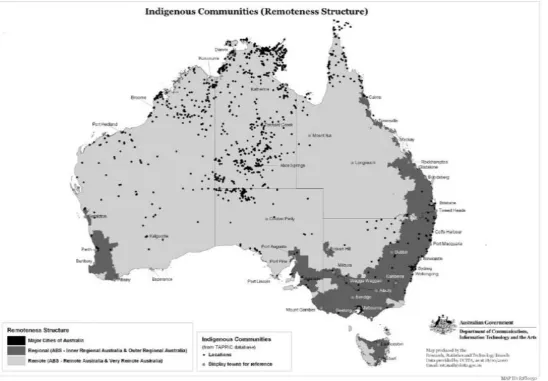
In Australia, geographical remoteness from urban centres has been used to determine levels of access to services and provides a useful mechanism for evaluating programs by location, as shown below in Figure 1.
In this map, the larger urban centres are dark black, the regional areas dark grey and the light grey regions are the remote and very remote areas1. This particular map also locates Australia’s
‘Indigenous’ communities, home to the first peoples of the land, the Aboriginal and the Torres Strait Islander peoples. Of the total land mass in Australia, approximately 86% is classified as remote and very remote and is home to 3% of Australia’s population—25% of the Aboriginal and Torres Strait Islander population and 2% for the non-Indigenous population (CRC-REP, 2013). This is an estimated 129, 300 people—families with children who have the same expectations that their children will receive as ‘good’ an education as the rest of the country. However, this is not the case.
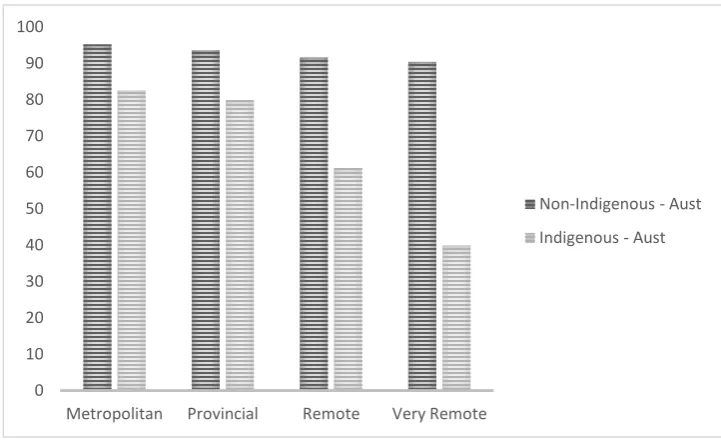
The data presented below in Figure 2 illustrates the disparity in student achievement for the remote areas of Australia compared with the rest of the country and even more so for the Aboriginal and Torres Strait Islander children.
Figure 2: Australian Year 3 NAPLAN results by geolocation and Indigenous/non-Indigenous for 2012: % at or above national minimum standard (generated using the data generator at www.nap.edu.au)
These figures on their own are shocking, that for a developed nation proud of its international standing, there can be such a disparity and no straightforward solutions. This graph clearly shows that the very remote children of Australia are the most disadvantaged in the country, according to the national testing regime. In the Northern Territory, the percentage of Indigenous children in Year 3 who live in very remote regions who are meeting the national minimum standard sits at 22.1%. What this data illustrate is that it is not only where you live in Australia, but who you are that will have the greatest impact on your education. Aboriginal and Torres Strait Islander children across Australia are achieving lower results on this national test than their non-Indigenous school mates and this gap widens as you travel more remote and worsens still if you are in the Northern Territory. It is also worthy of noting that these results are for the Year 3 reading tests and these are the least differential results of them all, that is, as you progress through to Year 9 these gaps widen.
The cohort of Australia’s most disadvantaged children by education achievement then are the Aboriginal and Torres Strait Islander children of remote and very remote Australia, some of Australia’s most vulnerable people. This vulnerability is part of a larger need for many of these children of the remote areas of Australia, one which is an almost overwhelmingly story of ill-health, violent, abusive or neglectful home lives and general socio-economic disadvantage combined with a loss of language and culture (Bath, 2012; Nguyen & Cairney, 2013; Wild & Anderson, 2007). The
1 In this paper, the term ‘remote’ will be used to refer to both remote and very remote areas unless specifically stated
otherwise.
0 10 20 30 40 50 60 70 80 90 100
Metropolitan Provincial Remote Very Remote
children’s commissioner of the Northern Territory has publicly expressed his dismay at this situation and called for an extraordinary response, noting that ‘we have a generation of Indigenous children (now 43% of the NT population aged between 0 and 17 years) with such devastatingly poor prospects for health, safety, and education, and that’s before we even consider the impact of systemic issues such as over-crowded housing, chronic welfare dependence and negligible opportunities for employment?’ (Bath, 2012, p. 37).
Schools in remote locations face many issues such as attracting and retaining qualified and
experienced teachers, maintaining services and providing resources, and in terms of the logistics of their staff attending professional development. Solutions to these issues still prove evasive, so new paradigms may be needed to help address them. (Thomson, et al., 2011, p. 299)
The kind of education that these children require is one that supports whole community wellbeing and education, a combined effort of communities, families, agencies and governments, to not just overcome disadvantage, but to build on the strengths that are still there, despite the marginalisation from the current education system (Blitner, et al., 2000; Nguyen & Cairney, 2013). These children and their families need to belong to the education system rather merely be the actors upon whom the script is applied. Such a complex education context is one which requires a complex response, one that brings together community development initiatives with wellbeing approaches, programs that are locally generated and supported by expert professionals. In an education context, these professionals are typically the teaching staff of the schools.
What kind of teachers does remote Australia need?
Remote Australia needs teachers with particular knowledge, skills and expertise so as to be able to educate effectively in this complex space. They need to be able to work in the ‘cultural interface’ (Nakata, 2007) and they need to be specialist ESL teachers (Hall, 2012; House of Representatives Standing Committee on Aboriginal and Torres Strait Islander Affairs, 2012). They need to be able to respond to and work with children who are suffering from developmental trauma disorder (Bath, 2012) as well as being able to work in locally controlled schools that are welcoming and loving and make children feel safe. The learning needs to build on the child’s existing knowledge, cultural and linguistic base and come from a position of success and encouragement (Nutton, Moss, Fraser, McKenzie, & Silburn, 2012; Silburn, Nutton, McKenzie, & Landrigan, 2011). Ideally, there would be local Aboriginal and Torres Strait Islander teachers who have sociocultural and linguistic knowledge that belongs to the community and the students, and who can ‘walk both worlds’ between their home community and culture and the western professional education culture (Behrendt, Larkin, Griew, & Kelly, 2012; House of Representatives Standing Committee on Aboriginal and Torres Strait Islander Affairs, 2012; Silburn, et al., 2011).
Where could remote Australia get these teachers from?
Firstly, there is a large cohort of experienced remote teachers currently working in the Aboriginal and Torres Strait Islander communities, many with years of experience; some of these are
Aboriginal and Torres Strait Islander teachers and all have a story to share. Although there is no specific data available, it is widely believed that these teachers, who were trained in an earlier, ‘less regulated’ era, are nearing retirement and there are no other new teachers coming up behind them (Hall, 2012). The reported reasons for this varied and include the myriad of factors impacting on remote communities.
remote and very remote areas (Bain, 2011; Ramsey, 2003). Preservice teachers in this context are more likely to gain entry to the program through a mature-aged entry or through a specialised program (Bandias, Fuller, & Larkin, 2013; Bat, 2010). Once in the program, they are expected to undertake their learning in English despite the fact that this may be their third or fourth language (Bandias, et al., 2013). Many Aboriginal and Torres Strait Islander preservice teachers do not complete their degrees and end up with large HECS debts and no qualifications (Bandias, et al., 2013; Bat, 2010). Many of these students are rejecting the teacher education system as one that is trying to turn them into something that they are not. Finally, from 2015, they will now be expected to sit literacy and numeracy tests to prove that they are ‘effective teachers, regardless of which subject or year group they teach’ (Australian Government, 2013). Given that this is now one of the national requirements for teacher education posited to guarantee quality, this creates a situation where the very peoples for whom the education programs are developed, are themselves, not eligible to become qualified to deliver those programs as registered teachers.
The most obvious ‘solution’ then is to bring in non-local teachers to the communities. As registered teachers who have graduated out of nationally accredited programs, surely these teachers will have the skills and expertise to meet the needs of the children. Clearly not, as evidenced not only by the data but also by the difference between the real needs of the children and those living in urban and metropolitan Australia, for whom the national curriculum has been designed. Teachers who are going to work with remote and very remote communities need a special skill set, one that differs from the national agenda.
There is a final option here and that is to train local Aboriginal and Torres Strait Islander people to work in schools alongside the registered teachers as co-workers, to provide the bridge between the community life and the formal schooling world of the children, taking a role more than their current support roles. There is an existing paraprofessional Indigenous education workforce in every remote and very remote locality in Australia, where Aboriginal and Torres Strait Islander peoples have worked for many, many years as Assistant Teachers, Teaching Assistants, and Aboriginal Teaching Assistants etc. Many people who work in these roles have expressed no desire to continue ‘up the staircase’ but to be recognised for the work that they do in these paraprofessional roles and be acknowledged for the important place that they play in remote education (Hall, 2011; Silburn, et al., 2011). This can be seen reflected in the education workforce of the Northern Territory.
The Northern Territory story
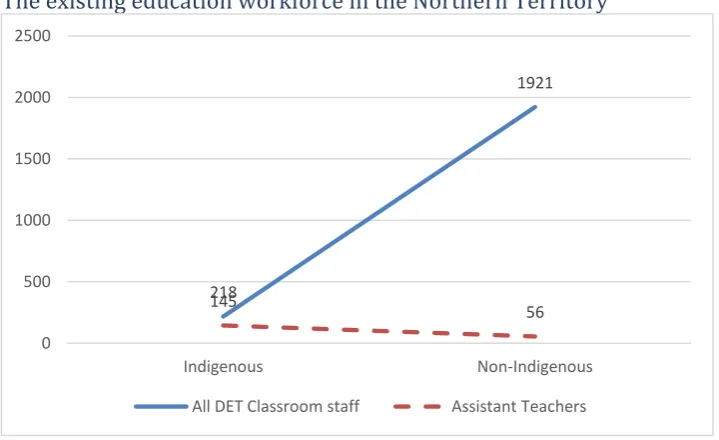
The existing education workforce in the Northern Territory
Figure 3: Teaching staff in the Northern Territory by identified stats: Indigenous/non-Indigenous (Data sourced from Nutton, et al., 2012, p. 17)
218
1921
145
56
0 500 1000 1500 2000 2500
Indigenous Non-Indigenous
This data shows clearly that most of the Aboriginal and Torres Strait Islander peoples working as educators in the Northern Territory schools are employed as Assistant Teachers rather than as other classroom workers or teachers. For many years there has been a call for more Aboriginal teachers in the Northern Territory, partly because the children need local teachers, but also because the non-Aboriginal teachers do not typically stay for very long (House of Representatives Standing Committee on Education and Vocational Training, 2007; Labour Economics Office Northern Territory, 2013).
Balanda (non-Aboriginal) educators are like pieces of paper stuck to a fence. Some stay for a short time, some for a long time, but eventually when the wind blows, they blow away, until the next piece of paper comes along. Aboriginal educators are here to stay and that’s what is special about us, because we are here for our future children.
(Yunupingu in Blitner, et al., 2000, p. 8)
Most of the new teachers each year in the Northern Territory are coming not from the Northern Territory but from other registering jurisdictions, as illustrated below in Figure 4.
Figure 4: New teacher registrations in the NT for the year 2010-2011 (Data sourced from Teacher Registration Board of the Northern Territory, 2012, p. 20)
Initiatives have been made in the Northern Territory to increase the number of Aboriginal teachers, through several federal programs and supported through the national “More Aboriginal and Torres Strait Islander Teachers” (MATSITI) program. One recognised mechanism to achieve this is to have multiple entry points into the degree program (More Aboriginal and Torres Strait Islander Teachers Initiative, 2012) and given further emphasis in the recently released Review of Indigenous Higher Education (Behrendt, et al., 2012). In the Northern Territory there are a number of pathways into the teaching profession. People can apply for entry into a higher education degree with the local university, Charles Darwin University. There are a number of alternative pathways into teacher education including mature-aged entry and alternative entry for Indigenous students. Enrolled degree students who are Aboriginal and/or Torres Strait Islander can choose to study through the Australian Centre for Indigenous Knowledges and Education (ACIKE) and can also opt for a workshop mode run by Batchelor Institute of Indigenous Tertiary Education (BIITE). CDU also runs community-based teacher education programs that enrol paraprofessionals into site-based programs that implement integrated learning into workplace learning programs. No evaluation of these programs is currently available, although reports indicate that students appreciate and welcome the opportunity to study at home in their own communities (Nutton, et al., 2012). However, CDU reports that in its higher education programs, for all Aboriginal and Torres Strait Islander students, reported completions and graduations are low. There is also much concern over whether or not these teachers, or indeed, many other preservice teachers, will be able to pass the literacy and numeracy tests for registration.
BIITE graduates
CDU graduates
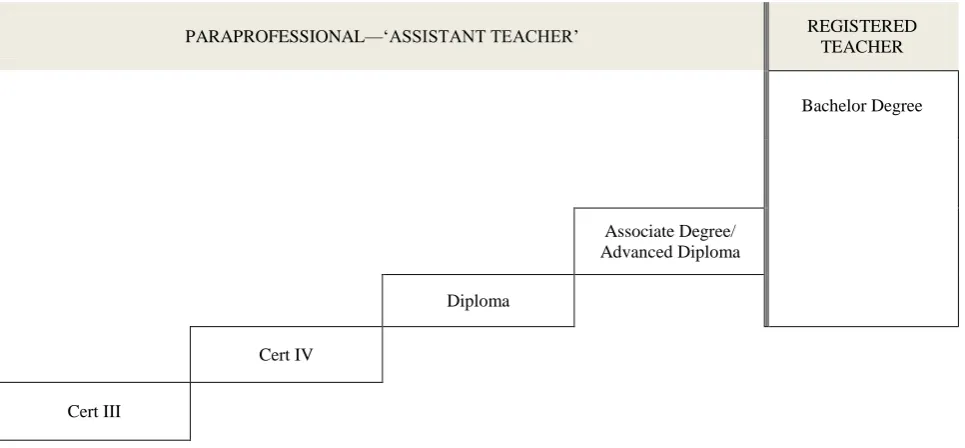
There is also a pathway into teacher education through the paraprofessional staircase approach as illustrated below in Figure 5.
PARAPROFESSIONAL—‘ASSISTANT TEACHER’ REGISTERED
TEACHER
Bachelor Degree
Associate Degree/ Advanced Diploma Diploma
Cert IV
Cert III
Figure 5: Assistant Teacher to Teacher Pathways in the Northern Territory
In this pathway, a clear progression can be seen through VET qualifications into the Higher Education degree, with recognition given for completion and an increase of professional
responsibilities. The Associate Degree/Advanced Diploma is a proposed high level paraprofessional category. At the time of writing, the VET Advanced Diploma is being developed in the Northern Territory and will be implemented in a number of jurisdictions in the near future.
The conundrum
So far, teacher education institutions seem to be doing o.k. insofar as professionally preparing teachers but not so o.k. in relation to ensuring cultural competencies, with destructive
consequences, especially in indigenous communities where schools, and now higher education institutions, continue to be sites of struggle for the majority of learners. (Thaman, 2012, p. 2)
The situation in the Northern Territory is a perplexing one. What we have is the best of intentions resulting in some of the worst possible outcomes. The national teacher education regulatory system is meant to ensure that there are quality teachers for all of the nation’s children. However, this system is producing barriers that are insurmountable for the communities of the Northern Territory. Aboriginal peoples in remote communities will most likely not meet entry or exit requirements and so will not be able to teach their own children as registered teachers. They are however able to undertake VET qualifications and support the predominately non-local teachers who are
ill-prepared for the real needs of the children and who do not stay for any length of time. There is also a real risk that the VET pathway, itself designed to give an alternative entry into teacher education helps to further crystallise what is fast becoming a tiered industrial situation with a divide between registered teachers and assistant teachers. Is it clever thinking to create this new pathway, or is it the path to apartheid?
not have to leave home to study and the learning is competency-based, requiring a different and perhaps more accessible register of English literacy and oracy. There is also a relatively easy path for recognition of current competency based on perhaps years of experience. The Assistant Teachers who undertake this qualification will become Senior Education Leaders in their
communities and will be paid a salary only slightly less than a registered teachers. They will not have the full responsibility of the classroom and so when they are required to be away from work due to cultural or family reasons, which is often the case in remote communities, this will not have as great an impact on the running of the school as when the teacher is absent. Many Aboriginal education workers in the Northern Territory have expressed a clear desire to stay in this VET space (Bartlett, 2012). This is precisely the qualification proposed as suitable for a restricted authority to teach for teachers of Indigenous languages (House of Representatives Standing Committee on Aboriginal and Torres Strait Islander Affairs, 2012)
However, they are not recognised by the profession or the employers as equal teachers to the ‘real’ teachers despite their extensive experience and expertise in remote education, because the national system does not have this flexibility. The non-local teachers do not have the cultural and linguistic knowledge needed to build on the children’s home knowledges, and neither do most have the necessary expertise for teaching children in crisis. The culture shock that they experience is compounded by their inability to create anything other than small moments of success in their classrooms and the high turnover rate is indicative of just how difficult a task this is. And yet, these are the teachers who are the products of the national teacher education system that is guaranteed to produce quality teachers for the whole of Australia. And it does—just not for Aboriginal and Torres Strait Islander communities in remote and very remote Australia.
Conclusion:
Teachers and educators are committed professionals who bring a deep level of personal
commitment to their work—this is true across the world and also in the Northern Territory, where they face a challenge that appears to be beyond the scope of the current education system to handle. The children of remote and very remote Australia deserve to be happy and healthy and to receive an education that supports their wellbeing and personal development. Surely this is not too much to ask in one of the world’s highest ranking national education systems. However, the education needs of the children cannot be separated from their other needs nor from those of their communities. Teachers in remote and very remote Australia need professional and personal skillsets that are markedly different from their counterparts in the rest of the country. The approach to education in remote communities requires a different set of practices, including that of teacher education.
References
Australian Curriculum and Reporting Authority. (2012a). NAPLAN Achievement in Reading, Persuasive Writing, Language Conventions and Numeracy: National report for 2012. Sydney: ACARA. Australian Curriculum and Reporting Authority. (2012b). National report of schooling in Australia 2010:
ACARA.
Australian Government. (2013). Better schools: A national plan for school improvement. Retrieved from
http://www.betterschools.gov.au/sites/betterschools.gov.au/files/docs/the_national_plan_for_sch ool_improvement_factsheet.pdf.
Australian Institute for Teaching and School Leadership. (2011). Accreditation of initial teacher education programs in Australia: Standards and procedures: MCEEDYA.
Bain, C. (2011). Indigenous retention: What can be learnt from Queensland. In N. Purdie, G. Milgate & H. R. Bell (Eds.), Two way teaching and learning: Toward culturally reflective and relevant education (pp. 70-89). Camberwell: ACER Press.
Bandias, S., Fuller, D., & Larkin, S. (2013). Vocational education, Indigenous students and the choice of pathways. Adelaide: NCVER.
Bartlett, C. (2012). What do you think about the idea of an Associate Teacher? Preliminary report of stakeholder opinions of the proposed Associate Teacher classification and qualification pathways.
Darwin: Northern Territory Department of Education.
Bat, M. (2010). Learning from the journeys: Quality in Indigenous teacher education in Australia (unpublished PhD thesis). Charles Darwin University, Darwin.
Bath, H. (2012). 'Intervening' in the Northern Territory. Developing Practice, Summer(30), 26-39.
Behrendt, L., Larkin, S., Griew, R., & Kelly, P. (2012). Review of higher education access and outcomes for Aboriginal and Torres Strait Islander people: Final report: Australian Government.
Blitner, S., Dobson, V., Gibson, F., Martin, B., Oldfield, N., Oliver, R., et al. (2000). Strong Voices. Batchelor: Batchelor Institute.
CRC-REP. (2013). About Remote Australia. Retrieved 01/05/2013, 2013, from http://crc-rep.com/about-remote-australia
Department of Communications Information Technology and the Arts (Cartographer). (2006). Indigenous communities (remoteness structure) map.
Hall, L. (2011, 3-6 July). A school based co-ordination and delivery model of remote Indigenous teacher education. Paper presented at the The Australian Teacher Education Association (ATEA) 2011 Conference: Valuing Teacher Education: Policy, Perspectives and Partnerships, Melbourne, Australia.
Hall, L. (2012). The ‘Come and Go’ syndrome of Teachers in Remote Indigenous Schools – Listening to the perspective of Indigenous Teachers about what helps teachers to stay and what makes them go.
Australian Journal of Indigenous Education, submitted for publication.
House of Representatives Standing Committee on Aboriginal and Torres Strait Islander Affairs. (2012). Our land. Our Languages: Language learning in Indigenous communities. Canberra: The Parliament of the Commonwealth of Australia.
House of Representatives Standing Committee on Education and Vocational Training. (2007). Top of the Class: Report on the inquiry into teacher education. Canberra: The Parliament of the
Commonwealth of Australia.
Labour Economics Office Northern Territory. (2013). ANZCO 2412-13 Primary Teacher: Northern Territory. Retrieved from
http://foi.deewr.gov.au/system/files/doc/other/anzsco_241213_primary_teacher_nt.pdf.
More Aboriginal and Torres Strait Islander Teachers Initiative. (2012). MATSITI 2012 Conference Next Steps: Recommendations and priorities for action from Conference delegates who attended MATSITI National Teachers are Deadly! forum, Adelaide, July 9-11, 2012: David Unaipon College of Indigenous Education and Research.
Nakata, M. (2007). The cultural interface. The Australian Journal of Indigenous Education, 36, 7-14. Nguyen, O. I., & Cairney, S. (2013). Literature review of the interplay between education, employment,
Nutton, G., Moss, B., Fraser, J., McKenzie, J., & Silburn, S. (2012). Recruitment, retention and development of quality educators in very remote NT schools, 2012" Prepared for Northern Territory Department of Education and Training. Darwin: The Centre for Child Development & Education, Menzies School of Health Research.
Ramsey, G. (2003). Report on future directions for secondary education in the Northern Territory. Darwin: Charles Darwin University and Northern Territory Department of Employment, Education and Training.
Silburn, S., Nutton, G., McKenzie, J., & Landrigan, M. (2011). Early years English language acquisition and instructional approaches for Aboriginal students with home languages other than English: A systematic review of the Australian and international literature. Darwin: Menzies School of Health Research.
Teacher Registration Board of the Northern Territory. (2012). Annual Report 2011. Darwin: Northern Territory Government.
Thaman, K. H. (2012, July). Reclaiming a place: teachers and the education of Indigenous peoples in Oceania. Paper presented at the Yamaiyamarna Paitya: Teachers are deadly! MATSITI National Conference, Adelaide.
Thomson, S., Bortoli, L. D., Nicholas, M., Hillman, K., & Buckley, S. (2011). Challenges for Australian education: Results from PISA 2009: Australian Council for Educational Research Ltd.