Research Article
Quantitative Analysis of
Lactobacillus
and
Enterococcus faecalis
between Irreversible Pulpitis and Pulp Necrosis in Primary Teeth
Kemthong Mitrakul
1*, Kutkao Vongsawan
2, Wananong Watcharakirin
3, Pim Khererat
41
Department of Pediatric Dentistry, Mahidol University, Bangkok, Thailand 2International College of Dentistry, Walailak University, Bangkok, Thailand 3Pediatric Dentist, Surin, Thailand
4Pediatric Dentist, Trang, Thailand
*Corresponding Author: Kemthong Mitrakul, Department of Pediatric Dentistry, Mahidol University, 6 Yothee
street, Ratchathewi, Bangkok 10400, Thailand, Tel: 02-200-7821-23; Fax: 02-200-7820; E-mail:
Received: 26 February 2019; Accepted: 10 April 2019; Published: 05 September 2019
Abstract
Introduction: Root canal infection is a common consequence of dental caries which can cause premature loss in
primary dentition. The exposure of pulp tissue to the oral environment allow oral microorganisms to access into the pulp chamber and lead to pulp necrosis without treatment. To identify bacteria associated with root canal infection would be beneficial and lead to providing more effective treatment.
Aims: To quantify Lactobacilli and Enterococcus faecalis levels in infectious root canal of primary teeth between irreversible pulpitis and pulp necrosis groups, and to analyze the association between these bacteria and clinical signs and symptoms.
Materials and methods: Total subjects were 170 Thai children aged 2-10 years old. All subjects were selected from
patients who came to the pediatric dental clinic, Pediatric Department, Faculty of Dentistry, Mahidol University, Thailand and needed a pulpectomy treatment. DNA extraction and quantitative real-time PCR was performed.
100% and 84% (142/170), respectively. The ratio of Lactobacillus and E. faecalis to total bacteria levels was 20% and 9%, respectively. When compared between irreversible pulpitis and pulp necrosis groups, the quantities of total bacteria (p=0.000), Lactobacillus (p=0.000) and E. faecalis (p=0.001) in pulp necrosis group were higher than those of the irreversible pulpitis group. The ratio of Lactobacillus to total bacteria in the pulp necrosis group was higher than in the irreversible pulpitis group (p=0.004), whereas the ratio of E. faecalis to total bacteria was not different between the two groups. Only Lactobacillus was associated with a history of pain (p=0.013). Gingival swelling was correlated with Lactobacillus quantities (p=0.01). When analyzed within each group, E. faecalis quantity was correlated with clinical pain (p=0.01) in pulp necrosis group. In the irreversible pulpitis group, the data showed pathologic finding of lamina dura (p=0.000) and furcation involvement (p=0.016) which correlated with E. faecalis quantities.
Conclusion: The bacterial levels of total bacteria, Lactobacillus and E. faecalis in pulp necrosis group were higher than the irreversible pulpitis group. Levels of Lactobacillus and E. faecalis were associated with a history of pain, pathologic finding of lamina dura and furcation involvement. Gingival swelling was correlated with Lactobacillus quantities.
Keywords: Quantitative real-time PCR; Infected root canal; Primary teeth; Severe early childhood caries (S-ECC)
1. Introduction
Primary dentition is important as it guides the eruption of permanent dentition and contributes to jaw development. Premature loss of primary teeth leads to the disturbance of permanent teeth eruption [1]. Dental biofilm on occlusal surfaces of primary teeth is associated with active carious lesions [2]. Once the dental caries progresses deeper, bacteria which are located at the advanced frontline of the biofilms are directly involved in inducing damage and consequential inflam pulp tissue. Studies had identified bacteria isolated from carious lesion biofilms and vital carious exposure of pulp from primary teeth. The results show that the microbiota of the carious exposed pulp was similar to those of carious lesions [3-8].
Lactobacilli is a rod-shaped, gram-positive, none spore forming, highly acidogenic and acid-tolerant bacteria. It grows under anaerobic, facultative anaerobic or microaerophillic conditions and plays an important role as a pioneer in advanced dental caries, which rises significantly as caries progressed from the initial to deep lesions [9-12]. Previous study analyzed biofilm and pulp chamber bacteria samples using 16S rRNA sequencing. Results showed that the dominant species were S. mutans, Actinomyces and Lactobacillus, suggesting that these species might play direct or supporting roles in pulp pathology in children [3]. Another study evaluated bacteria associated with acute apical abscesses in children by analyzing purulence samples from infected primary teeth. The dominant bacteria were Prevotella, Fusobacterium, Porphyromonas and Lactobacillus [13].
secondary canals, apical delta ramifications, apical foramen, apical root cementum surface and periapical tissues [13-15]. This infection leads to the development of apical periodontitis. Treatment of primary endodontic infections based on the elimination of the root canal infection [15]. In the beginning of the infection process, gram-positive facultative aerobes with cocci have been found in necrotic dental pulp tissues and Enterococcus faecalis has been reported in high prevalence in primary endodontic infections, especially secondary infection of faulty restorations [7, 16-21]. E. faecalis is a gram-positive facultative anaerobe, frequently found in re-infected root canals or chronic periodontitis [20, 21]. Even though the presence of different bacteria involved in endodontic infections of primary teeth, such as pulpitis, pulp necrosis and apical lesion has been reported, microbiological data are still scarce, especially in Thai children [22, 23]. Further study to quantitatively identify other root canal infected related bacteria would be beneficial and help to understand role of bacteria in infected root canals of primary teeth and lead to providing more effective treatment.
Quantitative real-time PCR provides an accurate result and is a sensitive method for detection and quantification of individual species in bacterial populations [23]. This study aimed to quantitatively identify Lactobacillus and E. faecalis in infected root canals of primary teeth between teeth diagnosed as irreversible pulpitis and pulp necrosis in Thai children using real-time PCR and to analyze the association between these bacteria and clinical signs and symptoms. The hypothesis was that quantities of Lactobacillus and E. faecalis in root canal samples of primary teeth diagnosed with pulp necrosis whould be higher than those of teeth diagnosed with irreversible pulpitis.
2. Materials and Methods
The study protocol was approved by the Human Institutional Review Board of the Faculty of Dentistry and the Faculty of Pharmacy, Mahidol University ( MU-DT/PY-IRB 2016/014.0809, 2018/009.2301 ( A statistician consultation was done prior to the sample size calculation, which based on previous studies, used α=0.05 and power
of 80%, with the software package Primer of Biostatistics (McGraw-Hill, NY, USA). Sample size calculations determined that a minimum of 69 children would be required to achieve the statistical difference [19, 22].
2.1 Subject selection and clinical examination
clinical or radiographic evidence of irreversible pulpitis or necrosed pulpal tissue due to dental caries. According to the Guideline on Pulp Therapy for Primary and Immature Permanent Teeth, pulpectomy treatment is provided to a primary tooth with irreversible pulpitis or necrosis or a tooth treatment planned for pulpotomy in which the radicular pulp exhibits clinical signs of irreversible pulpitis (eg. excessive hemorrhage that is not controlled with a damp cotton pellet applied for several minutes) or pulp necrosis (eg. suppuration, purulence)[12]. The roots should exhibit minimal or no resorption. If the tooth was unrestorable or root resorption was more than 2/3 of root length or degree of tooth mobility was more than grade II, it was excluded.
Clinical signs and symptoms of infected primary teeth, including pain history, swelling, pathologic mobility (grade I, II), presence of abscess or sinus tract, were recorded in documents by the examiners. Recent preoperative radiographs were taken from all patients before treatment. All samples were categorized to the irreversible pulpitis group or pulp necrosis group. The characteristics of pain and pain history were categorized as spontaneous pain, provoked pain or no history of pain. Clinical signs, including presence of clinical abscess or fistula and tooth mobility were recorded for analysis. Subjects who had any systemic disease(s), were taking any kind of antibiotic therapy in the 3 months prior to the examination, showed significant gingival recession or periodontal pockets deeper than 4 mm were excluded from the study.
For radiographic assessment, appropriate radiographs by periapical film using a paralleling technique were taken before the dental procedure to assess periradicular lesion, periodontal status, presence of underneath succedaneous tooth, and to measure initial working length. The roots should exhibit minimal or no resorption [12]. For pulpal diagnosis of irreversible pulpitis, a clinical diagnosis based on subjective and objective findings indicates incapable healing and vital inflamed pulp. In addition, irreversible pulpitis can be divided into symptomatic and asymptomatic groups. Pulp necrosis is a clinical diagnostic category indicating degeneration of the dental pulp. The tooth diagnosed with pulp necrosis should present no pulp tissue remaining when the pulp chamber is accessed or indicate the presence of purulent discharge from the canal root[12].
2.2 Sample collection
2.3 DNA extraction
DNA was extracted based on enzymatic lysis using a commercial kit (Flavogen, Taiwan) as previously described [12]. In brief, 20 µl of Proteinase K was added, 400 µl of FABG buffer and 20 µl of a lysozyme mixture (lysozyme 20 mg/ml and mutanolysin (Sigma Aldrich, USA) in 1:10 proteinase K) and vortex. This was incubated at 60°C. for 1 h.; 200 µl ethanol was added and centrifuged at 11,000 9 rpm for 30 s. The solution was transferred into a spin column and centrifuged for 1 min. The supernatant was discarded, 500 µl of W1 buffer was added and centrifuged for 1 min. The supernatant was discarded. Then 750 µl of wash buffer was added and centrifuged for 1 min. The next step was adding 50 µl of elution buffer, left at room temperature for 3 min, before a final centrifuge for 2 min. The extracted DNA concentration and purity was measured using a spectrophotometer at 260 nm/280 nm (Nanodrop 2000C Thermo Scientific, Delaware, USA).
2.4 Culture condition and standard strains
Lactobacillus fermentum (ATCC 14931) and Enterococcus faecalis (ATCC 29212) were cultured on Rogosa SL agar (Difco, Sparks, MD) and selective agar and broth, respectively. Both of them were grown at 37°C. anaerobically (5% CO2) for 24-48 hrs. Genomic DNA was extracted from the overnight culture as described above. A ten-fold serial dilution, starting from 108-102 CFU/ml, was performed.
2.5 Conventional PCR
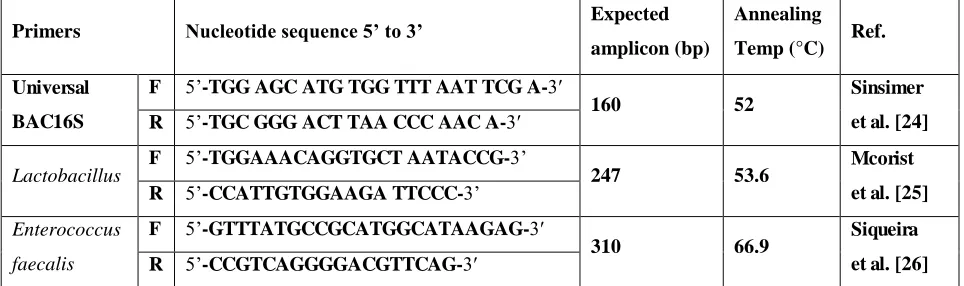
All extracted DNA samples were confirmed with 16srRNA universal primers (Table 1). Each reaction mixture (total volume of 26 µl) contained 2 µl of extracted DNA sample, 16.5 µl of nuclease-free water, 1 µl of 10 mM deoxynucleoside triphosphate (dNTP), 1 µl of each primer, 1.5 µl of 50 mM MgCl2, 2.5 µl of 10X PCR buffer minus Mg, and 0.5 µl of Taq DNA polymerase (KAPA Biosystems, USA). Thermocycle (GeneAmp PCR System 9600 PCR machine, PerkinElmer, CA, USA) was set at 45 cycles. The procedure started with preheating at 95°C for 10 minutes. Each cycle consisted of a denaturing step at 95°C for 30 seconds, annealing at 52°C for 30 seconds, extension at 72°C for 30 seconds, and incubated for an additional extension at 72°C for 10 minutes [23].
2.6 Quantitative real-time PCR
Primers Nucleotide sequence 5’ to 3’ Expected amplicon (bp)
Annealing
Temp (°C) Ref.
Universal BAC16S
F 5’-TGG AGC ATG TGG TTT AAT TCG A-3′
160 52 Sinsimer
et al. [24] R 5’-TGC GGG ACT TAA CCC AAC A-3′
Lactobacillus
F 5’-TGGAAACAGGTGCT AATACCG-3’
247 53.6 Mcorist
et al. [25] R 5’-CCATTGTGGAAGA TTCCC-3’
Enterococcus
faecalis
F 5’-GTTTATGCCGCATGGCATAAGAG-3′
310 66.9 Siqueira
et al. [26] R 5’-CCGTCAGGGGACGTTCAG-3′
Table 1: Primers used in this study.
2.7 Agarose gel electrophoresis
Amplified PCR products from conventional PCR and quantitative real-time PCR were checked with 2% agarose gel (Broad Separation Range for DNA/RNA agarose, Fisher Scientific, UK), respectively, using 1xTris–borate EDTA buffer (100 mM Tris, 90 mM borate; 1 mM EDTA, pH 8.4). The gels were stained with ethidium bromide and image results were captured with a digital imaging system (Molecular Imager ®Gel docTM Systems, Bio-Rad Laboratories Inc., CA, USA).
3. Statistical Analysis
All data were recorded and analyzed using SPSS 16.0 software (Microsoft Corporation, USA). Data distribution was tested with Kolmogorov-Smirnov. The different bacteria quantities between irreversible pulpitis and pulp necrosis were analyzed using a Mann-Whitney U test (p ≤ 0.05). The correlation between clinical signs and symptoms were
analyzed using Spearman’s correlation test (p ≤ 0.05).
4. Results
4.1 Participants
Total subjects were 170. Mean age of the children was 5 ± 1.3 years (age range between 2.1-8.2 years). All subjects were examined for pulpal status at baseline before sample collection, 110 samples were diagnosed with irreversible pulpitis and 60 with pulp necrosis. One hundred and seven subjects (63%) had a history of pain. One hundred and twenty subjects (71%) had clinical signs and symptoms. One hundred and thirty-four radiographs (79%) showed radiographic pathology, and 4 subjects had no permanent tooth bud (Table 2).
Variables Irreversible pulpitis N=110 Pulp necrosis N=60
Age (Years) 4.1 ± 1.3 5.3 ± 1.5
Gender, n (%) Boys, 47 (42.72%)
Girls, 63 (57.28%)
History of pain, n (%) 64 (58.18%) 43 (71.67%)
Clinical signs and symptoms, n (%) 75 (44.12%) 45 (75%)
Radiographic pathology, n (%) 83 (48.82%) 51 (85%)
Table 2: Subjects information in this study.
4.2 Conventional PCR and quantification real-time PCR
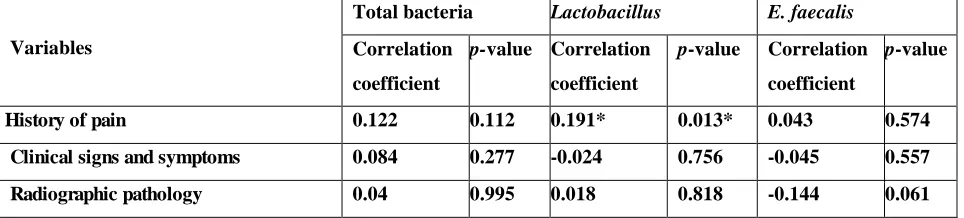
The detection of total bacteria, Lactobacillus and E. faecalis was 100%, 100% and 83.53% (142/170), respectively. The ratio of Lactobacillus and E. Faecalis to total bacteria levels was 20.41% and 8.83%, respectively. When compared between the irreversible pulpitis and pulp necrosis groups, the quantities of total bacteria (p=0.000), Lactobacillus (p=0.000) and E. faecalis (p=0.001) in pulp necrosis group were higher than those of irreversible pulpitis group (Table 3). The ratio of Lactobacillus to total bacteria in pulp necrosis group was higher than in the irreversible pulpitis group (p=0.004) whereas the ratio of E. faecalis to total bacteria was not different between two groups (Table 4). Only Lactobacillus was associated with a history of pain (p=0.013) (Table 5).
Bacteria Pulpal status N Mean quantity ± SD (cells/ml) Median (cells/ml) p-value
Total bacteria Irreversible pulpitis 110 9.44 × 10 5
± 2.55 × 10⁶ 5.20 × 10⁴
0.000* Pulp necrosis 60 2.86 × 10⁶ ± 4.13 × 10⁶ 1.04 × 10⁶
Lactobacillus
Irreversible pulpitis 110 5.93 × 10⁴ ± 1.84 × 10⁵ 4.36 × 10³
0.000* Pulp necrosis 60 6.24 × 10⁵ ± 1.28 × 10⁶ 1.22 × 10⁵
E. faecalis Irreversible pulpitis 110 1.44 × 10
4
± 4.08 × 10⁴ 1.21 × 10³
0.001* Pulp necrosis 60 1.32 ×10⁵ ± 2.77 × 10⁵ 6.81 × 10³
*Median was analyzed by Mann-Whitney U-test at p-value <0.05.
Table 3: Comparison of bacterial quantities between irreversible pulpitis and pulp necrosis.
The ratio of bacteria Pulpal status N percentage p-value
Lactobacillus to total bacteria
Irreversible pulpitis 110 18.89%
0.004*
Pulp necrosis 60 23.19%
E. faecalis tototal bacteria Irreversible pulpitis 110 9.67% 0.738
Pulp necrosis 60 7.28%
*p-value <0.05, Mann-Whitney U-test
Variables
Total bacteria Lactobacillus E. faecalis
Correlation
coefficient
p-value Correlation
coefficient
p-value Correlation
coefficient
p-value
History of pain 0.122 0.112 0.191* 0.013* 0.043 0.574
Clinical signs and symptoms 0.084 0.277 -0.024 0.756 -0.045 0.557
Radiographic pathology 0.04 0.995 0.018 0.818 -0.144 0.061
*p-value <0.05, Spearman’s rank correlation coefficient
Table 5: The correlations between bacterial quantities and the history of pain.
Gingival swelling was correlated with Lactobacillus quantities (p=0.01, Table 6). When analyzed within each group, E. faecalis quantity was correlated with clinical pain (p=0.01) in the pulp necrosis group while there was no association of each bacteria and clinical signs and symptoms in the irreversible pulpitis group (Table 7). In the irreversible pulpitis group, pathologic finding of lamina dura (p=0.000) and furcation involvement (p=0.016) were correlated with E. faecalis quantities (Table 8). There was no association between radiographic pathology and quantities of bacteria in the pulp necrosis group.
Variables
Total bacteria Lactobacillus E. faecalis
Correlation
coefficient
p-value Correlation
coefficient
p-value Correlation
coefficient
p-value
Clinical pain -0.082 0.286 0.005 0.948 -0.150 0.051
Sensitivity to air-blow 0.045 0.051 0.563 0.505 -0.110 0.153
Gingival swelling 0.114 0.138 0.197* 0.01* 0.100 0.193
Tooth mobility 0.051 0.511 0.730 0.091 -0.131 0.089
*p-value <0.05, Spearman’s rank correlation coefficient
Table 6: The association between bacterial quantities and clinical signs and symptoms.
Variables
Pulp necrosis
Total bacteria Lactobacillus E. faecalis
Correlation
coefficient
p-value Correlation
coefficient
p-value Correlation
coefficient
p-value
Clinical pain -0.003 0.980 0.132 0.314 0.305* 0.018
Sensitivity to air-blow 0.094 0.475 0.151 0.248 -0.155 0.237
Tooth mobility -0.03 0.818 0.032 0.811 -0.223 0.086 *p-value <0.05, Spearman’s rank correlation coefficient
Table 7: The association between bacterial quantities and clinical signs and symptoms in pulp necrosis group.
Variables
Irreversible pulpitis
Total bacteria Lactobacillus E. faecalis
Correlation
coefficient
p-value Correlation
coefficient
p-value Correlation
coefficient
p-value
Lamina dura -0.051 0.600 -0.055 0.567 -0.199* 0.00*
Periodontal space -0.077 0.424 -0.134 0.163 -0.181 0.059
Periapical lesion -0.159 0.980 -0.082 0.395 -0.070 0.465
Furcation invlovement -0.119 0.214 -0.135 0.159 -0.230* 0.016*
Root resorption 0.019 0.846 -0.012 0.900 0.175 0.068
*p-value <0.05, Spearman’s rank correlation coefficient
Table 8: The association between bacterial quantities and radiographic pathology in irreversible pulpitis group.
5. Discussion
Due to a limited number of studies reporting bacteria involving infected root canals in primary teeth, there was no previous study that had reported quantitative data of Lactobacillus and E. faecalis in root canal infection of primary teeth before. However, in this study total bacteria quantity from the pulp necrosis group was higher than in the irreversible pulpitis group, which similar to a previous study using checkerboard DNA hybridization that showed results taken from 55 infected root canal samples. Their results showed that the total bacteria were higher in the pulp necrosis group compared with the irreversible pulpitis group[19]. Because the bacterial community had changed after the bacterial invasion to the pulp, in the coronal part the major composition of microorganisms was gram-positive facultative anaerobes. When the lesion progressed to the root canal, anaerobic bacteria represented over 70% in the root canals of primary molars that had not been treated. As expected, the bacterial community in pulp necrosis should be found to be higher than in irreversible pulpitis.
quantitative real-time PCR. That study showed 97% of Lactobacillus prevalence in advanced caries with irreversible pulpitis [21]. Another study presented 44% of Lactobacillus prevalence in 9 carious exposed pulp lesions using a culture technique [3]. Other studies were done in Chinese children aged 5.4-7.6 years old showed the prevalence of Lactobacillus in 11 purulence samples (27.3%) from acute apical abscess using the PCR-DGGE method [21]. A study by Lana and colleagues found 19.35% of Lactobacillus in necrotic root canals of permanent teeth [13].
Another study by Sundqvist and colleagues showed the prevalence of Lactobacillus to total bacteria was 32% from bacteria that had been isolated from the infected root canal without intact pulp chamber walls [27]. Taken together, the presenting of a high prevalence of Lactobacillus in root canal infections in previous studies, including this study, supports the ability of Lactobacillus to invade into infected pulpal tissue and might be one of the pulpal pathogens in primary teeth. For the proportion of Lactobacillus to total bacteria in pulp necrosis and irreversible pulpitis, they were 23.19% and 19.4%, respectively. A previous study presented the role of Lactobacillus in the initial stages of polymicrobial infection of dental pulp and found that after pulpal exposure, Lactobacillus were displayed in the early stage of pulpal infection [28].
Others findings also showed that Lactobacillus was detected close to the pulp due to acidic environment changes at deeper levels [28, 29]. Afterwards, Lactobacillus levels rose again to initiate root canal biofilms [29]. In the early stage of pulpal infection or irreversible pulpitis, Lactobacillus plays an important role as one of the pulpal pathogens and rises significantly as caries progresses to initiate endodontic infection by playing as a pioneer for root canal biofilm formation [30].It could support the findings of this study that Lactobacillus can be found in necrotic root canals higher than in irreversible pulpitis root canal samples. For the prevalence of E. faecalis in this study, it was found to be higher than 80%, which is in line with previous studies. Those studies reported that the prevalence of E. faecalis in the infected root canals of primary teeth was between 14-83% [19, 31, 32]. A study by Cogulu and colleagues using cultural and PCR methods investigated E. faecalis in necrotic primary and permanent teeth, their results showed that the prevalence of this bacteria were 26% and 32% in primary teeth and permanent teeth, respectively [33].
In another study using checker board DNA hybridization, results showed that 83% of E. faecalis was detected in primary teeth necrotic pulp samples [31]. Interestingly, results from previous studies, including this study, showed that the prevalence of E. faecalis in root canal infection of primary teeth was higher than permanent teeth (4-40%) [33]. In addition, the previous study in permanent teeth presented the ratio of E. faecalis to total bacterial level as less than 1% of the total bacterial level in samples of oral rinse, saliva, dental plaque and subgingival biofilm samples [34, 35]. The reason might be due to the morphology of primary teeth roots which have more accessory canals and large dentinal tubules compared to permanent teeth. E. faecalis has the capacity to invade and live within the dentinal tubule, which might relate to the invasion of E. faecalis in primary root canal infections [36, 37].
faecalis was detected in 1.1 × 10³-1.7 × 10⁶ cells/ml. from 88 root canal samples (48 failed root canal treatments, 40 primary infection root canals) of permanent teeth using real-time PCR [39]. Another study using conventional PCR showed that E faecalis was cultured from 2 of 50 necrotic canals (4%) and from 21 of 50 root-treated canals (42%) [27]. There were no previous studies presenting quantitative levels of E. faecalis in infectious root canals of primary teeth before, most previous studies presented the prevalence of E. faecalis between primary infections compared with secondary infections. From previous study, they compared E. faecalis prevalence between primary infection and secondary infection and found that the prevalence of E. faecalis rose significantly after secondary infection due to their capacity to invade and adapt their cell surface to live within the dentinal tubule, this microorganism showed high resistance to calcium hydroxide and irrigating solutions used in root canal treatment [38, 40].
For the correlation of history of pain, clinical signs and symptoms and bacterial levels, this study found that Lactobacillus wasassociated with a history of pain and clinical signs and symptoms, which is similar to a study by Rocas and colleagues which found that the quantity of Lactobacillus increased when continuous pain occurred [28]. Due to the capacity to produce acid and initiate an inflammation process, Lactobacillus may affect pain from pulpal pathology [34, 39, 41-43]. When lesions progress nearly to the pulp horn, dental nerves are activated by mediators such as IL-10, histamine or organic acid from bacteria. Mediator accumulation affects pulpal pressure and low compliance of pulpal blood flow, which can cause pulpal inflammation [43]. E. faecalis significantly associated with only a history of pain, it can be related to pulpal pathology of the periapical area. There was some evidence showing that E. faecalis was most frequently found involving chronic periodontitis, and another study found E. faecalis was related with tenderness on percussion and periapical radiolucency [10, 28]. In addition, one study found that E. faecalis had a strong correlation with tenderness on percussion in permanent teeth [43].
However, the findings from the present study did not find an association between E. faecalis quantities and clinical signs and symptoms similar to previous study, which found no correlation of E. faecalis and pain in primary infection [24]. According to characteristic features of these bacteria, which are frequently found in secondary infections or failed root canal treatments and persistent of antibiotics, it would be better if we studied the prevalence of E. faecalis in secondary infections which can be represented as a pathogen. Although the relationship between E. faecalis levels and history of spontaneous pain was not found in this study, the study of Cogulu and colleagues presented an association between E. faecalis and previous pain in both primary and permanent teeth [6]. Moreover, Vineet and colleagues found that E. faecalis was strongly correlated with tenderness on percussion in permanent teeth [43]. Although the success of endodontic treatment depends on many factors, the reduction of bacteria is the important key. According to this finding, clinicians should consider taking more histories of pain in children because it might influence the treatment outcome in terms of bacteria elimination.
presented the predominance of Prevotella (24%), Fusobacterium (18%)and Porphyromonas (14%) [41].Moreover, Actinomyces, Streptococcus mitis, and Streptococcus oralis were found in high prevalence in abscesses of primary teeth infection. Studies from permanent teeth showed that the predominate microorganism of extra-radicular infection, which presented as gingival or periapical abscess was similar to the microflora in periodontal pockets and the pioneer bacteria that can develop scaffold building, which was Actinomyces [40].
History taking and clinical examination were examined before doing the dental procedure. All data were informed by children and guardians about history of pain, including spontaneous pain, provoked pain or pain on mastication, for the clinical examination, it included pain on percussion, tooth mobility, gingival swelling or gingival abscess. The weak point for collecting history of pain was reliability of information from children or guardians who did not recognize or were uncertain of the occurrence, which might be one drawback in this study.
Although, endodontic treatment of primary teeth is routine in dental practice to control endodontic infections and preserve the teeth by elimination of microorganisms, participating in the pathogenesis and success of treatment depends on many factors [21]. From the findings of this study, history taking and clinical examination together with radiographic finding affects the proper treatment and success of outcomes. In conclusion, the bacterial levels of total bacteria, Lactobacillus and E. faecalis in necrotic pulp necrosis group were higher than those of irreversible pulpitis group. The proportion of Lactobacillus to total bacteria in pulp necrosis group was significantly different from irreversible pulpitis group. Lactobacillus and E. faecalis levels were significantly associated with a history of pain. Only Lactobacillus levels were associated with a history of pain in irreversible pulpitis group.
References
1. American Academy of Pediatric D. Guideline on periodicity of examination, preventive dental services, anticipatory guidance/counseling, and oral treatment for infants, children, and adolescents. Pediatr Dent 35 (2013): 148-156.
2. Braga MM, Martignon S, Ekstrand KR, et al. Parameters associated with active caries lesions assessed by two different visual scoring systems on occlusal surfaces of primary molars a multilevel approach. Community Dent Oral Epidemiol 38 (2010): 549-558.
3. Byun R, Nadkarni MA, Chhour KL, et al. Quantitative analysis of diverse Lactobacillus species present in advanced dental caries. J Clin Microbiol 42 (2004): 3128-3136.
4. Chalmers NI, Oh K, Hughes CV, et al. Pulp and plaque microbiotas of children with severe early childhood caries. J Oral Microbiol 7 (2015): 25951.
5. Chhour KL, Nadkarni MA, Byun R, et al. Molecular analysis of microbial diversity in advanced caries. J Clin Microbiol 43 (2005): 843-849.
7. Cogulu D, Uzel A, Oncag O, et al. Detection of Enterococcus faecalis in Necrotic Teeth Root Canals by Culture and Polymerase Chain Reaction Methods. Eur J Dent 1 (2007): 216-221.
8. Cuoghi AO, Bertoz FA, Mendonca MR, et al. Loss of space and dental arch length after the loss of lower primary molar: longitudinal study. J Clin Pediatr Dent 22 (1998): 117-120.
9. Fabris AS, Nakano V, Avila-Campos MJ. Bacteriological analysis of necrotic pulp and fistulae in primary teeth. J Appl Oral Sci 22 (2014): 118-124.
10. Gomes BP, Pinheiro ET, Sousa EL, et al. Enterococcus faecalis in dental root canals detected by culture and by polymerase chain reaction analysis. Oral Surg Oral Med Oral Pathol Oral Radiol Endond 102 (2006): 247-253.
11. Gopikrishna AV, Kandaswamy D, Jeyavel RK. Comparative evaluation of the antimicrobial efficacy of five endodontic root canal sealers against Enterococcus faecalis and Candida albicans. J Conserv Dent 9 (2006): 2-12.
12. Guideline on Pulp Therapy for Primary and Immature Permanent Teeth. Pediatr Dent 38 (2016): 280-288. 13. Lana MA, Ribeiro-Sobrinho AP, Stehling R, et al. Microorganisms isolated from root canals presenting
necrotic pulp and their drug susceptibility in vitro. Oral Microbiol Immunol 16 (2001): 100-105.
14. Leser TD, Amenuvor JZ, Jensen TK, et al. Culture independent analysis of gut bacteria: the pig gastrointestinal tract microbiota revisited. Appl Environ Microbiol 68 (2002): 673-690.
15. Leonardo MR, Rossi MA, Silva LA, et al. EM evaluation of bacterial biofilm and microorganisms on the apical external root surface of human teeth. Journal of Endodontics 28 (2002): 815-818.
16. Morabito A, Defabianis PA. SEM investigation on pulpalperiodontal connections in primary teeth. ASDC J Dent Child 59 (1992): 53-57.
17. Munson MA, Banerjee A, Watson TF, et al. Molecular analysis of the microflora associated with dental caries. J Clin Microbiol 42 (2004): 3023-3029.
18. Nair PN, Sjogren U, Krey G, et al. Intraradicular bacteria and fungi in root-filled, asymptomatic human teeth with therapy-resistant periapical lesions: a long-term light and electron microscopic follow-up study. Journal of Endodontics 16 (1990): 580-588.
19. Narayanan LL, Vaishnavi C. Endodontic microbiology. J Conserv Dent 13 (2010): 233-239.
20. Nadkarni MA, Caldon CE, Chhour KL, et al. Carious dentine provides a habitat for a complex array of novel Prevotella-like bacteria. J Clin Microbiol 42 (2004): 5238-5244.
21. Nadkarni MA, Simonian MR, Harty DWS, et al. Lactobacilli are prominent in the initial stages of polymicrobial infection of dental pulp. J. Clin. Microbiol 48 (2010): 1732-1740.
22. Piwat S, Teanpaisan R, Thitasomakul S, et al. Lactobacillus species and genotypes associated with dental caries in Thai preschool children. Mol Oral Microbiol 25 (2010): 157-164
23. Mitrakul K, Chanvitan S, Jeamset A, et al. Quantitative analysis of S. mutans, Lactobacillus and Bifidobacterium found in initial and mature plaques in Thai children with early childhood caries. Eur Arch Paediatr Dent 18 (2017): 251-261.
25. McOrist AL, Jackson M, Bird AR. A comparison of five methods for extraction of bacterial DNA from human faecal samples. J Microbiol Methods 50 (2002): 131-139.
26. Siqueira JF Jr., Rocas IN. Polymerase chain reaction-based analysis of microorganisms associated with failed endodontic treatment. Oral Surg Oral Med Oral Pathol Oral Radiol Endod 97 (2004): 85-94.
27. Queiroz AM, Nelson-Filho P, Silva LA, et al. Antibacterial activityof rootcanal filling materials for primary teeth: zinc oxide and eugenol cement, Calen paste thickened with zinc oxide, Sealapex and EndoRez. Braz Dent J 20 (2009): 290-296.
28. Rocha CT, Rossi MA, Leonardo MR, et al. Biofilm on the apical region of the root in primary teeth with vital and necrotic pulps with or without radiographically evident apical pathosis. Int Endod J 41 (2008): 664-669.
29. Ruviere DB, Leonardo MR, da Silva LA, et al. Assessment of the microbiota in root canals of human primary teeth by checkerboard DNA-DNA hybridization. J Dent Child (Chic) 74 (2007): 118-123.
30. Rosenberg PA. Clinical strategies for managing endodontic pain. Endodontic Topics 3 (2002): 78-92. 31. Sakamoto M, Rocas IN, Siqueira JF, et al. Molecular analysis of bacteria in asymptomatic and symptomatic
endodontic infections. Oral Microbiol Immunol 21 (2006): 112-122.
32. Sen BH, Piskin B, Demirci T. Observation of bacteria and fungi in infected root canals and dentinal tubules by SEM. Endodontics and Dental Traumatology 11 (1995): 6-9.
33. Seow WK. Diagnosis and Management of Unusual Abscess in Children. Australian Dental Journal 48 (2003): 156-168.
34. Siqueira JF, Rocas IN. Diversity of endodontic microbiota revisited. J Dent Res 88 (2009): 969-981. 35. Siqueira JF Jr, Rocas IN. Patterns of microbial colonization in primary root canal infections. Oral Surgery,
Oral Med, Oral Pathol, Oral Radiol and Endod 93 (2002): 174-177.
36. Siqueira JF, Rocas IN, Souto R, et al. Actinomyces species, streptococci, and Enterococcus faecalis in primary root canal infections. J Endod 28 (2002): 168-172.
37. Siqueira JF Jr, Rôças IN. Exploiting molecular methods to explore endodontic infections: part 1-current molecular technologies for microbial diagnosis. J Endod 31 (2005): 411-423.
38. Sundqvist G. Taxonomy, ecology, and pathogenicity of root canal flora. Oral Surg Oral Med oral Pathol 78 (1994): 522-530.
39. Sedgley CM, Nagel AC, Shelburne CE, et al. Quantitative real-time PCR detection of oral Enterococcus faecalis in humans. Arch Oral Biol 50 (2005): 575-583.
40. Vadillo-Rodriguez V, Busscher HJ. Role of Lactobacillus cell surface hydrophobicity as probed by AFM in adhesion to surfaces at low and high ionic strength. Colloids Surf B Bio interfaces 41 (2005): 33-41. 41. Yang QB, Fan LN, Shi Q. Polymerase chain reaction-denaturing gradient gel electrophoresis, cloning, and
sequence analysis of bacteria associated with acute periapical abscesses in children. J Endod 36 (2010): 218-223.
Dental Research and Oral Health - Vol. 2 No. 2 – August 2019 31 43. Vineet R, Nayak M. Association of endodontic signs and symptoms with root canal pathogens: A clinical
comparative study. Saudi Endodontic Journal 6 (2016): 82-86.
This article is an open access article distributed under the terms and conditions of the
Creative Commons Attribution (CC-BY) license 4.0