RESEARCH PAPER
59(3): 2014: DOI 10.5958/0976-4666.2014.00001.1Livelihood Diversification Pattern among the
Farmers of West Bengal
Biswarup Saha
1*and Ram Bahal
21Department of Fisheries Extension, College of Fisheries, Central Agricultural University, Lembucherra, West Tripura, Tripura-799 210, India.
2Division of Agricultural Extension, IARI, New Delhi, India.
*Corresponding author: [email protected]
Paper No. 142 Received: 25th March, 2014 Accepted: 30 September, 2014
Abstract
Based on research from Darjeeling and Uttar Dinajpur districts of West Bengal this paper presents evidence that non-farm and off-farm activities are carried out by a significant proportion of farmers and make an important contribution to livelihoods. The average diversification index in the study area was 0.46. Majority of the diversifiers had medium extent of diversification. It shows that there is a high involvement of farm women (24%) in diversification activities. Diversification activities make a greater contribution to cash incomes for poorer households. The study found that farmers from Darjeeling district are more diversified (52%) compared to Uttar Dinajpur district (39%). The reason might be that the scope and marketing in non-farm sector are higher in Darjeeling as compared to Uttar Dinajpur district. In Darjeeling district unavailability of land as well as unproductive land particularly in the hill and comparatively high cost of living also forced farmers to diversify into other sectors for their livelihood. Despite the vast potentiality to diversify the livelihood towards farm and non-farm activities in the study area, there were problems such as negative perception of the community, outdated method of production, lack of improved technology and skills, lack of business start- up budget and absence of market for the non-farm output. There are also lacks of potential researches to study the effect of non-farm activities on farm production and to identify the major problems that hamper the non-farm sector. State machinery should play a facilitator’s role in terms of promoting investment in infrastructure such as road, electricity, irrigation facility etc. more of a decentralized operations for government programmes, especially using the local institution for greater efficiency and better outreach.
Keywords: livelihood diversification; diversification index; diversification pattern; farmers; off farm income; non farm income.
Introduction
Sustainable livelihoods have been increasingly recognized as an important element of sustainable development during the past decade. However, in India, land-based livelihoods of small and marginal farmers are increasingly becoming unsustainable, since their land is no longer able to meet the requirements of food for the family and of fodder for their cattle (Hiremath 2007). As a result, rural households are forced to look towards alternative sources of income. Kalavathi et al. (2012) found a significant income diversification pattern in India. Livelihood diversification has been embraced by a number of development agencies, with UNDP the first to do so fully and the Department for International Development (DFID) adopting it as central to its strategy for meeting the goals set out in its 1997 White Paper ‘Eliminating World Poverty. The contribution made by livelihood diversification to rural livelihoods is a significant one which has often been ignored by policy makers who have chosen to focus their activities on agriculture (Ellis 1998). In this context, the role of Livelihood Diversification has come under increasing scrutiny because of their powerful and pervasive impacts. Livelihood diversification refers to a continuous adaptive process whereby households add new activities, maintain existing ones or drop others, thereby maintaining diverse and changing livelihood portfolios. The literature on livelihood diversification, which crosses several related fields and disciplinary approaches, is characterised by many terms and definitions. For the purposes of this paper, the definition of livelihood diversification chosen by Ellis is used: Rural livelihood diversification is defined as the process by which rural households construct an increasingly diverse portfolio of activities and assets in order to survive and to improve their standard of living. (Ellis, 2000) People diversify by adopting a range of activities. Thus income sources may include ‘farm income’, ‘non-farm income’ (non-agricultural income sources, such as non-farm wages and business income), and ‘off-farm income’ (wages of exchange labour on other farms – i.e. within agriculture, including payment in kind) (Ellis, 2000). Main aim of the paper is to study the nature and pattern of livelihood diversification as well as the importance of livelihood diversification activity in farmer’s economy in selected districts of West Bengal.
Methodology
160. Both secondary and primary data were used for the study. A semi-structured interview schedule was developed based upon the information acquired during the explorative research phase, and pre-tested and adapted prior to the survey. Data were analysed with the suitable statistical tools. Diversification index was measured with the help of Simpson index of diversity. The Simpson index of diversity is defined as:
Where, Pi as the proportion of income coming from source i. The value of SID always falls between 0 and 1. If there is just one source of income, Pi=1, so SID=0. As the number of sources increases, the shares (Pi) decline, as does the sum of the squared shares, so that SID approaches to 1. If there are k sources of income, then SID falls between zero and 1-1/k. Accordingly, households with most diversified incomes will have the largest SID, and the less diversified incomes are associated with the smallest SID. For least diversified households (i.e., those depending on a single income source) SID takes on its minimum value of 0. The upper limit for SID is 1, depends on the number of income sources available and their relative shares. The higher the number of income sources as well as more evenly distributed the income shares, the higher the value of SID. The Simpson Index of Diversity is affected both by the number of income sources as well as by the distribution of income between the different sources (balance). The more uniformly distributed is the income from each source, the SID approaches to 1.
Results and Discussion
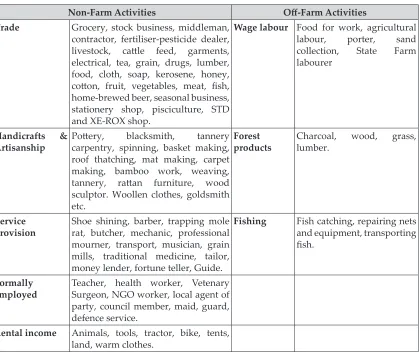
Table 1. Prevalence non-farm and off-farm activities in the study area.
Non-Farm Activities Off-Farm Activities Trade Grocery, stock business, middleman,
contractor, fertiliser-pesticide dealer, livestock, cattle feed, garments, electrical, tea, grain, drugs, lumber, food, cloth, soap, kerosene, honey, cotton, fruit, vegetables, meat, fish, home-brewed beer, seasonal business, stationery shop, pisciculture, STD and XE-ROX shop.
Wage labour Food for work, agricultural labour, porter, sand collection, State Farm labourer
Handicrafts &
Artisanship Pottery, carpentry, spinning, basket making, blacksmith, tannery roof thatching, mat making, carpet making, bamboo work, weaving, tannery, rattan furniture, wood sculptor. Woollen clothes, goldsmith etc.
Forest
products Charcoal, wood, grass, lumber.
Service
provision Shoe shining, barber, trapping mole rat, butcher, mechanic, professional mourner, transport, musician, grain mills, traditional medicine, tailor, money lender, fortune teller, Guide.
Fishing Fish catching, repairing nets and equipment, transporting fish.
Formally
employed Teacher, health worker, Vetenary Surgeon, NGO worker, local agent of party, council member, maid, guard, defence service.
Rental income Animals, tools, tractor, bike, tents, land, warm clothes.
Extent of livelihood diversification
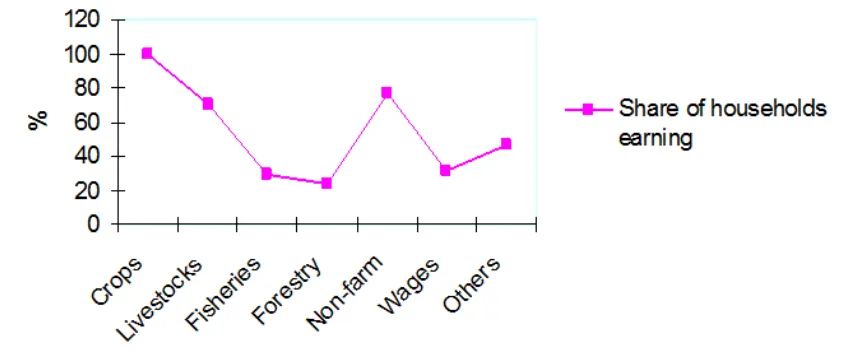
A person or household with a diverse livelihood relies on several different economic activities. A ‘diverse livelihood’ is the opposite of a specialized livelihood based on a single, full-time activity. Diversification is the incorporation of new activities into the economic portfolio. The number of income sources of different households were studied to measure the diversification in this regard and presented in Figure 1. It brings out very clearly that majority of the diversifiers households (23.75%) had three sources of income. On the other hand, only 11.25 per cent of the diversifiers’ households were having only one source of income. The households with one source of income mainly derived their livelihood from crop farming only, although they had diversified within crops. The crop diversification in the study area was seen from traditional food crops to cash crops. Only 8.12 per cent farmers households had more than five income sources to smoothen the livelihood out comes. The multi occupational approach particularly in rain-fed areas as well as in the context of poor economical condition was more desirable from the view point of avoiding unexpected shocks and uncertainty. Ersado (2003) reported similar types of findings in his study regarding livelihood in Zimbabwe.
Fig. 1. Different sources of income among farmers’ households
income as a household with 50 per cent of its income from farming and 50 per cent from wage labour. But, according to research target, and the actual diversification concept the household with 50 per cent of its income from farming and 50 per cent from non-farming sources has a more diversified income than another household obtaining more than 50 per cent of its income from farming and the rest from non-farming sources. This leads to a second measure of diversification. The definition of diversification relates to the number of source of income and the balance among them. The Simpson index of diversity is widely used to measure the diversity. Hill (1973) used Simpson index to measure diversity. Joshi et al., (2003) also adapt the Simpson index to compare crop diversification in several South Asian countries. Here, we use it to measure livelihood diversity. The distribution of extent of diversification among different diversifiers is given in Table- 2. Average Diversification Index in the study area was 0.46. It is clear from Table-2 that the majority of the diversifiers (60%) had medium level of Diversification Index as against only 21.74 per cent of diversifiers were under high level of Diversification Index. Diversification makes smooth flow of income to the household by reducing both predictable and unpredictable fluctuations. Predictable seasonal fluctuations in income can be enhanced by combining enterprises and activities that generate returns during different times of the year. Unpredictable fluctuations are those which create an unexpected loss in income, may be reduced by a diversified portfolio of economic activities.
Table 2. Distribution of diversification index among diversifiers’ households
Diversification Index Frequency Percentage
Low ( < 0.38 ) 21 18.26
Medium ( 0.38-0.63 ) 69 60.00
High ( > 0.63 ) 25 21.74
Total 115 100
Prevalence of diversification activities and gender
The diversification options are generally thought to be more available to men than to women (Ellis, 1998) but in the study area when the case of adoption of cultivation was put to one side, it can be seen that a significant percentage of women (38.31%) were involved in livelihood diversification activities (Table 3).
Table 3. Prevalence of secondary activities of all adult men and women (n=798)
Secondary Activities Adult Men % WomenAdult %
No diversification activities 124 26.72 186 55.69
Secondary activities categorized as LD activities 145 31.25 65 19.46
Livestock as a secondary activity 42 9.05 38 11.37
Casual Labour 44 9.48 18 5.39
Other activities not categorised as diversification 68 14.66 20 5.99
Temporary Migration 41 8.83 7 2.09
Total 464 100 334 100
The families in Darjeeling district were pre-dominantly headed by females. Many women in Darjeeling district started grocery and stationary shops in the front of their houses in addition to farm activities. They sale prepared food in the markets, carry out petty trade in cereals, wool, and fruit. They also adopted different craft activities such as carpet making, weaving, woollen clothes etc. A good number of women adopted tea-leaf plucking which is an important livelihood strategy in the area. In Uttar Dinajpur, besides many women engaged in agricultural labour they also taken up beedi (a country side cigarette: tobacco rolled in leaves) rolling activity in their villages and in the process earned on an average `1500/ per month. Many women also involved in soap, bakery, brick industry as casual labour. Some women make and sell millet beer, carry out petty trade in cereals, processed grains etc. Mostly women folk are engaged in mat weaving (Sitalpati), palm leaf weaving, bamboo crafts and tailoring
0 5 10 15 20 25 30
%
Trader Artisan Services
Provider EmployedFormally LabourCasual TemporaryMigration Livestock
Non-farm and Off-farm activities
Adult Men Adult Women
activities individually with the support of male members who help them in procurement of raw materials. Women from marginal farm households as well as landless agricultural labourer group engage themselves with multiple activities like back yard poultry, duckery, small animal rearing, rope making, and part time non-farm jobs. Besides meeting family consumption, these activities also earn some cash as income. A good number of women from both the district were engaged in livestock related activities. In the study of Dessalgen (1992) reported that 90 per cent of diversifiers having full control over the income they earn. All have implications for gender relations within the household. Livestock as one of the major source of income was also confirmed by the assertion Makhanya and Ngidi (2013). They observed that livestock farming was practised at subsistence level and was kept mainly for various social activities such as lobola (bride price), ritual functions, and social status.
Pattern of livelihood diversification
Diversification pattern of Darjeeling District
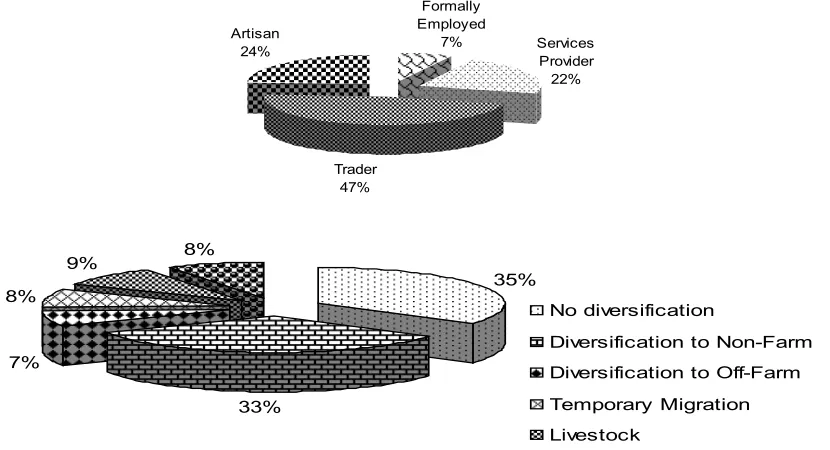
Darjeeling district showed an interesting pattern of diversification as shown in Figure- 3. Thirty five per cent adults from sample household did not diversified their livelihood, they solely dependent on their base livelihood activities. While 33 per cent diversified into non-farm sector and 9% of them adopted livestock as their diversified activities. About, 8% of them
Formally Employed
7% Services
Provider 22%
Trader 47% Artisan
24%
35%
33% 7%
8%
9% 8%
No diversification
Diversification to Non-Farm Diversification to Off-Farm Temporary Migration Livestock
Non-Economic Activity
took temporary migration to cities. Farming constitutes an important vocation in addition to tea garden. Maize, paddy, citrus, zinger and gladiolus are the main crops particularly in the hill area. In hill, agriculture fragments (terrace) determine operational and managerial cost and extent of difficulties in inter-cultural operations, irrigation management etc., and this in turn affects both productivity and profitability. For every farm family there was some area used as homestead garden because of pattern of dispersed settlement. The effective use of homestead enterprise can influence livelihood securities for the small and marginal holding farm families. However, with respect to poor soil fertility and disrupted irrigation management, they couldn’t make it profitable. The livelihood system in Darjeeling hills resolves around farming, tea garden, timber extraction, casual labour, handicrafts, and tourism.
Farm to Farm
Returns from agriculture have been uncertain and erratic, especially in the areas where low soil fertility and poor irrigation facilities. That is why agriculture does not provide enough livelihood security. To cope with the uncertainties of the agricultural output, the predominant occupation adopted by people were dairy farming, piggery, sheep rearing, and poultry as supplementary activities, without giving up agriculture. It seems that the practice of animal husbandry, dairy is/both periodic incomes to generate fund both on periodic basis as well as for emergency purpose.
Farm to Non-Farm
Farming activities can not absorb the bulk of working population which makes solid foundation to diversify into other sectors. About thirty three per cent of the adults from the selected households have diversified to non-farm from farm activities. Many people has shifted from farm based to trading of milk as their first non-farm activity, then slowly moving into tea-stalls, to small restaurant. Many families started different types of shops in front of their houses. Thus the predominant pattern was people diversified agriculture to dairy and livestock rearing, then scaled up dairy activity before they moved into trading of milk and milk products, eggs, chicken and pork. Finally, to tea stalls and restaurants. Formal employment (7%) as an option was not very evident in the area but the employment in Indian Army and B.S.F. gaining popularity Figure 2.
Non-Farm to Non-Farm
Migration
Temporary migration as an option for stabilizing the income was observed 8 per cent of total diversification activities in Darjeeling. The motive behind migration was higher income from casual labour or services in cities.
Diversification pattern of Uttar Dinajpur District
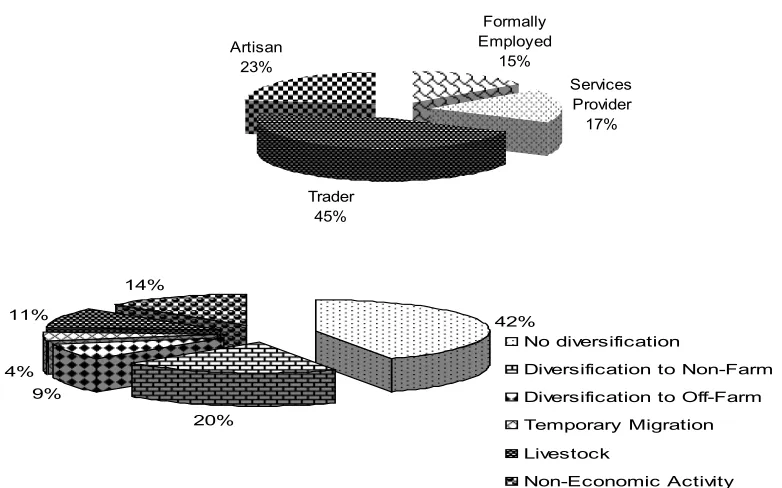
Unlike Darjeeling hill, Uttar Dinajpur has comparatively productive and fertile agricultural land. Agriculture was therefore, the primary livelihood in the area. Many more diverse opportunities had come up in this area including crop, farm and non-farm sector. This was allowing people to take up different routes of diversification. In spite of this, 42 per cent of the adults from the sample household not diversified their livelihood (as indicated in the Figure- 4). Some of them were reported that finance to start up business and required skill was the main constraints. Twenty per cent of them diversified into non-farm sectors including trading, services providing, artisanship and formal employment. About nine per cent of the adults from sample households diversified into off-farm activities in form of casual labour in kharif as well as dry season. While 14 per cent of them engaged in other secondary non-economic activities, including student, housework etc.
Formally Employed
15%
Services Provider
17%
Trader 45% Artisan
23%
42%
20% 9%
4% 11%
14%
No diversification
Diversification to Non-Farm Diversification to Off-Farm Temporary Migration Livestock
Non-Economic Activity
Farm to Farm
Many farmers diversified into farm to farm. They chose to scale up existing cropping pattern of a mix of food and cash crop, some diversified into fruit, flower and high value crops. A good number of house hold also adopted mixed farming, including livestock, fishery, poultry, piggery, bee-keeping, sericulture etc.
Farm to Non-farm
Uncertain income from agriculture and susceptibility to unforeseen future shocks leads farmers diversified into non-farm sectors. Trading and services were two common non-farm activities pursued in the district (as indicated in the Figure-4). Trading including wholesale and retail constitute 45 per cent of total non-farm activities. The commodities traded were paddy, jute, mastered, potato, fruit, vegetables, meat, fish, silk worm, honey, which were the most important commodities in the market. Stock business (stock of commodities for future marketing), middleman, stationery shop, tea-stall were the most prominent business in the area. Twenty three per cent of the adults involved in non-farm activities engaged in artisanship such as carpenter, spinning, basket making, carpet making, bamboo work, weaving, tannery, pottery, wood sculptor, goldsmith etc., and 17 per cent of them were adopted services providing as diversification activity. This is including mechanic, professional mourner, transport, musician, grain mills, tailor, money lender, fortune teller etc.
Non-Farm to Non-Farm
Many adults from sample households were found having diversified and/ or modified their non-farm activities and caste occupation for higher productivity and income.
Migration
As indicated in the Figure-4, four per cent of the adults from sample households adopted temporary migration as diversified livelihood, especially for wage labour. Besides, 15% have secured government jobs, who often used to come to the village periodically.
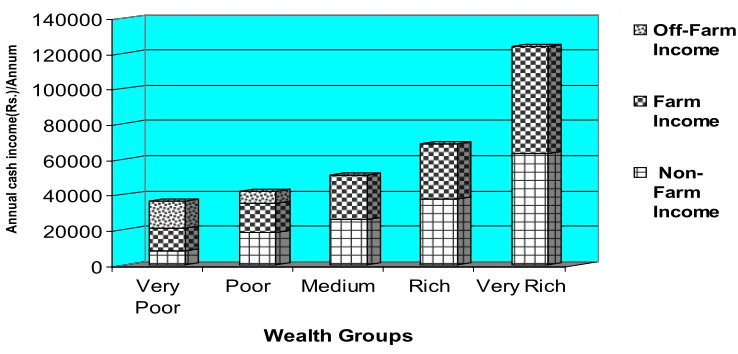
Importance of livelihoods diversification activities
0 20000 40000 60000 80000 100000 120000 140000 An nu al c as h i nc om e( Rs .)/ An nu m Very
Poor Poor Medium Rich Very Rich
Wealth Groups
Income sources amongst different wealth groups
Off-Farm Income Farm Income Non-Farm Income
Fig. 5. Income source among different wealth groups
Conclusion
It is evident that irrespective of the level of development, families pursue a mix of activities for income stabilization and risk mitigation. This mix is generally across sectors, farm and non-farm and also option of migration. Significant numbers of adults from the sample households diversified their livelihood in different farm, off-farm and non-farm activities. It has found that trading and artisanship are most important activities in the study area. It was also found that there is a high involvement of women in diversification activities. the diversification activities is dependent primarily upon the context within which it is occurring-this includes the different access to diversification activities, market condition, development of infrastructures, social and human capital and the distribution of the benefits of diversification. These findings need to be re-examined to make effective policy for sustainable development of the farmers.
Despite the vast potentiality to diversify the livelihood towards farm and non farm activities in the study area, there are problems such as negative perception of the community, outdated method of production, lack of improved technology and skills, lack of business start- up budget and absence of wide market for the non-farm out put. There are also lacks of potential researches to study the effect of non-farm activities on farm production and to identify the major problems that hamper the non-farm sector. State machinery should play a facilitator’s role in terms of promoting investment in infrastructure such as road, electricity, irrigation facility etc. more of a decentralize operations for government programmes, especially using the local institution for greater efficiency and better outreach is needed. Availability of support services such as credit to rural producers through appropriate changes in policies and delivery mechanisms should be ensured for sustainable development of farmers.
In order to improve the livelihoods and make it more sustainable so as to empowering the poor through participatory methods and lift the standard of living of farmers through diversified activities, the implementation of multidimensional policies through bottom up approach that will develop the capacities, choice, and diversity of livelihoods is deemed vital. Bottom-up approaches may include (i) beneficiary consultation and participatory planning including women empowerment, (ii) community development support, (iii) engagement of nongovernment organizations (NGOs), (iv) local government involvement, and (v) private sector participation. Therefore, bottom-up approach in the formulation of these policies and their successful implementation is utmost important for sustainable livelihood.
References
Carswell, G. (2000). Sustainable livelihoods in Southern Ethiopia, IDS Research Report, No. 44, Brighton: Institute of Development Studies.
Carswell, G., Hulme, D., Cooke, B. (2002). Livelihood diversification: increasing in importance or increasingly recognized? Evidence from southern Ethiopia, Journal of International Development, 14(6): 786-804.
Dessalegn, R. (1992). The Dynamics of Rural Poverty: Case studies from a district in Southern Ethiopia, Monograph Series 2/92, Addis Ababa: Institute of Development Research. Development Studies, 38(5): 59-87.
DFID, (1997). White Paper on international development. Department for International Development: London Ellis, F. (1998). Household Strategies and Rural Livelihood diversification, The Journal of Development Studies,
35(1): 1-38.
Ellis, F. (2000). Rural Livelihoods and Diversity in Developing Countries, Oxford University Press.
Ersado, L. (2003). Income diversification in Zimbabwe: Welfare implications from urban and rural areas. Food Consumption and Nutrition Division Discussion International Food Policy Research Institute, Washington, D.C. Paper No. 152.
Hill, M.O. (1973). Diversity and Evenness: A Unifying Notation and Its Consequences, Ecology, 54(2) : 427-432. Hiremath, B.N. (2007). The changing faces of rural livelihood in India, In: National Civil Society conference on
Joshi, P.K, A. Gulati, P.S. Birthal, and L. Twari. (2003). Agricultural diversification in South Asia: Patterns, determinants, and policy implications. Markets, Trade, and Institutions Division Discussion International Food Policy Research Institute. Washington, D.C. USA.
Kalavathi, S., Erlene, M., Naka, P., Long, V.V., Krishnakumar, V., Thomas, R.J., George, V. and George. M.L. (2012). Diversification for Livelihood Security: Experiences from Major Coconut Growing Countries, Cord, 28(2).
Khatun, D., and Roy, B.C. (2012). Rural Livelihood Diversification in West Bengal: Determinants and Constraints. Agricultural Economics Research Review, 25(1): 115-124.
Makhanya, E. M. and Ngidi, M.M. (2012). Poverty and Rural Livelihoods in Umzumbe, South African Geographical Journal, published online, 81(1): 44-51. http://dx.doi.org/10.1080/03736245.1999.9713660. Murthy, B.E.V.V.N. (1983). Entrepreneurship in small towns: A study with apecial reference to two selected
towns in coastal Andhra. Unpublished Ph.D. Thesis, Andhra University, Visakhapatnam.
Pankhurst, H. (1993). Vulnerability, coping mechanisms and the food security project in Kindo Koysha, Wolaita, SOS Sahel Research Report, London: SOS Sahel.
Reardon, T. (1997). ‘Using evidence of household income diversification to inform study of rural non-farm labour market in Africa’, World Development, 25(5): 735-47.
UNDP. (1997). Human Development Report 1997, Oxford University Press, Oxford.