Data Imputation Using a Trust Network for
Recommendation via Matrix Factorization
Won-Seok Hwang1, Shaoyu Li1, Sang-Wook Kim1, and Kichun Lee2
1
Dept. of Electronics and Computer Engineering Hanyang University, Korea
{hws23,chris,wook}@hanyang.ac.kr 2
Dept. of Industrial Engineering Hanyang University, Korea
Abstract. Existing recommendation methods suffer from thedata sparsity prob-lem which means that most of users have rated only a very small number of items, often resulting in low recommendation accuracy. In addition, forcold start users evaluating only few items, rating predictions with the methods also produce low ac-curacy. To address these problems, we propose a novel data imputation method that effectively substitutes missing ratings with probable values (i.e., imputed values). Our method successfully improves accuracy of recommendation methods from the following three aspects: (1) exploiting a trust network, (2) imputingonly a part of missing ratings, and (3) applying them to any recommendation methods. Our method employs a bidirectional connection structure within a distance level for find-ing reliable users in exploitfind-ing a trust network as useful information. In addition, our method imputes only some missing ratings, calledfillable ratings, whose im-puted values are expected to be accurate with a sufficient level of confidence. More-over, our imputation method is independent of, thus applicable to, any recommen-dation methods that may include application-specific ones and the most accurate one in each domain. We conduct experiments on three real-life datasets which arise from Epinions and Ciao. Our experimental results demonstrate that our method has recommendation accuracy better than existing recommendation methods equipped with imputation methods or trust networks, especially for cold start users.
Keywords:Recommendation systems, trust networks, data sparsity, imputation.
1.
Introduction
Due to the rapid growth of the amount of items such as products, web pages, and multi-media contents in the Internet, users need a tool to find information relevant to their tasks. In order to satisfy users’ needs, there have been a substantial number of researches about recommendation methods [1], and several recommendation services are in operation for movies3, books4, music5, etc.
3http://www.netflix.com 4
http://www.amazon.com 5
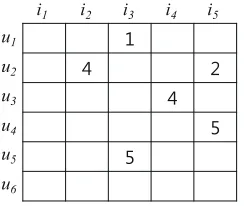
In the literature, a large number of recommendation methods have exploited arating matrixincluding users’ ratings for items in order to predict ratings [25][22][14][35]. Fig-ure 1 shows an example of a rating matrixR= (ru,i)M×N. In the matrix, a cell specified
on the scale of 1 to 5 indicates a rating given to an item by a user. A cellru,iwhose value
is empty (null) is called amissing ratingand represents a case in which useruhas not evaluated itemi. The subscriptsM andN mean the numbers of users and items, respec-tively. For example, in Figure 1 useru1has evaluated itemi3whereas the user has not evaluated itemi1.
i1 i2 i3 i4 i5 u1
u2 u3 u4 u5 u6
Fig. 1.A sample rating matrix
Recommendation methods predict ratings that anactive userwould assign to his/her unrated items, and then recommend those items whose predicted ratings are top-K high-est. Some existing methods suffer from low accuracy when most of users rated only a few items, i.e., the rating matrix is very sparse. The situation, called thedata sparsity prob-lem[1][13][8], is a universal obstacle to most of recommendation methods. In a real-life problem, it has been an important issue how to accurately predict ratings forcold start userswho rate only a small number of items [1][28] because 50% of users evaluate less than 5 items [10].
To solve the aforementioned problems, researchers [2][15][21] have adopted an ap-proach of imputing missing ratings. The imputation apap-proach infers imputed values for missing ratings by analyzing the users-given ratings. After that, it substitutes the missing ratings with the imputed values. Naturally, the more closely each imputed value on miss-ing ratmiss-ingru,ireflects useru’s preference on itemi, the more accurate the results of the
recommendation methods are.
Second, we selectively apply the imputation approach toonly a part ofmissing ratings rather than all of them. Most existing imputation approaches universally try to fill all missing ratings although they cannot accurately infer imputed values for some missing ratings due to the data sparsity problem. For this reason, we deal with only those missing ratings whose values are inferred with a sufficient level of confidence. We expect that our idea improves the accuracy because we eliminate ratings with inaccurate imputed ratings. Moreover, compared to dealing all missing ratings, our idea needs less time since the recommendation methods analyze less ratings (users-given ratings as well as filling ratings).
Third, we design our imputation approach to be applicable to any recommendation methods. The existing imputation approaches are targeted to specific recommendation methods such as user-based and item-based methods [23][27]. However, in the litera-ture there exists an ample number of recommendation methods that outperform them. In addition, businesses and domain experts can employ any appropriate recommendation methods suiting their particular settings. For this reason, we build theimputed rating ma-trixby substituting the missing ratings with the imputed values in a generic setting. This matrix has the same format as that of the original rating matrix, it can be applicable to any recommendation methods.
Based on the three ideas, we propose a novel trust-based imputation method. Our method infers the imputed values for missing ratings by the following sequence. It esti-mates a value for each missing ratingru,iof itemifor useruby aggregating the ratings
given byreliable neighborswho are reachable fromuin a trust network (Idea 1). After that, we estimate only the missing rating of an item evaluated by a sufficient number of reliable neighbors, effectively regulating the amount of imputed ratings in a way that the resulting rating matrix conveys accurate information (Idea 2). Finally, we make an im-puted rating matrix by assigning imim-puted values to the corresponding missing ratings in the original rating matrix, and then apply this matrix to the probabilistic matrix factor-ization (PMF) [11] model to obtain final recommendation results (Idea 3). PMF performs well on large and imbalanced datasets, requiring less learning time than other matrix fac-torization approaches.
To demonstrate the effectiveness of the proposed recommendation method, we per-form comprehensive experiments on two data sets [19][31] from Epinions6 and another data set [31] from Ciao7. Epinions and Ciao are websites where users assign ratings to items, write reviews, and specify trust relationships to other users. We suggest several ways to find sets of reliable neighbors for a user according to a distance level from the user in consideration of the edges’ direction. Examining the accuracy according to dif-ferent settings in thorough experiments, we find an optimal setting. Also, we analyze the effect of excluding imprecise imputed ratings. We compare the accuracy of the pro-posed method with a recommendation method equipped with the imputation based on the default voting approach [2] and existing recommendation methods. We demonstrate the superiority of the proposed method to those methods for whole users and cold start users, separately.
To summarize, our main contributions are as follows:
6http://www.epinions.com 7
– We propose a novel imputation method exploiting a trust network, which can be ap-plicable to any recommendation systems for more accurate results.
– We show that it is better to impute only a few missing ratings rather than all of them unlike the claim of the existing researches.
– We observe that users who are connected to a certain user in any direction (i.e., for-ward and backfor-ward) tend to have similar tastes to his/her.
– We conduct extensive experiments using three real-world datasets and show that recommendation equipped with our method outperforms existing recommendation methods exploiting existing imputation methods or trust networks.
The rest of this paper is organized as follows: We discuss some related work in Section 2. We present our proposed method in Section 3. We report and analyze experimental results in Section 4. Finally, we conclude the paper in Section 5.
2.
Related Work
Collaborative Filtering:In this section, we review collaborative filtering methods that are widely studied approaches in the recommendation fields. In general, collaborative fil-tering methods are categorized into two types:memory-basedandmodel-basedones [1]. First, memory-based methods [2][23][7] predict the ratings of a user using the similarity of her neighborhoods, and recommend the items with high ratings.
Second, model-based methods [26][22][24] learn a model capturing a users ratings on items, and then predict his/her unknown ratings based on the learned model. Some of them [25][11][13] exploit the matrix factorization for learning a model. These methods focus on fitting the rating matrix using low-rank approximations to make further predictions. The premise behind a low-rank factor model is that a user’s preference vector is determined by how each factor applies to that user. However, both of the memory-based and the model-based methods mostly suffer from low accuracy due to thedata sparsityandcold-start userproblems [1][13][8].
Imputation Approach:To overcome the problems, some methods that employ an impu-tation approachhave been proposed. Default voting [2] is a straightforward imputation-based method that substitutes the missing ratings with default values, such as average ratings by a small group of users for other items. Ma et al. [15] set a threshold to decide whether a user is confident or not and fill the missing data only to users that have highly confident reliable neighbors. Ren et al. [21] proposed an auto-adaptive imputation method which identifies a set of key ratings for a pair of an active user and a target item, and adap-tively impute them according to ratings of each user. Zhang et al. [34] propose a recursive recommendation method, where a rating predicted in each recommendation step is used in its next imputation step and the imputed value is also used in the next recommenda-tion step. Moreover, Su et al. [30][29] experimentally examine which recommendarecommenda-tion method is the most suitable for the recursive approach.
Trust-based Methods:Trust-based recommendation methods, as another solution to the data sparsity and the cold-start user problems, have drawn considerable attention [6][19][9]. These methods exploit a trust network crawled from Epinions, Ciao, and Flixter8as addi-tional information. Yang et al. [33] classify the trust-based methods into two categories: neighborhood based and matrix factorization based methods.
In the neighborhood based methods, TidalTrust [6] performs a modified breadth-first search in a trust network to predict a user rating for recommendation. Massa and Avesani [19] introduce MoleTrust, which has a similar idea with TidalTrust. However, when finding users who rated a target item, MoleTrust considers only those users in the trust network within a maximum-depth which is independent of any specific user and item. TrustWalker [9] supposes a random walker [3] who starts from an active user node and moves to the item nodes through the edges on the trust network. The probability of an active user’s stay in an item indicates a preference on the item. RelevantTrustWalker [4] is an extended version of TrustWalker. It performs a random walk on a trust relevancy graph built by considering the trust relationships and similarities among users. Dong et al. [5] identify an opinion leader from an active users trustees, and then integrate the comments of those opinion leaders and user preferences to predict a rating on a target item.
Some recent recommendation methods via the matrix factorization use trust networks as well. Ma et al. propose a method, called SoRec [18], which combines probabilistic matrix factorization and trust networks. The method factorizes both of a rating matrix and a trust matrix at the same time with considering latent user features of these matrices are identical. STE [16] considers that each users latent factor is also related to his/her trustors ratings when factorizing a rating matrix. In SocialMF [10], a users latent factor incorporates the users who are reachable from him/her (with decaying weights for more distant users) to improve the quality of recommendation.
Ma et al. [17] propose social regularization as to incorporate trust network information into the training procedure. The social regularization constrains the user’s latent factor to be similar his/her rating average or his/her trustees rating average. Wang et al. [32] assume that the topics or categories of a user determines whether she/he trusts someone else or not. Based on this assumption, their method incorporates the multi-faceted trust relationships between users into rating prediction. RTCF method [20] reconstructs a trust network to adjust incorrect trust relationships, and then uses it for more accurate rating prediction.
Noticeably, the trust-based recommendation methods only use ratings given by those users who are reachable from the active user through the edges’forward directionin the trust network. The premise behind this is that users have similar preferences with their trustees (i.e., users whom a user trusts). However, because the similarity relationship is symmetrical, users will be similar to not only theirtrusteesbut also their trustors(i.e., users who trust them), which has not been considered in recommender systems. In ad-dition, they merely examine reachable users from a certain user without considering the distance between users.
8
3.
Proposed Method
The recommendation method equipped with the imputation approach predicts a value for each missing rating based on user given ratings andimputed ratings. In this situation, it is a critical aspect for good recommendation accuracy how much each imputed value vu,iwell reflects the preference of useruon itemi. For this reason, our goal is to infer a
proper imputed value for each missing rating.
In our method, first we compute an imputed valuevu,i by aggregating the ratings
that reliable neighbors for useru, denoted byRelu, gave to itemi. We defineRelu as
the users who are reachable from useruin a trust network. The rationale behind this is that the existing researches [6][19][9] demonstrated thatReluhas similar tastes to user
u. Specifically, in definingReluwe consider two facets: (1)distance thresholdand (2)
bi-directional connectionof edges. The distance threshold prevents the users whose tastes are dissimilar from being selected as reliable neighbors. The bi-directional connection of edges helps to include more similar users.
We also select only apartof missing ratings whose imputed values are determined to be accurate enough rather than all missing ratings. If few users inReluevaluated item
i, it would be suspicious to compute imputed valuevu,idue to the lack of information.
For this reason, we infer an imputed value for only those unrated items evaluated by a sufficient number of reliable neighbors. After that, we build an imputed rating matrixR0 by substituting a part of missing rating in the original rating matrixRwith the imputed values.
Finally, we applyR0to the well-known recommendation methods such as the proba-bilistic matrix factorization (PMF) [11] model. The imputed rating matrixR0has the same format to that of the original rating matrixR, so it is applicable to any recommendation methods. In the following subsections, we explain each step in detail.
3.1. Estimating values for imputation through Trust Network
We examine a trust network to define the reliable neighborsRelu for each useru. The
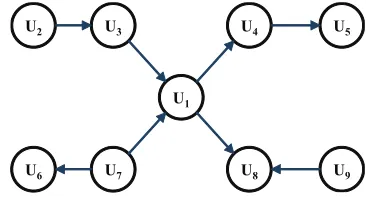
trust network can be seen as a graph where a node corresponds to each user and an edge corresponds to a trust relationship. Figure 2 demonstrates a sample trust network. For instance, the edge (U1 →U4) represents “U1trustsU4”. In this case, we callU1andU4
trustorandtrustee, respectively. Note that a user can be both a trustor and a trustee at the same time: e.g.,U4in Figure 2 is both a trustee ofU1and a trustor ofU5.
The imputed values become more accurate as more users are included inRelu and
those users inRelu have tastes more similar to that of useru. In order to gather more
U
1
U
4 U5
U
2 U3
U
8 U9
U
6 U7
Fig. 2.A sample trust network
In order to prevent users dissimilar touin tastes from being selected asRelu, we
include only those users who are reachable within a certain distanceδfromu. The rational behind this is that the greater distance between two users is in a trust network, the more different their tastes are.
When we consider bi-directions of edges and distance levelδ, we denote the reliable neighbors asRelBID,δ
u . Similarly, when considering forward directions, we denote it as
RelF W D,δu . For example, in Figure 2, if we setδ= 1,RelBID,U 1
1 ={U3, U4, U7, U8} andRelF W D,U 1
1 ={U4, U8}. If we setδ= 2,Rel
BID,2
U1 ={U2, U3, U4, U5, U6, U7, U8, U9}andRel
F W D,2
U1 ={U4, U5, U8}.
To impute a missing ratingru,i, our method findsReluBID,δand estimates the imputed
valuevu,ias follows:
vu,i= ¯u+
Σx∈Xwu,x(rx,i−x¯)
Σx∈Xwu,x
(1)
whererx,i denotes the rating of userxon item i, andu¯ represents the average rating
of useru. As in Equation (1), the proposed imputation method considers not all of the users inRelBID,δu but those users who rated an itemi. The index setXrepresents users
including in{x|rx,i6= 0, x∈RelBID,δu }. In addition,wu,xrepresents the weight which
describes the influence of a distance between two usersuandxin a trust network. It is necessary and in most cases improves the quality of imputation because it is likely that two users have different preferences if their distance is long. One could simply set it to a constant regardless of the distance if removing the distance influence.
3.2. Imputation Ratio
For estimating the imputed valuevu,i, the proposed method aggregates the ratings given
by users who evaluated itemiamong the reliable neighborsRelBID,δ
u . If there are only a
few users who evaluated itemi,vu,iwould be inaccurate due to the lack of information.
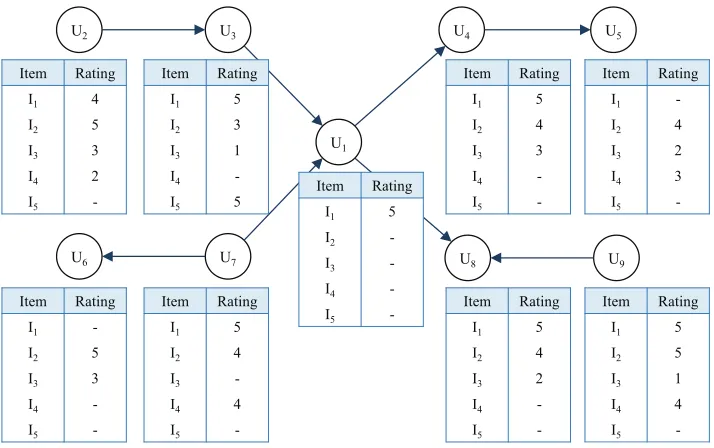
Figure 3 depicts this problem. Circles represent users, and edges between circles represent trust relationships. The table below each user denotes the ratings given by the user to items. Here, the items without ratings indicate that those items which have not been rated yet by the user. If we want to estimate the imputed values for the unevaluated items ofU1, the ratings given to those items byRelBID,U 2
be considered. In the case of itemI2, all the 8 reliable neighbors evaluated it. Thus, we can estimate impute valuev1,2by aggregating the opinions of those 8 reliable neighbors. On the other hand, in the case of itemI5which has been rated by only userU3, we can use only the opinion ofU3in the estimation process, which is less reliable relatively. In reality, not so many items have been rated by more than 8 users; on the other hand, many items just likeI5have been rated by only a small number of users. For instance, in the Epinions dataset crawled by [19], 56% of items are only rated by one user.
U1
U4 U5
U2 U3
U8 U9
U6 U7
Item Rating
I1 4
I2 5
I3 3
I4 2
I5
-Item Rating
I1 5
I2 4
I3 3
I4
-I5
-Item Rating
I1 5
I2 3
I3 1
I4
-I5 5
Item Rating
I1
-I2 4
I3 2
I4 3
I5
-Item Rating
I1
-I2 5
I3 3
I4
-I5
-Item Rating
I1 5
I2 4
I3 2
I4
-I5
-Item Rating
I1 5
I2 4
I3
-I4 4
I5
-Item Rating
I1 5
I2 5
I3 1
I4 4
I5
-Item Rating
I1 5
I2
-I3
-I4
-I5
-Fig. 3. An example of imputing U1’s missing ratings with the ratings ofU1’s reliable neighbors is shown. ItemI5will be not imputed due to the lack of ratings from the neigh-bors.
Although Equation (1) can calculate the imputed values for all missing ratings, we claim that it provides more accurate recommendation if we imputeonly a partof missing ratings. For a user u, we call the missing ratings that are substituted with the imputed valuesfillable ratingsFuθ, where given parameterθ, calledimputation ratio, controls the
number of fillable ratings. Specifically, we sort the missing ratings for a user according to the number of his/her reliable neighbors who evaluate his/her unrated item in descending order; and then, we include topθ percent of missing ratings in the fillable ratings. In Figure 3, ifθ= 50%, only ratingsr1,2andr1,3will be included inFUθ=50%1 .
vu,i=
¯
u+Σx∈Xwu,x(rx,i−x¯) Σx∈Xwu,x
, ifi∈Fuθ
0 otherwise.
(2)
whereX indicates users including in{x|rx,i6= 0, x∈RelBID,δu }.
After computing the imputed values, we densify the original rating matrixR by as-signing the impute values to their corresponding missing ratings and consequently build the imputed rating matrixR0 = (ru,i0 )M×N. This matrix has less missing ratings
help-ing recommendation methods to be free from the data sparsity problem. Moreover, our method eliminatesθ% missing ratings for every user, so it alleviates the cold start user problem as well. Thus, the recommendation methods would provide more accurate results with the “dense” imputed rating matrix.
3.3. Rating Prediction
Note that our proposed method helps regardless of the choice of underlying recommenda-tion methods as we can simply replace the original rating matrixRby the imputed rating matrixR0. In other words, our method is orthogonal to existing recommendation meth-ods, which is one of strengths of our method. Businesses and applications can choose their own appropriate recommendation methods suiting their particular settings, yet still use our proposed idea for improving accuracy and running time.
In this paper, we apply our imputed rating matrixR0to the probabilistic matrix factor-ization (PMF) [25],i.e., one of well-known and accurate recommendation methods. For applyingR0to PMF, we first map each ratingr0u,ito the interval[0,1]by linearly scaling functionf(x) = (x−1)/(rmax−1)wherermaxindicates the maximum value for ratings
inR0. LetX ∈RK×M andY ∈ RK×N represent latent feature matrices for users and items, respectively;Xu andYirepresentK-dimensional latent feature vectors of useru
and itemi, respectively. The conditional probability of the observed rating is defined as:
p(R0|X, Y, σ2R0) =ΠuM=1Π N i=1[N(r
0 u,i|g(X
T uYi), σ
2 R0)]I
R0
u,i (3)
whereN(x | µ, σ2)is the probability density function of the Gaussian distribution with meanµand varianceσ2, andIu,iR0 is the indicator function that is equal to 1 if useru rated itemiand equal to 0 otherwise. The functiong(x)is the logistic functiong(x) = 1/(1 +e−x), which bounds the range ofXT
uYi within the range [0, 1]. The zero-mean
spherical Gaussian priors are also assumed for user and item feature vectors:
p(X|σX2) =Π M
u=1N(Xu|0, σ 2
XI), p(Y |σ 2 Y) =Π
N
i=1N(Yi|0, σ 2
YI) (4) Hence, through a Bayesian inference, we can obtain the posterior probability of the latent variablesX andY as follows:
p(X, Y |R0, σR20, σ2X, σY2)∝p(R0|X, Y, σR20)p(X |σX2)p(Y |σ2Y)
=ΠuM=1Π N i=1[N(r
0 u,i|g(X
T uYi), σ
2 R0)]I
R0 u,i
×ΠuM=1N(Xu|0, σ 2 XI)×Π
N
i=1N(Yi|0, σ 2 YI)
The log of the posterior probability over the user and item features is given by
lnp(X, Y |R0, σ2R0, σX2, σ 2 Y) =−
1 2σ2
R0 ΣuM=1Σ
N i=1I
R0 u,i(r
0
u,i−g(X T uYi))
2
− 1
2σ2 X
ΣMu=1X T uXu−
1 2σ2
Y ΣNi=1Y
T i Yi
−1
2((Σ
M
u=1ΣiN=1IR 0
u,i) lnσ2R0+ (M×K) lnσX2 + (N×K) lnσY2) +C
(6)
whereCis a constant that does not depend on the parameters. Keeping the parame-ters (observation noise variance and prior variances) fixed, maximizing the log-posterior over two latent features is equivalent to minimizing the following sum-of-squared-errors objective function with quadratic regularization terms:
L(R0, X, Y) =1 2Σ
M u=1Σ
N i=1I
R0 u,i(r
0 u,i−g(U
T uVi)
2
+λX
2 Σ
M u=1kXuk
2 F+
λY
2 Σ
N i=1kYik
2 F
(7)
whereX = σ2R0/σ2X,Y = σR20/σY2 andkk2F denotes the Frobenius norm. A local minimum of the objective function can be found by performing a gradient descent search onXuandYifor all useruand all itemi.
∂L ∂Xu =Σ
N i=1I
R0
u,ig0(XuTYi)(g(X T uYi)−r
0
u,i)Yi+λXXu,
∂L ∂Yi =Σ
M u=1I
R0 u,ig
0
(XuTYi)(g(X T uYi)−r
0
u,i)Xu+λYYi
(8)
whereg0(x)is the derivative of the logistic function,i.e.,g0(x) = e−x/(1 +e−x)2. In order to reduce the model complexity, in all our experiments, we setλX =λY. When
estimates ofUandV are found, we can predict the rating of useruon itemias follows:
ˆ
ru,i=g(XuTYi) (9)
4.
Evaluation
4.1. Experimental Set-Up
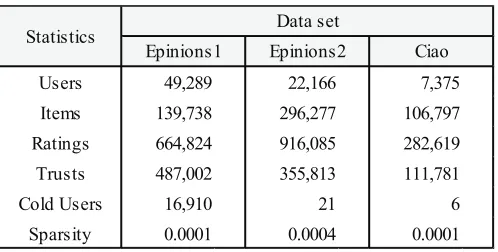
We use three data sets that are used by previous researches [19][31] for our experiments. Two of those data sets are collected from Epinions, and the last one is collected from Ciao. For convenience, we name those data sets as Epinons1,Epinions2, andCiao re-spectively. Table 1 shows the statistics of each data set. Epinions1 has more users than other data sets, and Epinons2 has more items and ratings than the other data sets. The number of trust relationships in Epinions1 is the highest among those of data sets. The size of Ciao is smaller than those of the other two data sets. In Table 1, we define the
cold-start usersas those users who have evaluated less than five items as in the exist-ing researches [19][9][10]. Although it is widely known that most users are generally the cold-start users in many domains, there are only few cold start users in Epinions2 and Ciao data sets. This is because that the previous researches that collected those data sets may not have included the cold start users. The sparsity means the ratio of the number of nonzero elements to the total number of elements in the rating matrix. Table 1 shows that all of the data sets are very sparse.
Table 1.Statistics of Data Sets
Users 49,289 22,166 7,375
Items 139,738 296,277 106,797
Ratings 664,824 916,085 282,619
Trusts 487,002 355,813 111,781
Cold Users 16,910 21 6
Sparsity 0.0001 0.0004 0.0001
Statistics Data set
Epinions1 Epinions2 Ciao
In the evaluation, we employmean absolute error (MAE)androot mean square er-ror (RMSE) as accuracy metrics. MAE is a measure that calculates the average of the differences between the predicted ratings and the actual ratings and can be computed by
P
(u,i)|Ru,i(ru,i−ˆru,i)
{(u,i)|Ru,i} whereRu,iis a boolean variable indicating whether useruhas a
rat-ing on itemiin the test data set.ru,iandˆru,idenote the user-given and predicted ratings,
respectively. RMSE is a measure that puts more emphasis on big errors and is computed
by qP
(u,i)|Ru,i(ru,i−rˆu,i)2
{(u,i)|Ru,i} . We perform 5-fold cross validation in our experiments. In
each fold, we use 80% of rating data as the training set and the remaining 20% as the test set. We use the same settings for all other experiments.
4.2. Edges Direction in a Trust Network
(i.e., bi-directions) of edges. Unlike our method, the existing trust-based recommendation methods [6][15][9][10] consider theforward direction onlyin their rating predictions. In this evaluation, we verify our reliable neighborsReluBID,δof using bi-direction of edges is more effective than the other neighborsRelF W D,δu defined by existing researches. This is becauseRelBID,δu includesmoreusers that havesimilar tastesto those of the users in
RelF W D,δu .
First, we analyze Epinions1 to confirm that the users ofReluBID,δhave similar tastes
with those users of RelF W D,δ
u . We set the distance threshold δfrom 1 to 6. We
com-pute the average of similarity between a useruand the users in each of RelBID,δ
u or
RelF W D,δ
u . As a similarity metric, we employ the Pearson’s correlation coefficient to
compare two users’ ratings on the common items. In the analysis, we ignore the simi-larity values that are equal or smaller than 0. Table 2 shows that the average similarities forRelBID,δ
u are slightly higher than those forRelF W D,δu in all settings ofδ. Thus, as
expected, users have similar preferences with their trustors as well as trustees.
Table 2.Similarity between each user and his/herRelBID,δ
u /RelF W D,δu
BID FWD
1 0.673 0.667
2 0.678 0.671
3 0.686 0.679
4 0.691 0.685
5 0.694 0.689
6 0.694 0.691
Distance Threshold (δ)
Edge's Direction
In addition, we apply two user sets, RelBID,δu and ReluF W D,δ to our imputation
method to compare them in terms of recommendation accuracy. The similarities of a user and itsRelBID,δ
u are similar to that ofReluF W D,δ, so more users in a user set deliver
more information that improves the accuracy. We vary the distance thresholdδfrom 1 to 6 and set the imputation ratioθas 10% or 20% that are shown as the best values in our experiments (We show details in Section 4.3). We produce the results for whole users and only the cold start users. For cold start users, the rating prediction would be more accurate usingRelBID,δ
u becauseRelBID,δu has much more users thanRelF W D,δu for each cold
start useru.
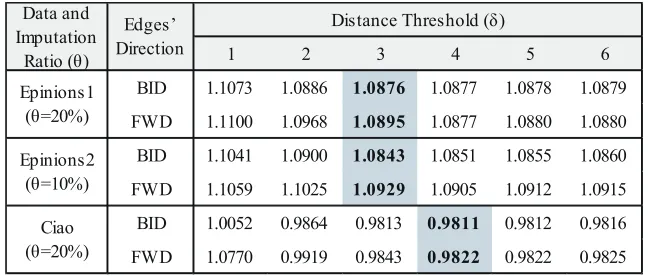
Table 3 compares RMSE of PMF equipped with our imputation when it usesRelBID,δ u
andRelF W D,δ
u as reliable neighbors. The colored cells indicate the lowest RMSE values
of RelBID,δ
u , and RMSE values of usingRelF W D,δu in the same settings ofδor θ. In
the result,RelBID,δu produces higher accuracy in all data sets and all distance threshold settings. In particular, in the Epinions2, the use ofRelBID,δu shows much better accuracy
Table 3.Effect of Edges’ Direction and Distance Thresholdδfor Whole Users (RMSE)
1 2 3 4 5 6
BID 1.1073 1.0886 1.0876 1.0877 1.0878 1.0879
FWD 1.1100 1.0968 1.0895 1.0877 1.0880 1.0880
BID 1.1041 1.0900 1.0843 1.0851 1.0855 1.0860
FWD 1.1059 1.1025 1.0929 1.0905 1.0912 1.0915
BID 1.0052 0.9864 0.9813 0.9811 0.9812 0.9816
FWD 1.0770 0.9919 0.9843 0.9822 0.9822 0.9825
Epinions2 (θ=10%)
Ciao (θ=20%) Data and Imputation
Ratio (θ)
Edges’ Direction
Distance Threshold (δ)
Epinions1 (θ=20%)
Table 4 shows the result for the cold start users. As shown in Table 1, Epinions2 and Ciao barely include the cold start users, so we perform the experiment on only Epinions1. Compared to Table 3, RMSE of all cases is worse because the cold start users have fewer ratings, which cause not sufficient for accurate prediction. For all cases, the accuracy employingRelBID,δ
u is higher than that employingReluF W D,δ. The difference between
cases usingRelBID,δ
u andRelF W D,δu is larger than that in Table 3 because considering
bi-directions of edges increases the number of reliable neighbors greatly compared to that considering the forward directions only. We note that the accuracy would increase as our imputation method uses a more number of reliable neighbors.
Table 4. Effect of Edges’ Direction and Distacne Threshold δ for Cold Start Users (RMSE)
1 2 3 4 5 6
BID 1.1995 1.1698 1.1492 1.1427 1.1415 1.1418
FWD 1.2027 1.1911 1.1737 1.1581 1.1539 1.1541
Data and Imputation
Ratio (θ)
Edges’ Direction
Distance Threshold (δ)
Epinions1 (θ=20%)
4.3. Effect of Parameterδandθ
In our imputation method, there are two parameters, the distance thresholdδand the imputation ratioθ.δandθ determine the reliable neighbors and missing ratings to be imputed, respectively. As a result, they have an effect on the accuracy of recommendation with our method. In this section, we examine the accuracy carefully with different settings of parametersδandθ.
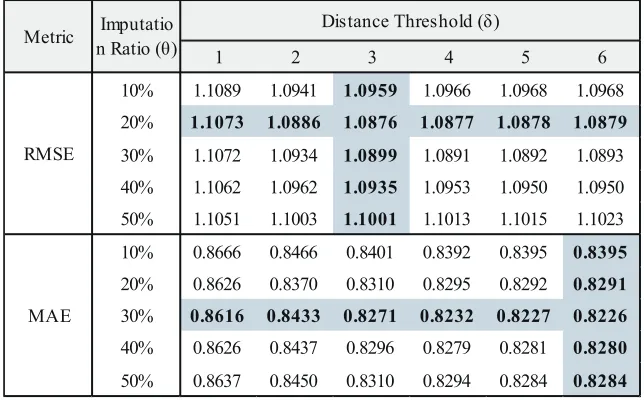
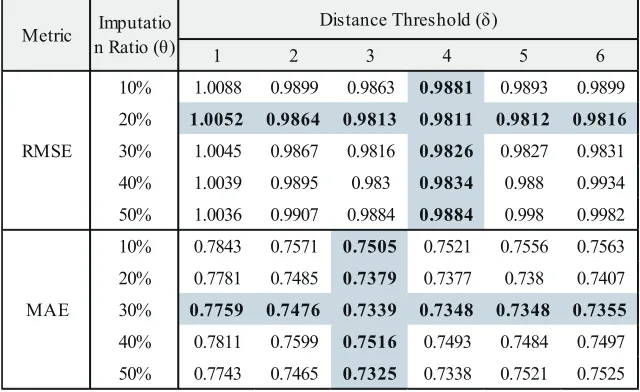
Tables 5, 6, and 7 show the experimental results on Epinions1, Epinions2, and Ciao, respectively. In those tables, the colored cells indicate the MAE and RMSE values of more accurate parameter settings.
Tables 5 and 7 show that our method has the lowest RMSE when the imputation ratio θ is 20%, and MAE is the lowest whenθis 30%. Unlike this result, setting θ as 10% achieves the lowest RMSE while settingθas 20% does the lowest MAE in Table 6. This is because that Epinions2 has more ratings than Epinions1 and Ciao. In most cases, our method produces the lowest RMSE or MAE when the distance thresholdδis 3 or 4. In Table 5, MAE shows somewhat different tendency to the other results, and it has lowest value whenδis 6.
The results show that settingδas 3 or 4 and θ as 20% seems to produce the best accuracy in most of data sets regardless of accuracy metric. This result coincides with the claim in Mole Trust [19] that the users who are reachable from the active user within the distance 4 are appropriate to get accurate prediction. Besides, the best imputation ratioθ is not high (i.e., 20%) because imputing more missing ratings cannot guarantee the better accuracy.
Table 5.Effect of Distance Thresholdδand Imputation Ratioθin Epinions1 Data Set
1 2 3 4 5 6
10% 1.1089 1.0941 1.0959 1.0966 1.0968 1.0968
20% 1.1073 1.0886 1.0876 1.0877 1.0878 1.0879
30% 1.1072 1.0934 1.0899 1.0891 1.0892 1.0893
40% 1.1062 1.0962 1.0935 1.0953 1.0950 1.0950
50% 1.1051 1.1003 1.1001 1.1013 1.1015 1.1023
10% 0.8666 0.8466 0.8401 0.8392 0.8395 0.8395
20% 0.8626 0.8370 0.8310 0.8295 0.8292 0.8291
30% 0.8616 0.8433 0.8271 0.8232 0.8227 0.8226
40% 0.8626 0.8437 0.8296 0.8279 0.8281 0.8280
50% 0.8637 0.8450 0.8310 0.8294 0.8284 0.8284
Metric Imputatio n Ratio (θ)
Distance Threshold (δ)
RMSE
Table 6.Effect of Distance Thresholdδand Imputation Ratioθin Epinions2 Data Set
1 2 3 4 5 6
10% 1.1041 1.0900 1.0843 1.0851 1.0855 1.0860
20% 1.1030 1.0923 1.0865 1.0907 1.0913 1.0916
30% 1.1013 1.0944 1.0942 1.1018 1.1025 1.1029
40% 1.0994 1.0969 1.1102 1.1204 1.1210 1.1249
50% 1.0977 1.1023 1.1519 1.1886 1.1984 1.1995
10% 0.8631 0.8404 0.8293 0.8281 0.8282 0.8294
20% 0.8618 0.8460 0.8285 0.8281 0.8287 0.8300
30% 0.8605 0.8465 0.8321 0.8329 0.8334 0.8353
40% 0.8590 0.8469 0.8395 0.8421 0.8420 0.8456
50% 0.8576 0.8501 0.8602 0.8798 0.8794 0.8752
Metric Imputatio n Ratio (θ)
Distance Threshold (δ)
RMSE
MAE
Table 7.Effect of Distance Thresholdδand Imputation Ratioθin Ciao Data Set
1 2 3 4 5 6
10% 1.0088 0.9899 0.9863 0.9881 0.9893 0.9899
20% 1.0052 0.9864 0.9813 0.9811 0.9812 0.9816
30% 1.0045 0.9867 0.9816 0.9826 0.9827 0.9831
40% 1.0039 0.9895 0.983 0.9834 0.988 0.9934
50% 1.0036 0.9907 0.9884 0.9884 0.998 0.9982
10% 0.7843 0.7571 0.7505 0.7521 0.7556 0.7563
20% 0.7781 0.7485 0.7379 0.7377 0.738 0.7407
30% 0.7759 0.7476 0.7339 0.7348 0.7348 0.7355
40% 0.7811 0.7599 0.7516 0.7493 0.7484 0.7497
50% 0.7743 0.7465 0.7325 0.7338 0.7521 0.7525 Distance Threshold (δ)
RMSE
MAE
4.4. Effect of a Trust Network in Imputation
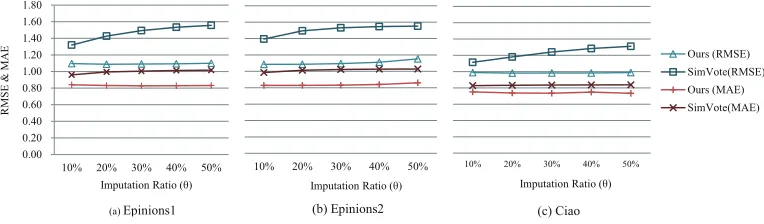
After finding the best combination of two parameters, we conduct the experiment to show the use of the trust network is helpful for accurate imputation. In this experiment, we observe the accuracy of prediction using the imputed rating matrix. As a baseline, we introduce a simple imputation method, calledSimVote, which does not consider the trust network but imputes a part of missing ratings same as our method, and compare it with our imputation method. SimVote fills the missing ratings for each user with average rat-ings of him/her by following the default voting [2] that is a simple one among the existing imputation methods. To impute similar number of the unrated ratings to our imputation method, we randomly selectθpercent of the missing ratings and assign the average rat-ings to them. Finally, we apply two imputed rating matrix produced by our method and SimVote to PMF and observe their accuracy.
Figure 4 shows the accuracy of prediction using two imputation methods. In this fig-ure, the x-axis and the y-axis represent the imputation ratioθand the values of MAE or RMSE, respectively. Each sub-figure corresponds to each data set. The proposed imputa-tion method is more accurate than SimVote regardless of the value ofθand the metric. The reason is that the proposed imputation method only imputes those unrated ratings that would be estimated precisely whereas SimVote does not consider this. Therefore, the ac-curacy of prediction using SimVote is certainly lower. For SimVote, the interesting point is that the more imputed ratings are, the worse accuracy is. This is because the more rat-ings whose values are inaccurate cannot improve the accuracy of recommendation even if the sparsity problem is addressed. On the other hand, our imputation method accurately fills the missing ratings up to 20%, so the MAE and RMSE is decreasing from 0 to 20% (see Tables 5, 6, and 7).
0.00 0.20 0.40 0.60 0.80 1.00 1.20 1.40 1.60 1.80
10% 20% 30% 40% 50%
R
M
S
E
&
M
A
E
Imputation Ratio (θ)
(a)Epinions1
10% 20% 30% 40% 50%
Imputation Ratio (θ)
Ours (RMSE)
SimVote(RMSE) Ours (MAE) SimVote(MAE)
(c) Ciao
10% 20% 30% 40% 50%
Imputation Ratio (θ)
(b) Epinions2
Fig. 4.Comparison Proposed Imputation Method with SimVote
4.5. Accuracy of CF Methods with Our Imputation Method
method, first selects the neighbors whose ratings are similar to those of an active user and predicts a rating by aggregating the ratings given by the neighbors. We consider UBM as a baseline.
AutAIis an imputation-based recommendation method, which is similar to UBM. One important difference is that AutAI defines the neighbors as all the users who rated the target item. Also, AutAI imputes the missing ratings, referred to as a key set, before its prediction. The key set consists of missing ratings on the items on which his/her neighbors did not give ratings but an active user gave ratings. We choose AutAI due to both of the two reasons: (1) to show the effect of the imputation by comparing it with UBM and (2) to show the effect of a trust network by comparing the imputation with a trust network to the imputation without it.
PMFPMF is a well-known model-based method, which factorizes a rating matrix into users and items latent features. Next, it calculates the inner product of the two latent fea-tures of an active user and a target item for the rating prediction. We choose PMF to show the effect of combining a trust network and imputation by comparing PMF equipped with our imputation method to original PMF.SocialMFalso employs the matrix factorization and overcomes the data sparsity problem by looking up a trust network. When this method factorizes a rating matrix, it adjusts a userus latent feature to be similar to the (weighted) average of latent features of those users who are reachable fromuin the trust network. We select SocialMF to show the strength of our method because it does not employ the imputation and also overlooks the backward directions of the trust network.
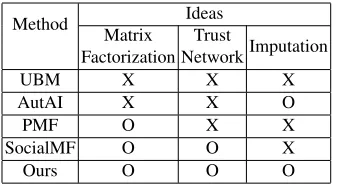
In summary, Table 8 shows the difference between our proposed method and four existing methods. Our method is based on the three ideas, i.e., the matrix factorization, the trust network, and the imputation. Unlike our method, the existing methods consider a part or none of them.
Table 8.Comparison of the proposed method with the existing methods
Method Ideas
Matrix Factorization
Trust
NetworkImputation
UBM X X X
AutAI X X O
PMF O X X
SocialMF O O X
Ours O O O
In the proposed imputation method, we setwu,vthat describes the weight of distance
Table 9 shows the accuracy of the recommendation methods for all users. PMF us-ing our method outperforms other methods especially on Ciao. In addition, two methods exploiting a turst network (i.e., our method and SocialMF overcome PMF that does not consider a trust network. It means that a trust network help rating prediction accuracy to improve. Besides, our method is more accurate than SocialMF due to two reasons. The one reason is that the proposed method considers those users who are reachable through the backward direction, and the other is that it only considers those users who within the distance threshold which can be seen as more reliable. Overall, our method and AutAI that employ the imputation approach overcome other existing recommendation methods because imputation approaches successfully address the data sparsity problem.
Table 9.Accuracy of Recommendation Methods for Whole Users
RMSE MAE
UBM 1.185 0.894
AutAI 1.097 0.838
PMF 1.118 0.880
SocialMF 1.115 0.879
Ours 1.088 0.823
UBM 1.136 0.837
AutAI 1.090 0.835
PMF 1.109 0.868
SocialMF 1.106 0.870
Ours 1.084 0.828
UBM 1.179 0.849
AutAI 1.006 0.736
PMF 1.033 0.810
SocialMF 1.030 0.808
Ours 0.981 0.734
Epinions1
Epinions2
Ciao
Metric Method
Dataset
users. Unlike AutAI, the proposed method can predict the accurate ratings for cold start users because it refers to additional information, a trust network.
Table 10.Accuracy of Recommendation Methods for Cold Start Users
RMSE MAE
UBM 1.350 0.993
AutAI 1.288 0.934
PMF 1.210 0.962
SocialMF 1.209 0.968
Ours 1.142 0.888
Dataset Method Metric
Epinions1
In summary, our experiments show that the bi-direction of edges is more useful than the forward direction of edges for rating prediction through a trust network. We find that the most appropriate parametersδ andθ are 3 and 20%, respectively in most cases. In addition, we show that a trust network improves imputation approach in terms of accu-racy. In addition, our imputation method with the trust network improves the accuracy of recommendation more than SimVote without considering the trust network. Finally, we showed that the proposed method outperforms the existing recommendation methods in terms of RMSE and MAE, and especially it is much better for the cold start users.
5.
Conclusions and Future Work
The existing recommendation methods suffer low accuracy from the data sparsity and the cold start user problems. To address these problems, we propose an imputation method that substitutes missing ratings with impute values in a rating matrix. Our method im-proves the recommendation accuracy in terms of three aspects. First, we employ a bidi-rectional connection structure in using a trust network as additional information to com-pute the imcom-pute values more accurately. Second, we select missing ratings, that are to be actually filled, whose related information is enough to accurately predict the imputed values. Last, we build the imputed rating matrix that can be applicable to any recommen-dation method so that more accurate recommenrecommen-dation methods may be utilize it. Through comprehensive experiments, we successfully demonstrated that our proposed method is effective in improving the accuracy of the existing PMF method and outperforms existing recommendation methods. Especially, our method is more effective in addressing the cold start user problem.
before purchasing and using them. Though the users do not leave the pre-use preference explicitly, it is possible to infer them by analyzing only a rating matrix. In our future work, we plan to develop an imputation method that exploits the pre-use preference as well as the trust network.
Acknowledgments.This work was supported by the National Research Foundation of Korea (NRF) grant funded by the Korea government (MSIT) (No. NRF-2017R1A2B3004581), the Next-Generation Information Computing Development Program through the National Research Foundation of Ko-rea (NRF) funded by the Ministry of Science, ICT (NRF-2017M3C4A7069440), and the Ministry of Science, ICT and Future Planning (MSIT), Korea, under the Information Technology Research Center (ITRC) support program (IITP-2017-2013-0-00881). Professor Sang-Wook Kim is the cor-responding author.
References
1. Adomavicius, G., Tuzhilin, A.: Toward the next generation of recommender systems: a survey of the state-of-the-art and possible extensions. IEEE Transactions on Knowledge and Data Engineering 17(6), 734–749 (2005)
2. Breese, J.S., Heckerman, D., Kadie, C.: Empirical analysis of predictive algorithms for collab-orative filtering. In: Proc. of the 14th Conf. on Uncertainty in Artificial Intelligence. pp. 43–52 (1998)
3. Brin, S., Page, L.: The anatomy of a large-scale hypertextual web search engine. Computer Networks and ISDN Systems 30(1-7), 107–117 (1998)
4. Deng, S., Huang., L., Xu, G.: Social network-based service recommendation with trust en-hancement. Expert Systems with Applications 41(18), 8075–8084 (2017)
5. Dong, W., Yi, C., Kai, Y.: Hybrid recommendation algorithm based on trust relationship and user preference. In: Proc. of Int’l Conf. on Electronics Information and Emergency Communi-cation, ICEIEC. pp. 429–433 (2017)
6. Golbeck, J.: Computing and Applying Trust in Web-based Social Networks. Ph.D. thesis, Uni-versity of Maryland College Park (2005)
7. Hwang, W.S., Lee, H.J., Kim, S.W., Won, Y., Lee, M.: Efficient recommendation methods using category experts for a large dataset. Information Fusion 28, 75–82 (2016)
8. Hwang, W.S., Parc, J., Kim, S.W., Lee, J., Lee, D.: “told you i didn’t like it”: Exploiting un-interesting items for effective collaborative filtering. In: Proc. of the 32nd IEEE Int’l Conf. on Data Engineering, IEEE ICDE. pp. 349–360 (2016)
9. Jamali, M., Ester, M.: Trustwalker: A random walk model for combining trust-based and item-based recommendation. In: Proc. ACM Int’l. Conf. on Knowledge Discovery and Data Mining, ACM SIGKDD. pp. 397–406 (2009)
10. Jamali, M., Ester, M.: A matrix factorization technique with trust propagation for recommen-dation in social networks. In: Proc. of the 4th ACM Conf. on Recommender Systems, Recsys. pp. 135–142 (2010)
11. Koren, Y., Bell, R., Volinsky, C.: Matrix factorization techniques for recommender systems. Computer 42(8), 30–37 (2009)
12. Lee, J., Hwang, W.S., Parc, J., Kim, S.W., Lee, D., Lee, Y.: l-injection: Toward effective col-laborative filtering using uninteresting items. IEEE Transactions on Knowledge and Data En-gineering, TKDE (2017)
13. Lee, J., Lee, D., Lee, Y.C., Hwang, W.S., Kim, S.W.: Improving the accuracy of top-n recom-mendation using a preference model. Information Sciences 348(20), 290–304 (2016)
15. Ma, H., King, I., Lyu, M.R.: Effective missing data prediction for collaborative filtering. In: Proc. of the 30th Annual Int’l ACM SIGIR Conf. on Research and Development in Information Retrieval, SIGIR. pp. 39–46 (2007)
16. Ma, H., King, I., Lyu, M.R.: Learning to recommend with social trust ensemble. In: Proc. of the 32nd Int’l ACM SIGIR Conf. on Research and Development in Information Retrieval, SIGIR. pp. 203–210 (2009)
17. Ma, H., Zhou, D., Liu, C., Lyu, M., King, I.: Recommender systems with social regularization. In: Proc. of ACM Int’l Conf. on Web Search and Data Mining, WSDM. pp. 287–296 (2011) 18. Ma, H., Yang, H., Lyu, M.R., King, I.: Sorec: Social recommendation using probabilistic matrix
factorization. In: Proc. of the 17st ACM Int’l Conf. on Information and Knowledge Manage-ment, CIKM. pp. 931–940 (2008)
19. Massa, P., Avesani, P.: Trust-aware recommender systems. In: Proc. of the 2007 ACM Conf. on Recommender Systems, RecSys. pp. 17–24 (2007)
20. Moradi, P., Ahmadian, S.: A reliability-based recommendation method to improve trust-aware recommender systems. Expert Systems with Applications 42(21), 7386–7398 (2015)
21. Ren, Y., Li, G., Zhang, J., Zhou, W.: The efficient imputation method for neighborhood-based collaborative filtering. In: Proc. of the 21st ACM Int’l Conf. on Information and knowledge management, CIKM. pp. 684–693 (2012)
22. Rennie, J., Srebro, N.: Fast maximum margin matrix factorization for collaborative prediction. In: Proc. of the 22nd Int’l Conf. on Machine Learning, ICML. pp. 713–719 (2005)
23. Resnick, P., Iacovou, N., Suchak, M., Bergstrom, P., Riedl, J.: Grouplens: an open architecture for collaborative filtering of netnews. In: Proc. of the ACM Conf. on Computer Supported Cooperative Work. pp. 175–186 (1994)
24. Salakhutdinov, R., Mnih, A.: Bayesian probabilistic matrix factorization using markov chain monte carlo. In: Proc. of the 25th Int’l Conf. on Machine learning, ICML. pp. 880–887 (2008) 25. Salakhutdinov, R., Mnih, A.: Probabilistic matrix factorization. Advances in Neural
Informa-tion Processing Systems, NIPS 20, 1257–1264 (2008)
26. Sarwar, B., Karypis, G., Konstan, J., Riedl, J.: Recommender systems for largscale e-commerce scalable neighborhood formation using clustering. In: Proc. of the 5th Int’l Conf. on Computer and Information Technology (2002)
27. Sarwar, B., Karypis, G., Konstan, J., Riedl, J.: Item-based collaboration filtering recommen-dation algorithms. In: Proc. of the 19th Intl Conf. on World Wide Web, WWW. pp. 285–295 (2010)
28. Schafer, J., Konstan, J., Riedl, J.: E-commerce recommendation applications. Data Mining and Knowledge Discovery 5(1), 115–153 (2001)
29. Su, X., Khoshgoftaar, T.M., Greiner, R.: A mixture imputation-boosted collaborative filter. In: Proc. of the 21th Int’l Florida Artificial Intelligence Research Society Conference, FLAIRS. pp. 312–317 (2008)
30. Su, X., Khoshgoftaar, T.M., Zhu, X., Greiner, R.: Imputation-boosted collaborative filtering using machine learning classifier. In: Proc. of the 2008 ACM Symp. on Applied Computing, ACM SAC. pp. 949–950 (2008)
31. Tang, J., Liu, H., Gao, H., Das Sarmas, A.: etrust: Understanding trust evolution in an online world. In: Proc. of the 18th Int’l Conf. on Knowledge Discovery and Data Mining, SIGKDD. pp. 253–261 (2012)
32. Wang, N., Chen, Z., Li, X.: Heterogeneous trust-aware recommender systems in social network. In: Proc. of IEEE 2nd Int’l Conf. on Big Data Analysis, ICBDA. pp. 767–771 (2017)
33. Yang, X., Guo, Y., Liu, Y., Steck, H.: A survey of collaborative filtering based social recom-mender systems. Computer Communications 41, 1–10 (2014)
35. Zhenzhen, X., Jiang, H., Kong, X., Kang, J., Wang, W., Xia, F.: Cross-domain item recommen-dation based on user similarity. Computer Science and Information Systems 13(2), 359–373 (2016)
Won-Seok Hwangreceived M.S. and Ph.D. degrees in Electronics and Computer Engi-neering from Hanyang University at 2009 and 2016. He currently is a researcher at Na-tional Security Research Institute. His research interests include recommendation, data mining, deep learning, and security.
Shaoyu Li received his M.S. degree in Electronics and Computer Engineering from Hanyang University at 2013. He is currently doing data analysis and project manage work at Samsung Electronics. His research interests include recommendation, data mining and deep learning.
Sang-Wook Kimreceived the BS degree in Computer Engineering from Seoul National University, Seoul, Korea in 1989 and earned the MS and PhD degrees from Korea Ad-vanced Science and Technology (KAIST) at 1991 and 1994, respectively. He is Professor at Department of Computer Science and Engineering, Hanyang University, Seoul, Korea. Professor Kim worked with Carnegie Mellon University and IBM Watson Research Cen-ter as a visiting scholar. He is an associate editor of Information Sciences. His research interests include data mining and databases.
Kichun Leeworked for ETRI, Tmax Soft, and Samsung SDS from 1999 to 2006. In 2010, he received his Ph.D. in statistics in Industrial Systems Engineering from Georgia Institute of Technology. After postdoctoral associate positions at Georgia Institute of Technology and Emory University, he is now working at the Department of Industrial Engineering, Hanyang University in Seoul, South Korea. He researches data mining, knowledge ex-traction, and enterprise computing on the domains of information systems and knowledge services.