Volume 3 Issue 4 October 2018 16
Protocols for Virtual Private Networks
Mr.Vishal D.Patil, Mr.Santosh A.Korde [email protected], [email protected]
Department of computer engineering DYPCOE Akurdi, Pune
ABSTRACT
This paper could be a survey on Virtual private Networks (VPNs). The practicality of a VPN is exactly a similar as any other personal network. This suggests that info passed between parties on the network is shielded from attackers. The distinction between a VPN and another personal network is that the previous operates over a public network, like the Internet. The VPN occupies its own personal address space on the general public network, so creating it inaccessible from the opposite users thereon network. Also, the knowledge in transit is encrypted so if the information is intercepted, the offender isn't ready to read it. Security parts like confidentiality, credibleness and information integrity are often supplied with these VPNs. These networks area attracting the eye of corporations round the world for 2 reasons: they are inexpensive; and that they are extremely versatile. Many consulting corporations, like hood, and Eagle Systems are planning VPNs specifically to their customer’s desires depending on their security and performance needs. Generally, in most VPN structures the upper the amount of needed security, the slower the system becomes. That fact that VPNs create use of a public network makes them extremely efficient. With sure VPNs the businesses requiring security facilities will create use of any Service supplier which is able to oblivious to the VPN it's hosting. Instead, the Service supplier will support the VPN so the burden of the corporate having to take care of its own personal network is lifted. Additionally, if the corporate chooses to manage its own VPN, and doesn't lease the service from a Service supplier, the maintenance and administration on a VPN is significantly less complicated than that on personal hired lines.
Keywords: VPN, virtual private network, IPSec, security, protocols.
INTRODUCTION
Volume 3 Issue 4 October 2018 17 unit intercepted on the shared or public network
area unit indecipherable while not the cryptography keys. The link during which the personal information is encapsulated or encrypted is thought as a virtual personal network (VPN) affiliation. A VPN [3] affiliation permits users performing at home or on the road to attach in a very secure fashion to a far off company server victimization the routing infrastructure provided by public internetworks (such because the Internet). From the user’s perspective, the VPN affiliation may be a point-to-point connection between the user’s laptop servers. The character of the intermediate internetworks is inapplicable to the user as a result of it seems as if the info is being sent over a dedicated personal link. Traditional personal networks facilitate property among numerous network entities through a group of links, comprising of dedicated circuits (T1, T3 etc). These are chartered from public telecommunication carriers like MCI-WorldCom or Regional Bell operational corporations (RBOCs) moreover as in private put in wiring. The capability of those links is offered in any respect times, albeit mounted & inflexible. The traffic on these personal networks belongs solely to the enterprise or company deploying the network. Therefore, there's an assured level of performance associated with the network. Such assurances keep company with a value. These will be viewed as [2]:
• Traditional private networks don't seem to be low-cost to arrange & deploy. The prices related to dedicated links area unit particularly high once they involve international locations. The look phase of such networks involves elaborated estimates of the applications, their traffic patterns and their growth rates. Also, the look periods area unit long owing to the work concerned in calculating these estimates.
• Further, dedicated links take time to put in. it's commonplace that telecommunication carriers take concerning sixty to ninety days to put in & activate a zealous link Such an extended waiting amount adversely affects the company’s ability to react to the short changes within the these areas.
• Another recent trend is that the quality of today’s workforce. Transportable computing facilities such as laptops & palm-based devices have created it simple for folks to figure while not being physically gift in their offices. This additionally makes less investment into assets.
• To support the rise in home offices, corporations ought to offer a reliable IT infrastructure thus staff will access company info from remote locations. This has resulted in massive modem pools for workers to dial-in remotely. The value keeps increasing due to the quality of managing & maintaining the massive electronic equipment pools. A further price with the mobile users is that the long-distance calls or fee numbers got by the corporate.
The costs area unit a lot of higher if we have a tendency to contemplate international job. For, corporations with massive, mobile work force, these expenses add up to important numbers. Also, dial-in connections limit the remote user to a most access speed of 56Kbps for analog modems & 128Kbps for Integrated Services Digital Network (ISDN).
PROTOCOLS
1. The SSH Transport Layer Protocol
Volume 3 Issue 4 October 2018 18 consumer connects to an unknown host, key
distribution is performed at identical time as rule negotiation. The human activity parties have a default key-exchange packet that they send to their parties. This packet contains the non-encrypted rule of that party's selection. If the guess is correct, communication proceeds as traditional. If the guess is inaccurate, the 2 parties take one by examination lists. Once an acceptable rule has been chosen, the parties send one another their public keys, which can be attested and verified using any reliable technique that the parties have previously chosen.
2. IPSec
IPSec [3 4] could be a family of protocols that's represented in seventeen IETF draft documents. Hat we present here could be a temporary summary of IPSec. IPSec defines protocols for authentication, confidentiality, and knowledge integrity. However, it does not describe access management aside from in its packet filtering skills. This is often seen as a major disadvantage. Additionally, the IPSec protocol has not been finalized regarding its key management standards. IPSec presently supports each SKIP (Simple Key Management for web Protocol) and ISAKMP (Internet Security Association Key Management Protocol). Yet one more disadvantage of IPSec is that it's not compliant with IPv4 then it needs the utilization of IPv6. This is often inflicting much discussion amongst IETF officers and so leading to the delay with the discharge of the protocol. Despite all this, IPSec is projected to be the quality for future VPN solutions. This is because it combines many completely different security technologies to supply the entire system: Diffie-Hellman key-exchange is employed for etymologizing key material between peers on a public network. Public-key cryptography is employed for sign language the Diffie-Hellman exchanges to guarantee the identity of the 2 parties. Secret writing algorithms like DES, Triple DES and IDEA for the secret writing of the info. Keyed hash algorithms, like HMAC, combined with traditional hash algorithms like MD5 or SHA for providing packet authentication. Digital certificates signed by a certificate authority.
The essential perform of IPSec is to encapsulate packets in 2 no obligatory headers. The Authentication Header supports authentication and knowledge integrity whereas the Encapsulating Security Payload ensures privacy. These 2 headers are often used along or singly or along, but, for many applications, one header is ample. IPSec provides 2 modes of operation transport and tunnelled mode. Within the transport mode, only the information processing payload is encrypted, not the first information processing headers. In tunnelled mode the whole packet is encrypted and encapsulated during a new information processing packet. This ends up in vital overhead, but it's extremely secure.
3. PPTP and L2TP
Volume 3 Issue 4 October 2018 19 that belong to the personal network. Further,
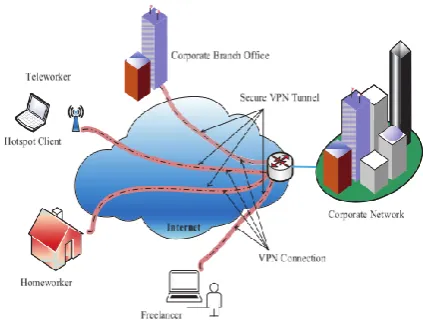
there's traffic isolation. It implies that, the traffic akin to this personal network doesn't have an effect on neither is it full of alternative traffic extraneous to the personal network. The ultimate characteristic of a VPN is that it's virtual. A virtual topology is made upon an existing, shared physical network infrastructure. A Virtual personal Network (VPN) is that the extension of a personal network that encompasses links across shared or public networks just like the web. A VPN allows you to send information between 2 computers across shared or public internetworks in a very manner that emulates the properties of a point-to-point personal link. The act of configuring a virtual personal network is thought as virtual personal networking [2]. To emulate a point-to-point link, information is encapsulated, or wrapped, with a header that has the routing info permitting it to traverse the shared or public internetworks to succeed in its endpoint. To emulate a personal link, the info being sent is encrypted for confidentiality. Packets that area unit intercepted on the shared or public network area unit indecipherable while not the cryptography keys. The link during which the personal information is encapsulated or encrypted is thought as a virtual personal network (VPN) affiliation. A VPN [1] affiliation permits users performing at home or on the road to attach in a very secure fashion to a far off company server victimization the routing infrastructure provided by public internetworks (such because the Internet). From the user’s perspective, the VPN affiliation may be a point-to-point connection between the user’s laptop servers. The character of the intermediate internetworks is inapplicable to the user as a result of it seems as if the info is being sent over a dedicated personal link. Traditional personal networks facilitate property among numerous network entities through a group of links, comprising of dedicated circuits (T1, T3 etc). These are chartered from public telecommunication carriers like MCI-WorldCom or Regional Bell operational corporations (RBOCs) moreover as in private put in wiring. The capability of those links is offered in any respect times, albeit
mounted & inflexible. The traffic on these personal networks belongs solely to the enterprise or company deploying the network. Therefore, there's an assured level of performance associated with the network. Such assurances keep company with a value. These will be viewed as [2]:
• Traditional private networks don't seem to be low-cost to arrange & deploy. The prices related to dedicated links area unit particularly high once they involve international locations. The look phase of such networks involves elaborated estimates of the applications, their traffic patterns and their growth rates. Also, the look periods area unit long owing to the work concerned in calculating these estimates.
• Further, dedicated links take time to put in. it's commonplace that telecommunication carriers take concerning sixty to ninety days to put in & activate a zealous link Such an extended waiting amount adversely affects the company’s ability to react to the short changes within the these areas.
• Another recent trend is that the quality of today’s workforce. Transportable computing facilities such as laptops & palm-based devices have created it simple for folks to figure while not being physically gift in their offices. This additionally makes less investment into assets.
• To support the rise in home offices, corporations ought to offer a reliable IT infrastructure thus staff will access company info from remote locations. This has resulted in massive modem pools for workers to dial-in remotely. The value keeps increasing due to the quality of managing & maintaining the massive electronic equipment pools. A further price with the mobile users is that the long-distance calls or fee numbers got by the corporate.
Volume 3 Issue 4 October 2018 20 SOCKS v5
SOCKS v5 [3] is that the IETF customary for attested Firewall Traversal. SOCKS v5, unlike IPSec, PPTP and L2TP, operates at layer 5 of the OSI model, the session layer. It thus has the flexibility to perform a lot of finer grain access management than the antecedently mentioned solutions. SOCKS v5 will work with a range of cryptography and authentication algorithms, which might be negotiated throughout the affiliation method. SOCKS v5 is directional, which is to say that it builds directed VPNs as opposed to tunnels. Thus, it is probably the foremost secure protocol available. Owing to its location in the OSI model, SOCKS v5 will easily interoperate with all the previously delineate protocols. SOCKS v5 is well supported by all the major VPN corporations including Microsoft thus its future in PN technology looks bright.
A. SSTP
SSTP permits traffic to go through firewalls that block the PPTP and L2TP/IPSec traffic [1]. It’s as secure because the Hypertext Transfer Protocol Secure (HTTPS) and uses Secure Socket Layer (SSL) that has higher layer security protocol encryption and encapsulation. Moreover, its marginal proxy problems as a result of it connects to port TCP 443 that is open by default. Once a shopper ab initio connects to a VPN server, the shopper and SSL VPN entrance manifest one another through digital certificates [3]. SSTP serves to encapsulate Point-to-Point protocol (PPP) traffic over the SSL channel
Figure 1virtal private networlk
Of the HTTPS protocol.
Uvulopalatopharyngoplasty supports robust authentication methods, like MS- HAPv2. Throughout encapsulation, PPP frames and science datagrams area encapsulated for transmission of communication knowledge over the network. Throughout encoding, the message is encrypted with the SSL channel of the HTTPS [2]. An internet browser is required within the SSL tunnel that may run active content that enables it to configure the practicality of the computer that's accessing it from an in remote locations.
B. IKEv2
Volume 3 Issue 4 October 2018 21 feature in known as quality and Multihoming
(MOBIKE) and is resilient to dynamic network. IKEv2 uses Internet Protocol Security (IPSec). Encapsulating Security Payload (ESP) or Authentication Header (AH) is employed in its tunnelling encapsulation to make sure the legitimacy yet as the integrity of the science packet payload victimisation symmetrical key encryption algorithms [3]. But IKEv2 is obtainable on relatively fewer platforms compared to alternative styles of VPN protocol; it's thought of equally sensible in terms of stability, security, and performance.
CONCLUSION
Whenever there are competitor protocols for a definite application, the foremost obvious question that arises is what protocol is best suited during a certain scenario? Within the case of VPN tunnelling protocols, there square measure 3 major protocols and a corporation or a personal attempting to install a VPN solution would be round-faced with this question. Sadly, there's not one single “magic” answer to the current question. The protocol choice depends on varied factors. As a conclusion of our report, we would like to produce some pointers that may assist during this choice method. The protocols running on the interior network of the corporate, searching for a VPN answer, will play a serious role during this call. This can be as a result of IPsec and different VPN protocols don't seem to be compatible with each different protocol. The lowest line here is that if your network is running solely on TCP/IP, you have got the common divisor of all VPN technologies. Each hardware and software VPN answer, despite the protocol, is meant to package and tunnel TCP/IP packets. NetBEUI or IPX/SPX-based networks can have a restricted variety of choices if your VPN solution needs those packets to be tunnelled to a different website, during this case, your best bet would be to go with either PPTP or L2TP.
REFERENCES
[1] Gleeson, B. et al, “A Framework for IP Based Virtual Private Networks”, RFC 2764, February 2000.
[2] Venkateswaran, R., “Virtual Private Networks”, IEEE Potentials Magazine, February/March 2001. [3] Narayan, Williams, Hart and Qualtrough, Network Performance Comparison of VPN Protocols on Wired and Wireless Networks, International Conference on Computer Communication and Informatics
(ICCCI), Coimbatore, India, January 2015