Leaf Morphological Characteristics of Leaf Lettuce
(
Lactuca sativa L
.) as Affected by Different Colored Plastic
Mulch
EDMAr N. FrANquErA
Department of Crop Science, Institute of Agriculture and Forestry, Tarlac College of Agriculture Philippines.
http://dx.doi.org/10.12944/CARJ.3.1.04 (Received: June 08, 2015; Accepted: June 23, 2015)
AbstrACt
Looseleaf and Romaine lettuce were grown in a vegetable experimental station in the University of the Philippines Los Banos to determine the effect of the different colored plastic mulch on the leaf morphological characteristics of the two lettuce varieties. A split plot following the Randomized Completely Block Design was used. Results of the study showed that red plastic mulch exhibited better response in terms of the different leaf morphology of the leaf lettuce. Lettuce leaf length, leaf diameter, leaf fresh and dry weight were higher when grown with red plastic mulch compared with the other colored plastic mulch. The result of the study showed that the color of the mulch had significant effect on the leaf morphological characteristics of the leaf lettuce.
Key words: Leaf lettuce, Leaf morphology, Colored plastic mulch, looseleaf, Romaine.
INtroDuCtIoN
Leaf lettuce (Lactuca sativa L.) which produces crisps leaves and has loosely arranged stalk is one of the most widely adapted type of lettuce. Lettuce can be eaten as raw in form as vegetable salads and can also be used as garnishing or decorations in foods. Plastic mulches are used for improving the production in different agricultural crops. Several advantages has been reported in using the plastic mulch for vegetable productions such as increase or improved in the quality, growth and yield of crops. Selecting the right or appropriate color of the mulch is very important in vegetable productions (Mutetwa, M. and T. Mtaita. 2014). The color of the mulch affects the net photosynthesis of the plant (Ibarra-Jiménez et al., 2011) thus affects also the growth and development of its vegetative parts such as the leaves especially on the initial stage of the plant. It also modifies the microclimate around the plant by modifying the underlying temperature
has an increasing trends since plastic mulch color has been reported to increase growth, yield and including crop quality in several crops (Diana-Perez and Batal, 2002; White, 2001; Franquera, 2011; Lamont 2004). Thus, the objective of the study is to determine the effect of the different colored plastic mulch on the leaf morphological characteristics of leaf lettuce.
MAtErIALs AND MEthoDs
per treatment was prepared and made by plowing and harrowing. The plots were covered with plastic mulch. Corresponding holes were made within the plastic mulch where the lettuce seedlings were planted. A pressurized sprayer was used to paint the plastic mulch with different colors following the corresponding color treatments. The lettuce seedlings were transplanted with a spacing of 45x20 cm. Regular watering and monitoring was done to ensure the maintenance of the lettuce plants. Ten sample lettuce plants were gathered randomly per plot at the end of the study. Leaf length was measured using a ruler which was expressed in centimeters. Leaf diameter measurement was done using a caliper. The leaf fresh weight was measured using an electronic weighing device to ensure the correct measurement. For the leaf dry weight, leaves were dried in an oven for 60 hours at 70 o C. The SAS (9.1) software with the Least Significant Differences (LSD) was used to compare the statistical differences of the different treatments.
rEsuLts AND DIsCussIoNs
Leaf Length
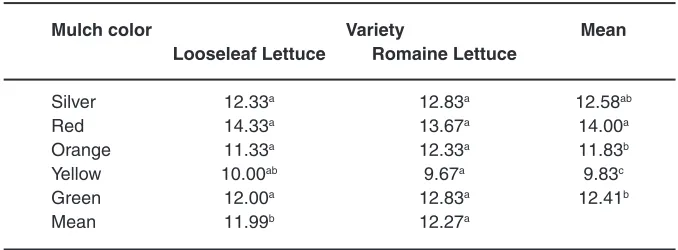
The different colored plastic mulch affected the length of the leaves. Lettuce grown with red plastic mulch produced longer leaves compared with the other colored plastic mulch. (Table 1).
The longer leaves within the red plastic mulch and the shortest leaves within the yellow plastic imply that the color of the mulch significantly influenced leaf growth. This could be attributed to
the amount and quality of reflected light from the different colored plastic mulch. Application of colored plastic mulch could alter the spectral quality of light that is reflected from the surface of the mulch back unto the growing leaves. The colored mulches reflect particular wavelengths of sunlight back up onto the leaves of the plants above them and this may explain the differences on the length of lettuce leaves grown within the different colored plastic mulch, since the quality of light reflected from the mulch differs. The increase in far the ratio of red to far red which is reflected from the nearby plants is sense by the plant although it was just the color of the mulch and as a result more energy is given into the shoots so that it outgrows the other plants (Bunty and Rana, 2005). Leaf Diameter
The leaf diameter of the two lettuce varieties shows no significant differences. Romaine and Looseleaf lettuce had a leaf diameter of 8.46 cm and 8.43 cm respectively (Table 2).
The different colored plastic mulch had a highly significant influence on the leaf diameter of the lettuce. Lettuce grown with red plastic mulch exhibited the highest value. Those grown with green and orange plastic mulch follows (8.66 cm, 8.58 cm) although the lowest values were obtained from the yellow plastic mulch (6.75 cm). However, this did not differ significantly with those grown with silver plastic mulch (7.91 cm). The higher values of leaf diameter exhibited in red plastic mulch could be a consequence of the light quality that is reflected on the growing leaves since the spectral quality of
table 1: Leaf length (cm) of leaf lettuce varieties grown with different colored plastic mulch
Mulch color Variety Mean Looseleaf Lettuce romaine Lettuce
Silver 12.33a 12.83a 12.58ab
Red 14.33a 13.67a 14.00a
Orange 11.33a 12.33a 11.83b
Yellow 10.00ab 9.67a 9.83c
Green 12.00a 12.83a 12.41b
Mean 11.99b 12.27a
table 2: Leaf diameter (cm) of leaf lettuce varieties grown with different colored plastic mulch
Mulch color Variety Mean Looseleaf Lettuce romaine Lettuce
Silver 7.67a 8.17a 7.91bc
Red 10.67a 10.00a 10.33a
Orange 8.33a 8.83a 8.58b
Yellow 6.83a 6.67a 6.75c
Green 8.67a 8.67a 8.66b
Mean 8.43b 8.47a
Means in the same column or row followed by a common letter(s) are not significantly different at 5% level by LSD
light is being altered with the use of colored plastic mulch. It is believed that this alteration of light quality could affect the growth and development of plants. Thus, the differences could further be explained by the consequence of other factors which affect the leaf development particularly its diameter. One factor which possibly affects the diameter of the leaf lettuce could be the temperature within the soil. The soil temperature differences within the different colored plastic mulch may also affect the root growth thus this also affects the development of the leaves. Moreover, the created microenvironment within the different colored plastic mulch and its modifications and other environmental variables such as the light that is reflected within the colored plastic mulch have an impact on the development and growth of the plants (Decoteau, 2007) thus, this may explain the signiificant differences on the lettuce leaf diameter.
Leaf Fresh Weight
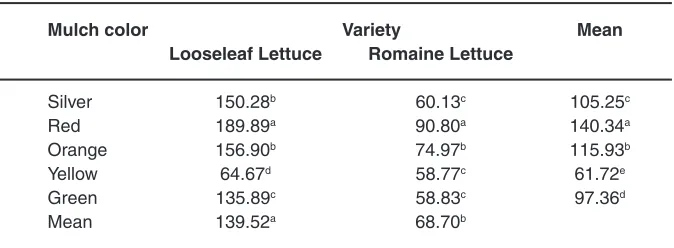
The average leaf fresh weight between the two varieties was observed to be highly significant. Apparently, Looseleaf lettuce produced heavier leaf with 139.52 g (Table 3) compared with Romaine lettuce (68.70g). This could be attributed to differences in the varietal characteristic of the two lettuce.
It was observed that the lettuce grown with red plastic mulch exhibited the highest value with 140.34 g. Those grown with orange plastic mulch followed (115.93g). It was succeeded by silver and green with 105.20 g and 97.36 g, respectively. The lowest value was found to be those grown with yellow plastic mulch with 61.72 g. This means that the color of the mulch affected the leaf fresh weight of lettuce. The differences in the leaf fresh weight could
table 3: Leaf fresh weight of leaf lettuce varieties grown with different colored plastic mulch
Mulch color Variety Mean Looseleaf Lettuce romaine Lettuce
Silver 150.28b 60.13c 105.25c
Red 189.89a 90.80a 140.34a
Orange 156.90b 74.97b 115.93b
Yellow 64.67d 58.77c 61.72e
Green 135.89c 58.83c 97.36d
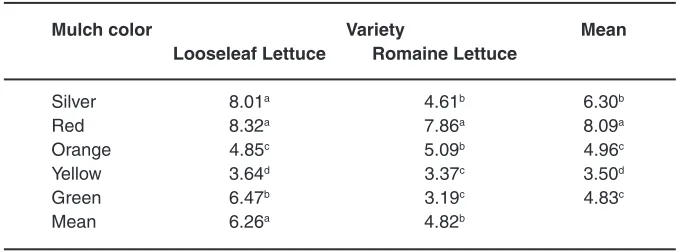
table 4: Leaf dry weight of leaf lettuce varieties grown with different colored plastic mulch
Mulch color Variety Mean Looseleaf Lettuce romaine Lettuce
Silver 8.01a 4.61b 6.30b
Red 8.32a 7.86a 8.09a
Orange 4.85c 5.09b 4.96c
Yellow 3.64d 3.37c 3.50d
Green 6.47b 3.19c 4.83c
Mean 6.26a 4.82b
Means in the same column or row followed by a common letter(s) are not significantly different at 5% level by LSD
be due to the reflected light from the surface of the mulch which was altered a spectral quality of lights small difference could enhance the development of growing plants. The color of the mulch absorbs and reflect different light wavelenghts. Different colors of the mulch create a specific environment which could have a considerable effect on plant growth and environment. This could be the reason for the differences in the amount of leaf fresh weights since plants are very sensitive to the color of the lights that their leaves would intercept from the sun and reflected surfaces (Orzolek and Otjen, 2000).
Generally, a red object reflects red light and absorbs the other colors. Plants absorb red light and blue light wavelengths and reflect green and yellow light, that is why we perceive the color of the leaves to be green. nishiyama y Kanahama (2009) found that in strawberry plants leaf production is promoted by light in the red range. This could explain the higher fresh weight observed within the red plastic mulch since the red color of the mulch would reflect red light within the plants and absorbed the other colors. Furthermore, Decoteau (2007) indicated that the response of plants to different colored mulch is highly dependent on species, experimental conditions and time of sampling. He observed in tomato that the leaf was unaffected when exposed to black or white plastic mulch while the leaf area in pre-flowering phase as well as leaf dry and fresh weight were affected by mulch color. nonetheless, the percentage of red light within the red plastic mulch had lower values as compared with yellow plastic mulch. The higher values in red plastic mulch and lower values in
yellow plastic mulch in terms of its leaf fresh weight could also be associated with the values within the leaf diameter and leaf length since those grown with red plastic mulch had higher leaf diameter and developed longer leaves.
The interaction effect between the varieties and the colored plastic mulch showed highly significant differences. It was noted that in both varieties those grown with red plastic mulch had higher values as compared with the other colored plastic mulch. The lowest value was obtained from those grown with yellow plastic mulch although Romaine lettuce grown within the yellow plastic mulch were not significantly different from those grown with silver and green plastic mulch.
Leaf Dry Weight
Leaf dry weight of Looseleaf lettuce (6.25g) showed significant differencewith Romaine lettuce with 4.82g (Table 6).
The consistent results of red plastic mulch which had highest values and yellow as the lowest value could be contibuted to the quality of the light reflected from the color of the mulch. Red light is said to be the most effective in photosynthesis because it has exactly the right amount of energy to energize or excite chlorophyll electrons and boost them out of their orbits to a higher energy level. Generally, red mulch reflects red light and absorbs the other colors and yellow mulch reflects yellow light and absorbs the other colors including the red. Tracy et. al., (2001) suggested that yellow light suppresses plant growth. The reason for the lowest leaf dry weight of lettuce obtained from the yellow plastic mulch could be due to reflected yellow light from the yellow plastic mulch. Based on the present research, a higher quantity of yellow light (580 to 600 nm) was observed within the yellow plastic mulch compared with the other colored plastic mulch.
Another aspect which could influence the differences in dry weight of lettuce within the colored
plastic mulch might be the soil temperature. Lamont (1999) revealed that red mulch significantly increase soil temperature. The increase in soil temperature could also affect physiological processes involved in plant growth and development. However Lamont (1999) pointed out that not all red colors are the same and the results could be inconsistent.
On the interaction effect, the varieties and the different colored plastic mulch also exhibited highly significant differences. Looseleaf grown with red plastic mulch had the highest value of 8.32 g. The lowest value was observed to be in Romaine grown with green plastic mulch (3.17g).
ACKNoWLEDgEMENts
The author would like to acknowledge Dr. Renato C. Mabesa, Dr. eduardo Paningbatan, Dr. edralina Serrano, Dr. Rene Rafael espino, Department of Science and Technology and the University of the Philippines Los Baños.
rEFErENCEs
1. Bunty, S. and R. Rana. Colored plastic mulches on horticultural crops. Science Tech enterpreneur. nauni, Solan, India (2005). 2. Decoteau, D. R. Leaf area distribution of
tomato plants as influenced by polyethylene mulch surface color. HortTechnology. 17(3). 341-345 (2007).
3. Diaz-Perez, J.C. and K.D. Batal. Colored plastic film mulches affect tomato growth via changes in root zone temperature. J. Amer. Soc. Hort. Sci. 114: 216-219 (2002).
4. Franquera, e.n. Influence of Different Colored Plastic Mulch on the Growth of Lettuce (Lactuca sativa L) Journal of Ornamental Plants 1.2 97-104. Print (2011).
5. Ibarra-Jiménez, L., R.H. Lira-Saldivar, L.A. Valdez-Aguilar, and J. Lozano-Del Río. Colored plastic mulches affect soil temperature and tuber production of potato. Acta Agriculturae Scandinavica Section B, Soil and Plant Science 61: 365-371 (2011).
of light quality on carotenoid contents of in vitro growing seedling of Cattleya. J. Orchid Soc. India, 14(1-2) : 7-17 (2000).
7. Lamont, J.W. Vegetable production using plasticulture The Pennsylvania State University University Park, Pennsylvania 16802-4200 USA (2004).
8. Lamont, W. J. Vegetable production using plasticulture. Food and Fertilizer Center extension Bulletin. no. 476. FFTC Thailand (1999).
9. Mutetwa, M. and T. Mtaita. effects of mulching and fertilizer sources on growth and yield of onion. J. Glob. Innov. Agric. Soc. Sci. 2: 102-106 (2014).
10. nishiyama, M. and K. Kanahama. effect of light quality on growth of everbearing strawberry plants. Acta Hortic. 842; 151-154 (2009).
Plastics Congr. 29: 321-329 (2000).
12. Tracy A., O. Dougher and Bruce Bugbee. evidence for yellow light suppression of lettuce growth. Photochem and Photobiol. 73(2) : 208-212 (2001).